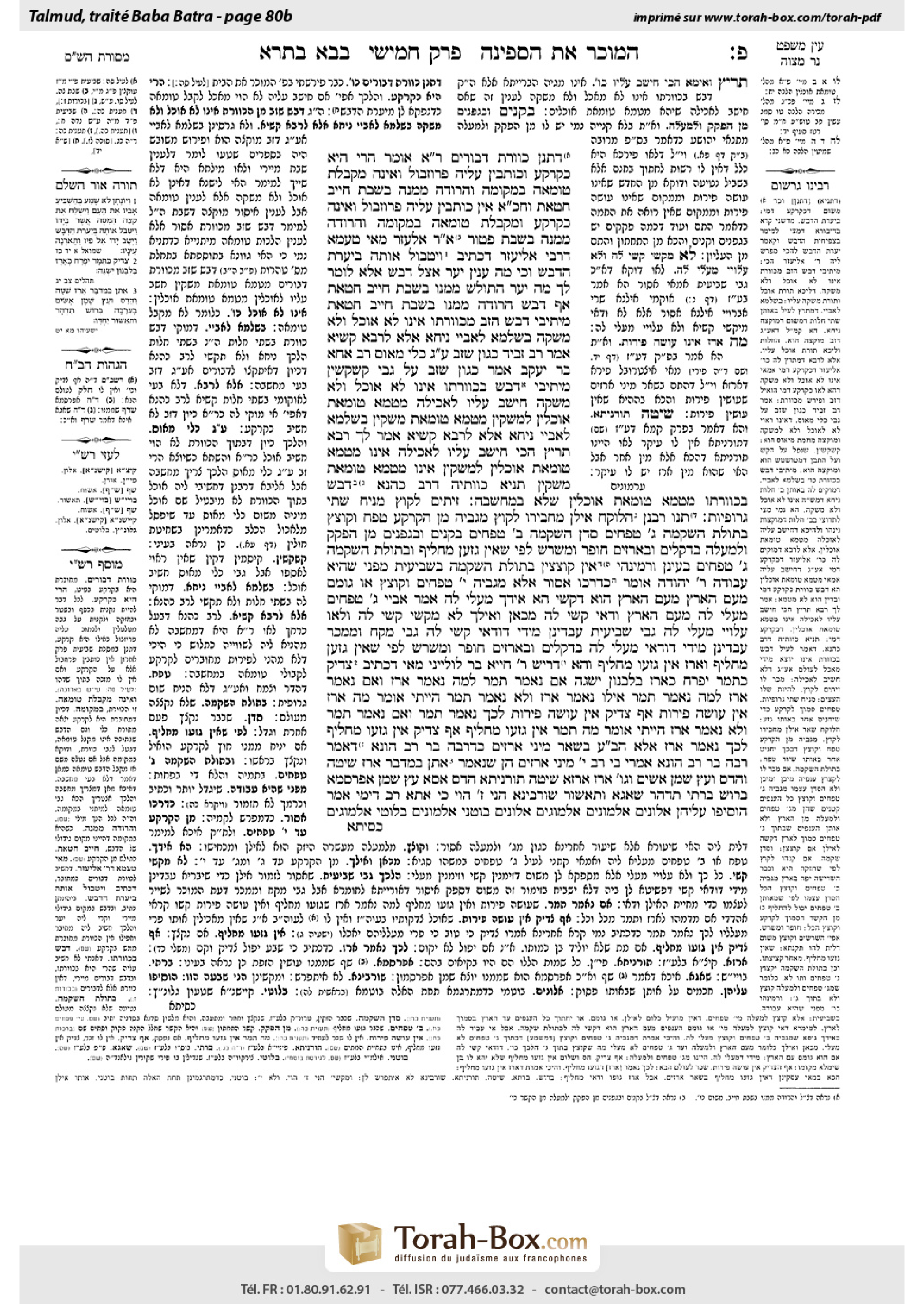
Bava Batra 80b: Talmud study for Daf Yomi
Study the Talmud for Daf Yomi with scanned pages, Hebrew text, English translations from Sefaria and AI-generated French translations.
Passage selection and English or AI-generated French translation are available where the scan has annotations. Daf Study is independent of Torah-Box and Sefaria.
Browse Bava Batra · בבא בתרא · All tractatesBava Batra 80b text and translations
This page of Bava Batra includes the Aramaic text, an English translation and an AI-generated French translation, alongside the scan above.
בבא בתרא פ׳ ב · Aramaic and Hebrew text
דִּתְנַן: כַּוֶּורֶת דְּבוֹרִים – רַבִּי אֱלִיעֶזֶר אוֹמֵר: הֲרֵי הִיא כַּקַּרְקַע, וְכוֹתְבִין עָלֶיהָ פְּרוֹזְבּוּל,
וְאֵינָהּ מְקַבֶּלֶת טוּמְאָה בִּמְקוֹמָהּ, וְהָרוֹדֶה מִמֶּנָּה בְּשַׁבָּת – חַיָּיב חַטָּאת.
וַחֲכָמִים אוֹמְרִים: אֵין כּוֹתְבִין עָלֶיהָ פְּרוֹזְבּוּל, וְאֵינָהּ כַּקַּרְקַע, וּמְקַבֶּלֶת טוּמְאָה בִּמְקוֹמָהּ, וְהָרוֹדֶה מִמֶּנָּה בְּשַׁבָּת – פָּטוּר.
אָמַר רַבִּי אֶלְעָזָר: מַאי טַעְמָא דְּרַבִּי אֱלִיעֶזֶר? דִּכְתִיב: ״וַיִּטְבֹּל אוֹתָהּ בְּיַעְרַת הַדְּבָשׁ״ – וְכִי מָה עִנְיַן יַעַר אֵצֶל דְּבַשׁ? אֶלָּא לוֹמַר לָךְ, מָה יַעַר – הַתּוֹלֵשׁ מִמֶּנּוּ בְּשַׁבָּת חַיָּיב חַטָּאת, אַף דְּבַשׁ – הָרוֹדֶה מִמֶּנּוּ בְּשַׁבָּת חַיָּיב חַטָּאת.
מֵיתִיבִי: דְּבַשׁ הַזָּב מִכַּוַּורְתּוֹ – אֵינוֹ לֹא אוֹכֶל, וְלֹא מַשְׁקֶה. בִּשְׁלָמָא לְאַבָּיֵי, נִיחָא;
אֶלָּא לְרָבָא, קַשְׁיָא! אָמַר רַב זְבִיד: כְּגוֹן שֶׁזָּב עַל גַּבֵּי כְּלִי מָאוּס. רַב אַחָא בַּר יַעֲקֹב אָמַר: כְּגוֹן שֶׁזָּב עַל גַּבֵּי קַשְׁקַשִּׁין.
מֵיתִיבִי: דְּבַשׁ בְּכַוַּורְתּוֹ – אֵינוֹ לֹא אוֹכֶל וְלֹא מַשְׁקֶה. חִישֵּׁב עָלָיו לַאֲכִילָה – מְטַמֵּא טוּמְאַת אוֹכָלִין. לְמַשְׁקִין – מְטַמֵּא טוּמְאַת מַשְׁקִין. בִּשְׁלָמָא לְאַבָּיֵי, נִיחָא;
אֶלָּא לְרָבָא, קַשְׁיָא!
אָמַר לָךְ רָבָא, תָּרֵיץ הָכִי: חִישֵּׁב עָלָיו לַאֲכִילָה – אֵינוֹ מְטַמֵּא טוּמְאַת אוֹכָלִין, לְמַשְׁקִין – אֵינוֹ מְטַמֵּא טוּמְאַת מַשְׁקִין. תַּנְיָא כְּווֹתֵיהּ דְּרַב כָּהֲנָא: דְּבַשׁ בְּכַוַּורְתּוֹ – מְטַמֵּא טוּמְאַת אוֹכָלִין שֶׁלֹּא בְּמַחְשָׁבָה.
זֵיתִים לָקוֹץ – מַנִּיחַ שְׁתֵּי גְרוֹפִיּוֹת. תָּנוּ רַבָּנַן: הַלּוֹקֵחַ אִילָן מֵחֲבֵירוֹ לָקוֹץ – מַגְבִּיהַּ מִן הַקַּרְקַע טֶפַח, וְקוֹצֵץ. בְּתוּלַת הַשִּׁקְמָה – שְׁלֹשָׁה טְפָחִים. סַדַּן הַשִּׁקְמָה – שְׁנֵי טְפָחִים. בְּקָנִים וּבִגְפָנִים – מִן הַפְּקָק וּלְמַעְלָה. בִּדְקָלִים וּבַאֲרָזִים – חוֹפֵר וּמְשָׁרֵשׁ, לְפִי שֶׁאֵין גִּזְעָן מַחְלִיף.
וּבְתוּלַת הַשִּׁקְמָה שְׁלֹשָׁה טְפָחִים בָּעֵינַן?! וּרְמִינְהִי: אֵין קוֹצְצִין בְּתוּלַת הַשִּׁקְמָה בִּשְׁבִיעִית, מִפְּנֵי שֶׁהִיא עֲבוֹדָה.
רַבִּי יְהוּדָה אוֹמֵר: כְּדַרְכּוֹ – אָסוּר; אֶלָּא מַגְבִּיהַּ עֲשָׂרָה טְפָחִים וְקוֹצֵץ, אוֹ גוֹמֵם מֵעִם הָאָרֶץ. מֵעִם הָאָרֶץ הוּא דְּקָשֵׁי, הָא אִידַּךְ מְעַלֵּי לַהּ!
אָמַר אַבָּיֵי: שְׁלֹשָׁה טְפָחִים מְעַלֵּי לַהּ, מֵעִם הָאָרֶץ וַדַּאי קָשֵׁי לַהּ; מִכָּאן וְאֵילָךְ – לָא מִקְשֵׁי קָשֵׁי לַהּ, וְלָאו עַלּוֹיֵי מְעַלֵּי לַהּ. גַּבֵּי שְׁבִיעִית – עָבְדִינַן מִידֵּי דְּוַדַּאי קָשֵׁי לָהּ, גַּבֵּי מִקָּח וּמִמְכָּר – עָבְדִינַן מִידֵּי דְּוַדַּאי מְעַלֵּי לַהּ.
בִּדְקָלִים וּבַאֲרָזִים – חוֹפֵר וּמְשָׁרֵשׁ, לְפִי שֶׁאֵין גִּזְעָן מַחְלִיף. וְאֶרֶז אֵין גִּזְעוֹ מַחְלִיף?! וְהָא דְּרֵישׁ רַבִּי חִיָּיא בַּר לוּלְיָינִי, מַאי דִּכְתִיב: ״צַדִּיק כַּתָּמָר יִפְרָח, כְּאֶרֶז בַּלְּבָנוֹן יִשְׂגֶּה״? אִם נֶאֱמַר תָּמָר לָמָּה נֶאֱמַר אֶרֶז, וְאִם נֶאֱמַר אֶרֶז לָמָּה נֶאֱמַר תָּמָר?
אִילּוּ נֶאֱמַר אֶרֶז וְלֹא נֶאֱמַר תָּמָר – הָיִיתִי אוֹמֵר: מָה אֶרֶז אֵין עוֹשֶׂה פֵּירוֹת, אַף צַדִּיק אֵין עוֹשֶׂה פֵּירוֹת; לְכָךְ נֶאֱמַר תָּמָר.
וְאִם נֶאֱמַר תָּמָר וְלֹא נֶאֱמַר אֶרֶז, הָיִיתִי אוֹמֵר: מָה תָּמָר אֵין גִּזְעוֹ מַחְלִיף, אַף צַדִּיק אֵין גִּזְעוֹ מַחְלִיף; לְכָךְ נֶאֱמַר אֶרֶז!
אֶלָּא הָכָא בְּמַאי עָסְקִינַן – בִּשְׁאָר מִינֵי אֲרָזִים, כִּדְרַבָּה בַּר רַב הוּנָא; דְּאָמַר רַבָּה בַּר רַב הוּנָא, אָמְרִי בֵּי רַב: עֲשָׂרָה מִינֵי אֲרָזִים הֵן, שֶׁנֶּאֱמַר: ״אֶתֵּן בַּמִּדְבָּר אֶרֶז, שִׁטָּה, וַהֲדַס; וְעֵץ שָׁמֶן אָשִׂים וְגוֹ׳״. ״אֶרֶז״ – אַרְזָא. ״שִׁיטָּה״ – תּוּרְנִיתָא. ״הֲדַס״ – אַסָּא. ״עֵץ שֶׁמֶן״ – אֲפַרְסְמָא. ״בְּרוֹשׁ״ – בְּרָתֵי. ״תִּדְהָר״ – שָׁאגָא. ״וּתְאַשּׁוּר״ – שׁוּרְבִּינָא.
הָנֵי שִׁבְעָה הָוֵי! כִּי אֲתָא רַב דִּימִי אָמַר, הוֹסִיפוּ עֲלֵיהֶן: אַלּוֹנִים, אַלְמוֹנִים, אַלְמוּגִּים. אַלּוֹנִים – בּוּטְנֵי, אַלְמוֹנִים – בָּלוּטֵי, אַלְמוּגִּים –
Bava Batra 80b · English translation
As we learned in a mishna (Shevi’it 10:7): Concerning a beehive, Rabbi Eliezer says: It is considered like land with regard to the manner in which one purchases it and with regard to other matters, and therefore one writes a document that prevents the Sabbatical Year from canceling an outstanding debt [prosbol] based on it, as a prosbol can be written only if the debtor possesses land of some sort.
And a beehive is not susceptible to ritual impurity, provided that it is in its place and attached to the ground, as it is considered equivalent to the ground itself, which is not susceptible to impurity. And one who takes honey out of it on Shabbat is liable to bring a sin-offering, like one who uproots something from the ground. According to this opinion, honey in a beehive is not considered to have the status of either food or liquid with regard to ritual impurity, as it is attached to the ground.
The mishna continues: And the Rabbis say: A beehive has the status of movable property; one may not write a prosbol based on it, and it is not considered like land with regard to its sale but is instead sold in the manner of movable property. And it is susceptible to ritual impurity even when it is in its place, and one who takes honey out of it on Shabbat is exempt from bringing a sin-offering. According to this opinion, the honey contained within the beehive is considered detached from the ground and is therefore susceptible to ritual impurity, as stated by Rav Kahana.
Rabbi Elazar said: What is the reasoning of Rabbi Eliezer? As it is written with regard to Jonathan: “He put forth the end of the rod that was in his hand, and dipped it in the honeycomb [ya’arat hadevash]” (I Samuel 14:27). Now, what does a forest [ya’ar] have to do with honey [devash]? Why is the honeycomb called a forest of honey [ya’arat hadevash]? Rather, this serves to tell you: Just as with regard to a forest, one who picks fruit from a tree on Shabbat is liable to bring a sin-offering, so too, with regard to honey, one who removes honey from a beehive on Shabbat is liable to bring a sin-offering.
The Gemara raises an objection from a baraita: Honey that flows from one’s beehive is not considered either food or liquid. Granted, according to the reasoning of Abaye this works out well, since he would explain here, as in the previous case, that this is referring to the two combs in the beehive designated for the sustenance of the bees, and is not intended for human consumption.
But according to the opinion of Rava, who says that the baraita is in accordance with the ruling of Rabbi Eliezer, this presents a difficulty, as even according to Rabbi Eliezer the honey is not considered attached to the ground once it leaves the beehive. Rav Zevid said: The baraita is referring to a case where the honey flowed onto a repulsive vessel and therefore is unfit for human consumption. Rav Aḥa bar Yaakov said: It is referring to a case where it flowed onto straw [kashkashin] and weeds, which renders it inedible.
The Gemara raises another objection from a baraita: Honey in one’s beehive is not considered either food or liquid. If one intended to use it as food, it is susceptible to ritual impurity as food, and if one intended to use it as liquid, it is susceptible to ritual impurity as liquid. Granted, according to the reasoning of Abaye, this works out well, as he can explain that this too is referring to the two combs of honey left for the bees, and that if one reconsidered and decided to eat the honey, it is once again considered fit for human consumption.
But according to Rava, who said that the ruling of the baraita that honey in a beehive does not have the status of food or liquid is in accordance with the opinion of Rabbi Eliezer, this poses a difficulty. This baraita does not accord with the reasoning of Rabbi Eliezer, as he maintains that one’s intention is not enough for honey attached to the ground to be considered as though it were detached. Therefore, the baraita must be in accordance with the opinion of the Rabbis, and yet it contradicts Rav Kahana’s statement that intention is not required for honey to be susceptible to ritual impurity.
The Gemara answers: Rava could have said to you that the baraita is in fact in accordance with the opinion of Rabbi Eliezer, and you should resolve the difficulty and answer like this: If one intended to use the honey as food, it is not susceptible to ritual impurity as food, and if one intended to use it as liquid, it is not susceptible to ritual impurity as liquid. The Gemara notes: It is taught in a baraita in accordance with the opinion of Rav Kahana: Honey in one’s beehive is susceptible to ritual impurity as food even if there was no intention to use it as food, as it has an innate status of food.
§ The mishna teaches: If one buys olive trees for felling, he must leave two shoots from the tree. The Sages taught: One who buys a tree from another for felling must cut the tree one handbreadth above the ground, to allow the tree to grow again. In the case of an untrimmed sycamore, he must cut the tree a minimum of three handbreadths above the ground, and with regard to a large sycamore, which has strong roots because the sycamore has been cut down once already, he must cut the tree a minimum of two handbreadths above the ground. In the case of reeds or of vines, he may cut only from the knot and above, so that they will grow back. In the cases of palm and of cedar trees, he may dig down and uproot them, because their trunks do not replenish themselves after they are cut down, and therefore there is no reason to leave anything behind.
The Gemara asks: And do we require an untrimmed sycamore to be cut a minimum of three handbreadths above the ground for it to grow back? And the Gemara raises a contradiction from a mishna (Shevi’it 4:5): One may not fell an untrimmed sycamore during the Sabbatical Year because it is considered work, as it promotes the growth of the tree.
The mishna continues. Rabbi Yehuda says: It is prohibited for one to fell the tree during the Sabbatical Year in its usual manner; rather, he must cut the tree ten handbreadths above the ground, or raze the tree until it is even with the ground. Neither of these methods promote the growth of the tree; in fact, they damage it. It can be inferred from here that it is only cutting the sycamore until it is even with the ground that is harmful for it, and it does not grow again. Cutting in another manner is beneficial for it, even if it is cut less than three handbreadths from the ground.
Abaye said that the mishna should be understood as follows: Cutting down a sycamore from a height of three handbreadths is beneficial for it, whereas cutting it so that it is even with the ground is certainly harmful for it and is permitted during the Sabbatical Year. Cutting it down from this point onward, i.e., between the ground and three handbreadths, is neither very harmful for it nor particularly beneficial for it. With regard to the Sabbatical Year, we perform only a matter that is certainly harmful to it, so as to avoid enhancing it. With regard to buying and selling, we perform only a matter that is certainly beneficial for it, as the seller intended to sell the sycamore in such a manner that the tree would grow again.
The baraita teaches: In the case of palm and cedar trees, a buyer may dig down and uproot them, because their trunks do not replenish themselves after being cut down. The Gemara asks: And is it correct with regard to a cedar that its trunk does not replenish itself? But didn’t Rabbi Ḥiyya bar Lulyani teach: What is the meaning of that which is written: “The righteous shall flourish like the palm tree; he shall grow like a cedar in Lebanon” (Psalms 92:13)? If “palm tree” is stated, why is “cedar” stated? And if “cedar” is stated, why is “palm tree” stated? What is added by this double comparison?
Rabbi Ḥiyya bar Lulyani explains: Had the verse stated only “cedar” and had not stated “palm tree,” I would have said that just as a cedar does not produce fruit, so too, a righteous person does not produce fruit, i.e., he will have no reward in the World-to-Come. Therefore, it is stated: “Palm tree,” which is a fruit-bearing tree.
And had the verse stated only “palm tree” and had not stated “cedar,” I would have said that just as with regard to a palm tree its trunk does not replenish itself after being cut down, so too, in the case of a righteous person, his trunk does not replenish itself, i.e., he will be unable to recover from misfortune. Therefore, it is stated: “Cedar,” to indicate that just as the trunk of the cedar replenishes itself, so too, the righteous will thrive again. This demonstrates that the trunk of a cedar does grow again.
The Gemara answers: Rather, with what are we are dealing here? We are dealing with other types of cedars, as the trunks of certain species do not grow back after the tree is felled. This is in accordance with the opinion of Rabba bar Rav Huna. As Rabba bar Rav Huna says that they say in the school of Rav: There are ten types of cedars; as it is stated: “I will place in the wilderness the cedar [erez], the acacia tree [shitta], and the myrtle [hadas] and the pine tree [etz shemen]; I will set in the desert the juniper [berosh], the teak [tidhar], and the cypress [te’ashur] all together” (Isaiah 41:19). The Gemara elaborates: Erez means cedar; shitta means acacia tree [tornita]; hadas is the myrtle; etz shemen is the balsam tree; berosh means juniper [berati]; tidhar is the teak [shaga]; and te’ashur is the cypress [shurbina].
The Gemara asks: But these are seven species of cedar, not ten. When Rav Dimi came from Eretz Yisrael to Babylonia he said: They added to the list of cedars allonim, almonim, and almugim. Allonim refers to pistachio trees [butnei], almonim are oaks [balutei], and almugim
Bava Batra 80b · Traduction française (IA)
Comme nous avons appris dans une mitsva (Shevi’it 10:7) : Concernant une ruche, Rabbi Eliezer dit : Elle est considérée comme un terrain en ce qui concerne la manière dont on l'achète et en ce qui concerne d'autres choses, et par conséquent on écrit un document qui empêche l'année sabbatique de résilier une dette en suspens [prosbul] en vertu de cela, car un prosbul peut être écrit uniquement si le débiteur possède un terrain de quelque sorte.
Et la ruche n'est pas sujette à la souillure rituelle, à condition qu'elle soit en place et attachée au sol, car elle est considérée comme équivalente au sol lui-même, qui n'est pas sujette à la souillure. Et celui qui extrait du miel d'elle le sabbat est tenu de présenter un sacrifice expiatoire, comme celui qui arrache quelque chose du sol. Selon cet avis, le miel contenu dans la ruche n'est pas considéré comme ayant le statut de nourriture ou de liquide en ce qui concerne la souillure rituelle, car il est attaché au sol.
La mitsva continue : Et les Rabbins disent : La ruche a le statut d'une propriété mobile ; on ne peut pas écrire un prosbul en vertu d'elle, et elle n'est pas considérée comme un terrain en ce qui concerne sa vente, mais est vendue comme une propriété mobile. Et elle est sujette à la souillure rituelle même lorsqu'elle est en place, et celui qui extrait du miel d'elle le sabbat est exempt de présenter un sacrifice expiatoire. Selon cet avis, le miel contenu dans la ruche est considéré comme détaché du sol et est donc sujette à la souillure rituelle, comme l'a dit Rav Kahana.
Rabbi Elazar dit : Quel est le raisonnement de Rabbi Eliezer ? Comme il est écrit concernant Jonathan : « Il tendit la pointe du bâton qui était dans sa main, et le plongea dans le miel [ya’arat hadevash] » (I Samuel 14:27). Maintenant, à quoi sert une forêt [ya’ar] pour le miel [devash] ? Pourquoi appelle-t-on le miel une forêt de miel [ya’arat hadevash] ? Plutôt, cela sert à vous dire : Comme, concernant une forêt, celui qui récolte des fruits d'un arbre le sabbat est tenu de présenter un sacrifice expiatoire, de même, concernant le miel, celui qui retire du miel d'une ruche le sabbat est tenu de présenter un sacrifice expiatoire.
La Guemara soulève un objet à partir d'une baraïta : Le miel qui coule d'une ruche n'est pas considéré comme nourriture ou liquide. Cela est acceptable selon la raisonnement d'Abaye, car il expliquerait ici, comme dans le cas précédent, que cela fait référence aux deux cadres de miel destinés à la nourriture des abeilles et non à la consommation humaine.
Mais selon l'opinion de Rava, qui dit que la baraïta est en conformité avec la décision de Rabbi Eliezer, cela présente un problème, car même selon Rabbi Eliezer, le miel n'est pas considéré comme attaché au sol une fois qu'il a quitté la ruche. Rav Zevid dit : La baraïta fait référence à un cas où le miel s'est écoulé dans un récipient repoussant et est donc inedible. Rav Acha bar Yaakov dit : Elle fait référence à un cas où il s'est écoulé sur des pailles [kashkashin] et des herbes, ce qui le rend inedible.
La Guemara soulève une autre objection tirée d'une baraïta : Le miel contenu dans une ruche n'est pas considéré comme nourriture ou liquide. Si l'on avait l'intention de l'utiliser comme nourriture, il est sujet à la souillure rituelle comme nourriture, et si l'on avait l'intention de l'utiliser comme liquide, il est sujet à la souillure rituelle comme liquide. Cela est acceptable selon la raison d'Abaye, car il peut expliquer que cela fait référence aux deux cadres de miel laissés aux abeilles, et que si l'on change d'avis et décide de manger le miel, il est à nouveau considéré comme comestible.
Mais selon Rava, qui affirme que la décision de la baraïta selon laquelle le miel contenu dans une ruche n'a pas le statut de nourriture ou de liquide est conforme à l'opinion de Rabbi Eliezer, cela pose un problème. Cette baraïta ne correspond pas au raisonnement de Rabbi Eliezer, car il maintient que l'intention seule n'est pas suffisante pour que le miel attaché au sol soit considéré comme détaché. Par conséquent, la baraïta doit être en conformité avec l'opinion des Rabbins, et pourtant elle contredit la déclaration de Rav Kahana selon laquelle l'intention n'est pas requise pour que le miel soit sujet à la souillure rituelle.
La Guemara répond : Rava aurait pu dire que la baraïta est en fait en conformité avec l'opinion de Rabbi Eliezer, et vous devriez résoudre le problème et répondre ainsi : Si l'on avait l'intention d'utiliser le miel comme nourriture, il n'est pas sujet à la souillure rituelle comme nourriture, et si l'on avait l'intention d'utiliser le miel comme liquide, il n'est pas sujet à la souillure rituelle comme liquide. La Guemara note : Il est enseigné dans une baraïta selon l'opinion de Rav Kahana : Le miel contenu dans une ruche est sujet à la souillure rituelle comme nourriture même s'il n'y avait pas d'intention d'en faire usage, car il possède un statut inné de nourriture.
§ La mitsva enseigne : Si l'on achète des oliviers pour les couper, il faut laisser deux branches de l'arbre. Les Sages enseignent : Celui qui achète un arbre d'un autre pour le couper doit couper l'arbre à un tefach au-dessus du sol, afin que l'arbre puisse reprendre sa croissance. Dans le cas d'un saule non taillé, il faut couper l'arbre au minimum à trois tefachim au-dessus du sol, et concernant un grand saule, qui a des racines fortes car le saule a déjà été coupé une fois, il faut couper l'arbre au minimum à deux tefachim au-dessus du sol. Dans le cas des roseaux ou des vignes, il faut couper uniquement à partir du nœud et au-dessus, afin qu'ils repoussent. Dans les cas des palmiers et des cèdres, on peut creuser et arracher les arbres, car leurs troncs ne se régénèrent pas après avoir été coupés, et par conséquent il n'y a pas de raison de laisser quelque chose derrière.
La Guemara demande : Et exige-t-on qu'un saule non taillé soit coupé au minimum à trois tefachim au-dessus du sol pour qu'il repousse ? Et la Guemara soulève une contradiction à partir d'une mitsva (Shevi’it 4:5) : On ne peut pas couper un saule non taillé pendant l'année sabbatique, car cela est considéré comme un travail, car cela favorise la croissance de l'arbre.
La Michna continue. Rabbi Yéhuda dit : Il est interdit à une personne de couper un arbre pendant l'année sabbatique selon sa manière habituelle ; plutôt, il doit couper l'arbre à dix paumes au-dessus du sol, ou détruire l'arbre jusqu'au niveau du sol. Aucune de ces méthodes ne favorise la croissance de l'arbre ; en fait, elles le nuisent. On peut en déduire ici que c'est seulement la coupe du saule jusqu'au niveau du sol qui est nuisible pour lui, et il ne repousse pas. La coupe par une autre méthode est bénéfique pour lui, même si elle est faite à moins de trois paumes du sol.
Abaye dit que la Michna doit être comprise ainsi : Couper un saule à trois paumes de hauteur est bénéfique pour lui, tandis que le couper jusqu'au niveau du sol est certainement nuisible pour lui et est permis pendant l'année sabbatique. Couper le saule à partir de ce point, c'est-à-dire entre le sol et trois paumes, n'est ni très nuisible ni particulièrement bénéfique. En ce qui concerne l'année sabbatique, nous effectuons uniquement une action certainement nuisible pour l'arbre afin d'éviter de le favoriser. En ce qui concerne l'achat et la vente, nous effectuons uniquement une action certainement bénéfique pour l'arbre, car le vendeur avait l'intention de vendre le saule de manière à ce qu'il repousse.
La baraïta enseigne : En ce qui concerne les arbres de type palmier et cèdre, un acheteur peut creuser et arracher l'arbre, car leurs troncs ne se régénèrent pas après avoir été coupés. La Guemara demande : Et cela est-il correct en ce qui concerne le cèdre, que son tronc ne se régénère pas ? Mais n'avait pas Rabbi Hiyah bar Lulyani enseigné : Quelle est la signification de ce qui est écrit : « Le juste prospérera comme le palmier ; il grandira comme le cèdre du Liban » (Psaumes 92:13) ? Si « palmier » est mentionné, pourquoi « cèdre » ? Et si « cèdre » est mentionné, pourquoi « palmier » ? Quel est l'ajout de cette double comparaison ?
Rabbi Hiyah bar Lulyani explique : Si la parabole avait mentionné uniquement « cèdre » et n'avait pas mentionné « palmier », j'aurais dit que justement comme le cèdre ne produit pas de fruits, ainsi le juste ne produit pas de fruits, c'est-à-dire qu'il n'aura pas de récompense dans le monde à venir. Par conséquent, il est mentionné : « palmier », qui est un arbre fruitier.
Et si la parabole avait mentionné uniquement « palmier » et n'avait pas mentionné « cèdre », j'aurais dit que justement comme pour le palmier son tronc ne se régénère pas après avoir été coupé, ainsi pour le juste, son tronc ne se régénère pas, c'est-à-dire qu'il ne pourra pas se remettre de la misère. Par conséquent, il est mentionné : « cèdre », pour indiquer que justement comme le tronc du cèdre se régénère, ainsi le juste prospérera à nouveau. Cela démontre que le tronc du cèdre se régénère.
La Guemara répond : Plutôt, avec quels arbres sommes-nous en train de parler ici ? Nous parlons d'autres types de cèdres, car les troncs de certaines espèces ne repoussent pas après que l'arbre ait été abattu. Cela est conforme à l'opinion de Rabba bar Rav Huna. Comme Rabba bar Rav Huna dit que l'école de Rav affirme : Il y a dix espèces de cèdres ; comme il est dit : « Je placerai dans le désert le cèdre [erez], l'acacia [shitta], et le myrte [hadas] et le pin [etz shemen] ; je placerai dans le désert le genévrier [berosh], le teck [tidhar], et le cèdre [te'ashur] ensemble » (Yachin 41:19). La Guemara développe : Erez signifie cèdre ; shitta signifie acacia [tornita] ; hadas est le myrte ; etz shemen est l'arbre à résine ; berosh signifie genévrier [berati] ; tidhar est le teck [shaga] ; et te'ashur est le cèdre [shurbina].
La Guemara demande : Mais ces sept espèces de cèdres, pas dix. Lorsque Rav Dimi est venu de la Terre d'Israël vers Babylone, il a dit : Ils ont ajouté à la liste des cèdres allonim, almonim et almugim. Allonim désigne les arbres à pistache [butnei], almonim sont les chênes [balutei], et almugim
Traduction française générée par IA à partir de l’édition anglaise de Sefaria. Vérifie toujours un passage avec le texte source.
Text from Sefaria: William Davidson Edition - Vocalized Aramaic (CC BY NC); William Davidson Edition - English (CC BY NC).