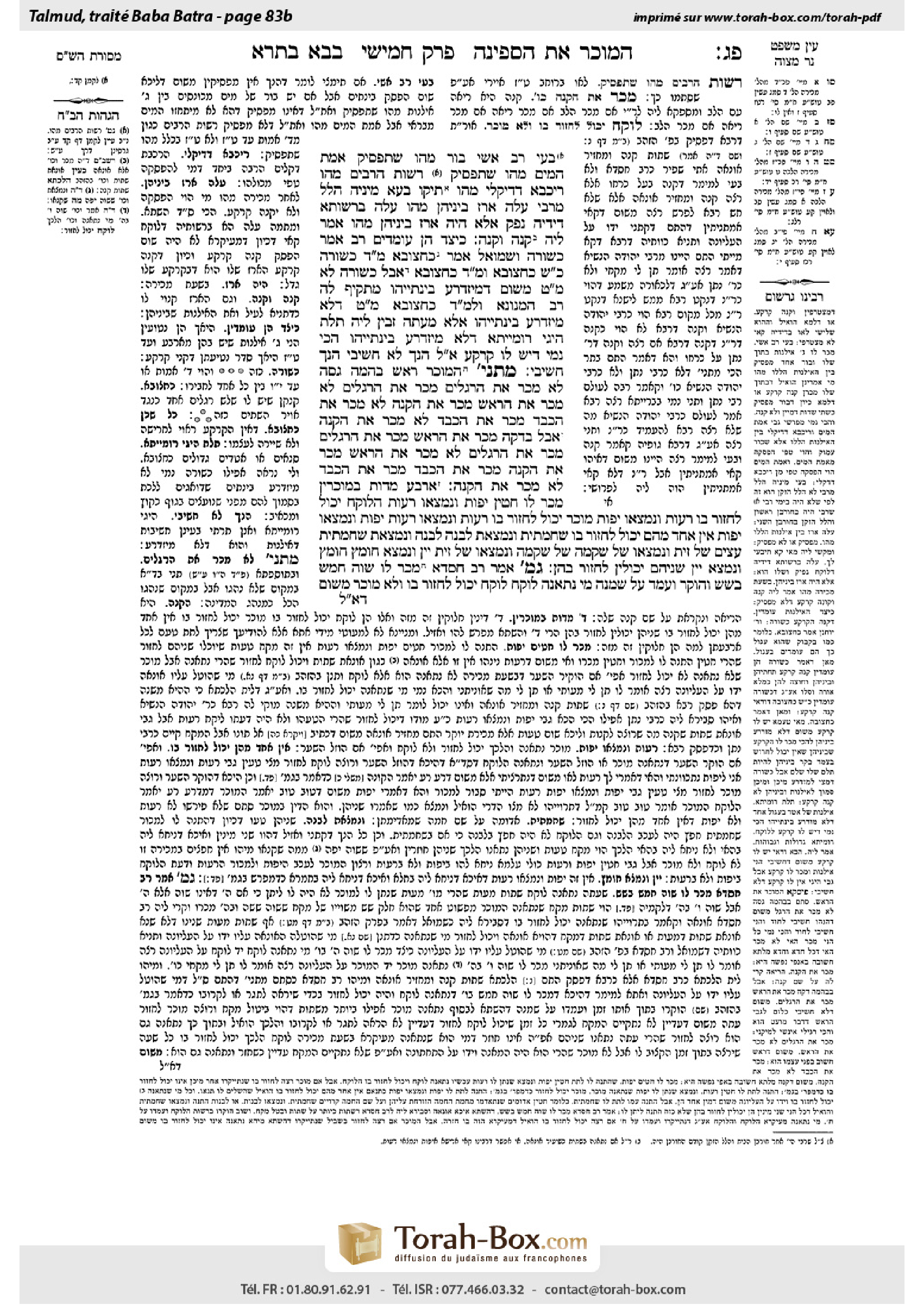
Bava Batra 83b: Talmud study for Daf Yomi
Study the Talmud for Daf Yomi with scanned pages, Hebrew text, English translations from Sefaria and AI-generated French translations.
Passage selection and English or AI-generated French translation are available where the scan has annotations. Daf Study is independent of Torah-Box and Sefaria.
Browse Bava Batra · בבא בתרא · All tractatesBava Batra 83b text and translations
This page of Bava Batra includes the Aramaic text, an English translation and an AI-generated French translation, alongside the scan above.
בבא בתרא פ״ג ב · Aramaic and Hebrew text
בָּעֵי רַב אָשֵׁי: בּוֹר, מַהוּ שֶׁתַּפְסִיק? אַמַּת הַמַּיִם, מַהוּ שֶׁתַּפְסִיק? רְשׁוּת הָרַבִּים מַהוּ? רִיכְבָּא דְּדִיקְלֵי מַהוּ? תֵּיקוּ.
בְּעָא מִינֵּיהּ הִלֵּל מֵרַבִּי: עָלָה אֶרֶז בֵּינֵיהֶן, מַהוּ? ״עָלָה״?! בִּרְשׁוּתָא דִידֵיהּ נְפַק! אֶלָּא ״הָיָה אֶרֶז בֵּינֵיהֶן, מַהוּ?״ אֲמַר לֵיהּ: קָנָה וְקָנָה.
כֵּיצַד הֵן עוֹמְדִים? רַב אָמַר: כְּשׁוּרָה, וּשְׁמוּאֵל אָמַר: כַּחֲצוּבָא. מַאן דְּאָמַר כְּשׁוּרָה – כׇּל שֶׁכֵּן כַּחֲצוּבָא; וּמַאן דְּאָמַר כַּחֲצוּבָא – אֲבָל כְּשׁוּרָה לָא, מַאי טַעְמָא? מִשּׁוּם דְּמִיזְדְּרַע בֵּינְתַיְיהוּ.
מַתְקֵיף לַהּ רַב הַמְנוּנָא: וּלְמַאן דְּאָמַר כַּחֲצוּבָא, מַאי טַעְמָא – דְּלָא מִיזְדְּרַע בֵּינְתַיְיהוּ? אֶלָּא מֵעַתָּה, זַבֵּין לֵיהּ תְּלָת הִיגֵי רוֹמָיָיתָא, דְּלָא מִיזְדְּרַע בֵּינְתַיְיהוּ, הָכִי נָמֵי דְּיֵשׁ לוֹ קַרְקַע?! אָמַר לֵיהּ: הָנָךְ לָא חֲשִׁיבִי, הָנָךְ חֲשִׁיבִי.
מַתְנִי׳ הַמּוֹכֵר רֹאשׁ בְּהֵמָה גַּסָּה – לֹא מָכַר אֶת הָרַגְלַיִם, מָכַר אֶת הָרַגְלַיִם – לֹא מָכַר אֶת הָרֹאשׁ. מָכַר אֶת הַקָּנֶה – לֹא מָכַר אֶת הַכָּבֵד, מָכַר אֶת הַכָּבֵד – לֹא מָכַר אֶת הַקָּנֶה. אֲבָל בְּדַקָּה; מָכַר אֶת הָרֹאשׁ – מָכַר אֶת הָרַגְלַיִם, מָכַר אֶת הָרַגְלַיִם – לֹא מָכַר אֶת הָרֹאשׁ. מָכַר אֶת הַקָּנֶה – מָכַר אֶת הַכָּבֵד, מָכַר אֶת הַכָּבֵד – לֹא מָכַר אֶת הַקָּנֶה.
אַרְבַּע מִדּוֹת בַּמּוֹכְרִין: מָכַר לוֹ חִטִּין יָפוֹת וְנִמְצְאוּ רָעוֹת – הַלּוֹקֵחַ יָכוֹל לַחֲזוֹר בּוֹ. רָעוֹת וְנִמְצְאוּ יָפוֹת – מוֹכֵר יָכוֹל לַחֲזוֹר בּוֹ. רָעוֹת וְנִמְצְאוּ רָעוֹת; יָפוֹת וְנִמְצְאוּ יָפוֹת – אֵין אֶחָד מֵהֶם יָכוֹל לַחֲזוֹר בּוֹ.
שְׁחַמְתִּית וְנִמְצֵאת לְבָנָה, לְבָנָה וְנִמְצֵאת שְׁחַמְתִּית; עֵצִים שֶׁל זַיִת וְנִמְצְאוּ שֶׁל שִׁקְמָה, שֶׁל שִׁקְמָה וְנִמְצְאוּ שֶׁל זַיִת; יַיִן וְנִמְצָא חוֹמֶץ, חוֹמֶץ וְנִמְצָא יַיִן – שְׁנֵיהֶם יְכוֹלִין לַחֲזוֹר בָּהֶן.
גְּמָ׳ אָמַר רַב חִסְדָּא: מָכַר לוֹ שָׁוֶה חָמֵשׁ – בְּשֵׁשׁ, וְהוּקַר וְעָמַד עַל שְׁמֹנֶה, מִי נִתְאַנָּה? לוֹקֵחַ. לוֹקֵחַ יָכוֹל לַחֲזוֹר בּוֹ, וְלֹא מוֹכֵר; מִשּׁוּם
Bava Batra 83b · English translation
Rav Ashi raises a dilemma: In the case of a pit situated between the trees, what is the halakha with regard to the possibility that it divides between the trees, and therefore the owner of the trees does not acquire the ground? Similarly, in the case of a stream of water, what is the halakha with regard to the possibility that it divides between the trees? With regard to the public thoroughfare that divides between trees, what is the halakha? Finally, in the case of a line of palm trees, what is the halakha? No answer is found for these problems, and the Gemara states that the dilemmas shall stand unresolved.
Hillel raises a dilemma before Rabbi Yehuda HaNasi: If a cedar grew between the three trees that one bought, what is the halakha? The Gemara asks: If it grew, then it emerged in his domain, as he already owns the ground, and therefore it is obvious that the cedar belongs to him. Rather, the dilemma is as follows: If, when one bought three trees, there already was a cedar between them, what is the halakha? Is it considered a division between the three trees? Rabbi Yehuda HaNasi said to him: Since he bought the trees, he has thereby acquired the cedar and acquired the land between them.
The Gemara asks: In what manner must the three trees be positioned for the buyer to acquire the ground between them? Rav says: They may be planted in a straight line, and Shmuel says: They must be planted in the form of a tripod. The Gemara notes: According to the one who says that the trees may be positioned in a straight line, all the more so one acquires the ground when the trees are planted in the form of a tripod. But according to the one who says they must be positioned in a tripod, the buyer acquires the ground only in this case; but if the trees were planted in a straight line, he does not acquire the ground. What is the reason? It is because when the trees are planted in the form of a straight line one can sow between them, and therefore the seller would not relinquish his right to the ground between the trees.
Rav Hamnuna objects to this: And according to the one who says that the trees must be planted in the form of a tripod, what is the reason that one who buys the trees acquires the ground? Is it that one cannot sow between the trees? But if that is so, in a case where he sold him three Roman thorny shrubs, where one cannot sow between them, so too would he say that the purchaser has ownership of the ground? The other Sage said to Rav Hamnuna: Those Roman shrubs are not significant, as they are merely shrubs and not trees, and therefore the ground is not acquired when one purchases them. By contrast, these trees are important.
MISHNA: One who sells the head of a large domesticated animal has not sold along with it the forelegs, as each part is considered important in its own right. All the more so, if one sold the forelegs he has not sold the head. Similarly, if one sold the windpipe and the lungs he has not sold the liver, despite the fact that they are sometimes attached, and if he sold the liver he has not sold the windpipe and lungs. But in the case of small domesticated animals, if one sold the head he has sold the forelegs, although if one sold the legs he has not sold the head. Likewise, if one sold the windpipe and lungs he has sold the liver, but if he sold the liver he has not sold the windpipe and lungs.
There are four basic cases with regard to sellers and buyers. If the seller sold him wheat and said that the wheat was good, and it is found to be bad, the buyer, but not the seller, can renege on the sale. If the seller sold him what he thought was bad wheat and it is found to be good, the seller can renege on the sale but the buyer cannot. If he sold bad wheat and it is found to be bad, or good wheat and it is found to be good, neither one of them can renege on the sale, as the condition of the sale was met.
If the seller sold reddish-brown wheat and it is found to be white, or white wheat and it is found to be reddish-brown, and similarly, if he sold olive wood and it is found to be wood of a sycamore, or he sold wood of a sycamore and it is found to be wood of an olive tree, or if the seller sold him wine and it is found to be vinegar, or vinegar and it is found to be wine, in all of these cases both the seller and the buyer can renege on the sale. Since the sale was for a different item than that which was delivered, the transaction can be nullified even if there was no mistake with regard to the price.
GEMARA: Rav Ḥisda says: If the seller sold him an item that was worth five dinars for six dinars, and the item became more expensive and its value stood at eight dinars, and the seller wished to return the money and cancel the sale because the item’s value had increased, who was exploited here? The buyer; therefore, the buyer, but not the seller, can renege on the sale, despite the fact that in such a situation the seller loses out. This is because
Bava Batra 83b · Traduction française (IA)
Rav Ashi soulève un dilemme : Dans le cas d'un puits situé entre les arbres, quelle est la halakha concernant la possibilité qu'il divise entre les arbres, et donc que l'propriétaire des arbres ne puisse acquérir la terre ? De même, dans le cas d'un cours d'eau, quelle est la halakha concernant la possibilité qu'il divise entre les arbres ? Concernant la voie publique qui divise entre les arbres, quelle est la halakha ? Enfin, dans le cas d'une rangée d'arbres de palmier, quelle est la halakha ? Aucune réponse n'est trouvée à ces problèmes, et la Guemara indique que ces dilemmes restent sans solution.
Hillel soulève un dilemme devant Rabbi Yehuda HaNasi : Si un cèdre a grandi entre trois arbres que l'on a achetés, quelle est la halakha ? La Guemara demande : Si c'est le cas, alors il a émergé dans son domaine, puisqu'il possède déjà la terre, et donc il est évident que le cèdre lui appartient. Au contraire, le dilemme est le suivant : Si, lorsqu'on a acheté trois arbres, il y avait déjà un cèdre entre eux, quelle est la halakha ? Est-ce considéré comme une division entre les trois arbres ? Rabbi Yehuda HaNasi répondit à lui : Puisqu'il a acheté les arbres, il a donc acquis le cèdre et la terre entre eux.
La Guemara demande : Dans quel sens doivent être positionnés les trois arbres pour que l'acheteur acquière la terre entre eux ? Rav dit : Ils peuvent être plantés en ligne droite, et Shmuel dit : Ils doivent être plantés en forme de trépied. La Guemara note : Selon celui qui dit que les arbres peuvent être positionnés en ligne droite, tout autant que l'on acquiert la terre lorsque les arbres sont plantés en forme de trépied. Mais selon celui qui dit qu'ils doivent être positionnés en trépied, l'acheteur acquiert la terre uniquement dans ce cas ; mais si les arbres ont été plantés en ligne droite, il ne peut pas acquérir la terre. Quelle est la raison ? C'est parce que lorsque les arbres sont plantés en ligne droite, on peut semer entre eux, et donc le vendeur ne renonce pas à son droit sur la terre entre les arbres.
Rav Hamnuna s'oppose à cela : Et selon celui qui dit que les arbres doivent être plantés en forme de trépied, quelle est la raison pour laquelle l'acheteur acquiert la terre ? Est-ce que l'on ne peut pas semer entre les arbres ? Mais si c'est le cas, dans un cas où il a vendu trois buissons romains, où l'on ne peut pas semer entre eux, il dirait aussi que l'acheteur possède la terre ? L'autre Sage répondit à Rav Hamnuna : Ces buissons romains ne sont pas importants, puisqu'ils sont simplement des buissons et non des arbres, et donc la terre n'est pas acquise lorsqu'on les achète. À l'inverse, ces arbres sont importants.
MICHNA : Celui qui vend la tête d'un grand animal domestique n'a pas vendu avec elle les avant-bras, car chaque partie est considérée comme importante en soi. De même, si l'on vend les avant-bras, l'on n'a pas vendu la tête. De même, si l'on vend la trachée et les poumons, l'on n'a pas vendu le foie, malgré le fait qu'ils soient parfois attachés, et si l'on vend le foie, l'on n'a pas vendu la trachée et les poumons. Mais dans le cas des petits animaux domestiques, si l'on vend la tête, l'on a vendu les avant-bras, bien que si l'on vend les pattes, l'on n'ait pas vendu la tête. De même, si l'on vend la trachée et les poumons, l'on a vendu le foie, mais si l'on vend le foie, l'on n'a pas vendu la trachée et les poumons.
Il y a quatre cas fondamentaux concernant les vendeurs et les acheteurs. Si le vendeur vend du blé et dit que le blé est bon, et il est trouvé être mauvais, l'acheteur, mais pas le vendeur, peut annuler la vente. Si le vendeur vend ce qu'il pensait être du mauvais blé et il est trouvé être bon, le vendeur peut annuler la vente mais l'acheteur ne peut pas. Si l'on vend du mauvais blé et il est trouvé être mauvais, ou du bon blé et il est trouvé être bon, ni l'un ni l'autre ne peut annuler la vente, car la condition de la vente a été satisfaite.
Si le vendeur vend du blé roussâtre et il est trouvé être blanc, ou du blé blanc et il est trouvé être roussâtre, de même, si l'on vend du bois d'olivier et il est trouvé être du bois de saule, ou l'on vend du bois de saule et il est trouvé être du bois d'olivier, ou si le vendeur vend du vin et il est trouvé être du vinaigre, ou du vinaigre et il est trouvé être du vin, dans tous ces cas, à la fois le vendeur et l'acheteur peuvent annuler la vente. Puisque la vente était pour un objet différent de celui livré, la transaction peut être annulée même s'il n'y avait pas d'erreur concernant le prix.
GUEMARA : Rav Ḥisda dit : Si le vendeur vend un objet qui valait cinq dinars contre six dinars, et que l'objet devient plus cher et vaut huit dinars, et que le vendeur souhaite rendre l'argent et annuler la vente parce que la valeur de l'objet a augmenté, qui est exploité ici ? L'acheteur ; donc, l'acheteur, mais pas le vendeur, peut annuler la vente, malgré le fait que dans ce cas le vendeur subit une perte. Cela est dû à
Traduction française générée par IA à partir de l’édition anglaise de Sefaria. Vérifie toujours un passage avec le texte source.
Text from Sefaria: William Davidson Edition - Vocalized Aramaic (CC BY NC); William Davidson Edition - English (CC BY NC).