Bava Batra 84a: Talmud study for Daf Yomi
Study the Talmud for Daf Yomi with scanned pages, Hebrew text, English translations from Sefaria and AI-generated French translations.
Passage selection and English or AI-generated French translation are available where the scan has annotations. Daf Study is independent of Torah-Box and Sefaria.
Browse Bava Batra · בבא בתרא · All tractatesBava Batra 84a text and translations
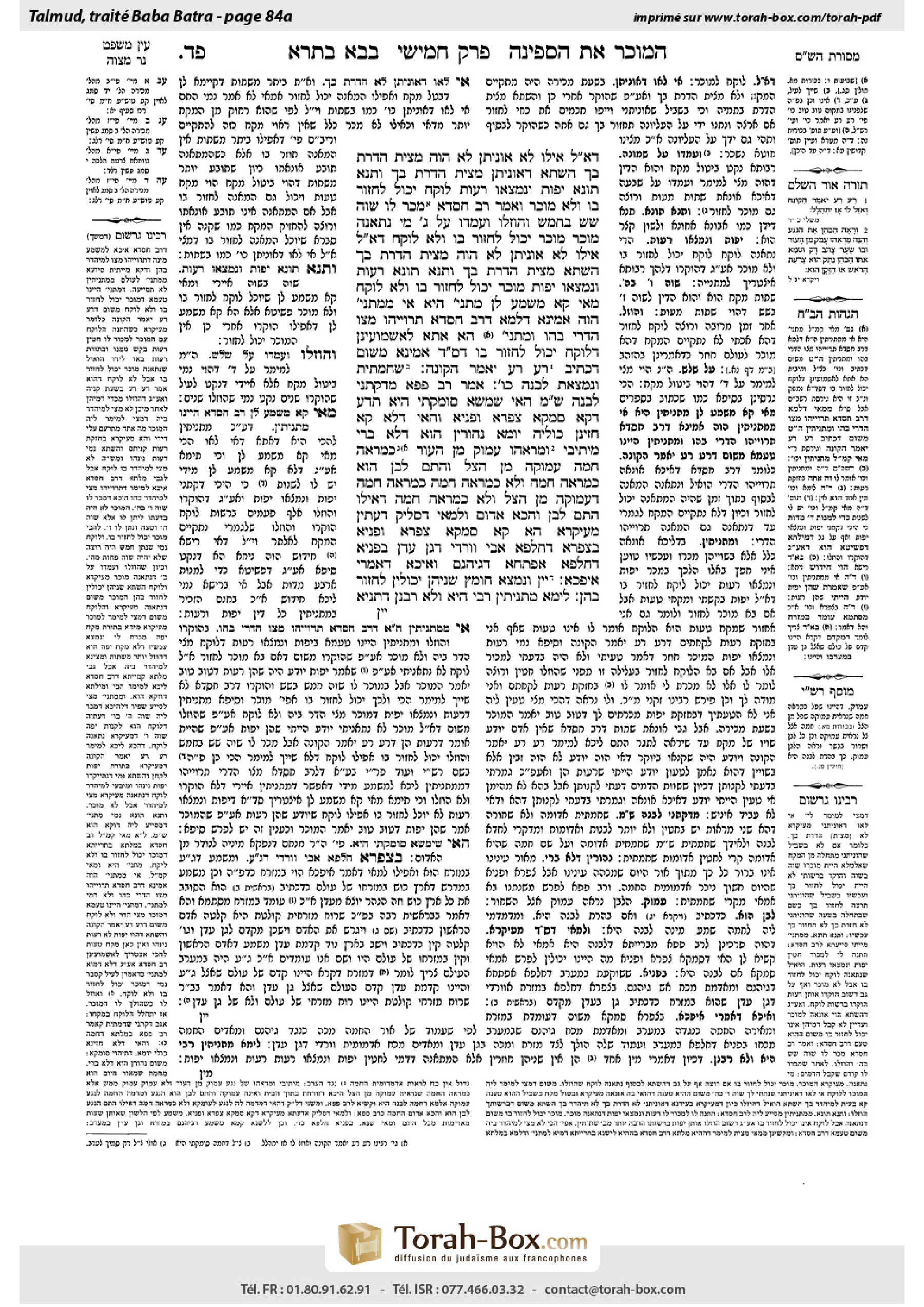
This page of Bava Batra includes the Aramaic text, an English translation and an AI-generated French translation, alongside the scan above.
בבא בתרא פ״ד א · Aramaic and Hebrew text
דְּאָמַר לֵיהּ: אִילּוּ לָא אוֹנִיתַן – לָא הֲוָה מָצֵית הָדְרַתְּ בָּךְ; הַשְׁתָּא דְּאוֹנִיתָן, מָצֵית הָדְרַתְּ בָּךְ?! וְתַנָּא תּוּנָא: יָפוֹת וְנִמְצְאוּ רָעוֹת – לוֹקֵחַ יָכוֹל לַחֲזוֹר בּוֹ, וְלֹא מוֹכֵר.
וְאָמַר רַב חִסְדָּא: מָכַר לוֹ שָׁוֶה שֵׁשׁ – בְּחָמֵשׁ, וְהוּזְלוּ וְעָמְדוּ עַל שָׁלֹשׁ, מִי נִתְאַנָּה? מוֹכֵר. מוֹכֵר יָכוֹל לַחֲזוֹר בּוֹ, וְלֹא לוֹקֵחַ; דְּאָמַר לֵיהּ: אִילּוּ לָא אוֹנִיתַן – לָא הֲוָה מָצֵית הָדְרַתְּ בָּךְ; הַשְׁתָּא מָצֵית הָדְרַתְּ בָּךְ?! וְתַנָּא תּוּנָא: רָעוֹת וְנִמְצְאוּ יָפוֹת – מוֹכֵר יָכוֹל לַחֲזוֹר בּוֹ, וְלֹא לוֹקֵחַ.
מַאי קָא מַשְׁמַע לַן? מַתְנִיתִין הִיא! אִי מִמַּתְנִיתִין, הֲוָה אָמֵינָא: דִּלְמָא דְּרַב חִסְדָּא – תַּרְוַיְיהוּ מָצוּ הָדְרִי בְּהוּ, וּמַתְנִיתִין הָא אֲתָא לְאַשְׁמוֹעִינַן – דְּלוֹקֵחַ יָכוֹל לַחֲזוֹר בּוֹ.
דְּסָלְקָא דַּעְתָּךְ אָמֵינָא, מִשּׁוּם דִּכְתִיב: ״רַע רַע יֹאמַר הַקּוֹנֶה״.
שְׁחַמְתִּית וְנִמְצֵאת לְבָנָה כּוּ׳. אָמַר רַב פָּפָּא: מִדְּקָתָנֵי ״לְבָנָה״, שְׁמַע מִינַּהּ הַאי שִׁמְשָׁא סוּמַּקְתִּי הִיא. תֵּדַע, דְּקָא סָמְקָא צַפְרָא וּפַנְיָא. וְהַאי דְּלָא קָא חָזֵינַן כּוּלֵּיהּ יוֹמָא – נְהוֹרִין הוּא דְּלָא בָּרִי.
מֵיתִיבִי: ״וּמַרְאֵהוּ עָמֹק מִן הָעוֹר״ – כְּמַרְאֵה חַמָּה עֲמוּקָּה מִן הַצֵּל. וְהָתָם לָבָן הוּא! כְּמַרְאֵה חַמָּה – וְלֹא כְּמַרְאֵה חַמָּה; כְּמַרְאֵה חַמָּה – דַּעֲמוּקָּה מִן הַצֵּל, וְלֹא כְּמַרְאֵה חַמָּה – דְּאִילּוּ הָתָם לָבָן, וְהָכָא אָדוֹם.
וּלְמַאי דִּסְלֵיק דַּעְתִּין מֵעִיקָּרָא – הָא קָא סָמְקָא צַפְרָא וּפַנְיָא! בְּצַפְרָא – דְּחָלְפָא אַבֵּי וַורְדֵי דְּגַן עֵדֶן, בְּפַנְיָא – דְּחָלְפָא אַפִּתְחָא דְגֵיהִנָּם. וְאִיכָּא דְּאָמְרִי אִיפְּכָא.
יַיִן וְנִמְצָא חוֹמֶץ – שְׁנֵיהֶן יְכוֹלִין לַחֲזוֹר בָּהֶן. לֵימָא מַתְנִיתִין רַבִּי הִיא וְלָא רַבָּנַן? דְּתַנְיָא:
Bava Batra 84a · English translation
the buyer can say to the seller: If you had not exploited me, you would not be able to renege on the sale, and I would receive the profit. Now that you have exploited me, can you renege on the sale and benefit? And similarly, the tanna of the mishna also taught: If the seller sold him wheat while claiming that the wheat was good, and it is found to be bad, the buyer can renege on the sale. This implies that the buyer can renege but not the seller, even in a situation where the seller would want to renege on the sale, e.g., if the item became more expensive.
And similarly, Rav Ḥisda says: If he sold him an item that was worth six dinars for five dinars, and its price was reduced and its value now stood at three dinars, who was exploited in this case? The seller; therefore, the seller, but not the buyer, can renege on the sale. The reason is that the seller can say to him: If you had not exploited me, you would not be able to renege on the sale. Now that you have exploited me, can you renege on the sale? And similarly, the tanna of the mishna also taught: If the seller sold him bad wheat and it is found to be good, the seller can renege on the sale, but not the buyer.
The Gemara asks: What is Rav Ḥisda teaching us? It is all already taught in the mishna. The Gemara answers: If the halakha were derived from the mishna alone, I would say that perhaps in the cases brought by Rav Ḥisda, both the buyer and the seller are able to renege on the sale. The reason is that this is a case of exploitation, as the item was sold for more than its value, and therefore as long the buyer can renege on the sale, the sale is not complete. Consequently, as the seller lost out as well, he can also renege on the sale. And as for the mishna, it comes to teach us that if the seller said that he is selling good wheat and it is found to be bad, the buyer can renege on the sale, as this is considered a case of exploitation.
It is necessary to teach this, as it might enter your mind to say that this is not a case of exploitation because it is written: “It is bad, it is bad, says the buyer; but when he is gone his way, then he boasts” (Proverbs 20:14). In other words, it is the usual manner of sellers to praise their merchandise, while buyers disparage it. Therefore, the mishna teaches that the buyer can renege on the sale if the item was found to be bad, and the seller can change his mind if it was found to be good.
§ The mishna teaches that if the seller said that he was selling reddish-brown [sheḥamtit] wheat and it is found to be white, both the seller and the buyer can renege on the sale. The Gemara assumes that sheḥamtit means the color of the sun [ḥama]. Therefore, Rav Pappa said: From the fact that the mishna teaches: White, in contrast to sheḥamtit, and there are two types of wheat, one white and the other red, conclude from the mishna that this sun is red, not white. Know that this is the case, as it reddens in the morning and evening. And the reason that we do not see the red color all day is because our eyesight is not strong and we cannot discern the redness of the sun.
The Gemara raises an objection to this claim: With regard to a verse that speaks of leprosy: “And, behold, if its appearance is deeper than the skin” (Leviticus 13:30), the Sages explain: This means that it is like the appearance of the sun, which is deeper than the shadow. But there, leprosy is white and yet it is likened to the sun. The Gemara answers: There, it means that it has an appearance like the sun in certain respects, but it is not like the appearance of the sun in all respects. It is like the appearance of the sun in that it is deeper than the shadow, and it is not entirely like the appearance of the sun, as there the leprous spot is white, and here the sun is red.
The Gemara asks: And according to that which entered our mind initially, that the sun is white, doesn’t it redden in the morning and evening? The Gemara answers: In the morning it becomes red as it passes over the site of the roses of the Garden of Eden, whose reflections give the light a red hue. In the evening the sun turns red because it passes over the entrance of Gehenna, whose fires redden the light. And there are those who say the opposite in explaining why the sun is red in the morning and the evening, i.e., in the morning it passes over the entrance of Gehenna, while in the evening it passes over the site of the roses of the Garden of Eden.
§ The mishna teaches: If the seller sold wine and it is found to be vinegar, both the seller and the buyer can renege on the sale. The Gemara suggests: Shall we say that the mishna is in accordance with the opinion of Rabbi Yehuda HaNasi and not in accordance with the opinion of the Rabbis? As it is taught in a baraita:
Bava Batra 84a · Traduction française (IA)
L'acheteur peut dire au vendeur : Si tu ne m'avais pas exploité, tu ne pourrais pas annuler la vente, et je recevrais le bénéfice. Maintenant que tu m'as exploité, peux-tu annuler la vente et en tirer profit ? De même, le tanna de la mitsna a également enseigné : Si le vendeur a vendu du blé en affirmant qu'il était bon, et qu'on découvre qu'il est mauvais, l'acheteur peut annuler la vente. Cela implique que l'acheteur peut annuler la vente, mais pas le vendeur, même dans un cas où le vendeur souhaiterait annuler la vente, par exemple si l'objet est devenu plus cher.
De même, Rav Ḥisda dit : Si l'acheteur a acheté un objet qui valait six dinars pour cinq dinars, et que son prix a baissé jusqu'à trois dinars, qui a été exploité dans ce cas ? L'acheteur ; donc, l'acheteur, mais pas le vendeur, peut annuler la vente. La raison est que le vendeur peut dire à l'acheteur : Si tu ne m'avais pas exploité, tu ne pourrais pas annuler la vente. Maintenant que tu m'as exploité, peux-tu annuler la vente ? De même, le tanna de la mitsna a également enseigné : Si le vendeur a vendu du blé mauvais et qu'on découvre qu'il est bon, le vendeur peut annuler la vente, mais pas l'acheteur.
La Guemara demande : Qu'est-ce que Rav Ḥisda nous enseigne ? Cela est déjà enseigné dans la mitsna. La Guemara répond : Si la halakha était dérivée uniquement de la mitsna, je dirais que peut-être, dans les cas apportés par Rav Ḥisda, à la fois l'acheteur et le vendeur peuvent annuler la vente. La raison est que c'est un cas d'exploitation, car l'objet a été vendu à un prix supérieur à sa valeur, et donc, tant que l'acheteur peut annuler la vente, la vente n'est pas achevée. Ainsi, comme le vendeur a également subi une perte, il peut également annuler la vente. Et concernant la mitsna, elle vient enseigner que si le vendeur a dit qu'il vendait du blé bon et qu'on découvre qu'il est mauvais, l'acheteur peut annuler la vente, car cela est considéré comme un cas d'exploitation.
Il est nécessaire d'enseigner cela, car cela pourrait entrer en votre pensée de dire que ce n'est pas un cas d'exploitation, car il est écrit : « C'est mauvais, c'est mauvais, dit l'acheteur ; mais quand il est parti, il se glorifie » (Proverbes 20:14). Autrement dit, c'est la manière habituelle des vendeurs de louanger leur marchandise, tandis que les acheteurs la dénigrent. Ainsi, la mitsna enseigne que l'acheteur peut annuler la vente si l'objet est trouvé mauvais, et que le vendeur peut changer d'avis si l'objet est trouvé bon.
§ La mitsna enseigne que si le vendeur a dit qu'il vendait du blé sheḥamtit et qu'on découvre qu'il est blanc, à la fois le vendeur et l'acheteur peuvent annuler la vente. La Guemara suppose que sheḥamtit signifie la couleur du soleil [ḥama]. Ainsi, Rav Pappa dit : D'après le fait que la mitsna enseigne : blanc, en contraste avec sheḥamtit, et qu'il existe deux types de blé, l'un blanc et l'autre rouge, on conclut de la mitsna que ce soleil est rouge, pas blanc. Sachez que c'est ainsi, car il rougit le matin et le soir. Et la raison pour laquelle nous ne voyons pas la couleur rouge toute la journée est que notre vue n'est pas forte et nous ne pouvons pas distinguer la rougeur du soleil.
La Guemara soulève une objection à cette affirmation : Concernant un verset qui parle de la lèpre : « Et, voici, si son apparence est plus profonde que la peau » (Lévitique 13:30), les Sages expliquent : cela signifie qu'il est comme l'apparence du soleil, qui est plus profond que l'ombre. Mais là, la lèpre est blanche et pourtant elle est comparée au soleil. La Guemara répond : Là, cela signifie qu'elle a une apparence semblable au soleil en certains aspects, mais pas en tous. C'est comme l'apparence du soleil en ce qu'elle est plus profonde que l'ombre, mais elle n'est pas entièrement semblable à l'apparence du soleil, car là la tache de lèpre est blanche, et ici le soleil est rouge.
La Guemara demande : Et selon ce qui nous est entré dans l'esprit au début, que le soleil est blanc, ne rougit-il pas le matin et le soir ? La Guemara répond : Le matin, il devient rouge en passant sur le site des roses du Jardin d'Éden, dont les reflets donnent à la lumière un teint rouge. Le soir, le soleil devient rouge en passant sur l'entrée de Gehenna, dont les flammes rougissent la lumière. Et il y a ceux qui disent l'inverse pour expliquer pourquoi le soleil est rouge le matin et le soir, c'est-à-dire que le matin il passe sur l'entrée de Gehenna, tandis que le soir il passe sur le site des roses du Jardin d'Éden.
§ La mitsva enseigne : Si le vendeur a vendu du vin et qu'on découvre qu'il est du vinaigre, à la fois le vendeur et l'acheteur peuvent annuler la vente. La Guemara suggère : Devons-nous dire que la mitsva suit l'opinion de Rabbi Yehuda HaNasi et non celle des Rabbins ? Car il est enseigné dans une baraïta :
Traduction française générée par IA à partir de l’édition anglaise de Sefaria. Vérifie toujours un passage avec le texte source.
Text from Sefaria: William Davidson Edition - Vocalized Aramaic (CC BY NC); William Davidson Edition - English (CC BY NC).