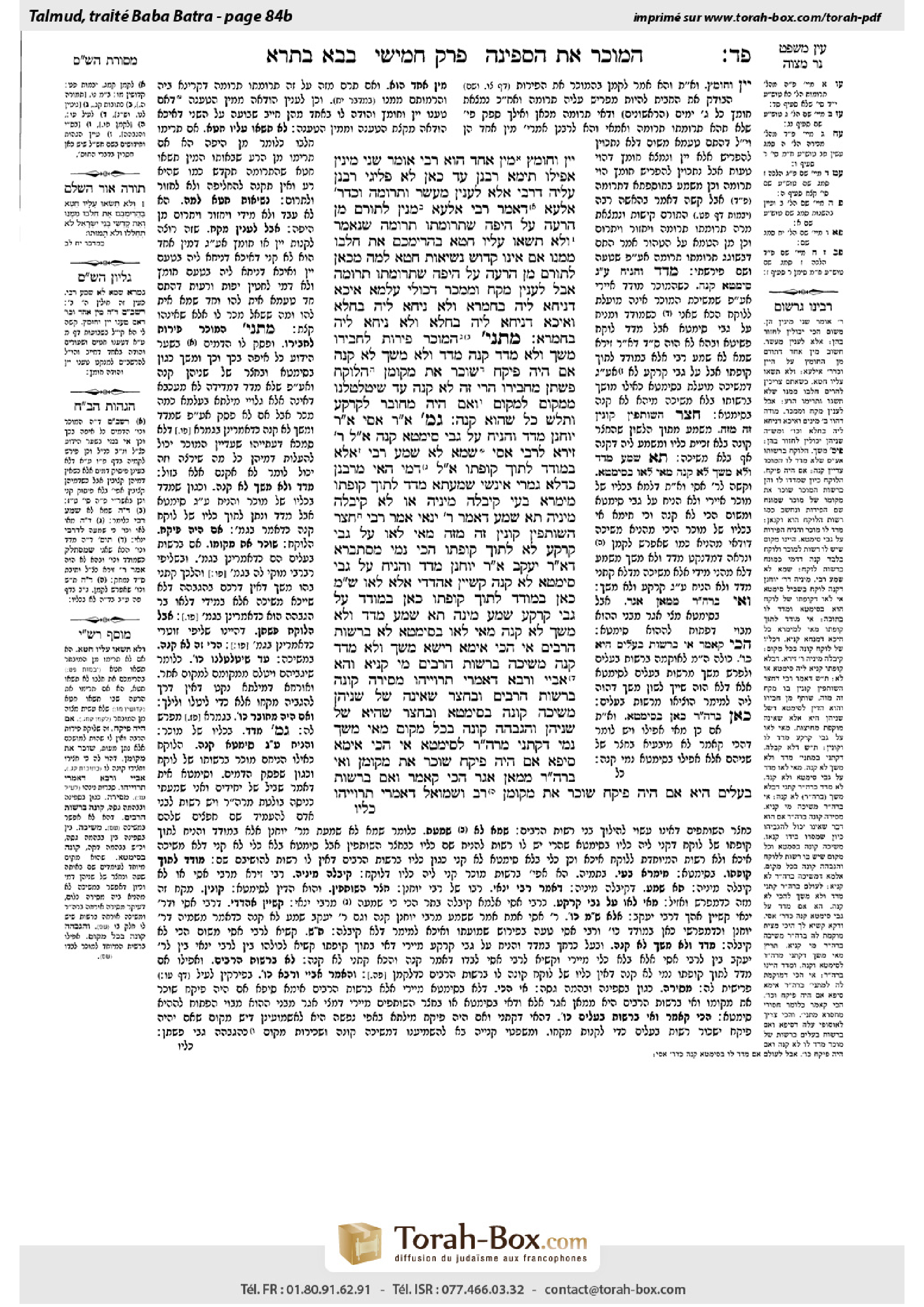
Bava Batra 84b: Talmud study for Daf Yomi
Study the Talmud for Daf Yomi with scanned pages, Hebrew text, English translations from Sefaria and AI-generated French translations.
Passage selection and English or AI-generated French translation are available where the scan has annotations. Daf Study is independent of Torah-Box and Sefaria.
Browse Bava Batra · בבא בתרא · All tractatesBava Batra 84b text and translations
This page of Bava Batra includes the Aramaic text, an English translation and an AI-generated French translation, alongside the scan above.
בבא בתרא פ״ד ב · Aramaic and Hebrew text
יַיִן וָחוֹמֶץ – מִין אֶחָד הוּא. רַבִּי אוֹמֵר: שְׁנֵי מִינִין. אֲפִילּוּ תֵּימָא רַבָּנַן – עַד כָּאן לָא פְּלִיגִי רַבָּנַן עֲלֵיהּ דְּרַבִּי אֶלָּא לְעִנְיַן מַעֲשֵׂר וּתְרוּמָה, וְכִדְרַבִּי אִלָּעָא –
דְּאָמַר רַבִּי אִלְעָא: מִנַּיִן לַתּוֹרֵם מִן הָרָעָה עַל הַיָּפָה, שֶׁתְּרוּמָתוֹ תְּרוּמָה? שֶׁנֶּאֱמַר: ״וְלֹא תִשְׂאוּ עָלָיו חֵטְא בַּהֲרִימְכֶם אֶת חֶלְבּוֹ מִמֶּנּוּ״.
אִם אֵינוֹ קָדוֹשׁ, נְשִׂיאוּת חֵטְא לָמָּה? מִכָּאן לַתּוֹרֵם מִן הָרָעָה עַל הַיָּפָה, שֶׁתְּרוּמָתוֹ תְּרוּמָה.
אֲבָל לְעִנְיַן מִקָּח וּמִמְכָּר – דְּכוּלֵּי עָלְמָא אִיכָּא דְּנִיחָא לֵיהּ בְּחַמְרָא וְלָא נִיחָא לֵיהּ בְּחַלָּא, וְאִיכָּא דְּנִיחָא לֵיהּ בְּחַלָּא וְלָא נִיחָא לֵיהּ בְּחַמְרָא.
מַתְנִי׳ הַמּוֹכֵר פֵּירוֹת לַחֲבֵירוֹ, מָשַׁךְ וְלֹא מָדַד – קָנָה. מָדַד וְלֹא מָשַׁךְ – לֹא קָנָה. אִם הָיָה פִּיקֵּחַ – שׂוֹכֵר אֶת מְקוֹמָן.
הַלּוֹקֵחַ פִּשְׁתָּן מֵחֲבֵירוֹ – הֲרֵי זֶה לֹא קָנָה, עַד שֶׁיְּטַלְטְלֶנּוּ מִמָּקוֹם לְמָקוֹם. וְאִם הָיָה מְחוּבָּר לַקַּרְקַע, וְתָלַשׁ כׇּל שֶׁהוּא – קָנָה.
גְּמָ׳ אָמַר רַבִּי אַסִּי אָמַר רַבִּי יוֹחָנָן: מָדַד וְהִנִּיחַ עַל גַּבֵּי סִימְטָא, קָנָה.
אָמַר לוֹ רַבִּי זֵירָא לְרַבִּי אַסִּי: שֶׁמָּא לֹא שָׁמַע רַבִּי אֶלָּא בְּמוֹדֵד לְתוֹךְ קוּפָּתוֹ? אֲמַר לֵיהּ: דָּמֵי הַאי מֵרַבָּנַן כִּדְלָא גָּמְרִי אִינָשֵׁי שְׁמַעְתָּא. מָדַד לְתוֹךְ קוּפָּתוֹ – מֵימְרָא בָּעֵי?!
קַיבְּלַהּ מִינֵּיהּ, אוֹ לָא קַיבְּלַהּ מִינֵּיהּ? תָּא שְׁמַע, דְּאָמַר רַבִּי יַנַּאי אָמַר רַבִּי: חֲצַר הַשּׁוּתָּפִין – קוֹנִין זֶה מִזֶּה. מַאי, לָאו עַל גַּבֵּי קַרְקַע? לֹא, לְתוֹךְ קוּפָּתוֹ.
הָכִי נָמֵי מִסְתַּבְּרָא, דְּאָמַר רַבִּי יַעֲקֹב אָמַר רַבִּי יוֹחָנָן: מָדַד וְהִנִּיחַ עַל גַּבֵּי סִימְטָא – לֹא קָנָה. קַשְׁיָין אַהֲדָדֵי! אֶלָּא לָאו שְׁמַע מִינַּהּ כָּאן בְּמוֹדֵד לְתוֹךְ קוּפָּתוֹ, כָּאן בְּמוֹדֵד עַל גַּבֵּי קַרְקַע? שְׁמַע מִינַּהּ.
תָּא שְׁמַע: מָדַד וְלֹא מָשַׁךְ – לֹא קָנָה. מַאי, לָאו בְּסִימְטָא? לֹא, בִּרְשׁוּת הָרַבִּים. אִי הָכִי, אֵימָא רֵישָׁא: מָשַׁךְ וְלֹא מָדַד – קָנָה. מְשִׁיכָה בִּרְשׁוּת הָרַבִּים מִי קָנְיָא?!
וְהָא אַבָּיֵי וְרָבָא דְּאָמְרִי תַּרְוַיְיהוּ: מְסִירָה קוֹנָה בִּרְשׁוּת הָרַבִּים וּבְחָצֵר שֶׁאֵינָהּ שֶׁל שְׁנֵיהֶן; מְשִׁיכָה קוֹנָה בְּסִימְטָא וּבְחָצֵר שֶׁהִיא שֶׁל שְׁנֵיהֶן; וְהַגְבָּהָה קוֹנָה בְּכׇל מָקוֹם!
מַאי ״מָשַׁךְ״ נָמֵי דְּקָתָנֵי – מֵרְשׁוּת הָרַבִּים לְסִימְטָא. אִי הָכִי, אֵימָא סֵיפָא: אִם הָיָה פִּיקֵּחַ – שׂוֹכֵר אֶת מְקוֹמָן. וְאִי בִּרְשׁוּת הָרַבִּים, מִמַּאן אָגַר? הָכִי קָאָמַר: וְאִם בִּרְשׁוּת בְּעָלִים הִיא, אִם הָיָה פִּיקֵּחַ – שׂוֹכֵר אֶת מְקוֹמָן.
רַב וּשְׁמוּאֵל דְּאָמְרִי תַּרְוַיְיהוּ:
Bava Batra 84b · English translation
Wine and vinegar are one type of food, which means that if, for example, one separated teruma from one of these with the intention that it should exempt the other, his action is effective. Rabbi Yehuda HaNasi says: They are two types of food. Apparently, the mishna is not in accordance with the opinion of the Rabbis in the baraita. The Gemara rejects this claim: You may even say that the mishna is in accordance with the opinion of the Rabbis, as the Rabbis disagree with Rabbi Yehuda HaNasi only with regard to the issue of whether one can separate tithe and teruma from wine to redeem vinegar and vice versa. And the Rabbis hold in accordance with the opinion of Rabbi Ela.
As Rabbi Ela says: From where is it derived with regard to one who separates teruma from poor-quality produce for superior-quality produce, i.e., in order to fulfill the obligation of separating teruma from the high-quality produce, that his teruma is valid teruma? As it is stated: “And you shall bear no sin by reason of it, seeing as you have set apart from it its best” (Numbers 18:32).
The verse is understood as indicating that one who sets aside inferior produce has sinned. It also demonstrates that if one did, in fact, set aside teruma from poor-quality produce in order to render permitted superior-quality produce, his action is effective and the inferior produce is sanctified as teruma. The reason is that if the inferior produce is not consecrated, why would one bear a sin? It should be considered as though he did nothing. From here it is derived with regard to one who separates teruma from poor-quality produce for superior-quality produce that his teruma is valid teruma. The Rabbis agree and hold that in the case of one who separates vinegar in order to redeem wine, his teruma is valid despite the difference in quality, as wine and vinegar are considered a single type of food.
But with regard to buying and selling, everyone, including the Rabbis, agrees that wine and vinegar are two types of food, as they have different uses. There are those for whom wine is preferable and vinegar is not preferable, and there are those for whom vinegar is preferable and wine is not preferable.
MISHNA: This mishna discusses several methods of acquiring movable property. With regard to one who sells produce to another, if the buyer pulled the produce but did not measure it, he has acquired the produce through the act of acquisition of pulling. If he measured the produce but did not pull it, he has not acquired it, and either the seller or the buyer can decide to rescind the sale. If the buyer is perspicacious and wants to acquire the produce without having to pull it, and he wishes to do so before the seller could change his mind and decide not to sell, he rents its place, where the produce is located, and his property immediately effects acquisition of the produce on his behalf.
With regard to one who buys flax from another, because flax is usually carried around this purchaser has not acquired it until he carries it from place to place and acquires it by means of the act of acquisition of lifting. Pulling the flax is ineffective. And if it was attached to the ground, and he detached any amount, he has acquired it, as the Gemara will explain.
GEMARA: The mishna mentions several modes of acquisition without elaboration. It does not explain in which domain the act takes place, whether on the property of the seller or in the public domain. Likewise, it does not specify who performs these actions. The Gemara clarifies these details. Rabbi Asi says that Rabbi Yoḥanan says: If the seller measured the produce and placed it in an alleyway, which is not the public domain but a location where people can keep their belongings, then even if the buyer did not pull the produce, he acquires it.
Rabbi Zeira said to Rabbi Asi: Perhaps my teacher heard this halakha from Rabbi Yoḥanan only with regard to one who measures into his basket, i.e., that of the buyer, in which case his possessions effect acquisition of the produce for him. But if the produce is placed on the floor of the alleyway, the buyer does not acquire the produce. Rabbi Asi said to him: This one of the Sages, i.e., Rabbi Zeira, seems like one who has not studied halakha. If he measured it into the basket of the buyer, is it necessary to say that he acquires it? If an item is placed in the buyer’s basket it is clearly acquired by him, regardless of the location of the basket. Rather, Rabbi Yoḥanan’s statement with regard to an alleyway must be referring to items placed on the floor of the alleyway.
The Gemara asks: Did Rabbi Zeira accept this claim from Rabbi Asi, or did he not accept it from him? The Gemara suggests: Come and hear a proof, as Rabbi Yannai says that Rabbi Yehuda HaNasi says: With regard to a courtyard belonging to partners, which is similar in status to an alleyway, the partners acquire from one another. What, is it not correct to say that there is no difference between placing items on the ground and in their basket, as a partner acquires an item even when it is placed upon the ground, in accordance with the statement of Rabbi Asi? The Gemara rejects this suggestion: No, this is referring to a case where the item is measured into the basket of the buyer.
The Gemara points out: So, too, Rabbi Zeira’s statement is reasonable, as Rabbi Ya’akov says that Rabbi Yoḥanan says: If one measured and placed an item in an alleyway, the buyer has not acquired it. Apparently, these two halakhot cited in the name of Rabbi Yoḥanan are difficult, as they contradict each other, since earlier it was stated that according to Rabbi Yoḥanan the buyer can acquire an item in this manner. Rather, isn’t it correct to conclude from this apparent contradiction that here, i.e., in the statement cited by Rabbi Asi, he is referring to one who measures into the basket of the buyer, which effects acquisition; and there, i.e., in the statement of Rabbi Yaakov, he is referring to one who measures onto the ground, which does not effect acquisition. The Gemara affirms: Learn from it that this is the case.
The Gemara suggests: Come and hear a proof from the mishna: If he measured the produce but did not pull it, he does not acquire it. What, is it not referring to one who did so in an alleyway, which indicates that placing produce on the ground of an alleyway does not effect acquisition, in accordance with the statement of Rabbi Zeira? The Gemara rejects this proof: No, the mishna is referring to one who did so in the public domain. The Gemara asks: If that is so, say the first clause: If the buyer pulled the produce but did not measure it, he has acquired the produce. But does pulling in the public domain effect acquisition?
But don’t Abaye and Rava both say that passing effects acquisition in the public domain and in a courtyard that does not belong to either of them; pulling effects acquisition only in an alleyway or in a courtyard that belongs to both of them, but not in the public domain; and lifting effects acquisition in every place, even in the seller’s domain? This demonstrates that pulling in the public domain does not effect acquisition.
The Gemara answers: What is the meaning of the phrase: If he pulled it, that is taught in the mishna? It means that he pulled it from the public domain into an alleyway. The Gemara asks: If that is so, say the latter clause: If the buyer is perspicacious he rents its place, i.e., where the produce is located. The Gemara explains the difficulty: But if the mishna is referring to a spot in the public domain, from whom can he rent the place where the produce is located? The Gemara answers: The latter clause is referring to a separate halakha, and this is what the mishna is saying: And if the produce is in a domain that has an owner, if he is perspicacious he rents the place where the produce is located from the owner.
§ The Gemara continues to discuss the manner in which an acquisition takes place. Rav and Shmuel both say:
Bava Batra 84b · Traduction française (IA)
Le vin et le vinaigre sont une seule catégorie de nourriture, ce qui signifie que si, par exemple, l'on sépare la terouma d'un de ces deux avec l'intention qu'elle exempt l'autre, son action est efficace. Rabbi Yehuda HaNasi dit : Ils sont deux catégories de nourriture. Apparemment, la michna n'est pas en accord avec l'opinion des Sages dans la baraïta. La guemara rejette cette affirmation : On peut même dire que la michna est en accord avec l'opinion des Sages, car les Sages ne s'opposent qu'à Rabbi Yehuda HaNasi concernant la question de savoir si l'on peut séparer la tithe et la terouma du vin pour racheter le vinaigre et vice versa. Et les Sages suivent l'opinion de Rabbi Ela.
Comme Rabbi Ela dit : D'où est tiré le cas d'une personne qui sépare la terouma de produits de qualité inférieure pour des produits de qualité supérieure, c'est-à-dire afin de remplir l'obligation de séparer la terouma des produits de qualité supérieure, que sa terouma est valide ? Comme il est dit : « Et tu ne porteras point de péché à cause de cela, car tu as séparé de cela son meilleur » (Nombres 18:32).
Cette verset indique que celui qui sépare des produits de qualité inférieure a péché. Il montre également que si l'on a effectivement séparé la terouma de produits de qualité inférieure afin de rendre permis les produits de qualité supérieure, son action est efficace et les produits de qualité inférieure sont sanctifiés comme terouma. La raison est que si les produits de qualité inférieure ne sont pas consacrés, pourquoi l'on porterait un péché ? On devrait considérer qu'il a fait rien. D'où l'on tire que celui qui sépare la terouma de produits de qualité inférieure pour des produits de qualité supérieure a une terouma valide. Les Sages sont d'accord et considèrent que dans le cas d'une personne qui sépare du vinaigre afin de racheter du vin, sa terouma est valide malgré la différence de qualité, car le vin et le vinaigre sont considérés comme une seule catégorie de nourriture.
Mais concernant l'achat et la vente, tout le monde, y compris les Sages, est d'accord sur le fait que le vin et le vinaigre sont deux types de nourriture, car ils ont des usages différents. Il y a ceux pour qui le vin est préférable et le vinaigre ne l'est pas, et il y a ceux pour qui le vinaigre est préférable et le vin ne l'est pas.
MICHNA : Cette michna discute de plusieurs méthodes d'acquisition de biens mobiles. Concernant celui qui vend des produits à un autre, si l'acheteur tire les produits mais ne les mesure pas, il acquiert les produits par l'acte d'acquisition de tirage. Si l'acheteur mesure les produits mais ne les tire pas, il ne les acquiert pas, et soit le vendeur, soit l'acheteur peut décider de résilier la vente. Si l'acheteur est perspicace et veut acquérir les produits sans avoir à les tirer, et s'il veut le faire avant que le vendeur ne change d'avis et ne décide pas de vendre, il loue l'endroit où les produits sont situés, et ses biens acquièrent immédiatement les produits à sa place.
Concernant celui qui achète du lin à un autre, car le lin est généralement transporté, cet acheteur n'acquiert pas les produits jusqu'à ce qu'il les transporte d'un lieu à un autre et les acquière par l'acte d'acquisition de levée. Tirer le lin est inefficace. Et si le lin était attaché au sol, et s'il a détaché une quantité, il l'a acquéri, comme l'explique la Guemara.
GUEMARA : La michna mentionne plusieurs modes d'acquisition sans précision. Elle ne précise pas dans quel domaine l'acte s'effectue, que ce soit sur la propriété du vendeur ou dans le domaine public. De même, elle ne spécifie pas qui effectue ces actions. La guemara clarifie ces détails. Rabbi Asi dit que Rabbi Yoḥanan dit : Si le vendeur mesure les produits et les place dans un passage, qui n'est pas le domaine public mais un lieu où les gens peuvent garder leurs affaires, alors même si l'acheteur ne tire pas les produits, il les acquiert.
Rabbi Zeira a dit à Rabbi Asi : Peut-être que mon maître a entendu cette halakha de Rabbi Yoḥanan uniquement concernant celui qui mesure dans son panier, c'est-à-dire celui de l'acheteur, dans lequel cas ses biens acquièrent les produits à sa place. Mais si les produits sont placés sur le sol du passage, l'acheteur ne les acquiert pas. Rabbi Asi a dit à lui : Ce Sage, c'est-à-dire Rabbi Zeira, semble être celui qui n'a pas étudié la halakha. Si l'on mesure les produits dans le panier de l'acheteur, est-ce nécessaire de dire qu'il les acquiert ? Si un objet est placé dans le panier de l'acheteur, il est clairement acquis par lui, indépendamment de l'emplacement du panier. Plutôt, la déclaration de Rabbi Yoḥanan concernant un passage doit se référer aux objets placés sur le sol du passage.
La Guemara pose la question : Rabbi Zeira a-t-il accepté cette affirmation de Rabbi Asi, ou pas ? La Guemara suggère : Viens écouter une preuve, comme Rabbi Yannai dit que Rabbi Yehuda HaNasi dit : Concernant un jardin appartenant à des partenaires, qui est semblable en statut à un passage, les partenaires acquièrent les uns les autres. Qu'est-ce que cela ne signifie pas que la différence entre placer des objets sur le sol et dans leur panier n'existe pas, comme un partenaire acquiert un objet même s'il est placé sur le sol, conformément à la déclaration de Rabbi Asi ? La Guemara rejette cette suggestion : Non, cela se réfère à un cas où l'objet est mesuré dans le panier de l'acheteur.
La Guemara souligne : De même, la déclaration de Rabbi Zeira est raisonnable, comme Rabbi Ya’akov dit que Rabbi Yoḥanan dit : Si l'on mesure et place un objet dans un passage, l'acheteur n'a pas acquis l'objet. Apparemment, ces deux halakhot cités au nom de Rabbi Yoḥanan sont difficiles, car elles s'opposent mutuellement, puisque plus tôt il a été dit que selon Rabbi Yoḥanan l'acheteur peut acquérir un objet ainsi. Plutôt, n'est-ce pas correct de conclure de ce paradoxe apparent que ici, c'est-à-dire dans la déclaration citée par Rabbi Asi, il s'agit d'une personne qui mesure dans le panier de l'acheteur, ce qui acquiert l'objet ; et là, c'est-à-dire dans la déclaration de Rabbi Yaakov, il s'agit d'une personne qui mesure sur le sol, ce qui ne produit pas l'acquisition. La Guemara confirme : Apprends-en que c'est ainsi.
La Guemara suggère : Viens écouter une preuve tirée de la Michna : Si l'acheteur a mesuré les produits mais n'a pas tiré, il ne les acquiert pas. Mais ne s'agit-il pas d'une personne qui a fait cela dans une allée, ce qui indique que poser les produits sur le sol d'une allée ne permet pas l'acquisition, conformément à la déclaration de Rabbi Zéira ? La Guemara rejette cette preuve : Non, la Michna s'applique à une personne qui a fait cela dans le domaine public. La Guemara pose la question : Si c'est ainsi, disons alors la première clause : Si l'acheteur a tiré les produits mais n'a pas mesuré, il les acquiert. Mais l'acte de tirer dans le domaine public permet-il l'acquisition ?
Mais n'ont pas aussi Abaye et Rava dit que le passage permet l'acquisition dans le domaine public et dans une cour qui n'appartient à aucun des deux ; le tirage permet l'acquisition uniquement dans une allée ou dans une cour qui appartient aux deux, mais pas dans le domaine public ; et le levage permet l'acquisition partout, même dans le domaine du vendeur ? Cela démontre que le tirage dans le domaine public ne permet pas l'acquisition.
La Guemara répond : Quelle est la signification de la phrase : Si l'acheteur a tiré, ce qui est enseigné dans la Michna ? Cela signifie qu'il a tiré les produits du domaine public dans une allée. La Guemara pose la question : Si c'est ainsi, disons alors la clause suivante : Si l'acheteur est perspicace, il loue la place, c'est-à-dire où les produits sont situés. La Guemara explique la difficulté : Mais si la Michna s'applique à un endroit dans le domaine public, auprès de qui peut-il louer la place où les produits sont situés ? La Guemara répond : La clause suivante fait référence à une halakha séparée, et c'est ce que la Michna dit : Et si les produits sont dans un domaine qui a un propriétaire, si l'acheteur est perspicace, il loue la place où les produits sont situés auprès du propriétaire.
§ La Guemara continue de discuter de la manière dont une acquisition a lieu. Rav et Shmuel disent tous les deux :
Traduction française générée par IA à partir de l’édition anglaise de Sefaria. Vérifie toujours un passage avec le texte source.
Text from Sefaria: William Davidson Edition - Vocalized Aramaic (CC BY NC); William Davidson Edition - English (CC BY NC).