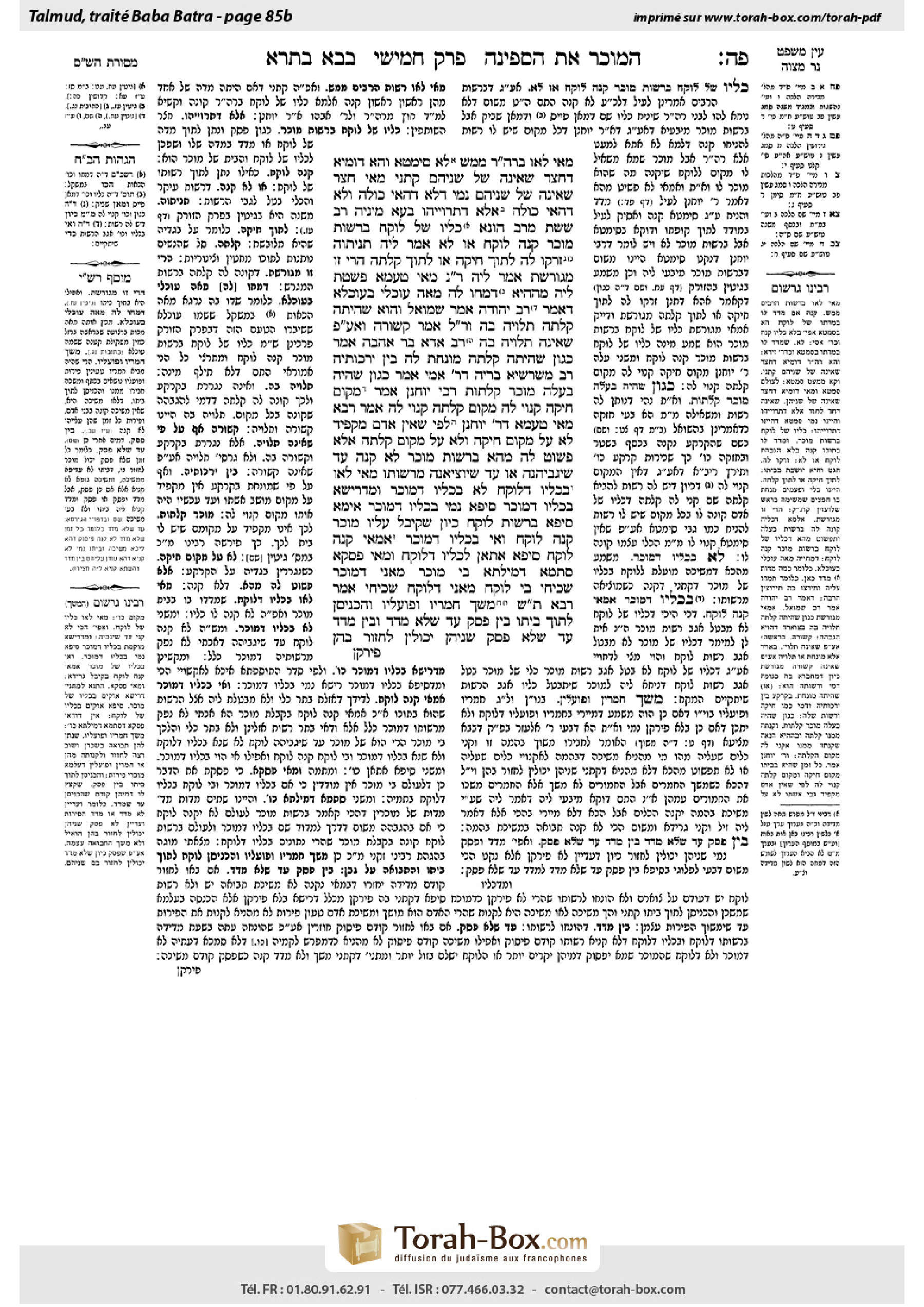
Bava Batra 85b: Talmud study for Daf Yomi
Study the Talmud for Daf Yomi with scanned pages, Hebrew text, English translations from Sefaria and AI-generated French translations.
Passage selection and English or AI-generated French translation are available where the scan has annotations. Daf Study is independent of Torah-Box and Sefaria.
Browse Bava Batra · בבא בתרא · All tractatesBava Batra 85b text and translations
This page of Bava Batra includes the Aramaic text, an English translation and an AI-generated French translation, alongside the scan above.
בבא בתרא פ״ה ב · Aramaic and Hebrew text
מַאי, לָאו בִּרְשׁוּת הָרַבִּים מַמָּשׁ? לָא; סִימְטָא. וְהָא דּוּמְיָא דְּחָצֵר שֶׁאֵינָהּ שֶׁל שְׁנֵיהֶם קָתָנֵי!
מַאי ״חָצֵר שֶׁאֵינָהּ שֶׁל שְׁנֵיהֶם״ נָמֵי – דְּלָא דְּהַאי כּוּלָּהּ וְלָא דְּהַאי כּוּלָּהּ; אֶלָּא דְּתַרְוַיְיהוּ.
בְּעָא מִינֵּיהּ רַב שֵׁשֶׁת מֵרַב הוּנָא: כִּלְיוֹ שֶׁל לוֹקֵחַ בִּרְשׁוּת מוֹכֵר – קָנָה לוֹקֵחַ, אוֹ לָא? אֲמַר לֵיהּ, תְּנֵיתוּהָ: זְרָקוֹ לָהּ לְתוֹךְ חֵיקָהּ אוֹ לְתוֹךְ קַלְתָּהּ – הֲרֵי זוֹ מְגוֹרֶשֶׁת.
אֲמַר לֵיהּ רַב נַחְמָן: מַאי טַעְמָא פָּשְׁטַתְּ לֵיהּ מֵהַהִיא, דְּמָחוּ לַהּ מְאָה עוּכְלֵי בְּעוּכְלָא?
דְּאָמַר רַב יְהוּדָה אָמַר שְׁמוּאֵל: וְהוּא שֶׁהָיְתָה קַלְתָּהּ תְּלוּיָה בָּהּ. וְרֵישׁ לָקִישׁ אָמַר: קְשׁוּרָה, וְאַף עַל פִּי שֶׁאֵינָהּ תְּלוּיָה בַּהּ. רַב אַדָּא בַּר אַהֲבָה אָמַר: כְּגוֹן שֶׁהָיְתָה קַלְתָּהּ מוּנַּחַת לָהּ בֵּין יַרְכוֹתֶיהָ. רַב מְשַׁרְשְׁיָא בְּרֵיהּ דְּרַבִּי אַמֵּי אָמַר: כְּגוֹן שֶׁהָיָה בַּעְלָהּ מוֹכֵר קְלָתוֹת.
רַבִּי יוֹחָנָן אָמַר: מְקוֹם חֵיקָהּ קָנוּי לָהּ, מְקוֹם קַלְתָּהּ קָנוּי לָהּ. אָמַר רָבָא: מַאי טַעְמָא דְּרַבִּי יוֹחָנָן? לְפִי שֶׁאֵין אָדָם מַקְפִּיד לֹא עַל מְקוֹם חֵיקָהּ וְלֹא עַל מְקוֹם קַלְתָּהּ.
אֶלָּא פְּשׁוֹט לָהּ מֵהָא: בִּרְשׁוּת מוֹכֵר – לֹא קָנָה עַד שֶׁיַּגְבִּיהֶנָּה אוֹ עַד שֶׁיּוֹצִיאֶנָּה מֵרְשׁוּתוֹ. מַאי, לָאו בְּכִלְיוֹ דְלוֹקֵחַ? לֹא, בְּכִלְיוֹ דְמוֹכֵר.
וּמִדְּרֵישָׁא בְּכִלְיוֹ דְמוֹכֵר – סֵיפָא נָמֵי בְּכִלְיוֹ דְמוֹכֵר; אֵימָא סֵיפָא: בִּרְשׁוּת לוֹקֵחַ, כֵּיוָן שֶׁקִּיבֵּל עָלָיו מוֹכֵר – קָנָה לוֹקֵחַ. וְאִי בְּכִלְיוֹ דְמוֹכֵר, אַמַּאי קָנָה לוֹקֵחַ? סֵיפָא אֲתָאן לְכִלְיוֹ דְלוֹקֵחַ.
וּמַאי פַּסְקָא? סְתָמָא דְמִילְּתָא, בֵּי מוֹכֵר – מָאנֵי דְמוֹכֵר שְׁכִיחִי, בֵּי לוֹקֵחַ – מָאנֵי דְלוֹקֵחַ שְׁכִיחִי.
אָמַר רָבָא, תָּא שְׁמַע: מָשַׁךְ חֲמָרָיו וּפוֹעֲלָיו, וְהִכְנִיסָן לְתוֹךְ בֵּיתוֹ; בֵּין פָּסַק עַד שֶׁלֹּא מָדַד, וּבֵין מָדַד עַד שֶׁלֹּא פָּסַק – שְׁנֵיהֶן יְכוֹלִין לַחֲזוֹר בָּהֶן.
Bava Batra 85b · English translation
What, is it not stating that a buyer’s vessels effect acquisition of items on his behalf even in the actual public domain, which contradicts Rav Pappa’s explanation? The Gemara answers: No, the baraita is referring to an alleyway, not the actual public domain. The Gemara asks: How can this be what the baraita means? But the baraita teaches that it is similar to a courtyard that does not belong to either of them, i.e., a location to which neither of them have any rights, whereas they both have some rights in an alleyway. Consequently, this must be referring to the actual public domain, not an alleyway.
The Gemara answers: What is the meaning of the phrase: A courtyard that does not belong to either of them? It also refers to shared property, specifically a courtyard shared by partners, which does not belong to this one entirely and does not belong to that one entirely, but rather it is the property of both of them. Consequently, this courtyard is comparable to an alleyway.
Rav Sheshet raises a dilemma before Rav Huna: If the vessels of the buyer are in the domain of the seller, does the buyer acquire the merchandise once it is placed in his vessels or not? Rav Huna said to him: You learned the answer already in a mishna (Gittin 77a): A wife is divorced when her husband hands her a bill of divorce or places it in a manner that is considered equivalent to handing it to her, e.g., placing in her courtyard. Accordingly, if the husband threw the bill of divorce to her into her lap or into her basket [kaltah], this woman is divorced even if she was in her husband’s domain at that time. By the same token, even if the buyer’s vessels are in the domain of the seller, they effect acquisition of the sold items on his behalf.
Rav Naḥman said to Rav Huna: What is the reason that you resolved Rav Sheshet’s dilemma from that mishna, which has already been struck with one hundred strikes of a hammer [uklei be’ukela]? In their analysis of this mishna, the Sages have already inserted so many qualifications that it cannot be understood in a straightforward manner.
As Rav Yehuda says that Shmuel says: This halakha of the mishna in Gittin applies only if her basket was hanging from her body, so that it is considered on her or in her hand. And Reish Lakish says: It is sufficient if it was tied to her, even though it is not hanging from her, but resting on the ground. Rav Adda bar Ahava says: The mishna is referring to a case where her basket was placed between her thighs. Although it is not hanging from her, since it is placed on her body it serves to acquire the bill of divorce on her behalf. Rav Mesharshiyya, son of Rabbi Ami, says: This is referring to a case where her husband was a basket seller. Since he is not particular about the place where the basket into which he placed the bill of divorce is located, as his entire courtyard is full of baskets, it is considered as though he expressly granted her the right to make use of its location.
Rabbi Yoḥanan says: The place of her lap, i.e., the place within her husband’s property where she stands or sits, belongs to her, and the place of her basket is acquired to her. Rava said: What is the reason behind the statement of Rabbi Yoḥanan? It is because a person, including a husband, is not particular neither about the place of her lap nor about the place of her basket, as she requires these areas and they do not take up much space. It is evident from all of these qualifications that one cannot infer a halakhic principle from here with regard to a buyer’s vessels in a seller’s domain.
Rather, resolve the dilemma from that which was taught in a baraita: If the merchandise was in the domain of a seller, the buyer does not acquire the merchandise until he lifts it or until he removes it from the domain of the seller. What, is it not referring to merchandise placed in the vessels of the buyer, which proves that the buyer’s vessels do not effect acquisition of the merchandise on his behalf when they are in the seller’s domain? The Gemara answers: No, this does not serve as proof, as it is referring to merchandise placed in the vessels of the seller. That is why the buyer must lift or pull the merchandise to acquire it.
The Gemara asks: But from the fact that the first clause is referring to the vessels of the seller, as currently understood, the latter clause must also be referring to the vessels of the seller. Say the latter clause: If the merchandise was in the domain of the buyer, once the seller accepts upon himself to sell an item, the buyer acquires it. And if this is referring to merchandise in the vessels of the seller, as in the earlier clause, why does the buyer acquire it? The Gemara answers: In the latter clause, we come to a different scenario, which involves the vessels of the buyer.
The Gemara asks: But if the clauses of the baraita are addressing different cases, why was it stated without qualification? The Gemara answers: The normal way of things is that in the house of the seller the vessels of the seller are commonly found, and in the house of the buyer the vessels of the buyer are commonly found. In sum, the dilemma cannot be resolved from the baraita.
Rava said: Come and hear a resolution from a baraita: If one pulled his donkey drivers, thereby dragging along with them the donkeys laden with goods, and likewise, if he pulled his laborers, who were carrying merchandise he wished to purchase, and he brought them into his house, whether he fixed a price before he measured the merchandise or whether he measured before fixing a price, both parties can renege on the sale, provided that the merchandise has not been unloaded from the laborers or the donkeys.
Bava Batra 85b · Traduction française (IA)
Qu'est-ce que cela signifie, que ce n'est pas en disant que les ustensiles du acheteur permettent l'acquisition des objets à sa place même dans le domaine public, ce qui contredit l'explication de Rav Pappa ? La Guemara répond : Non, la baraïta parle d'un passage étroit, pas du domaine public. La Guemara demande : Comment peut-on dire que c'est ce que la baraïta veut dire ? Mais la baraïta enseigne que c'est comparable à un courtil qui n'appartient à aucun des deux, c'est-à-dire un lieu auquel aucun des deux n'a de droits, alors que les deux ont des droits dans un passage étroit. Par conséquent, cela doit parler du domaine public, pas d'un passage étroit.
La Guemara répond : Qu'entend-on par la phrase : un courtil qui n'appartient à aucun des deux ? Cela fait référence à une propriété partagée, spécifiquement un courtil partagé par des partenaires, qui n'appartient pas entièrement à l'un et pas entièrement à l'autre, mais plutôt à la propriété des deux. Par conséquent, ce courtil est comparable à un passage étroit.
Rav Sheshet pose un dilemme devant Rav Huna : Si les ustensiles de l'acheteur sont dans le domaine du vendeur, l'acheteur acquiert-il les marchandises une fois qu'elles sont placées dans ses ustensiles ou non ? Rav Huna lui répond : Tu as déjà appris la réponse dans une mitsna (Gittin 77a) : Une femme est divorcée lorsque son mari lui remet un divorce ou le place de manière considérée comme équivalente à le lui remettre, par exemple en le plaçant dans son courtil. Ainsi, si le mari jette le divorce à sa femme dans ses bras ou dans son panier [kaltah], cette femme est divorcée même si elle était dans le domaine de son mari à ce moment-là. De la même manière, même si les ustensiles de l'acheteur sont dans le domaine du vendeur, ils permettent l'acquisition des objets vendus à sa place.
Rav Naḥman dit à Rav Huna : Quel est le motif qui te fait résoudre le dilemme de Rav Sheshet à partir de cette mitsna, qui a déjà été frappée cent fois par un marteau [uklei be’ukela] ? Dans leur analyse de cette mitsna, les Sages ont déjà inséré tant de qualifications qu'elle ne peut plus être comprise de manière directe.
Comme Rav Yehuda dit que Shmuel dit : Cette halakha de la mitsna dans Gittin s'applique uniquement si son panier était suspendu à son corps, de sorte qu'il est considéré comme étant sur elle ou dans sa main. Et Reish Lakish dit : Il suffit qu'il soit attaché à elle, même s'il ne pend pas de son corps, mais repose sur le sol. Rav Adda bar Ahava dit : La mitsna parle d'un cas où son panier était placé entre ses jambes. Bien qu'il ne pend pas de son corps, puisqu'il est placé sur son corps, il permet l'acquisition du divorce à sa place. Rav Mesharshiyya, fils de Rabbi Ami, dit : Cela fait référence à un cas où son mari était un vendeur de paniers. Puisqu'il n'est pas exigeant quant à l'emplacement du panier dans lequel il a placé le divorce, puisque tout son courtil est rempli de paniers, il est considéré comme s'il avait expressément autorisé l'utilisation de cet emplacement.
Rabbi Yoḥanan dit : Le lieu de son siège, c'est-à-dire le lieu dans la propriété de son mari où elle se tient ou s'assoit, appartient à elle, et le lieu de son panier est acquis à elle. Rava dit : Quel est le motif de la déclaration de Rabbi Yoḥanan ? C'est parce qu'une personne, y compris un mari, n'est pas exigeant ni quant au lieu de son siège ni quant au lieu de son panier, puisqu'elle a besoin de ces espaces et qu'ils ne prennent pas beaucoup de place. Il est évident à partir de toutes ces qualifications que l'on ne peut pas déduire un principe halakhique d'ici concernant les ustensiles de l'acheteur dans le domaine du vendeur.
Plutôt, résous le dilemme à partir de ce qui a été enseigné dans une baraïta : Si les marchandises étaient dans le domaine d'un vendeur, l'acheteur ne les acquiert pas jusqu'à ce qu'il les soulève ou jusqu'à ce qu'il les enlève du domaine du vendeur. Qu'est-ce que cela ne signifie pas en parlant des marchandises placées dans les ustensiles de l'acheteur, ce qui prouve que les ustensiles de l'acheteur ne permettent pas l'acquisition des marchandises à sa place lorsqu'ils sont dans le domaine du vendeur ? La Guemara répond : Non, cela ne sert pas de preuve, puisqu'il s'agit des marchandises placées dans les ustensiles du vendeur. C'est pourquoi l'acheteur doit soulever ou tirer les marchandises pour les acquérir.
La Guemara demande : Mais si la première clause parle des ustensiles du vendeur, comme on l'entend actuellement, la seconde clause doit aussi parler des ustensiles du vendeur. Dis la seconde clause : Si les marchandises étaient dans le domaine de l'acheteur, une fois que le vendeur s'est engagé à vendre un objet, l'acheteur l'acquiert. Et si cela parle des marchandises dans les ustensiles du vendeur, comme dans la clause précédente, pourquoi l'acheteur l'acquiert-il ? La Guemara répond : Dans la seconde clause, on vient à un scénario différent, qui implique les ustensiles de l'acheteur.
La Guemara demande : Mais si les clauses de la baraïta parlent de cas différents, pourquoi a-t-elle été déclarée sans qualification ? La Guemara répond : La manière normale des choses est que dans la maison du vendeur, les ustensiles du vendeur sont couramment trouvés, et dans la maison de l'acheteur, les ustensiles de l'acheteur sont couramment trouvés. En résumé, le dilemme ne peut pas être résolu à partir de la baraïta.
Rava dit : Viens écouter une résolution tirée d'une baraïta : Si l'on a tiré ses conducteurs de bœufs, entraînant avec eux les bœufs chargés de marchandises, et de même, si l'on a tiré ses ouvriers, qui portaient les marchandises qu'on voulait acheter, et qu'on les a amenés dans sa maison, qu'on ait fixé un prix avant de mesurer les marchandises ou qu'on ait mesuré avant de fixer un prix, les deux parties peuvent annuler la vente, à condition que les marchandises n'aient pas été déchargées des ouvriers ou des bœufs.
Traduction française générée par IA à partir de l’édition anglaise de Sefaria. Vérifie toujours un passage avec le texte source.
Text from Sefaria: William Davidson Edition - Vocalized Aramaic (CC BY NC); William Davidson Edition - English (CC BY NC).