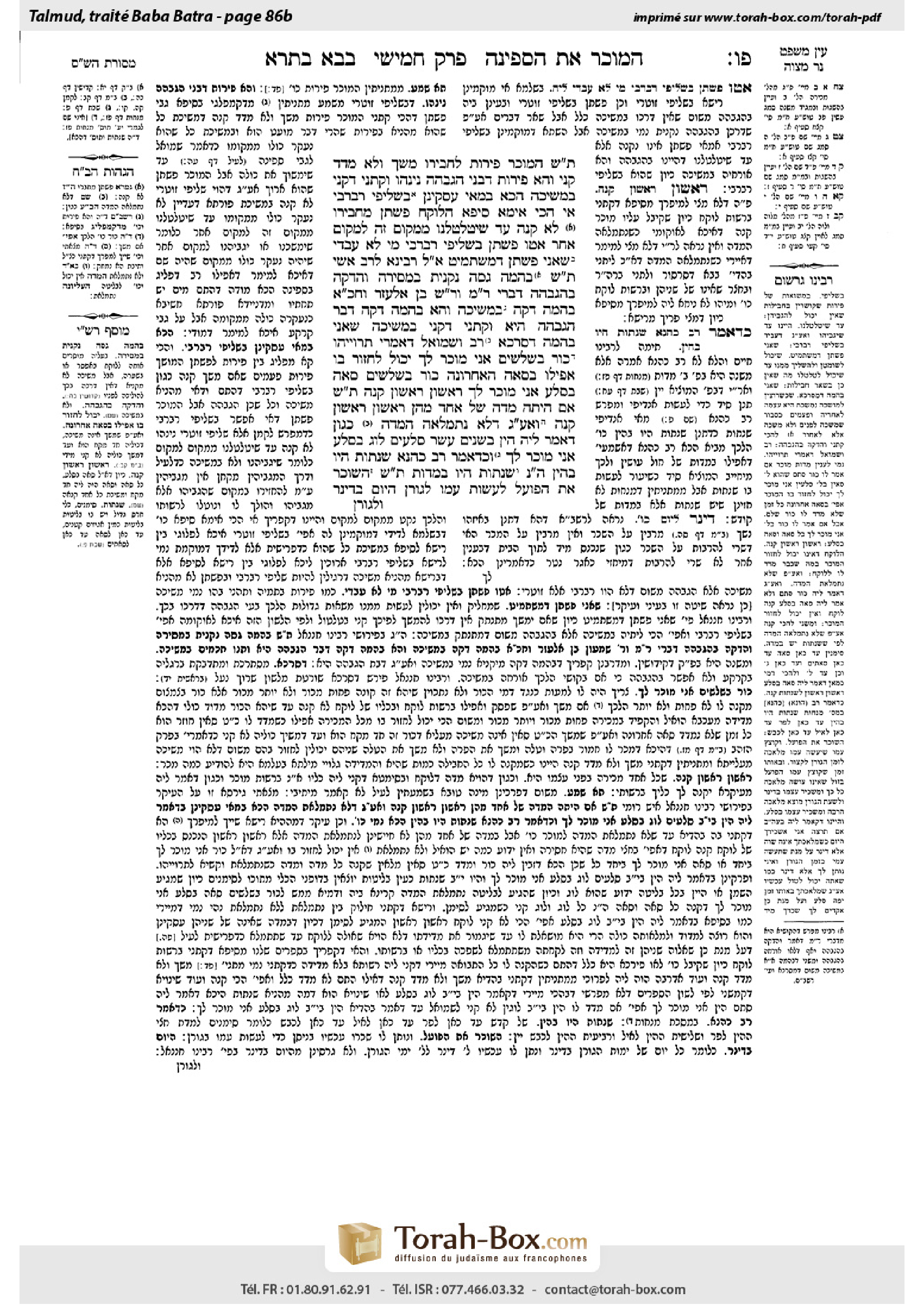
Bava Batra 86b: Talmud study for Daf Yomi
Study the Talmud for Daf Yomi with scanned pages, Hebrew text, English translations from Sefaria and AI-generated French translations.
Passage selection and English or AI-generated French translation are available where the scan has annotations. Daf Study is independent of Torah-Box and Sefaria.
Browse Bava Batra · בבא בתרא · All tractatesBava Batra 86b text and translations
This page of Bava Batra includes the Aramaic text, an English translation and an AI-generated French translation, alongside the scan above.
בבא בתרא פ״ו ב · Aramaic and Hebrew text
תָּא שְׁמַע: הַמּוֹכֵר פֵּירוֹת לַחֲבֵירוֹ, מָשַׁךְ וְלֹא מָדַד – קָנֵי. וְהָא פֵּירוֹת, דִּבְנֵי הַגְבָּהָה נִינְהוּ, וְקָתָנֵי דְּקָנֵי בִּמְשִׁיכָה!
הָכָא בְּמַאי עָסְקִינַן – בִּשְׁלִיפֵי רַבְרְבֵי. אִי הָכִי, אֵימָא סֵיפָא: הַלּוֹקֵחַ פִּשְׁתָּן מֵחֲבֵירוֹ – לֹא קָנָה עַד שֶׁיְּטַלְטְלֶנּוּ מִמָּקוֹם זֶה לְמָקוֹם אַחֵר. אַטּוּ פִּשְׁתָּן בִּשְׁלִיפֵי רַבְרְבֵי מִי לָא עָבְדִי?! שָׁאנֵי פִּשְׁתָּן – דְּמִשְׁתְּמִיט.
אֲמַר לֵיהּ רָבִינָא לְרַב אָשֵׁי, תָּא שְׁמַע: בְּהֵמָה גַּסָּה נִקְנֵית בִּמְסִירָה, וְהַדַּקָּה – בְּהַגְבָּהָה; דִּבְרֵי רַבִּי מֵאִיר וְרַבִּי שִׁמְעוֹן בֶּן אֶלְעָזָר. וַחֲכָמִים אוֹמְרִים: בְּהֵמָה דַּקָּה – בִּמְשִׁיכָה. וְהָא בְּהֵמָה דַּקָּה, דְּבַר הַגְבָּהָה הִיא, וְקָתָנֵי דְּקָנֵי בִּמְשִׁיכָה! שָׁאנֵי בְּהֵמָה, דְּסָרְכָא.
רַב וּשְׁמוּאֵל דְּאָמְרִי תַּרְוַיְיהוּ: ״כּוֹר בִּשְׁלֹשִׁים אֲנִי מוֹכֵר לָךְ״ – יָכוֹל לַחֲזוֹר בּוֹ, אֲפִילּוּ בִּסְאָה הָאַחֲרוֹנָה. ״כּוֹר בִּשְׁלֹשִׁים – סְאָה בְּסֶלַע אֲנִי מוֹכֵר לָךְ״ – רִאשׁוֹן רִאשׁוֹן קָנָה.
תָּא שְׁמַע: אִם הָיְתָה מִדָּה שֶׁל אֶחָד מֵהֶן – רִאשׁוֹן רִאשׁוֹן קָנָה. וְאַף עַל גַּב דְּלֹא נִתְמַלְּאָה הַמִּדָּה!
כְּגוֹן דַּאֲמַר לֵיהּ: ״הִין בִּשְׁנֵים עָשָׂר סְלָעִים – לוֹג בְּסֶלַע אֲנִי מוֹכֵר לָךְ״; וְכִדְאָמַר רַב כָּהֲנָא: שְׁנָתוֹת הָיוּ בַּהִין, הָכָא נָמֵי – שְׁנָתוֹת הָיוּ בַּמִּדּוֹת.
תָּא שְׁמַע: הַשּׂוֹכֵר אֶת הַפּוֹעֵל לַעֲשׂוֹת עִמּוֹ לַגּוֹרֶן הַיּוֹם בְּדִינָר,
Bava Batra 86b · English translation
The Gemara suggests: Come and hear a proof from the mishna (84b) that even items that are usually lifted can be acquired by means of pulling: With regard to one who sells produce to another, if the buyer pulled the produce but did not measure it, he has acquired it. The Gemara explains the proof: But produce can be lifted, and yet the mishna teaches that it is acquired by means of pulling.
The Gemara rejects this proof: With what are we dealing here? We are dealing with large bundles that are pulled from place to place and are not carried, due to their size. The Gemara asks: If that is so, say the latter clause of the mishna: One who buys flax from another has not acquired it until he carries it from this place to another place, i.e., it is acquired only though lifting and not through pulling. Is that to say that flax is not prepared in large bundles? The Gemara answers: Yes, flax is different. Unlike other produce, flax is not packed in large bundles, as it would slip from its place. Rather, it is packed in small bundles, and therefore flax is acquired specifically through lifting.
Ravina said to Rav Ashi: Come and hear a proof from a mishna (Kiddushin 25b): Large domesticated animals are acquired through passing the animal’s leash to the buyer, and small domesticated animals are acquired through lifting; this is the statement of Rabbi Meir and Rabbi Shimon ben Elazar. And the Rabbis say: Small domesticated animals are acquired through pulling. Ravina explains the proof: But small domesticated animals are creatures that can be lifted, and yet the mishna teaches that one acquires them through pulling. Rav Ashi rejected this proof: Domesticated animals are different, as they cling to the ground and it is difficult to lift them. Therefore, the usual manner of moving animals is to pull them.
§ The Gemara cites another case with regard to sales. Rav and Shmuel both say: If a seller said to a buyer: I am selling you one kor, a measure equivalent to thirty se’a, of grain for the price of thirty sela, the seller can renege on the sale as long as the measuring vessel is not filled, even when only the last se’a has yet to be measured, because he had agreed to sell only a complete kor. By contrast, if the seller said: I am selling you one kor for thirty sela and each se’a is sold for one sela, he cannot completely renege on the sale in the middle of the transaction. This is because the buyer acquires each se’a one by one as it is measured, since the seller sold each se’a individually.
The Gemara raises a difficulty from the baraita cited on 85a. Come and hear: If the measuring vessel belonged to one of them, the buyer acquires the items of sale one by one. And since this halakha is stated in general terms, it indicates that the buyer acquires each item as it is placed in the measuring vessel, even though the measuring vessel was not filled.
The Gemara answers: The baraita is referring to a case where the seller said to him: I am selling you one hin, a liquid measure equivalent to twelve log, for twelve sela, each log for one sela. And this is in accordance with an observation that Rav Kahana says: In the Temple there were markings on the vessel that measured hin, with which one could measure the different libations. Here too, there were markings on the measuring vessels, and since the measuring vessel indicates at which point each log had been filled, the buyer acquires it. This is comparable to the case of one who sells each se’a individually.
The Gemara raises another difficulty. Come and hear: One who hires a laborer in the winter or the spring to work for him in the harvest, for one dinar a day,
Bava Batra 86b · Traduction française (IA)
La Guemara suggère : Viens écouter une preuve tirée de la Michna (84b) selon laquelle même des objets habituellement soulevés peuvent être acquis par le fait de les tirer : En ce qui concerne celui qui vend des produits à un autre, si l'acheteur a tiré les produits mais n'a pas mesuré, il les a acquis. La Guemara explique la preuve : Mais les produits peuvent être soulevés, et pourtant la Michna enseigne qu'ils sont acquis par le fait de les tirer.
La Guemara rejette cette preuve : Avec quels objets sommes-nous en train de parler ? Nous parlons de grands fagots qui sont tirés d'un lieu à un autre et ne sont pas portés, en raison de leur taille. La Guemara pose la question : Si c'est ainsi, disons la dernière partie de la Michna : Celui qui achète du lin à un autre n'a pas acquis ce dernier jusqu'à ce qu'il le transporte d'un lieu à un autre, c'est-à-dire qu'il est acquis uniquement par le fait de le soulever et non par le fait de le tirer. Est-ce que cela signifie que le lin n'est pas préparé en grands fagots ? La Guemara répond : Oui, le lin est différent. Contrairement à d'autres produits, le lin n'est pas emballé en grands fagots, car il glisserait de son emplacement. Il est plutôt emballé en petits fagots, et c'est donc par le fait de le soulever que le lin est acquis.
Ravina dit à Rav Ashi : Viens écouter une preuve tirée d'une Michna (Kiddushin 25b) : Les grands animaux domestiques sont acquis par le fait de transmettre la corde de l'animal à l'acheteur, et les petits animaux domestiques sont acquis par le fait de les soulever ; c'est la déclaration de Rabbi Meïr et de Rabbi Shimon ben Elazar. Et les Sages disent : Les petits animaux domestiques sont acquis par le fait de les tirer. Ravina explique la preuve : Mais les petits animaux domestiques sont des créatures qui peuvent être soulevées, et pourtant la Michna enseigne qu'on les acquiert par le fait de les tirer. Rav Ashi rejette cette preuve : Les animaux domestiques sont différents, car ils sont collés au sol et il est difficile de les soulever. Par conséquent, la manière habituelle de déplacer les animaux est de les tirer.
§ La Guemara cite un autre cas concernant les ventes. Rav et Shmuel disent tous les deux : Si un vendeur dit à un acheteur : Je te vends un kor, une mesure équivalant à trente se'a, de céréales au prix de trente sela, le vendeur peut annuler la vente tant que le récipient de mesure n'est pas rempli, même lorsque seul le dernier se'a reste à mesurer, car il avait convenu de vendre uniquement un kor complet. À l'inverse, si le vendeur dit : Je te vends un kor pour trente sela et chaque se'a est vendu pour un sela, il ne peut pas annuler entièrement la vente au milieu de la transaction. Cela est dû au fait que l'acheteur acquiert chaque se'a un par un à mesure qu'il est mesuré, car le vendeur a vendu chaque se'a individuellement.
La Guemara soulève une difficulté à partir de la baraïta citée sur 85a. Viens écouter : Si le récipient de mesure appartenait à l'un d'eux, l'acheteur acquiert les objets de la vente un par un. Et puisque cette halakha est formulée de manière générale, cela indique que l'acheteur acquiert chaque objet à mesure qu'il est placé dans le récipient de mesure, même si le récipient n'était pas rempli.
La Guemara répond : La baraïta fait référence à un cas où le vendeur dit à l'acheteur : Je te vends un hin, une mesure liquide équivalant à douze log, pour douze sela, un log pour un sela. Et cela est en conformité avec une observation que Rav Kahana dit : Dans le Temple, il y avait des marques sur le récipient qui mesuraient le hin, avec lesquelles on pouvait mesurer les différentes offrandes. Ici aussi, il y avait des marques sur les récipients de mesure, et puisque le récipient indiquait à quel point chaque log avait été rempli, l'acheteur l'acquiert. Cela est comparable au cas d'une personne qui vend chaque se'a individuellement.
La Guemara soulève une autre difficulté. Écoutez : Celui qui embauche un ouvrier en hiver ou en printemps pour travailler chez lui pendant la récolte, pour un dinar par jour,
Traduction française générée par IA à partir de l’édition anglaise de Sefaria. Vérifie toujours un passage avec le texte source.
Text from Sefaria: William Davidson Edition - Vocalized Aramaic (CC BY NC); William Davidson Edition - English (CC BY NC).