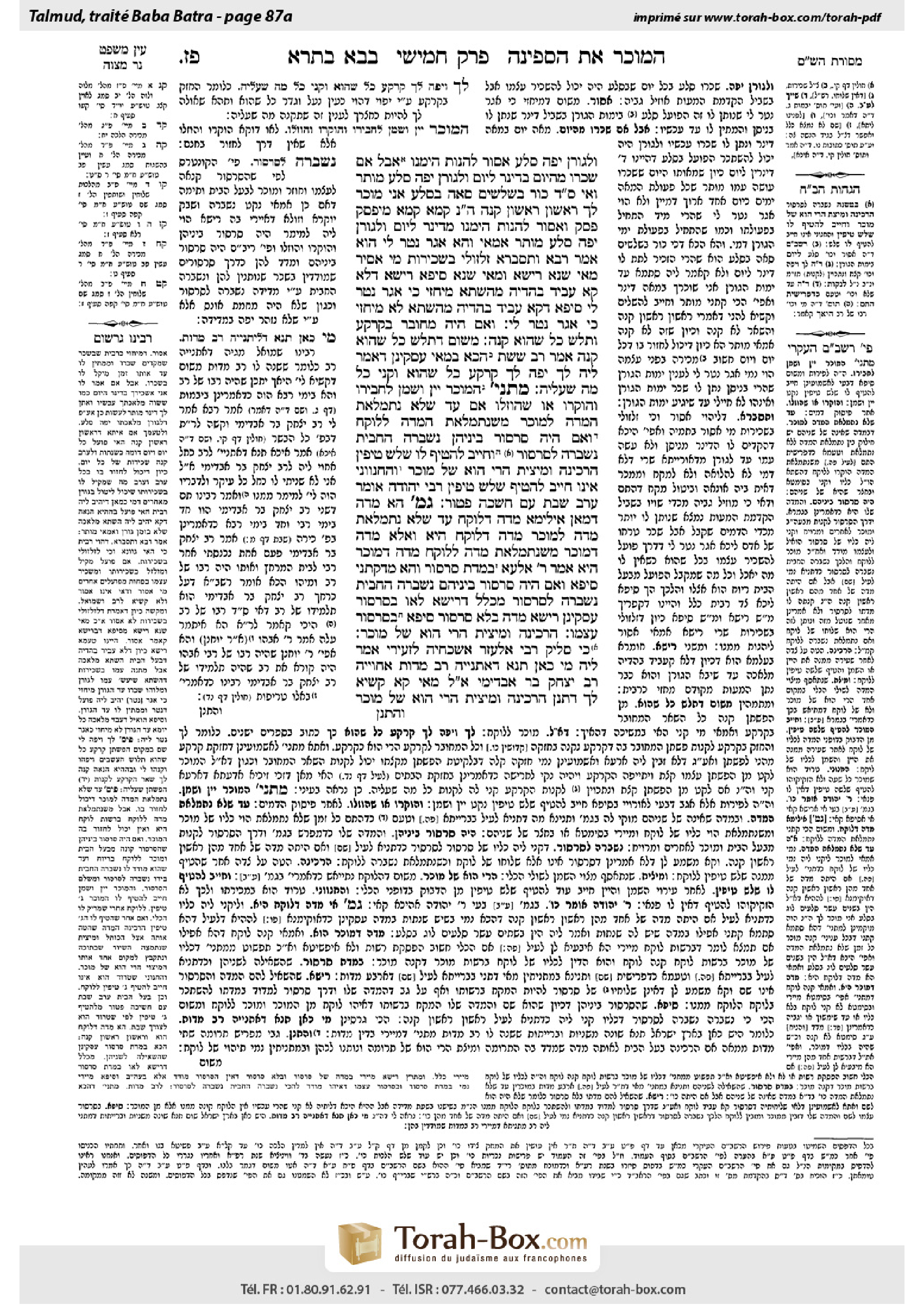
Bava Batra 87a: Talmud study for Daf Yomi
Study the Talmud for Daf Yomi with scanned pages, Hebrew text, English translations from Sefaria and AI-generated French translations.
Passage selection and English or AI-generated French translation are available where the scan has annotations. Daf Study is independent of Torah-Box and Sefaria.
Browse Bava Batra · בבא בתרא · All tractatesBava Batra 87a text and translations
This page of Bava Batra includes the Aramaic text, an English translation and an AI-generated French translation, alongside the scan above.
בבא בתרא פ״ז א · Aramaic and Hebrew text
וְלַגּוֹרֶן יָפֶה סֶלַע – אָסוּר לֵהָנוֹת הֵימֶנּוּ. אֲבָל אִם שְׂכָרוֹ מֵהַיּוֹם בְּדִינָר לְיוֹם, וְלַגּוֹרֶן יָפֶה סֶלַע – מוּתָּר.
וְאִי סָלְקָא דַּעְתָּךְ ״כּוֹר בִּשְׁלֹשִׁים, סְאָה בְּסֶלַע אֲנִי מוֹכֵר לָךְ״ – רִאשׁוֹן רִאשׁוֹן קָנָה; הָכָא נָמֵי – קַמָּא קַמָּא מִיפְסָק פְּסַק, וְאָסוּר לֵהָנוֹת הֵימֶנּוּ; מִדִּינָר לְיוֹם וְלַגּוֹרֶן יָפֶה סֶלַע – מוּתָּר?! אַמַּאי? וְהָא אֲגַר ״נְטַר לִי״ הוּא!
אָמַר רָבָא: וְתִסְבְּרָא?! זַלְזוֹלֵי בִּשְׂכִירוּת מִי אֲסִיר?! מַאי שְׁנָא רֵישָׁא וּמַאי שְׁנָא סֵיפָא?
רֵישָׁא דְּלָא קָא עָבֵיד בַּהֲדֵיהּ מֵהַשְׁתָּא, מִיחֲזֵי כִּי אֲגַר ״נְטַר לִי״; סֵיפָא דְּקָא עָבֵיד בַּהֲדֵיהּ מֵהַשְׁתָּא, לָא מִיחֲזֵי כִּי אֲגַר ״נְטַר לִי״.
וְאִם הָיָה מְחוּבָּר בְּקַרְקַע, וְתָלַשׁ כׇּל שֶׁהוּא – קָנָה. מִשּׁוּם דְּתָלַשׁ כׇּל שֶׁהוּא – קָנָה?! אָמַר רַב שֵׁשֶׁת: הָכָא בְּמַאי עָסְקִינַן – דְּאָמַר לֵיהּ: לֵךְ, יַפֵּה לְךָ קַרְקַע כׇּל שֶׁהוּא, וְקָנֵי כֹּל מַה שֶּׁעָלֶיהָ.
מַתְנִי׳ הַמּוֹכֵר יַיִן וָשֶׁמֶן לַחֲבֵירוֹ, וְהוּקְרוּ אוֹ שֶׁהוּזְלוּ, אִם עַד שֶׁלֹּא נִתְמַלֵּאת הַמִּדָּה – לַמּוֹכֵר. מִשֶּׁנִּתְמַלֵּאת הַמִּדָּה – לַלּוֹקֵחַ. וְאִם הָיָה סַרְסוּר בֵּינֵיהֶן, נִשְׁבְּרָה הֶחָבִית – נִשְׁבְּרָה לַסַּרְסוּר.
וְחַיָּיב לְהַטִּיף לוֹ שָׁלֹשׁ טִיפִּין. הִרְכִּינָהּ וּמִיצֵּית – הֲרֵי הוּא שֶׁל מוֹכֵר. וְהַחֶנְווֹנִי – אֵינוֹ חַיָּיב לְהַטִּיף שָׁלֹשׁ טִיפִּין. רַבִּי יְהוּדָה אוֹמֵר: עֶרֶב שַׁבָּת עִם חֲשֵׁכָה – פָּטוּר.
גְּמָ׳ הָא מִדָּה, דְּמַאן? אִילֵּימָא מִדָּה דְלוֹקֵחַ, עַד שֶׁלֹּא נִתְמַלֵּאת מִדָּה – לַמּוֹכֵר?! מִדָּה דְלוֹקֵחַ הִיא! וְאֶלָּא מִדָּה דְמוֹכֵר? מִשֶּׁנִּתְמַלֵּאת מִדָּה – לַלּוֹקֵחַ?! מִדָּה דְמוֹכֵר הִיא!
אָמַר רַבִּי אִלְעָא: בְּמִדַּת סַרְסוּר. וְהָא מִדְּקָתָנֵי סֵיפָא: וְאִם הָיָה סַרְסוּר בֵּינֵיהֶם, נִשְׁבְּרָה הֶחָבִית – נִשְׁבְּרָה לַסַּרְסוּר; מִכְּלָל דְּרֵישָׁא לָאו בְּסַרְסוּר עָסְקִינַן! רֵישָׁא – מִדָּה בְּלֹא סַרְסוּר, סֵיפָא – בְּסַרְסוּר עַצְמוֹ.
הִרְכִּינָהּ וּמִיצֵּית – הֲרֵי הוּא שֶׁל מוֹכֵר. כִּי סָלֵיק רַבִּי אֶלְעָזָר, אַשְׁכְּחֵיהּ לִזְעֵירִי, אֲמַר לֵיהּ: מִי כָּאן תַּנָּא דְּאַתְנְיֵיהּ רַב מִדּוֹת? אַחַוְיֵיהּ רַב יִצְחָק בַּר אַבְדִּימִי. אָמַר לֵיהּ: מַאי קָא קַשְׁיָא לָךְ? דִּתְנַן: הִרְכִּינָהּ וּמִיצִּיתָ – הֲרֵי הוּא שֶׁל מוֹכֵר,
Bava Batra 87a · English translation
and a day of a laborer’s work during the harvest is worth a sela, the equivalent of four silver dinars, for each day, it is prohibited to derive benefit from him, i.e., one may not employ the laborer under these conditions. The reason is that this is akin to taking interest, as the laborer works and receives less than he is entitled to in exchange for early payment. But if one hires him already from now to work for one dinar a day for an extended period of time, including the harvest season, and the work of a laborer during the harvest is worth a sela, this is permitted.
And if it enters your mind, as Rav and Shmuel claim, that if a seller said: I am selling you one kor for thirty sela, each se’a for one sela, he cannot fully renege on the sale in the middle of the transaction, as the buyer acquires each se’a one by one as it is measured, then the halakha in this case should be different. Here too, as he does not agree to one large sum but fixes a price for each day, one by one, it is akin to taking interest, as the laborer works and receives less than he is entitled to in exchange for early payment. And therefore, it should be prohibited to derive benefit from him. Whereas the baraita states: If one hires him from now to work for one dinar a day over an extended period of time, including the harvest, and one day of a laborer’s work during the harvest is worth one sela, this is permitted. Why is it permitted? But isn’t it payment for waiting, i.e., for advancing the money to the laborer?
Rava said: And how can you understand the baraita in that manner? Is it prohibited for one to lower his hiring price and receive lower wages in order to ensure that he is employed? This arrangement is not a form of interest and violates no prohibition. The Gemara asks: If this is not considered taking interest, then what is different in the first clause, where the laborer is not employed immediately and this arrangement is prohibited, and what is different in the latter clause, where it is permitted?
The Gemara explains: In the first clause, as the laborer does not work with him from now, it has the appearance of payment for waiting, i.e., advancing the money to the laborer. In the latter clause, as the laborer works with him from now, it does not have the appearance of payment for waiting.
§ The mishna teaches: And if the flax was attached to the ground and he detached any amount, he has acquired it. The Gemara asks: Is it correct to say that due to the fact that he detached any amount, he acquired it? If he does not perform an act of acquisition with all of the flax, how can he acquire all of it? Rav Sheshet said: Here we are dealing with a case where the seller said to him: Go and clear for yourself any amount of land, and thereby acquire everything that is on it. When the buyer clears the land by detaching the flax from the ground, he is considered to be renting the land and thereby acquires all the flax that grows on it.
MISHNA: With regard to one who sells food or drink that has an established price, such as wine and oil, to another, and the price rises or falls and the buyer or the seller wishes to renege on the sale, if the price changed before the measuring vessel is filled, the merchandise still belongs to the seller and he can cancel the sale. Once the measuring vessel is filled the merchandise belongs to the buyer, and the seller can no longer cancel the sale. And if there was a middleman [sarsur] between them and the barrel belonging to the middleman, being used to measure the merchandise, broke during the transaction and the merchandise is ruined, it broke for the middleman, i.e., he is responsible for the ruined merchandise.
The mishna teaches an additional halakha with regard to sales: And anyone who sells wine, oil, or similar liquids is obligated, after he transfers the liquid into the buyer’s vessel, to drip for him three extra drops from the measure. After he drips those three drops, if he turned the barrel on its side and drained out the last bits of liquid that it contained, this belongs to the seller and he is not required to give these last drops to the buyer. And a storekeeper is not obligated to drip three drops, because he is too busy to do this constantly. Rabbi Yehuda says: If the sale occurs on Shabbat eve as nightfall arrives, one is exempt from dripping these three drops, as there is a need to complete the transaction before Shabbat begins.
GEMARA: The Gemara clarifies the mishna’s statement that the sale occurs once the measuring vessel is filled. This measuring vessel, to whom does it belong? If we say that the measuring vessel belongs to the buyer, why does the mishna teach that before the measuring vessel is filled the merchandise still belongs to the seller? Since it is the measuring vessel of the buyer, he should acquire everything that is placed in his vessel, whether or not it is filled. But if we say that the measuring vessel belongs to the seller, why does the mishna teach that once the measuring vessel is filled the merchandise belongs to the buyer? Since it is the measuring vessel of the seller, the merchandise has yet to enter the possession of the buyer.
Rabbi Ela says: The mishna is referring to a case where the measuring vessel belongs to the middleman. The middleman lends it to the seller, and once it is filled it is loaned to the buyer so that he can transfer its contents into his vessels. The Gemara asks: But from the fact that the latter clause teaches: And if there was a middleman between them and the barrel broke, it broke for the middleman, it may be inferred that in the first clause we are not dealing with a middleman. The Gemara answers: The first clause addresses a measuring vessel belonging to a middleman without the presence of the middleman at the transaction, whereas the latter clause is concerned with a middleman himself, who is present at the sale and therefore accepts responsibility for the barrel and its contents.
§ The mishna teaches that if he turned the barrel on its side and drained out the last bits of liquid within it, this liquid belongs to the seller. The Gemara relates: When Rabbi Elazar ascended from Babylonia to Eretz Yisrael, he found Ze’eiri and said to him: Who here is the tanna to whom Rav taught this halakha with regard to measures? Ze’eiri showed him Rav Yitzḥak bar Avdimi. Rav Yitzḥak bar Avdimi said to Rabbi Elazar: What is it about this halakha that poses a difficulty for you? Rabbi Elazar said to him that the problem is that we learned in the mishna: If he turned the barrel on its side and drained out the last bits of liquid within it, that liquid belongs to the seller.
Bava Batra 87a · Traduction française (IA)
et un jour de travail d’un ouvrier pendant la moisson vaut un sela, c’est-à-dire quatre dinars d’argent, et pour chaque jour, il est interdit de tirer profit de lui, c’est-à-dire qu’on ne peut pas employer l’ouvrier sous ces conditions. La raison est que cela ressemble à un intérêt, car l’ouvrier travaille et reçoit moins de ce à quoi il a droit en échange d’un paiement anticipé. Mais si l’on embauche déjà l’ouvrier dès maintenant pour qu’il travaille un dinar par jour pendant une période prolongée, y compris la moisson, et que le travail d’un ouvrier pendant la moisson vaut un sela, cela est permis.
Et si cela entre dans votre pensée, comme Rav et Shmuel le disent, que si un vendeur dit : Je vends à vous un kor pour trente sela, chaque se’a pour un sela, il ne peut pas annuler entièrement la vente au milieu de la transaction, car l’acheteur acquiert chaque se’a un par un à mesure qu’il est mesuré, alors la halakha dans ce cas devrait être différente. Ici aussi, comme il ne s’agit pas d’une somme unique mais d’un prix fixé par jour, un par un, cela ressemble à un intérêt, car l’ouvrier travaille et reçoit moins de ce à quoi il a droit en échange d’un paiement anticipé. Et par conséquent, il devrait être interdit de tirer profit de lui. En revanche, la baraïta dit : Si l’on embauche l’ouvrier dès maintenant pour qu’il travaille un dinar par jour pendant une période prolongée, y compris la moisson, et que le travail d’un ouvrier pendant la moisson vaut un sela, cela est permis. Pourquoi est-ce permis ? Mais n’est-ce pas un paiement pour l’attente, c’est-à-dire pour avancer de l’argent à l’ouvrier ?
Rava dit : Et comment pouvez-vous comprendre la baraïta ainsi ? Est-il interdit à quelqu’un de baisser le prix de son embauche et de recevoir des salaires réduits afin de s’assurer qu’il est employé ? Cette disposition n’est pas une forme d’intérêt et ne viole aucune interdiction. La Guemara demande : Si cela n’est pas considéré comme un intérêt, alors qu’est-ce qui diffère dans la première clause, où l’ouvrier n’est pas immédiatement employé et cette disposition est interdite, et qu’est-ce qui diffère dans la seconde clause, où elle est permise ?
La Guemara explique : Dans la première clause, comme l’ouvrier ne travaille pas avec lui dès maintenant, cela a l’apparence d’un paiement pour l’attente, c’est-à-dire d’avancer de l’argent à l’ouvrier. Dans la seconde clause, comme l’ouvrier travaille avec lui dès maintenant, cela n’a pas l’apparence d’un paiement pour l’attente.
§ La mitsna enseigne : Et si la linde était attachée au sol et qu’il a détaché une quantité quelconque, il l’a acquise. La Guemara demande : Est-ce correct de dire que, en raison du fait qu’il a détaché une quantité quelconque, il l’a acquise ? Si il ne réalise pas un acte d’acquisition avec toute la linde, comment peut-il acquérir toute la linde ? Rav Sheshet dit : Ici nous sommes dans un cas où le vendeur a dit à lui : Va et dégager toi-même une quantité quelconque de terre, et ainsi acquérir tout ce qui est sur elle. Lorsque l’acheteur dégager la terre en détachant la linde du sol, il est considéré comme louer la terre et ainsi acquérir toute la linde qui pousse sur elle.
MICHNA : Concernant celui qui vend des aliments ou boissons dont le prix est établi, comme le vin et l’huile, à un autre, et que le prix monte ou baisse et que l’acheteur ou le vendeur souhaite annuler la vente, si le prix a changé avant que le récipient de mesure ne soit rempli, la marchandise appartient encore au vendeur et il peut annuler la vente. Une fois que le récipient de mesure est rempli, la marchandise appartient à l’acheteur, et le vendeur ne peut plus annuler la vente. Et si un intermédiaire [sarsur] était entre eux et le tonneau appartenant à l’intermédiaire, utilisé pour mesurer la marchandise, s’est cassé pendant la transaction et la marchandise s’est abîmée, cela s’est cassé pour l’intermédiaire, c’est-à-dire qu’il est responsable de la marchandise abîmée.
La mitsna enseigne une autre halakha concernant les ventes : Et celui qui vend du vin, de l’huile ou des liquides semblables est tenu, après avoir transféré le liquide dans le récipient de l’acheteur, de verser trois gouttes supplémentaires pour lui. Après avoir versé ces trois gouttes, si il a tourné le tonneau sur le côté et vidé les dernières gouttes qu’il contenait, cela appartient au vendeur et il n’est pas tenu de donner ces dernières gouttes à l’acheteur. Et le gardien de magasin n’est pas tenu de verser trois gouttes, car il est trop occupé pour le faire constamment. Rabbi Yehuda dit : Si la vente a lieu le soir du sabbat comme la nuit arrive, on est exempt de verser ces trois gouttes, car il y a besoin de terminer la transaction avant que le sabbat commence.
GUEMARA : La Guemara clarifie l'affirmation de la mitsna selon laquelle la vente a lieu une fois que le récipient de mesure est rempli. À qui appartient ce récipient de mesure ? Si nous disons qu'il appartient à l'acheteur, pourquoi la mitsna enseigne que avant que le récipient de mesure ne soit rempli, la marchandise appartient encore au vendeur ? Comme c'est le récipient de mesure de l'acheteur, il devrait acquérir tout ce qui est placé dans son récipient, qu'il soit rempli ou non. Mais si nous disons qu'il appartient au vendeur, pourquoi la mitsna enseigne que dès que le récipient de mesure est rempli, la marchandise appartient à l'acheteur ? Comme c'est le récipient de mesure du vendeur, la marchandise n'a pas encore entré en possession de l'acheteur.
Rabbi Ela dit : La mitsna fait référence à un cas où le récipient de mesure appartient à l'intermédiaire. L'intermédiaire le prête au vendeur, et une fois rempli, il est prêt à l'acheteur afin qu'il puisse transférer son contenu dans ses récipients. La Guemara demande : Mais à partir du fait que la clause ultérieure enseigne : Et si un intermédiaire était entre eux et le tonneau s'est cassé, cela s'est cassé pour l'intermédiaire, on peut en déduire que dans la première clause nous ne sommes pas dans un cas d'intermédiaire. La Guemara répond : La première clause traite d'un récipient de mesure appartenant à un intermédiaire sans la présence de l'intermédiaire lors de la transaction, tandis que la seconde clause est concernée par l'intermédiaire lui-même, qui est présent lors de la vente et accepte donc la responsabilité du tonneau et de son contenu.
§ La mitsna enseigne que si l'on a tourné le tonneau sur sa base et vidé les dernières gouttes de liquide qu'il contenait, ce liquide appartient au vendeur. La Guemara rapporte : Quand le Rabbi Elazar est monté de Babylone vers la Terre d'Israël, il a trouvé Ze’eiri et lui a dit : Qui est ici le tanna à qui Rav a enseigné cette halakha concernant les mesures ? Ze’eiri lui a montré Rav Yitzḥak bar Avdimi. Rav Yitzḥak bar Avdimi a dit à Rabbi Elazar : Qu'est-ce dans cette halakha qui te pose un problème ? Rabbi Elazar lui a dit que le problème est que nous avons appris dans la mitsna : Si l'on a tourné le tonneau sur sa base et vidé les dernières gouttes de liquide qu'il contenait, ce liquide appartient au vendeur.
Traduction française générée par IA à partir de l’édition anglaise de Sefaria. Vérifie toujours un passage avec le texte source.
Text from Sefaria: William Davidson Edition - Vocalized Aramaic (CC BY NC); William Davidson Edition - English (CC BY NC).