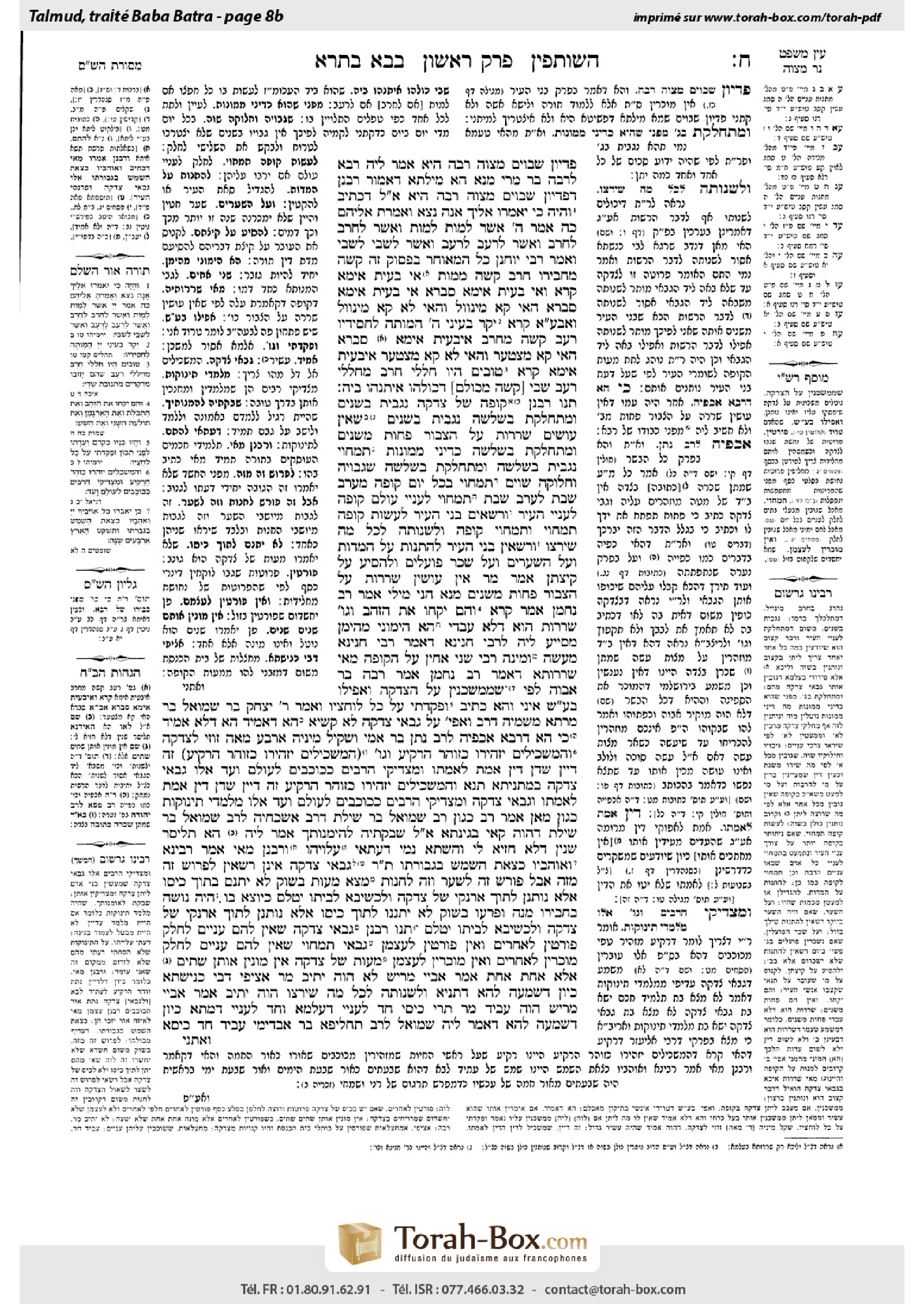
Bava Batra 8b: Talmud study for Daf Yomi
Study the Talmud for Daf Yomi with scanned pages, Hebrew text, English translations from Sefaria and AI-generated French translations.
Passage selection and English or AI-generated French translation are available where the scan has annotations. Daf Study is independent of Torah-Box and Sefaria.
Browse Bava Batra · בבא בתרא · All tractatesBava Batra 8b text and translations
This page of Bava Batra includes the Aramaic text, an English translation and an AI-generated French translation, alongside the scan above.
בבא בתרא ח׳ ב · Aramaic and Hebrew text
פִּדְיוֹן שְׁבוּיִם מִצְוָה רַבָּה הִיא.
אֲמַר לֵיהּ רָבָא לְרַבָּה בַּר מָרִי: מְנַָא הָא מִילְּתָא דַאֲמוּר רַבָּנַן דְּפִדְיוֹן שְׁבוּיִם מִצְוָה רַבָּה הִיא? אֲמַר לֵיהּ, דִּכְתִיב: ״וְהָיָה כִּי יֹאמְרוּ אֵלֶיךָ אָנָה נֵצֵא, וְאָמַרְתָּ אֲלֵיהֶם כֹּה אָמַר ה׳, אֲשֶׁר לַמָּוֶת – לַמָּוֶת, וַאֲשֶׁר לַחֶרֶב – לַחֶרֶב, וַאֲשֶׁר לָרָעָב – לָרָעָב, וַאֲשֶׁר לַשְּׁבִי – לַשֶּׁבִי״. וְאָמַר רַבִּי יוֹחָנָן: כׇּל הַמְאוּחָר בְּפָסוּק זֶה קָשֶׁה מֵחֲבֵירוֹ.
חֶרֶב קָשָׁה מִמָּוֶת – אִי בָּעֵית אֵימָא קְרָא, וְאִי בָּעֵית אֵימָא סְבָרָא. אִי בָּעֵית אֵימָא סְבָרָא – הַאי קָא מִינַּוַּול, וְהַאי לָא קָא מִינַּוַּול. וְאִיבָּעֵית אֵימָא קְרָא – ״יָקָר בְּעֵינֵי ה׳ הַמָּוְתָה לַחֲסִידָיו״.
רָעָב קָשֶׁה מֵחֶרֶב – אִיבָּעֵית אֵימָא סְבָרָא: הַאי קָא מִצְטַעַר, וְהַאי לָא קָא מִצְטַעַר. אִיבָּעֵית אֵימָא קְרָא: ״טוֹבִים הָיוּ חַלְלֵי חֶרֶב מֵחַלְלֵי רָעָב״. שֶׁבִי [קָשֶׁה מִכּוּלָּם] – דְּכוּלְּהוּ אִיתַנְהוּ בֵּיהּ.
תָּנוּ רַבָּנַן: קוּפָּה שֶׁל צְדָקָה נִגְבֵּית בִּשְׁנַיִם, וּמִתְחַלֶּקֶת בִּשְׁלֹשָׁה. נִגְבֵּית בִּשְׁנַיִם – שֶׁאֵין עוֹשִׂים שְׂרָרוֹת עַל הַצִּבּוּר פָּחוֹת מִשְּׁנַיִם, וּמִתְחַלֶּקֶת בִּשְׁלֹשָׁה – כְּדִינֵי מָמוֹנוֹת.
תַּמְחוּי נִגְבֵּית בִּשְׁלֹשָׁה, וּמִתְחַלֶּקֶת בִּשְׁלֹשָׁה; שֶׁגִּבּוּיָהּ וְחִלּוּקָהּ שָׁוִים. תַּמְחוּי – בְּכׇל יוֹם, קוּפָּה – מֵעֶרֶב שַׁבָּת לְעֶרֶב שַׁבָּת.
תַּמְחוּי – לַעֲנִיֵּי עוֹלָם, קוּפָּה – לַעֲנִיֵּי הָעִיר. וְרַשָּׁאִים בְּנֵי הָעִיר לַעֲשׂוֹת קוּפָּה – תַּמְחוּי, וְתַמְחוּי – קוּפָּה, וּלְשַׁנּוֹתָהּ לְכׇל מַה שֶּׁיִּרְצוּ.
וְרַשָּׁאִין בְּנֵי הָעִיר לְהַתְנוֹת עַל הַמִּדּוֹת, וְעַל הַשְּׁעָרִים, וְעַל שְׂכַר פּוֹעֲלִים; וּלְהַסִּיעַ עַל קִיצָתָן.
אָמַר מָר: אֵין עוֹשִׂין שְׂרָרוֹת עַל הַצִּבּוּר פָּחוֹת מִשְּׁנַיִם. מְנָא הָנֵי מִילֵּי? אָמַר רַב נַחְמָן, אָמַר קְרָא: ״וְהֵם יִקְחוּ אֶת הַזָּהָב וְגוֹ׳״.
שְׂרָרוֹת הוּא דְּלָא עָבְדִי, הָא הֵימוֹנֵי מְהֵימַן – מְסַיַּיע לֵיהּ לְרַבִּי חֲנִינָא, דְּאָמַר רַבִּי חֲנִינָא: מַעֲשֶׂה וּמִינָּה רַבִּי שְׁנֵי אַחִין עַל הַקּוּפָּה.
מַאי שְׂרָרוּתָא? דְּאָמַר רַב נַחְמָן אָמַר רַבָּה בַּר אֲבוּהּ: לְפִי שֶׁמְּמַשְׁכְּנִין עַל הַצְּדָקָה, וַאֲפִילּוּ בְּעֶרֶב שַׁבָּת. אִינִּי? וְהָא כְּתִיב: ״וּפָקַדְתִּי עַל כׇּל לֹחֲצָיו״, וְאָמַר רַבִּי יִצְחָק בַּר שְׁמוּאֵל בַּר מָרְתָא מִשְּׁמֵיהּ דְרַב: וַאֲפִילּוּ עַל גַּבָּאֵי צְדָקָה!
לָא קַשְׁיָא; הָא דַּאֲמִיד, הָא דְּלָא אֲמִיד. כִּי הָא דְּרָבָא אַכְפְּיֵהּ לְרַב נָתָן בַּר אַמֵּי, וּשְׁקַיל מִינֵּיהּ אַרְבַּע מְאָה זוּזֵי לִצְדָקָה.
״וְהַמַּשְׂכִּלִים יַזְהִרוּ כְּזֹהַר הָרָקִיעַ וְגוֹ׳״; ״הַמַּשְׂכִּלִים יַזְהִרוּ כְּזֹהַר הָרָקִיעַ״ – זֶה דַּיָּין שֶׁדָּן דִּין אֱמֶת לַאֲמִתּוֹ. ״וּמַצְדִּיקֵי הָרַבִּים כַּכּוֹכָבִים לְעוֹלָם וָעֶד״ – אֵלּוּ גַּבָּאֵי צְדָקָה.
בְּמַתְנִיתָא תָּנָא: ״וְהַמַּשְׂכִּלִים יַזְהִרוּ כְּזֹהַר הָרָקִיעַ״ – זֶה דַּיָּין שֶׁדָּן דִּין אֱמֶת לַאֲמִתּוֹ, וְגַבָּאֵי צְדָקָה. ״וּמַצְדִּיקֵי הָרַבִּים כַּכּוֹכָבִים לְעוֹלָם וָעֶד״ – אֵלּוּ מְלַמְּדֵי תִינוֹקוֹת. כְּגוֹן מַאן? אָמַר רַב: כְּגוֹן רַב שְׁמוּאֵל בַּר שִׁילַת. דְּרַב אַשְׁכְּחֵיהּ לְרַב שְׁמוּאֵל בַּר שִׁילַת דַּהֲוָה קָאֵי בְּגִינְּתָא, אֲמַר לֵיהּ: שְׁבַקְתֵּיהּ לְהֵימָנוּתָךְ? אֲמַר לֵיהּ: הָא תְּלֵיסַר שְׁנִין דְּלָא חַזְיָא לִי, וְהַשְׁתָּא נָמֵי דַּעְתַּאי עִלָּוַיְהוּ.
וְרַבָּנַן מַאי? אָמַר רָבִינָא: ״וְאֹהֲבָיו כְּצֵאת הַשֶּׁמֶשׁ בִּגְבֻרָתוֹ״.
תָּנוּ רַבָּנַן: גַּבָּאֵי צְדָקָה אֵינָן רַשָּׁאִין לִפְרוֹשׁ זֶה מִזֶּה, אֲבָל פּוֹרֵשׁ זֶה לַשַּׁעַר וְזֶה לַחֲנוּת. מָצָא מָעוֹת בַּשּׁוּק – לֹא יִתְּנֵם בְּתוֹךְ כִּיסוֹ; אֶלָּא נוֹתְנָן לְתוֹךְ אַרְנָקִי שֶׁל צְדָקָה, וּלִכְשֶׁיָּבֹא לְבֵיתוֹ יִטְּלֵם. כַּיּוֹצֵא בּוֹ, הָיָה נוֹשֶׁה בַּחֲבֵירוֹ מָנֶה, וּפְרָעוֹ בַּשּׁוּק – לֹא יִתְּנֶנּוּ לְתוֹךְ כִּיסוֹ, אֶלָּא נוֹתְנָן לְתוֹךְ אַרְנָקִי שֶׁל צְדָקָה, וּלִכְשֶׁיָּבֹא לְבֵיתוֹ יַטְלֵם.
תָּנוּ רַבָּנַן: גַּבָּאֵי צְדָקָה שֶׁאֵין לָהֶם עֲנִיִּים לְחַלֵּק – פּוֹרְטִין לַאֲחֵרִים, וְאֵין פּוֹרְטִין לְעַצְמָן. גַּבָּאֵי תַמְחוּי שֶׁאֵין לָהֶם עֲנִיִּים לְחַלֵּק – מוֹכְרִין לַאֲחֵרִים וְאֵין מוֹכְרִין לְעַצְמָן. מָעוֹת שֶׁל צְדָקָה – אֵין מוֹנִין אוֹתָן שְׁתַּיִם, אֶלָּא אַחַת אַחַת.
אָמַר אַבָּיֵי: מֵרֵישׁ לָא הֲוָה יָתֵיב מָר אַצִּיפֵּי דְּבֵי כְנִישְׁתָּא. כֵּיוָן דְּשַׁמְעַהּ לְהָא דְּתַנְיָא: ״וּלְשַׁנּוֹתָהּ לְכׇל מַה שֶּׁיִּרְצוּ״, הֲוָה יָתֵיב. אָמַר אַבָּיֵי: מֵרֵישׁ הֲוָה עָבֵיד מָר תְּרֵי כִיסֵי – חַד לַעֲנִיֵּי דְעָלְמָא, וְחַד לַעֲנִיֵּי דְמָתָא. כֵּיוָן דְּשַׁמְעַהּ לְהָא דַּאֲמַר לֵיהּ שְׁמוּאֵל לְרַב תַּחְלִיפָא בַּר אַבְדִּימִי: ״עָבֵיד חַד כִּיסָא,
Bava Batra 8b · English translation
that redeeming captives is a great mitzva.
Rava said to Rabba bar Mari: Concerning this matter that the Sages stated, that redeeming captives is a great mitzva, from where is it derived? Rabba bar Mari said to him: As it is written: “And it shall come to pass, when they say to you: To where shall we depart? Then you shall tell them: So says the Lord: Such as are for death, to death; and such as are for the sword, to the sword; and such as are for famine, to famine; and such as are for captivity, to captivity” (Jeremiah 15:2). And Rabbi Yoḥanan says: Whichever punishment is written later in this verse is more severe than the one before it.
Rabbi Yoḥanan explains: The sword is worse than death. If you wish, say that this is learned from a verse; if you wish, say instead that it is derived by way of logical reasoning. If you wish, say that this is derived by way of logical reasoning: This punishment, i.e., death by sword, mutilates the body, but that punishment, i.e., natural death, does not mutilate it. And if you wish, say that the fact that the sword is worse than death is learned from a verse: “Precious in the sight of the Lord is the death of His pious ones” (Psalms 116:15).
Famine is worse than the sword. If you wish, say that this is derived by way of logical reasoning: This one, who dies of famine, suffers greatly before departing from this world, but that one, who dies by the sword, does not suffer. If you wish, say instead that the fact that famine is worse than the sword is learned from a verse: “More fortunate were the victims of the sword than the victims of famine” (Lamentations 4:9). And captivity is worse than all of them, as it includes all of them, i.e., famine, the sword, and death.
§ In connection with the previous discussion concerning charity distribution, the Gemara cites a baraita in which the Sages taught: Money for the charity fund is collected by two people and distributed by three people. It is collected by two people because one does not appoint an authority over the community composed of fewer than two people. And it is distributed by three people, like the number of judges needed in cases of monetary law, since the distributors determine who receives money and who does not, as well as how much each person receives.
Food for the charity platter is collected by three people and distributed by three people because its collection and its distribution take place on the same day. Food for the charity platter is collected and distributed every day, and therefore a third individual must participate in the collection so that he will be available to take part in the distribution without delay; whereas the money of the charity fund is distributed only once a week, on each Shabbat eve.
There are additional differences between these two types of charity operations: The food from the charity platter is distributed to the poor of the world, meaning, to any poor individual arriving in the city; the money of the charity fund is allocated exclusively to the poor of the city. But it is permitted for the residents of the city to use money that has been collected for the charity fund to purchase food for the charity platter to feed the poor; and similarly they may use food that had been collected for the charity platter for the charity fund. In general, it is permitted for them to change the purpose toward which charity will be used to whatever they want, in accordance with the needs of the community.
Similarly, it is permitted for the residents of the city to set the measures used in that city, the prices set for products sold there, and the wages paid to its workers, and to fine people for violating their specifications, in order to enforce observance of these halakhot. This marks the end of the baraita, the details of which the Gemara proceeds to analyze.
The Master said in the baraita: One does not appoint an authority over the community composed of fewer than two people. The Gemara asks: From where are these matters derived? Rav Naḥman says that this is derived from a verse referring to those engaged in building the Tabernacle and weaving the priestly vestments, who received the community’s donations. The verse states: “And they shall take the gold, and the sky-blue wool, and the purple wool” (Exodus 28:5). The plural “they” indicates that the collection must be performed by two people.
The Gemara comments: The baraita indicates that authority may not be exercised by less than two people, but even a single individual is trusted to be a treasurer. That is, money for the charity fund is collected by two people, not because a single individual is not trusted not to misappropriate the money, but rather because a single individual should not be given authority over the community. This supports the opinion of Rabbi Ḥanina, as Rabbi Ḥanina says: There was an incident where Rabbi Yehuda HaNasi appointed two brothers to administer the charity fund. Even though the brothers were relatives who are not trusted to testify against each other, Rabbi Yehuda HaNasi was not concerned and he appointed them.
The Gemara asks: What authority is associated with collecting charity? The Gemara answers: As Rav Naḥman says that Rabba bar Avuh says: Because they can seize collateral for the charity; i.e., they can collect charity by force, and even on Shabbat eve, when people are busy and might claim that they have no time or money. The Gemara objects: Is that so? But isn’t it written: “I will punish all that oppress them” (Jeremiah 30:20), and Rabbi Yitzḥak bar Shmuel bar Marta says in the name of Rav: And punishment will be meted out even to charity collectors? If charity collectors are permitted to force people to contribute charity, why are they counted among Israel’s oppressors?
The Gemara answers: This is not difficult. This, Rabbi Naḥman’s statement, applies when the contributor is rich, in which case the collectors may seize money from him even by force. That, Rabbi Yitzḥak’s statement, applies when he is not rich, in which case the collectors who take money from him by force are termed oppressors of Israel. This right to force contributions from the rich is like what occurred in the incident in which Rava compelled Rav Natan bar Ami and took four hundred dinars from him for charity.
Having raised the issue of charity collection, the Gemara cites various rabbinic expositions with regard to the matter. The verse states: “And they who are wise shall shine like the brightness of the firmament; and they who turn many to righteousness like the stars for ever and ever” (Daniel 12:3). “And they who are wise shall shine like the brightness of the firmament”; this is a judge who judges an absolutely true judgment, as his wisdom and understanding lead him to a correct judgment. “And they who turn many to righteousness like the stars for ever and ever”; these are the charity collectors, who facilitate the giving of charity.
It was taught in a baraita: “And they who are wise shall shine like the brightness of the firmament”; this is a judge who judges an absolutely true judgment and also charity collectors. “And they who turn many to righteousness like the stars for ever and ever”; these are schoolteachers. The Gemara asks: Like whom? Certainly not every schoolteacher is worthy of such accolades. Rav said: For example, Rav Shmuel bar Sheilat. As it is told that Rav once found Rav Shmuel bar Sheilat standing in a garden. Rav said to him: Have you abandoned your trust and neglected your students? Rav Shmuel bar Sheilat said to him: It has been thirteen years now that I have not seen my garden, and even now my thoughts are on the children.
In light of the praises heaped upon judges, tax collectors, and schoolteachers, the Gemara asks: And what was said about the Sages? Ravina said that about them it is stated: “But let them that love Him be as the sun when it comes out in its might” (Judges 5:31).
The Gemara resumes its discussion of the halakhot of charity collection: The Sages taught in a baraita: Charity collectors may not separate from each other, each one collecting in a different place; but in a place where the two can see each other, one collector may separate from the other, e.g., this one going to the gate of a house and that one going to a store. If a charity collector found coins in the market, he may not put them into his own pocket, but rather he must put them into the charity purse, and then later when he comes home, he may take them from there. This is necessary so that people should not suspect him of taking charity money for himself. Similarly, if the charity collector was owed one hundred dinars by another, and the latter repaid his debt in the market, the collector may not put the money he received into his own pocket, but rather he must put it into the charity purse, and then later when he comes home, he may take it.
The Sages taught in a baraita: Charity collectors who have no poor people to whom they can distribute the money, may exchange [poretin] the money, i.e., exchange the copper coins, which tend to rust, for silver dinars, with other people, but they should not change it by themselves, i.e., with their own coins, to avoid any suspicion of wrongdoing. Likewise, collectors of food for the charity platter who do not have poor people to whom to distribute the food may sell the food to others, but they should not sell it to themselves, for a similar reason. Coins of charity are not counted two by two, but rather one by one, to avoid errors in tallying.
Abaye said: At first, my Master, Rabba, would not sit on the mats in the synagogue because they had been purchased with charity funds. Once he heard that which is taught in a baraita, that it is permitted for the residents of a city to change the purpose toward which charity will be used to whatever they want, he did sit on them. Abaye said: At first, my Master, Rabba, would make two purses, one for the poor of the rest of the world, and one for the poor of his city. Once he heard what Shmuel said to Rav Taḥalifa bar Avdimi: Make only one purse,
Bava Batra 8b · Traduction française (IA)
que l'achèvement des captifs est une grande mitsva.
Rava dit à Rabba bar Mari : Concernant cette question que les Sages ont établie, que l'achèvement des captifs est une grande mitsva, d'où cela est tiré ? Rabba bar Mari dit à lui : Comme il est écrit : « Et il arrivera, quand ils diront à toi : Où irons-nous ? Tu diras à eux : Ainsi dit l'Éternel : Ceux qui sont pour la mort, à la mort ; et ceux qui sont pour l'épée, à l'épée ; et ceux qui sont pour la famine, à la famine ; et ceux qui sont pour l'achèvement, à l'achèvement » (Jérémie 15:2). Et Rabbi Yoḥanan dit : Quelle punition que soit écrite plus tard dans cette verset est plus grave que celle qui précède.
Rabbi Yoḥanan explique : L'épée est pire que la mort. Si tu veux, dis que cela est tiré d'un verset ; si tu veux, dis plutôt que cela est déduit par raisonnement logique. Si tu veux, dis que cela est déduit par raisonnement logique : Cette punition, c'est-à-dire la mort par l'épée, mutilate le corps, mais cette punition, c'est-à-dire la mort naturelle, ne le mutilate pas. Et si tu veux, dis que le fait que l'épée est pire que la mort est tiré d'un verset : « Précieux aux yeux de l'Éternel est la mort de ses justes » (Psaumes 116:15).
La famine est pire que l'épée. Si tu veux, dis que cela est tiré par raisonnement logique : Celui qui meurt de famine souffre beaucoup avant de quitter ce monde, mais celui qui meurt par l'épée ne souffre pas. Si tu veux, dis plutôt que le fait que la famine est pire que l'épée est tiré d'un verset : « Plus heureux furent les victimes de l'épée que les victimes de la famine » (Lamentations 4:9). Et l'achèvement est pire que tous ceux-ci, car il inclut tous ceux-ci, c'est-à-dire la famine, l'épée et la mort.
§ En lien avec la discussion précédente concernant la distribution de la charité, le Guemara cite une baraïta dans laquelle les Sages enseignent : L'argent pour le fonds de charité est collecté par deux personnes et distribué par trois personnes. Il est collecté par deux personnes car on ne désigne pas un autorité sur la communauté composée de moins de deux personnes. Et il est distribué par trois personnes, comme le nombre de juges nécessaires dans les cas de droit civil, car les distributeurs déterminent qui reçoit de l'argent et qui ne le reçoit pas, ainsi que la quantité que chaque personne reçoit.
La nourriture pour la table de charité est collectée par trois personnes et distribuée par trois personnes car sa collecte et sa distribution ont lieu le même jour. La nourriture pour la table de charité est collectée et distribuée chaque jour, et par conséquent un troisième individu doit participer à la collecte afin qu'il soit disponible pour participer à la distribution sans délai ; tandis que l'argent du fonds de charité est distribué uniquement une fois par semaine, à chaque veille de Shabbat.
Il y a d'autres différences entre ces deux types d'opérations de charité : la nourriture provenant de la table de charité est distribuée aux pauvres du monde, c'est-à-dire à tout individu pauvre arrivant dans la ville ; l'argent du fonds de charité est alloué exclusivement aux pauvres de la ville. Mais il est permis aux habitants de la ville d'utiliser l'argent collecté pour le fonds de charité afin d'acheter de la nourriture pour la table de charité afin de nourrir les pauvres ; de même, ils peuvent utiliser la nourriture collectée pour la table de charité pour le fonds de charité. En général, il est permis à eux de changer l'usage de la charité selon leur volonté, en fonction des besoins de la communauté.
De même, il est permis aux habitants de la ville de fixer les mesures utilisées dans cette ville, les prix fixés pour les produits vendus là, et les salaires payés à ses ouvriers, et de sanctionner les personnes qui violent ces spécifications, afin d'imposer l'observance de ces halakhot. Cela marque la fin de la baraïta, les détails desquels le Guemara procède à analyser.
Le Maître dit dans la baraïta : On ne désigne pas d'autorité sur une communauté composée de moins de deux personnes. Le Guemara demande : D'où sont déduits ces enseignements ? Rav Naḥman dit que cela est tiré d'un verset concernant ceux qui travaillaient à la construction du Tabernacle et à la confection des vêtements sacerdotaux, qui recevaient les dons de la communauté. Le verset dit : « Et ils prendront l'or, et le lin bleu, et le lin pourpre » (Exode 28:5). Le pluriel « ils » indique que la collecte doit être effectuée par deux personnes.
Le Guemara commente : La baraïta indique que l'autorité ne peut être exercée par moins de deux personnes, mais même un seul individu est considéré comme un trésorier. C'est-à-dire que l'argent du fonds de charité est collecté par deux personnes, pas parce qu'un seul individu n'est pas considéré comme digne de confiance pour ne pas mal utiliser l'argent, mais plutôt parce qu'un seul individu ne devrait pas être donné l'autorité sur la communauté. Cela soutient l'opinion de Rabbi Ḥanina, car Rabbi Ḥanina dit : Il y avait un incident où Rabbi Yehuda HaNasi a désigné deux frères pour administrer le fonds de charité. Même si les frères étaient des parents qui ne sont pas considérés comme dignes de témoigner l'un contre l'autre, Rabbi Yehuda HaNasi n'avait pas d'inquiétude et il les a désignés.
Le Guemara demande : Quelle autorité est associée à la collecte de la charité ? Le Guemara répond : Comme Rav Naḥman dit que Rabba bar Avuh dit : Parce qu'ils peuvent saisir un garant pour la charité ; c'est-à-dire qu'ils peuvent collecter la charité par la force, et même le soir du Shabbat, lorsque les gens sont occupés et pourraient affirmer qu'ils n'ont pas le temps ou l'argent. Le Guemara s'oppose : Est-ce ainsi ? Mais n'est-il pas écrit : « Je punirai tous ceux qui les oppriment » (Jérémie 30:20), et Rabbi Yitzḥak bar Shmuel bar Marta dit en nom de Rav : Et la punition sera appliquée même aux collecteurs de charité ? Si les collecteurs de charité sont autorisés à forcer les gens à contribuer à la charité, pourquoi sont-ils considérés comme des oppresseurs d'Israël ?
La Guemara répond : Cela n'est pas difficile. Celle-ci, la déclaration de Rabbi Naḥman, s'applique lorsque le donateur est riche, dans ce cas les collecteurs peuvent saisir de l'argent chez lui même par la force. Celle-là, la déclaration de Rabbi Yitzḥak, s'applique lorsque celui-ci n'est pas riche, dans ce cas les collecteurs qui prennent de l'argent chez lui par la force sont appelés oppresseurs d'Israël. Ce droit de faire des contributions par la force aux riches est semblable à ce qui s'est produit dans l'incident où Rava a contraint Rav Natan bar Ami et a pris quatre cents dinars de lui pour la charité.
Ayant soulevé la question de la collecte de la charité, la Guemara cite divers développements rabbiniques concernant cette affaire. La Parashah dit : « Et ceux qui sont sages brillent comme la lumière du firmament ; et ceux qui convertissent beaucoup à la justice comme les étoiles pour toujours et pour toujours » (Daniel 12:3). « Et ceux qui sont sages brillent comme la lumière du firmament » ; c'est un juge qui rend un jugement absolument juste, car sa sagesse et sa compréhension le conduisent à un jugement correct. « Et ceux qui convertissent beaucoup à la justice comme les étoiles pour toujours et pour toujours » ; ce sont les collecteurs de charité, qui facilitent la donation de charité.
Il a été enseigné dans une baraïta : « Et ceux qui sont sages brillent comme la lumière du firmament » ; c'est un juge qui rend un jugement absolument juste et aussi les collecteurs de charité. « Et ceux qui convertissent beaucoup à la justice comme les étoiles pour toujours et pour toujours » ; ce sont les maîtres de l'école. La Guemara demande : Comme qui ? Certainement, ce n'est pas chaque maître d'école qui mérite de telles louanges. Rav a dit : Par exemple, Rav Shmuel bar Sheilat. Comme il est raconté que Rav a trouvé Rav Shmuel bar Sheilat debout dans un jardin. Rav a dit à lui : As-tu abandonné ta confiance et négligé tes élèves ? Rav Shmuel bar Sheilat a dit à lui : Il y a maintenant treize ans que je n'ai pas vu mon jardin, et même maintenant mes pensées sont sur les enfants.
En lumière des louanges accordées aux juges, aux collecteurs de taxes et aux maîtres d'école, la Guemara demande : Et qu'a-t-on dit des Sages ? Ravina a dit qu'à leur sujet il est dit : « Mais ceux qui l'aiment seront comme le soleil lorsqu'il sort en sa puissance » (Juges 5:31).
La Guemara reprend la discussion des halakhot de la collecte de charité : Les Sages ont enseigné dans une baraïta : Les collecteurs de charité ne doivent pas se séparer les uns des autres, chacun collectant dans un endroit différent ; mais dans un lieu où les deux peuvent se voir, un collecteur peut se séparer de l'autre, par exemple, celui-ci allant à la porte d'une maison et celui-là à un magasin. Si un collecteur de charité trouvait des pièces sur le marché, il ne devait pas les mettre dans sa propre poche, mais plutôt dans le sac de charité, et ensuite, lorsqu'il rentrait chez lui, il pouvait les prendre de là. Cela est nécessaire afin que les gens ne soupçonnent pas qu'il prenne l'argent de la charité pour lui-même. De même, si le collecteur de charité était dû un cent dinars par un autre, et que ce dernier remboursait sa dette sur le marché, le collecteur ne devait pas mettre l'argent qu'il avait reçu dans sa propre poche, mais plutôt dans le sac de charité, et ensuite, lorsqu'il rentrait chez lui, il pouvait le prendre.
Les Sages ont enseigné dans une baraïta : Les collecteurs de charité qui n'ont pas de pauvres à qui ils peuvent distribuer l'argent peuvent échanger [poretin] l'argent, c'est-à-dire échanger les pièces de cuivre, qui tendent à rouiller, contre des dinars d'argent avec d'autres personnes, mais ils ne doivent pas l'échanger eux-mêmes, c'est-à-dire avec leurs propres pièces, afin d'éviter tout soupçon de malveillance. De même, les collecteurs de nourriture pour la table de charité qui n'ont pas de pauvres à qui distribuer la nourriture peuvent vendre la nourriture à d'autres, mais ils ne doivent pas la vendre à eux-mêmes, pour une raison similaire. Les pièces de charité ne sont pas comptées par paires, mais une par une, afin d'éviter les erreurs dans le comptage.
Abaye a dit : D'abord, mon maître, Rabba, ne s'asseyait pas sur les tapis dans la synagogue car ils avaient été achetés avec des fonds de charité. Une fois qu'il avait entendu ce qui est enseigné dans une baraïta, que les habitants d'une ville peuvent changer à leur guise l'usage auquel la charité sera employée, il s'est assis dessus. Abaye a dit : D'abord, mon maître, Rabba, faisait deux sacs, un pour les pauvres du reste du monde, et un pour les pauvres de sa ville. Une fois qu'il avait entendu ce que Shmuel avait dit à Rav Taḥalifa bar Avdimi : Fais un seul sac,
Traduction française générée par IA à partir de l’édition anglaise de Sefaria. Vérifie toujours un passage avec le texte source.
Text from Sefaria: William Davidson Edition - Vocalized Aramaic (CC BY NC); William Davidson Edition - English (CC BY NC).