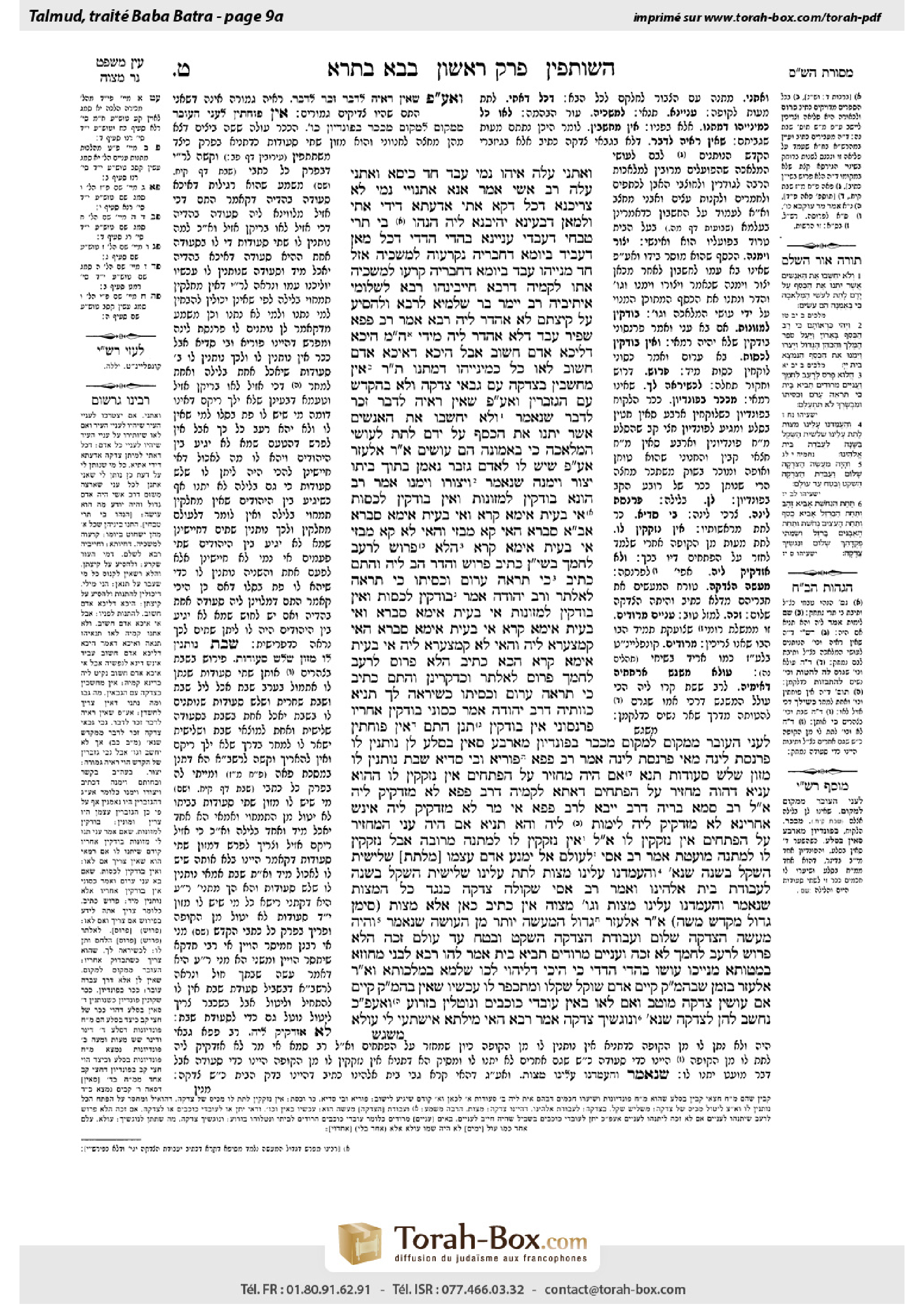
Bava Batra 9a: Talmud study for Daf Yomi
Study the Talmud for Daf Yomi with scanned pages, Hebrew text, English translations from Sefaria and AI-generated French translations.
Passage selection and English or AI-generated French translation are available where the scan has annotations. Daf Study is independent of Torah-Box and Sefaria.
Browse Bava Batra · בבא בתרא · All tractatesBava Batra 9a text and translations
This page of Bava Batra includes the Aramaic text, an English translation and an AI-generated French translation, alongside the scan above.
בבא בתרא ט׳ א · Aramaic and Hebrew text
וְאַתְנִי עֲלַהּ״; אִיהוּ נָמֵי עֲבַד חַד כִּיסָא, וְאַתְנִי עֲלַהּ. רַב אָשֵׁי אָמַר: אֲנָא – אַתְנוֹיֵי נָמֵי לָא צְרִיכְנָא, דְּכׇל דְּקָא אָתֵי אַדַּעְתָּא דִּידִי אָתֵי, וּלְמַאן דְּבָעֵינָא יָהֵיבְנָא לֵיהּ.
הָנְהוּ בֵּי תְרֵי טַבָּחֵי דְּעָבְדִי עִנְיָינָא בַּהֲדֵי הֲדָדֵי, דְּכֹל מַאן דְּעָבֵיד בְּיוֹמָא דְּחַבְרֵיהּ – נִקְרְעוּהּ לְמַשְׁכֵּיהּ. אֲזַל חַד מִנַּיְיהוּ עֲבַד בְּיוֹמָא דְּחַבְרֵיהּ, קְרַעוּ לְמַשְׁכֵּיהּ. אֲתוֹ לְקַמֵּיהּ דְּרָבָא, חַיְּיבִינְהוּ רָבָא לְשַׁלּוֹמֵי.
אֵיתִיבֵיהּ רַב יֵימַר בַּר שֶׁלֶמְיָא לְרָבָא: ״וּלְהַסִּיעַ עַל קִיצָתָם״! לָא אַהְדַּר לֵיהּ רָבָא. אָמַר רַב פָּפָּא: שַׁפִּיר עֲבַד דְּלָא אַהְדַּר לֵיהּ מִידֵּי; הָנֵי מִילֵּי הֵיכָא דְּלֵיכָּא אָדָם חָשׁוּב, אֲבָל הֵיכָא דְּאִיכָּא אָדָם חָשׁוּב – לָאו כֹּל כְּמִינַּיְיהוּ דְּמַתְנוּ.
תָּנוּ רַבָּנַן: אֵין מְחַשְּׁבִין בִּצְדָקָה עִם גַּבָּאֵי צְדָקָה, וְלֹא בְּהֶקְדֵּשׁ עִם הַגִּזְבָּרִין. וְאַף עַל פִּי שֶׁאֵין רְאָיָה לַדָּבָר, זֵכֶר לַדָּבָר – שֶׁנֶּאֱמַר: ״וְלֹא יְחַשְּׁבוּ אֶת הָאֲנָשִׁים אֲשֶׁר יִתְּנוּ אֶת הַכֶּסֶף עַל יָדָם לָתֵת לְעֹשֵׂי הַמְּלָאכָה, כִּי בֶאֱמֻנָה הֵם עֹשִׂים״.
אָמַר רַבִּי אֶלְעָזָר: אַף עַל פִּי שֶׁיֵּשׁ לוֹ לָאָדָם גִּזְבָּר נֶאֱמָן בְּתוֹךְ בֵּיתוֹ – יָצוּר וְיִמְנֶה, שֶׁנֶּאֱמַר: וַיָּצֻרוּ וַיִּמְנוּ.
אָמַר רַב הוּנָא: בּוֹדְקִין לִמְזוֹנוֹת, וְאֵין בּוֹדְקִין לִכְסוּת – אִי בָּעֵית אֵימָא קְרָא, וְאִי בָּעֵית אֵימָא סְבָרָא;
אִי בָּעֵית אֵימָא סְבָרָא – הַאי קָא מִבַּזֵּי, וְהַאי לָא קָא מִבַּזֵּי. אִי בָּעֵית אֵימָא קְרָא – ״הֲלֹא פָרֹשׂ לָרָעֵב לַחְמֶךָ״; בְּשִׁין כְּתִיב – פְּרֹשׁ, וַהֲדַר הַב לֵיהּ. וְהָתָם כְּתִיב: ״כִּי תִרְאֶה עָרֹם וְכִסִּיתוֹ״; ״כִּי תִרְאֶה״ – לְאַלְתַּר.
וְרַב יְהוּדָה אָמַר: בּוֹדְקִין לִכְסוּת, וְאֵין בּוֹדְקִין לִמְזוֹנוֹת – אִי בָּעֵית אֵימָא סְבָרָא, וְאִי בָּעֵית אֵימָא קְרָא;
אִי בָּעֵית אֵימָא סְבָרָא – הַאי קָמְצַעֲרָא לֵיהּ, וְהַאי לָא קָמְצַעֲרָא לֵיהּ. אִי בָּעֵית אֵימָא קְרָא – הָכָא כְּתִיב: ״הֲלֹא פָרֹס לָרָעֵב לַחְמֶךָ״ – פְּרוֹס לְאַלְתַּר, וּכְדִקְרֵינַן; וְהָתָם כְּתִיב: ״כִּי תִרְאֶה עָרֹם וְכִסִּיתוֹ״ – כְּשֶׁיֵּרָאֶה לְךָ. תַּנְיָא כְּווֹתֵיהּ דְּרַב יְהוּדָה: אָמַר ״כַּסּוּנִי״ – בּוֹדְקִין אַחֲרָיו. ״פַּרְנְסוּנִי״ – אֵין בּוֹדְקִין.
תְּנַן הָתָם: אֵין פּוֹחֲתִין לְעָנִי הָעוֹבֵר מִמָּקוֹם לְמָקוֹם, מִכִּכָּר בְּפוּנְדְּיוֹן – מֵאַרְבַּע סְאִין בְּסֶלַע. לָן – נוֹתְנִין לוֹ פַּרְנָסַת לִינָה. מַאי ״פַּרְנָסַת לִינָה״? אָמַר רַב פָּפָּא: פּוּרְיָא וּבֵי סַדְיָא. שָׁבַת – נוֹתְנִין לוֹ מְזוֹן שָׁלֹשׁ סְעוּדוֹת. תָּנָא: אִם הָיָה מְחַזֵּיר עַל הַפְּתָחִים – אֵין נִזְקָקִין לוֹ.
הָהוּא עַנְיָא דַּהֲוָה מְחַזֵּיר עַל הַפְּתָחִים, דַּאֲתָא לְקַמֵּיהּ דְּרַב פָּפָּא – לָא מִזְדְּקִיק לֵיהּ. אֲמַר לֵיהּ רַב סַמָּא בְּרֵיהּ דְּרַב יֵיבָא לְרַב פָּפָּא: אִי מָר לָא מִזְדְּקִיק לֵיהּ, אִינָשׁ אַחֲרִינָא לָא מִזְדְּקִיק לֵיהּ! לֵימוּת לֵיהּ?! וְהָא תַּנְיָא: אִם הָיָה עָנִי הַמְחַזֵּיר עַל הַפְּתָחִים – אֵין נִזְקָקִין לוֹ! אֲמַר לֵיהּ: אֵין נִזְקָקִין לוֹ לְמַתָּנָה מְרוּבָּה, אֲבָל נִזְקָקִין לוֹ לְמַתָּנָה מוּעֶטֶת.
אָמַר רַב אַסִּי: לְעוֹלָם אַל יִמְנַע אָדָם עַצְמוֹ [מִלָּתֵת] שְׁלִישִׁית הַשֶּׁקֶל בְּשָׁנָה, שֶׁנֶּאֱמַר: ״וְהֶעֱמַדְנוּ עָלֵינוּ מִצְוֹת לָתֵת עָלֵינוּ שְׁלִישִׁית הַשֶּׁקֶל בַּשָּׁנָה לַעֲבֹדַת בֵּית אֱלֹהֵינוּ״. וְאָמַר רַב אַסִּי: שְׁקוּלָה צְדָקָה כְּנֶגֶד כׇּל הַמִּצְוֹת, שֶׁנֶּאֱמַר: ״וְהֶעֱמַדְנוּ עָלֵינוּ מִצְוֹת וְגוֹ׳״ – ״מִצְוָה״ אֵין כְּתִיב כָּאן, אֶלָּא ״מִצְוֹת״.
(סִימָן: גָּדוֹל, מִקְדָּשׁ, מֹשֶׁה) אָמַר רַבִּי אֶלְעָזָר: גָּדוֹל הַמְעַשֶּׂה יוֹתֵר מִן הָעוֹשֶׂה – שֶׁנֶּאֱמַר: ״וְהָיָה מַעֲשֵׂה הַצְּדָקָה שָׁלוֹם, וַעֲבֹדַת הַצְּדָקָה הַשְׁקֵט וָבֶטַח עַד עוֹלָם״; זָכָה – ״הֲלֹא פָרֹשׂ לָרָעֵב לַחְמֶךָ״. לֹא זָכָה – ״וַעֲנִיִּים מְרוּדִים תָּבִיא בָיִת״.
אֲמַר לְהוּ רָבָא לִבְנֵי מָחוֹזָא: בְּמָטוּתָא מָנַיְיכוּ, עוּשׂוּ בַּהֲדֵי הֲדָדֵי, כִּי הֵיכִי דְּלֶיהְוֵי לְכוּ שְׁלָמָא בְּמַלְכוּתָא. וְאָמַר רַבִּי אֶלְעָזָר: בִּזְמַן שֶׁבֵּית הַמִּקְדָּשׁ קַיָּים, אָדָם שׁוֹקֵל שִׁקְלוֹ – וּמִתְכַּפֵּר לוֹ; עַכְשָׁיו שֶׁאֵין בֵּית הַמִּקְדָּשׁ קַיָּים, אִם עוֹשִׂין צְדָקָה – מוּטָב, וְאִם לָאו – בָּאִין אוּמּוֹת הָעוֹלָם וְנוֹטְלִין בִּזְרוֹעַ. וְאַף עַל פִּי כֵן נֶחְשָׁב לָהֶן לִצְדָקָה – שֶׁנֶּאֱמַר: ״וְנֹגְשַׂיִךְ צְדָקָה״.
אָמַר רָבָא: הַאי מִילְּתָא אִישְׁתַּעִי לִי עוּלָּא
Bava Batra 9a · English translation
and stipulate about it with the people of your city that the money collected will be given to whomever needs it, he too made only one purse and stipulated with the people of his city about it. Rav Ashi said: I do not even need to make a stipulation, as whoever comes to donate to this charity fund comes relying on my discretion and understanding that I will give the funds to whomever I want.
The Gemara relates: There were these two butchers who made an agreement with each other that whichever one of them worked on the day assigned to the other according to their mutually agreed-upon schedule would tear up the hide of the animal that he slaughtered that day. One of them went and worked on the other’s day, and the other butcher tore up the hide of the animal that he slaughtered. They came before Rava for judgment, and Rava obligated him to pay the butcher who slaughtered that animal.
Rav Yeimar bar Shelamya raised an objection to Rava: Isn’t it stated among actions that the residents of a city may take: And to fine people for violating their specifications, i.e., those ordinances that the residents passed? Rava did not respond to him. Rav Pappa said: He did well that he did not respond to him, as this matter applies only where there is no important person in the city, in which case it is permitted for the residents of the city to draw up ordinances on their own. But where there is an important person, it is not in the residents’ power to make stipulations, i.e., regulations; rather, they are required to obtain the approval of the city’s leading authority to give force to their regulations.
§ The Sages taught: One does not calculate sums with charity collectors concerning the money they collected for charity, to verify how much they received and how much they distributed, nor does one calculate sums with the Temple treasurers concerning the property consecrated to the Temple. And even though there is no explicit proof of the matter from the Bible, there is nevertheless an allusion to the matter, as it is stated: “And they did not reckon with the men into whose hand they delivered the money to pay out to the workmen; for they dealt in good faith” (II Kings 12:16).
Rabbi Elazar says: Even though a person has a trusted treasurer in his house like the aforementioned Temple treasurers, who were fully trusted, he should nevertheless tie up his money and count it, as it is stated: “And the king’s scribe and the High Priest came up, and they tied it in bags and counted the money…And they gave the money that was counted into the hands of them that did the work, that had the oversight of the House of the Lord” (II Kings 12:11–12).
Rav Huna says: Charity collectors examine the level of poverty of one who asks for food, but they do not examine the level of poverty of one who asks for clothing. If a person comes before the charity collectors in tattered clothes, he is given clothing without any questions being asked. If you wish, say that this distinction is derived from a verse; if you wish, say instead that it is derived via logical reasoning.
If you wish, say that this distinction is derived via logical reasoning: This one who stands before us in rags is exposed to contempt, whereas that one who is hungry is not exposed to contempt. If you wish, say instead that this distinction is derived from a verse, as it is written: “Is it not to share [paros] your bread with the hungry?” (Isaiah 58:7). The word paros is written with a shin, alluding to the word parosh, meaning examine and investigate, and only then should you give him. And there in the same verse it is written with regard to clothing: “When you see the naked, that you cover him,” indicating that “when you see” him you should immediately cover him.
And Rav Yehuda says just the opposite: Charity collectors examine the level of poverty of one who asks for clothing, but they do not examine the level of poverty of one who asks for food. He too adduces supports for his opinion. If you wish, say that this distinction is derived via logical reasoning; if you wish, say instead that it is derived from a verse.
If you wish, say that this distinction is derived via logical reasoning: This one who is hungry suffers, whereas that one who is in tattered clothing does not suffer in the same way. And if you wish, say instead that this distinction is derived from a verse. Here, it is written: “Is it not to share [paros] your bread with the hungry?” meaning, share it immediately, just as the word is read. Since the word is read with a samekh, Rav Yehuda does not understand it as alluding to examining the recipient. And there, it is written: “When you see the naked, that you cover him,” meaning, when it will be clearly apparent to you, after you have investigated the matter and found that the supplicant is deserving, then you shall cover him. The Gemara comments: It is taught in a baraita in accordance with the opinion of Rav Yehuda: If a poor person said: Cover me with clothing, the charity collectors examine him; but if he said: Sustain me with food, they do not examine him.
We learned in a mishna there (Pe’a 8:7): One does not give a poor person who is traveling from place to place requesting charity less than a loaf worth a pundeyon, one forty-eighth of a sela, when the standard price of grain is four se’a for a sela. If the poor person sleeps in that place, one gives him provisions for lodging. The Gemara asks: What is meant by provisions for lodging? Rav Pappa said: A bed and a pillow [bei sadya]. And if he spends Shabbat in that place, one gives him food for three meals. A Sage taught in a baraita: If a poor person was going door to door asking for charity, one is not required to attend to him and give him money from the charity fund.
It is related that a certain poor person who was going door to door requesting charity came before Rav Pappa, the local charity collector, but Rav Pappa did not attend to him. Rav Sama, son of Rav Yeiva, said to Rav Pappa: If the Master does not attend to him, nobody else will attend to him either; should he be left to die of hunger? Rav Pappa said to him: But isn’t it taught in a baraita: If a poor person was going door to door asking for charity, one is not required to attend to him? Rav Sama said to him: That baraita means to say that one is not required to attend to him and give him a large gift, since he is already collecting money as he goes door to door, but one does attend to him and give him a small gift.
Rav Asi says: A person should never prevent himself from giving at least one-third of a shekel a year in charity, as it is stated: “And we also established mitzvot upon ourselves, to charge ourselves yearly with the third part of a shekel for the service of the House of our God” (Nehemiah 10:33). And Rav Asi says: Charity is equivalent to all the other mitzvot combined, as it is stated in that verse: “We also established mitzvot upon ourselves.” A mitzva is not written here, but rather mitzvot, in the plural, thereby teaching that this mitzva is equivalent to all the other mitzvot.
The Gemara offers a mnemonic device for the following statements extolling the mitzva of charity: Greater; Temple; Moses. Rabbi Elazar says: One who causes others to perform [me’aseh] a meritorious act is greater than one who performs that act himself, as it is stated: “And the causing [ma’aseh] of righteousness shall be peace, and the work of righteousness, quietness, and assurance forever” (Isaiah 32:17). If one merits, the following verse is applied to him: “Is it not to share your bread with the hungry?” (Isaiah 58:7), i.e., he will wholeheartedly give charity to the poor. If he does not merit, the latter clause of that verse is applied to him: “You shall bring the poor that are cast out to your house,” i.e., he will be compelled by the government to billet soldiers in his house and sustain them against his will.
Rava said to the people of Meḥoza: I beg of you, strive with each other to perform acts of charity and righteousness, so that you will live in peace with the government, since if you do not act charitably toward each other, you will end up paying fines to the government. And Rabbi Elazar says: When the Temple is standing, a person contributes his shekel for the Temple service and achieves atonement for his sins. Now that the Temple no longer stands, if people act charitably, it will be well for them; but if not, the nations of the world will come and take their money by force. The Gemara comments: And even so, the money taken from them by force is credited to them as if they had freely given charity, as it is stated: “And I will make your oppressors charity” (Isaiah 60:17).
Rava said: This following matter was told to me by the infant
Bava Batra 9a · Traduction française (IA)
et il stipula avec les habitants de sa ville que l'argent collecté serait donné à celui qui en avait besoin, il fit également un seul sac et stipula avec les habitants de sa ville à ce sujet. Rav Ashi dit : Je n'ai même pas besoin de stipuler, car celui qui vient donner à cette fondation caritative se repose sur mon discernement et comprend que je donnerai l'argent à celui que je veux.
La Guemara rapporte : Il y avait deux bouchers qui avaient convenu l'un avec l'autre que celui qui travaillait le jour assigné à l'autre selon leur emploi du temps mutuel déchirerait la peau de l'animal qu'il avait tué ce jour-là. L'un d'eux alla travailler le jour de l'autre, et l'autre boucher déchira la peau de l'animal qu'il avait tué. Ils vinrent devant Rava pour être jugés, et Rava les obligea à payer le boucher qui avait tué cet animal.
Rav Yeimar bar Shelamya souleva une objection contre Rava : N'est-ce pas dit concernant les actions que les habitants d'une ville peuvent prendre : Et punir les gens pour avoir violé leurs spécifications, c'est-à-dire ces ordonnances que les habitants ont adoptées ? Rava ne répondit pas à lui. Rav Pappa dit : Il a bien fait de ne pas répondre, car cette affaire s'applique uniquement là où il n'y a pas de personnalité importante dans la ville, dans ce cas, il est permis aux habitants de la ville de créer des règlements eux-mêmes. Mais là où il y a une personnalité importante, il n'est pas en pouvoir des habitants de faire des stipulations, c'est-à-dire des règlements ; ils doivent obtenir l'approbation de l'autorité principale de la ville pour que leurs règlements soient valides.
§ Les Sages enseignèrent : On ne calcule pas les sommes avec les collecteurs de charité concernant l'argent qu'ils ont collecté pour la charité, pour vérifier combien ils ont reçu et combien ils ont distribué, ni on ne calcule les sommes avec les trésoriers du Temple concernant les biens consacrés au Temple. Et même si il n'y a pas de preuve explicite de cette affaire dans la Bible, il y a néanmoins une allusion à cette affaire, car il est dit : « Et ils ne comptaient pas avec les hommes auxquels ils remettaient l'argent pour payer les ouvriers ; car ils agissaient avec honnêteté » (II Rois 12:16).
Rabbi Elazar dit : Même si une personne a un trésorier de confiance chez elle comme les trésoriers du Temple mentionnés plus haut, qui étaient entièrement de confiance, il devrait tout de même enfermer son argent et le compter, car il est dit : « Et le scribe du roi et le grand prêtre montèrent, et ils le tinrent dans des sacs et le comptèrent... Et ils donnèrent l'argent compté aux hommes qui faisaient le travail, ceux qui surveillaient la Maison du Seigneur » (II Rois 12:11–12).
Rav Huna dit : Les collecteurs de charité examinent le niveau de pauvreté de celui qui demande de la nourriture, mais ils n'examinent pas le niveau de pauvreté de celui qui demande des vêtements. Si une personne vient devant les collecteurs de charité en habits rapiécés, on lui donne des vêtements sans poser de questions. Si vous le souhaitez, dites que cette distinction provient d'une verset ; si vous le souhaitez, dites plutôt qu'elle provient d'une raisonnement logique.
Si vous le souhaitez, dites que cette distinction provient d'une raison logique : Celui qui se tient devant nous en habits rapiécés est exposé à la honte, tandis que celui qui a faim n'est pas exposé à la honte. Si vous le souhaitez, dites plutôt que cette distinction provient d'un verset, car il est écrit : « N'est-ce pas partager [paros] votre pain avec le faim ? » (Yachout 58:7). Le mot paros est écrit avec un shin, allusion au mot parosh, signifiant examiner et investiguer, et seulement après cela devriez-vous lui donner. Et là, dans le même verset, il est écrit concernant les vêtements : « Quand vous voyez le nu, couvrez-le », indiquant que « quand vous voyez » lui, vous devriez immédiatement le couvrir.
Et Rav Yehuda dit tout le contraire : Les collecteurs de charité examinent le niveau de pauvreté de celui qui demande des vêtements, mais ils n'examinent pas le niveau de pauvreté de celui qui demande de la nourriture. Il avance également des arguments en faveur de son opinion. Si vous le souhaitez, dites que cette distinction provient d'une raison logique ; si vous le souhaitez, dites plutôt qu'elle provient d'un verset.
Si vous le souhaitez, dites que cette distinction provient d'une raisonnement logique : Celui qui a faim souffre, tandis que celui qui est en habits rapiécés ne souffre pas de la même manière. Et si vous le souhaitez, dites plutôt que cette distinction provient d'un verset. Ici, il est écrit : « N'est-ce pas partager [paros] votre pain avec le faim ? » signifiant, partager immédiatement, comme le mot est lu. Puisque le mot est lu avec un mêmekh, Rav Yehuda ne le comprend pas comme allusion à l'examen du receveur. Et là, il est écrit : « Quand vous voyez le nu, couvrez-le », signifiant, quand cela sera clairement apparent à vous, après que vous ayez investigué la question et trouvé que le supplicateur est digne, alors vous le couvrez. La Guemara commente : Il est enseigné dans une baraïta selon l'opinion de Rav Yehuda : Si un pauvre dit : Couvre-moi avec des vêtements, les collecteurs de charité l'examinent ; mais si il dit : Sustente-moi avec de la nourriture, ils ne l'examinent pas.
Nous avons appris dans une mishna là (Pe’a 8:7) : On ne donne à un pauvre qui voyage d'un lieu à un autre en demandant de la charité moins qu'un pain valant un pundeyon, un quarantième d'un sela, lorsque le prix standard du grain est quatre se’a pour un sela. Si le pauvre dort dans ce lieu, on lui donne des provisions pour loger. La Guemara demande : Qu'entend-on par provisions pour loger ? Rav Pappa dit : Un lit et un coussin [bei sadya]. Et si il passe le Shabbat dans ce lieu, on lui donne de la nourriture pour trois repas. Un Sage enseigna dans une baraïta : Si un pauvre allait de porte en porte en demandant de la charité, on n'est pas tenu de s'occuper de lui et de lui donner de l'argent du fonds de charité.
On est rapporté que certains pauvres qui demandaient la charité de porte en porte se présentèrent devant Rav Pappa, le récepteur local de la charité, mais Rav Pappa ne les écouta pas. Rav Sama, fils de Rav Yéhôva, dit à Rav Pappa : Si le Maître ne les écoutait pas, personne d'autre ne le ferait non plus ; devrait-on laisser mourir de faim ce pauvre ? Rav Pappa répondit à lui : Mais n'est-ce pas enseigné dans une baraïta : Si un pauvre demandait la charité de porte en porte, on n'est pas tenu de l'écouter ? Rav Sama répondit à lui : Cette baraïta veut dire que l'on n'est pas tenu de l'écouter et de lui donner un grand don, puisqu'il est déjà en train de collecter de l'argent de porte en porte, mais l'on l'écoute et l'on lui donne un petit don.
Rav Asi dit : Une personne ne doit jamais se priver de donner au moins un tiers de sela par an en charité, car il est dit : « Et nous avons aussi établi des mitsvot sur nous-mêmes, pour nous imposer annuellement la troisième partie d'un sela pour le service de la Maison de notre Dieu » (Néhémie 10:33). Et Rav Asi dit : La charité est équivalente à toutes les autres mitsvot combinées, car il est dit dans cette même verset : « Nous avons aussi établi des mitsvot sur nous-mêmes. » Une mitsva n'est pas écrite ici, mais plutôt mitsvot, au pluriel, ce qui enseigne que cette mitsva est équivalente à toutes les autres mitsvot.
La Guemara propose un dispositif mnémotechnique pour les affirmations suivantes louant la mitsva de la charité : Plus grand ; Temple ; Moïse. Rabbi Eléazar dit : Celui qui incite d'autres à accomplir un acte méritoire est plus grand que celui qui accomplit lui-même cet acte, car il est dit : « Et l'accomplissement de la justice sera la paix, et l'œuvre de la justice, la tranquillité et la certitude éternelle » (Yachout 32:17). Si l'on mérite, la verset suivant s'applique à lui : « N'est-ce pas partager votre pain avec le faible ? » (Yachout 58:7), c'est-à-dire qu'il donnera volontairement la charité aux pauvres. Si l'on ne mérite pas, la clause suivante de ce verset s'applique à lui : « Vous ferez entrer les pauvres expulsés chez vous », c'est-à-dire qu'on le forcerait par l'État à loger des soldats chez lui et à les nourrir contre sa volonté.
Rava dit aux habitants de Méhoza : Je vous supplie, disputez-vous entre vous pour accomplir des actes de charité et de justice, afin que vous viviez en paix avec l'État, car si vous ne faites pas de charité entre vous, vous finirez par payer des amendes à l'État. Et Rabbi Eléazar dit : Lorsque le Temple était debout, une personne donnait son sela pour le service du Temple et obtenait l'at-onement pour ses péchés. Maintenant que le Temple ne se dresse plus, si les gens agissent charitablement, cela sera bien pour eux ; mais s'ils ne le font pas, les nations du monde viendront et prendront leur argent par la force. La Guemara commente : Et même ainsi, l'argent pris par la force est compté pour eux comme s'ils avaient donné librement la charité, car il est dit : « Et je ferai de vos oppresseurs votre charité » (Yachout 60:17).
Rava dit : Cette affaire suivante fut racontée à moi par l'enfant
Traduction française générée par IA à partir de l’édition anglaise de Sefaria. Vérifie toujours un passage avec le texte source.
Text from Sefaria: William Davidson Edition - Vocalized Aramaic (CC BY NC); William Davidson Edition - English (CC BY NC).