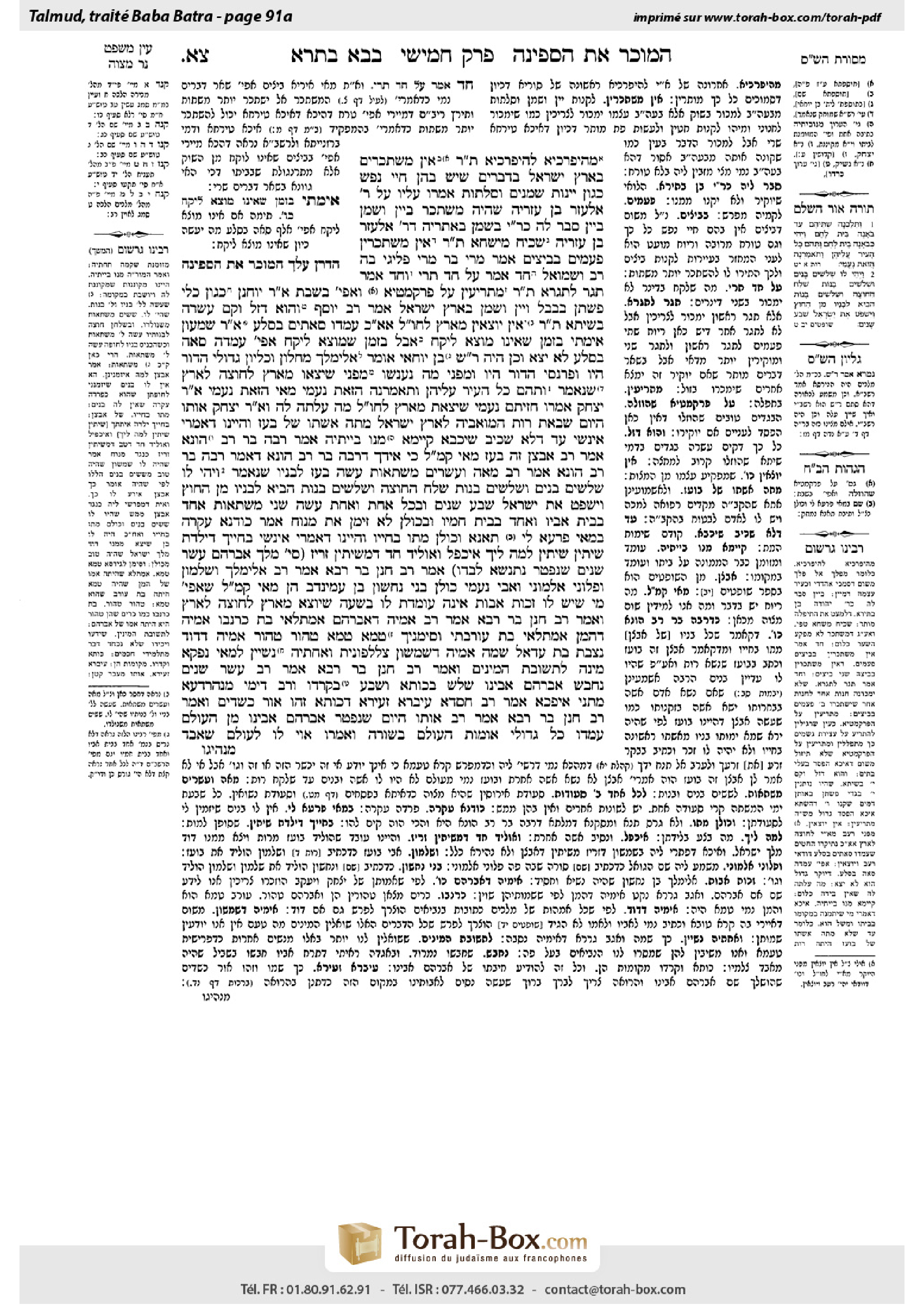
Bava Batra 91a: Talmud study for Daf Yomi
Study the Talmud for Daf Yomi with scanned pages, Hebrew text, English translations from Sefaria and AI-generated French translations.
Passage selection and English or AI-generated French translation are available where the scan has annotations. Daf Study is independent of Torah-Box and Sefaria.
Browse Bava Batra · בבא בתרא · All tractatesBava Batra 91a text and translations
This page of Bava Batra includes the Aramaic text, an English translation and an AI-generated French translation, alongside the scan above.
בבא בתרא צ״א א · Aramaic and Hebrew text
מֵהִיפַּרְכְיָא לְהִיפַּרְכְיָא.
תָּנוּ רַבָּנַן: אֵין מִשְׂתַּכְּרִים בְּאֶרֶץ יִשְׂרָאֵל בִּדְבָרִים שֶׁיֵּשׁ בָּהֶן חַיֵּי נֶפֶשׁ, כְּגוֹן: יֵינוֹת, שְׁמָנִים וּסְלָתוֹת.
אָמְרוּ עָלָיו עַל רַבִּי אֶלְעָזָר בֶּן עֲזַרְיָה, שֶׁהָיָה מִשְׂתַּכֵּר בְּיַיִן וָשֶׁמֶן. בְּיַיִן – סָבַר לַהּ כְּרַבִּי יְהוּדָה; בְּשֶׁמֶן – בְּאַתְרֵיהּ דְּרַבִּי אֶלְעָזָר בֶּן עֲזַרְיָה שְׁכִיחַ מִישְׁחָא.
תָּנוּ רַבָּנַן: אֵין מִשְׂתַּכְּרִין פַּעֲמַיִם בְּבֵיצִים. אָמַר מָרִי בַּר מָרִי: פְּלִיגִי בַּהּ רַב וּשְׁמוּאֵל; חַד אָמַר: עַל חַד תְּרֵי. וְחַד אָמַר: תַּגָּר לְתַגָּרָא.
תָּנוּ רַבָּנַן: מַתְרִיעִין עַל פְּרַקְמַטְיָא, וַאֲפִילּוּ בְּשַׁבָּת.
אָמַר רַבִּי יוֹחָנָן: כְּגוֹן כְּלֵי פִשְׁתָּן בְּבָבֶל, וְיַיִן וָשֶׁמֶן בְּאֶרֶץ יִשְׂרָאֵל. אָמַר רַב יוֹסֵף: וְהוּא דְּזָל וְקָם עַשְׂרָה בְּשִׁיתָּא.
תָּנוּ רַבָּנַן: אֵין יוֹצְאִין מֵאָרֶץ לְחוּץ לָאָרֶץ, אֶלָּא אִם כֵּן עָמְדוּ סָאתַיִם בְּסֶלַע. אָמַר רַבִּי שִׁמְעוֹן: אֵימָתַי – בִּזְמַן שֶׁאֵינוֹ מוֹצֵא לִיקַּח, אֲבָל בִּזְמַן שֶׁמּוֹצֵא לִיקַּח – אֲפִילּוּ עָמְדָה סְאָה בְּסֶלַע, לֹא יֵצֵא.
וְכֵן הָיָה רַבִּי שִׁמְעוֹן בֶּן יוֹחַאי אוֹמֵר: אֱלִימֶלֶךְ, מַחְלוֹן וְכִלְיוֹן, גְּדוֹלֵי הַדּוֹר הָיוּ, וּפַרְנְסֵי הַדּוֹר הָיוּ; וּמִפְּנֵי מָה נֶעְנְשׁוּ? מִפְּנֵי שֶׁיָּצְאוּ מֵאָרֶץ לְחוּצָה לָאָרֶץ, שֶׁנֶּאֱמַר: ״וַתֵּהֹם כׇּל הָעִיר עֲלֵיהֶן, וַתֹּאמַרְנָה הֲזֹאת נׇעֳמִי״. מַאי ״הֲזֹאת נָעֳמִי״? אָמַר רַבִּי יִצְחָק, אָמְרוּ: חֲזִיתֶם נָעֳמִי שֶׁיָּצָאת מֵאָרֶץ לְחוּץ לָאָרֶץ – מָה עָלְתָה לָהּ?
וְאָמַר רַבִּי יִצְחָק: אוֹתוֹ הַיּוֹם שֶׁבָּאת רוּת הַמּוֹאֲבִיָּה לְאֶרֶץ יִשְׂרָאֵל, מֵתָה אִשְׁתּוֹ שֶׁל בֹּעַז. וְהַיְינוּ דְּאָמְרִי אִינָשֵׁי: עַד דְּלָא שָׁכֵיב שִׁיכְבָא – קָיְימָא מְנוּ בַיְיתֵיהּ.
אָמַר רַבָּה בַּר רַב הוּנָא אָמַר רַב: אִבְצָן זֶה בֹּעַז. מַאי קָא מַשְׁמַע לַן? כִּי אִידַּךְ דְּרַבָּה בַּר רַב הוּנָא – דְּאָמַר רַבָּה בַּר רַב הוּנָא אָמַר רַב: מֵאָה וְעֶשְׂרִים מִשְׁתָּאוֹת עָשָׂה בֹּעַז לְבָנָיו, שֶׁנֶּאֱמַר: ״וַיְהִי לוֹ שְׁלֹשִׁים בָּנִים, וּשְׁלֹשִׁים בָּנוֹת שִׁלַּח הַחוּצָה, וּשְׁלֹשִׁים בָּנוֹת הֵבִיא לְבָנָיו מִן הַחוּץ, וַיִּשְׁפֹּט אֶת יִשְׂרָאֵל שֶׁבַע שָׁנִים״.
וּבְכׇל אַחַת וְאַחַת עָשָׂה שְׁנֵי מִשְׁתָּאוֹת – אֶחָד בְּבֵית אָבִיו, וְאֶחָד בְּבֵית חָמִיו; וּבְכוּלָּן לֹא זִימֵּן אֶת מָנוֹחַ – אָמַר: כּוּדָנָא עֲקָרָה, בְּמַאי פָּרְעָא לִי?
תָּאנָא: וְכוּלָּן מֵתוּ בְּחַיָּיו. וְהַיְינוּ דְּאָמְרִי אִינָשֵׁי: ״בְּחַיִּיךְ דִּילַדְתְּ שִׁיתִּין שִׁיתִּין – לְמָה לִיךְ? אִיכְּפַל, וְאוֹלִיד חַד דְּמִשִּׁיתִּין זָרִיז.
(סִימָן: מָלַךְ, אַבְרָהָם, עֶשֶׂר שָׁנִים, שֶׁנִּפְטַר, נִתְנַשֵּׂא לְבַדּוֹ.) אָמַר רַב חָנָן בַּר רָבָא אָמַר רַב: אֱלִימֶלֶךְ, וְשַׂלְמוֹן, וּפְלוֹנִי אַלְמוֹנִי, וַאֲבִי נָעֳמִי – כּוּלָּן בְּנֵי נַחְשׁוֹן בֶּן עַמִּינָדָב הֵן. מַאי קָא מַשְׁמַע לַן? שֶׁאֲפִילּוּ מִי שֶׁיֵּשׁ לוֹ זְכוּת אָבוֹת, אֵינָהּ עוֹמֶדֶת לוֹ בְּשָׁעָה שֶׁיּוֹצֵא מֵאָרֶץ לְחוּצָה לָאָרֶץ.
וְאָמַר רַב חָנָן בַּר רָבָא אָמַר רַב: אִמֵּיהּ דְּאַבְרָהָם – אֲמַּתְלַאי בַּת כַּרְנְבוֹ. אִמֵּיהּ דְּהָמָן – אֲמַּתְלַאי בַּת עוֹרֶבְתִּי. וְסִימָנָיךְ: טָמֵא – טָמֵא, טָהוֹר – טָהוֹר.
אִמֵּיהּ דְּדָוִד – נִצֶּבֶת בַּת עַדְאֵל שְׁמָהּ. אִמֵּיהּ דְּשִׁמְשׁוֹן – צְלֶלְפּוֹנִית, וַאֲחָתֵיהּ נַשְׁיָין. לְמַאי נָפְקָא מִינַּהּ? לִתְשׁוּבַת הַמִּינִים.
וְאָמַר רַב חָנָן בַּר רָבָא אָמַר רַב: עֶשֶׂר שָׁנִים נֶחְבַּשׁ אַבְרָהָם אָבִינוּ – שָׁלֹשׁ בְּכוּתָא, וְשֶׁבַע בְּקַרְדּוּ. וְרַב דִּימִי מִנְּהַרְדְּעָא מַתְנִי אִיפְּכָא. אָמַר רַב חִסְדָּא: עִיבְרָא זְעֵירָא דְּכוּתָא – זֶהוּ אוּר כַּשְׂדִּים.
וְאָמַר רַב חָנָן בַּר רָבָא אָמַר רַב: אוֹתוֹ הַיּוֹם שֶׁנִּפְטַר אַבְרָהָם אָבִינוּ מִן הָעוֹלָם, עָמְדוּ כׇּל גְּדוֹלֵי אוּמּוֹת הָעוֹלָם בְּשׁוּרָה; וְאָמְרוּ: אוֹי לוֹ לָעוֹלָם שֶׁאָבַד
Bava Batra 91a · English translation
from the northernmost province [mehiparkheya] of Eretz Yisrael to the southernmost province of Syria.
The Sages taught: One may not earn a profit in Eretz Yisrael by buying and reselling items that contain an element of basic sustenance, such as wines, oils, and flours, because this causes their price to rise. Rather, those who grow the produce should sell them in the markets, without recourse to a middleman.
The Sages said of Rabbi Elazar ben Azarya that he would earn a profit through the sale of wine and oil. With regard to wine, he holds in accordance with the opinion of Rabbi Yehuda ben Beteira, who says that it is permitted to export wine from Eretz Yisrael despite the fact that this causes it to become more expensive, as drinking wine leads to licentiousness. With regard to oil, in Rabbi Elazar ben Azarya’s locale oil was common; consequently, there was no concern that its price would rise if it were not sold directly to the consumer.
The Sages taught: One may not earn a profit twice from the sale of eggs. Mari bar Mari said: Rav and Shmuel disagree about the meaning of that statement. One said it means that the seller may not charge double the price he paid for the eggs. And one said that one merchant may not sell to another merchant; rather, the merchant who buys from the owner of the eggs must sell directly to the consumer.
§ Apropos price fluctuations, the Gemara cites a baraita. The Sages taught: A community sounds the alarm and gathers in public prayer for merchandise [perakmatya] whose price has dropped. And even on Shabbat it is permitted to cry and plead, even though one may not pray for his personal needs on Shabbat, as this hardship affects the entire public.
Rabbi Yoḥanan said: The baraita is referring specifically to merchandise that serves as the basis of the local economy, such as linen garments in Babylonia, and wine and oil in Eretz Yisrael. Rav Yosef said: And that halakha, that public prayer is recited even on Shabbat, applies only when the merchandise was reduced in price and stood at such prices that goods that had been worth ten are currently selling for six.
The Sages taught: One may not leave Eretz Yisrael to live outside of Eretz Yisrael unless the price of two se’a of grain stood at a sela, which is double its usual price. Rabbi Shimon said: When does this exception, permitting one to leave Eretz Yisrael under certain circumstances, apply? It applies when one is unable to find produce to buy, as he has no money. But when one has money and is able to find produce to buy, even if the price of a se’a of grain stood at a sela, he may not leave.
And Rabbi Shimon ben Yoḥai would likewise say: Elimelech and his sons Mahlon and Chilion were prominent members of their generation and were leaders of their generation. And for what reason were they punished? They were punished because they left Eretz Yisrael to go outside of Eretz Yisrael, as it is stated concerning Naomi and Ruth: “And all the city was astir concerning them, and the women said: Is this Naomi?” (Ruth 1:19). The Gemara asks: What is the meaning of the phrase: “Is this Naomi”? How does this indicate that her husband and sons were punished for leaving Eretz Yisrael? Rabbi Yitzḥak says that the women said: Have you seen what befell Naomi, who left Eretz Yisrael for outside of Eretz Yisrael? Not only did she not escape tribulations there, but she lost her status entirely.
And Rabbi Yitzḥak also says with regard to this passage: That very day when Ruth the Moabite came to Eretz Yisrael, the wife of Boaz died, i.e., from the moment of their arrival the possibility was created for Ruth’s eventual marriage to Boaz. This explains the adage that people say: Before the deceased dies, the person who will next be in charge of his house arises, as in this case Boaz’s new wife, Ruth, arrived as his previous wife died.
Apropos the story of Ruth the Gemara adds: Rabba bar Rav Huna says that Rav says: The judge Ibzan of Bethlehem (see Judges 12:8–10) is Boaz. The Gemara asks: What is he teaching us? The Gemara explains that this comment is in accordance with the other statement of Rabba bar Rav Huna, as Rabba bar Rav Huna says that Rav says: Boaz prepared one hundred and twenty feasts for his children at their weddings. As it is stated, concerning Ibzan: “And he had thirty sons, and thirty daughters he sent abroad, and thirty daughters he brought in from abroad for his sons. And he judged Israel seven years” (Judges 12:9). The verse indicates that he had sixty children.
And at each and every wedding he prepared for his children, he made two feasts, one in the house of the father of the groom and one in the house of the father-in-law of the groom. And he did not invite Manoah, the future father of Samson, whose wife was barren (see Judges 13:2) to any of them, as he said: It is not worth inviting him; he is a sterile mule, how will he pay me back? Manoah will never invite me in return, as he has no children.
A Sage taught: And all of the children of Ibzan died during his lifetime. And this explains the adage that people say: Why do you need the sixty, the sixty children that you beget during your lifetime? Go to the trouble and beget one who will be more diligent than sixty. This adage refers to Boaz, who had sixty children who died, and yet his last child, born from Ruth, is his glory, as King David was born from this line.
The Gemara provides a mnemonic for the ensuing statements that Rav Ḥanan bar Rava said that Rav said: Melech; Abraham; ten years; when he died; and He alone was exalted. Rav Ḥanan bar Rava says that Rav says: With regard to Elimelech, and Boaz’s father, Salmon, and So-and-so, the unnamed relative who was a closer relative to Elimelech than Boaz (Ruth 4:1), and Naomi’s father, all of these are descendants of Nahshon, son of Amminadab, the head of the tribe of Judah (see Ruth 4:20–21 and Numbers 2:3). The Gemara asks: What is he teaching us by this statement? He is teaching that even in the case of one who has the merit of his ancestors to protect him, this merit does not stand for him when he leaves Eretz Yisrael to go outside of Eretz Yisrael, as Elimelech died on account of this sin.
And Rav Ḥanan bar Rava says that Rav says: The mother of Abraham was called Amatlai bat Karnevo. The mother of Haman was called Amatlai bat Orevati. And your mnemonic, to ensure that the two are not confused for one another, is that a raven [orev] is impure, and in this manner one remembers that Orevati is the grandmother of the impure Haman, while a sheep [kar] is pure, which indicates that Karnevo is the grandmother of the pure Abraham.
Rav Ḥanan bar Rava continues: The mother of David was named Natzvat bat Ada’el. The mother of Samson was named Tzelelponit, and his sister was called Nashyan. The Gemara asks: What is the practical difference as to what their names were? The Gemara answers: It is important with regard to an answer for heretics who inquire into the names of these women, which are not stated in the Bible. One can reply that there is a tradition handed down concerning their names.
And Rav Ḥanan bar Rava says that Rav says: Our forefather Abraham was imprisoned for ten years, because he rejected the idol worship that was accepted in his land. He was imprisoned for three years in the city of Khuta, and seven years in Karddu. And Rav Dimi of Neharde’a teaches the opposite, that he was imprisoned seven years in Khuta and three in Karddu. Rav Ḥisda said: The small passage of Khuta, this is Ur of the Chaldeans (see Genesis 11:31).
And Rav Ḥanan bar Rava says that Rav says: On that day when our forefather Abraham left the world, the leaders of the nations of the world stood in a line, in the manner of mourners, and said: Woe to the world that has lost
Bava Batra 91a · Traduction française (IA)
du nord le plus septentrional [mehiparkheya] d'Israël jusqu'au sud le plus méridional de la Syrie.
Les Sages enseignèrent : On ne doit pas réaliser un profit en Israël en achetant et en revendant des denrées alimentaires essentielles, telles que le vin, l'huile et la farine, car cela entraîne une hausse de leur prix. Il est préférable que ceux qui produisent ces denrées les vendent directement aux marchés, sans recours à un intermédiaire.
Les Sages parlèrent de Rabbi Eléazar ben Azarya en disant qu'il réalisait un profit grâce à la vente du vin et de l'huile. En ce qui concerne le vin, il suit l'opinion de Rabbi Yéhouda ben Bétaira, qui affirme que l'exportation du vin d'Israël est permise, même si cela entraîne une hausse de son prix, car boire du vin conduit à la luxure. En ce qui concerne l'huile, dans la région de Rabbi Eléazar ben Azarya, l'huile était courante ; par conséquent, il n'y avait pas de préoccupation quant à une hausse de son prix si elle n'était pas vendue directement au consommateur.
Les Sages enseignèrent : On ne doit pas tirer un profit double à partir de la vente d'œufs. Mari bar Mari dit : Rav et Shmuel s'opposent sur la signification de cette déclaration. L'un disait qu'il s'agissait de dire que le vendeur ne doit pas facturer double le prix qu'il a payé pour les œufs. L'autre disait que l'un des marchands ne doit pas vendre à un autre marchand ; plutôt, le marchand qui achète directement au propriétaire des œufs doit vendre directement au consommateur.
§ En ce qui concerne les fluctuations de prix, le Guemara cite une baraïta. Les Sages enseignèrent : Une communauté sonne l'alarme et se réunit pour prier en public concernant les marchandises [perakmatya] dont le prix a baissé. Et même le sabbat, il est permis de pleurer et de supplier, même si l'on ne peut pas prier pour ses besoins personnels le sabbat, car cette difficulté affecte toute la communauté.
Rabbi Yoḥanan dit : La baraïta fait référence spécifiquement aux marchandises qui constituent la base de l'économie locale, telles que les vêtements en lin en Babylonie, et le vin et l'huile en Eretz Yisrael. Rav Yosef dit : Et cette halakha, que la prière publique est récitée même le sabbat, s'applique uniquement lorsque les marchandises ont baissé de prix et se trouvent à un niveau tel que des denrées qui valaient dix sont maintenant vendues à six.
Les Sages enseignèrent : On ne doit pas quitter Eretz Yisrael pour habiter en dehors d'Eretz Yisrael à moins que le prix de deux se'ah de céréales ne soit égal à un sela, ce qui est double de son prix habituel. Rabbi Shimon dit : Quand cette exception, permettant de quitter Eretz Yisrael sous certaines circonstances, s'applique-t-elle ? Elle s'applique quand on ne peut pas trouver de produits à acheter, car on n'a pas d'argent. Mais quand on a de l'argent et qu'on peut trouver des produits à acheter, même si le prix d'un se'ah de céréales est égal à un sela, on ne doit pas quitter.
Et Rabbi Shimon ben Yoḥai disait également : Elimelech et ses fils Mahlon et Chilion étaient des figures marquantes de leur génération et des leaders de leur époque. Et pour quelle raison furent-ils punis ? Ils furent punis parce qu'ils sont sortis d'Eretz Yisrael pour habiter en dehors d'Eretz Yisrael, comme il est dit concernant Naomi et Ruth : « Et toute la ville était en émoi à leur sujet, et les femmes dirent : C'est-ce que Naomi ? » (Ruth 1:19). Le Guemara demande : Quelle est la signification de la phrase : « C'est-ce que Naomi ? » Comment cela indique-t-il que son mari et ses fils furent punis pour avoir quitté Eretz Yisrael ? Rabbi Yitzḥak dit que les femmes dirent : Avez-vous vu ce qui est arrivé à Naomi, qui est sortie d'Eretz Yisrael pour en dehors d'Eretz Yisrael ? Non seulement elle n'a pas échappé aux tribulations là-bas, mais elle a perdu entièrement son statut.
Et Rabbi Yitzḥak dit également concernant ce passage : Ce jour-là où Ruth la Moabite est arrivée en Eretz Yisrael, la femme de Boaz est morte, c'est-à-dire, dès leur arrivée, la possibilité a été créée pour le mariage ultérieur de Ruth avec Boaz. Cela explique l'adage que les gens disent : Avant que le défunt meure, la personne qui sera à la tête de sa maison arrive, comme dans ce cas, la nouvelle épouse de Boaz, Ruth, est arrivée alors que sa femme précédente était décédée.
Concernant l'histoire de Ruth, la Guemara ajoute : Rabba bar Rav Huna dit que Rav dit : Le juge Ibzan de Béthléem (voir Juges 12:8–10) est Boaz. La Guemara demande : Qu'est-ce que ce commentaire nous apprend ? La Guemara explique que ce commentaire s'inscrit dans l'autre déclaration de Rabba bar Rav Huna, car Rabba bar Rav Huna dit que Rav dit : Boaz a préparé cent vingt festins pour ses enfants lors de leurs mariages. Comme il est dit concernant Ibzan : « Et il avait trente fils, et trente filles qu'il envoya à l'étranger, et trente filles qu'il ramena d'étranger pour ses fils. Et il jugea Israël sept ans » (Juges 12:9). La versette indique qu'il avait soixante enfants.
Et à chaque mariage qu'il préparait pour ses enfants, il préparait deux festins, un dans la maison du père du marié et un dans la maison du beau-père du marié. Et il n'invita pas Manoah, le futur père de Samson, dont la femme était stérile (voir Juges 13:2), à aucun d'eux, car il disait : Il n'est pas utile d'inviter ce dernier ; il est un mulet stérile, comment va-t-il me rembourser ? Manoah ne m'invitera jamais à son tour, car il n'a pas d'enfants.
Un Sage enseigna : Et tous les enfants d'Ibzan moururent pendant sa vie. Et cela explique l'adage que les gens disent : Pourquoi avez-vous besoin des soixante, les soixante enfants que vous engendrez pendant votre vie ? Faites l'effort et engendrez un seul qui sera plus assidu que soixante. Cet adage fait référence à Boaz, qui avait soixante enfants qui moururent, et pourtant son dernier enfant, né de Ruth, est sa gloire, car David, roi, était né de cette lignée.
La Guemara fournit un mnémonique pour les déclarations suivantes que Rav Ḥanan bar Rava a dites que Rav a dit : Melech ; Abraham ; dix ans ; lorsqu'il est mort ; et Il seul fut exalté. Rav Ḥanan bar Rava dit que Rav dit : Concernant Elimelech, et le père de Boaz, Salmon, et celui-là, le parent inconnu qui était un parent plus proche d'Elimelech que Boaz (Ruth 4:1), et le père de Naomi, tous ces derniers sont descendants de Nahshon, fils d'Amminadab, chef de la tribu de Juda (voir Ruth 4:20–21 et Nombres 2:3). La Guemara demande : Qu'est-ce que cette déclaration nous apprend ? Elle apprend que même dans le cas d'une personne qui a le mérite de ses ancêtres pour le protéger, ce mérite ne lui sert pas lorsqu'il quitte la Terre d'Israël pour aller en dehors de la Terre d'Israël, car Elimelech est mort à cause de ce péché.
Et Rav Ḥanan bar Rava dit que Rav dit : La mère d'Abraham s'appelait Amatlai bat Karnevo. La mère d'Haman s'appelait Amatlai bat Orevati. Et votre mnémonique, afin de ne pas confondre les deux, est que un corbeau [orev] est impur, et ainsi on se souvient que Orevati est la grand-mère d'Haman impur, tandis qu'un mouton [kar] est pur, ce qui indique que Karnevo est la grand-mère d'Abraham pur.
Rav Ḥanan bar Rava continue : La mère de David s'appelait Natzvat bat Ada’el. La mère de Samson s'appelait Tzelelponit, et sa sœur s'appelait Nashyan. La Guemara demande : Quelle est la différence pratique concernant leurs noms ? La Guemara répond : C'est important pour répondre aux hérétiques qui interrogent sur les noms de ces femmes, qui ne sont pas mentionnés dans la Bible. On peut répondre qu'il existe une tradition transmise concernant leurs noms.
Et Rav Ḥanan bar Rava dit que Rav dit : Notre ancêtre Abraham fut emprisonné pendant dix ans, car il rejeta l'idolâtrie qui était acceptée dans son pays. Il fut emprisonné trois ans dans la ville de Khuta, et sept ans à Karddu. Et Rav Dimi de Neharde’a enseigne l'opposé, à savoir qu'il fut emprisonné sept ans à Khuta et trois ans à Karddu. Rav Ḥisda a dit : Le petit passage de Khuta, c'est Ur des Chaldéens (voir Genèse 11:31).
Et Rav Ḥanan bar Rava dit que Rav dit : Le jour où notre ancêtre Abraham est parti de ce monde, les chefs des nations du monde se sont alignés en ligne, comme des veufs, et ont dit : Malheur à la monde qui a perdu
Traduction française générée par IA à partir de l’édition anglaise de Sefaria. Vérifie toujours un passage avec le texte source.
Text from Sefaria: William Davidson Edition - Vocalized Aramaic (CC BY NC); William Davidson Edition - English (CC BY NC).