Bava Batra 91b: Talmud study for Daf Yomi
Study the Talmud for Daf Yomi with scanned pages, Hebrew text, English translations from Sefaria and AI-generated French translations.
Passage selection and English or AI-generated French translation are available where the scan has annotations. Daf Study is independent of Torah-Box and Sefaria.
Browse Bava Batra · בבא בתרא · All tractatesBava Batra 91b text and translations
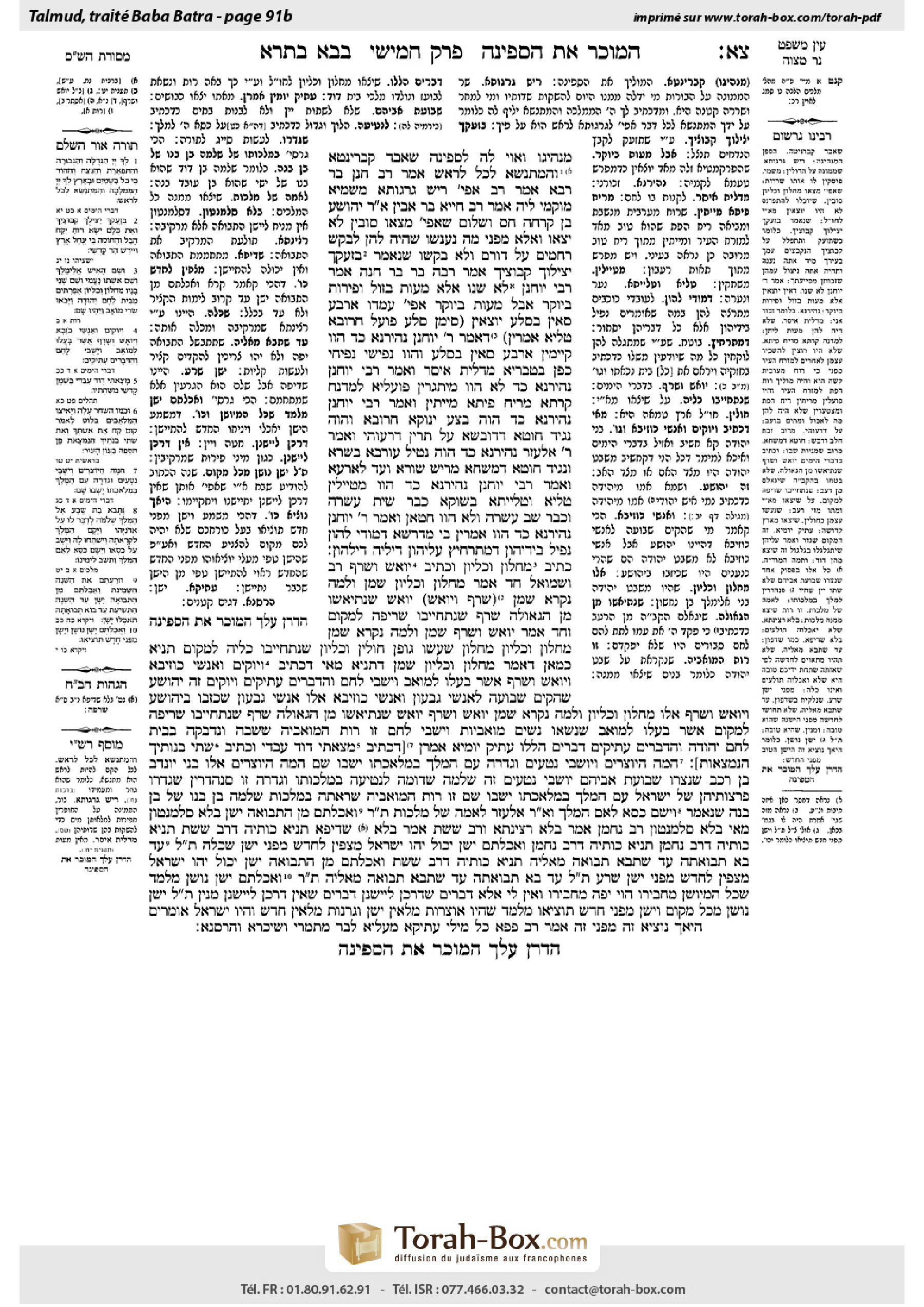
This page of Bava Batra includes the Aramaic text, an English translation and an AI-generated French translation, alongside the scan above.
בבא בתרא צ״א ב · Aramaic and Hebrew text
מַנְהִיגוֹ, וְאוֹי לָהּ לַסְּפִינָה שֶׁאָבַד קַבַּרְנִיטָהּ.
״וְהַמִּתְנַשֵּׂא לְכֹל לְרֹאשׁ״ – אָמַר רַב חָנָן בַּר רָבָא אָמַר רַב: אֲפִילּוּ רֵישׁ גַּרְגּוּתָא, מִשְּׁמַיָּא מוֹקְמִי לֵיהּ.
אָמַר רַב חִיָּיא בַּר אָבִין אָמַר רַבִּי יְהוֹשֻׁעַ בֶּן קׇרְחָה: חַס וְשָׁלוֹם, שֶׁאֲפִילּוּ מָצְאוּ סוּבִּין – לֹא יָצְאוּ. וְאֶלָּא מִפְּנֵי מָה נֶעֶנְשׁוּ? שֶׁהָיָה לָהֶן לְבַקֵּשׁ רַחֲמִים עַל דּוֹרָם, וְלֹא בִּקְּשׁוּ – שֶׁנֶּאֱמַר: ״בְּזַעֲקֵךְ יַצִּילֻךְ קִבּוּצַיִךְ״.
אָמַר רַבָּה בַּר בַּר חָנָה אָמַר רַבִּי יוֹחָנָן: לֹא שָׁנוּ אֶלָּא מָעוֹת בְּזוֹל, וּפֵירוֹת בְּיוֹקֶר; אֲבָל מָעוֹת בְּיוֹקֶר – אֲפִילּוּ עָמְדוּ אַרְבַּע סְאִין בְּסֶלַע, יוֹצְאִין.
(סִימָן: סֶלַע, פּוֹעֵל, חָרוּבָא, טַלְיָא, אָמְרִין.) דְּאָמַר רַבִּי יוֹחָנָן: נְהִירְנָא כַּד הֲווֹ קָיְימִין אַרְבַּע סְאִין בְּסֶלַע; וַהֲווֹ נְפִישִׁי נְפִיחֵי כְפַן בִּטְבֶרְיָא, מִדְּלֵית אִיסָּר. וְאָמַר רַבִּי יוֹחָנָן: נְהִירְנָא כַּד לָא הֲווֹ מִיתַּגְרִין פּוֹעֲלַיָּא לְמַדְנַח קַרְתָּא; מֵרֵיחַ פִּיתָּא מָיְיתִין.
וְאָמַר רַבִּי יוֹחָנָן: נְהִירְנָא כַּד הֲוָה בָּצַע יָנוֹקָא חָרוּבָא; וַהֲוָה נְגִיד חוּטָא דְּדוּבְשָׁא עַל תְּרֵין דְּרָעוֹהִי. וְאָמַר רַבִּי אֶלְעָזָר: נְהִירְנָא כַּד הֲוָה נָטֵיל עוֹרְבָא בִּשְׂרָא; וּנְגִיד חוּטָא דְמִשְׁחָא מֵרֵישׁ שׁוּרָא וְעַד לְאַרְעָא. וְאָמַר רַבִּי יוֹחָנָן: נְהִירְנָא כַּד הֲווֹ מְטַיְּילִין טַלְיָא וְטַלְיְיתָא בְּשׁוּקָא כְּבַר שֵׁית עֶשְׂרֵה וּכְבַר שַׁב עֶשְׂרֵה, וְלָא הֲווֹ חָטַאן. וְאָמַר רַבִּי יוֹחָנָן: נְהִירְנָא כַּד הֲווֹ אָמְרִין בֵּי מִדְרְשָׁא: דְּמוֹדֵי לְהוֹן – נָפֵיל בִּידֵיהוֹן; דְּמִתְרְחִיץ עֲלֵיהוֹן – דִּילֵיהּ דִּילְהוֹן.
כְּתִיב: ״מַחְלוֹן וְכִלְיוֹן״, וּכְתִיב: ״יוֹאָשׁ וְשָׂרָף״ – רַב וּשְׁמוּאֵל; חַד אָמַר: ״מַחְלוֹן״ וְ״כִלְיוֹן״ שְׁמָן, וְלָמָּה נִקְרָא שְׁמָן ״שָׂרָף״ וְ״יוֹאָשׁ״? ״יוֹאָשׁ״ – שֶׁנִּתְיָאֲשׁוּ מִן הַגְּאוּלָּה, ״שָׂרָף״ – שֶׁנִּתְחַיְּיבוּ שְׂרֵיפָה לַמָּקוֹם.
וְחַד אָמַר: ״יוֹאָשׁ״ וְ״שָׂרָף״ שְׁמָן, וְלָמָּה נִקְרָא שְׁמָן ״מַחְלוֹן״ וְ״כִלְיוֹן״? ״מַחְלוֹן״ – שֶׁעָשׂוּ גּוּפָן חוּלִּין, וְ״כִלְיוֹן״ – שֶׁנִּתְחַיְּיבוּ כְּלָיָה לַמָּקוֹם.
תַּנְיָא כְּמַאן דְּאָמַר ״מַחְלוֹן״ וְ״כִלְיוֹן״ שְׁמָן – דְּתַנְיָא, מַאי דִּכְתִיב: ״וְיוֹקִים, וְאַנְשֵׁי כֹזֵבָא, וְיוֹאָשׁ, וְשָׂרָף – אֲשֶׁר בָּעֲלוּ לְמוֹאָב; וְיָשֻׁבִי לָחֶם; וְהַדְּבָרִים עַתִּיקִים״. ״וְיוֹקִים״ – זֶה יְהוֹשֻׁעַ, שֶׁהֵקִים שְׁבוּעָה לְאַנְשֵׁי גִּבְעוֹן. ״וְאַנְשֵׁי כֹזֵבָא״ – אֵלּוּ אַנְשֵׁי גִבְעוֹן, שֶׁכִּזְּבוּ בִּיהוֹשֻׁעַ. ״וְיוֹאָשׁ וְשָׂרָף״ – אֵלּוּ מַחְלוֹן וְכִלְיוֹן. וְלָמָּה נִקְרָא שְׁמָן ״יוֹאָשׁ״ וְ״שָׂרָף״? ״יוֹאָשׁ״ – שֶׁנִּתְיָאֲשׁוּ מִן הַגְּאוּלָּה, ״שָׂרָף״ – שֶׁנִּתְחַיְּיבוּ שְׂרֵיפָה לַמָּקוֹם.
״אֲשֶׁר בָּעֲלוּ לְמוֹאָב״ – שֶׁנָּשְׂאוּ נָשִׁים מוֹאָבִיּוֹת. ״וְיָשֻׁבִי לָחֶם״ – זוֹ רוּת הַמּוֹאֲבִיָּה, שֶׁשָּׁבָה וְנִדְבְּקָה בְּבֵית לֶחֶם יְהוּדָה. ״וְהַדְּבָרִים עַתִּיקִים״ – דְּבָרִים הַלָּלוּ, עַתִּיק יוֹמַיָּא אֲמָרָן; דִּכְתִיב: ״מָצָאתִי דָּוִד עַבְדִּי״, וּכְתִיב: ״שְׁתֵּי בְנֹתֶיךָ הַנִּמְצָאֹת״.
״הֵמָּה הַיּוֹצְרִים וְיֹשְׁבֵי נְטָעִים וּגְדֵרָה, עִם הַמֶּלֶךְ בִּמְלַאכְתּוֹ יָשְׁבוּ שָׁם״; ״הֵמָּה הַיּוֹצְרִים״ – אֵלּוּ בְּנֵי יוֹנָדָב בֶּן רֵכָב, שֶׁנָּצְרוּ שְׁבוּעַת אֲבִיהֶם.
״יֹשְׁבֵי נְטָעִים״ – זֶה שְׁלֹמֹה, שֶׁדּוֹמֶה לִנְטִיעָה בְּמַלְכוּתוֹ. ״וּגְדֵרָה״ – זוֹ סַנְהֶדְרִין, שֶׁגָּדְרוּ פִּרְצוֹתֵיהֶן שֶׁל יִשְׂרָאֵל. ״עִם הַמֶּלֶךְ בִּמְלַאכְתּוֹ יָשְׁבוּ שָׁם״ – זוֹ רוּת הַמּוֹאֲבִיָּה, שֶׁרָאֲתָה בְּמַלְכוּת שְׁלֹמֹה בֶּן בְּנוֹ שֶׁל בֶּן בְּנָהּ – שֶׁנֶּאֱמַר: ״וַיָּשֶׂם כִּסֵּא לְאֵם הַמֶּלֶךְ״, וְאָמַר רַבִּי אֶלְעָזָר: לְאִמָּהּ שֶׁל מַלְכוּת.
תָּנוּ רַבָּנַן: ״וַאֲכַלְתֶּם מִן הַתְּבוּאָה יָשָׁן״ – בְּלֹא סַלְמַנְטוֹן. מַאי ״בְּלֹא סַלְמַנְטוֹן״? רַב נַחְמָן אָמַר: בְּלָא רְצִינְתָּא. וְרַב שֵׁשֶׁת אָמַר: בְּלָא שְׁדִיפָא.
תַּנְיָא כְּוָתֵיהּ דְּרַב שֵׁשֶׁת, תַּנְיָא כְּוָתֵיהּ דְּרַב נַחְמָן. תַּנְיָא כְּוָתֵיהּ דְּרַב נַחְמָן: ״וַאֲכַלְתֶּם יָשָׁן״ – יָכוֹל יְהוּ יִשְׂרָאֵל מְצַפִּין לֶחָדָשׁ, מִפְּנֵי יָשָׁן שֶׁכָּלָה? תַּלְמוּד לוֹמַר: ״עַד בֹּא תְּבוּאָתָהּ״ – עַד שֶׁתָּבֹא תְּבוּאָה מֵאֵלֶיהָ.
תַּנְיָא כְּוָתֵיהּ דְּרַב שֵׁשֶׁת: ״וַאֲכַלְתֶּם מִן הַתְּבוּאָה יָשָׁן״ – יָכוֹל יְהוּ יִשְׂרָאֵל מְצַפִּין לֶחָדָשׁ מִפְּנֵי יָשָׁן שֶׁרַע? תַּלְמוּד לוֹמַר: ״עַד בֹּא תְּבוּאָתָהּ״ – עַד שֶׁתָּבֹא תְּבוּאָה מֵאֵלֶיהָ.
תָּנוּ רַבָּנַן: ״וַאֲכַלְתֶּם יָשָׁן נוֹשָׁן״ – מְלַמֵּד שֶׁכׇּל הַמְיוּשָּׁן מֵחֲבֵירו,ֹ הָוֵי יָפֶה מֵחֲבֵירוֹ. וְאֵין לִי אֶלָּא דְּבָרִים שֶׁדַּרְכָּן לְיַישְּׁנָן; דְּבָרִים שֶׁאֵין דַּרְכָּן לְיַישְּׁנָן – מִנַּיִן? תַּלְמוּד לוֹמַר: ״יָשָׁן נוֹשָׁן״ מִכׇּל מָקוֹם.
״וְיָשָׁן מִפְּנֵי חָדָשׁ תּוֹצִיאוּ״ – מְלַמֵּד שֶׁהָיוּ אוֹצָרוֹת מְלֵאִין יָשָׁן וָגֳרָנוֹת מְלֵאִין חָדָשׁ, וְהָיוּ יִשְׂרָאֵל אוֹמְרִים: הֵיאַךְ נוֹצִיא זֶה מִפְּנֵי זֶה? אָמַר רַב פָּפָּא: כׇּל מִילֵּי עַתִּיקָא – מְעַלְּיָא, לְבַר מִתַּמְרֵי, וְשִׁיכְרָא, וְהַרְסָנָא.
הֲדַרַן עֲלָךְ הַמּוֹכֵר אֶת הַסְּפִינָה
Bava Batra 91b · English translation
its leader, and woe to the ship that has lost its captain.
With regard to leaders, the Gemara adds that it is stated in praise of God: “And You are exalted as head above all” (I Chronicles 29:11). Rav Ḥanan bar Rava says that Rav says: Even one with the most insignificant position of authority, e.g., an appointee over irrigation, is appointed by Heaven.
The Gemara returns to its discussion of the punishment of Elimelech and his sons, which Rabbi Shimon ben Yoḥai says they received because they left Eretz Yisrael. Rav Ḥiyya bar Avin says that Rabbi Yehoshua ben Korḥa says: Heaven forfend that they sinned in this manner, as if Elimelech and his sons had found even bran they would not have left Eretz Yisrael. But rather, for what reason were they punished? They were punished because they should have requested mercy of God for their generation, and they did not request this, as it is stated: “When you cry, let those you have gathered deliver you” (Isaiah 57:13).
Rabba bar bar Ḥana says that Rabbi Yoḥanan says: They taught that it is prohibited to leave Eretz Yisrael only if money is cheap, i.e., not excessively difficult to obtain, and produce is expensive, similar to the case in the baraita where two se’a of wheat are sold for a sela. But when money is expensive, i.e., it is difficult to earn money for sustenance, even if the price of four se’a of grain stood at a sela, one may leave Eretz Yisrael in order to survive.
The Gemara provides a mnemonic for the following list of Rabbi Yoḥanan’s recollections: Sela; laborer; carob; boy; they would say. The first statement is that Rabbi Yoḥanan said: I remember when four se’a of produce were sold for one sela, and yet there were many swollen from hunger in Tiberias, as they did not have even one issar coin with which to purchase food. And Rabbi Yoḥanan further said: I remember when laborers would not agree to work on the east side of the city, because they would die from the smell of the bread that would waft over them from the city’s west side.
The Gemara continues to relate other, more salutary, memories: And Rabbi Yoḥanan said: I remember when a child would break a carob, and a line of honey would extend over his two arms. And Rabbi Elazar said: I remember when a raven would take a piece of meat, and a line of fat would extend from the top of the wall upon which it was standing to the ground. And Rabbi Yoḥanan said: I remember when a boy and girl, of sixteen and seventeen years of age, would walk together in the market, and they would not sin. And Rabbi Yoḥanan said: I remember when they would say in the study hall that one who agrees with the gentiles falls into their hands, and that one who relies on them sees that which is his become theirs.
The Gemara returns to its discussion of the story of Ruth. It is written: “Mahlon and Chilion” (Ruth 1:2), and it is written elsewhere: “Joash and Saraph, who had dominion in Moab” (I Chronicles 4:22). Apparently, both names refer to the same individuals who married Moabite wives. Rav and Shmuel disagreed with regard to their true names. One says: Their given names were Mahlon and Chilion, and why were they called by the names Saraph and Joash? One was called Joash [yoash] because they despaired [nitya’ashu] of the redemption of Eretz Yisrael, as they established themselves in Moab and lived there for many years. The other was called Saraph, because they were liable to receive the punishment of burning [sereifa] for their sins against God, because they left their community.
And one of them says: Their given names were Joash and Saraph, and why were they called by the names Mahlon and Chilion? One was called Mahlon [maḥlon] because they made their bodies profane [ḥullin], and the other was called Chilion [khilyon] because they were liable to receive the punishment of destruction [kelaya] for their sins against God.
The Gemara notes: It is taught in a baraita in accordance with the one who says that their given names were Mahlon and Chilion. As it is taught in a baraita: What is the meaning of that which is written: “And Jokim, and the men of Cozeba, and Joash, and Saraph, who had dominion in Moab, and Jashubi Lehem. And the matters are ancient” (I Chronicles 4:22)? “And Jokim,” this refers to Joshua, who established [shehekim] and kept the oath with people of Gibeon (see Joshua, chapter 9). “And the men of Cozeba,” these are the men of Gibeon, who lied [shekizevu] to Joshua by saying that they came from a distant land. “And Joash, and Saraph,” these are Mahlon and Chilion. And why were they called by the names Joash and Saraph? One was called Joash because they despaired [shenitya’ashu] of the redemption; the other was called Saraph because they were liable to receive the punishment of burning [sereifa] for their sins against God.
“Who had dominion in Moab,” this means that they married Moabite women. “And Jashubi Lehem,” this is referring to Ruth the Moabite, who returned [sheshava] and attached herself to Bethlehem of Judea. “And the matters are ancient,” this means that these matters were said by the Ancient of Days, i.e., they occurred through God’s will, as it is written: “I have found David My servant” (Psalms 89:21); and the same term “found” also appears with regard to the daughters of Lot, as it is written: “Your two daughters that are found here” (Genesis 19:15). This teaches that David’s ancestry can be traced this far back, as he was destined to be born from Moab, who was the son of Lot’s daughter and Lot himself.
The Gemara cites a baraita that analyzes the next verse: “These were the potters, and those who dwelt among plantations and hedges; there they dwelt occupied in the king’s work” (I Chronicles 4:23). “These were the potters [yotzerim],” these are the sons of Jonadab, son of Rechab, who kept [natzeru] their father’s oath.
“Those who dwelt among plantations,” this is referring to Solomon, who in his kingship was similar to a plant. “And hedges [ugdera],” this is the Sanhedrin, which fenced [gaderu] in the breaches of the Jewish people by means of ordinances. “There they dwelt occupied in the king’s work,” this is referring to Ruth the Moabite, who saw the kingship of Solomon, the grandson of her grandson. As it is stated about Solomon: “And he caused a throne to be set for the king’s mother” (I Kings 2:19), and Rabbi Elazar says: This means for the mother of the dynasty of kingship, i.e., Ruth.
§ Since the Gemara has discussed times of famine in Eretz Yisrael, it concludes the chapter with a blessing of times of prosperity: The Sages taught: When the verse states: “And you shall eat of the produce of the old store” (Leviticus 25:22), referring to the produce grown in the sixth year of the Sabbatical cycle, this means without salmanton. The Gemara asks: What is the meaning of: Without salmanton? Rav Naḥman said: Without worms [retzinta] that consume the produce, and Rav Sheshet said: Without blight, which destroys the taste of the produce.
The Gemara notes: It is taught in a baraita in accordance with the opinion of Rav Sheshet, and it is taught in another baraita in accordance with the opinion of Rav Naḥman. It is taught in a baraita in accordance with the opinion of Rav Naḥman: From the verse: “And you shall sow the eighth year, and you shall eat of the produce of the old store, until the ninth year” (Leviticus 25:22), one might have thought that the Jewish people will wait for the new produce because the old store has been destroyed. Therefore the same verse states: “Until its produce comes in,” to indicate that they will not stop eating the old produce until the new produce comes of itself, i.e., until it is fully ripe and they do not need the old produce. The old produce will last until then and will not become worm infested, as stated by Rav Naḥman.
It is taught in a baraita in accordance with the opinion of Rav Sheshet: From the verse: “And you shall eat of the produce of the old store,” one might have thought that the Jewish people will wait for the new produce due to the old store because the old store will have gone bad, since blight will ruin the taste of the produce. Therefore, the verse states: “Until its produce comes in,” which indicates that they will not stop eating the old produce until the new produce comes of itself, as the stored produce will not suffer from blight.
The Sages taught with regard to a verse in the chapter of the blessings stated to the Jewish people: “And you shall eat old store long kept” (Leviticus 26:10). This teaches that any produce that is older than other produce of that same type will be better than that other produce. And I have derived that this is the case only with regard to items for which it is the normal manner to age them. From where do I derive in the case of items for which it is not the normal manner to age them, e.g., fruit, that they too will improve with age? The verse states: “Old store long kept,” a general expression that indicates that in any case the land will keep its produce from spoiling, as all types of produce will improve with age.
The continuation of the verse: “You shall bring forth the old from before the new,” teaches that there will be storehouses full of old produce and threshing floors full of new produce, and the Jewish people will say: How will we manage to take out this produce from the storehouse before that produce is brought in? Rav Pappa said: Everything that is old is superior in quality to the new, except for dates, liquor, and small fish, which are better when they are fresh.
Bava Batra 91b · Traduction française (IA)
son chef, et malheur à la nef qui a perdu son capitaine.
En ce qui concerne les leaders, la Guemara ajoute que cela est dit en l'honneur de Dieu : « Et tu es exalté comme chef au-dessus de tous » (I Chroniques 29:11). Rav Hanan bar Rava dit que Rav dit : même celui qui occupe la position d'autorité la plus insignifiante, par exemple un appointé sur l'irrigation, est nommé par le Ciel.
La Guemara retourne à sa discussion sur la punition d'Elimelech et de ses fils, qui Rabbi Shimon ben Yoḥai dit qu'ils l'ont reçue parce qu'ils sont partis d'Eretz Yisrael. Rav Chiyah bar Avin dit que Rabbi Yehoshua ben Korḥa dit : Dieu merci qu'ils aient commis ce péché de cette manière, car si Elimelech et ses fils avaient trouvé même un peu de blé, ils n'auraient pas quitté Eretz Yisrael. Mais plutôt, pour quelle raison furent-ils punis ? Ils furent punis parce qu'ils auraient dû demander la miséricorde de Dieu pour leur génération, et ils ne l'ont pas demandée, comme il est dit : « Quand tu pleures, que ceux que tu as rassemblés te délivrent » (Isaïe 57:13).
Rabba bar bar Ḥana dit que Rabbi Yoḥanan dit : Ils enseignent que c'est interdit de quitter Eretz Yisrael uniquement si l'argent est bon marché, c'est-à-dire pas excessivement difficile à obtenir, et les produits sont chers, semblable au cas de la baraïta où deux se'a de blé sont vendus pour un sela. Mais quand l'argent est cher, c'est-à-dire qu'il est difficile d'obtenir de l'argent pour subsister, même si le prix de quatre se'a de céréales était un sela, on peut quitter Eretz Yisrael pour survivre.
Le Guemara fournit un mnémonique pour la liste suivante des souvenirs de Rabbi Yoḥanan : sela ; ouvrier ; carob ; enfant ; ils disaient. La première déclaration est que Rabbi Yoḥanan dit : Je me souviens quand quatre se'a de produits étaient vendus pour un sela, et pourtant il y avait beaucoup de personnes gonflées de faim à Tiberias, car ils n'avaient même pas un coin d'issar avec lequel acheter de la nourriture. Et Rabbi Yoḥanan dit encore : Je me souviens quand les ouvriers ne voulaient pas travailler du côté est de la ville, car ils mourraient de l'odeur du pain qui flottait sur eux du côté ouest de la ville.
Le Guemara continue à rapporter d'autres souvenirs plus salutaires : Et Rabbi Yoḥanan dit : Je me souviens quand un enfant cassait un carob, et une ligne de miel s'étendait sur ses deux bras. Et Rabbi Elazar dit : Je me souviens quand un corbeau prenait un morceau de viande, et une ligne de graisse s'étendait du haut du mur sur lequel il était perché jusqu'au sol. Et Rabbi Yoḥanan dit : Je me souviens quand un garçon et une fille, de seize et de dix-sept ans, marchaient ensemble au marché, et ils ne péchaient pas. Et Rabbi Yoḥanan dit : Je me souviens quand ils disaient dans la salle de étude que celui qui s'accorde avec les gentils tombe entre leurs mains, et que celui qui s'appuie sur eux voit que ce qui est à lui devient à eux.
Le Guemara reprend la discussion sur l'histoire de Ruth. Il est écrit : « Mahlon et Chilion » (Ruth 1:2), et il est écrit ailleurs : « Joash et Saraph, qui avaient la domination en Moab » (I Chroniques 4:22). Apparemment, les deux noms désignent les mêmes individus qui se sont mariés à des femmes moabites. Rav et Shmuel étaient en désaccord concernant leurs vrais noms. L'un dit : Leurs noms donnés étaient Mahlon et Chilion, et pourquoi étaient-ils appelés par les noms Saraph et Joash ? L'un était appelé Joash [yoash] parce qu'ils avaient perdu espoir de la rédemption d'Eretz Yisrael, car ils s'étaient établis en Moab et y avaient vécu pendant de nombreuses années. L'autre était appelé Saraph, parce qu'ils étaient condamnés à la punition de brûlement [sereifa] pour leurs péchés contre Dieu, car ils avaient quitté leur communauté.
Et l'un d'eux dit : Leurs noms donnés étaient Joash et Saraph, et pourquoi étaient-ils appelés par les noms Mahlon et Chilion ? L'un était appelé Mahlon [maḥlon] parce qu'ils avaient rendu leurs corps profanes [ḥullin], et l'autre était appelé Chilion [khilyon] parce qu'ils étaient condamnés à la punition de destruction [kelaya] pour leurs péchés contre Dieu.
Le Guemara note : Il est enseigné dans une baraïta selon celui qui dit que leurs noms donnés étaient Mahlon et Chilion. Comme il est enseigné dans une baraïta : Quelle est la signification de ce qui est écrit : « Et Jokim, et les hommes de Cozeba, et Joash, et Saraph, qui avaient la domination en Moab, et Jashubi Lehem. Et les affaires sont anciennes » (I Chroniques 4:22) ? « Et Jokim », cela désigne Josué, qui a établi [shehekim] et a tenu l'engagement avec les gens de Gibeon (voir Josué, chapitre 9). « Et les hommes de Cozeba », ces sont les hommes de Gibeon, qui ont menti [shekizevu] à Josué en disant qu'ils venaient d'une terre lointaine. « Et Joash, et Saraph », ces sont Mahlon et Chilion. Et pourquoi étaient-ils appelés par les noms Joash et Saraph ? L'un était appelé Joash parce qu'ils avaient perdu espoir [shenitya'ashu] de la rédemption ; l'autre était appelé Saraph parce qu'ils étaient condamnés à la punition de brûlement [sereifa] pour leurs péchés contre Dieu.
« Qui avaient la domination en Moab », cela signifie qu'ils se sont mariés à des femmes moabites. « Et Jashubi Lehem », cela fait référence à Ruth la moabite, qui est revenue [sheshava] et s'est attachée à Béthléhem de Juda. « Et les affaires sont anciennes », cela signifie que ces affaires ont été dites par le Père des Temps, c'est-à-dire qu'ils sont survenus selon la volonté de Dieu, comme il est écrit : « J'ai trouvé David Mon serviteur » (Psaumes 89:21) ; et le même terme « trouvé » apparaît également concernant les filles de Lot, comme il est écrit : « Vos deux filles qui sont trouvées ici » (Genèse 19:15). Cela enseigne que la lignée de David remonte aussi loin, car il était destiné à naître de Moab, qui était le fils de la fille de Lot et de Lot lui-même.
Le Guemara cite une baraïta qui analyse le verset suivant : « Ces étaient les potiers, et ceux qui habitaient parmi les plantations et les haies ; là ils habitaient occupés dans le travail du roi » (I Chroniques 4:23). « Ces étaient les potiers [yotzerim] », ces sont les fils de Jonadab, fils de Rechab, qui ont gardé [natzeru] leur serment paternel.
«Ceux qui habitaient parmi les plantations», c'est en référence à Salomon, qui, dans son royaume, était semblable à une plante. «Et les haies [ugdera]», c'est le Sanhédrin, qui a enclos [gaderu] les failles du peuple juif par l'intermédiaire des ordonnances. «Ils y habitaient occupés par le travail du roi», c'est en référence à Ruth la Moabite, qui a vu le royaume de Salomon, le petit-fils de son petit-fils. Comme il est dit à propos de Salomon : «Et il fit dresser un trône pour la mère du roi» (I Rois 2:19), et le maître Eléazar dit : cela signifie pour la mère de la dynastie royale, c'est-à-dire Ruth.
§ Puisque la Guemara a discuté des temps de famine en Eretz Yisraël, elle conclut le chapitre avec une bénédiction de temps de prospérité : Les Sages enseignent : Lorsque la parabole dit : «Et vous mangerez de la production des réserves anciennes» (Lévitique 25:22), en référence à la production cultivée en sixième année du cycle sabbatique, cela signifie sans salmanton. La Guemara demande : Quelle est la signification de «sans salmanton» ? Rav Naḥman dit : sans vers [retzinta] qui dévorent la production, et Rav Sheshet dit : sans pourriture, qui détruit le goût de la production.
La Guemara note : Il est enseigné dans une baraïta selon l'opinion de Rav Sheshet, et il est enseigné dans une autre baraïta selon l'opinion de Rav Naḥman. Il est enseigné dans une baraïta selon l'opinion de Rav Naḥman : De la parole : «Et vous serez semés en huitième année, et vous mangerez de la production des réserves anciennes, jusqu'à la neuvième année» (Lévitique 25:22), on aurait pu penser que le peuple juif attendra la nouvelle production car les réserves anciennes ont été détruites. Par conséquent, la même parole dit : «Jusqu'à ce que sa production arrive», pour indiquer qu'ils ne cesseront pas de manger la production ancienne jusqu'à ce que la nouvelle production arrive d'elle-même, c'est-à-dire jusqu'à ce qu'elle soit pleinement mûre et qu'ils n'auront plus besoin des réserves anciennes. Les réserves anciennes dureront jusqu'à ce moment et ne deviendront pas infestées de vers, comme dit Rav Naḥman.
Il est enseigné dans une baraïta selon l'opinion de Rav Sheshet : De la parole : «Et vous mangerez de la production des réserves anciennes», on aurait pu penser que le peuple juif attendra la nouvelle production en raison des réserves anciennes, car les réserves anciennes auront été détériorées, la pourriture ruinant le goût de la production. Par conséquent, la parole dit : «Jusqu'à ce que sa production arrive», ce qui indique qu'ils ne cesseront pas de manger la production ancienne jusqu'à ce que la nouvelle production arrive d'elle-même, la production stockée ne souffrant pas de pourriture.
Les Sages enseignent concernant une parole du chapitre des bénédictions données au peuple juif : « Et vous mangerez de la production des réserves anciennes » (Lévitique 26:10). Cela enseigne que toute production plus ancienne que d'autres productions de ce même type sera meilleure que ces autres productions. Et j'ai déduit cela uniquement concernant les choses pour lesquelles il est normal de les faire vieillir. D'où déduis-je, dans le cas des choses pour lesquelles il n'est pas normal de les faire vieillir, par exemple les fruits, que celles-ci s'amélioreront également avec l'âge ? La parole dit : « Réserves anciennes longtemps conservées », une expression générale indiquant que, dans tous les cas, la terre conservera sa production de ne pas se gâter, car toutes sortes de productions s'améliorent avec l'âge.
La continuation de la parole : « Vous sortirez l'ancien avant le nouveau », enseigne qu'il y aura des greniers remplis de productions anciennes et des claies remplies de productions nouvelles, et le peuple juif dira : Comment ferons-nous pour sortir cette production des greniers avant que celle-ci ne soit apportée ? Rav Pappa dit : Tout ce qui est ancien est supérieur en qualité à ce qui est nouveau, sauf les dattes, les boissons et les petits poissons, qui sont meilleurs lorsqu'ils sont frais.
Traduction française générée par IA à partir de l’édition anglaise de Sefaria. Vérifie toujours un passage avec le texte source.
Text from Sefaria: William Davidson Edition - Vocalized Aramaic (CC BY NC); William Davidson Edition - English (CC BY NC).