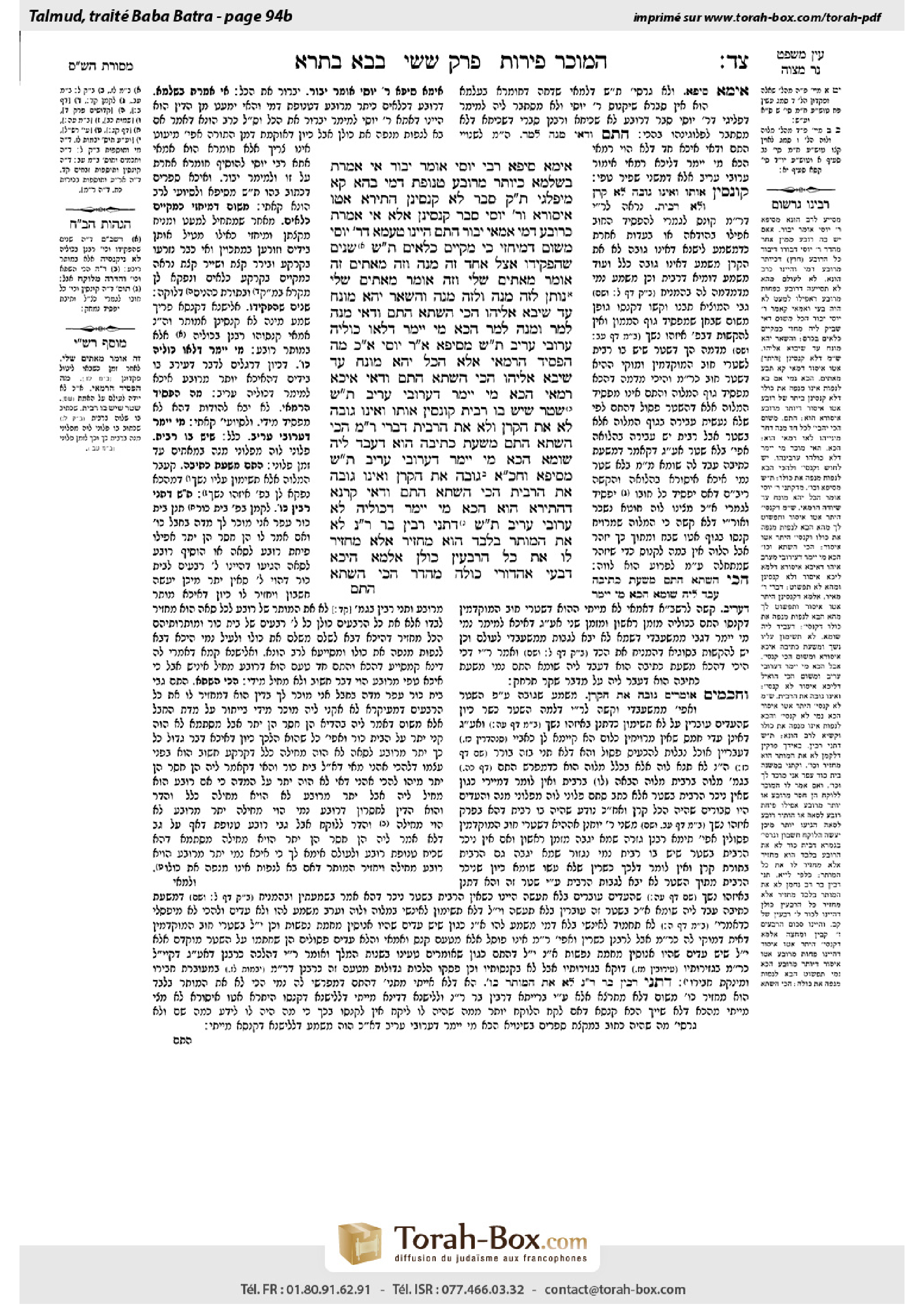
Bava Batra 94b: Talmud study for Daf Yomi
Study the Talmud for Daf Yomi with scanned pages, Hebrew text, English translations from Sefaria and AI-generated French translations.
Passage selection and English or AI-generated French translation are available where the scan has annotations. Daf Study is independent of Torah-Box and Sefaria.
Browse Bava Batra · בבא בתרא · All tractatesBava Batra 94b text and translations
This page of Bava Batra includes the Aramaic text, an English translation and an AI-generated French translation, alongside the scan above.
בבא בתרא צ״ד ב · Aramaic and Hebrew text
אֵימָא סֵיפָא – רַבִּי יוֹסֵי אוֹמֵר: יָבוֹר.
אִי אָמְרַתְּ בִּשְׁלָמָא כְּיוֹתֵר מֵרוֹבַע טִנּוֹפֶת דָּמֵי, בְּהָא קָא מִיפַּלְגִי – תַּנָּא קַמָּא סָבַר: לָא קָנְסִינַן הֶתֵּירָא אַטּוּ אִיסּוּרָא, וְרַבִּי יוֹסֵי סָבַר: קָנְסִינַן. אֶלָּא אִי אָמְרַתְּ כְּרוֹבַע דָּמֵי, אַמַּאי יָבוֹר?
הָתָם הַיְינוּ טַעְמָא דְּרַבִּי יוֹסֵי – מִשּׁוּם דְּמִיחֲזֵי כִּי מְקַיֵּים כִּלְאַיִם.
תָּא שְׁמַע: שְׁנַיִם שֶׁהִפְקִידוּ אֵצֶל אֶחָד, זֶה מָנֶה וְזֶה מָאתַיִם; זֶה אוֹמֵר: ״מָאתַיִם שֶׁלִּי״, וְזֶה אוֹמֵר: ״מָאתַיִם שֶׁלִּי״ – נוֹתֵן לָזֶה מָנֶה וְלָזֶה מָנֶה, וְהַשְּׁאָר יְהֵא מוּנָּח עַד שֶׁיָּבֹא אֵלִיָּהוּ!
הָכִי הַשְׁתָּא?! הָתָם, וַדַּאי מָנֶה לְמָר וּמָנֶה לְמָר; הָכָא, מִי יֵימַר דְּלָאו כּוּלֵּיהּ עָרוֹבֵי עָרֵיב?
תָּא שְׁמַע מִסֵּיפָא – אָמַר רַבִּי יוֹסֵי: אִם כֵּן, מָה הִפְסִיד הָרַמַּאי? אֶלָּא הַכֹּל יְהֵא מוּנָּח עַד שֶׁיָּבֹא אֵלִיָּהוּ.
הָכִי הַשְׁתָּא?! הָתָם וַדַּאי אִיכָּא רַמַּאי, הָכָא מִי יֵימַר דְּעָרוֹבֵי עָרֵיב.
תָּא שְׁמַע: שְׁטָר שֶׁיֵּשׁ בּוֹ רִבִּית – קוֹנְסִין אוֹתוֹ, וְאֵינוֹ גּוֹבֶה לֹא אֶת הַקֶּרֶן וְלֹא אֶת הָרִבִּית; דִּבְרֵי רַבִּי מֵאִיר!
הָכִי הַשְׁתָּא?! הָתָם מִשְּׁעַת כְּתִיבָה הוּא דַּעֲבַד לֵיהּ שׂוּמָא, הָכָא מִי יֵימַר דְּעָרוֹבֵי עָרֵיב.
תָּא שְׁמַע מִסֵּיפָא – וַחֲכָמִים אוֹמְרִים: גּוֹבֶה אֶת הַקֶּרֶן, וְאֵינוֹ גּוֹבֶה אֶת הָרִבִּית!
הָכִי הַשְׁתָּא?! הָתָם וַדַּאי קַרְנָא דְּהֶתֵּירָא הוּא, הָכָא מִי יֵימַר דְּכוּלֵּיהּ לָא עָרוֹבֵי עָרֵיב.
תָּא שְׁמַע, דְּתָנֵי רָבִין בַּר רַב נַחְמָן: לֹא אֶת הַמּוֹתָר בִּלְבַד הוּא מַחֲזִיר, אֶלָּא מַחֲזִיר לוֹ אֶת כָּל הָרְבָעִין כּוּלָּן. אַלְמָא הֵיכָא דְּבָעֵי אַהְדּוֹרֵי – כּוּלַּהּ מַהְדַּר!
הָכִי הַשְׁתָּא?!
Bava Batra 94b · English translation
say the latter clause of the mishna: Rabbi Yosei says: It is insufficient to merely reduce the quantity of seeds of a different kind; rather, one must pick out all the seeds of a different kind.
The Gemara explains the difficulty: Granted, if you say that a quarter-kav of seeds of a different kind per se’a with regard to diverse kinds is comparable to more than a quarter-kav of impurities per se’a with regard to a sale, then it is about this that they disagree: The first tanna holds that we do not penalize one by requiring him to remove that which is permitted due to that which is prohibited, and consequently it is sufficient to merely reduce the quantity of seeds of a different kind to an acceptable level, whereas Rabbi Yosei holds that we do penalize one by requiring him to remove that which is permitted due to that which is prohibited. But if you say that a quarter-kav of seeds of a different kind per se’a with regard to diverse kinds is comparable to a quarter-kav of impurities per se’a with regard to a sale, then why does Rabbi Yosei rule that one must pick out all the seeds of a different kind?
The Gemara answers: There, with regard to diverse kinds, this is the reasoning of Rabbi Yosei: One must pick out all the seeds, because once he is purifying the admixture of seeds, if he deliberately leaves a quantity of seeds of a different kind mixed in, it appears as though he is intentionally planting and maintaining diverse kinds in his field.
The Gemara suggests: Come and hear another challenge to Rav Huna’s ruling from a mishna (Bava Metzia 37a): In the case of two people who deposited money with one person, and this one deposited one hundred dinars and that one deposited two hundred dinars, and when they return to collect their deposits, this one says: My deposit was two hundred dinars, and that one says: My deposit was two hundred dinars, the bailee gives one hundred dinars to this one and one hundred dinars to that one, and the rest of the money, i.e., the contested one hundred dinars, will be placed in a safe place until Elijah comes and prophetically determines the truth. In this case, one of the parties is certainly lying, but nevertheless, the Sages did not penalize the parties by placing all of the money in a safe place. Similarly, in the case of a sale, where a seller deceitfully mixed additional impurities into the produce he sold, he should not be penalized and required to take back all of the impurities.
The Gemara rejects this challenge: How can these cases be compared? There, in the case of the deposits, it is certain that at least one hundred dinars belongs to this Master and one hundred dinars belongs to that Master. Here, in the case of a sale where there is an unacceptable proportion of impurities mixed in, who can say that the seller did not mix in the entire amount intentionally? Accordingly, no proof can be drawn from the mishna.
The Gemara suggests: Come and hear a support for Rav Huna’s ruling from the latter clause of that mishna: Rabbi Yosei says: If so, what did the swindler lose? He lost nothing by claiming the one hundred dinars that belongs to another, and he has no incentive to admit the truth. Rather, the entire deposit will be placed in a safe place until Elijah comes. Since through his lie the swindler risks losing even the one hundred dinars that he deposited, perhaps that will induce him to admit his deceit. According to Rabbi Yosei, the Sages did penalize one who acts deceitfully, which accords with Rav Huna’s ruling.
The Gemara rejects the proof: How can these cases be compared? There, in the case of the deposits, there is certainly a swindler, and it is reasonable to penalize both parties in order to induce the swindler to admit his deceit. Here, in the case of a sale where there is an unacceptable level of impurities mixed in with the produce, who can say that the seller intentionally mixed in anything? Perhaps the impurities were inadvertently mixed in during the processing. Accordingly, no proof can be drawn from the mishna.
The Gemara suggests: Come and hear another support for Rav Huna’s ruling from a baraita: In the case of a promissory note in which the details of a loan with interest were written, the court penalizes the creditor, and he may collect neither the principal nor the interest; this is the statement of Rabbi Meir. According to Rabbi Meir, the Sages did penalize one who acts improperly, which accords with Rav Huna’s ruling.
The Gemara rejects the proof: How can these cases be compared? There, in the case of a loan with interest, it is already at the time of the writing of the bill that the lender performed the transgression of placing interest upon the borrower. Since he certainly committed a transgression, it is reasonable that the Sages penalized him. But here, in the case of a sale where there is an unacceptable proportion of impurities mixed in with the produce, who can say that the seller intentionally mixed in anything? Perhaps the impurities were inadvertently mixed in during the processing. Accordingly, no proof can be drawn from the baraita.
The Gemara suggests: Come and hear a challenge to Rav Huna’s ruling from the latter clause of the baraita: But the Rabbis say: He may collect the principal but may not collect the interest. According to Rabbi Meir, the Sages did not penalize one who acts improperly, contrary to Rav Huna’s ruling.
The Gemara rejects this challenge: How can these cases be compared? There, in the case of a loan with interest, according to strict halakha it is certainly permitted to collect the principal, so the Sages did not penalize him with regard to it. But here, in the case of a sale where there is an unacceptable proportion of impurities mixed in, who can say that the seller did not mix in the entire amount intentionally? Accordingly, no proof can be drawn from the mishna.
Come and hear further support for Rav Huna’s ruling from that which Ravin bar Rav Naḥman teaches (104b). Ravin bar Rav Naḥman’s statement is with regard to a situation when land that was sold is later found to be larger than stated at the time of the sale. If the deviation is not more than an area required to sow a quarter-kav of seed per beit se’a of land, then the buyer need not return any land to the seller. If the proportion of extra land is larger than this, not only must the buyer return the extra land that is beyond the limit of a quarter-kav area per beit se’a, but he must also return to him every one of the extra quarter-kav areas of land that he received beyond the stated area of a beit kor. The Gemara infers: Apparently, when one is required to return part of a sale because of a discrepancy that is beyond the acceptable limit of deviation, then one is required to return the entire discrepancy and not just the amount that is beyond the acceptable limit. This supports Rav Huna’s ruling.
The Gemara rejects this: How can these cases be compared?
Bava Batra 94b · Traduction française (IA)
dites la seconde partie de la mitsna : Rabbi Yosei dit : Il n'est pas suffisant de simplement réduire la quantité de grain d'une autre espèce ; il faut plutôt enlever tous les grains d'une autre espèce.
La Guemara explique la difficulté : Cela est admis, si vous dites qu'un quart de kav de grain d'une autre espèce par se'a concernant les espèces diverses est comparable à plus d'un quart de kav d'impuretés par se'a concernant une vente, alors c'est à ce sujet qu'ils discutent : le premier tanna affirme que nous ne sanctionnons pas celui qui doit enlever ce qui est permis en raison de ce qui est interdit, et par conséquent il suffit de simplement réduire la quantité de grain d'une autre espèce à un niveau acceptable, tandis que Rabbi Yosei affirme que nous sanctionnons celui qui doit enlever ce qui est permis en raison de ce qui est interdit. Mais si vous dites qu'un quart de kav de grain d'une autre espèce par se'a concernant les espèces diverses est comparable à un quart de kav d'impuretés par se'a concernant une vente, alors pourquoi Rabbi Yosei déclare-t-il qu'il faut enlever tous les grains d'une autre espèce ?
La Guemara répond : Là, concernant les espèces diverses, c'est la raisonnement de Rabbi Yosei : il faut enlever tous les grains, car une fois qu'on purifie l'admixture des grains, si l'on laisse délibérément une quantité de grain d'une autre espèce mélangée, cela semble comme si l'on plantait et maintenait des espèces diverses dans son champ.
La Guemara suggère : Venez écouter un autre défi à la décision de Rav Huna à partir d'une mitsva (Bava Metzia 37a) : Dans le cas de deux personnes qui ont déposé de l'argent auprès d'une personne, et cette personne a déposé cent dinars et celle-ci a déposé deux cents dinars, et lorsqu'ils reviennent récupérer leurs dépôts, cette personne dit : Mon dépôt était deux cents dinars, et celle-ci dit : Mon dépôt était deux cents dinars, le gardien donne cent dinars à cette personne et cent dinars à celle-ci, et le reste de l'argent, c'est-à-dire les cent dinars contestés, sera mis en lieu sûr jusqu'à ce que l'ange Elie vienne et détermine la vérité prophétiquement. Dans ce cas, l'une des parties est certainement menteuse, mais néanmoins les Sages n'ont pas sanctionné les parties en plaçant tout l'argent en lieu sûr. De même, dans le cas d'une vente, où un vendeur a mélangé intentionnellement des impuretés supplémentaires dans les produits qu'il a vendus, il ne devrait pas être sanctionné et contraint de récupérer toutes les impuretés.
La Guemara rejette ce défi : Comment peuvent ces cas être comparés ? Là, dans le cas des dépôts, il est certain que au moins cent dinars appartiennent à ce maître et cent dinars à celui-ci. Ici, dans le cas d'une vente où il y a une proportion inacceptable d'impuretés mélangées, qui peut dire que le vendeur n'a pas mélangé l'intégralité de la quantité intentionnellement ? Ainsi, aucun argument ne peut être tiré de la mitsva.
La Guemara suggère : Venez écouter un soutien pour la décision de Rav Huna à partir de la seconde partie de cette mitsna : Rabbi Yosei dit : Si tel est le cas, que a perdu le trompeur ? Il a perdu rien en prétendant que les cent dinars appartiennent à un autre, et il n'a pas d'incentif à avouer la vérité. Plutôt, l'ensemble du dépôt sera mis en lieu sûr jusqu'à ce que l'ange Elie vienne. Puisque par son mensonge le trompeur risque de perdre même les cent dinars qu'il a déposés, peut-être cela l'incitera à avouer son mensonge. Selon Rabbi Yosei, les Sages ont sanctionné celui qui agit de manière trompeuse, ce qui correspond à la décision de Rav Huna.
La Guemara rejette cette preuve : Comment peuvent ces cas être comparés ? Là, dans le cas des dépôts, il y a certainement un trompeur, et il est raisonnable de sanctionner les deux parties afin d'inciter le trompeur à avouer son mensonge. Ici, dans le cas d'une vente où il y a une proportion inacceptable d'impuretés mélangées avec les produits, qui peut dire que le vendeur a mélangé intentionnellement quelque chose ? Peut-être les impuretés ont été mélangées accidentellement lors du traitement. Ainsi, aucune preuve ne peut être tirée de la mitsna.
La Guemara suggère : Venez écouter un autre soutien pour la décision de Rav Huna à partir d'une baraïta : Dans le cas d'un billet de promesse où les détails d'un prêt à intérêt ont été écrits, le tribunal sanctionne le créancier, et il ne peut ni récupérer le principal ni l'intérêt ; c'est la déclaration de Rabbi Meir. Selon Rabbi Meir, les Sages ont sanctionné celui qui agit de manière incorrecte, ce qui correspond à la décision de Rav Huna.
La Guemara rejette cette preuve : Comment peuvent ces cas être comparés ? Là, dans le cas d'un prêt à intérêt, il est déjà à l'époque de l'écriture du billet que le prêteur a commis la transgression de placer un intérêt sur le prêteur. Puisqu'il a certainement commis une transgression, il est raisonnable que les Sages l'aient sanctionné. Mais ici, dans le cas d'une vente où il y a une proportion inacceptable d'impuretés mélangées avec les produits, qui peut dire que le vendeur a mélangé intentionnellement quelque chose ? Peut-être les impuretés ont été mélangées accidentellement lors du traitement. Ainsi, aucune preuve ne peut être tirée de la baraïta.
La Guemara suggère : Venez écouter un défi à la décision de Rav Huna à partir de la seconde partie de la baraïta : Mais les Rabbins disent : Il peut récupérer le principal mais ne peut pas récupérer l'intérêt. Selon Rabbi Meir, les Sages n'ont pas sanctionné celui qui agit de manière incorrecte, contrairement à la décision de Rav Huna.
La Guemara rejette ce défi : Comment peuvent ces cas être comparés ? Là, dans le cas d'un prêt à intérêt, selon la halakha stricte, il est certainement permis de récupérer le principal, donc les Sages n'ont pas sanctionné en ce qui concerne cela. Mais ici, dans le cas d'une vente où il y a une proportion inacceptable d'impuretés mélangées, qui peut dire que le vendeur n'a pas mélangé l'intégralité de la quantité intentionnellement ? Ainsi, aucun argument ne peut être tiré de la mitsna.
Viens écouter une autre preuve en faveur de la décision de Rav Huna, tirée de ce que Ravin bar Rav Naḥman enseigne (104b). La déclaration de Ravin bar Rav Naḥman concerne une situation où un terrain vendu est ultérieurement découvert être plus vaste que ce qui avait été indiqué lors de la vente. Si la déviation ne dépasse pas une surface suffisante pour semer un quart de kav de grain par beit se’a de terrain, alors l'acheteur n'a pas besoin de rendre de terrain au vendeur. Si la proportion de terrain supplémentaire est plus grande que cela, non seulement l'acheteur doit rendre le terrain excédentaire au-delà du seuil d'un quart de kav par beit se’a, mais il doit aussi rendre au vendeur chaque quart de kav supplémentaire de terrain qu'il a reçu au-delà de la surface indiquée d'un beit kor. La Guemara en déduit : Apparemment, lorsqu'on est tenu de rendre une partie d'une vente en raison d'une inexactitude dépassant la limite acceptable de déviation, on est tenu de rendre l'ensemble de l'inexactitude et non seulement la quantité au-delà de la limite acceptable. Cela soutient la décision de Rav Huna.
La Guemara rejette cela : Comment peuvent ces cas être comparés ?
Traduction française générée par IA à partir de l’édition anglaise de Sefaria. Vérifie toujours un passage avec le texte source.
Text from Sefaria: William Davidson Edition - Vocalized Aramaic (CC BY NC); William Davidson Edition - English (CC BY NC).