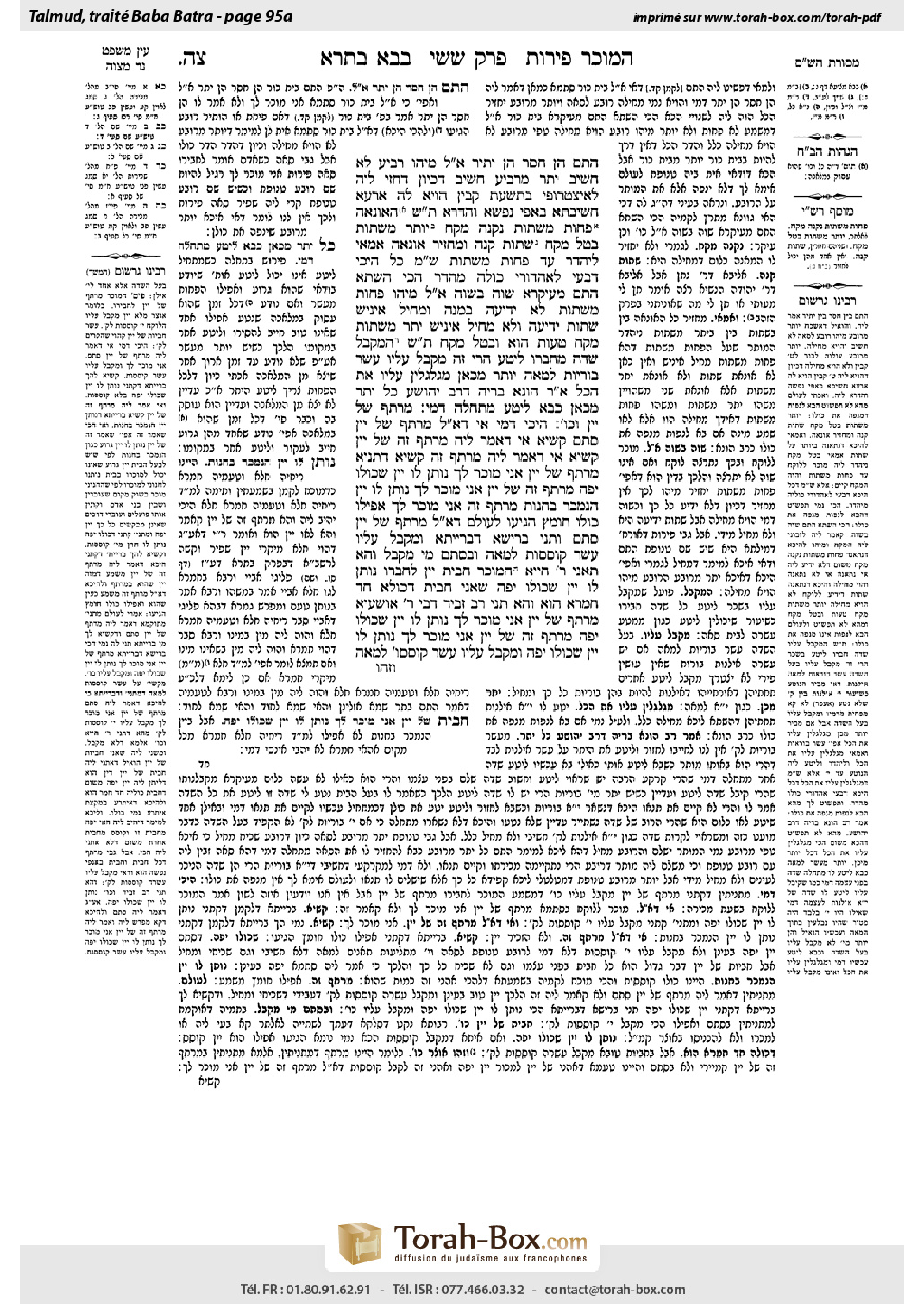
Bava Batra 95a: Talmud study for Daf Yomi
Study the Talmud for Daf Yomi with scanned pages, Hebrew text, English translations from Sefaria and AI-generated French translations.
Passage selection and English or AI-generated French translation are available where the scan has annotations. Daf Study is independent of Torah-Box and Sefaria.
Browse Bava Batra · בבא בתרא · All tractatesBava Batra 95a text and translations
This page of Bava Batra includes the Aramaic text, an English translation and an AI-generated French translation, alongside the scan above.
בבא בתרא צ״ה א · Aramaic and Hebrew text
הָתָם, ״הֵן חָסֵר הֵן יָתֵיר״ אֲמַר לֵיהּ, מִיהוּ רְבִיעַ לָא חֲשִׁיב; יָתֵר מֵרְבִיעַ – חֲשִׁיב,
דְּכֵיוָן דַּחֲזֵי לֵיהּ לְאִיצְטְרוֹפֵי בְּתִשְׁעַת קַבִּין, הָוְיָא לַהּ אַרְעָא חֲשִׁיבְתָּא בְּאַפֵּי נַפְשָׁא; וְהָדְרָא.
תָּא שְׁמַע: הָאוֹנָאָה; פָּחוֹת מִשְּׁתוּת – נִקְנֶה מִקָּח, יוֹתֵר מִשְּׁתוּת – בָּטֵל מִקָּח. שְׁתוּת – קָנָה, וּמַחְזִיר אוֹנָאָה.
אַמַּאי? לַיהְדַּר עַד פָּחוֹת מִשְּׁתוּת! שְׁמַע מִינַּהּ, כׇּל הֵיכִי דְּבָעֵי לְאַהְדּוֹרֵי – כּוּלַּהּ מַהְדַּר!
הָכִי הַשְׁתָּא?! הָתָם, מֵעִיקָּרָא שָׁוֶה בְּשָׁוֶה אֲמַר לֵיהּ, מִיהוּ, פָּחוֹת מִשְּׁתוּת לָא יְדִיעָה בְּמָנֶה, וּמָחֵיל אִינִישׁ; שְׁתוּת – יְדִיעָה, וְלָא מָחֵיל אִינִישׁ, יָתֵר מִשְּׁתוּת – מִקָּח טָעוּת הוּא, וּבָטֵל מִקָּח.
תָּא שְׁמַע: הַמְקַבֵּל שָׂדֶה מֵחֲבֵרוֹ לִיטַּע – הֲרֵי זֶה מְקַבֵּל עָלָיו עֶשֶׂר בּוֹרִיּוֹת לְמֵאָה. יוֹתֵר מִכָּאן – מְגַלְגְּלִין עָלָיו אֶת הַכֹּל.
אָמַר רַב הוּנָא בְּרֵיהּ דְּרַב יְהוֹשֻׁעַ: כׇּל יָתֵר מִכָּאן, כְּבָא לִיטַּע מִתְּחִלָּה דָּמֵי.
מַרְתֵּף שֶׁל יַיִן וְכוּ׳. הֵיכִי דָּמֵי? אִי דְּאָמַר לֵיהּ: ״מַרְתֵּף שֶׁל יַיִן״ סְתָם – קַשְׁיָא; אִי דְּאָמַר לֵיהּ: ״מַרְתֵּף זֶה שֶׁל יַיִן״ – קַשְׁיָא.
אִי דְּאָמַר לֵיהּ: ״מַרְתֵּף זֶה״ – קַשְׁיָא, דְּתַנְיָא: ״מַרְתֵּף שֶׁל יַיִן אֲנִי מוֹכֵר לָךְ״ – נוֹתֵן לוֹ יַיִן שֶׁכּוּלּוֹ יָפֶה. ״מַרְתֵּף זֶה שֶׁל יַיִן אֲנִי מוֹכֵר לָךְ״ – נוֹתֵן לוֹ יַיִן הַנִּמְכָּר בַּחֲנוּת. ״מַרְתֵּף זֶה אֲנִי מוֹכֵר לָךְ״ – אֲפִילּוּ כּוּלּוֹ חוֹמֶץ, הִגִּיעוֹ!
לְעוֹלָם דְּאָמַר לֵיהּ ״מַרְתֵּף שֶׁל יַיִן״ – סְתָם, וְתָנֵי בְּרֵישָׁא דְבָרַיְיתָא: וּמְקַבֵּל עָלָיו עֶשֶׂר קוֹסְסוֹת לְמֵאָה.
וּבִסְתָם מִי מְקַבֵּל?! וְהָא תָּאנֵי רַבִּי חִיָּיא: הַמּוֹכֵר חָבִית יַיִן לַחֲבֵרוֹ – נוֹתֵן לוֹ יַיִן שֶׁכּוּלּוֹ יָפֶה! שָׁאנֵי חָבִית, דְּכוּלָּא חַד חַמְרָא הוּא.
וְהָא תָּנֵי רַב זְבִיד דְּבֵי רַבִּי אוֹשַׁעְיָא: ״מַרְתֵּף שֶׁל יַיִן אֲנִי מוֹכֵר לָךְ״ – נוֹתֵן לוֹ יַיִן שֶׁכּוּלּוֹ יָפֶה. ״מַרְתֵּף זֶה שֶׁל יַיִן אֲנִי מוֹכֵר לָךְ״ – נוֹתֵן לוֹ יַיִן שֶׁכּוּלּוֹ יָפֶה, וּמְקַבֵּל עָלָיו עֶשֶׂר קוֹסְסוֹת לְמֵאָה,
Bava Batra 95a · English translation
There, in the case of the sale of land, the reason the buyer may keep the extra land when it is less than the acceptable limit is that the seller said to him: I am selling you this piece of land whether it is slightly less or slightly more than a beit kor, i.e., he agrees to accept a small deviation from the stated area. But while an extra quarter-kav area per beit se’a is not significant, and therefore the seller is willing to forgo it, more than a quarter-kav area per beit se’a is significant, and the seller is not willing to forgo any of it. Consequently, all of the extra land must be returned. By contrast, in the case of Rav Huna’s ruling, the buyer is aware that it is normal to have a certain proportion of impurities mixed in and accepts this possibility from the outset. Accordingly, even if the proportion of impurities is greater than the acceptable limit, it might be sufficient if the seller takes back only the quantity of impurities above the acceptable limit.
The Gemara explains why more than an area required to sow a quarter-kav of seed per beit se’a of land is significant: The reason is that since all those extra areas of land are fit to combine together to form an area in which one could sow nine kav of seed, the extra land is a significant plot of land in its own right, and therefore it must all be returned. The land that was sold was stated to be a beit kor, which is thirty beit se’a. If the area of the extra land was of a proportion somewhat more than an area required to sow a quarter-kav of seed per beit se’a of land, then thirty such areas would collectively be about equal to an area required to sow nine kav.
The Gemara suggests: Come and hear a support for Rav Huna’s ruling from a baraita: The halakha of price exploitation is that if the disparity is less than one-sixth of the value of the merchandise, the merchandise is acquired immediately and the sum of the exploitation need not be returned. If the disparity is greater than one-sixth, then the transaction is nullified. If the disparity is precisely one-sixth, the buyer has acquired the merchandise, and the one who benefited from the exploitation returns the entire sum of the exploitation.
The Gemara explains the proof: Why, in the case where the disparity is precisely one-sixth, is the entire sum of the exploitation returned? Instead, let him return only a small amount of the exploitation until the difference is less than one-sixth. The Gemara concludes: Learn from the fact that he must return the entire sum that when one is required to return part of a sale because of a discrepancy that is beyond the acceptable limit of deviation, one is required to return the entire discrepancy and not just the amount that is beyond the acceptable limit. This supports Rav Huna’s ruling.
The Gemara rejects this: How can these cases be compared? There, in the case of exploitation, the seller initially said to the buyer that he would sell the merchandise for a sum equal to its value. Any price difference should be unacceptable. But a disparity of less than one-sixth is not recognizable in a sale worth one hundred dinars, and a person will forgo it. By contrast, a disparity of one-sixth is considered significant, and a person will not forgo it. Consequently, the entire sum of the exploitation must be returned. If the disparity is greater than one-sixth, it is a mistaken transaction and the transaction is nullified. By contrast, in the case of Rav Huna’s ruling, the buyer is aware that it is normal to have a certain proportion of impurities mixed in and accepted that possibility from the outset. Accordingly, even if the proportion of impurities was greater than the acceptable limit, it might be sufficient if the seller takes back only the quantity of impurities above the acceptable limit.
The Gemara suggests: Come and hear a support for Rav Huna’s ruling from a baraita: When one receives a field from another under a contract to plant trees in it, then this field owner accepts upon himself that there may be ten deficient trees per every hundred trees planted, as he is aware that not every tree planted will necessarily flourish. If the number of deficient trees is more than this, the court imposes upon him the responsibility to replace all of those trees, and not only the number of trees above the acceptable limit. This supports Rav Huna’s ruling.
Rav Huna, son of Rav Yehoshua, said: There is no proof from this case, because any time there are more than this number of deficient trees, the overall area that contains the deficient trees is of a size equivalent to a whole field. Therefore, the contractor is comparable to one who comes to plant a whole field from the outset, who has not fulfilled his remit if he plants only a few trees; rather, he must plant the entire area. But in the case of Rav Huna’s ruling, the impurities never constitute an independent unit; consequently, it might be sufficient if the seller takes back only the quantity of impurities that is above the acceptable limit.
§ The mishna teaches: When purchasing a cellar containing barrels of wine, one accepts upon himself that up to ten barrels of souring wine may be present in each hundred barrels purchased. The Gemara asks: What are the circumstances of the sale? If one said to the buyer: I am selling to you a wine cellar, without specification of which cellar he meant, it is difficult, as the Gemara will soon explain. And if he said to him: I am selling to you this particular wine cellar, it is difficult.
The Gemara elaborates: If he said to him: I am selling to you this particular wine cellar, it is difficult, as it is taught in a baraita: If one said to a buyer: I am selling to you a wine cellar, then he is required to give him wine that is all of good quality, i.e., the buyer does not have to accept any quantity of souring wine. If he said: I am selling to you this particular wine cellar, then he may give him the wine that is in his possession, even if it is of the quality that is sold in the shops, i.e., it is beginning to sour. If he said: I am selling to you this particular cellar, without mentioning the word: Wine, then even if everything he gives him is wine that had turned into vinegar, it has come to the buyer and the sale is valid. The mishna’s ruling that the buyer must accept that up to ten percent of the wine might be souring does not accord with any of the rulings of the baraita.
The Gemara answers: Actually, the mishna concerns a case when he said to the buyer: I am selling to you a wine cellar, without specification of which cellar he was selling. And emend the baraita and teach the following qualification in the first clause of the baraita: And the buyer accepts upon himself that up to ten barrels of souring wine may be present in each hundred barrels purchased.
The Gemara challenges this addition: But if he sold the buyer a wine cellar without specification of which one he was selling, does the buyer accept upon himself any souring wine at all? Didn’t Rabbi Ḥiyya teach: One who sells a barrel of wine to another must give him wine that is all of good quality? The Gemara answers: A barrel is different, because the wine inside is all one body of wine of the same quality.
The Gemara once again challenges the addition: But didn’t Rav Zevid teach a baraita of the school of Rabbi Oshaya: If one says to a buyer: I am selling to you a wine cellar, then he is required to give him wine that is all of good quality? Similarly, if he said: I am selling to you this particular wine cellar, then he is required to give him wine that is all of good quality, but the buyer accepts upon himself ten souring barrels per hundred barrels.
Bava Batra 95a · Traduction française (IA)
Là, dans le cas d'une vente de terre, la raison pour laquelle l'acheteur peut conserver la terre supplémentaire lorsqu'elle est inférieure à la limite acceptable est que le vendeur a dit à l'acheteur : Je te vends cette parcelle de terre, qu'elle soit légèrement plus ou moins grande qu'un beit kor, c'est-à-dire qu'il accepte une petite déviation par rapport à la surface indiquée. Cependant, alors qu'une surface supplémentaire d'un quart de kav par beit se’a n'est pas significative, et donc le vendeur est prêt à la renoncer, plus d'un quart de kav par beit se’a est significatif, et le vendeur n'est pas prêt à renoncer à aucune de ces surfaces. Par conséquent, toute la terre supplémentaire doit être rendue. À l'inverse, dans le cas du jugement de Rav Huna, l'acheteur sait qu'il est normal de trouver une certaine proportion d'impuretés mélangées et accepte cette possibilité dès le départ. Ainsi, même si la proportion d'impuretés est supérieure à la limite acceptable, il pourrait suffire que le vendeur rende uniquement la quantité d'impuretés au-delà de la limite acceptable.
La Guemara explique pourquoi une surface supérieure à celle nécessaire pour semer un quart de kav de grain par beit se’a est significative : la raison est que puisque toutes ces surfaces supplémentaires sont adaptées à être combinées pour former une surface dans laquelle on pourrait semer neuf kav de grain, cette terre supplémentaire est une parcelle de terre à part entière et doit donc être entièrement rendue. La terre vendue était indiquée comme un beit kor, c'est-à-dire trente beit se’a. Si la surface de la terre supplémentaire était proportionnelle à un quart de kav de grain par beit se’a, trente de ces surfaces combinées seraient équivalentes à une surface nécessaire pour semer neuf kav.
La Guemara suggère : Viens écouter un soutien pour le jugement de Rav Huna à partir d'une baraïta : La halakha de l'exploitation du prix est que si la différence est inférieure à un sixième de la valeur des marchandises, les marchandises sont acquises immédiatement et la somme de l'exploitation n'a pas besoin d'être rendue. Si la différence est supérieure à un sixième, la transaction est annulée. Si la différence est exactement un sixième, l'acheteur a acquis les marchandises, et celui qui a bénéficié de l'exploitation rend l'intégralité de la somme de l'exploitation.
La Guemara explique la preuve : Pourquoi, dans le cas où la différence est exactement un sixième, la somme totale de l'exploitation doit-elle être rendue ? Au lieu de cela, laisse-le rendre uniquement une petite partie de l'exploitation jusqu'à ce que la différence soit inférieure à un sixième. La Guemara conclut : Apprends-en que l'on doit rendre l'intégralité de la différence lorsque l'on est tenu de rendre une partie d'une vente en raison d'une divergence au-delà de la limite acceptable de déviation, on est tenu de rendre l'intégralité de la divergence et non seulement la quantité au-delà de la limite acceptable. Cela soutient le jugement de Rav Huna.
La Guemara refuse cette comparaison : Comment peuvent ces cas être comparés ? Là, dans le cas d'exploitation, le vendeur a dit à l'acheteur qu'il lui vendait les marchandises pour une somme égale à leur valeur. Toute différence de prix devrait être inacceptable. Cependant, une différence inférieure à un sixième n'est pas identifiable dans une vente d'une centaine de dinars, et une personne la renonce. À l'inverse, une différence d'un sixième est considérée comme significative, et une personne ne la renonce pas. Par conséquent, l'intégralité de la somme de l'exploitation doit être rendue. Si la différence est supérieure à un sixième, c'est une transaction erronée et la transaction est annulée. À l'inverse, dans le cas du jugement de Rav Huna, l'acheteur sait qu'il est normal de trouver une certaine proportion d'impuretés mélangées et a accepté cette possibilité dès le départ. Ainsi, même si la proportion d'impuretés était supérieure à la limite acceptable, il pourrait suffire que le vendeur rendît uniquement la quantité d'impuretés au-delà de la limite acceptable.
La Guemara suggère : Viens écouter un soutien pour le jugement de Rav Huna à partir d'une baraïta : Lorsqu'on reçoit un champ d'un autre sous contrat de planter des arbres dedans, alors le propriétaire de ce champ accepte qu'il puisse y avoir dix arbres défectueux par cent arbres plantés, car il sait que non chaque arbre planté ne fleurira nécessairement. Si le nombre d'arbres défectueux est supérieur à cela, la cour impose à lui la responsabilité de remplacer tous ces arbres, et non seulement le nombre d'arbres au-delà de la limite acceptable. Cela soutient le jugement de Rav Huna.
Rav Huna, fils de Rav Yéhoshua, a dit : Il n'y a pas de preuve dans ce cas, car chaque fois qu'il y a plus de ce nombre d'arbres défectueux, la surface contenant ces arbres défectueux est de la taille d'un champ entier. Par conséquent, le contractant est comparable à celui qui vient planter un champ entier dès le départ, qui n'a pas rempli son contrat s'il plante seulement quelques arbres ; il doit planter l'ensemble de la surface. Cependant, dans le cas du jugement de Rav Huna, les impuretés ne constituent jamais une unité indépendante ; par conséquent, il pourrait suffire que le vendeur rendît uniquement la quantité d'impuretés au-delà de la limite acceptable.
§ La mitsna enseigne : Lorsqu'on achète un cellier contenant des barriques de vin, on accepte qu'il puisse y avoir jusqu'à dix barriques de vin rance par cent barriques achetées. La Guemara pose la question : Quelles sont les circonstances de la vente ? Si l'on a dit à l'acheteur : Je te vends un cellier de vin, sans préciser lequel, c'est difficile, car la Guemara l'expliquera bientôt. Et si l'on a dit à l'acheteur : Je te vends ce cellier particulier, c'est également difficile.
La Guemara développe : Si l'on dit à un acheteur : Je vends à toi ce chai de vin particulier, c'est difficile, car il est enseigné dans une baraïta : Si l'on dit à un acheteur : Je vends à toi un chai de vin, alors il est tenu de lui donner du vin de bonne qualité, c'est-à-dire que l'acheteur n'a pas à accepter toute quantité de vin qui commence à s'acidifier. Si l'on dit : Je vends à toi ce chai de vin particulier, alors il peut lui donner le vin qu'il possède, même s'il est de la qualité vendue dans les boutiques, c'est-à-dire qu'il commence à s'acidifier. Si l'on dit : Je vends à toi ce chai particulier, sans mentionner le mot : vin, alors même si tout ce qu'il lui donne est du vin devenu vinaigre, cela arrive à l'acheteur et la vente est valide. La décision de la mitsva selon laquelle l'acheteur doit accepter que jusqu'à dix pour cent du vin puisse être en train de s'acidifier ne correspond à aucune des décisions de la baraïta.
La Guemara répond : En réalité, la mitsva concerne un cas où l'on dit à l'acheteur : Je vends à toi un chai de vin, sans préciser lequel. Et corrige la baraïta et enseigne la suivante qualification dans la première phrase de la baraïta : Et l'acheteur s'engage à ce que jusqu'à dix barils de vin en train de s'acidifier puissent être présents dans chaque cent barils achetés.
La Guemara conteste cette addition : Mais si l'on vend à l'acheteur un chai de vin sans préciser lequel, l'acheteur s'engage-t-il à tout type de vin en train de s'acidifier ? N'a-t-il pas enseigné Rabbi Ḥiyya : Celui qui vend un baril de vin à un autre doit lui donner du vin de bonne qualité ? La Guemara répond : Le baril est différent, car le vin à l'intérieur est une seule masse de vin de la même qualité.
La Guemara conteste à nouveau cette addition : Mais n’a-t-il pas enseigné Rav Zevid une baraïta de la maison de Rabbi Oshaya : Si l’on dit à un acheteur : Je vends à toi un chai de vin, alors il est tenu de lui donner du vin de bonne qualité ? De même, si l’on dit : Je vends à toi ce chai de vin particulier, alors il est tenu de lui donner du vin de bonne qualité, mais l’acheteur s’engage à dix barils en train de s’acidifier par cent barils.
Traduction française générée par IA à partir de l’édition anglaise de Sefaria. Vérifie toujours un passage avec le texte source.
Text from Sefaria: William Davidson Edition - Vocalized Aramaic (CC BY NC); William Davidson Edition - English (CC BY NC).