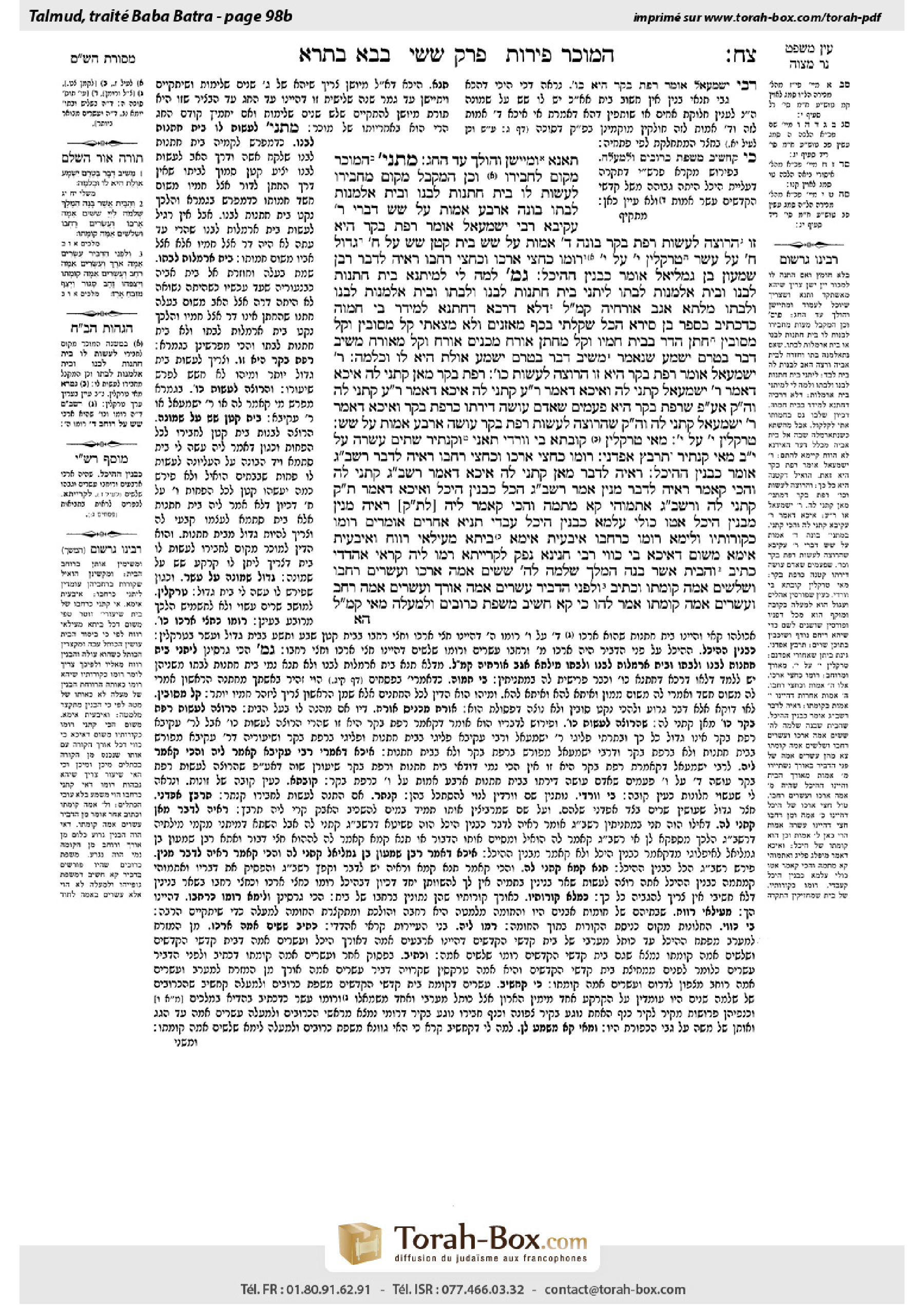
Bava Batra 98b: Talmud study for Daf Yomi
Study the Talmud for Daf Yomi with scanned pages, Hebrew text, English translations from Sefaria and AI-generated French translations.
Passage selection and English or AI-generated French translation are available where the scan has annotations. Daf Study is independent of Torah-Box and Sefaria.
Browse Bava Batra · בבא בתרא · All tractatesBava Batra 98b text and translations
This page of Bava Batra includes the Aramaic text, an English translation and an AI-generated French translation, alongside the scan above.
בבא בתרא צ״ח ב · Aramaic and Hebrew text
תָּאנָא: וּמְיַישֵּׁן וְהוֹלֵךְ עַד הַחַג.
מַתְנִי׳ הַמּוֹכֵר מָקוֹם לַחֲבֵירוֹ, וְכֵן הַמְקַבֵּל מָקוֹם מֵחֲבֵירוֹ לַעֲשׂוֹת לוֹ בֵּית חַתְנוּת לִבְנוֹ וּבֵית אַלְמְנוּת לְבִתּוֹ – בּוֹנֶה אַרְבַּע אַמּוֹת עַל שֵׁשׁ, דִּבְרֵי רַבִּי עֲקִיבָא. רַבִּי יִשְׁמָעֵאל אוֹמֵר: רֶפֶת בָּקָר הִיא זוֹ!
הָרוֹצֶה לַעֲשׂוֹת רֶפֶת בָּקָר – בּוֹנֶה אַרְבַּע אַמּוֹת עַל שֵׁשׁ.
בַּיִת קָטָן – שֵׁשׁ עַל שְׁמוֹנֶה, גָּדוֹל – שְׁמוֹנֶה עַל עֶשֶׂר, טְרַקְלִין – עֶשֶׂר עַל עֶשֶׂר. רוּמוֹ כַּחֲצִי אׇרְכּוֹ וְכַחֲצִי רׇחְבּוֹ. רְאָיָה לַדָּבָר – רַבָּן שִׁמְעוֹן בֶּן גַּמְלִיאֵל אוֹמֵר: כְּבִנְיַן הַהֵיכָל.
גְּמָ׳ לְמָה לִי לְמִיתְנָא ״בֵּית חַתְנוּת לִבְנוֹ, וּבֵית אַלְמְנוּת לְבִתּוֹ״? לִיתְנֵי ״בֵּית חַתְנוּת לִבְנוֹ וּלְבִתּוֹ, וּבֵית אַלְמְנוּת לִבְנוֹ וּלְבִתּוֹ״! מִלְּתָא אַגַּב אוֹרְחֵיהּ קָא מַשְׁמַע לַן, דְּלָא דַּרְכָּא דְחַתְנָא לְמֵידַר בֵּי חֲמוּהּ –
כְּדִכְתִיב בְּסֵפֶר בֶּן סִירָא: הַכֹּל שָׁקַלְתִּי בְּכַף מֹאזְנַיִם, וְלֹא מָצָאתִי קַל מִסּוּבִּין; וְקַל מִסּוּבִּין – חָתָן הַדָּר בְּבֵית חָמִיו; וְקַל מֵחָתָן – אוֹרֵחַ מַכְנִיס אוֹרֵחַ; וְקַל מֵאוֹרֵחַ – מֵשִׁיב דָּבָר בְּטֶרֶם יִשְׁמָע – שֶׁנֶּאֱמַר: ״מֵשִׁיב דָּבָר בְּטֶרֶם יִשְׁמָע אִוֶּלֶת הִיא לוֹ וּכְלִמָּה״.
רַבִּי יִשְׁמָעֵאל אוֹמֵר: רֶפֶת בָּקָר הִיא זוֹ! הָרוֹצֶה לַעֲשׂוֹת כּוּ׳. רֶפֶת בָּקָר מַאן קָתָנֵי לַהּ? אִיכָּא דְּאָמַר רַבִּי יִשְׁמָעֵאל קָתָנֵי לַהּ, וְאִיכָּא דְּאָמַר רַבִּי עֲקִיבָא קָתָנֵי לַהּ.
אִיכָּא דְּאָמַר רַבִּי עֲקִיבָא קָתָנֵי לַהּ – וְהָכִי קָאָמַר: אַף עַל פִּי שֶׁרֶפֶת בָּקָר הִיא, פְּעָמִים שֶׁאָדָם עוֹשֶׂה דִּירָתוֹ כְּרֶפֶת בָּקָר. וְאִיכָּא דְּאָמַר רַבִּי יִשְׁמָעֵאל קָתָנֵי לַהּ – וְהָכִי קָאָמַר: שֶׁהָרוֹצֶה לַעֲשׂוֹת רֶפֶת בָּקָר, עוֹשֶׂה אַרְבַּע אַמּוֹת עַל שֵׁשׁ.
טְרַקְלִין עֶשֶׂר עַל עֶשֶׂר. מַאי טְרַקְלִין? קוּבְּתָא בֵּי וַורְדֵי.
תָּאנֵי: וְקַנְתֵּיר – שְׁתֵּים עֶשְׂרֵה עַל שְׁתֵּים עֶשְׂרֵה. מַאי קַנְתֵּיר? תַּרְבֵּץ אַפַּדְנֵי.
רוּמוֹ כַּחֲצִי אׇרְכּוֹ וְכַחֲצִי רׇחְבּוֹ, רְאָיָה לַדָּבָר – רַבָּן שִׁמְעוֹן בֶּן גַּמְלִיאֵל אוֹמֵר: כְּבִנְיַן הַהֵיכָל. ״רְאָיָה לַדָּבָר״ מַאן קָתָנֵי לַהּ? אִיכָּא דְּאָמַר רַבָּן שִׁמְעוֹן בֶּן גַּמְלִיאֵל קָתָנֵי לַהּ – וְהָכִי קָאָמַר: רְאָיָה לַדָּבָר מִנַּיִן? אָמַר רַבָּן שִׁמְעוֹן בֶּן גַּמְלִיאֵל: הַכֹּל כְּבִנְיַן הֵיכָל.
וְאִיכָּא דְּאָמַר תַּנָּא קַמָּא קָתָנֵי לַהּ – וְרַבָּן שִׁמְעוֹן בֶּן גַּמְלִיאֵל אַתְמוֹהֵי קָא מַתְמַהּ, וְהָכִי קָאָמַר לֵיהּ [לְתַנָּא קַמָּא]: רְאָיָה מִנַּיִן – מִבִּנְיַן הֵיכָל?! אַטּוּ כּוּלֵּי עָלְמָא כְּבִנְיַן הֵיכָל עָבְדִי?
תַּנְיָא, אֲחֵרִים אוֹמְרִים: רוּמוֹ – כְּקוֹרוֹתָיו. וְלֵימָא: רוּמוֹ כְּרׇחְבּוֹ! אִיבָּעֵית אֵימָא: בֵּיתָא מֵעִילַּאי רָוַוח, וְאִיבָּעֵית אֵימָא: מִשּׁוּם דְּאִיכָּא בֵּי כַוֵּוי.
רַבִּי חֲנִינָא נְפַק לְקִרְיָיתָא, רְמוֹ לֵיהּ קְרָאֵי אַהֲדָדֵי – כְּתִיב: ״וְהַבַּיִת אֲשֶׁר בָּנָה הַמֶּלֶךְ שְׁלֹמֹה לַה׳ – שִׁשִּׁים אַמָּה אׇרְכּוֹ, וְעֶשְׂרִים רׇחְבּוֹ, וּשְׁלֹשִׁים אַמָּה קוֹמָתוֹ״; וּכְתִיב: ״וְלִפְנֵי הַדְּבִיר – עֶשְׂרִים אַמָּה אֹרֶךְ, וְעֶשְׂרִים אַמָּה רֹחַב, וְעֶשְׂרִים אַמָּה קוֹמָתוֹ״! אֲמַר לְהוּ: כִּי קָא חָשֵׁיב – מִשְּׂפַת כְּרוּבִים וּלְמַעְלָה.
מַאי קָא מַשְׁמַע לַן?
Bava Batra 98b · English translation
It is taught in a baraita: And where he sold him aged wine, he is responsible to provide wine that will continue to age, i.e., maintain its quality, until the festival of Sukkot.
MISHNA: With regard to one who sells a plot of land to another, with the buyer intending to build a bridal house for his son or a widowhood home for his daughter on that plot, and similarly, with regard to a contractor who receives a plot of land from another under a commission to build for the owner on that land a bridal house for his son, or a widowhood home for his daughter, the terms of the transaction are a matter of dispute. The mishna presents the dispute: In the latter case, the contractor must build a building that is at least four cubits by six cubits in size, and similarly, in the case of the sale, the seller must provide a plot of land that can accommodate a building of that size; this is the statement of Rabbi Akiva. Rabbi Yishmael says: A structure of this size is a cowshed, and a bridal house or a widowhood home is larger than that.
One who wants to construct a cowshed builds a structure at least four cubits by six cubits in size.
The mishna delineates the standard dimensions for various other structures. A small house is six by eight cubits. A large house is eight by ten cubits. A banquet hall [teraklin] is ten by ten cubits. The standard height for each of these structures is equal to the sum of half its length and half its width. There is a proof of the matter; Rabban Shimon ben Gamliel says: The proportions are like the building of the Sanctuary; it was forty cubits wide and twenty cubits long and its height was thirty cubits, which is the sum of half the width and half the length.
GEMARA: Why do I need the mishna to teach specifically: A bridal house for his son, and: A widowhood home for his daughter? Instead, let it teach: A bridal house for his son or his daughter, and a widowhood home for his son or his daughter. The Gemara answers: It teaches us a matter in passing, that it is not the proper manner of conduct for a son-in-law to live in his father-in-law’s home. Therefore, it is the father of the groom who generally provides a bridal home for the couple and the bride will return to live near her parents’ house only if she is widowed or divorced.
Support for this is as it is written in the book of ben Sira: I have weighed everything in the pan of a balance scale and I have not found anything inferior to bran; but inferior to bran is a son-in-law who lives in his father-in-law’s house; and inferior to a son-in-law is a guest who brings in a guest; and inferior to a guest is one who answers a matter before he listens. As it is stated: “He that gives an answer before he listens, it is folly for him and a disgrace” (Proverbs 18:13).
§ The mishna teaches: Rabbi Yishmael says: A structure of this size is a cowshed. And then the mishna continues: One who wants to construct a cowshed builds a structure at least four cubits by six cubits in size. The Gemara asks: Who teaches this subsequent clause about a cowshed? There is a Sage who says that Rabbi Yishmael teaches it and it is an elaboration of his statement. And there is a Sage who says that Rabbi Akiva teaches it in response to Rabbi Yishmael’s statement.
The Gemara elaborates: There is a Sage who says that Rabbi Akiva teaches it, and this is what Rabbi Akiva is saying: Even though this structure is of the same dimensions as a cowshed, nevertheless, since there are times when a person constructs his home as small as a cowshed, a contractor has fulfilled his commission if he builds a house to such dimensions. And there is a Sage who says that Rabbi Yishmael teaches it, and this is what Rabbi Yishmael is saying to Rabbi Akiva: The dimensions that you stated are clearly not the correct dimensions for a bridal house or widowhood home, as one who wants to construct a cowshed constructs a structure of four cubits by six cubits. A house for human dwelling is certainly larger than that.
§ The mishna teaches: A banquet hall is ten by ten cubits. The Gemara clarifies: What is a banquet hall? A pavilion of roses.
It is taught in a baraita: The standard size of a kanteir is twelve by twelve cubits. The Gemara clarifies: What is a kanteir? It is a decorative courtyard of a mansion.
The mishna teaches: The standard height for each of these structures is equal to the sum of half its length and half its width. There is a proof of the matter; Rabban Shimon ben Gamliel says: The proportions are like the building of the Sanctuary. The Gemara asks: Who teaches the phrase: Proof of the matter? There is a Sage who says that Rabban Shimon ben Gamliel teaches it, and this is what he is saying: From where can a proof of the matter be derived? The mishna then cites that Rabban Shimon ben Gamliel said that everything is like the building of the Sanctuary.
And there is a Sage who says that the first tanna teaches it, and, understanding that the proof the tanna wished to cite was from the example of the Sanctuary, Rabban Shimon ben Gamliel interjected and expressed astonishment at the idea. And this is what Rabban Shimon ben Gamliel is saying to the first tanna: From where do you derive a proof? Do you derive it from the building of the Sanctuary? Is that to say that everyone constructs their buildings like the building of the Sanctuary? Why should they do so?
It is taught in a baraita: Aḥerim say: The standard height of each of these structures is equal to the length of its crossbeams. The Gemara suggests: And let us say more simply that its height is equal to its width. The Gemara answers: If you wish, say that formulating the ruling in this way is necessary, because the space inside a house widens at the top, as the walls get thinner toward the top and the crossbeams are actually longer than the width of the floor of the building. And if you wish, say instead that formulating it in this way is necessary because there are indentations in the wall into which the crossbeams are inserted. The crossbeams are consequently longer than the space inside the house.
§ Apropos the building of the Sanctuary, the Gemara relates the following incident: Rabbi Ḥanina once went out to the villages to teach Torah there, and he raised a contradiction between two verses that detail the dimensions of the Sanctuary: It is written: “And the house that King Solomon built for the Lord, was sixty cubits in length, and twenty cubits in width, and its height was thirty cubits” (I Kings 6:2). But it is also written: “And before the partition was twenty cubits in length, and twenty cubits in width, and its height was twenty cubits” (I Kings 6:20). The first verse states that its height was thirty cubits, whereas the second verse states that its height was only twenty cubits. He said to the villagers that the reason for the difference is that when the latter verse calculated the height, it did so from the upper edge of the cherubs and upward, as the cherubs themselves stood ten cubits high.
The Gemara asks: What is the verse teaching us by considering only the area above the cherubs?
Bava Batra 98b · Traduction française (IA)
Il est enseigné dans une baraïta : Et où il a vendu un vin âgé, il est tenu responsable de fournir un vin qui continuera à vieillir, c'est-à-dire de maintenir sa qualité jusqu'au festival de la Sucrose.
MICHNA : En ce qui concerne celui qui vend un terrain à un autre, avec l'intention du acheteur de construire une maison nuptiale pour son fils ou une maison de veuve pour sa fille sur ce terrain, et de même en ce qui concerne un entrepreneur qui reçoit un terrain d'un autre sous commission pour construire pour l'propriétaire sur ce terrain une maison nuptiale pour son fils ou une maison de veuve pour sa fille, les termes de la transaction sont un objet de débat. La mishna présente ce débat : dans le second cas, l'entrepreneur doit construire une bâtisse dont la taille est d'au moins quatre coudées par six coudées, et de même, dans le cas de la vente, le vendeur doit fournir un terrain pouvant accueillir une bâtisse de cette taille ; c'est l'opinion de Rabbi Akiva. Rabbi Yishmael dit : une bâtisse de cette taille est une étable, et une maison nuptiale ou une maison de veuve est plus grande que cela.
Celui qui veut construire une étable construit une bâtisse dont la taille est d'au moins quatre coudées par six coudées.
La mishna définit les dimensions standard pour diverses autres bâtisses. Une petite maison mesure six par huit coudées. Une grande maison mesure huit par dix coudées. Une salle de banquet [teraklin] mesure dix par dix coudées. La hauteur standard de chacune de ces bâtisses est égale à la somme de la moitié de sa longueur et de la moitié de sa largeur. Il y a une preuve de cette affaire ; Rabban Shimon ben Gamliel dit : les proportions sont comme la construction du Sanctuaire ; il mesurait quarante coudées de largeur, vingt coudées de longueur, et sa hauteur était de trente coudées, ce qui est la somme de la moitié de la largeur et de la moitié de la longueur.
GUEMARA : Pourquoi la mishna précise-t-elle spécifiquement : une maison nuptiale pour son fils, et : une maison de veuve pour sa fille ? Pourquoi ne pas enseigner : une maison nuptiale pour son fils ou sa fille, et une maison de veuve pour son fils ou sa fille ? La Guemara répond : elle nous apprend une chose en passant, à savoir que ce n'est pas la bonne manière de faire pour un gendre de vivre chez son père ou sa mère. Par conséquent, c'est le père du mari qui fournit généralement une maison nuptiale pour le couple, et la mariée revient vivre près de la maison de ses parents uniquement si elle est veuve ou divorcée.
Soutien à cela est trouvé comme il est écrit dans le livre de ben Sira : J'ai pesé tout dans la balance et je n'ai pas trouvé quelque chose inférieur à la farine ; mais inférieur à la farine est un gendre qui vit chez son père ou sa mère ; et inférieur à un gendre est un invité qui amène un invité ; et inférieur à un invité est celui qui répond avant d'avoir écouté. Comme il est dit : « Celui qui répond avant d'avoir écouté, c'est la folie pour lui et la honte » (Proverbes 18:13).
§ La Michna enseigne : Rabbi Yishmael dit : une bâtisse de cette taille est une étable. Et puis la Michna continue : Celui qui veut construire une étable construit une bâtisse dont la taille est d'au moins quatre coudées par six coudées. La Guemara demande : Qui enseigne cette clause subséquente sur l'étable ? Il y a un Sage qui dit que Rabbi Yishmael l'enseigne et c'est une élucidation de son déclaration. Et il y a un Sage qui dit que Rabbi Akiva l'enseigne en réponse à la déclaration de Rabbi Yishmael.
La Guemara développe : Il y a un Sage qui dit que Rabbi Akiva l'enseigne, et c'est ce que Rabbi Akiva dit : Même si cette bâtisse est de la même taille qu'une étable, néanmoins, puisque parfois une personne construit sa maison aussi petite qu'une étable, un entrepreneur a accompli sa commission s'il construit une maison à cette dimension. Et il y a un Sage qui dit que Rabbi Yishmael l'enseigne, et c'est ce que Rabbi Yishmael dit à Rabbi Akiva : Les dimensions que vous avez déclarées ne sont clairement pas les bonnes dimensions pour une maison nuptiale ou une maison de veuve, car celui qui veut construire une étable construit une bâtisse de quatre coudées par six coudées. Une maison pour habitation humaine est certainement plus grande que cela.
§ La Michna enseigne : une salle de banquet est dix par dix coudées. La Guemara clarifie : Qu'est-ce qu'une salle de banquet ? Un pavillon de roses.
Il est enseigné dans une baraïta : la taille standard d'un kanteir est de douze coudées par douze coudées. La Guemara clarifie : Qu'est-ce qu'un kanteir ? C'est un jardin décoratif d'une maison.
La mishna enseigne : la hauteur standard de chacune de ces bâtisses est égale à la somme de la moitié de sa longueur et de la moitié de sa largeur. Il y a une preuve de cette affaire ; Rabban Shimon ben Gamliel dit : les proportions sont comme la construction du Sanctuaire. La Guemara demande : Qui enseigne la phrase : preuve de cette affaire ? Il y a un Sage qui dit que Rabban Shimon ben Gamliel l'enseigne, et c'est ce qu'il dit : d'où peut-on déduire une preuve de cette affaire ? La mishna cite alors que Rabban Shimon ben Gamliel a dit que tout est comme la construction du Sanctuaire.
Et il y a un Sage qui dit que le premier tanna l'enseigne, et, comprenant que la preuve que le tanna voulait citer était tirée de l'exemple du Sanctuaire, Rabban Shimon ben Gamliel a interpellé et exprimé son étonnement à l'idée. Et c'est ce que Rabban Shimon ben Gamliel dit au premier tanna : d'où tiens-tu cette preuve ? Est-ce que tu la tiens de la construction du Sanctuaire ? Est-ce que cela signifie que tout le monde construit ses bâtiments comme la construction du Sanctuaire ? Pourquoi devraient-ils le faire ?
Il est enseigné dans une baraïta : Les autres disent : La hauteur standard de chacune de ces structures est égale à la longueur de ses poutres transversales. La Guemara suggère : Et disons plutôt simplement que sa hauteur est égale à sa largeur. La Guemara répond : Si tu le souhaites, dis que formuler la décision ainsi est nécessaire, car l'espace intérieur d'une maison s'élargit vers le haut, car les murs se font plus fins vers le haut et les poutres sont en réalité plus longues que la largeur du plancher de la maison. Et si tu le souhaites, dis plutôt que formuler ainsi est nécessaire parce qu'il y a des retraits dans le mur dans lesquels les poutres sont insérées. Les poutres sont donc plus longues que l'espace intérieur de la maison.
§ En ce qui concerne la construction du Sanctuaire, la Guemara rapporte l'incident suivant : Rabbi Ḥanina est allé un jour dans les villages pour enseigner la Torah là-bas, et il a soulevé une contradiction entre deux versets qui décrivent les dimensions du Sanctuaire : Il est écrit : « Et la maison que le roi Salomon construisit pour l'Éternel était de soixante coudées de longueur, et de vingt coudées de largeur, et sa hauteur était de trente coudées » (I Rois 6:2). Mais il est aussi écrit : « Et devant la cloison, il était de vingt coudées de longueur, et de vingt coudées de largeur, et sa hauteur était de vingt coudées » (I Rois 6:20). Le premier verset indique que sa hauteur était de trente coudées, tandis que le second verset indique qu'elle était seulement de vingt coudées. Il a dit aux villageois que la raison de cette différence est que lorsqu'on a calculé la hauteur dans le second verset, on l'a fait à partir du bord supérieur des chérubins et vers le haut, car les chérubins eux-mêmes mesuraient dix coudées de haut.
La Guemara demande : Qu'enseigne le verset en considérant uniquement la surface au-dessus des chérubins ?
Traduction française générée par IA à partir de l’édition anglaise de Sefaria. Vérifie toujours un passage avec le texte source.
Text from Sefaria: William Davidson Edition - Vocalized Aramaic (CC BY NC); William Davidson Edition - English (CC BY NC).