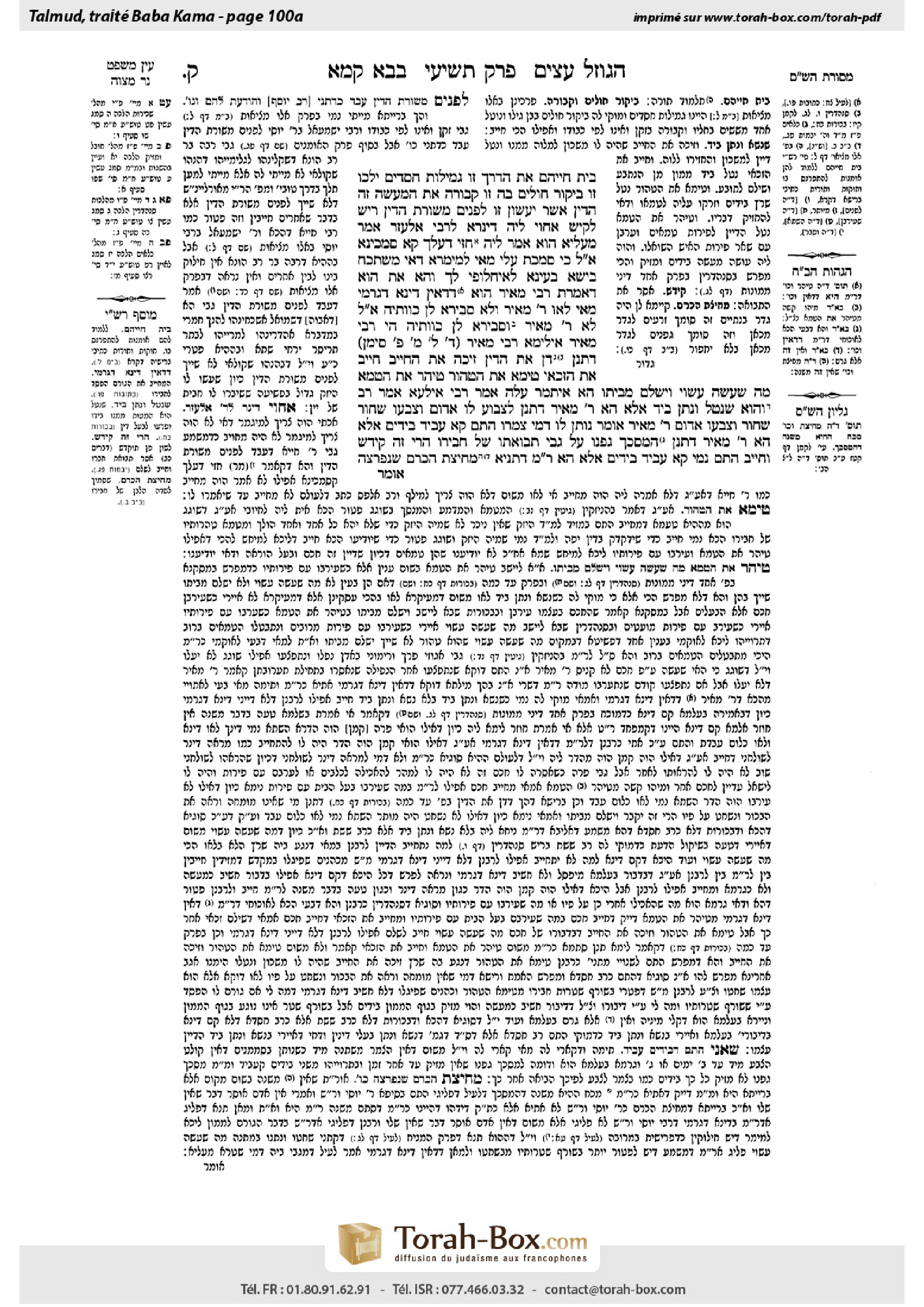
Bava Kamma 100a: Talmud study for Daf Yomi
Study the Talmud for Daf Yomi with scanned pages, Hebrew text, English translations from Sefaria and AI-generated French translations.
Passage selection and English or AI-generated French translation are available where the scan has annotations. Daf Study is independent of Torah-Box and Sefaria.
Browse Bava Kamma · בבא קמא · All tractatesBava Kamma 100a text and translations
This page of Bava Kamma includes the Aramaic text, an English translation and an AI-generated French translation, alongside the scan above.
בבא קמא ק׳ א · Aramaic and Hebrew text
בֵּית חַיֵּיהֶם. ״אֶת הַדֶּרֶךְ״ – זוֹ גְּמִילוּת חֲסָדִים. ״יֵלְכוּ״ – זוֹ בִּיקּוּר חוֹלִים. ״בָּהּ״ – זוֹ קְבוּרָה. ״אֶת הַמַּעֲשֶׂה״ – זֶה הַדִּין. ״אֲשֶׁר יַעֲשׂוּן״ – זוֹ לִפְנִים מִשּׁוּרַת הַדִּין.
רֵישׁ לָקִישׁ אַחְוִי לֵיהּ דִּינָרָא לְרַבִּי אֶלְעָזָר. אֲמַר: מְעַלְּיָא הוּא. אֲמַר לֵיהּ: חֲזִי דַּעֲלָךְ קָא סָמַכְינָא. אֲמַר לֵיהּ: כִּי סָמְכַתְּ עֲלַי מַאי לְמֵימְרָא, דְּאִי מִשְׁתְּכַח בִּישָׁא – בָּעֵינָא לְאַיחְלוֹפֵי לָךְ? וְהָא אַתְּ הוּא דְּאָמְרַתְּ: רַבִּי מֵאִיר הוּא, דְּדָאֵין דִּינָא דִּגְרָמֵי. מַאי, לָאו רַבִּי מֵאִיר – וְלָא סְבִירָא לַן כְּווֹתֵיהּ?
אֲמַר לֵיהּ: לָא, רַבִּי מֵאִיר – וּסְבִירָא לַן כְּווֹתֵיהּ.
הֵי רַבִּי מֵאִיר? אִילֵימָא רַבִּי מֵאִיר (ד׳ ל׳ מ׳ פ׳ סִימָן)
דִּתְנַן: דָּן אֶת הַדִּין; זִיכָּה אֶת הַחַיָּיב; חִיֵּיב אֶת הַזַּכַּאי; טִימֵּא אֶת הַטָּהוֹר; טִיהֵר אֶת הַטָּמֵא – מַה שֶּׁעָשָׂה עָשׂוּי, וִישַׁלֵּם מִבֵּיתוֹ.
הָא אִיתְּמַר עֲלַהּ, אָמַר רַבִּי אִילְעָא אָמַר רַב: וְהוּא שֶׁנָּטַל וְנָתַן בַּיָּד!
אֶלָּא הָא רַבִּי מֵאִיר – דִּתְנַן: לִצְבּוֹעַ לוֹ אָדוֹם וּצְבָעוֹ שָׁחוֹר, שָׁחוֹר וּצְבָעוֹ אָדוֹם – רַבִּי מֵאִיר אוֹמֵר: נוֹתֵן לוֹ דְּמֵי צַמְרוֹ. הָתָם קָא עָבֵיד בְּיָדַיִם!
אֶלָּא הָא רַבִּי מֵאִיר – דִּתְנַן: הַמְסַכֵּךְ גַּפְנוֹ עַל גַּבֵּי תְּבוּאָתוֹ שֶׁל חֲבֵירוֹ – הֲרֵי זֶה קִידֵּשׁ, וְחַיָּיב. הָתָם נָמֵי קָא עָבֵיד בְּיָדַיִם!
אֶלָּא הָא רַבִּי מֵאִיר – דְּתַנְיָא: מְחִיצַת הַכֶּרֶם שֶׁנִּפְרְצָה –
Bava Kamma 100a · English translation
the core of their existence, i.e., Torah study, which is the source of life. “The way”; this is referring to acts of kindness. “They must walk”; this is referring to visiting the sick. “Wherein”; this is referring to the burial of the dead. “The work”; this is referring to conducting oneself in accordance with the law. “That they must do”; this is referring to conducting oneself beyond the letter of the law. This indicates that the Torah mandates that people conduct themselves beyond the letter of the law.
The Gemara relates: Reish Lakish presented a dinar to Rabbi Elazar so that the latter would assess it. Rabbi Elazar said: It is a proper coin. Reish Lakish said to him: Realize that I am relying on you. Rabbi Elazar said to him: What is the purpose of stating that you are relying on me? Is it so that if this dinar is later found to be bad, I will be required to exchange it for you with a good dinar? But it is you who said that it is Rabbi Meir who is of the opinion that there is liability for damage caused by indirect action, even if he did not directly cause damage to the property. What, is it not that you intended to say: This is the opinion of Rabbi Meir, but we do not hold in accordance with his opinion?
Reish Lakish said to him: No, I intended to say that this is the opinion of Rabbi Meir, and we do hold in accordance with his opinion.
The Gemara asks: Which statement of Rabbi Meir is Rabbi Elazar referring to? If we say it is this statement of Rabbi Meir, that is difficult. Parenthetically, the Gemara states that the letters dalet, lamed, mem, peh serve as a mnemonic device for the four statements of Rabbi Meir that will be cited. It stands for: Judged [dan], to dye [litzboa], covers [mesakekh], and broke open [pirtza].
The Gemara returns to the matter at hand. As we learned in a mishna (Bekhorot 28b): If a judge issued a judgment and erred, and he acquitted one who was in fact liable, or deemed liable one who should have in fact been acquitted, or if he ruled that a pure item is impure, or ruled that an impure item is pure, and by doing so he caused a litigant a monetary loss, what he did is done, i.e., the judgment stands, and the judge must pay damages from his home, i.e., from his personal funds. He is therefore liable to pay the damages even though he caused the loss indirectly.
The Gemara explains why this cannot be the statement of Rabbi Meir that Shmuel was referring to: But wasn’t it stated with regard to that mishna that Rabbi Ile’a says that Rav says: And this mishna is discussing a case where the judge not only issued a ruling, but actively took the money from the one whom he found liable, and gave it to the other party by his own hand. This is not a case of causation but of direct action.
Rather, Rabbi Elazar must be referring to this statement of Rabbi Meir, as we learned in a mishna (100b): If one gave wool to a dyer to dye it red for him, and he dyed it black, or to dye it black, and he dyed it red, Rabbi Meir says: The dyer gives the owner the value of his wool. The Gemara responds: This too does not prove that according to the opinion of Rabbi Meir one is liable even if the loss was brought about by causation, since there he does cause damage through direct action.
Rather, Rabbi Elazar must be referring to this statement of Rabbi Meir, as we learned in a mishna (Kilayim 7:4): One who drapes his grapevine atop another’s grain has rendered them forbidden due to the prohibition against growing diverse kinds in a vineyard, and he is liable to pay the owner of the grain for the damage. The Gemara responds: This too does not prove that according to the opinion of Rabbi Meir one is liable even if the loss was brought about by causation, since there too he does cause damage by direct action.
Rather, it must be referring to this statement of Rabbi Meir, as it is taught in the Tosefta (Kilayim 3:4): If there was a partition of a vineyard that is adjacent to a wheat field, and that partition broke open,
Bava Kamma 100a · Traduction française (IA)
le noyau de leur existence, c'est-à-dire l'étude de la Torah, qui est la source de la vie. « La voie » : cela fait référence aux actes de bonté. « Ils doivent marcher » : cela fait référence à la visite des malades. « Où » : cela fait référence à l'enterrement des morts. « Le travail » : cela fait référence à la conduite en conformité avec la loi. « Qu'ils doivent faire » : cela fait référence à la conduite au-delà de la lettre de la loi. Cela indique que la Torah exige que les gens agissent au-delà de la lettre de la loi.
La Guemara rapporte : Reish Lakish a présenté un dinar à Rabbi Elazar afin qu'il le vire. Rabbi Elazar a dit : C'est une monnaie propre. Reish Lakish a dit à lui : Prends conscience que je compte sur toi. Rabbi Elazar a répondu à lui : Quel est l'objectif de dire que tu comptes sur moi ? Est-ce pour que, si ce dinar est ultérieurement trouvé être mauvais, je sois tenu de l'échanger pour toi avec un dinar bon ? Mais c'est toi qui as dit que c'est Rabbi Meir qui estime qu'il y a responsabilité pour les dommages causés par une action indirecte, même s'il n'a pas directement causé de dommage à la propriété. Qu'est-ce que cela signifie ? N'est-ce pas que tu voulais dire : C'est l'opinion de Rabbi Meir, mais nous ne suivons pas son opinion ?
Reish Lakish a dit à lui : Non, j'intendais dire que c'est l'opinion de Rabbi Meir, et nous suivons son opinion.
La Guemara pose la question : Quelle déclaration de Rabbi Meir Rabbi Elazar fait-il référence ? Si nous disons que c'est cette déclaration de Rabbi Meir, c'est difficile. Par ailleurs, la Guemara indique que les lettres dalet, lamed, mem, peh servent de dispositif mnémotechnique pour les quatre déclarations de Rabbi Meir qui seront citées. Elles signifient : Juger [dan], teindre [litzboa], couvrir [mesakekh], et ouvrir [pirtza].
La Guemara retourne à la question principale. Comme nous l'avons appris dans une mitsva (Bekhorot 28b) : Si un juge a rendu un jugement et s'est trompé, et s'il a acquitté une personne qui était en fait responsable, ou s'il a déclaré responsable une personne qui devrait être acquittée, ou s'il a jugé un objet pur comme impur, ou un objet impur comme pur, et en le faisant il a causé à un litige une perte financière, ce qu'il a fait est fait, c'est-à-dire le jugement reste, et le juge doit payer des dommages à partir de ses biens, c'est-à-dire de ses fonds personnels. Il est donc responsable de payer les dommages même s'il a causé la perte indirectement.
La Guemara explique pourquoi cela ne peut pas être la déclaration de Rabbi Meir à laquelle Shmuel faisait référence : N'était-ce pas dit concernant cette mitsva que Rabbi Ile’a dit que Rav dit : Et cette mitsva parle d'un cas où le juge n'a pas seulement rendu un jugement, mais a activement pris l'argent de celui qu'il avait trouvé responsable et l'a donné à l'autre partie de sa propre main. Cela n'est pas un cas de causalité mais d'action directe.
Plutôt, Rabbi Elazar doit faire référence à cette déclaration de Rabbi Meir, comme nous l'avons appris dans une mitsva (100b) : Si l'on a donné du laine à un teinturier pour la teindre en rouge, et qu'il l'a teinte en noir, ou pour la teindre en noir et qu'il l'a teinte en rouge, Rabbi Meir dit : Le teinturier donne à l'propriétaire la valeur de sa laine. La Guemara répond : Cela non plus ne prouve pas que selon l'opinion de Rabbi Meir on est responsable même si la perte a été causée par la causalité, car là il cause des dommages par une action directe.
Plutôt, Rabbi Elazar doit faire référence à cette déclaration de Rabbi Meir, comme nous l'avons appris dans une mitsva (Kilayim 7:4) : Celui qui drapé son vignoble sur celui d'un autre a rendu ces deux interdits en raison de l'interdiction de cultiver des espèces différentes dans un vignoble, et il est responsable de payer l'propriétaire du grain pour le dommage. La Guemara répond : Cela non plus ne prouve pas que selon l'opinion de Rabbi Meir on est responsable même si la perte a été causée par la causalité, car là aussi il cause des dommages par une action directe.
Plutôt, il doit s'agir de cette déclaration de Rabbi Meir, comme il est enseigné dans la Tosefta (Kilayim 3:4) : Si un partage d'un vignoble adjacent à un champ de blé s'est brisé,
Traduction française générée par IA à partir de l’édition anglaise de Sefaria. Vérifie toujours un passage avec le texte source.
Text from Sefaria: William Davidson Edition - Vocalized Aramaic (CC BY NC); William Davidson Edition - English (CC BY NC).