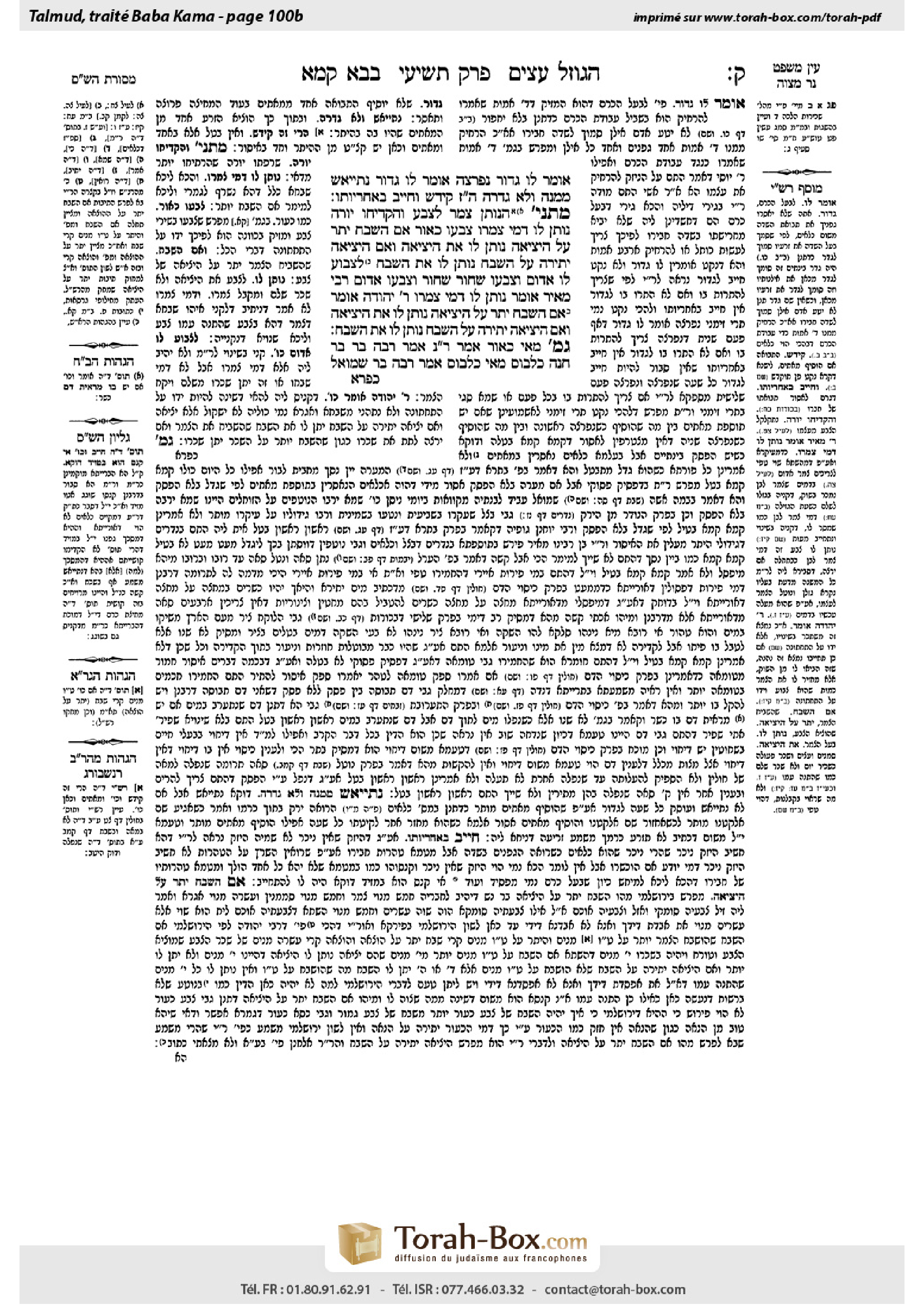
Bava Kamma 100b: Talmud study for Daf Yomi
Study the Talmud for Daf Yomi with scanned pages, Hebrew text, English translations from Sefaria and AI-generated French translations.
Passage selection and English or AI-generated French translation are available where the scan has annotations. Daf Study is independent of Torah-Box and Sefaria.
Browse Bava Kamma · בבא קמא · All tractatesBava Kamma 100b text and translations
This page of Bava Kamma includes the Aramaic text, an English translation and an AI-generated French translation, alongside the scan above.
בבא קמא ק׳ ב · Aramaic and Hebrew text
אוֹמֵר לוֹ ״גְּדוֹר״. נִפְרְצָה – אוֹמֵר לוֹ ״גְּדוֹר״, נִתְיָיאֵשׁ מִמֶּנָּה וְלֹא גְּדָרָהּ – הֲרֵי זֶה קִידֵּשׁ, וְחַיָּיב בְּאַחְרָיוּתוֹ.
מַתְנִי׳ הַנּוֹתֵן צֶמֶר לַצַבָּע, וְהִקְדִּיחוֹ יוֹרָה – נוֹתֵן לוֹ דְּמֵי צַמְרוֹ. צְבָעוֹ כָּאוּר – אִם הַשֶּׁבַח יָתֵר עַל הַיְּצִיאָה, נוֹתֵן לוֹ אֶת הַיְּצִיאָה; וְאִם הַיְּצִיאָה יְתֵירָה עַל הַשֶּׁבַח, נוֹתֵן לוֹ אֶת הַשֶּׁבַח.
לִצְבּוֹעַ לוֹ אָדוֹם וּצְבָעוֹ שָׁחוֹר, שָׁחוֹר וּצְבָעוֹ אָדוֹם – רַבִּי מֵאִיר אוֹמֵר: נוֹתֵן לוֹ דְּמֵי צַמְרוֹ. רַבִּי יְהוּדָה אוֹמֵר: אִם הַשֶּׁבַח יָתֵר עַל הַיְּצִיאָה – נוֹתֵן לוֹ אֶת הַיְּצִיאָה, וְאִם הַיְּצִיאָה יְתֵירָה עַל הַשֶּׁבַח – נוֹתֵן לוֹ אֶת הַשֶּׁבַח.
גְּמָ׳ מַאי ״כָּאוּר״? אָמַר רַב נַחְמָן אָמַר רַבָּה בַּר בַּר חָנָה: כַּלְבּוֹס. מַאי כַּלְבּוֹס? אָמַר רַבָּה בַּר שְׁמוּאֵל:
Bava Kamma 100b · English translation
the owner of the wheat field may tell the owner of the vineyard to repair the breach before the vines intermingle with the grain and cause it to become forbidden. If the partition broke open again, he may again tell him to repair it. If the owner of the vineyard abandoned the partition and did not repair it, he has rendered the grain forbidden, and is obligated to pay restitution for it. This demonstrates that one is liable to pay damages even if he did not perform any action at all, and consequently proves that Rabbi Meir rules there is liability for damage caused by indirect action.
MISHNA: In the case of one who gives wool to a dyer and it was burned in the cauldron during the dyeing process, thereby completely ruining the wool so that there is no enhancement, only loss, the dyer gives the owner the value of his wool. If he dyed it unattractively [ka’ur] so that the dye is not absorbed well by the wool, if the enhancement, i.e., the amount that the value of the wool has increased by being dyed, exceeds the dyer’s expenses, the owner of the wool gives the dyer the expenses. And if the expenses exceed the enhancement, he gives him the value of the enhancement.
If the owner gave wool to a dyer to dye it red for him and instead he dyed it black, or to dye it black and he dyed it red, Rabbi Meir says: The dyer gives the owner of the wool the value of his wool. Rabbi Yehuda says: Here too, if the value of the enhancement exceeds the dyer’s expenses, the owner of the wool gives the dyer the expenses. And if the expenses exceed the enhancement, he gives him the value of the enhancement.
GEMARA: The Gemara clarifies: What does the mishna mean by unattractively? Rav Naḥman said that Rabba bar bar Ḥana said: Kelabus. The Gemara asks: What does kelabus mean? Rabba bar Shmuel said:
Bava Kamma 100b · Traduction française (IA)
le propriétaire du champ de blé peut demander au propriétaire du domaine de vigne de réparer la brèche avant que les vignes ne s'entremêlent avec le blé et ne le rendent interdit. Si la clôture s'est à nouveau ouverte, il peut à nouveau lui demander de la réparer. Si le propriétaire du domaine de vigne a abandonné la clôture et n'a pas réparé celle-ci, il a rendu le blé interdit et est tenu de réparer le préjudice. Cela démontre que l'on est tenu de payer des dommages même s'il n'a pas accompli aucune action, et par conséquent prouve que Rabbi Meir considère qu'il y a responsabilité pour un préjudice causé par une action indirecte.
MICHNA : Dans le cas d'une personne qui donne du laine à un teinturier et que celle-ci est brûlée dans la marmite pendant le processus de teinture, la rendant ainsi complètement inutilisable, sans aucune amélioration, seulement une perte, le teinturier doit donner au propriétaire la valeur de sa laine. Si le teinturier l'a teint de manière peu attrayante [ka’ur], de sorte que la teinture ne s'absorbe pas bien dans la laine, et si l'amélioration, c'est-à-dire la quantité par laquelle la valeur de la laine a augmenté grâce à la teinture, excède les dépenses du teinturier, le propriétaire de la laine doit donner au teinturier ses dépenses. Et si les dépenses excèdent l'amélioration, il doit lui donner la valeur de l'amélioration.
Si le propriétaire a donné de la laine à un teinturier pour la teindre en rouge et qu'il l'a teinte en noir, ou pour la teindre en noir et qu'il l'a teinte en rouge, Rabbi Meir dit : Le teinturier doit donner au propriétaire de la laine la valeur de sa laine. Rabbi Yéhuda dit : Ici aussi, si la valeur de l'amélioration excède les dépenses du teinturier, le propriétaire de la laine doit donner au teinturier ses dépenses. Et si les dépenses excèdent l'amélioration, il doit lui donner la valeur de l'amélioration.
GUEMARA : La Guemara précise : De quoi la Michna parle-t-elle lorsqu'elle mentionne « de manière peu attrayante » ? Rav Naḥman a dit que Rabba bar bar Ḥana a dit : Kelabus. La Guemara pose la question : Quel est le sens de kelabus ? Rabba bar Shmuel a dit :
Traduction française générée par IA à partir de l’édition anglaise de Sefaria. Vérifie toujours un passage avec le texte source.
Text from Sefaria: William Davidson Edition - Vocalized Aramaic (CC BY NC); William Davidson Edition - English (CC BY NC).