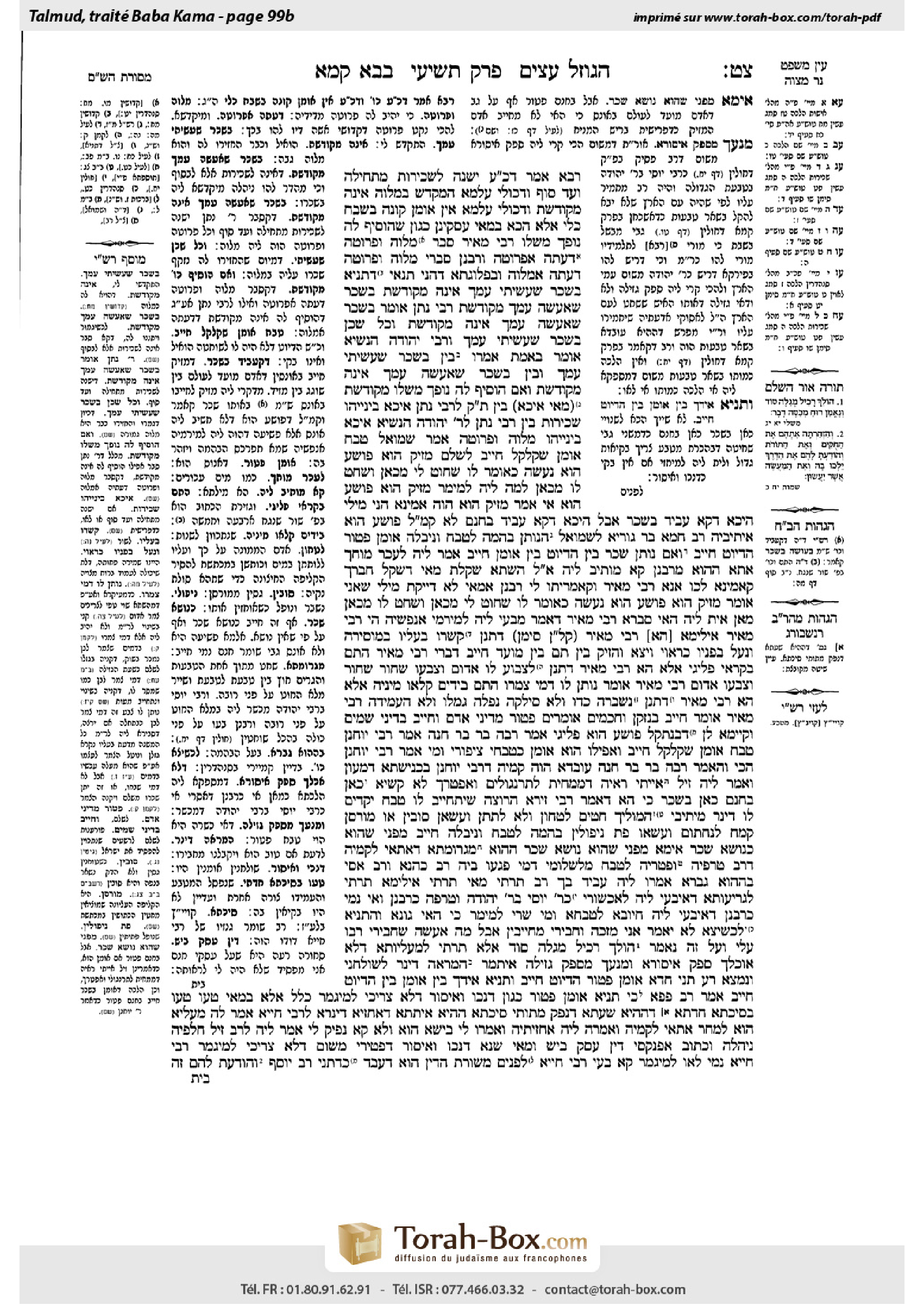
Bava Kamma 99b: Talmud study for Daf Yomi
Study the Talmud for Daf Yomi with scanned pages, Hebrew text, English translations from Sefaria and AI-generated French translations.
Passage selection and English or AI-generated French translation are available where the scan has annotations. Daf Study is independent of Torah-Box and Sefaria.
Browse Bava Kamma · בבא קמא · All tractatesBava Kamma 99b text and translations
This page of Bava Kamma includes the Aramaic text, an English translation and an AI-generated French translation, alongside the scan above.
בבא קמא צ״ט ב · Aramaic and Hebrew text
רָבָא אָמַר: דְּכוּלֵּי עָלְמָא יֶשְׁנָהּ לִשְׂכִירוּת מִתְּחִילָּה וְעַד סוֹף, וּדְכוּלֵּי עָלְמָא הַמְקַדֵּשׁ בְּמִלְוָה אֵינָהּ מְקוּדֶּשֶׁת, וּדְכוּלֵּי עָלְמָא אֵין אוּמָּן קוֹנֶה בִּשְׁבַח כְּלִי;
אֶלָּא הָכָא בְּמַאי עָסְקִינַן – כְּגוֹן שֶׁהוֹסִיף לָהּ נוֹפֶךְ מִשֶּׁלּוֹ. רַבִּי מֵאִיר סָבַר: מִלְוָה וּפְרוּטָה – דַּעְתַּהּ אַפְּרוּטָה, וְרַבָּנַן סָבְרִי: מִלְוָה וּפְרוּטָה – דַּעְתַּהּ אַמִּלְוָה.
וּבִפְלוּגְתָּא דְּהָנֵי תַּנָּאֵי, דְּתַנְיָא: ״בִּשְׂכַר שֶׁעָשִׂיתִי עִמָּךְ״ – אֵינָהּ מְקוּדֶּשֶׁת. ״בִּשְׂכַר שֶׁאֶעֱשֶׂה עִמָּךְ״ – מְקוּדֶּשֶׁת. רַבִּי נָתָן אוֹמֵר: ״בִּשְׂכַר שֶׁאֶעֱשֶׂה עִמָּךְ״ – אֵינָהּ מְקוּדֶּשֶׁת, וְכׇל שֶׁכֵּן ״בִּשְׂכַר שֶׁעָשִׂיתִי עִמָּךְ״.
וְרַבִּי יְהוּדָה הַנָּשִׂיא אוֹמֵר, בֶּאֱמֶת אָמְרוּ: בֵּין ״בִּשְׂכַר שֶׁעָשִׂיתִי עִמָּךְ״, וּבֵין ״בִּשְׂכַר שֶׁאֶעֱשֶׂה עִמָּךְ״ – אֵינָהּ מְקוּדֶּשֶׁת. וְאִם הוֹסִיף לָהּ נוֹפֶךְ מִשֶּׁלּוֹ – מְקוּדֶּשֶׁת.
מַאי אִיכָּא בֵּין תַּנָּא קַמָּא לְרַבִּי נָתָן? אִיכָּא בֵּינַיְיהוּ שְׂכִירוּת. בֵּין רַבִּי נָתָן לְרַבִּי יְהוּדָה הַנָּשִׂיא? אִיכָּא בֵּינַיְיהוּ מִלְוָה וּפְרוּטָה.
אָמַר שְׁמוּאֵל: טַבָּח אוּמָּן שֶׁקִּלְקֵל – חַיָּיב לְשַׁלֵּם. מַזִּיק הוּא, פּוֹשֵׁעַ הוּא, נַעֲשָׂה כְּאוֹמֵר לוֹ: ״שְׁחוֹט לִי מִכָּאן״, וְשָׁחַט לוֹ מִכָּאן.
לְמָה לֵיהּ לְמֵימַר ״מַזִּיק הוּא, פּוֹשֵׁעַ הוּא״? אִי אָמַר ״מַזִּיק הוּא״, הֲוָה אָמֵינָא הָנֵי מִילֵּי הֵיכָא דְּקָא עָבֵיד בְּשָׂכָר, אֲבָל הֵיכָא דְּקָא עָבֵיד בְּחִנָּם – לָא; קָא מַשְׁמַע לַן ״פּוֹשֵׁעַ הוּא״.
אֵיתִיבֵיהּ רַב חָמָא בַּר גּוּרְיָא לִשְׁמוּאֵל: הַנּוֹתֵן בְּהֵמָה לַטַּבָּח וְנִיבְּלָהּ, אוּמָּן – פָּטוּר, הֶדְיוֹט – חַיָּיב. וְאִם נוֹתֵן שָׂכָר, בֵּין הֶדְיוֹט בֵּין אוּמָּן – חַיָּיב! אֲמַר לֵיהּ: לִעֲכַר מוֹחָךְ!
אֲתָא הָהוּא מֵרַבָּנַן קָא מוֹתֵיב לֵיהּ. אֲמַר לֵיהּ: הַשְׁתָּא שָׁקְלַתְּ מַאי דִּשְׁקַל חַבְרָךְ! קָאָמֵינָא לְכוּ אֲנָא רַבִּי מֵאִיר, וְקָאָמְרִיתוּ לִי רַבָּנַן?! אַמַּאי לָא דָּיְיקַתְּ מִילֵּי – שֶׁאֲנִי אוֹמֵר: מַזִּיק הוּא, פּוֹשֵׁעַ הוּא, נַעֲשֶׂה כְּאוֹמֵר לוֹ ״שְׁחוֹט לִי מִכָּאן״ – וְשָׁחַט לוֹ מִכָּאן; מַאן אִית לֵיהּ הַאי סְבָרָא – רַבִּי מֵאִיר, דְּאָמַר: מִבְּעֵי לֵיהּ לְמִירְמֵי אַנַּפְשֵׁיהּ!
הֵי רַבִּי מֵאִיר? אִילֵּימָא [הָא] רַבִּי מֵאִיר (קל״ן סִימָן) –
דִּתְנַן: קְשָׁרוֹ בְּעָלָיו בְּמוֹסֵירָה וְנָעַל בְּפָנָיו כָּרָאוּי, וְיָצָא וְהִזִּיק, בֵּין תָּם בֵּין מוּעָד – חַיָּיב, דִּבְרֵי רַבִּי מֵאִיר.
הָתָם בִּקְרָאֵי פְּלִיגִי!
אֶלָּא הָא רַבִּי מֵאִיר – דִּתְנַן: לִצְבּוֹעַ לוֹ אָדוֹם וּצְבָעוֹ שָׁחוֹר, שָׁחוֹר וּצְבָעוֹ אָדוֹם – רַבִּי מֵאִיר אוֹמֵר: נוֹתֵן לוֹ דְּמֵי צַמְרוֹ. הָתָם בְּיָדַיִם קְלָאו מִינֵּיהּ!
אֶלָּא הָא רַבִּי מֵאִיר – דִּתְנַן: נִשְׁבְּרָה כַּדּוֹ וְלֹא סִילְּקָהּ, נָפְלָה גְּמַלּוֹ וְלֹא הֶעֱמִידָה – רַבִּי מֵאִיר אוֹמֵר: חַיָּיב בְּנִזְקָן, וַחֲכָמִים אוֹמְרִים: פָּטוּר מִדִּינֵי אָדָם, וְחַיָּיב בְּדִינֵי שָׁמַיִם. וְקַיְימָא לַן דִּבְנִתְקַל פּוֹשֵׁעַ הוּא פְּלִיגִי.
אָמַר רַבָּה בַּר בַּר חָנָה אָמַר רַבִּי יוֹחָנָן: טַבָּח אוּמָּן שֶׁקִּלְקֵל – חַיָּיב, וַאֲפִילּוּ הוּא אוּמָּן כְּטַבָּחֵי צִיפּוֹרִי. וּמִי אָמַר רַבִּי יוֹחָנָן הָכִי?! וְהָאָמַר רַבָּה בַּר בַּר חָנָה: עוֹבָדָא הֲוָה קַמֵּיהּ דְּרַבִּי יוֹחָנָן בִּכְנִישְׁתָּא דְמָעוֹן, וַאֲמַר לֵיהּ: זִיל אַיְיתִי רְאָיָה דְּמַמְחֵית לְתַרְנְגוֹלִים, וְאֶפְטְרָךְ!
לָא קַשְׁיָא; כָּאן בְּחִנָּם, כָּאן בְּשָׂכָר. כִּי הָא דְּאָמַר רַבִּי זֵירָא: הָרוֹצֶה שֶׁיִּתְחַיֵּיב לוֹ טַבָּח – יַקְדִּים לוֹ דִּינָר.
מֵיתִיבִי: הַמּוֹלִיךְ חִטִּים לַטָּחוֹן – וְלֹא לְתָתָן, וַעֲשָׂאָן סוּבִּין אוֹ מוּרְסָן; קֶמַח לַנַּחְתּוֹם – וַעֲשָׂאוֹ פַּת נִיפּוּלִין; בְּהֵמָה לַטַּבָּח – וְנִיבְּלָהּ; חַיָּיב, מִפְּנֵי שֶׁהוּא כְּנוֹשֵׂא שָׂכָר! אֵימָא: מִפְּנֵי שֶׁהוּא נוֹשֵׂא שָׂכָר.
הָהוּא מַגְרוּמְתָּא דַּאֲתַאי לְקַמֵּיהּ דְּרַב, טַרְפֵהּ, וּפַטְרֵיהּ לְטַבָּח מִלְּשַׁלּוֹמֵי דְּמֵי. פְּגַעוּ בֵּיהּ רַב כָּהֲנָא וְרַב אַסִּי בְּהָהוּא גַּבְרָא, אֲמַרוּ לֵיהּ: עֲבֵיד בָּךְ רַב תַּרְתֵּי.
מַאי תַּרְתֵּי? אִילֵימָא תַּרְתֵּי לִגְרִיעוּתָא – דְּאִיבְּעִי לֵיהּ לְאַכְשׁוֹרֵי כְּרַבִּי יוֹסֵי בְּרַבִּי יְהוּדָה, וְטַרְפַהּ כְּרַבָּנַן; וְאִי נָמֵי כְּרַבָּנַן – דְּאִיבְּעִי לֵיהּ חִיּוּבָא לְטַבָּחָא; וּמִי שְׁרֵי לְמֵימַר כִּי הַאי גַּוְנָא?!
וְהָתַנְיָא: לִכְשֶׁיֵּצֵא, לֹא יֹאמַר: ״אֲנִי מְזַכֶּה וַחֲבֵירַי מְחַיְּיבִין, אֲבָל מָה אֶעֱשֶׂה שֶׁחֲבֵירַי רַבּוּ עָלַי״, וְעַל זֶה נֶאֱמַר: ״הוֹלֵךְ רָכִיל מְגַלֶּה סּוֹד״!
אֶלָּא תַּרְתֵּי לִמְעַלְּיוּתָא – דְּלָא אוֹכְלָךְ סְפֵק אִיסּוּרָא, וּמַנְעָךְ מִסְּפֵק גְּזֵילָה.
אִיתְּמַר: הַמַּרְאֶה דִּינָר לַשּׁוּלְחָנִי וְנִמְצָא רַע, תָּנֵי חֲדָא: אוּמָּן – פָּטוּר, הֶדְיוֹט – חַיָּיב; וְתַנְיָא אִידַּךְ: בֵּין אוּמָּן בֵּין הֶדְיוֹט – חַיָּיב!
אָמַר רַב פָּפָּא: כִּי תַּנְיָא אוּמָּן פָּטוּר – כְּגוֹן דַּנְכּוּ וְאִיסּוּר, דְּלָא צְרִיכִי לְמִיגְמַר כְּלָל. אֶלָּא בְּמַאי טְעוֹ? טְעוֹ בְּסִיכְּתָא חַדְתָּא, דְּהָהִיא שַׁעְתָּא דִּנְפַק מִתּוּתֵי סִיכְּתָא.
הָהִיא אִיתְּתָא דְּאַחְזְיָא דִּינָרָא לְרַבִּי חִיָּיא, אֲמַר לַהּ: מְעַלְּיָא הוּא. לְמָחָר אֲתַאי לְקַמֵּיהּ, וַאֲמַרָה לֵיהּ: אַחֲזִיתֵיהּ, וַאֲמַרוּ לִי בִּישָׁא הוּא, וְלָא קָא נָפֵיק לִי! אֲמַר לֵיהּ לְרַב: זִיל חַלְּפֵיהּ נִיהֲלַהּ, וּכְתוֹב אַפִּנְקָסִי: ״דֵּין עֵסֶק בִּישׁ״.
וּמַאי שְׁנָא דַּנְכּוּ וְאִיסּוּר דִּפְטִירִי – מִשּׁוּם דְּלָא צְרִיכִי לְמִיגְמַר? רַבִּי חִיָּיא נָמֵי לָאו לְמִיגְמַר קָא בָּעֵי! רַבִּי חִיָּיא, לִפְנִים מִשּׁוּרַת הַדִּין הוּא דַּעֲבַד. כִּדְתָנֵי רַב יוֹסֵף: ״וְהוֹדַעְתָּ לָהֶם״ – זֶה
Bava Kamma 99b · English translation
Rava said another interpretation: Everyone agrees that the obligation to pay a wage is incurred continuously from the beginning of the period a craftsman is hired to its end; and everyone agrees that with regard to one who betroths a woman with a loan, she is not betrothed; and everyone agrees that a craftsman does not acquire ownership rights through the enhancement of the vessel.
But with what are we dealing here? We are dealing with a case where he added a jewel [nofekh] of his own for her. Rabbi Meir holds that if a man betroths a woman with a loan and one peruta, her mind is focused on the peruta. Therefore, in this case the jewel serves as the betrothal money. And the Rabbis hold that if a man betroths a woman with a loan and one peruta her mind is focused on the loan, so the loan serves as the betrothal money, and if one betroths a woman with a loan, she is not betrothed.
And Rabbi Meir and the Rabbis disagree in the dispute between these tanna’im. As it is taught in the Tosefta (Kiddushin 3:4): If one says to a woman: Be betrothed to me with the payment for which I have worked for you, she is not betrothed, as the payment is a loan, since she already owes him this money. But if he says: Be betrothed to me with the payment for which I will work for you, she is betrothed, as from the moment he is entitled to the money, he gives it to her for her betrothal. Rabbi Natan says: If he says: Be betrothed to me with the payment for which I will work for you, she is not betrothed, as Rabbi Natan holds that the obligation to pay a wage is incurred continuously from the beginning of the period he was hired to its end, which means that upon the completion of the labor it is a loan, and all the more so if he says: Be betrothed to me with the payment for which I have worked for you.
The baraita cites a third opinion: And Rabbi Yehuda HaNasi says: Actually they said that the halakha is that regardless of whether he said: With the payment for which I have worked for you, or whether he said: With the payment for which I will work for you, she is not betrothed. But if he added a jewel of his own for her, she is betrothed.
The Gemara clarifies the dispute: What difference is there between the first tanna and Rabbi Natan? The difference between them is with regard to a wage: Is the obligation incurred continuously or only upon the completion of the work? The difference between Rabbi Natan and Rabbi Yehuda HaNasi is the issue of a loan and one peruta. Rabbi Natan holds that if a man betroths a woman with a loan and one peruta her mind is focused on the loan, and in this case his jewel is disregarded; and Rabbi Yehuda HaNasi holds that her mind is focused on the peruta, in this case the jewel, and she is betrothed with the jewel.
§ The Gemara now returns to the topic of a craftsman who damages the item with which he is working. Shmuel says: An expert butcher who damaged an animal by slaughtering it incorrectly, thereby rendering it non-kosher, is liable to pay the owner of the animal for the damage. Why? He is one who causes damage; he is negligent; he is like one who is told by the animal’s owner to slaughter it from here, i.e., the area of the throat where ritual slaughter is performed, and he slaughtered it from there, i.e., a different area of the throat, in violation of the owner’s wishes.
The Gemara asks: Why must he say both that the butcher is one who causes damage and that he is negligent? The Gemara explains: If Shmuel had said only that he is one who causes damage, I would say that this statement applies only in a case where the butcher slaughtered the animal for pay, in which case, due to the extra responsibility that he bears, he is considered to be one who caused damage and is liable to pay even in a case where the damage was unintentional; but in a case where he does the work for free, I would say no, he is exempt from liability in a case where the damage was unintentional. Shmuel therefore teaches us that the butcher is negligent, and one who works without pay is analogous to an unpaid bailee, who is liable to pay for damage caused by negligence.
Rav Ḥama bar Gurya raised an objection to Shmuel from the Tosefta (10:10): With regard to one who gives an animal to a butcher, and the butcher killed it in a way that rendered it an animal carcass, if the butcher is an expert, then he is exempt from liability; if he is an ordinary person, without particular expertise in the act of ritual slaughter, he is liable. And if the owner of the animal paid the butcher, then regardless of whether he is an ordinary person or whether he is an expert, the butcher is liable to pay for the damage. This indicates that an expert butcher who slaughtered the animal improperly is exempt if he slaughtered it without pay. Shmuel said to him: May your mind be muddled for raising a ridiculous objection.
One of the Sages came and raised the same objection to Shmuel. Shmuel said to him: Now you shall receive what your friend received from me, since I say to you my statement in accordance with the opinion of Rabbi Meir, and you say to me, i.e., you raise an objection, based upon the opinion of the Rabbis. Why were you not precise in your consideration of my choice of words? As I say: He is one who causes damage; he is negligent; he is like one who is told by the animal’s owner to slaughter it from here, and he slaughtered it from there. Who accepts this reasoning? It is Rabbi Meir, who says: He should have taken upon himself the responsibility to perform his task properly, and if he did not, he is liable to pay for the damage that he caused. The other baraita is in accordance with the opinion of the Rabbis, who exempt him from liability.
The Gemara asks: Which statement of Rabbi Meir is Shmuel referring to? If we say it is this statement of Rabbi Meir, that is difficult. Parenthetically, the Gemara states that the letters kuf, lamed, nun serve as a mnemonic device for the three statements of Rabbi Meir that will be cited. It stands for: He tied it [kesharo], to dye [litzboa], and broke [nishbera].
The Gemara returns to the matter at hand: As we learned in a mishna (45b): If the ox’s owner tied it with reins to a fence or locked the gate before it in an appropriate manner, but nevertheless the ox emerged and caused damage, whether the ox is innocuous or forewarned the owner is liable, since this is not considered sufficient precaution to prevent damage; this is the statement of Rabbi Meir. As the Gemara explains on 45b, Rabbi Meir holds that a forewarned ox requires a heightened level of safeguarding, and since the owner did not safeguard it, he is liable. The same would apply here, that one who agrees to perform a task must exercise care in executing it. Otherwise, he will be held liable to pay for damage.
The Gemara explains why this cannot be the statement of Rabbi Meir that Shmuel was referring to: There, in that mishna, the Sages disagree with regard to the interpretation of biblical verses, not logical reasoning, as the Gemara explains there, and conclusions cannot be drawn from that halakha to this one.
Rather, it is this statement of Rabbi Meir that Shmuel is referring to, as we learned in a mishna (100b): If one gave wool to a dyer to dye it red for him, and he dyed it black, or to dye it black, and he dyed it red, Rabbi Meir says: The dyer gives the owner the value of his wool, indicating that he is liable to pay for the damage. The Gemara rejects this opinion: This statement also does not prove that according to Rabbi Meir a worker is liable to pay for a job performed improperly, since there, the dyer burned the wool, thereby removing it from the owner by direct action.
Rather, it is this statement of Rabbi Meir that Shmuel is referring to, as we learned in a baraita: If one’s jug broke on the road and he did not remove it, or if his camel fell on the road and he did not stand it up, Rabbi Meir says: He is liable for the damage that they cause, and the Rabbis say: He is exempt according to human laws but liable according to the laws of Heaven. The Gemara notes: And we maintain that they disagree with regard to the question of whether one who stumbles is considered negligent. According to the opinion of Rabbi Meir, one who stumbles is considered negligent, since he should have paid attention while walking. He is therefore liable for whatever damage he causes. In the case of an expert butcher as well, Rabbi Meir holds that he is considered negligent when damaging the animal he slaughtered, and the Rabbis hold that he is not negligent and therefore exempt from liability.
The Gemara discusses Rabbi Yoḥanan’s opinion concerning the case of an expert butcher. Rabba bar bar Ḥana says that Rabbi Yoḥanan says: An expert butcher who damaged an animal by slaughtering it incorrectly, thereby rendering it non-kosher, is liable to pay the owner of the animal, and even if he is as expert as the butchers of Tzippori, it is not considered an accident, and he is considered to be at fault. The Gemara asks: And did Rabbi Yoḥanan actually say this? But didn’t Rabba bar bar Ḥana say that there was an incident in which a butcher who damaged an animal was brought to court before Rabbi Yoḥanan in the synagogue of the town Maon, and Rabbi Yoḥanan said to the butcher: Go bring proof that you are an expert at slaughtering chickens, and I will exempt you from payment.
The Gemara responds: This is not difficult. Here, in the aforementioned incident, the butcher slaughtered the animal for free, and he is therefore exempt, while there, in Rabba bar bar Ḥana’s previous statement, he slaughtered the animal for pay, and is therefore liable to pay for the damage. This is in accordance with that which Rabbi Zeira says: One who wants a butcher to be liable to pay him in the event that he damages the animal during slaughter should advance him a dinar, so that he is paid for his services, and he is consequently liable to pay damages.
The Gemara raises an objection from the Tosefta (10:9): One who brought wheat to another to grind for him, and the miller did not wet the grains sufficiently for the grinding to be performed effectively, and as a result he converted the grain into bran or coarse bran; or if one gave flour to the baker and he made bread that is underbaked and tends to crumble; or if one gave an animal to a butcher and the butcher killed it in a way that rendered it an unslaughtered animal carcass, the worker is liable, because he is like a paid bailee. This indicates that even if the work was done for free, the worker has the legal status of one who is paid, and he is liable to pay for the damage. The Gemara answers by emending the baraita: Say instead: Because he is a paid bailee and actually receives payment.
The Gemara relates: There was a certain animal that was slaughtered with an incision not in the neck that was brought before Rav. He declared it non-kosher, and exempted the butcher from paying its value. Rav Kahana and Rav Asi encountered that man, i.e., the owner of the animal, and they said to him: Rav did two for you.
The Gemara asks: What are the two? If we say there were two unfavorable rulings, what are they? One is that he should have declared the animal kosher, in accordance with the opinion of Rabbi Yosei, son of Rabbi Yehuda, who says that an animal that has been slaughtered in this manner is kosher, and instead he declared it non-kosher, in accordance with the opinion of the Rabbis, who hold that it is not kosher. And the second is that even if he holds in accordance with the opinion of the Rabbis, he should have ruled that the butcher is liable to pay for the damage. The Gemara challenges this explanation: But if these are the two that Rav Kahana and Rav Asi are referring to, is it permitted for them to say this type of statement to the owner of the animal?
But isn’t it taught in a baraita that when a judge leaves the courthouse, he should not say to the litigant: I found you innocent and my colleagues found you liable, but what can I do, since my colleagues outnumber me? And it is concerning a circumstance such as this that it is stated: “He that goes about as a talebearer reveals secrets; but he that is of a faithful spirit conceals a matter” (Proverbs 11:13).
Rather, the intention is that they told him that there were two favorable rulings: First, that by declaring the animal to be non-kosher, he did not allow you to eat an item about which there is uncertainty as to whether it is forbidden, and second, by exempting the butcher from paying you, he prevented you from being in a situation where there is uncertainty as to whether receiving payment from the butcher constitutes robbery, since you would have been given the butcher’s money when he may be exempt, as the animal may in fact be kosher.
§ The Gemara continues the discussion of an expert who erred, thereby causing a loss. It was stated: With regard to one who presents a dinar to a money changer to assess its value or authenticity and the money changer declares it valid, and it is found to be bad, i.e., invalid, causing its owner a monetary loss, it is taught in one baraita that if the money changer is an expert, he is exempt, while if he is an ordinary person he is liable. And it is taught in another baraita that irrespective of whether he is an expert or whether he is an ordinary person, he is liable to pay for the owner’s loss.
To reconcile the baraitot, Rav Pappa said: When the baraita teaches that an expert is exempt from liability, it is referring to renowned experts such as the money changers Dankhu and Issur, whose expertise is so great that they do not need to learn about assessing currency at all. The Gemara asks: But if they are so proficient, in what did they err? The Gemara answers: They erred with regard to a coin from a new press, which at that time was leaving the press, and they did not know its value.
The Gemara relates: There was a certain woman who presented a dinar to Rabbi Ḥiyya to assess its authenticity. He said to her: It is a proper coin. The next day she came before him and said to him: I presented it to others, and they told me that it is a bad dinar, and I am not able to spend it. Rabbi Ḥiyya said to Rav: Go exchange it for her, and write on my tablet [apinkasi]: This was a bad transaction, as I should not have assessed the coin.
The Gemara asks: But what is different about Dankhu and Issur, who are exempt due to the fact that they do not need to learn about assessing currency? Rabbi Ḥiyya too did not need to learn, as he was also an expert. The Gemara responds: Rabbi Ḥiyya was not actually required to return a dinar to this woman, but when he did so he acted beyond the letter of the law. This is as that which Rav Yosef taught concerning the verse: “And you shall show them the way wherein they must walk, and the work that they must do” (Exodus 18:20): “And you shall show them”; this is referring to
Bava Kamma 99b · Traduction française (IA)
Rava a dit une autre interprétation : Tout le monde convient que l'obligation de payer un salaire s'engage continuellement depuis le début de la période pendant laquelle un artisan est embauché jusqu'à sa fin ; et tout le monde convient que celui qui fiance une femme avec un prêt ne l'engage pas ; et tout le monde convient qu'un artisan ne devient propriétaire par l'amélioration du vase.
Mais de quoi sommes-nous en train de parler ? Nous parlons d'un cas où il a ajouté un joyau [nofekh] de son propre fait pour elle. Rabbi Meïr considère que si un homme fiance une femme avec un prêt et une peruta, son esprit est focalisé sur la peruta. Ainsi, dans ce cas, le joyau sert de dot de fiancée. Et les Sages considèrent que si un homme fiance une femme avec un prêt et une peruta, son esprit est focalisé sur le prêt, donc le prêt sert de dot de fiancée, et si l'on fiance une femme avec un prêt, elle n'est pas fiancée.
Et Rabbi Meïr et les Sages s'opposent dans le débat entre ces tannaïm. Comme il est enseigné dans la Tosefta (Kiddushin 3:4) : Si l'on dit à une femme : Fie-toi à moi avec le paiement pour lequel j'ai travaillé pour toi, elle n'est pas fiancée, car le paiement est un prêt, puisqu'elle lui doit déjà cette somme. Mais si l'on dit : Fie-toi à moi avec le paiement pour lequel je travaillerai pour toi, elle est fiancée, car dès que l'homme est dûment autorisé à recevoir l'argent, il le donne à elle pour sa fiancée. Rabbi Natan dit : Si l'on dit : Fie-toi à moi avec le paiement pour lequel je travaillerai pour toi, elle n'est pas fiancée, car Rabbi Natan considère que l'obligation de payer un salaire s'engage continuellement depuis le début de la période pendant laquelle il a été embauché jusqu'à sa fin, ce qui signifie que, à la fin du travail, c'est un prêt, et encore plus si l'on dit : Fie-toi à moi avec le paiement pour lequel j'ai travaillé pour toi.
La baraïta cite un troisième avis : Rabbi Yéhuda HaNasi dit : En réalité, ils ont dit que la halakha est que, qu'il dise : Avec le paiement pour lequel j'ai travaillé pour toi, ou qu'il dise : Avec le paiement pour lequel je travaillerai pour toi, elle n'est pas fiancée. Mais si il ajoute un joyau de son propre fait pour elle, elle est fiancée.
La Guemara clarifie le débat : Quelle différence y a-t-il entre le premier tanna et Rabbi Natan ? La différence entre eux est concernant un salaire : l'obligation s'engage-t-elle continuellement ou seulement à la fin du travail ? La différence entre Rabbi Natan et Rabbi Yéhuda HaNasi est l'issue d'un prêt et d'une peruta. Rabbi Natan considère que si un homme fiance une femme avec un prêt et une peruta, son esprit est focalisé sur le prêt, et dans ce cas, son joyau est négligé ; et Rabbi Yéhuda HaNasi considère que son esprit est focalisé sur la peruta, dans ce cas, le joyau, et elle est fiancée avec le joyau.
§ La Guemara revient maintenant au sujet d'un artisan qui endommage l'objet avec lequel il travaille. Shmuel dit : Un boucher expert qui a endommagé un animal en le sacrifiant incorrectement, rendant ainsi l'animal non-kosher, est tenu de payer au propriétaire de l'animal la somme correspondant au préjudice. Pourquoi ? Il est celui qui cause un préjudice ; il est négligent ; il est comme celui qui est informé par le propriétaire de l'animal de sacrifier l'animal à cet endroit, c'est-à-dire la zone de la gorge où le sacrificateur effectue le sacrifice, et il l'a sacrifié à un autre endroit de la gorge, en violation des souhaits du propriétaire.
La Guemara pose la question : Pourquoi doit-il dire à la fois que le boucher est celui qui cause un préjudice et qu'il est négligent ? La Guemara explique : Si Shmuel avait dit seulement qu'il est celui qui cause un préjudice, je dirais que cette déclaration s'applique uniquement dans le cas où le boucher a tué l'animal en échange d'une rémunération, dans ce cas, en raison de la responsabilité supplémentaire qu'il porte, il est considéré comme celui qui a causé un préjudice et est tenu de payer même dans le cas où le préjudice était involontaire ; mais dans le cas où il fait le travail gratuitement, je dirais que non, il est exempt de responsabilité dans le cas où le préjudice était involontaire. Shmuel explique donc que le boucher est négligent, et celui qui travaille sans rémunération est comparable à un dépositaire gratuit, qui est tenu de payer pour le préjudice causé par négligence.
Rav Ḥama bar Gurya a soulevé un objet contre Shmuel à partir de la Tosefta (10:10) : Concernant celui qui donne un animal à un boucher, et le boucher l'a tué de manière à le rendre un cadavre, si le boucher est un expert, il est exempt de responsabilité ; si c'est un homme ordinaire, sans expertise particulière dans l'acte de sacrifice rituel, il est tenu. Et si le propriétaire de l'animal a payé le boucher, alors, qu'il soit un homme ordinaire ou un expert, le boucher est tenu de payer pour le préjudice. Cela indique que le boucher expert qui a sacrifié l'animal de manière incorrecte est exempt de responsabilité s'il l'a sacrifié sans rémunération. Shmuel a dit à lui : Que ton esprit soit embrouillé pour soulever une objection ridicule.
Un des Sages est venu soulever la même objection contre Shmuel. Shmuel a dit à lui : Maintenant tu recevras ce que ton ami a reçu de moi, car je dis à toi mon déclaration selon l'opinion de Rabbi Meïr, et tu dis à moi, c'est-à-dire tu soulevais une objection, selon l'opinion des Sages. Pourquoi n'étais-tu pas précis dans ton examen de mon choix de mots ? Comme je dis : Il est celui qui cause un préjudice ; il est négligent ; il est comme celui qui est informé par le propriétaire de l'animal de sacrifier l'animal à cet endroit, et il l'a sacrifié à un autre endroit. Qui accepte cette raison ? C'est Rabbi Meïr, qui dit : Il aurait dû s'engager à accomplir sa tâche correctement, et s'il ne l'a pas fait, il est tenu de payer pour le préjudice qu'il a causé. L'autre baraïta est selon l'opinion des Sages, qui l'exonère de responsabilité.
La Guemara pose la question : Quelle déclaration de Rabbi Meïr Shmuel fait-il référence ? Si nous disons que c'est cette déclaration de Rabbi Meïr, c'est difficile. En parenthèse, la Guemara indique que les lettres kuf, lamed, nun servent de dispositif mnémotechnique pour les trois déclarations de Rabbi Meïr qui seront citées. Elle signifie : Il l'a lié [kesharo], il l'a teint [litzboa], et il l'a brisé [nishbera].
La Guemara reprend le sujet : Comme nous l'avons appris dans une mitsva (45b) : Si l'propriétaire de l'ox le liait avec des brides à un mur ou verrouillait la porte avant lui d'une manière appropriée, mais néanmoins l'ox sortit et causa un préjudice, que l'ox soit inoffensif ou avertis, l'propriétaire est responsable, car cela n'est pas considéré comme une précaution suffisante pour empêcher le préjudice ; c'est l'opinion de Rabbi Meir. Comme la Guemara l'explique à 45b, Rabbi Meir considère qu'un ox avertis nécessite un niveau accru de précaution, et puisque l'propriétaire n'a pas mis en place cette précaution, il est responsable. La même logique s'appliquerait ici, à savoir que celui qui s'engage à accomplir une tâche doit prendre soin d'executer cette tâche correctement. Sinon, il sera tenu responsable de payer le préjudice causé.
La Guemara explique pourquoi cela ne peut pas être l'opinion de Rabbi Meir que Shmuel faisait référence : Là, dans cette mitsva, les Sages s'opposent à l'interprétation des versets bibliques, pas à la raison logique, comme la Guemara l'explique là-bas, et les conclusions ne peuvent pas être tirées de cette halakha à celle-ci.
Au contraire, c'est cette opinion de Rabbi Meir que Shmuel fait référence, comme nous l'avons appris dans une baraïta (100b) : Si l'on donne du laine à un teinturier pour la teindre en rouge, et qu'il la teint en noir, ou si l'on lui donne du laine pour la teindre en noir et qu'il la teint en rouge, Rabbi Meir dit : Le teinturier doit donner à l'propriétaire la valeur de sa laine, indiquant qu'il est responsable du préjudice. La Guemara rejette cette opinion : Cette déclaration ne prouve pas non plus que selon Rabbi Meir un ouvrier est responsable d'un travail mal exécuté, car là, le teinturier a brûlé la laine, enlevant ainsi la propriété à l'propriétaire par une action directe.
Au contraire, c'est cette déclaration de Rabbi Meir que Shmuel fait référence, comme nous l'avons appris dans une baraïta : Si le récipient de quelqu'un se brise sur la route et qu'il ne l'enlève pas, ou si son chameau tombe sur la route et qu'il ne le relève pas, Rabbi Meir dit : Il est responsable du préjudice qu'ils causent, et les Rabbins disent : Il est exempt selon les lois humaines mais responsable selon les lois du Royaume des Cieux. La Guemara note : Et nous maintenons qu'ils s'opposent à la question de savoir si celui qui trébuche est considéré comme négligent. Selon l'opinion de Rabbi Meir, celui qui trébuche est considéré comme négligent, car il aurait dû être attentif en marchant. Il est donc responsable de tout préjudice qu'il cause. Dans le cas d'un boucher expert également, Rabbi Meir considère qu'il est négligent lorsqu'il endommage l'animal qu'il a sacrifié, et les Rabbins pensent qu'il n'est pas négligent et donc exempt de responsabilité.
La Guemara discute de l'opinion de Rabbi Yoḥanan concernant le cas d'un boucher expert. Rabba bar bar Ḥana dit que Rabbi Yoḥanan dit : Un boucher expert qui a endommagé un animal en le sacrifiant incorrectement, rendant ainsi l'animal non-kosher, est responsable de payer l'owner de l'animal, et même s'il est aussi expert que les bouchers de Tzippori, cela n'est pas considéré comme un accident, et il est considéré comme coupable. La Guemara pose la question : Et Rabbi Yoḥanan a-t-il vraiment dit cela ? Mais n'a-t-il pas dit Rabba bar bar Ḥana qu'il y avait un incident où un boucher qui avait endommagé un animal a été amené devant Rabbi Yoḥanan dans la synagogue de la ville Maon, et Rabbi Yoḥanan a dit au boucher : Va apporter la preuve que tu es expert pour sacrifier les poulets, et je t'exonérerai de paiement.
La Guemara répond : Ce n'est pas difficile. Ici, dans l'incident mentionné, le boucher a tué l'animal gratuitement, et il est donc exempt, tandis que là, dans l'affirmation précédente de Rabba bar bar Ḥana, il a tué l'animal pour de l'argent, et est donc tenu responsable de payer le préjudice. Cela s'inscrit selon ce que Rabbi Zeira dit : Celui qui veut qu'un boucher soit tenu responsable de payer en cas de dommage lors de la découpe doit lui avancer un dinar, de sorte qu'il soit payé pour ses services, et il est donc tenu responsable de payer les dommages.
La Guemara soulève une objection tirée de la Tosefta (10:9) : Celui qui apporte du blé à un autre pour le moudre, et le moudreur n'a pas suffisamment humidifié les grains pour que le moudage soit effectué correctement, et en conséquence il a transformé le grain en farine ou en farine grossière ; ou si l'on donne de la farine à un boulanger et qu'il a fait du pain sous-cuit qui a tendance à se désintégrer ; ou si l'on donne un animal à un boucher et que le boucher l'a tué de manière à le rendre un cadavre non sacrifié, le travailleur est tenu responsable, car il est comme un bailee payé. Cela indique que même si le travail a été fait gratuitement, le travailleur a le statut juridique d'un bailee payé, et il est tenu responsable de payer le préjudice. La Guemara répond en modifiant la baraïta : Dites plutôt : Parce qu'il est un bailee payé et qu'il reçoit effectivement un paiement.
La Guemara rapporte : Il y avait un certain animal qui a été tué avec une incision non dans le cou qui a été apporté devant Rav. Il l'a déclaré non-kosher, et a exempté le boucher de payer sa valeur. Rav Kahana et Rav Asi ont rencontré cette personne, c'est-à-dire l'propriétaire de l'animal, et ils ont dit à lui : Rav a fait deux choses pour vous.
La Guemara pose la question : Quels sont les deux ? Si nous disons qu'il y avait deux décisions défavorables, quels sont-ils ? L'une est qu'il aurait dû déclarer l'animal kosher, conformément à l'opinion de Rabbi Yosei, fils de Rabbi Yehuda, qui affirme qu'un animal sacrifié ainsi est kosher, et au lieu de cela il l'a déclaré non-kosher, conformément à l'opinion des Rabbins, qui pensent qu'il n'est pas kosher. Et la seconde est qu'encore que l'on tienne compte de l'opinion des Rabbins, il aurait dû décider que le boucher est tenu responsable de la réparation. La Guemara conteste cette explication : Mais si ces deux sont ceux que Rav Kahana et Rav Asi font référence, est-il permis qu'ils fassent ce type de déclaration à l'propriétaire de l'animal ?
Mais n'est-il pas enseigné dans une baraïta que lorsqu'un juge quitte la cour de justice, il ne doit pas dire au litigeant : J'ai trouvé que vous êtes innocent et mes collègues ont trouvé que vous êtes coupable, mais que puis-je faire, puisque mes collègues sont plus nombreux ? Et c'est concernant une situation telle que celle-ci que cela est dit : « Celui qui circule comme un raconteur de secrets révèle les secrets ; mais celui qui a un esprit fidèle cache une affaire » (Proverbes 11:13).
En réalité, l'intention est qu'ils lui ont dit qu'il y avait deux décisions favorables : premièrement, que déclarer l'animal non-kosher ne permettait pas de manger un objet dont on ne savait pas s'il est interdit, et deuxièmement, en exemptant le boucher de vous payer, il évitait que vous soyez dans une situation où il y a incertitude sur le fait que recevoir de l'argent du boucher constitue un vol, car vous auriez été donné l'argent du boucher lorsqu'il pourrait être exempt, car l'animal pourrait en fait être kosher.
§ La Guemara continue la discussion sur un expert qui s'est trompé, causant ainsi une perte. Il a été dit : Concernant celui qui présente un dinar à un changeur pour évaluer sa valeur ou son authenticité et le changeur déclare qu'il est bon, et il est trouvé être mauvais, c'est-à-dire invalide, causant ainsi une perte monétaire à son propriétaire, il est enseigné dans une baraïta que si le changeur est un expert, il est exempt, tandis que si c'est un homme ordinaire, il est responsable. Et il est enseigné dans une autre baraïta que, qu'importe s'il est un expert ou s'il est un homme ordinaire, il est responsable de réparer la perte du propriétaire.
Pour concilier ces baraïtotes, Rav Pappa a dit : Lorsque la baraïta enseigne que l'expert est exempt de responsabilité, elle fait référence à des experts célèbres tels que les changeurs Dankhu et Issur, dont l'expertise est si grande qu'ils n'ont pas besoin d'apprendre à évaluer les monnaies. La Guemara demande : Mais si ils sont si compétents, dans quel cas se sont-ils trompés ? La Guemara répond : Ils se sont trompés concernant une pièce issue d'une presse nouvelle, qui sortait alors de la presse, et ils ne connaissaient pas sa valeur.
La Guemara rapporte : Il y avait une femme qui a présenté un dinar à Rabbi Ḥiyya pour qu'il évalue son authenticité. Il lui a dit : C'est une pièce authentique. Le lendemain, elle est revenue devant lui et lui a dit : J'ai présenté cette pièce à d'autres, et ils m'ont dit qu'il s'agit d'un mauvais dinar, et je ne peux pas l'utiliser. Rabbi Ḥiyya a dit à Rav : Échange-la pour elle, et écris sur mon tablette [apinkasi] : C'était une mauvaise transaction, car je ne devrais pas avoir évalué la pièce.
La Guemara demande : Mais qu'y a-t-il de particulier chez Dankhu et Issur, qui sont exemptés en raison du fait qu'ils n'ont pas besoin d'apprendre à évaluer les monnaies ? Rabbi Ḥiyya n'avait pas besoin non plus d'apprendre, car il était également un expert. La Guemara répond : Rabbi Ḥiyya n'était pas réellement tenu de rendre le dinar à cette femme, mais lorsqu'il l'a fait, il a agi au-delà de la lettre de la loi. C'est comme ce que Rav Yosef a enseigné concernant la parole : « Et tu montreras le chemin où ils doivent marcher, et l'œuvre qu'ils doivent faire » (Exode 18:20) : « Et tu montreras » : cela fait référence à
Traduction française générée par IA à partir de l’édition anglaise de Sefaria. Vérifie toujours un passage avec le texte source.
Text from Sefaria: William Davidson Edition - Vocalized Aramaic (CC BY NC); William Davidson Edition - English (CC BY NC).