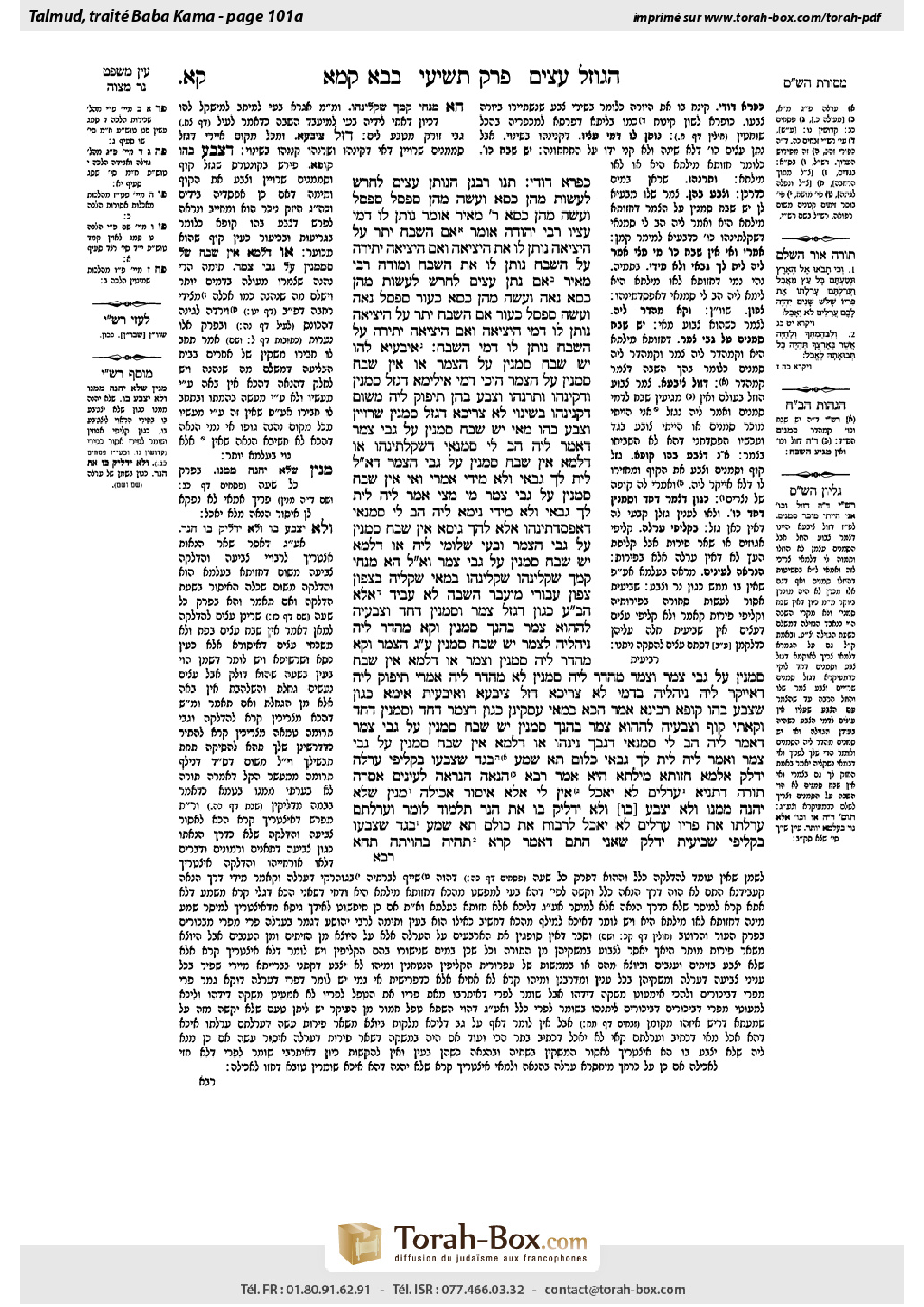
Bava Kamma 101a: Talmud study for Daf Yomi
Study the Talmud for Daf Yomi with scanned pages, Hebrew text, English translations from Sefaria and AI-generated French translations.
Passage selection and English or AI-generated French translation are available where the scan has annotations. Daf Study is independent of Torah-Box and Sefaria.
Browse Bava Kamma · בבא קמא · All tractatesBava Kamma 101a text and translations
This page of Bava Kamma includes the Aramaic text, an English translation and an AI-generated French translation, alongside the scan above.
בבא קמא ק״א א · Aramaic and Hebrew text
כַּפְרָא דּוּדֵי.
תָּנוּ רַבָּנַן: הַנּוֹתֵן עֵצִים לֶחָרָשׁ לַעֲשׂוֹת מֵהֶן כִּסֵּא, וְעָשָׂה מֵהֶן סַפְסָל; סַפְסָל, וְעָשָׂה מֵהֶן כִּסֵּא – רַבִּי מֵאִיר אוֹמֵר: נוֹתֵן לוֹ דְּמֵי עֵצָיו. רַבִּי יְהוּדָה אוֹמֵר: אִם הַשֶּׁבַח יָתֵר עַל הַיְּצִיאָה – נוֹתֵן לוֹ אֶת הַיְּצִיאָה, וְאִם הַיְּצִיאָה יְתֵירָה עַל הַשֶּׁבַח – נוֹתֵן לוֹ אֶת הַשֶּׁבַח.
וּמוֹדֶה רַבִּי מֵאִיר אִם נָתַן עֵצִים לֶחָרָשׁ לַעֲשׂוֹת מֵהֶן כִּסֵּא נָאֶה, וְעָשָׂה מֵהֶן כִּסֵּא כָּעוּר; סַפְסָל נָאֶה, וְעָשָׂה סַפְסָל כָּעוּר – אִם הַשֶּׁבַח יָתֵר עַל הַיְּצִיאָה, נוֹתֵן לוֹ דְּמֵי הַיְּצִיאָה; וְאִם הַיְּצִיאָה יְתֵירָה עַל הַשֶּׁבַח, נוֹתֵן לוֹ דְּמֵי הַשֶּׁבַח.
אִיבַּעְיָא לְהוּ: יֵשׁ שֶׁבַח סַמָּנִין עַל הַצֶּמֶר, אוֹ אֵין שֶׁבַח סַמָּנִין עַל הַצֶּמֶר?
הֵיכִי דָמֵי? אִילֵּימָא דִּגְזַל סַמָּנִין וְדַקִּינְהוּ וּתְרָנְהוּ וּצְבַע (בָּהֶן) [בְּהוּ], תִּיפּוֹק לֵיהּ מִשּׁוּם דִּקְנָנְהוּ בְּשִׁינּוּי!
לָא צְרִיכָא, דִּגְזַל סַמָּנִין שְׁרוּיִין, וּצְבַע בְּהוּ. מַאי? יֵשׁ שֶׁבַח סַמָּנִין עַל גַּבֵּי צֶמֶר, דַּאֲמַר לֵיהּ: ״הַב לִי סַמָּנַאי דִּשְׁקַלְתִּינְהוּ״; אוֹ דִלְמָא אֵין שֶׁבַח סַמָּנִין עַל גַּבֵּי הַצֶּמֶר, דַּאֲמַר לֵיהּ: ״לֵית לָךָ גַּבַּאי וְלָא מִידֵּי״?
אָמְרִי: וְאִי אֵין שֶׁבַח סַמָּנִין עַל גַּבֵּי צֶמֶר, מִי מָצֵי אָמַר לֵיהּ: ״לֵית לָךָ גַּבַּאי וְלָא מִידֵּי״?! נֵימָא לֵיהּ: ״הַב לִי סַמָּנַאי דְּאַפְסֵדְתִּינְהוּ״!
אֶלָּא לְהָךְ גִּיסָא: אֵין שֶׁבַח סַמָּנִין עַל גַּבֵּי הַצֶּמֶר, וּבָעֵי שַׁלּוֹמֵי לֵיהּ; אוֹ דִּלְמָא יֵשׁ שֶׁבַח סַמָּנִין עַל גַּבֵּי צֶמֶר, וַאֲמַר לֵיהּ: ״הָא מַנְּחִי קַמָּךְ – שִׁקְלִינְהוּ״? ״שִׁקְלִינְהוּ״?! בְּמַאי (שָׁקְלֵיהּ) [שָׁקֵיל לְהוּ], בְּצָפוֹן? צָפוֹן עַבּוֹרֵי מְיעַבַּר, הֲשָׁבָה לָא עָבֵיד!
אֶלָּא הָכָא בְּמַאי עָסְקִינַן – כְּגוֹן דִּגְזַל צֶמֶר וְסַמָּנִין דְּחַד, וְצַבְעֵיהּ לְהָהוּא צֶמֶר בְּהָנָךְ סַמָּנִין, וְקָא מַהְדַּר לֵיהּ נִיהֲלֵיהּ לְצֶמֶר. יֵשׁ שֶׁבַח סַמָּנִין עַל גַּבֵּי הַצֶּמֶר, וְקָא מַהְדַּר לֵיהּ סַמָּנִין וְצֶמֶר; אוֹ דִלְמָא אֵין שֶׁבַח סַמָּנִין עַל גַּבֵּי צֶמֶר, וְצֶמֶר מַהְדַּר לֵיהּ, סַמָּנִין לָא מַהְדַּר לֵיהּ?
אָמְרִי: תִּיפּוֹק לֵיהּ דְּאִיַּיקַּר לֵיהּ נִיהֲלֵיהּ בִּדְמֵי! לָא צְרִיכָא, דְּזַל צִיבְעָא. וְאִיבָּעֵית אֵימָא: כְּגוֹן שֶׁצָּבַע בְּהוּ קוֹפָא.
רָבִינָא אָמַר: הָכָא בְּמַאי עָסְקִינַן – כְּגוֹן דְּצֶמֶר דְּחַד וְסַמָּנִין דְּחַד, וְקָאָתֵי קוֹף וְצַבְעֵיהּ לְהָהוּא צֶמֶר בְּהָנָךְ סַמָּנִין. יֵשׁ שֶׁבַח סַמָּנִין עַל גַּבֵּי צֶמֶר, דַּאֲמַר לֵיהּ: הַב לִי סַמָּנַאי דְּגַבָּךְ נִינְהוּ; אוֹ דִלְמָא אֵין שֶׁבַח סַמָּנִין עַל גַּבֵּי צֶמֶר, וַאֲמַר לֵיהּ: לֵית לָךָ גַּבַּאי כְּלוּם?
תָּא שְׁמַע: בֶּגֶד שֶׁצְּבָעוֹ בִּקְלִיפֵּי עׇרְלָה – יִדָּלֵק. אַלְמָא חֲזוּתָא מִילְּתָא הִיא!
אָמַר רָבָא: הֲנָאָה הַנִּרְאֶה לָעֵינַיִם אָסְרָה תּוֹרָה – דְּתַנְיָא: ״עֲרֵלִים לֹא יֵאָכֵל״ – אֵין לִי אֶלָּא אִיסּוּר אֲכִילָה; מִנַּיִן שֶׁלֹּא יֵהָנֶה מִמֶּנּוּ, וְלֹא יִצְבַּע [בּוֹ], וְלֹא יַדְלִיק בּוֹ אֶת הַנֵּר?
תַּלְמוּד לוֹמַר: ״וַעֲרַלְתֶּם עׇרְלָתוֹ אֶת פִּרְיוֹ״, ״עֲרֵלִים לֹא יֵאָכֵל״ – לְרַבּוֹת אֶת כּוּלָּם.
תָּא שְׁמַע: בֶּגֶד שֶׁצְּבָעוֹ בִּקְלִיפֵּי שְׁבִיעִית – יִדָּלֵק! שָׁאנֵי הָתָם, דְּאָמַר קְרָא: ״תִּהְיֶה״ – בַּהֲוָיָתָהּ תְּהֵא.
Bava Kamma 101a · English translation
The sediments of dye in the cauldrons, that is, the dyer took the dye remaining in the cauldron from previous use, and used that dye for this garment, leading to an inferior result.
§ The Sages taught (Tosefta 10:8): With regard to one who gives wood to a carpenter to fashion a chair from it and he fashioned a bench from it instead, or one who gives him wood to fashion a bench and he fashioned a chair from it instead, Rabbi Meir says: The carpenter gives him the value of his wood and keeps the chair or bench, as he has acquired it due to the change. Rabbi Yehuda says: He does not acquire the item. Rather, if the value of the wood’s enhancement exceeds the carpenter’s expenses the owner gives the carpenter the expenses, and if the expenses exceed the enhancement of the wood he gives him the value of the enhancement. Since the carpenter deviated from the customer’s order, he is entitled to either his expenses or the enhancement, the smaller amount of the two.
The baraita continues: And Rabbi Meir concedes that if he gave wood to a carpenter to fashion a beautiful chair from it and he fashioned an ugly chair from it, or to fashion a beautiful bench from it and he fashioned an ugly bench from it, then if the value of the wood’s enhancement exceeds the carpenter’s expenses the owner gives the carpenter the value of the expenses, and if the expenses exceed the enhancement he gives him the value of the enhancement. Since the carpenter did not deviate significantly from the customer’s instructions, Rabbi Meir concedes that the carpenter does not acquire the item due to the change.
§ In connection with the discussion of the halakhic implications of the enhancement of a garment quoted above, the Gemara records that a dilemma was raised before the Sages: What is the halakha? That the enhancement which dye provides to the wool is substantive, i.e., the dye is considered a separate entity from the wool it dyed? Or is the halakha that the enhancement which dye provides to the wool is not substantive, i.e., the dye does not remain an independent entity, and it is viewed as if there is only colored wool?
The Gemara asks: What are the circumstances in which this dilemma is relevant? If we say that the dilemma arises where one robbed another of pigments, and ground them up and soaked them in water, converting them into dye, and then dyed wool with them, then the dilemma would be concerning how the robber returns the pigments. In this case, derive the halakha due to the fact that the robber acquired the pigments due to a change of form, which occurred when he ground the pigments, and in any event will be obligated to return the value of the pigments at the time of the robbery.
The Gemara answers: No, it is necessary to resolve the dilemma in a case where one robbed another of pigments that had already been soaked in water, and then dyed wool with them. What is the halakha here? Is the enhancement which dye provides to the wool substantive, i.e., a separate entity, so that the owner can say to the robber: Give me my dyes that you took? Or perhaps the enhancement which dye provides to the wool is not substantive, but becomes one with the wool, so that the robber can say to the owner: I have nothing at all of yours, since the dyes are no longer considered extant.
The Gemara rejects this understanding of the application of the dilemma. The Sages say: And even if the enhancement which dye provides to the wool is not substantive, can the robber really say to him: I have nothing at all of yours? Let the owner say to him: Give me my dyes that you have caused to be lost. Even if the dyes are no longer considered extant, the owner is still entitled to monetary compensation for the robbery.
Rather, the dilemma is relevant to that other side of the question: Is the halakha that the enhancement which dye provides to the wool is not substantive, and therefore the robber needs to pay him? Or perhaps the enhancement which dye provides to the wool is substantive, and the robber can say to him: The dyes absorbed into the wool lie before you; take them. The Gemara rejects this as well: Take them? With what should he take the dyes, with soap? While soap does remove dye from the wool, it does not return the dye to the robbery victim, as the dye cannot be recovered.
The Gemara suggests another scenario: Rather, with what are we dealing here? We are dealing with a case where he robbed one person of wool and dyes, and dyed that wool with those dyes, and he is returning the dyed wool to him. The dilemma is: Is the halakha that enhancement which dye provides to the wool is substantive, and he is therefore returning both the dye and the wool to him? Or perhaps enhancement which dye provides to the wool is not substantive, and it is only the wool that he is returning to him, but he is not returning the dye to him, since it is no longer extant.
The Gemara rejects this understanding of the application of the dilemma as well. The Sages say: Derive the halakha in this case based on the fact that he increased the value of the wool for him, as dyed wool is more expensive than undyed wool. Consequently, even if the robber has not returned the dye, he reimburses the owner for it when he returns the appreciated wool. The Gemara suggests: No, it is necessary to resolve the dilemma in a case where the cost of the dye has depreciated. If the dye is viewed as an independent entity the robber is returning both the wool and the dye. If it is not, he must reimburse the robbery victim for the value of the dye at the time of the robbery. And if you wish, say instead: The dilemma is relevant in a case where he robbed another of dye and a basket, and dyed the basket with the dye, in which case the dye does not increase the value of the dyed item.
The Gemara presents an alternative understanding of the case where the dilemma applies. Ravina said: With what are we dealing here? We are dealing with a case where there was wool that belonged to one person and dyes that belonged to one other person, and a monkey came and dyed that wool with those dyes. The dilemma is as follows: Is the halakha that enhancement which dye provides to the wool is substantive, so that the owner of the dye can say to the owner of the wool: Give me my dyes that are with you? Or perhaps enhancement which dye provides to the wool is not substantive and the owner of the wool can say to the owner of the dye: There is nothing of yours with me, and he is exempt from liability because the dyes are no longer extant.
Having determined the scenario in which the dilemma is relevant, the Gemara proceeds to resolve the dilemma. Come and hear a solution from a mishna (Orla 3:1): A garment that one dyed with dye extracted from peels of orla, i.e., fruit that grows on a tree during its first three years, must be burned, as it is prohibited to derive benefit from orla. Apparently, the enhancement of an item’s appearance is considered a significant matter, and the dye therefore remains an independent substance even after having been absorbed by the wool.
The Gemara rejects this resolution. Rava said: The reason the garment must be burned is not because the dye remains an independent substance. Rather, it is because the Torah prohibited benefit that is visible to the eye, as it is taught in a baraita: The verse states: “And shall have planted all manner of trees for food, then you shall count the fruit thereof as forbidden; three years shall it be as forbidden [areilim] to you; it shall not be eaten” (Leviticus 19:23). From this verse I have derived only a prohibition against eating it; from where is it derived that one may not even derive benefit from it, and that one may not dye with dyes extracted from the fruit, and that one may not light a lamp with oil extracted from the fruit?
The baraita answers: The verse states: “Then you shall count the fruit thereof [orlato] as forbidden [araltem]. Three years shall it be as forbidden [areilim] to you; it shall not be eaten” (Leviticus 19:23), to include all these types of benefit in the prohibition. Consequently, there is an explicit derivation that an item dyed with orla dye is forbidden.
The Gemara attempts another resolution of the dilemma. Come and hear a resolution from that which was taught in a baraita: A garment that one dyed with dye extracted from the peels of produce from the Sabbatical Year must be burned when the time for the elimination of Sabbatical Year produce arrives. This indicates that the dye evidently remains an independent substance. The Gemara rejects this proof: It is different there, as the verse states: “Shall all the increase thereof be” (Leviticus 25:7), and the phrase: “Shall be,” teaches that it will always remain as it is, i.e., it retains its status as Sabbatical Year produce despite any change to its form.
Bava Kamma 101a · Traduction française (IA)
Les dépôts de teinture dans les cuvettes, c'est-à-dire que le teinturier a utilisé la teinture restante dans la cuvette d'une utilisation précédente pour teindre cette robe, ce qui a entraîné un résultat inférieur.
§ Les Sages enseignent (Tosefta 10:8) : En ce qui concerne celui qui donne du bois à un charpentier pour qu'il en fabrique une chaise, et qu'il en fait plutôt un banc, ou celui qui lui donne du bois pour qu'il en fabrique un banc et qu'il en fait plutôt une chaise, Rabbi Meïr dit : Le charpentier lui donne la valeur du bois et garde la chaise ou le banc, car il les a acquis grâce au changement. Rabbi Yéhuda dit : Il ne les acquiert pas. En revanche, si la valeur de l'amélioration du bois dépasse les dépenses du charpentier, l'owner donne au charpentier la valeur des dépenses, et si les dépenses dépassent l'amélioration du bois, il lui donne la valeur de l'amélioration. Puisque le charpentier a dévié de la commande de l'acheteur, il est autorisé à retenir soit ses dépenses, soit l'amélioration, le montant le plus petit des deux.
La baraïta continue : Et Rabbi Meïr reconnaît que si l'on a donné du bois à un charpentier pour qu'il en fasse une chaise belle et qu'il en a fait une laide, ou pour qu'il en fasse un banc beau et qu'il en a fait un laide, alors si la valeur de l'amélioration du bois dépasse les dépenses du charpentier, l'owner donne au charpentier la valeur des dépenses, et si les dépenses dépassent l'amélioration du bois, il lui donne la valeur de l'amélioration. Puisque le charpentier n'a pas dévié significativement des instructions de l'acheteur, Rabbi Meïr reconnaît que le charpentier ne peut pas acquérir l'objet grâce au changement.
§ En lien avec la discussion sur les implications halakhiques de l'amélioration d'un vêtement mentionnée ci-dessus, le Guemara note qu'un dilemme a été soulevé devant les Sages : Quelle est la halakha ? Que l'amélioration que la teinture apporte à la laine est substantielle, c'est-à-dire que la teinture est considérée comme une entité distincte de la laine qu'elle a teint, ou que la halakha est que l'amélioration que la teinture apporte à la laine n'est pas substantielle, c'est-à-dire que la teinture ne reste pas une entité indépendante, et qu'elle est vue comme si la laine teintée n'était qu'une laine colorée.
Le Guemara demande : Quels sont les circonstances dans lesquelles ce dilemme est pertinent ? Si l'on dit que ce dilemme survient lorsque l'on a volé à un autre des pigments, qu'on les a broyés et qu'on les a trempés dans l'eau pour les transformer en teinture, puis qu'on a teint la laine avec eux, alors ce dilemme concerne la manière dont le voleur doit rendre les pigments. Dans ce cas, on dérive la halakha du fait que le voleur a acquis les pigments grâce à un changement de forme, qui s'est produit lorsqu'il a broyé les pigments, et qu'en tout cas il sera tenu de rendre la valeur des pigments au moment du vol.
Le Guemara répond : Non, il est nécessaire de résoudre ce dilemme dans un cas où l'on a volé à un autre des pigments qui avaient déjà été trempés dans l'eau, puis qu'on a teint la laine avec eux. Quelle est la halakha ici ? L'amélioration que la teinture apporte à la laine est-elle substantielle, c'est-à-dire une entité distincte, de sorte que l'propriétaire puisse dire au voleur : Rends-moi tes teintures que tu as prises ? Ou bien l'amélioration que la teinture apporte à la laine n'est-elle pas substantielle, mais devient une entité unique avec la laine, de sorte que le voleur puisse dire à l'propriétaire : Je n'ai rien de tien, car les teintures ne sont plus considérées comme existantes.
Le Guemara rejette cette interprétation de l'application du dilemme. Les Sages disent : Et même si l'amélioration que la teinture apporte à la laine n'est pas substantielle, le voleur peut-il vraiment dire à l'propriétaire : Je n'ai rien de tien ? L'propriétaire peut dire au voleur : Rends-moi mes teintures que tu as fait disparaître. Même si les teintures ne sont plus considérées comme existantes, l'propriétaire est toujours autorisé à demander une compensation monétaire pour le vol.
Plutôt, le dilemme est pertinent pour l'autre côté de la question : La halakha est-elle que l'amélioration que la teinture apporte à la laine n'est pas substantielle, et donc le voleur doit payer ? Ou bien l'amélioration que la teinture apporte à la laine est-elle substantielle, et le voleur peut dire à l'propriétaire : Les teintures absorbées dans la laine sont devant toi ; prends-les. Le Guemara rejette cela également : Prends-les ? Avec quoi devrait-il prendre les teintures, avec du savon ? Bien que le savon puisse enlever la teinture de la laine, il ne la rend pas au victime du vol, car la teinture ne peut pas être récupérée.
Le Guemara suggère un autre scénario : Plutôt, avec quoi sommes-nous en train de nous occuper ici ? Nous sommes en train de nous occuper d'un cas où l'on a volé à une personne du laine et des teintures, et qu'on a teint cette laine avec ces teintures, et qu'on lui rend cette laine teintée. Le dilemme est : La halakha est-elle que l'amélioration que la teinture apporte à la laine est substantielle, et qu'il doit donc lui rendre à la fois la teinture et la laine ? Ou bien l'amélioration que la teinture apporte à la laine n'est-elle pas substantielle, et qu'il ne lui rend que la laine, mais qu'il ne lui rend pas la teinture, car elle n'est plus existante.
Le Guemara rejette également cette interprétation de l'application du dilemme. Les Sages disent : Dérive la halakha dans ce cas du fait qu'il a augmenté la valeur du laine pour lui, car la laine teintée est plus chère que la laine non teintée. Par conséquent, même si le voleur n'a pas rendu la teinture, il indemnisera l'owner pour celle-ci lorsqu'il rend la laine appréciée. Le Guemara suggère : Non, il est nécessaire de résoudre le dilemme dans un cas où la valeur de la teinture a diminué. Si la teinture est vue comme une entité distincte, le voleur rend à la fois la laine et la teinture. Si ce n'est pas le cas, il doit indemnisé le victime du vol pour la valeur de la teinture au moment du vol. Et si vous le souhaitez, dites plutôt : Le dilemme est pertinent dans un cas où l'on a volé à un autre de la teinture et d'un panier, et qu'on a teint le panier avec la teinture, dans lequel cas la teinture ne fait pas augmenter la valeur de l'objet teint.
La Guemara présente une autre interprétation du cas où la difficulté s'applique. Ravina dit : De quoi sommes-nous en train de parler ? Nous parlons d'un cas où il y avait du laine appartenant à une personne et des teintures appartenant à une autre personne, et un singe est venu et a teint cette laine avec ces teintures. La difficulté est la suivante : La halakha est-elle que l'amélioration que la teinture apporte à la laine est substantielle, de sorte que l'propriétaire des teintures peut dire à l'propriétaire de la laine : Donnez-moi mes teintures qui sont avec vous ? Ou bien l'amélioration que la teinture apporte à la laine n'est-elle pas substantielle, et l'propriétaire de la laine peut dire à l'propriétaire des teintures : Il n'y a rien de vôtre chez moi, et il est exempt de responsabilité car les teintures ne sont plus présentes ?
Ayant déterminé le scénario dans lequel la difficulté est pertinente, la Guemara passe à la résolution de cette difficulté. Vient-on entendre une solution d'une mitsva (Orla 3:1) : Un vêtement que l'on a teint avec une teinture extraite des peaux d'orla, c'est-à-dire des fruits qui poussent sur un arbre pendant ses trois premières années, doit être brûlé, car il est interdit de tirer un bénéfice d'orla. Apparemment, l'amélioration de l'apparence d'un objet est considérée comme une affaire importante, et la teinture reste donc une substance indépendante même après avoir été absorbée par la laine.
La Guemara rejette cette résolution. Rava dit : La raison pour laquelle le vêtement doit être brûlé n'est pas parce que la teinture reste une substance indépendante. C'est plutôt parce que la Torah interdit le bénéfice visible à l'œil, comme il est enseigné dans une baraïta : La parabole dit : « Et vous planterez toutes sortes d'arbres pour la nourriture, et vous compterez les fruits d'entre eux comme interdits ; trois ans seront-ils comme interdits pour vous ; vous ne les mangerez pas » (Lévitique 19:23). De cette parabole j'ai déduit uniquement une interdiction de les manger ; d'où est-il déduit que l'on ne peut pas non plus tirer un bénéfice d'eux, et que l'on ne peut pas teindre avec des teintures extraites des fruits, et que l'on ne peut pas allumer une lampe avec de l'huile extraite des fruits ?
La baraïta répond : La parabole dit : « Et vous compterez les fruits d'entre eux [orlato] comme interdits [araltem]. Trois ans seront-ils comme interdits [areilim] pour vous ; vous ne les mangerez pas » (Lévitique 19:23), pour inclure tous ces types de bénéfice dans l'interdiction. Ainsi, il y a une dérivation explicite que l'objet teint avec une teinture d'orla est interdit.
La Guemara tente une autre résolution de la difficulté. Vient-on entendre une résolution de ce qui a été enseigné dans une baraïta : Un vêtement que l'on a teint avec une teinture extraite des peaux des produits de l'année sabbatique doit être brûlé lorsque vient le temps d'éliminer les produits de l'année sabbatique. Cela indique que la teinture reste clairement une substance indépendante. La Guemara rejette cette preuve : C'est différent là-bas, car la parabole dit : « Tout l'excédent d'entre eux sera » (Lévitique 25:7), et la phrase : « sera », enseigne qu'il restera toujours ainsi, c'est-à-dire qu'il conserve son statut de produit de l'année sabbatique malgré tout changement de sa forme.
Traduction française générée par IA à partir de l’édition anglaise de Sefaria. Vérifie toujours un passage avec le texte source.
Text from Sefaria: William Davidson Edition - Vocalized Aramaic (CC BY NC); William Davidson Edition - English (CC BY NC).