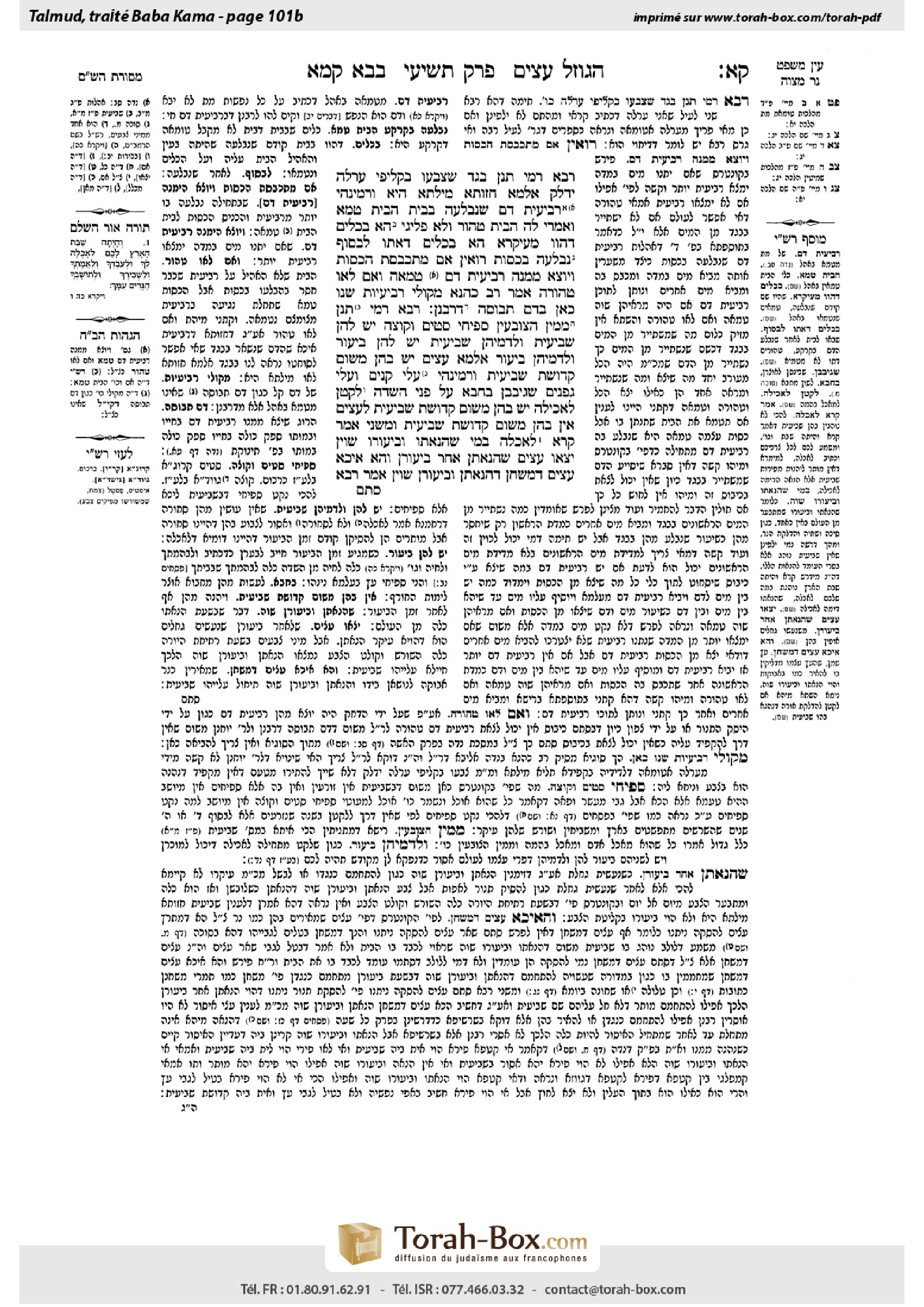
Bava Kamma 101b: Talmud study for Daf Yomi
Study the Talmud for Daf Yomi with scanned pages, Hebrew text, English translations from Sefaria and AI-generated French translations.
Passage selection and English or AI-generated French translation are available where the scan has annotations. Daf Study is independent of Torah-Box and Sefaria.
Browse Bava Kamma · בבא קמא · All tractatesBava Kamma 101b text and translations
This page of Bava Kamma includes the Aramaic text, an English translation and an AI-generated French translation, alongside the scan above.
בבא קמא ק״א ב · Aramaic and Hebrew text
רָבָא רָמֵי, תְּנַן: בֶּגֶד שֶׁצְּבָעוֹ בִּקְלִיפֵּי עׇרְלָה – יִדָּלֵק; אַלְמָא חֲזוּתָא מִילְּתָא הִיא. וּרְמִינְהִי: רְבִיעִית דָּם שֶׁנִּבְלְעָה בַּבַּיִת – הַבַּיִת טָמֵא. וְאָמְרִי לַהּ: הַבַּיִת טָהוֹר. וְלָא פְּלִיגִי, הָא בְּכֵלִים דַּהֲווֹ מֵעִיקָּרָא, הָא בְּכֵלִים דַּאֲתוֹ לְבַסּוֹף.
נִבְלְעָה בִּכְסוּת – רוֹאִין; אִם מִתְכַּבֶּסֶת הַכְּסוּת וְיוֹצָא מִמֶּנָּה רְבִיעִית דָּם – טְמֵאָה, וְאִם לָאו – טְהוֹרָה!
אָמַר רַב כָּהֲנָא: מִקּוּלֵּי רְבִיעִיּוֹת שָׁנוּ כָּאן; בְּדַם תְּבוּסָה דְּרַבָּנַן.
רָבָא רָמֵי, תְּנַן: מִמִּין הַצּוֹבְעִין – סְפִיחֵי סְטִיס וְקוֹצָה, יֵשׁ לָהֶן שְׁבִיעִית וְלִדְמֵיהֶן שְׁבִיעִית, יֵשׁ לָהֶן בִּיעוּר וְלִדְמֵיהֶן בִּיעוּר. אַלְמָא עֵצִים יֵשׁ בָּהֶן מִשּׁוּם קְדוּשַּׁת שְׁבִיעִית.
וּרְמִינְהִי: עֲלֵי קָנִים וַעֲלֵי גְפָנִים שֶׁגִּיבְּבָן בְּחֵבֶא עַל פְּנֵי הַשָּׂדֶה, לִקְּטָן לַאֲכִילָה – יֵשׁ בָּהֶן מִשּׁוּם קְדוּשַּׁת שְׁבִיעִית, לְעֵצִים – אֵין בָּהֶן מִשּׁוּם קְדוּשַּׁת שְׁבִיעִית!
וּמְשַׁנֵּי, אָמַר קְרָא: ״לְאׇכְלָה״ – בְּמִי שֶׁהֲנָאָתוֹ וּבִיעוּרוֹ שָׁוִין, יָצְאוּ עֵצִים שֶׁהֲנָאָתָן אַחַר בִּיעוּרָן.
וְהָא אִיכָּא עֵצִים דְּמִשְׁחָן, דַּהֲנָאָתָן וּבִיעוּרָן שָׁוִין!
אָמַר רָבָא:
Bava Kamma 101b · English translation
The Gemara states that Rava raises a contradiction: We learned in a mishna (Orla 3:1): A garment that one dyed with dye extracted from peels of orla must be burned. Apparently, the change in appearance precipitated by the orla peels is considered a significant matter, and the dye retains its status as orla. And raise a contradiction from another mishna (Oholot 3:2): With regard to a quarter-log of blood from a corpse that was absorbed in the floor of a house, every vessel in the house is ritually impure by virtue of being under the same roof as the blood. And some say that any vessel in the house is ritually pure. And these two statements do not disagree, as this first statement was in reference to vessels that were in the house at the outset, before the blood was absorbed; and this second statement was in reference to vessels that came into the house at the end, after the blood had already been absorbed.
The mishna continues: If the blood was absorbed in a garment, it is examined, and if the garment is washed and a quarter-log of blood emerges from it, it is ritually impure, and the garment imparts ritual impurity to the vessels in the house as well. But if not, i.e., if less than a quarter-log of blood emerges, then it is pure, and it does not impart impurity. Apparently, only the blood that can be removed from the garment is considered blood, while the blood absorbed in the garment is insignificant. If this is the case, the change in appearance precipitated by the blood is not considered a significant matter, and the blood absorbed in the garment does not remain an independent substance.
The Gemara presents an answer. Rav Kahana said: A halakha from among the leniencies applied to the measurements of a quarter-log was taught here, as the mishna is written in reference to the blood of submission that is discharged from a body at the time of death, and such blood is ritually impure by rabbinic law, but in general, a change in appearance precipitated by blood is significant.
§ Having cited a contradiction raised by Rava, the Gemara proceeds to cite another. Rava raises another contradiction. We learned in a mishna (Shevi’it 7:1): Concerning plants from among the species that are used as dyes, for example the sefiḥin, i.e., produce that grew without being intentionally planted, of woad and safflower; they have sanctity of the Sabbatical Year and money exchanged for them has sanctity of the Sabbatical Year. Additionally, they are subject to the halakha of eradication, and money exchanged for them is subject to the halakha of eradication. Apparently, wood, a type of inedible growth, is subject to the sanctity of the Sabbatical Year despite the fact that it is not edible.
And raise a contradiction from a baraita: With regard to reed leaves and vine leaves that one piled for storage upon the field, if he gathered them for eating, they are subject to the sanctity of the Sabbatical Year; if he gathered them for use as wood, e.g., for kindling a fire, they are not subject to the sanctity of the Sabbatical Year. Apparently, wood or any other non-food product is not subject to the sanctity of the Sabbatical Year.
And Rava answers the contradiction, as the verse states: “And the Sabbath produce of the land shall be for food for you” (Leviticus 25:6), indicating that the sanctity of the Sabbatical Year takes effect only with regard to those items whose benefit and whose consumption coincide, as is the case with regard to food. Wood is excluded, as its benefit follows its consumption. The primary purpose of kindling wood is not accomplished with the burning of the wood; rather, it is with the charcoal that heats the oven. Therefore, wood is not subject to the sanctity of the Sabbatical Year.
The Gemara objects: But isn’t there wood that is used to provide heat, whose benefit coincides with its consumption, as one enjoys the warmth provided by the fire while the wood is burned?
Rava said:
Bava Kamma 101b · Traduction française (IA)
La Guemara affirme que Rava soulève une contradiction : Nous avons appris dans une mitsva (Orla 3:1) : Un vêtement teint avec un colorant extrait des peaux d’orla doit être brûlé. Apparemment, le changement d’apparence provoqué par les peaux d’orla est considéré comme une affaire importante, et le colorant conserve son statut d’orla. Et il soulève une contradiction à partir d’une autre mitsva (Oholot 3:2) : En ce qui concerne un quart de log de sang d’un cadavre absorbé dans le plancher d’une maison, chaque récipient de la maison est impur rituellement en raison d’être sous le même toit que le sang. Et certains disent que tout récipient de la maison est pur rituellement. Et ces deux déclarations ne s’opposent pas, car cette première déclaration faisait référence aux récipients qui étaient dans la maison dès le départ, avant que le sang ne soit absorbé ; et cette deuxième déclaration faisait référence aux récipients qui sont entrés dans la maison plus tard, après que le sang avait déjà été absorbé.
La mitsva continue : Si le sang a été absorbé dans un vêtement, il est examiné, et si le vêtement est lavé et un quart de log de sang en émerge, il est impur rituellement, et le vêtement transmet l’impureté rituelle aux récipients de la maison. Mais si ce n’est pas le cas, c’est-à-dire si moins d’un quart de log de sang en émerge, alors il est pur, et il ne transmet pas l’impureté. Apparemment, seul le sang qui peut être retiré du vêtement est considéré comme du sang, tandis que le sang absorbé dans le vêtement est insignifiant. Si c’est le cas, le changement d’apparence provoqué par le sang n’est pas considéré comme une affaire importante, et le sang absorbé dans le vêtement ne reste pas une substance indépendante.
La Guemara présente une réponse. Rav Kahana dit : Une halakha parmi les facilités applicables aux mesures d’un quart de log a été enseignée ici, car la mitsva fait référence au sang de soumission qui est émis du corps au moment de la mort, et ce sang est impur rituellement selon la loi rabbinique, mais en général, un changement d’apparence provoqué par le sang est significatif.
§ Ayant cité la contradiction soulevée par Rava, la Guemara passe à une autre. Rava soulève une autre contradiction. Nous avons appris dans une mitsva (Shevi’it 7:1) : En ce qui concerne les plantes parmi les espèces utilisées comme colorants, par exemple les sefiḥin, c’est-à-dire des productions qui ont grandi sans être plantées intentionnellement, comme le woad et le safran ; elles ont la sanctité de l’année sabbatique et l’argent échangé contre elles a la sanctité de l’année sabbatique. De plus, elles sont soumises à la halakha de l’effacement, et l’argent échangé contre elles est soumis à la halakha de l’effacement. Apparemment, le bois, une sorte de croissance non comestible, est soumis à la sanctité de l’année sabbatique malgré le fait qu’il n’est pas comestible.
Et soulève une contradiction à partir d’une baraïta : En ce qui concerne les feuilles de roseau et les feuilles de vigne que l’on empile pour le stockage sur le champ, si l’on les a réunis pour manger, elles sont soumises à la sanctité de l’année sabbatique ; si l’on les a réunis pour l’usage comme bois, par exemple pour allumer un feu, elles ne sont pas soumises à la sanctité de l’année sabbatique. Apparemment, le bois ou tout autre produit non alimentaire n’est pas soumis à la sanctité de l’année sabbatique.
Et Rava répond à la contradiction, car la Parashah dit : « Et la production du sabbat de la terre sera pour votre nourriture » (Lvït 25:6), indiquant que la sanctité de l’année sabbatique s’applique uniquement aux objets dont le bénéfice et la consommation coïncident, comme c’est le cas avec les aliments. Le bois est exclu, car son bénéfice suit sa consommation. L’usage principal du bois pour la chaleur n’est pas accompli par la combustion du bois, mais par le charbon qui chauffe la cuisinière. Par conséquent, le bois n’est pas soumis à la sanctité de l’année sabbatique.
La Guemara s’oppose : Mais n’y a-t-il pas du bois utilisé pour fournir de la chaleur, dont le bénéfice coïncide avec sa consommation, car l’on apprécie la chaleur du feu pendant que le bois est brûlé ?
Rava dit :
Traduction française générée par IA à partir de l’édition anglaise de Sefaria. Vérifie toujours un passage avec le texte source.
Text from Sefaria: William Davidson Edition - Vocalized Aramaic (CC BY NC); William Davidson Edition - English (CC BY NC).