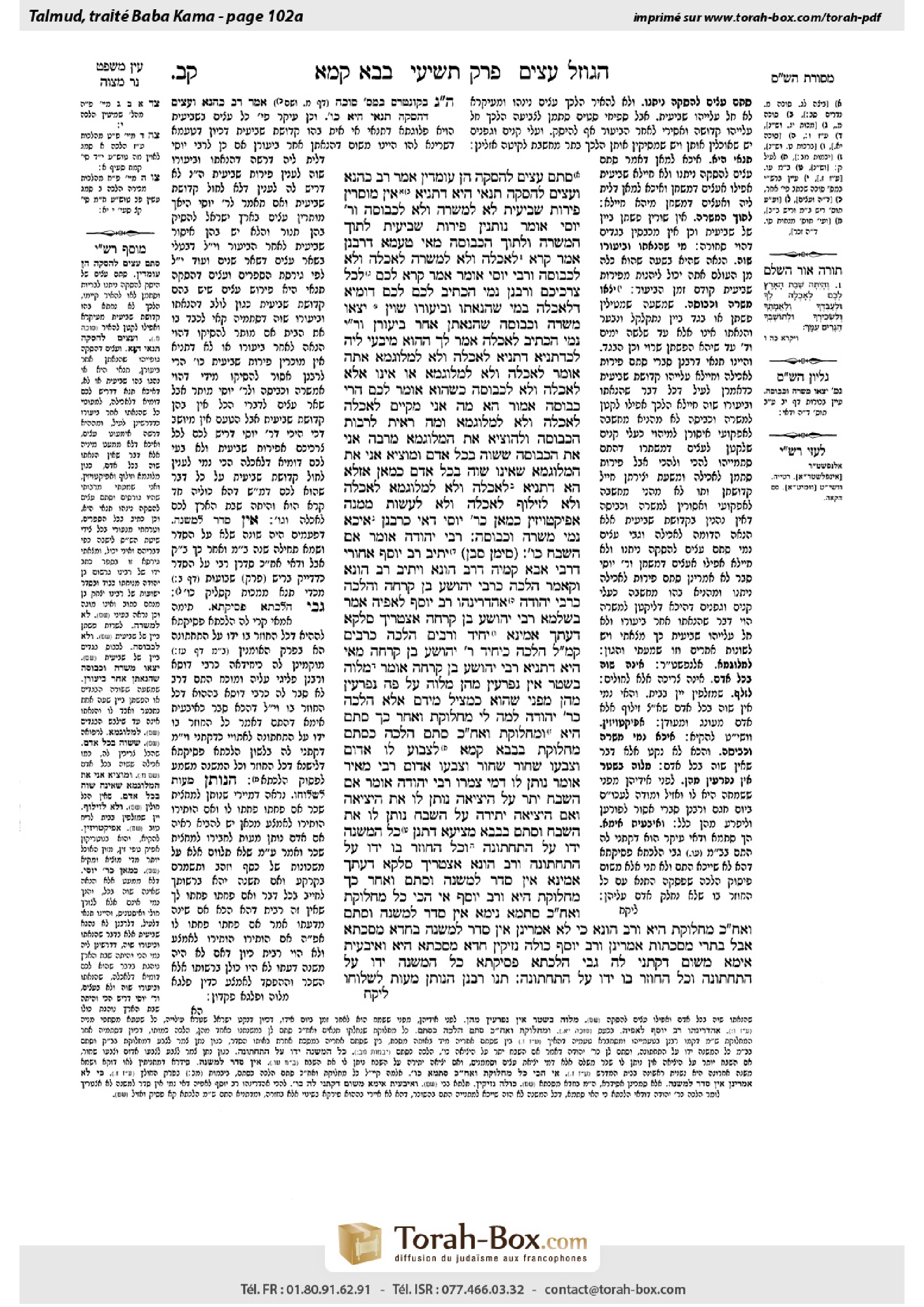
Bava Kamma 102a: Talmud study for Daf Yomi
Study the Talmud for Daf Yomi with scanned pages, Hebrew text, English translations from Sefaria and AI-generated French translations.
Passage selection and English or AI-generated French translation are available where the scan has annotations. Daf Study is independent of Torah-Box and Sefaria.
Browse Bava Kamma · בבא קמא · All tractatesBava Kamma 102a text and translations
This page of Bava Kamma includes the Aramaic text, an English translation and an AI-generated French translation, alongside the scan above.
בבא קמא ק״ב א · Aramaic and Hebrew text
סְתָם עֵצִים – לְהַסָּקָה הֵן עוֹמְדִין.
אָמַר רַב כָּהֲנָא: וְעֵצִים לְהַסָּקָה – תַּנָּאֵי הִיא, דְּתַנְיָא: אֵין מוֹסְרִין פֵּירוֹת שְׁבִיעִית לֹא לְמִשְׁרָה וְלֹא לִכְבוּסָה. וְרַבִּי יוֹסֵי אוֹמֵר: נוֹתְנִין פֵּירוֹת שְׁבִיעִית לְתוֹךְ הַמִּשְׁרָה וּלְתוֹךְ הַכְּבוּסָה.
מַאי טַעְמָא דְּרַבָּנַן? אָמַר קְרָא: ״לְאׇכְלָה״ – וְלֹא לְמִשְׁרָה, ״לְאׇכְלָה״ – וְלֹא לִכְבוּסָה. וְרַבִּי יוֹסֵי אוֹמֵר, אָמַר קְרָא: ״לָכֶם״ – לְכׇל צׇרְכֵיכֶם.
וְרַבָּנַן נָמֵי, הָכְתִיב ״לָכֶם״! ״לָכֶם״ דֻּומְיָא דִּ״לְאָכְלָה״ – בְּמִי שֶׁהֲנָאָתוֹ וּבִיעוּרוֹ שָׁוִין, יָצְאוּ מִשְׁרָה וּכְבוּסָה שֶׁהֲנָאָתָן אַחַר בִּיעוּרָן.
וְרַבִּי יוֹסֵי נָמֵי, הָכְתִיב ״לְאׇכְלָה״! אָמַר לָךְ: הַהוּא מִיבְּעֵי לֵיהּ לְכִדְתַנְיָא. דְּתַנְיָא: ״לְאׇכְלָה״ – וְלֹא לִמְלוּגְמָא. אַתָּה אוֹמֵר ״לְאׇכְלָה״ וְלֹא לִמְלוּגְמָא; אוֹ אֵינוֹ אֶלָּא ״לְאׇכְלָה״ וְלֹא לִכְבוּסָה? כְּשֶׁהוּא אוֹמֵר ״לָכֶם״ – הֲרֵי כְּבוּסָה אָמוּר; הָא מָה אֲנִי מְקַיֵּים ״לְאׇכְלָה״? ״לְאׇכְלָה״ – וְלֹא לִמְלוּגְמָא.
וּמָה רָאִיתָ לְרַבּוֹת הַכְּבוּסָה וּלְהוֹצִיא אֶת הַמְּלוּגְמָא? מְרַבֶּה אֲנִי אֶת הַכְּבוּסָה – שֶׁשָּׁוָה בְּכׇל אָדָם, וּמוֹצִיא אֲנִי אֶת הַמְּלוּגְמָא – שֶׁאֵינוֹ שָׁוֶה בְּכׇל אָדָם.
כְּמַאן אָזְלָא הָא דְּתַנְיָא: ״לְאׇכְלָה״ – וְלֹא לִמְלוּגְמָא, ״לְאׇכְלָה״ – וְלֹא לְזִילּוּף, ״לְאׇכְלָה״ – וְלֹא לַעֲשׂוֹת מִמֶּנָּה אַפִּיקְטְוִיזִין? כְּמַאן – כְּרַבִּי יוֹסֵי; דְּאִי כְּרַבָּנַן, אִיכָּא נָמֵי מִשְׁרָה וּכְבוּסָה.
רַבִּי יְהוּדָה אוֹמֵר: אִם הַשֶּׁבַח כּוּ׳. (סִימָן סב״ן)
יָתֵיב רַב יוֹסֵף אֲחוֹרֵי דְּרַבִּי אַבָּא – קַמֵּיהּ דְּרַב הוּנָא, וְיָתֵיב רַב הוּנָא וְקָאָמַר: הֲלָכָה כְּרַבִּי יְהוֹשֻׁעַ בֶּן קׇרְחָה, וַהֲלָכָה כְּרַבִּי יְהוּדָה.
אַהְדְּרִינְהוּ רַב יוֹסֵף לְאַפֵּיהּ, אָמַר: בִּשְׁלָמָא רַבִּי יְהוֹשֻׁעַ בֶּן קׇרְחָה – אִצְטְרִיךְ; סָלְקָא דַּעְתָּךְ אָמֵינָא: יָחִיד וְרַבִּים – הֲלָכָה כְּרַבִּים, קָא מַשְׁמַע לַן הֲלָכָה כְּיָחִיד.
רַבִּי יְהוֹשֻׁעַ בֶּן קׇרְחָה מַאי הִיא? דְּתַנְיָא, רַבִּי יְהוֹשֻׁעַ בֶּן קׇרְחָה אוֹמֵר: מִלְוָה בִּשְׁטָר – אֵין נִפְרָעִין מֵהֶן. מִלְוָה עַל פֶּה – נִפְרָעִין מֵהֶן, מִפְּנֵי שֶׁהוּא כְּמַצִּיל מִיָּדָם.
אֶלָּא ״הֲלָכָה כְּרַבִּי יְהוּדָה״ לְמָה לִי? מַחְלוֹקֶת וְאַחַר כָּךְ סְתָם הִיא, וּמַחְלוֹקֶת וְאַחַר כָּךְ סְתָם – הֲלָכָה כִּסְתָם!
מַחֲלוֹקֶת – בְּבָבָא קַמָּא, לִצְבּוֹעַ לוֹ אָדוֹם וּצְבָעוֹ שָׁחוֹר, שָׁחוֹר וּצְבָעוֹ אָדוֹם – רַבִּי מֵאִיר אוֹמֵר: נוֹתֵן לוֹ דְּמֵי צַמְרוֹ. רַבִּי יְהוּדָה אוֹמֵר: אִם הַשֶּׁבַח יָתֵר עַל הַיְּצִיאָה – נוֹתֵן לוֹ אֶת הַיְּצִיאָה, וְאִם הַיְּצִיאָה יְתֵירָה עַל הַשֶּׁבַח – נוֹתֵן לוֹ אֶת הַשֶּׁבַח. וּסְתָם – בְּבָבָא מְצִיעָא, דִּתְנַן: כׇּל הַמְשַׁנֶּה – יָדוֹ עַל הַתַּחְתּוֹנָה, וְכׇל הַחוֹזֵר בּוֹ – יָדוֹ עַל הַתַּחְתּוֹנָה!
וְרַב הוּנָא – אִצְטְרִיךְ; סָלְקָא דַּעְתָּךְ אָמֵינָא: אֵין סֵדֶר לַמִּשְׁנָה, וּסְתָם וְאַחַר כָּךְ מַחְלוֹקֶת הִיא. וְרַב יוֹסֵף – אִי הָכִי, כׇּל מַחְלוֹקֶת וְאַחַר כָּךְ סְתָמָא – נֵימָא: אֵין סֵדֶר לַמִּשְׁנָה, וּסְתָם וְאַחַר כָּךְ מַחֲלוֹקֶת הִיא!
וְרַב הוּנָא – כִּי לָא אָמְרִינַן אֵין סֵדֶר לַמִּשְׁנָה, בַּחֲדָא מַסֶּכְתָּא; אֲבָל בִּתְרֵי מַסֶּכְתּוֹת אָמְרִינַן. וְרַב יוֹסֵף – כּוּלַּהּ נְזִיקִין חֲדָא מַסֶּכְתָּא הִיא.
וְאִיבָּעֵית אֵימָא: מִשּׁוּם דְּקָתָנֵי לַהּ גַּבֵּי הִלְכָתָא פְּסִיקָתָא – כׇּל הַמְשַׁנֶּה, יָדוֹ עַל הַתַּחְתּוֹנָה; וְכׇל הַחוֹזֵר בּוֹ, יָדוֹ עַל הַתַּחְתּוֹנָה.
תָּנוּ רַבָּנַן: הַנּוֹתֵן מָעוֹת לִשְׁלוּחוֹ
Bava Kamma 102a · English translation
Unspecified wood exists for fuel, i.e., charcoal, so its benefit follows its consumption.
Rav Kahana says: And the matter of whether kindling wood, whose benefit follows its consumption, is subject to the sanctity of the Sabbatical Year is a dispute among the tanna’im, as it is taught in the Tosefta (Shevi’it 6:25): One may not transfer Sabbatical Year produce, e.g., wine, to another person; neither for soaking flax to prepare it for spinning, as the benefit derived from the flax follows its soaking, when the soaked and spun thread is woven into a garment; nor for laundering with it, as the benefit derived follows the laundering when one wears the clean clothes. Soaking the flax or laundering the garment in wine is considered the consumption of the wine, as it is no longer potable. And Rabbi Yosei says: One may transfer to another Sabbatical Year produce for soaking and for laundering.
The Gemara asks: What is the reasoning for the statement of the Rabbis? The verse states with regard to Sabbatical Year produce: “For food” (Leviticus 25:6), from which it is inferred: But not for soaking; “for food,” but not for laundering. And Rabbi Yosei says that it is permitted, as the verse also states: “For you,” from which it is inferred: For you, for all your needs, even for soaking and for laundering.
The Gemara asks: And according to the Rabbis as well, isn’t it written: “For you”? How do they explain that term? The Gemara answers: From that term “for you” it is derived: “For you,” similar to “for food,” i.e., the sanctity of the Sabbatical Year takes effect with regard to those items whose benefit and whose consumption coincide, which excludes soaking and laundering, where the items’ benefit follows their consumption.
The Gemara asks: And according to Rabbi Yosei as well, isn’t it written: “For food”? Rabbi Yosei could have said to you: That term is necessary for that which is taught in a baraita, as it is taught: The verse states: “For food,” but not for a poultice [melogema]. The baraita continues: Do you say “for food” but not for a poultice, or perhaps it is only “for food” but not for laundering? When the verse says: “For you,” laundering is already stated as permitted since it includes all of one’s bodily needs. How do I realize the meaning of that which the verse states: “For food”? It is “for food” but not for a poultice.
The baraita continues. Should one ask: And what did you see that led you to include the use of Sabbatical Year produce for laundering and to exclude the use of Sabbatical Year produce as a poultice? Perhaps the opposite should be said. The baraita answers: I include the use for laundering, which applies equally to every person, as everyone needs clean clothes, and I exclude the use as a poultice, which does not apply equally to every person; it is only for the ill or wounded.
In accordance with whose opinion is that which is taught in a baraita with regard to Sabbatical Year produce: “For food,” but not for a poultice; “for food,” but not for sprinkling wine in one’s house to provide a pleasant fragrance; “for food,” but not to make an emetic [apiktevizin] from it to induce vomiting? In accordance with whose opinion is this baraita? It is in accordance with the opinion of Rabbi Yosei, as, if it were in accordance with the opinion of the Rabbis, is there not also soaking and laundering that should have been excluded from the baraita, as in the Rabbis’ opinion the use of Sabbatical Year produce for those purposes is forbidden?
§ The mishna (100b) teaches that if the owner gave wool to a dyer to dye it red and instead he dyed it black, Rabbi Meir says: The dyer gives the owner of the wool the value of his wool. Rabbi Yehuda says: If the value of the enhancement exceeds the dyer’s expenses, the owner of the wool gives the dyer the expenses. If the expenses exceed the enhancement, he gives him the value of the enhancement. The Gemara provides a mnemonic device, the acrostic saban, for the names of the Sages involved in the following incident; each letter in the acrostic represents the middle letter of one of the names: Samekh, Rav Yosef; beit, Rabbi Abba; nun, Rav Huna.
The Gemara relates: Rav Yosef was sitting behind Rabbi Abba, and they were both sitting before Rav Huna. And Rav Huna was sitting and saying: The halakha is in accordance with the opinion of Rabbi Yehoshua ben Korḥa and the halakha is in accordance with the opinion of Rabbi Yehuda.
Rav Yosef turned his face in disdain of Rav Huna’s statement. He said: Granted, stating that the halakha is in accordance with the opinion of Rabbi Yehoshua ben Korḥa is necessary, as it would enter your mind to say that there is a principle that when there is a dispute between an individual and the many, the halakha is in accordance with the opinion of the many. Rav Huna therefore teaches us that in this case the halakha is in accordance with the opinion of Rabbi Yehoshua ben Korḥa, despite the fact that he is an individual.
The Gemara interrupts Rav Yosef’s remark and asks: What is the ruling of Rabbi Yehoshua ben Korḥa to which Rav Huna is referring? It is as it is taught in a baraita: Rabbi Yehoshua ben Korḥa says that with regard to a loan with a promissory note, one may not collect the loan from gentiles near the time of their holidays, but with regard to a loan by oral agreement, one may collect from gentiles even near the time of their holidays, because the creditor is considered as one who salvages money from their possession.
But with regard to the statement that the halakha is in accordance with the opinion of Rabbi Yehuda, why do I need it? This is an example of the Mishna recording a dispute, and afterward recording only one side of that dispute as an unattributed opinion. And the principle is that when the Mishna records a dispute, and afterward records only one side of that dispute as an unattributed opinion, then the halakha is in accordance with the unattributed opinion.
The Gemara identifies the dispute and the unattributed mishna. The dispute is found in tractate Bava Kamma: If one gave wool to a dyer to dye it red for him and instead he dyed it black, or to dye it black and he dyed it red, Rabbi Meir says: The dyer gives the owner of the wool the value of his wool. Rabbi Yehuda says: If the value of the enhancement exceeds the expenses, the owner of the wool gives the expenses to the dyer. And if the expenses exceed the enhancement, he gives him the value of the enhancement. And the unattributed mishna appears in tractate Bava Metzia, as we learned in a mishna there (76a): Whoever changes from the terms of an agreement is at a disadvantage, and whoever reneges from an agreement is at a disadvantage. This unattributed mishna accords with the opinion of Rabbi Yehuda, who holds that a craftsman who deviates from his assignment receives either the expenses or the enhancement, whichever is of lesser value.
The Gemara asks: And being that this is a dispute and afterward an unattributed opinion, why did Rav Huna find it necessary to state that the halakha follows the opinion of Rabbi Yehuda? It is necessary, as it would enter your mind to say that the Mishna is not sequential and, in fact, this is a case of an unattributed ruling followed by a dispute. And why does Rav Yosef disagree? He disagrees because if that is so, then with regard to every case where a dispute is recorded and afterward an unattributed opinion is recorded, let us say: The Mishna is not sequential, and this is a case of an unattributed ruling followed by a dispute.
And Rav Huna would respond: The situation where we do not say that the Mishna is not sequential, i.e., where we say that the Mishna is sequential, is only when both mishnayot appear in one tractate, but when they appear in two different tractates we say that the Mishna is not sequential. Since these mishnayot are found in two different tractates, Bava Kamma and Bava Metzia, the assumption is that the Mishna is not sequential. And Rav Yosef would respond: All of Nezikin, i.e., Bava Kamma, Bava Metzia, and Bava Batra, is one tractate.
And if you wish, say that even if Bava Kamma and Bava Metzia are to be considered two separate tractates, Rav Yosef would still hold that Rav Huna’s statement was unnecessary because it is taught as one of a pair of established halakhot: Whoever changes from the terms of an agreement is at a disadvantage, and whoever reneges on an agreement is at a disadvantage. Since this ruling was taught with another, established halakha, it is apparent that this is also an established halakha.
§ The Gemara notes another dispute concerning one who deviates from the terms of an agreement. The Sages taught in the Tosefta (Bava Metzia 4:20): One who gives money to his agent
Bava Kamma 102a · Traduction française (IA)
Le bois non spécifié existe pour le combustible, c'est-à-dire du charbon, donc son bénéfice suit sa consommation.
Rav Kahana dit : Et la question de savoir si le bois de chauffe, dont le bénéfice suit sa consommation, est soumis à la sanctité de l'année sabbatique est un débat entre les tannaïm, comme il est enseigné dans la Tosefta (Shevi’it 6:25) : On ne peut pas transférer les produits de l'année sabbatique, par exemple le vin, à une autre personne ; ni pour imbibir la lin afin de le préparer à tisser, car le bénéfice tiré du lin suit son imbibition, lorsque le fil imbibé et tissé est tissé en vêtement ; ni pour laver avec, car le bénéfice tiré suit le lavage lorsque l'on porte les vêtements propres. Imbibir la lin ou laver le vêtement dans le vin est considéré comme la consommation du vin, car il n'est plus potable. Et Rabbi Yosei dit : On peut transférer les produits de l'année sabbatique à une autre personne pour imbibir et pour laver.
Le Guemara demande : Quel est le raisonnement des Rabbins ? La Parashah stipule concernant les produits de l'année sabbatique : « Pour la nourriture » (Lévitique 25:6), d'où on déduit : Mais pas pour l'imbibition ; « pour la nourriture », mais pas pour le lavage. Et Rabbi Yosei dit qu'il est permis, car la Parashah stipule aussi : « Pour vous », d'où on déduit : Pour vous, pour toutes vos besoins, même pour l'imbibition et pour le lavage.
Le Guemara demande : Et selon les Rabbins également, n'est-il pas écrit : « Pour vous » ? Comment expliquent-ils ce terme ? Le Guemara répond : De ce terme « pour vous », on déduit : « Pour vous », semblable à « pour la nourriture », c'est-à-dire que la sanctité de l'année sabbatique s'applique aux objets dont le bénéfice et la consommation coïncident, ce qui exclut l'imbibition et le lavage, où le bénéfice des objets suit leur consommation.
Le Guemara demande : Et selon Rabbi Yosei également, n'est-il pas écrit : « Pour la nourriture » ? Rabbi Yosei pourrait avoir dit à vous : Ce terme est nécessaire pour ce qui est enseigné dans une baraïta, comme il est enseigné : La Parashah stipule : « Pour la nourriture », mais pas pour un panade [melogema]. La baraïta continue : Dites-vous « pour la nourriture » mais pas pour un panade, ou peut-être est-ce seulement « pour la nourriture » mais pas pour le lavage ? Lorsque la Parashah dit : « Pour vous », le lavage est déjà mentionné comme permis, car il inclut toutes les besoins du corps. Comment puis-je comprendre le sens de ce que la Parashah stipule : « Pour la nourriture » ? C'est « pour la nourriture » mais pas pour un panade.
La baraïta continue. Si l'on demande : Et qu'avez-vous vu qui vous a conduit à inclure l'utilisation des produits de l'année sabbatique pour le lavage et à exclure l'utilisation de ces produits comme panade ? Peut-être devrait-on dire l'opposé. La baraïta répond : J'inclure l'utilisation pour le lavage, qui s'applique également à chaque personne, car tout le monde a besoin de vêtements propres, et j'exclure l'utilisation comme panade, qui ne s'applique pas également à chaque personne ; c'est seulement pour les malades ou les blessés.
Selon l'opinion de qui est-ce que la baraïta enseigne concernant les produits de l'année sabbatique : « Pour la nourriture », mais pas pour un panade ; « pour la nourriture », mais pas pour pulvériser du vin dans sa maison pour un parfum agréable ; « pour la nourriture », mais pas pour en faire un émetique [apiktevizin] pour provoquer le vomissement ? Selon l'opinion de qui est-ce que cette baraïta ? C'est selon l'opinion de Rabbi Yosei, car, si c'était selon l'opinion des Rabbins, n'y a-t-il pas aussi l'imbibition et le lavage qui devraient être exclus de la baraïta, comme dans l'opinion des Rabbins, l'utilisation des produits de l'année sabbatique à ces fins est interdite ?
§ La mitsva (100b) enseigne que si l'propriétaire a donné du laine à un teinturier pour la teindre en rouge et qu'il l'a teinte en noir, Rabbi Meir dit : Le teinturier donne à l'propriétaire de la laine la valeur de sa laine. Rabbi Yehuda dit : Si la valeur de l'amélioration excède les dépenses du teinturier, l'propriétaire de la laine donne au teinturier ses dépenses. Si les dépenses excèdent l'amélioration, il lui donne la valeur de l'amélioration. Le Guemara fournit un dispositif mnémonique, l'acronyme saban, pour les noms des Sages impliqués dans l'incident suivant ; chaque lettre de l'acronyme représente la lettre médiane d'un des noms : Samekh, Rav Yosef ; beit, Rabbi Abba ; nun, Rav Huna.
Le Guemara rapporte : Rav Yosef était assis derrière Rabbi Abba, et ils étaient tous les deux assis devant Rav Huna. Et Rav Huna était assis et disait : La halakha est selon l'opinion de Rabbi Yehoshua ben Korḥa et la halakha est selon l'opinion de Rabbi Yehuda.
Rav Yosef tourna son visage en dédain face à l'affirmation de Rav Huna. Il dit : Bien sûr, il est nécessaire d'affirmer que la halakha suit l'opinion de Rabbi Yehoshua ben Korḥa, car cela pourrait entrer dans votre esprit de penser qu'il existe un principe selon lequel, lorsqu'il y a un débat entre un individu et la majorité, la halakha suit l'opinion de la majorité. Rav Huna enseigne donc que dans ce cas la halakha suit l'opinion de Rabbi Yehoshua ben Korḥa, malgré le fait qu'il s'agit d'un individu.
Le Guemara interrompt la remarque de Rav Yosef et lui demande : Quel est le jugement de Rabbi Yehoshua ben Korḥa auquel Rav Huna fait référence ? C'est ce qui est enseigné dans une baraïta : Rabbi Yehoshua ben Korḥa dit que concernant un prêt avec un billet de promesse, on ne peut pas récupérer le prêt auprès des non-Juifs près de leurs fêtes, mais concernant un prêt par accord oral, on peut récupérer auprès des non-Juifs même près de leurs fêtes, car le créancier est considéré comme celui qui récupère de l'argent de leur possession.
Mais concernant l'affirmation que la halakha suit l'opinion de Rabbi Yehuda, pourquoi ai-je besoin de cela ? C'est un exemple de la Michna enregistrant un débat, puis enregistrant seulement un côté de ce débat comme une opinion non attribuée. Et le principe est que lorsque la Michna enregistre un débat, puis enregistre seulement un côté de ce débat comme une opinion non attribuée, alors la halakha suit l'opinion non attribuée.
La Guemara identifie le débat et la mishna non attribuée. Le débat est trouvé dans le traité Bava Kamma : Si l'on donne du laine à un teinteur pour la teindre en rouge à sa place et qu'il la teint en noir, ou si l'on lui demande de la teindre en noir et qu'il la teint en rouge, Rabbi Meir dit : Le teinteur donne à l'propriétaire de la laine la valeur de sa laine. Rabbi Yéhuda dit : Si la valeur de l'amélioration excède les dépenses, l'propriétaire de la laine donne les dépenses au teinteur. Et si les dépenses excèdent l'amélioration, il lui donne la valeur de l'amélioration. Et la mishna non attribuée apparaît dans le traité Bava Métsia, comme nous l'avons appris dans une mishna là (76a) : Celui qui change les termes d'un accord est désavantagé, et celui qui rompt un accord est désavantagé. Cette mishna non attribuée correspond à l'opinion de Rabbi Yéhuda, qui considère que l'artisan qui s'écarte de sa tâche reçoit soit les dépenses soit l'amélioration, selon ce qui a la valeur moindre.
La Guemara pose la question : Et puisque c'est un débat suivi d'une opinion non attribuée, pourquoi Rav Huna a-t-il jugé nécessaire de dire que la halakha suit l'opinion de Rabbi Yéhuda ? Il est nécessaire, car cela pourrait entrer dans votre esprit de dire que la Michna n'est pas séquentielle, et en effet, c'est un cas d'une décision non attribuée suivie d'un débat. Et pourquoi Rav Yosef s'y oppose-t-il ? Il s'y oppose parce que si c'est ainsi, alors concernant tout cas où un débat est enregistré suivi d'une opinion non attribuée, disons : La Michna n'est pas séquentielle, et c'est un cas d'une décision non attribuée suivie d'un débat.
Et Rav Huna répondrait : La situation où nous ne disons pas que la Michna n'est pas séquentielle, c'est-à-dire où nous disons que la Michna est séquentielle, est seulement lorsque les deux mishnayot apparaissent dans un même traité, mais lorsque les deux apparaissent dans des traités différents, nous disons que la Michna n'est pas séquentielle. Puisque ces mishnayot sont trouvées dans des traités différents, Bava Kamma et Bava Métsia, l'hypothèse est que la Michna n'est pas séquentielle. Et Rav Yosef répondrait : Toute la Nezikin, c'est-à-dire Bava Kamma, Bava Métsia et Bava Batra, est un seul traité.
Et si vous le souhaitez, dites que même si Bava Kamma et Bava Métsia sont considérés comme deux traités séparés, Rav Yosef maintiendrait que l'affirmation de Rav Huna était inutile, car elle est enseignée comme l'une d'une paire d'halakhot établies : Celui qui change les termes d'un accord est désavantagé, et celui qui rompt un accord est désavantagé. Puisque cette décision a été enseignée avec une autre halakha établie, il est évident que celle-ci est également une halakha établie.
§ La Guemara note un autre débat concernant celui qui s'écarte des termes d'un accord. Les Sages ont enseigné dans la Tosefta (Bava Métsia 4:20) : Celui qui donne de l'argent à son agent, il est tenu responsable de tout ce qu'il fait avec cet argent.
Traduction française générée par IA à partir de l’édition anglaise de Sefaria. Vérifie toujours un passage avec le texte source.
Text from Sefaria: William Davidson Edition - Vocalized Aramaic (CC BY NC); William Davidson Edition - English (CC BY NC).