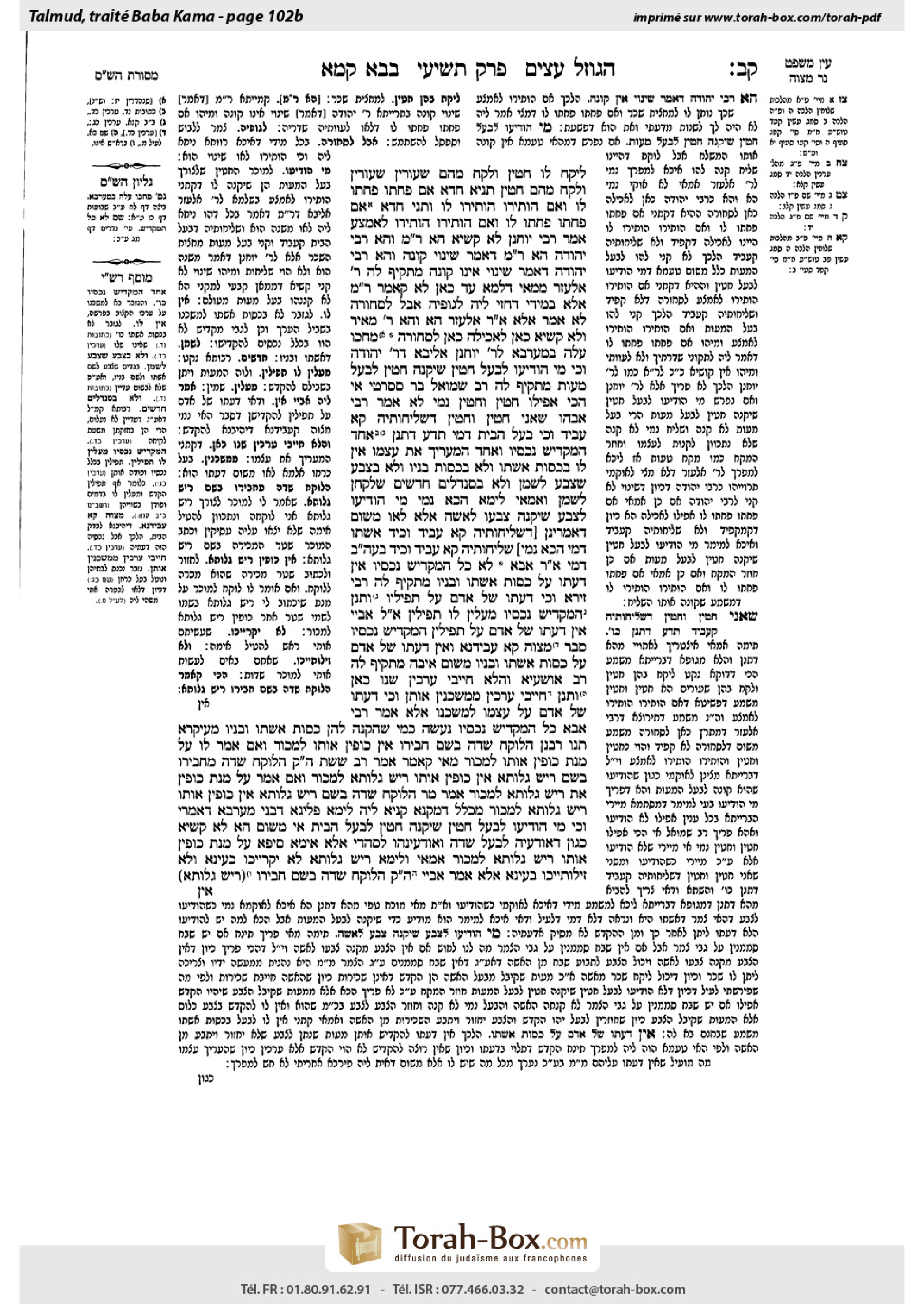
Bava Kamma 102b: Talmud study for Daf Yomi
Study the Talmud for Daf Yomi with scanned pages, Hebrew text, English translations from Sefaria and AI-generated French translations.
Passage selection and English or AI-generated French translation are available where the scan has annotations. Daf Study is independent of Torah-Box and Sefaria.
Browse Bava Kamma · בבא קמא · All tractatesBava Kamma 102b text and translations
This page of Bava Kamma includes the Aramaic text, an English translation and an AI-generated French translation, alongside the scan above.
בבא קמא ק״ב ב · Aramaic and Hebrew text
לִיקַּח לוֹ חִטִּין – וְלָקַח מֵהֶם שְׂעוֹרִין, שְׂעוֹרִין – וְלָקַח מֵהֶם חִטִּין; תַּנְיָא חֲדָא: אִם פָּחֲתוּ – פָּחֲתוּ לוֹ, וְאִם הוֹתִירוּ – הוֹתִירוּ לוֹ; וְתָנֵי חֲדָא: אִם פָּחֲתוּ – פָּחֲתוּ לוֹ, וְאִם הוֹתִירוּ – הוֹתִירוּ לָאֶמְצַע!
אָמַר רַבִּי יוֹחָנָן: לָא קַשְׁיָא; הָא רַבִּי מֵאִיר, וְהָא רַבִּי יְהוּדָה.
הָא רַבִּי מֵאִיר, דְּאָמַר שִׁינּוּי קוֹנֶה; וְהָא רַבִּי יְהוּדָה, דְּאָמַר שִׁינּוּי אֵינוֹ קוֹנֶה.
מַתְקֵיף לַהּ רַבִּי אֶלְעָזָר: מִמַּאי? דִּלְמָא עַד כָּאן לָא קָאָמַר רַבִּי מֵאִיר – אֶלָּא בְּמִידֵּי דַּחֲזֵי לֵיהּ לְגוּפֵיהּ, אֲבָל לִסְחוֹרָה – לָא אָמַר!
אֶלָּא אָמַר רַבִּי אֶלְעָזָר: הָא וְהָא רַבִּי מֵאִיר, וְלָא קַשְׁיָא – כָּאן לַאֲכִילָה, כָּאן לִסְחוֹרָה.
מַחֲכוּ עֲלַהּ בְּמַעְרְבָא: לְרַבִּי יוֹחָנָן אַלִּיבָּא דְּרַבִּי יְהוּדָה, וְכִי מִי הוֹדִיעוֹ לְבַעַל חִטִּין – שֶׁיַּקְנֶה חִטִּין לְבַעַל מָעוֹת? מַתְקֵיף לַהּ רַב שְׁמוּאֵל בַּר סַסְרָטִי: אִי הָכִי, אֲפִילּוּ חִטִּין וְחִטִּין נָמֵי לָא!
אָמַר רַבִּי אֲבָהוּ: שָׁאנֵי חִטִּין וְחִטִּין, דִּשְׁלִיחוּתֵיהּ קָא עָבֵיד – וְכִי בַּעַל הַבַּיִת דָּמֵי.
תִּדַּע – דִּתְנַן: אֶחָד הַמַּקְדִּישׁ נְכָסָיו, וְאֶחָד הַמַּעֲרִיךְ אֶת עַצְמוֹ – אֵין לוֹ בִּכְסוּת אִשְׁתּוֹ, וְלֹא בִּכְסוּת בָּנָיו, וְלֹא בְּצֶבַע שֶׁצָּבַע לִשְׁמָן, וְלֹא בְּסַנְדָּלִים חֲדָשִׁים שֶׁלְּקָחָן לִשְׁמָן.
וְאַמַּאי? לֵימָא הָכָא נָמֵי: מִי הוֹדִיעוֹ לַצַבָּע – שֶׁיַּקְנֶה צִבְעוֹ לָאִשָּׁה? אֶלָּא לָאו מִשּׁוּם דְּאָמְרִינַן [דִּשְׁלִיחוּתֵיהּ קָא עָבֵיד, וּכְיַד אִשְׁתּוֹ דָּמֵי? הָכָא נָמֵי] שְׁלִיחוּתֵיהּ קָא עָבֵיד, וּכְיַד בַּעַל הַבַּיִת דָּמֵי.
אָמַר רַבִּי אַבָּא: לֹא; כׇּל הַמַּקְדִּישׁ נְכָסָיו – אֵין דַּעְתּוֹ עַל כְּסוּת אִשְׁתּוֹ וּבָנָיו.
מַתְקֵיף לַהּ רַבִּי זֵירָא: וְכִי דַּעְתּוֹ שֶׁל אָדָם עַל תְּפִילָּיו? וּתְנַן: הַמַּקְדִּישׁ נְכָסָיו – מַעֲלִין לוֹ תְּפִילִּין! אָמַר לֵיהּ אַבָּיֵי: אִין; דַּעְתּוֹ שֶׁל אָדָם עַל תְּפִילִּין – הַמַּקְדִּישׁ נְכָסָיו סָבַר: מִצְוָה קָא עָבֵידְנָא. וְאֵין דַּעְתּוֹ שֶׁל אָדָם עַל כְּסוּת אִשְׁתּוֹ וּבָנָיו – מִשּׁוּם אֵיבָה.
מַתְקֵיף לַהּ רַב אוֹשַׁעְיָא: וַהֲלֹא חַיָּיבֵי עֲרָכִין שָׁנוּ כָּאן, וּתְנַן: חַיָּיבֵי עֲרָכִין – מְמַשְׁכְּנִין אוֹתָן;
וְכִי דַּעְתּוֹ שֶׁל אָדָם עַל עַצְמוֹ לְמַשְׁכְּנוֹ?!
אֶלָּא אָמַר רַבִּי אַבָּא: כׇּל הַמַּקְדִּישׁ נְכָסָיו – נַעֲשָׂה כְּמִי שֶׁהִקְנָה לָהֶן כְּסוּת אִשְׁתּוֹ וּבָנָיו מֵעִיקָּרָא.
תָּנוּ רַבָּנַן: הַלּוֹקֵחַ שָׂדֶה בְּשֵׁם חֲבֵירוֹ – אֵין כּוֹפִין אוֹתוֹ לִמְכּוֹר. וְאִם אָמַר לוֹ: ״עַל מְנָת״ – כּוֹפִין אוֹתוֹ לִמְכּוֹר.
מַאי קָאָמַר? אָמַר רַב שֵׁשֶׁת, הָכִי קָאָמַר: הַלּוֹקֵחַ שָׂדֶה מֵחֲבֵירוֹ בְּשֵׁם רֵישׁ גָּלוּתָא – אֵין כּוֹפִין אוֹתוֹ רֵישׁ גָּלוּתָא לִמְכּוֹר. וְאִם אָמַר ״עַל מְנָת״ – כּוֹפִין אֶת רֵישׁ גָּלוּתָא לִמְכּוֹר.
אָמַר מָר: הַלּוֹקֵחַ שָׂדֶה בְּשֵׁם רֵישׁ גָּלוּתָא – אֵין כּוֹפִין אוֹתוֹ רֵישׁ גָּלוּתָא לִמְכּוֹר. מִכְּלָל דְּמִקְנָא קַנְיָא לֵיהּ; לֵימָא פְּלִיגָא דִּבְנֵי מַעְרְבָא, דְּאָמְרִי: וְכִי מִי הוֹדִיעוֹ לְבַעַל חִטִּין – שֶׁיַּקְנֶה חִטִּין לְבַעַל הַבַּיִת?
אִי מִשּׁוּם הָא – לָא קַשְׁיָא; כְּגוֹן דְּאוֹדְעֵיהּ לְבַעַל שָׂדֶה, וְאוֹדְעִינְהוּ לְסָהֲדֵי.
אֶלָּא אֵימָא סֵיפָא: ״עַל מְנָת״ – כּוֹפִין אוֹתוֹ רֵישׁ גָּלוּתָא לִמְכּוֹר. אַמַּאי? וְלֵימָא רֵישׁ גָּלוּתָא: לָא יְקָרַיְיכוּ בָּעֵינָא, וְלָא זִילוּתַיְיכוּ בָּעֵינָא!
אֶלָּא אָמַר אַבָּיֵי, הָכִי קָאָמַר: הַלּוֹקֵחַ שָׂדֶה בְּשֵׁם חֲבֵירוֹ, רֵישׁ גָּלוּתָא –
Bava Kamma 102b · English translation
to purchase wheat for him, which he plans to sell at a profit, and instead the agent purchased barley with the money, or if he gave his agent money to purchase barley and instead he purchased wheat with the money, two baraitot issue discordant rulings with regard to the halakha. It is taught in one baraita that if there was a loss, the loss is for the agent, and if there was a profit, the profit is for the agent as well, as he is considered to have abrogated his status as an agent by deviating from the instructions. And it is taught in one baraita (Tosefta, Bava Metzia 4:20) that if there was an agreement that both parties would split the profits from the transaction, if there was a loss, the loss is for the agent, and if there was a profit, the profit goes to the middle, i.e., the agent and the investor split the profit.
To reconcile the baraitot, Rabbi Yoḥanan said: This is not difficult. This first baraita is in accordance with the opinion of Rabbi Meir, and this second baraita is in accordance with the opinion of Rabbi Yehuda.
Rabbi Yoḥanan explains his rationale: This first baraita is in accordance with the opinion of Rabbi Meir, who says that a change by an agent that deviates from the terms of his assignment means that the agent acquires the item in question for himself, as in the case of one who was paid to dye wool red but dyed it black. In this case as well, when the agent purchases wheat instead of barley, or vice versa, he acquires the grain for himself. And this second baraita is in accordance with the opinion of Rabbi Yehuda, who says that a change by an agent which deviates from the terms of his assignment does not mean that the agent acquires the item in question for himself. It is acquired by the one who appointed the agent, and they split the profits as agreed. But the agent is held responsible for any loss incurred, due to his deviation from the instructions.
Rabbi Elazar objects to this explanation: From where do you say that the dispute between Rabbi Meir and Rabbi Yehuda extends to the case of these baraitot? Perhaps Rabbi Meir says that a change by an agent from the terms of his assignment results in the acquisition of the item by the agent only with regard to an item that is fit for use by the one who appointed the agent himself, such as wool dyed the wrong color, which is now not usable for its intended purpose. But Rabbi Meir does not say his ruling with regard to an item purchased for subsequent sale as merchandise, since it is intended to be sold for a profit in any event, and the transaction would take effect as agreed upon initially, with the agent held responsible for any loss incurred.
Rather, Rabbi Elazar said: Both this baraita and that baraita are written in accordance with the opinion of Rabbi Meir, and it is not difficult. Here, in the first baraita, it is discussing grain purchased for eating, and since the one who appointed the agent desired wheat, he does not acquire the barley. There, in the second baraita, it is discussing grain purchased for subsequent sale as merchandise, and the transaction takes effect as agreed upon initially, with the agent held responsible for any loss incurred.
The Gemara notes that they laughed at it in the West, Eretz Yisrael, at the explanation of Rabbi Yoḥanan, who said that according to the opinion of Rabbi Yehuda, a deviation by an agent from the terms of his assignment does not result in the acquisition of the item for the agent himself: And who informed the owner of the wheat, i.e., the seller, that he should transfer the wheat to the owner of the money? If the seller was unaware that the agent was acting on someone else’s behalf, how would the one who appointed the agent acquire the wheat? Rav Shmuel bar Sasrati objects to this rationale: If so, then even in a case where the agent was sent to purchase wheat and he purchased wheat, the one who appointed the agent should not acquire the wheat, since the seller was unaware that the agent was acting on someone else’s behalf.
Rabbi Abbahu said: The case of an agent who was assigned to purchase wheat and purchased wheat is different, as the agent is performing his assignment and, as such, he is like the customer, i.e., the one who appointed him, and it is as though the latter has purchased the grain himself.
Rabbi Abbahu further explains: Know that the agent is viewed as an extension of the one who appointed him, as we learned in a mishna (Arakhin 24a): Concerning both one who consecrates his property and one who valuates himself by donating his fixed value to the Temple, the Temple treasury does not have any rights with regard to the donor’s wife’s clothing; and not with regard to his children’s clothing; and not with regard to new clothes colored with dye that the donor dyed for his wife or children; and not with regard to new sandals that the donor purchased for his wife or children. Presumably, the treasurer has no right to these items because they are for the personal use of the donor’s wife and children, and are considered as if owned by them.
Rabbi Abbahu continues: And why is it so, i.e., why is it that the wife is considered the owner of the dyed clothing for which the husband paid? Here also, let us say: Who informed the dyer that he should transfer his dye to the wife? Rather, is it not because we say that the husband is performing his assignment and, as such, he is like an extension of his wife’s hand? Here also, in the case of one who purchases grain for another, the agent is performing his assignment, and is like an extension of the customer’s hand.
The Gemara rejects this explanation. Rabbi Abba said: No, the reason for the ruling of the mishna is that the intention of anyone who consecrates his property is not upon the clothing of his wife and his children, i.e., he does not intend to consecrate those items.
Rabbi Zeira objects to Rabbi Abba’s explanation: And is it the intention of a person who consecrates his property to do so upon his phylacteries? Presumably not. And we learned in a mishna (Arakhin 23b) that with regard to one who consecrates all of his property, his phylacteries are evaluated for him and consecrated. Apparently, lack of intent to consecrate a particular item does not prevent its consecration. Abaye said to Rabbi Zeira: Yes, the intention of a person who consecrates his property is upon his phylacteries, because one who consecrates his property thinks to himself: I am performing a mitzva, and he therefore intends to include his phylacteries; but the intention of a person is not upon the clothing of his wife and his children, due to the enmity that would be engendered if he consecrated their clothing.
Rav Oshaya also objects to Rabbi Abba’s explanation: But is it not so that the matter of those who are obligated in valuations was taught here in the mishna, and we learned in a mishna (Arakhin 21a): Concerning those who are obligated in valuations, the Temple treasury seizes collateral from them to force them to fulfill their vow.
And is the intention of a person upon himself to allow the treasurer to seize collateral from him? Presumably not. Nevertheless, collateral is seized from him, proving that one’s intention does not prevent consecration. Accordingly, even if it is assumed that he does not intend to consecrate the clothing of his wife or children, the clothing should nevertheless be consecrated. Why, then, is the clothing of his wife or children not consecrated?
Rather, Rabbi Abba also holds that the reason the clothing is not consecrated is not due to his intent, and he said a different explanation: Anyone who consecrates his property becomes as one who transferred his wife’s and his children’s clothing to them at the outset. Therefore, the clothing did not belong to him at the time that he consecrated his property.
§ The Gemara presents another situation in which one makes a purchase involving a third party. The Sages taught: In the case of one who purchases a field in the name of another, he is not compelled to sell it. But if he said to him at the time of the sale: I will purchase the field on the condition that he will sell it to me, he is compelled to sell it.
Noting the ambiguity of this statement, the Gemara asks: What is it saying? Rav Sheshet said that this is what it is saying: With regard to one who purchases a field from another, claiming that he is acting in the name of the Exilarch or another dominant figure, so that others will be discouraged from contesting the sale, the Exilarch is not compelled to sell it to him, i.e., the Exilarch is not required to provide the purchaser with documentation that the field belongs to the purchaser. But if the purchaser said to the seller: I will purchase the field on the condition that the Exilarch will provide me with that documentation, the Exilarch is compelled to sell it to him, i.e., to provide him with the documentation.
The Gemara questions Rav Sheshet’s interpretation. The Master said: With regard to one who purchases a field in the name of the Exilarch, the Exilarch is not compelled to sell it to him. Since the baraita teaches only that the Exilarch is not required to provide the purchaser with documentation that the field is his, it can be understood by inference that the purchaser has nevertheless acquired the field for himself. Let us say that this interpretation of the baraita disagrees with the statement of the residents of the West, Eretz Yisrael, who say: And who informed the owner of the wheat that he should transfer the wheat to the customer? Since the seller assumed he was selling the field to the Exilarch, the Sages of Eretz Yisrael would hold that the sale does not take effect.
The Gemara rejects this: If it is due to this inference that it is surmised that the baraita is in conflict with the opinion of the Sages of Eretz Yisrael, it is not difficult, as it can be said that the baraita is discussing a case where the purchaser informed the owner of the field and informed the witnesses that he intends to purchase the field for himself.
The Gemara rejects Rav Sheshet’s interpretation for a different reason. Rather, say that the latter clause is difficult, as it states that if the purchaser said to the seller: I will purchase the field on the condition that the Exilarch will sell it to me, the Exilarch is compelled to sell it to him. Why should the Exilarch be compelled to provide the purchaser with documentation? But let the Exilarch say: I do not desire your esteem nor do I desire your disgrace, i.e., I am not involved in your affairs. Since the Exilarch had not been party to the negotiations, how can a stipulation stated by the purchaser render him obligated?
Rather, Abaye said: This is what the baraita is saying: With regard to one who purchases a field in the name of his friend, the Exilarch,
Bava Kamma 102b · Traduction française (IA)
Pour acheter du blé pour lui, qu'il prévoit de vendre à profit, et l'agent a acheté de l'orge avec l'argent, ou s'il a donné à son agent de l'argent pour acheter de l'orge et qu'il a acheté du blé avec l'argent, deux baraitot donnent des décisions discordantes concernant la halakha. Il est enseigné dans une baraïta que si il y a une perte, la perte incombe à l'agent, et si il y a un bénéfice, le bénéfice incombe également à l'agent, car il est considéré comme ayant abrogé son statut d'agent en déviant des instructions. Et il est enseigné dans une autre baraïta (Tosefta, Bava Metzia 4:20) que si il y avait un accord selon lequel les deux parties partagent les bénéfices de la transaction, si il y a une perte, la perte incombe à l'agent, et si il y a un bénéfice, le bénéfice va au milieu, c'est-à-dire que l'agent et l'investisseur partagent le bénéfice.
Pour concilier les baraitot, Rabbi Yoḥanan a dit : Ce n'est pas difficile. Cette première baraïta est selon l'opinion de Rabbi Meir, et cette seconde baraïta est selon l'opinion de Rabbi Yehuda.
Rabbi Yoḥanan explique sa raison : Cette première baraïta est selon l'opinion de Rabbi Meir, qui dit qu'un changement par l'agent qui dévie des termes de sa mission signifie que l'agent acquiert l'objet en question pour lui-même, comme dans le cas d'une personne payée pour teindre la laine en rouge mais qui la teint en noir. Dans ce cas également, lorsque l'agent achète du blé au lieu de l'orge, ou inversement, il acquiert la céréale pour lui-même. Et cette seconde baraïta est selon l'opinion de Rabbi Yehuda, qui dit qu'un changement par l'agent qui dévie des termes de sa mission ne signifie pas que l'agent acquiert l'objet en question pour lui-même. Il est acquis par celui qui a désigné l'agent, et ils partagent les bénéfices selon l'accord. Mais l'agent est tenu responsable de toute perte subie, en raison de son déviation des instructions.
Rabbi Elazar s'oppose à cette explication : D'où dis-tu que le désaccord entre Rabbi Meir et Rabbi Yehuda s'étend aux cas de ces baraitot ? Peut-être Rabbi Meir affirme que tout changement par l'agent par rapport aux termes de sa mission entraîne l'acquisition de l'objet par l'agent uniquement concernant un objet adapté à l'usage du propriétaire, comme du laine teint d'une couleur erronée, qui n'est plus utilisable à son usage prévu. Mais Rabbi Meir ne dit pas son jugement concernant un objet acheté pour la vente ultérieure comme marchandise, car il est destiné à être vendu à profit, et la transaction prend effet comme convenu initialement, avec l'agent tenu responsable de toute perte subie.
Plutôt, Rabbi Elazar a dit : Ces deux baraitot sont formulées selon l'opinion de Rabbi Meir, et ce n'est pas difficile. Ici, dans la première baraïta, il s'agit de céréales achetées pour la consommation, et puisque le propriétaire souhaitait du blé, il ne l'acquiert pas. Là, dans la seconde baraïta, il s'agit de céréales achetées pour la vente ultérieure comme marchandise, et la transaction prend effet comme convenu initialement, avec l'agent tenu responsable de toute perte subie.
Le Guemara note que l'on a ri de cette explication dans l'Ouest, Eretz Yisrael, à l'explication de Rabbi Yoḥanan, qui a dit que selon l'opinion de Rabbi Yehuda, une déviation par l'agent par rapport aux termes de sa mission ne conduit pas à l'acquisition de l'objet par l'agent lui-même : Et qui a informé le propriétaire du blé, c'est-à-dire le vendeur, qu'il devait transférer le blé au propriétaire de l'argent ? Si le vendeur était ignorant du fait que l'agent agissait au nom d'une autre personne, comment le propriétaire de l'argent pourrait-il acquérir le blé ? Rav Shmuel bar Sasrati s'oppose à cette raison : Si c'est ainsi, alors même dans le cas où l'agent était envoyé pour acheter du blé et qu'il a acheté du blé, le propriétaire de l'argent ne devrait pas acquérir le blé, car le vendeur était ignorant du fait que l'agent agissait au nom d'une autre personne.
Rabbi Abbahu a dit : Le cas d'un agent envoyé pour acheter du blé et qui a acheté du blé est différent, car l'agent exécute sa mission et, en conséquence, il est comme le client, c'est-à-dire celui qui l'a désigné, et c'est comme si le dernier avait acheté lui-même la céréale.
Rabbi Abbahu explique davantage : Sache que l'agent est considéré comme une extension de celui qui l'a désigné, comme nous l'avons appris dans une mishna (Arakhin 24a) : Concernant celui qui consacre sa propriété et celui qui évalue lui-même sa valeur fixe pour le Temple, le trésor du Temple n'a aucun droit concernant les vêtements de la femme du donateur ; ni concernant les vêtements de ses enfants ; ni concernant les vêtements nouveaux teints avec du colorant que le donateur a teint pour sa femme ou ses enfants ; ni concernant les sandales neuves que le donateur a acheté pour sa femme ou ses enfants. Probablement, le trésor n'a aucun droit sur ces objets car ils sont destinés à l'usage personnel de la femme et des enfants du donateur, et sont considérés comme appartenant à eux.
Rabbi Abbahu continue : Et pourquoi est-ce ainsi, c'est-à-dire pourquoi la femme est considérée comme propriétaire des vêtements teints pour lesquels le mari a payé ? Ici aussi, disons : Qui a informé le teinteur qu'il devait transférer son colorant à la femme ? Plutôt, n'est-ce pas parce que nous disons que le mari exécute sa mission et, en conséquence, il est comme une extension de la main de sa femme ? Ici aussi, dans le cas d'une personne qui achète des céréales pour une autre, l'agent exécute sa mission et est comme une extension de la main du client.
Le Guemara rejette cette explication. Rabbi Abba a dit : Non, la raison du jugement de la mishna est que l'intention de celui qui consacre sa propriété n'est pas sur les vêtems de sa femme et de ses enfants, c'est-à-dire qu'il ne veut pas consacrer ces objets.
Rabbi Zeira s'oppose à l'explication de Rabbi Abba : Et est-ce l'intention d'une personne qui consacre ses biens de le faire sur ses phylactères ? Probablement pas. Et nous avons appris dans une mitsva (Arakhin 23b) que concernant celui qui consacre tous ses biens, ses phylactères sont évalués à sa place et consacrés. Apparemment, l'absence d'intention de consacrer un objet particulier ne bloque pas sa consécration. Abaye dit à Rabbi Zeira : Oui, l'intention d'une personne qui consacre ses biens est sur ses phylactères, car celui qui consacre ses biens se dit : Je m'acquitte d'une mitsva, et il veut donc inclure ses phylactères ; mais l'intention d'une personne n'est pas sur les vêtements de sa femme et de ses enfants, en raison de l'hostilité qu'il engendrerait s'il consacrait leurs vêtements.
Rav Oshaya s'oppose également à l'explication de Rabbi Abba : Mais n'est-ce pas ainsi que la question des personnes obligées à évaluer est enseignée ici dans la mitsva, et nous avons appris dans une mitsva (Arakhin 21a) : Concernant ceux qui sont obligés à évaluer, le trésor du Temple saisit un cautionnement auprès d'eux pour les obliger à remplir leur vœu.
Et l'intention d'une personne est-elle sur lui-même pour permettre au trésorier de saisir un cautionnement auprès de lui ? Probablement pas. Cependant, un cautionnement est saisi auprès de lui, prouvant que l'intention ne bloque pas la consécration. Ainsi, même si l'on suppose qu'il n'intend pas consacrer les vêtements de sa femme ou de ses enfants, ceux-ci devraient néanmoins être consacrés. Pourquoi, alors, les vêtements de sa femme ou de ses enfants ne sont-ils pas consacrés ?
Plutôt, Rabbi Abba considère également que la raison pour laquelle les vêtements ne sont pas consacrés n'est pas due à son intention, et il a donné une autre explication : Quiconque consacre ses biens devient comme celui qui a transféré dès le départ les vêtements de sa femme et de ses enfants à ceux-ci. Ainsi, les vêtements n'appartenaient pas à lui au moment où il a consacré ses biens.
§ Le Guemara présente une autre situation où l'on fait un achat impliquant un tiers. Les Sages ont enseigné : Dans le cas d'une personne qui achète un champ au nom d'une autre, il n'est pas contraint de le vendre. Mais s'il a dit à l'époque de l'achat : Je vais acheter le champ sous condition qu'il me le vende, il est contraint de le vendre.
Notant l'ambiguïté de cette déclaration, le Guemara pose la question : De quoi parle-t-elle ? Rav Sheshet a dit que c'est ce que cela signifie : Concernant celui qui achète un champ d'un autre, affirmant agir au nom de l'Exilarch ou d'une autre figure dominante, afin que les autres ne s'opposent pas à la vente, l'Exilarch n'est pas contraint de le vendre à lui, c'est-à-dire l'Exilarch n'est pas tenu de fournir à l'acheteur la documentation prouvant que le champ lui appartient. Mais si l'acheteur a dit au vendeur : Je vais acheter le champ sous condition que l'Exilarch me fournisse cette documentation, l'Exilarch est contraint de le vendre à lui, c'est-à-dire de lui fournir cette documentation.
Le Guemara questionne l'interprétation de Rav Sheshet. Le Maître a dit : Concernant celui qui achète un champ au nom de l'Exilarch, l'Exilarch n'est pas contraint de le vendre à lui. Puisque la baraïta enseigne seulement que l'Exilarch n'est pas tenu de fournir au acheteur la documentation prouvant que le champ lui appartient, il peut être compris par déduction que l'acheteur a néanmoins acquis le champ pour lui-même. Disons que cette interprétation de la baraïta contredit l'opinion des Sages d'Eretz Yisrael, qui disent : Et qui a informé l'propriétaire du blé qu'il devait transférer le blé au client ? Puisque le vendeur a supposé vendre le champ à l'Exilarch, les Sages d'Eretz Yisrael diraient que la vente ne prend effet pas.
Le Guemara rejette cela : Si c'est à cause de cette déduction que la baraïta est en conflit avec l'opinion des Sages d'Eretz Yisrael, cela n'est pas difficile, car on peut dire que la baraïta parle d'un cas où l'acheteur a informé l'propriétaire du champ et les témoins qu'il veut acheter le champ pour lui-même.
Le Guemara rejette l'interprétation de Rav Sheshet pour une autre raison. Plutôt, disons que la dernière clause est difficile, car elle dit que si l'acheteur a dit au vendeur : Je vais acheter le champ sous condition que l'Exilarch le vende à moi, l'Exilarch est contraint de le vendre à lui. Pourquoi l'Exilarch devrait-il être contraint de fournir à l'acheteur la documentation ? Mais l'Exilarch pourrait dire : Je n'aspire pas à votre estime ni à votre disgrâce, c'est-à-dire je ne m'implique pas dans vos affaires. Puisque l'Exilarch n'était pas partie des négociations, comment une stipulation émise par l'acheteur peut-elle le rendre obligé ?
Plutôt, Abaye a dit : C'est ce que la baraïta dit : Concernant celui qui achète un champ au nom de son ami, l'Exilarch,
Traduction française générée par IA à partir de l’édition anglaise de Sefaria. Vérifie toujours un passage avec le texte source.
Text from Sefaria: William Davidson Edition - Vocalized Aramaic (CC BY NC); William Davidson Edition - English (CC BY NC).