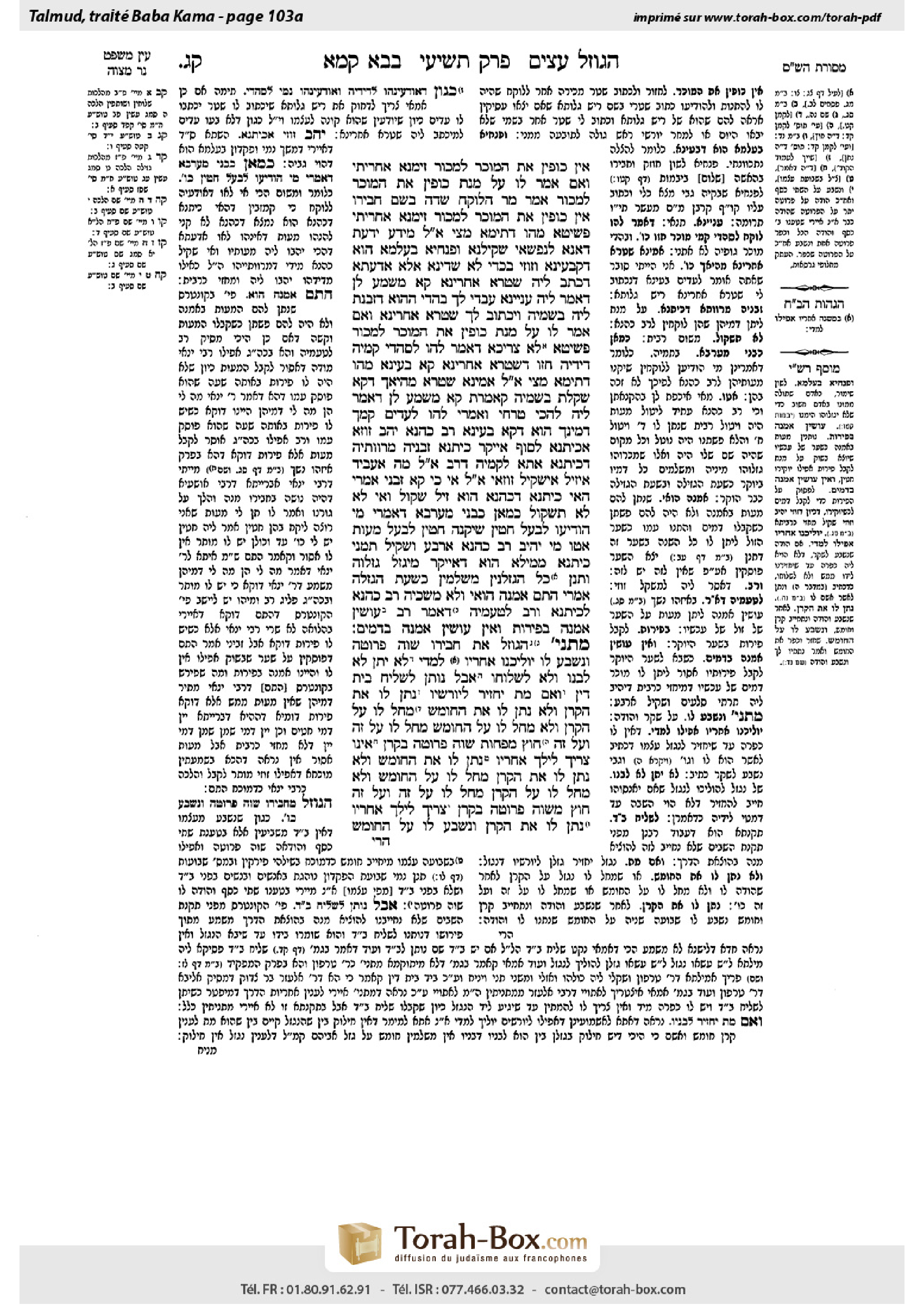
Bava Kamma 103a: Talmud study for Daf Yomi
Study the Talmud for Daf Yomi with scanned pages, Hebrew text, English translations from Sefaria and AI-generated French translations.
Passage selection and English or AI-generated French translation are available where the scan has annotations. Daf Study is independent of Torah-Box and Sefaria.
Browse Bava Kamma · בבא קמא · All tractatesBava Kamma 103a text and translations
This page of Bava Kamma includes the Aramaic text, an English translation and an AI-generated French translation, alongside the scan above.
בבא קמא ק״ג א · Aramaic and Hebrew text
אֵין כּוֹפִין אֶת הַמּוֹכֵר לִמְכּוֹר זִימְנָא אַחֲרִיתִי. וְאִם אָמַר לוֹ: ״עַל מְנָת״ – כּוֹפִין אֶת הַמּוֹכֵר לִמְכּוֹר.
אָמַר מָר: הַלּוֹקֵחַ שָׂדֶה בְּשֵׁם חֲבֵירוֹ – אֵין כּוֹפִין אֶת הַמּוֹכֵר לִמְכּוֹר זִימְנָא אַחֲרִיתִי. פְּשִׁיטָא! מַהוּ דְּתֵימָא, מָצֵי אָמַר לֵיהּ: מִידָּע יָדְעַתְּ דַּאֲנָא לְנַפְשַׁאי שָׁקֵילְנָא – וּפַנְחַיָּא בְּעָלְמָא הוּא דְּקָבָעֵינָא, וְזוּזִי בִּכְדִי לָא שָׁדֵינָא, אֶלָּא אַדַּעְתָּא דְּכָתֵב לֵיהּ שְׁטָרָא אַחֲרִינָא; קָא מַשְׁמַע לַן דְּאָמַר לֵיהּ: עִנְיָינָא עֲבַדִי לָךְ בַּהֲדֵי הָהוּא דִּזְבַנְתְּ לֵיהּ בִּשְׁמֵיהּ, וְיִכְתּוֹב לָךְ שְׁטָרָא אַחֲרִינָא.
וְאִם אָמַר לוֹ ״עַל מְנָת״ – כּוֹפִין אֶת הַמּוֹכֵר לִמְכּוֹר. פְּשִׁיטָא! לָא צְרִיכָא, דַּאֲמַר לְהוּ לְסָהֲדִי קַמֵּיהּ דִּידֵיהּ: חֲזוֹ דִּשְׁטָרָא אַחֲרִינָא קָא בָעֵינָא. מַהוּ דְּתֵימָא, מָצֵי אֲמַר לֵיהּ: אָמֵינָא, שְׁטָרָא מֵהַיְאךְ דְּקָא שָׁקְלַתְּ בִּשְׁמֵיהּ קָאָמְרַתְּ; קָא מַשְׁמַע לַן דַּאֲמַר לֵיהּ: לְהָכִי טְרַחִי וַאֲמַרִי לְהוּ לְעֵדִים קַמָּךְ, דְּמִינָּךְ הוּא דְּקָא בָעֵינָא.
רַב כָּהֲנָא יְהַב זוּזָא אַכִּיתָּנָא. לְסוֹף אִיַּיקַּר כִּיתָּנָא, זַבְּנֵיהּ מָרָווֹתֵיהּ דְּכִיתָּנָא. אֲתָא לְקַמֵּיהּ דְּרַב, אֲמַר לֵיהּ: מָה אֶעְבֵּיד, אֵיזִיל אֶישְׁקֹיל זוּזַאי? אֲמַר לֵיהּ: אִי כִּי קָא [מְ]זַבְּנִי אָמְרִי: ״הַאי כִּיתָּנָא דְכָהֲנָא הוּא״ – זִיל שְׁקוֹל; וְאִי לָא – לָא תִּשְׁקוֹל.
כְּמַאן? כִּבְנֵי מַעְרְבָא, דְּאָמְרִי: מִי הוֹדִיעוֹ לְבַעַל חִטִּין – שֶׁיַּקְנֶה חִטִּין לְבַעַל מָעוֹת?
אַטּוּ מִי יָהֵיב רַב כָּהֲנָא אַרְבַּע, וְשָׁקֵיל תַּמְנֵי?! כִּיתָּנָא מִמֵּילָא הוּא דְּאִיַּיקַּר; מִיגְזָל גַּזְלוּהּ, וּתְנַן: כׇּל הַגַּזְלָנִין מְשַׁלְּמִין כִּשְׁעַת הַגְּזֵלָה!
אָמְרִי: הָתָם אֲמָנָה הֲוַאי, וְלָא מַשְׁכֵיהּ רַב כָּהֲנָא לְכִיתָּנָא; וְרַב לְטַעְמֵיהּ, דַּאֲמַר רַב: עוֹשִׂין אֲמָנָה בְּפֵירוֹת, וְאֵין עוֹשִׂין אֲמָנָה בְּדָמִים.
מַתְנִי׳ הַגּוֹזֵל אֶת חֲבֵירוֹ שָׁוֶה פְּרוּטָה, וְנִשְׁבַּע לוֹ – יוֹלִיכֶנּוּ אַחֲרָיו לְמָדַי. לֹא יִתֵּן לֹא לִבְנוֹ, וְלֹא לִשְׁלוּחוֹ, אֲבָל נוֹתֵן לִשְׁלִיחַ בֵּית דִּין. וְאִם מֵת – יַחֲזִיר לְיוֹרְשָׁיו.
נָתַן לוֹ אֶת הַקֶּרֶן, וְלֹא נָתַן לוֹ אֶת הַחוֹמֶשׁ; מָחַל לוֹ עַל הַקֶּרֶן, וְלֹא מָחַל לוֹ עַל הַחוֹמֶשׁ; מָחַל לוֹ עַל זֶה וְעַל זֶה, חוּץ מִפָּחוּת שָׁוֶה פְּרוּטָה בַּקֶּרֶן – אֵינוֹ צָרִיךְ לֵילֵךְ אַחֲרָיו. נָתַן לוֹ אֶת הַחוֹמֶשׁ, וְלֹא נָתַן לוֹ אֶת הַקֶּרֶן; מָחַל לוֹ עַל הַחוֹמֶשׁ, וְלֹא מָחַל לוֹ עַל הַקֶּרֶן; מָחַל לוֹ עַל זֶה וְעַל זֶה, חוּץ מִשָּׁוֶה פְּרוּטָה בַּקֶּרֶן – צָרִיךְ לֵילֵךְ אַחֲרָיו.
נָתַן לוֹ אֶת הַקֶּרֶן, וְנִשְׁבַּע לוֹ עַל הַחוֹמֶשׁ –
Bava Kamma 103a · English translation
the seller is not compelled to sell the field another time, i.e., to provide the purchaser with a document denoting him as the owner of the field. But if he said to him: I will purchase the field on the condition that you will provide a deed in my name, the seller is compelled to sell the field again, i.e., to provide the purchaser with a document denoting him as the owner.
The Gemara clarifies the baraita: The Master said: In the case of one who purchases a field in the name of another, the seller is not compelled to sell the field another time. The Gemara asks: Isn’t this obvious? The Gemara answers: Lest you say that the purchaser can say to the seller: You knew that I took, i.e., purchased, the field for myself, and it was merely for protection [ufanaḥya] that I desired to obtain ownership by claiming to purchase it in the name of the other person, and I do not throw out money for naught. Rather, it was with the intention that you will write another document for him, i.e., the seller, stating that I purchased the field. The baraita therefore teaches us that the seller can say to him: I have performed a matter for you together with the one in whose name you purchased the field, and let him write you another document.
The Gemara discusses Abaye’s interpretation of the latter clause of the baraita, which states: But if he said to him: I will purchase the field on the condition that you will provide a deed in my name, the seller is compelled to sell the field again. Isn’t that obvious? No, it is necessary to state this halakha in a case where the purchaser said to the witnesses in front of the seller: You can see that I require another document. Lest you say that the seller can say to him: I thought that it was a document from the one in whose name you purchased the field that you were saying you required, and not from me. Therefore, the baraita teaches us that the purchaser can say to him: It was for this that I took the trouble and said to the witnesses, in front of you, that I require another document, as it is from you that I require the document.
§ The Gemara mentions a related incident: Rav Kahana gave money to a salesman in exchange for flax, and temporarily left the flax in the possession of the seller. Ultimately, the flax appreciated in value and the owner of the flax sold it for a greater profit on behalf of Rav Kahana, intending to give him all of the money. Rav Kahana then came before Rav, and said to him: What should I do? Should I go and take my money, or would doing so have the appearance of collecting interest for a loan? Rav said to Rav Kahana: If, when they sold the flax, they said: This flax is Kahana’s, go take the money, as in such a case it is as though the flax was purchased directly from you. But if they did not say this, do not take the money, since you would be receiving a greater sum of money than you provided, and this would appear to be a loan repaid with interest.
The Gemara asks: In accordance with whose opinion was Rav’s ruling? Was it only in accordance with the opinion of the people of the West, Eretz Yisrael, who say: Who informed the owner of the wheat that he should transfer the wheat to the owner of the money? As the Gemara taught earlier, the Sages of Eretz Yisrael hold that the sale can be performed on another’s behalf only if such an arrangement is explicitly stated at the time of the transaction. In this case as well, if the seller did not explicitly state that the money would belong to Rav Kahana, all the money from the sale would be acquired by the seller, who would then be prohibited to give it to Rav Kahana due to the appearance of paying interest.
The Gemara rejects this: Is that to say that Rav Kahana gave four dinars and took eight in return? He did not lend money to the seller. Rather, the flax appreciated in value by itself, and when the seller sold it he robbed Rav Kahana of his flax, and we learned in a mishna (93b) that all robbers pay compensation according to the value of the stolen item at the time of the robbery. Therefore, according to all opinions the seller owes Rav Kahana the value of the flax at the time the seller sold it for its appreciated value, and Rav Kahana’s accepting the money would not constitute collecting interest for a loan.
Having rejected the previous explanation of Rav’s ruling, the Gemara presents an alternative understanding of the case. The Sages say: There, it was a matter of trust, as the seller was paid in advance and Rav Kahana did not pull the flax as an act of acquisition, or perform any other formal act of acquisition. Consequently, at the time of the second sale the flax belonged to the seller. And Rav conforms to his standard line of reasoning, as Rav says: One may make an arrangement of trust with regard to the delivery of items such as produce, i.e., one may pay the money in advance with the agreement that he will receive the produce at a later date, but one may not make an arrangement of trust with regard to money, i.e., one may not pay the money in advance with the agreement that he will receive the value of the produce at a later date, as this has the appearance of collecting interest.
MISHNA: One who robs another of an item having the value of at least one peruta and takes a false oath to the robbery victim claiming his innocence, and then later wishes to repent, must bring the money, which includes the principal together with an additional one-fifth payment, to the robbery victim, even if this necessitates following after him to a distant place like Media. The robber may not give the payment to the robbery victim’s son to return it to the robbery victim, and neither may he give it to his agent, but he may give the payment to an agent of the court. And if the robbery victim dies, he returns it to his heirs.
If he gave the robbery victim the principal value of the stolen item but did not give him the additional one-fifth payment, or if the owner forgave him concerning the principal but did not forgive him concerning the additional one-fifth payment, or if he forgave him concerning this and concerning that, with the exception of the value of less than one peruta of the principal, he need not pursue him to repay the remaining debt. By contrast, if he gave the robbery victim the additional one-fifth payment but did not give him the principal, or if the robbery victim forgave him concerning the additional one-fifth payment but did not forgive him concerning the principal, or if he forgave him concerning this and concerning that, with the exception of the value of one peruta of the principal, he must pursue him to repay the remaining debt.
If the robber gave the robbery victim the principal and took a false oath to him concerning the additional one-fifth payment, asserting that he had already paid it,
Bava Kamma 103a · Traduction française (IA)
Le vendeur n'est pas tenu de vendre à nouveau le champ, c'est-à-dire de fournir à l'acheteur un document le désignant comme propriétaire du champ. Mais si il dit à lui : Je vais acheter le champ à la condition que tu me fournisses un acte en mon nom, le vendeur est tenu de vendre à nouveau le champ, c'est-à-dire de fournir à l'acheteur un document le désignant comme propriétaire.
La Guemara clarifie la baraïta : Le Maître dit : Dans le cas d'une personne qui achète un champ au nom d'une autre, le vendeur n'est pas tenu de vendre à nouveau le champ. La Guemara demande : N'est-ce pas évident ? La Guemara répond : Pour éviter que l'on dise que l'acheteur peut dire au vendeur : Tu savais que j'ai acheté le champ pour moi-même, et c'était simplement pour la protection [ufanaḥya] que j'avais souhaité obtenir la propriété en prétendant l'acheter au nom de la personne d'autre, et je ne dépense pas mon argent à vide. Plutôt, c'était avec l'intention que tu écrives un autre document pour lui, c'est-à-dire pour le vendeur, disant que j'ai acheté le champ. La baraïta enseigne donc que le vendeur peut dire à lui : J'ai accompli une affaire pour toi avec la personne dont tu as acheté le champ, et laisse-le t'écrire un autre document.
La Guemara discute l'interprétation d'Abaye de la dernière clause de la baraïta, qui stipule : Mais si l'acheteur dit au vendeur : Je vais acheter le champ à la condition que tu me fournisses un acte en mon nom, le vendeur est tenu de vendre à nouveau le champ. N'est-ce pas évident ? Non, il est nécessaire d'énoncer cette halakha dans un cas où l'acheteur a dit aux témoins devant le vendeur : Vous pouvez voir que j'ai besoin d'un autre document. Pour éviter que l'on dise que le vendeur peut dire à l'acheteur : Je croyais que c'était un document de la personne dont tu as acheté le champ que tu disais avoir besoin, et non de moi. Ainsi, la baraïta nous enseigne que l'acheteur peut dire à lui : C'est pour cela que j'ai pris la peine de dire aux témoins, devant toi, que j'ai besoin d'un autre document, car c'est de toi que je dois le document.
§ La Guemara mentionne un incident lié : Rav Kahana a donné de l'argent à un vendeur en échange de lin, et a laissé temporairement le lin en possession du vendeur. Finalement, le lin a augmenté en valeur et l'propriétaire du lin l'a vendu à un prix plus élevé au nom de Rav Kahana, avec l'intention de lui donner tout l'argent. Rav Kahana est ensuite venu devant Rav et lui a dit : Que dois-je faire ? Dois-je aller prendre mon argent, ou cela aurait-il l'air de collecter des intérêts pour un prêt ? Rav a dit à Rav Kahana : Si, lors de la vente du lin, ils ont dit : Ce lin est de Kahana, va prendre l'argent, car dans ce cas, cela est comme si le lin avait été acheté directement de toi. Mais si ils n'ont pas dit cela, ne prends pas l'argent, car tu recevrais une somme supérieure à celle que tu as donnée, et cela aurait l'air d'un prêt récompensé avec des intérêts.
La Guemara demande : Selon l'opinion de qui était le jugement de Rav ? Était-ce uniquement selon l'opinion des gens du West, Eretz Yisrael, qui disent : Qui a informé l'propriétaire du blé qu'il devait transférer le blé à l'propriétaire de l'argent ? Comme la Guemara a enseigné plus tôt, les Sages d'Eretz Yisrael considèrent que la vente peut être faite au nom d'une autre personne uniquement si une telle disposition est explicitement établie lors de la transaction. Dans ce cas également, si le vendeur n'a pas explicitement indiqué que l'argent appartenait à Rav Kahana, toute l'argent de la vente serait acquis par le vendeur, qui ne pourrait ensuite pas le donner à Rav Kahana en raison de l'apparence de paiement d'intérêts.
La Guemara rejette cette explication : Est-ce dire que Rav Kahana a donné quatre dinars et a reçu huit en retour ? Il n'a pas prêté de l'argent au vendeur. Plutôt, le lin a augmenté en valeur par lui-même, et lorsque le vendeur l'a vendu, il a volé Rav Kahana à son lin, et nous avons appris dans une mishna (93b) que tous les voleurs paient une compensation égale à la valeur de l'objet volé au moment du vol. Ainsi, selon toutes les opinions, le vendeur doit à Rav Kahana la valeur du lin au moment où il l'a vendu à sa valeur augmentée, et l'acceptation de l'argent par Rav Kahana ne constituerait pas la collecte d'intérêts pour un prêt.
Ayant rejeté l'explication précédente du jugement de Rav, la Guemara présente une autre compréhension du cas. Les Sages disent : Là, il s'agissait d'une confiance, car le vendeur avait été payé à l'avance et Rav Kahana n'avait pas tiré le lin comme un acte d'acquisition, ni effectué tout autre acte formel d'acquisition. Ainsi, au moment de la seconde vente, le lin appartenait au vendeur. Et Rav s'aligne sur sa ligne de raisonnement habituelle, car Rav dit : On peut conclure un accord de confiance concernant la livraison d'objets tels que les produits, c'est-à-dire on peut payer l'argent à l'avance avec l'accord de recevoir les produits ultérieurement, mais on ne peut pas conclure un accord de confiance concernant l'argent, c'est-à-dire on ne peut pas payer l'argent à l'avance avec l'accord de recevoir la valeur des produits ultérieurement, car cela a l'apparence de prêter de l'argent à intérêt.
MICHNA : Celui qui vole un objet ayant une valeur d'au moins un peruta et qui prétend à un faux serment à l'encontre de la victime du vol, et qui souhaite plus tard se repentir, doit apporter l'argent, qui inclut le principal ainsi qu'un paiement supplémentaire d'un cinquième, à la victime du vol, même si cela nécessite de le suivre à une distance lointaine comme Media. Le voleur ne peut pas donner le paiement à l'enfant de la victime pour le rendre à la victime, ni ne peut-il le donner à son agent, mais il peut le donner à un agent du tribunal. Et si la victime meurt, il le rend à ses héritiers.
Si l'homme a donné à la victime du vol la valeur principale de l'objet volé mais n'a pas donné la somme supplémentaire d'un cinquième, ou si l'owner a pardonné l'homme concernant la valeur principale mais n'a pas pardonné concernant la somme supplémentaire d'un cinquième, ou s'il a pardonné l'homme concernant cela et cela, à l'exception de la valeur d'une perute du principal, il n'est pas nécessaire de le poursuivre pour régler la dette restante. En revanche, si l'homme a donné à la victime la somme supplémentaire d'un cinquième mais n'a pas donné la valeur principale, ou si la victime a pardonné l'homme concernant la somme supplémentaire d'un cinquième mais n'a pas pardonné concernant la valeur principale, ou s'il a pardonné l'homme concernant cela et cela, à l'exception de la valeur d'une perute du principal, il faut le poursuivre pour régler la dette restante.
Si le voleur a donné à la victime du vol la valeur principale et a pris un faux serment à son égard concernant la somme supplémentaire d'un cinquième, affirmant qu'il avait déjà payé cela,
Traduction française générée par IA à partir de l’édition anglaise de Sefaria. Vérifie toujours un passage avec le texte source.
Text from Sefaria: William Davidson Edition - Vocalized Aramaic (CC BY NC); William Davidson Edition - English (CC BY NC).