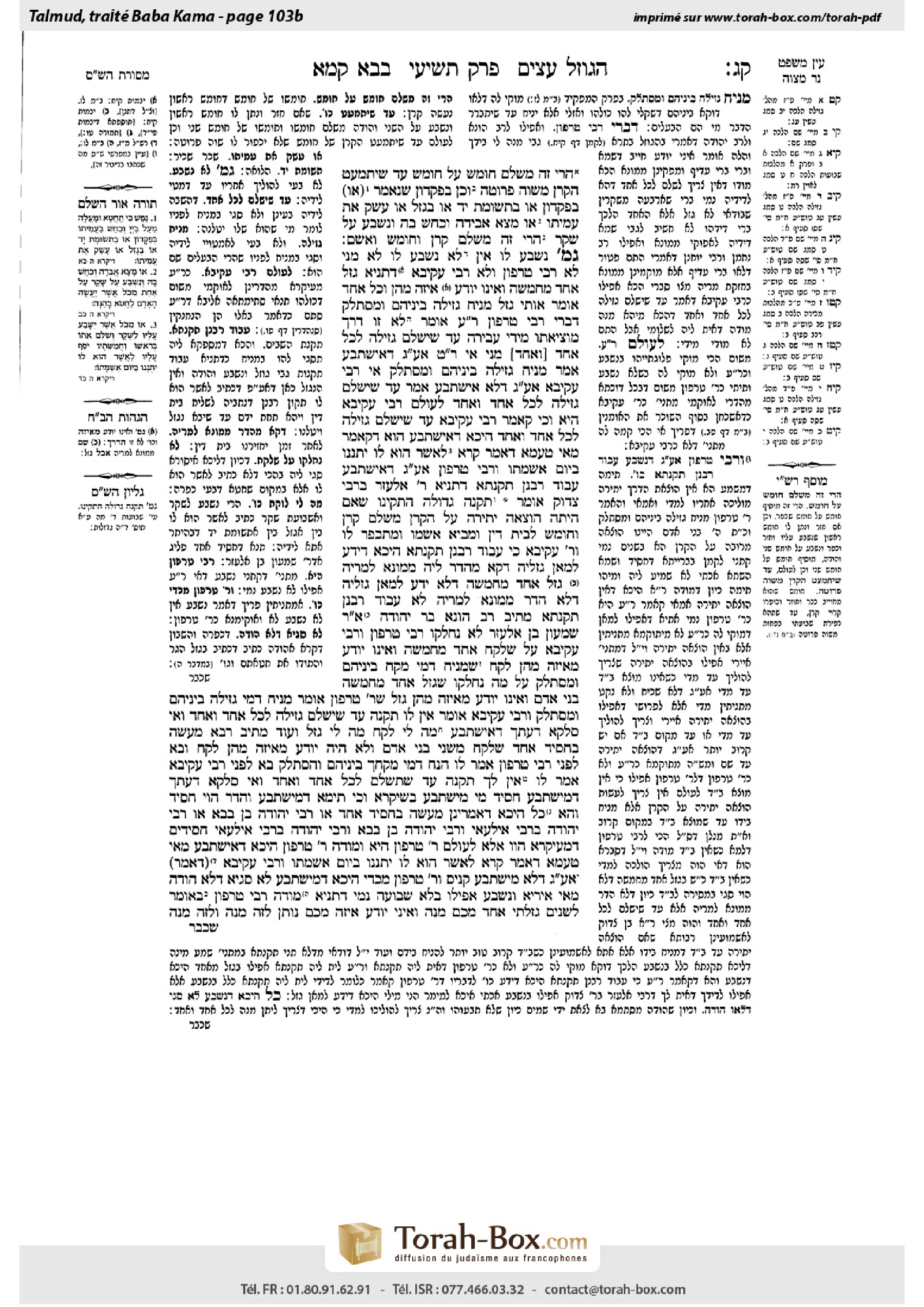
Bava Kamma 103b: Talmud study for Daf Yomi
Study the Talmud for Daf Yomi with scanned pages, Hebrew text, English translations from Sefaria and AI-generated French translations.
Passage selection and English or AI-generated French translation are available where the scan has annotations. Daf Study is independent of Torah-Box and Sefaria.
Browse Bava Kamma · בבא קמא · All tractatesBava Kamma 103b text and translations
This page of Bava Kamma includes the Aramaic text, an English translation and an AI-generated French translation, alongside the scan above.
בבא קמא ק״ג ב · Aramaic and Hebrew text
הֲרֵי זֶה מְשַׁלֵּם חוֹמֶשׁ עַל חוֹמֶשׁ, עַד שֶׁיִּתְמַעֵט הַקֶּרֶן מִשָּׁוֶה פְּרוּטָה.
וְכֵן בְּפִקָּדוֹן, שֶׁנֶּאֱמַר: ״אוֹ בְּפִקָּדוֹן אוֹ בִתְשׂוּמֶת יָד אוֹ בְגָזֵל, אוֹ עָשַׁק אֶת עֲמִיתוֹ אוֹ מָצָא אֲבֵדָה; וְכִחֶשׁ בָּהּ וְנִשְׁבַּע עַל שָׁקֶר״ – הֲרֵי זֶה מְשַׁלֵּם קֶרֶן וָחוֹמֶשׁ וְאָשָׁם.
גְּמָ׳ נִשְׁבַּע לוֹ – אִין, לֹא נִשְׁבַּע לוֹ – לָא; מַנִּי? לָא רַבִּי טַרְפוֹן וְלָא רַבִּי עֲקִיבָא! דְּתַנְיָא: גָּזַל אֶחָד מֵחֲמִשָּׁה וְאֵינוֹ יוֹדֵעַ אֵיזֶה מֵהֶן, וְכׇל אֶחָד אוֹמֵר: ״אוֹתִי גָּזַל״ – מַנִּיחַ גְּזֵילָה בֵּינֵיהֶם וּמִסְתַּלֵּק, דִּבְרֵי רַבִּי טַרְפוֹן. רַבִּי עֲקִיבָא אוֹמֵר: לֹא זוֹ דֶּרֶךְ מוֹצִיאָתוֹ מִידֵי עֲבֵירָה, עַד שֶׁיְּשַׁלֵּם גְּזֵילָה לְכׇל אֶחָד [וְאֶחָד].
מַנִּי? אִי רַבִּי טַרְפוֹן – אַף עַל גַּב דְּאִישְׁתְּבַע, אָמַר: מַנִּיחַ גְּזֵילָה בֵּינֵיהֶם וּמִסְתַּלֵּק! אִי רַבִּי עֲקִיבָא – אַף עַל גַּב דְּלָא אִישְׁתְּבַע, אָמַר: עַד שֶׁיְּשַׁלֵּם גְּזֵילָה לְכׇל אֶחָד וְאֶחָד!
לְעוֹלָם רַבִּי עֲקִיבָא הִיא, וְכִי קָאָמַר רַבִּי עֲקִיבָא עַד שֶׁיְּשַׁלֵּם גְּזֵילָה לְכׇל אֶחָד וְאֶחָד – הֵיכָא דְּאִישְׁתְּבַע הוּא דְּקָאָמַר. מַאי טַעְמָא? דְּאָמַר קְרָא: ״לַאֲשֶׁר הוּא לוֹ, יִתְּנֶנּוּ בְּיוֹם אַשְׁמָתוֹ״.
וְרַבִּי טַרְפוֹן – אַף עַל גַּב דְּאִישְׁתְּבַע, עֲבוּד רַבָּנַן תַּקַּנְתָּא. דְּתַנְיָא, רַבִּי אֶלְעָזָר בְּרַבִּי צָדוֹק אוֹמֵר: תַּקָּנָה גְּדוֹלָה הִתְקִינוּ, שֶׁאִם הָיְתָה הוֹצָאָה יְתֵירָה עַל הַקֶּרֶן – מְשַׁלֵּם קֶרֶן וָחוֹמֶשׁ לְבֵית דִּין, וּמֵבִיא אֲשָׁמוֹ וּמִתְכַּפֵּר לוֹ.
וְרַבִּי עֲקִיבָא – כִּי עֲבוּד רַבָּנַן תַּקַּנְתָּא, הֵיכָא דְּיָדַע לְמַאן גַּזְלֵיהּ, דְּקָא מַהְדַּר לֵיהּ מָמוֹנָא לְמָרֵיהּ; גָּזַל אֶחָד מֵחֲמִשָּׁה, דְּלָא יָדַע לְמַאן גַּזְלֵיהּ, דְּלָא הָדַר מָמוֹנָא לְמָרֵיהּ – לָא עֲבוּד רַבָּנַן תַּקַּנְתָּא.
מֵתִיב רַב הוּנָא בַּר יְהוּדָה, אָמַר רַבִּי שִׁמְעוֹן בֶּן אֶלְעָזָר: לֹא נֶחְלְקוּ רַבִּי טַרְפוֹן וְרַבִּי עֲקִיבָא עַל שֶׁלָּקַח אֶחָד מֵחֲמִשָּׁה וְאֵינוֹ יוֹדֵעַ מֵאֵיזֶה מֵהֶן לָקַח – שֶׁמַּנִּיחַ דְּמֵי מִקָּח בֵּינֵיהֶם וּמִסְתַּלֵּק. עַל מָה נֶחְלְקוּ? שֶׁגָּזַל אֶחָד מֵחֲמִשָּׁה בְּנֵי אָדָם, וְאֵינוֹ יוֹדֵעַ מֵאֵיזֶה מֵהֶן גָּזַל; שֶׁרַבִּי טַרְפוֹן אוֹמֵר: מַנִּיחַ דְּמֵי גְּזֵילָה בֵּינֵיהֶם וּמִסְתַּלֵּק, וְרַבִּי עֲקִיבָא אוֹמֵר: אֵין לוֹ תַּקָּנָה, עַד שֶׁיְּשַׁלֵּם גְּזֵילָה לְכׇל אֶחָד וְאֶחָד.
וְאִי סָלְקָא דַעְתָּךְ דְּאִישְׁתְּבַע, מָה לִי לָקַח מָה לִי גָּזַל?
וְעוֹד מֵתִיב רָבָא: מַעֲשֶׂה בְּחָסִיד אֶחָד שֶׁלָּקַח מִשְּׁנֵי בְּנֵי אָדָם וְלֹא הָיָה יוֹדֵעַ מֵאֵיזֶה מֵהֶן לָקַח, וּבָא לִפְנֵי רַבִּי טַרְפוֹן, אָמַר לוֹ: הַנַּח דְּמֵי מִקָּחֲךָ בֵּינֵיהֶם, וְהִסְתַּלֵּק. בָּא לִפְנֵי רַבִּי עֲקִיבָא, אָמַר לוֹ: אֵין לְךָ תַּקָּנָה, עַד שֶׁתְּשַׁלֵּם לְכׇל אֶחָד וְאֶחָד. וְאִי סָלְקָא דַעְתָּךְ דְּמִישְׁתְּבַע, חָסִיד מִי מִישְׁתְּבַע בְּשִׁיקְרָא?
וְכִי תֵּימָא דְּמִישְׁתְּבַע וַהֲדַר הָוֵי חָסִיד, וְהָא כׇּל הֵיכָא דְּאָמְרִינַן ״מַעֲשֶׂה בְּחָסִיד אֶחָד״ – אוֹ רַבִּי יְהוּדָה בֶּן בָּבָא, אוֹ רַבִּי יְהוּדָה בְּרַבִּי אִילְעַאי; וְרַבִּי יְהוּדָה בֶּן בָּבָא וְרַבִּי יְהוּדָה בְּרַבִּי אִילְעַאי חֲסִידִים דְּמֵעִיקָּרָא הֲווֹ!
אֶלָּא לְעוֹלָם רַבִּי טַרְפוֹן הִיא, וּמוֹדֶה רַבִּי טַרְפוֹן הֵיכָא דְּאִישְׁתְּבַע. מַאי טַעְמָא? דְּאָמַר קְרָא: ״לַאֲשֶׁר הוּא לוֹ, יִתְּנֶנּוּ בְּיוֹם אַשְׁמָתוֹ״. וְרַבִּי עֲקִיבָא דְּאָמַר אַף עַל גַּב דְּלָא מִישְׁתְּבַע – קָנֵיס.
וְרַבִּי טַרְפוֹן, מִכְּדֵי הֵיכָא דְּמִישְׁתְּבַע – לָא סַגִּיא דְּלָא הוֹדָה; מַאי אִירְיָא ״וְנִשְׁבַּע״? אֲפִילּוּ בְּלָא שְׁבוּעָה נָמֵי! דְּתַנְיָא, מוֹדֶה רַבִּי טַרְפוֹן בְּאוֹמֵר לִשְׁנַיִם: ״גָּזַלְתִּי אֶחָד מִכֶּם מָנֶה וְאֵינִי יוֹדֵעַ אֵיזֶה מִכֶּם״ – נוֹתֵן לָזֶה מָנֶה וְלָזֶה מָנֶה,
Bava Kamma 103b · English translation
then the additional one-fifth is considered a new principal obligation. The robber pays an additional one-fifth payment apart from the additional one-fifth payment about which he had taken a false oath. If he then takes a false oath concerning the second one-fifth payment, he is assessed an additional one-fifth payment for that oath, until the principal, i.e., the additional one-fifth payment about which he has most recently taken the false oath, is reduced to less than the value of one peruta.
And such is the halakha with regard to a deposit, as it is stated: “If anyone sins, and commits a trespass against the Lord, and he defrauds his counterpart with regard to a deposit, or with regard to a pledge, or with regard to a robbery, or if he exploited his counterpart; or he has found that which was lost, and deals falsely with it, and swears to a lie…he shall restore it in full, and shall add the fifth part more to it” (Leviticus 5:21–24). This one must pay the principal and an additional one-fifth payment, and bring a guilt-offering.
GEMARA: The mishna teaches that if a robber took a false oath that he did not rob, he must travel even as far as Media in order to repay the robbery victim. This indicates that if he takes an oath to the robbery victim, yes, he is required to go to any length to repay his obligation, but if he did not take an oath to him, no, he does not have to do so. Whose opinion is this? It is not the opinion of Rabbi Tarfon and not the opinion of Rabbi Akiva, as it is taught in a mishna (Yevamot 118b): If one robbed one of five people and he does not know which of them he robbed, and each one of the five says: He robbed me, the robber places the stolen item between them and withdraws from them; this is the statement of Rabbi Tarfon. Rabbi Akiva says: This is not the way to spare him from transgression. He is not considered to have returned the stolen item until he pays the value of the stolen item to each and every one of the five.
The Gemara clarifies: In accordance with whose opinion is the mishna written? If one suggests that it is in accordance with the opinion of Rabbi Tarfon, it is not so, because even though the robber took a false oath that he did not rob, Rabbi Tarfon says: He places the stolen item between them and withdraws; it is not his responsibility to ensure that it reaches the robbery victim. If one suggests that it is in accordance with the opinion of Rabbi Akiva, it is also not so, because even though the robber did not necessarily take a false oath, Rabbi Akiva says: He is not considered to have returned the stolen item until he pays the value of the stolen item to each and every one of the five, while the mishna rules that his obligation is contingent upon his having taken the false oath.
The Gemara answers: Actually, it is in accordance with the opinion of Rabbi Akiva, and when Rabbi Akiva says that the robber is not considered to have returned the stolen item until he pays the value of the stolen item to each and every one of the five, it is only in a case where the robber took a false oath that Rabbi Akiva says this. What is the reason? As the verse states with regard to one who takes a false oath concerning a financial obligation: “Unto him to whom it appertains shall he give it, on the day of his being guilty” (Leviticus 5:24). The halakha that the guilty party must make a rigorous effort to return what he owes is stated in the case of one who took a false oath, and Rabbi Akiva would state his ruling only in that case.
The Gemara asks: And how does Rabbi Tarfon rule that a robber who took a false oath is not required to pay all claimants, being that the verse indicates otherwise? The Gemara answers: Even though he took a false oath and by Torah law is obligated to return the stolen item to the robbery victim, the Sages instituted an ordinance allowing him to place it between the five possible victims, as it is taught in a baraita that Rabbi Elazar, son of Rabbi Tzadok, says: The Sages instituted a great ordinance stating that if the expense required to return a stolen item to the victim is greater than the principal, the robber may pay the principal and the additional one-fifth payment to the court, and he then brings his guilt-offering and achieves atonement for himself. This ordinance would apply here as well, as the expense required to pay all five claimants is greater than the principal.
The Gemara asks: And doesn’t Rabbi Akiva agree that the Sages instituted this ordinance? The Gemara answers: Rabbi Akiva holds that when the Sages instituted the ordinance, they did so only for cases where the robber knows whom he robbed, as in such cases he is definitely returning the money to its owner by depositing it with the court, who will convey it to the robbery victim. But in the case of one who robbed one of five people, where he does not know whom he robbed, and where, by merely placing the stolen item between the five of them the money is not returned to its owner, the Sages did not institute an ordinance.
Rav Huna bar Yehuda raises an objection to the explanation that Rabbi Akiva stated his opinion specifically in a case where the robber took an oath. The baraita in the Tosefta (Yevamot 14:2) states that Rabbi Shimon ben Elazar says: Rabbi Tarfon and Rabbi Akiva did not disagree with regard to one who purchased an item from one of five people and does not know from which of them he purchased it, as both agree that in this case he places the money of the purchase between them and withdraws. Since the purchaser has not transgressed, he is not penalized by being required to suffer the loss of paying each of them. With regard to what did they disagree? They disagree with regard to one who robbed one of five people, and he does not know from which of them he robbed the item, as Rabbi Tarfon says: He places the stolen item between them and withdraws, and Rabbi Akiva says: He has no remedy, i.e., he has not fulfilled his obligation to return the stolen item, until he pays the value of the stolen item to each and every one of them.
Rav Huna bar Yehuda states his objection: And if it enters your mind that Rabbi Akiva stated his ruling specifically with regard to one who took a false oath, what is the difference to me if he purchased an item from another, and what is the difference to me if he robbed him? In either case he has transgressed the prohibition against taking a false oath denying his obligation, and he should be penalized by being required to ensure that the one to whom he owes the money receives it.
And Rava raises another objection to the explanation that Rabbi Akiva stated his opinion specifically in a case where the robber took an oath. There was an incident involving a certain pious man who purchased an item from one of two people, and he did not know from which of them he purchased the item, and he came before Rabbi Tarfon for a ruling. Rabbi Tarfon said to him: Place the money of your purchase between them and withdraw. He then came before Rabbi Akiva, who said to him: You have no remedy until you pay each and every one, i.e., both of them. And if it enters your mind that Rabbi Akiva stated his ruling specifically where the purchaser took a false oath, does a pious man take a false oath? It seems from this incident that Rabbi Akiva rules he must pay all potential owners regardless of whether or not he took a false oath.
And if you would say that perhaps he took a false oath and later became a pious man, but isn’t there a tradition that anywhere that we say: There was an incident involving a certain pious man, the pious man is either Rabbi Yehuda ben Bava or Rabbi Yehuda, son of Rabbi Elai, and Rabbi Yehuda ben Bava and Rabbi Yehuda, son of Rabbi Elai, were both pious men from the beginning.
Due to these objections, the Gemara offers an alternative explanation. Rather, the mishna here is actually in accordance with the opinion of Rabbi Tarfon, and Rabbi Tarfon concedes that a robber must pay every potential owner in a case where he took a false oath, as is the case in the mishna here. What is the reason? As the verse states: “Unto him to whom it appertains shall he give it, in the day of his being guilty” (Leviticus 5:24). This verse, which requires one to go to any length to return money owed, is referring specifically to one who takes a false oath concerning his financial obligation. And Rabbi Akiva, who said in the mishna in tractate Yevamot that a robber must pay all potential owners even though he did not take a false oath, agrees that the verse is referring specifically to one who takes a false oath, but holds that the Sages penalize the robber by obligating him to pay them all in any event.
The Gemara questions this explanation of the mishna: But if the mishna is in accordance with the opinion of Rabbi Tarfon, after all, the mere fact that it is a case where he took a false oath is not sufficient to obligate him to pay the additional one-fifth and to bring a guilt-offering if it is a case where he did not also admit that he took a false oath and owes the money. Therefore, why would the mishna here specifically state: And he took a false oath? Even without taking the false oath, the robber should also be obligated to pursue the owner as a result of his having admitted his obligation. As it is taught in a baraita: Rabbi Tarfon concedes that in a case where a robber says to two people: I robbed one of you of one hundred dinars and I do not know which of you it was, he gives one hundred dinars to this person and one hundred dinars to that person,
Bava Kamma 103b · Traduction française (IA)
alors le cinquième supplément est considéré comme une nouvelle obligation principale. Le voleur paie un supplément de cinquième en plus du cinquième supplément dont il avait pris un faux serment. Si ensuite il prend un faux serment concernant ce deuxième cinquième supplément, il est sanctionné d’un autre cinquième supplément pour ce serment, jusqu’à ce que l’obligation principale, c’est-à-dire le cinquième supplément concernant lequel il a le plus récemment pris un faux serment, soit réduit à moins de la valeur d’un peruta.
Et c’est ainsi que la halakha s’applique concernant un dépôt, comme il est dit : « Si quelqu’un péche et commet un outrage contre l’Éternel, et s’il trompe son compagnon concernant un dépôt, ou concernant un cautionnement, ou concernant un vol, ou s’il exploite son compagnon ; ou s’il a trouvé quelque chose qui était perdu, et s’il agit de manière trompeuse à son égard, et s’il jure un mensonge… il doit rendre la chose entièrement, et ajouter la cinquième partie à la chose » (Lévitique 5:21–24). Il doit payer l’obligation principale et un supplément de cinquième, et présenter un sacrifice de culpabilité.
GUEMARA : La mitsva enseigne que si un voleur a pris un faux serment qu’il n’a pas volé, il doit voyager même jusqu’en Mésopotamie pour rembourser la victime du vol. Cela indique que s’il prend un serment envers la victime du vol, oui, il est tenu de faire tout ce qui est nécessaire pour remplir son obligation, mais s’il n’a pas pris de serment envers lui, non, il n’a pas à le faire. De quel opinion est-ce ? Ce n’est pas l’opinion de Rabbi Tarfon ni celle de Rabbi Akiva, comme il est enseigné dans une mitsva (Yévamot 118b) : Si l’on a volé l’un des cinq, et qu’on ne sait pas lequel, et que chacun des cinq dit : Il m’a volé, le voleur place l’objet volé entre eux et s’en va ; c’est l’opinion de Rabbi Tarfon. Rabbi Akiva dit : Ce n’est pas la manière de le dispenser de la transgression. Il n’est pas considéré comme ayant rendu l’objet volé jusqu’à ce qu’il paie la valeur de l’objet volé à chacun des cinq.
La Guemara clarifie : Selon l’opinion de qui est rédigée la mitsva ? Si l’on suggère qu’elle est selon l’opinion de Rabbi Tarfon, ce n’est pas le cas, car même si le voleur a pris un faux serment qu’il n’a pas volé, Rabbi Tarfon dit : Il place l’objet volé entre eux et s’en va ; ce n’est pas sa responsabilité de s’assurer qu’il arrive à la victime du vol. Si l’on suggère qu’elle est selon l’opinion de Rabbi Akiva, ce n’est pas non plus le cas, car même si le voleur n’a pas nécessairement pris un faux serment, Rabbi Akiva dit : Il n’est pas considéré comme ayant rendu l’objet volé jusqu’à ce qu’il paie la valeur de l’objet volé à chacun des cinq, tandis que la mitsva règle que son obligation dépend du fait qu’il ait pris un faux serment.
La Guemara répond : En réalité, c’est selon l’opinion de Rabbi Akiva, et lorsque Rabbi Akiva dit que le voleur n’est pas considéré comme ayant rendu l’objet volé jusqu’à ce qu’il paie la valeur de l’objet volé à chacun des cinq, c’est uniquement dans le cas où le voleur a pris un faux serment qu’il dit cela. Pourquoi ? Comme le verset indique concernant celui qui prend un faux serment concernant une obligation financière : « À celui à qui il appartient, il doit le donner, le jour de son péché » (Lévitique 5:24). La halakha selon laquelle la personne coupable doit faire un effort rigoureux pour rendre ce qu’il doit est énoncée dans le cas de celui qui a pris un faux serment, et Rabbi Akiva formule son jugement uniquement dans ce cas.
La Guemara pose la question : Et comment Rabbi Tarfon règle-t-il que le voleur qui a pris un faux serment n’est pas tenu de payer tous les prétendants, étant donné que le verset indique le contraire ? La Guemara répond : Même s’il a pris un faux serment et qu’il est tenu par la Torah de rendre l’objet volé à la victime du vol, les Sages ont institué un ordonnance permettant de placer l’objet entre les cinq possibles victimes, comme il est enseigné dans une baraïta que Rabbi Eléazar, fils de Rabbi Tzadok, dit : Les Sages ont institué un grand ordonnance stipulant que si le coût requis pour rendre l’objet volé à la victime est supérieur à la valeur principale, le voleur peut payer la valeur principale et le supplément de cinquième au tribunal, et il présente alors son sacrifice de culpabilité et obtient la rédemption pour lui-même. Cette ordonnance s’applique également ici, car le coût requis pour payer tous les cinq prétendants est supérieur à la valeur principale.
La Guemara pose la question : Et ne serait-ce pas que Rabbi Akiva accepte que les Sages aient institué cette ordonnance ? La Guemara répond : Rabbi Akiva considère que lorsque les Sages ont institué cette ordonnance, ils l'ont fait uniquement dans les cas où le voleur connaît la victime, car dans ces cas, il est certain de rendre l'argent à son propriétaire en déposant l'argent auprès du tribunal, qui le transmettra à la victime du vol. Mais dans le cas où l'on a volé l'un des cinq, et qu'on ne sait pas lequel, et que simplement en plaçant l'objet volé entre les cinq, l'argent n'est pas rendu à son propriétaire, les Sages n'ont pas institué d'ordonnance.
Rav Huna bar Yéhuda soulève une objection contre l'explication selon laquelle Rabbi Akiva a formulé son opinion spécifiquement dans le cas où le voleur a pris un serment. La baraïta dans la Tosefta (Yévamot 14:2) stipule que Rabbi Shim'on ben Eléazar dit : Rabbi Tarfon et Rabbi Akiva n'ont pas discuté concernant celui qui a acheté un objet auprès d'un des cinq et ne sait pas auprès de quel d'entre eux il l'a acheté, car tous deux s'accordent sur le fait qu'il place l'argent de l'achat entre eux et s'en va. Puisque l'acheteur n'a pas transgressé, il n'est pas pénalisé par la perte de payer chacun d'entre eux. À propos de quoi ont-ils discuté ? Ils ont discuté concernant celui qui a volé l'un des cinq, et ne sait pas auprès de quel d'entre eux il a volé l'objet, car Rabbi Tarfon dit : Il place l'objet volé entre eux et s'en va, et Rabbi Akiva dit : Il n'a pas de remède, c'est-à-dire qu'il n'a pas accompli son obligation de rendre l'objet volé jusqu'à ce qu'il paie la valeur de l'objet volé à chacun d'entre eux.
Rav Huna bar Yehuda énonce son objection : Et si cela entre dans votre pensée que Rabbi Akiva a formulé sa décision spécifiquement concernant celui qui a pris un faux serment, quelle est la différence pour moi si l'acheteur a acheté un objet à un autre, et quelle est la différence pour moi si l'acheteur a volé ? Dans les deux cas, il a transgressé l'interdiction de prendre un faux serment en niant son obligation, et il devrait être puni en étant tenu de s'assurer que celui à qui il doit l'argent le reçoive.
Et Rava soulève une autre objection contre l'explication selon laquelle Rabbi Akiva a formulé son opinion spécifiquement dans un cas où le voleur a pris un serment. Il y avait un incident concernant un homme pieux qui a acheté un objet à l'un des deux, et il ne savait pas de quel côté il l'avait acheté, et il est venu devant Rabbi Tarfon pour une décision. Rabbi Tarfon lui a dit : Placez l'argent de votre achat entre eux et retirez-vous. Il est ensuite venu devant Rabbi Akiva, qui lui a dit : Vous n'avez pas de remède jusqu'à ce que vous payiez chacun d'eux, c'est-à-dire les deux. Et si cela entre dans votre pensée que Rabbi Akiva a formulé sa décision spécifiquement dans le cas où l'acheteur a pris un faux serment, un homme pieux prend-il un faux serment ? Il semble que cet incident montre que Rabbi Akiva considère qu'il doit payer tous les propriétaires potentiels indépendamment du fait qu'il ait pris un faux serment ou non.
Et si vous dites que peut-être il a pris un faux serment et est ensuite devenu un homme pieux, mais n'y a-t-il pas une tradition selon laquelle partout que nous disons : Il y avait un incident concernant un certain homme pieux, l'homme pieux est soit Rabbi Yehuda ben Bava, soit Rabbi Yehuda, fils de Rabbi Elai, et Rabbi Yehuda ben Bava et Rabbi Yehuda, fils de Rabbi Elai, étaient tous les deux des hommes pieux dès le début.
En raison de ces objections, la Guemara propose une autre explication. En réalité, la Michna ici est en conformité avec l'opinion de Rabbi Tarfon, et Rabbi Tarfon reconnaît que le voleur doit payer chaque propriétaire potentiel dans le cas où il a pris un faux serment, comme c'est le cas dans la Michna ici. Quelle est la raison ? Comme le texte saint dit : « À celui à qui il appartient, il doit le donner, le jour où il est coupable » (Lévitique 5:24). Ce texte, qui exige de parcourir toute la longueur pour rendre l'argent dû, se réfère spécifiquement à celui qui prend un faux serment concernant son obligation financière. Et Rabbi Akiva, qui a dit dans la Michna du traité Yevamot que le voleur doit payer tous les propriétaires potentiels même s'il n'a pas pris un faux serment, reconnaît que ce texte se réfère spécifiquement à celui qui prend un faux serment, mais considère que les Sages pénalisent le voleur en l'obligeant à les payer tous de toute façon.
La Guemara questionne cette explication de la Michna : Mais si la Michna est en conformité avec l'opinion de Rabbi Tarfon, après tout, le fait qu'il s'agisse d'un cas où il a pris un faux serment n'est pas suffisant pour l'obliger à payer le cinquième supplémentaire et à apporter un sacrifice de culpabilité si c'est un cas où il n'a pas non plus admis avoir pris un faux serment et doit l'argent. Par conséquent, pourquoi la Michna ici précise-t-elle : Et il a pris un faux serment ? Même sans prendre le faux serment, le voleur devrait être tenu de rechercher le propriétaire en raison de son admission de son obligation. Comme il est enseigné dans une baraïta : Rabbi Tarfon reconnaît que dans le cas où un voleur dit à deux personnes : J'ai volé à l'un de vous cent dinars et je ne sais pas lequel, il donne cent dinars à cette personne et cent dinars à celle-ci,
Traduction française générée par IA à partir de l’édition anglaise de Sefaria. Vérifie toujours un passage avec le texte source.
Text from Sefaria: William Davidson Edition - Vocalized Aramaic (CC BY NC); William Davidson Edition - English (CC BY NC).