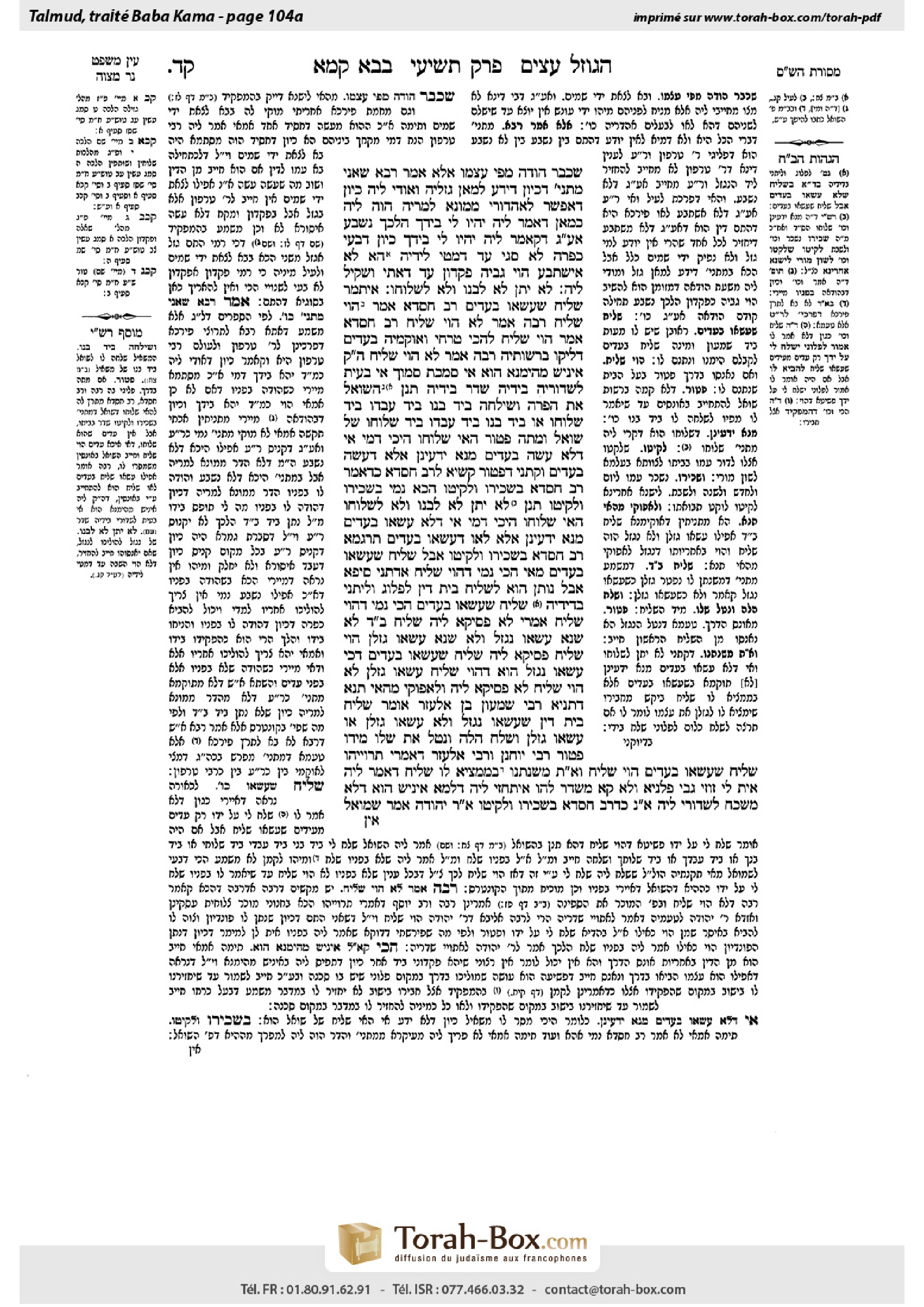
Bava Kamma 104a: Talmud study for Daf Yomi
Study the Talmud for Daf Yomi with scanned pages, Hebrew text, English translations from Sefaria and AI-generated French translations.
Passage selection and English or AI-generated French translation are available where the scan has annotations. Daf Study is independent of Torah-Box and Sefaria.
Browse Bava Kamma · בבא קמא · All tractatesBava Kamma 104a text and translations
This page of Bava Kamma includes the Aramaic text, an English translation and an AI-generated French translation, alongside the scan above.
בבא קמא ק״ד א · Aramaic and Hebrew text
שֶׁכְּבָר הוֹדָה מִפִּי עַצְמוֹ!
אֶלָּא אָמַר רָבָא: שָׁאנֵי מַתְנִיתִין, דְּכֵיוָן דְּיָדַע לְמַאן גַּזְלֵיהּ, וְאוֹדִי לֵיהּ; כֵּיוָן דְּאֶפְשָׁר לְאַהְדּוֹרֵי מָמוֹנָא לְמָרֵיהּ – הָוֵה לֵיהּ כְּמַאן דְּאָמַר לֵיהּ: ״יִהְיוּ לִי בְּיָדְךָ״. הִלְכָּךְ, נִשְׁבַּע – אַף עַל גַּב דְּקָאָמַר לֵיהּ: ״יִהְיוּ לִי בְּיָדְךָ״, כֵּיוָן דְּבָעֵי כַּפָּרָה, לָא סַגִּי עַד דְּמָטֵי לִידֵיהּ; הָא לָא אִישְׁתְּבַע – הָוֵי גַּבֵּיהּ פִּקָּדוֹן, עַד דְּאָתֵי וְשָׁקֵיל לֵיהּ.
לֹא יִתֵּן לֹא לִבְנוֹ וְלֹא לִשְׁלוּחוֹ. אִיתְּמַר: שָׁלִיחַ שֶׁעֲשָׂאוֹ בְּעֵדִים – רַב חִסְדָּא אָמַר: הָוֵי שָׁלִיחַ, רַבָּה אָמַר: לָא הָוֵי שָׁלִיחַ.
רַב חִסְדָּא אָמַר הָוֵי שָׁלִיחַ – לְהָכִי טְרַחִי וְאוֹקְמֵיהּ בְּעֵדִים, דְּלֵיקוּ בִּרְשׁוּתֵיהּ. רַבָּה אָמַר לָא הָוֵי שָׁלִיחַ – הָכִי קָאָמַר: אִינִישׁ מְהֵימְנָא הוּא; אִי סָמְכַתְּ – סְמוֹךְ, אִי בָּעֵית לְשַׁדּוֹרֵיה בִּידֵיהּ – שַׁדַּר בִּידֵיהּ.
תְּנַן: הַשּׁוֹאֵל אֶת הַפָּרָה, וְשִׁילְּחָהּ בְּיַד בְּנוֹ, בְּיַד עַבְדּוֹ, בְּיַד שְׁלוּחוֹ; אוֹ בְּיַד בְּנוֹ, בְּיַד עַבְדּוֹ, בְּיַד שְׁלוּחוֹ שֶׁל שׁוֹאֵל; וּמֵתָה – פָּטוּר.
הַאי שְׁלוּחוֹ הֵיכִי דָמֵי? אִי דְּלֹא (עָשָׂה) [עֲשָׂאוֹ] בְּעֵדִים, מְנָא יָדְעִינַן? אֶלָּא (דְּעָשָׂה) [דַּעֲשָׂאוֹ] בְּעֵדִים – וְקָתָנֵי דְּפָטוּר? קַשְׁיָא לְרַב חִסְדָּא!
כִּדְאָמַר רַב חִסְדָּא: בִּשְׂכִירוֹ וּלְקִיטוֹ, הָכָא נָמֵי בִּשְׂכִירוֹ וּלְקִיטוֹ.
תְּנַן: לֹא יִתֵּן לֹא לִבְנוֹ וְלֹא לִשְׁלוּחוֹ. הַאי שְׁלוּחוֹ הֵיכִי דָמֵי? אִי דְּלָא עֲשָׂאוֹ בְּעֵדִים, מְנָא יָדְעִינַן? אֶלָּא לָאו דַּעֲשָׂאוֹ בְּעֵדִים? תַּרְגְּמַהּ רַב חִסְדָּא: בִּשְׂכִירוֹ וּלְקִיטוֹ.
אֲבָל שָׁלִיחַ שֶׁעֲשָׂאוֹ בְּעֵדִים – מַאי, הָכִי נָמֵי דְּהָוֵי שָׁלִיחַ? אַדְּתָנֵי סֵיפָא: אֲבָל נוֹתֵן הוּא לִשְׁלִיחַ בֵּית דִּין; לִפְלוֹג וְלִיתְנֵי בְּדִידֵיהּ – שָׁלִיחַ שֶׁעֲשָׂאוֹ בְּעֵדִים, הָכִי נָמֵי דְּהָוֵי שָׁלִיחַ!
אָמְרִי: לָא פְּסִיקָא לֵיהּ; שְׁלִיחַ בֵּית דִּין, לָא שְׁנָא עֲשָׂאוֹ נִגְזָל וְלָא שְׁנָא עֲשָׂאוֹ גַּזְלָן, הָוֵי שָׁלִיחַ – פְּסִיקָא לֵיהּ. שְׁלִיחַ שֶׁעֲשָׂאוֹ בְּעֵדִים, דְּכִי עֲשָׂאוֹ נִגְזָל הוּא דְּהָוֵי שָׁלִיחַ, עֲשָׂאוֹ גַּזְלָן לָא הָוֵי שָׁלִיחַ – לָא פְּסִיקָא לֵיהּ.
וּלְאַפּוֹקֵי מֵהַאי תַּנָּא – דְּתַנְיָא, רַבִּי שִׁמְעוֹן בֶּן אֶלְעָזָר אוֹמֵר: שְׁלִיחַ בֵּית דִּין שֶׁעֲשָׂאוֹ נִגְזָל וְלֹא עֲשָׂאוֹ גַּזְלָן, אוֹ עֲשָׂאוֹ גַּזְלָן וְשָׁלַח הַלָּה וְנָטַל אֶת שֶׁלּוֹ מִיָּדוֹ – פָּטוּר.
רַבִּי יוֹחָנָן וְרַבִּי אֶלְעָזָר דְאָמְרִי תַּרְוַיְיהוּ: שָׁלִיחַ שֶׁעֲשָׂאוֹ בְּעֵדִים, הָוֵי שָׁלִיחַ. וְאִם תֹּאמַר מִשְׁנָתֵנוּ;
בְּמַמְצִיא לוֹ שָׁלִיחַ, דַּאֲמַר לֵיהּ: ״אִית לִי זוּזֵי גַּבֵּי פְלָנְיָא, וְלָא קָא מְשַׁדַּר לְהוּ. אִיתְחֲזִי לֵיהּ, דִּלְמָא אִינִישׁ הוּא דְּלָא מַשְׁכַּח לְשַׁדּוֹרֵי לֵיהּ״.
אִי נָמֵי, כִּדְרַב חִסְדָּא – בִּשְׂכִירוֹ וּלְקִיטוֹ.
אָמַר רַב יְהוּדָה אָמַר שְׁמוּאֵל:
Bava Kamma 104a · English translation
as he has already admitted his obligation on his own. Rabbi Tarfon concedes that a robber who wishes to repent must go to any length to return the stolen item to its owner. If the mishna here is in accordance with his opinion, it should not have stated its ruling specifically in a case where the robber took a false oath.
Rather, Rava said: The case of the mishna is different, and the halakha stated here could be in accordance with the opinions of both Rabbi Tarfon and Rabbi Akiva. For as the robber knows whom he robbed and admitted to him that he robbed him, since it is possible to return the money to its owner, the robbery victim is as the one who says to the robber: The money you owe me will be kept in your possession as a deposit for me. Therefore, in a case where the robber took a false oath, even though the owner is considered to have said to him: The money you owe me will be kept in your possession as a deposit for me, since the robber requires atonement for his false oath, it is not possible for him to achieve atonement until the money reaches the possession of the robbery victim. But in a case where the robber did not take a false oath, the money is considered as a deposit given to the robber until the owner comes and takes it.
§ The mishna teaches that if the robber wishes to return the stolen item, he may not give the payment to the robbery victim’s son to return it to the robbery victim, nor to his agent. The Gemara comments: It was stated with regard to an agent who was appointed in the presence of witnesses to collect a debt from another: Rav Ḥisda said: Such an agent is a legally recognized agent, so that the debtor is considered to have repaid his debt as soon as he transfers the money to the agent, and the debtor will not be held responsible if an accident occurs causing the loss of the money before the agent gives it to the creditor. Rabba said: Such an agent is not a legally recognized agent, and the debtor remains responsible until the money reaches the creditor’s possession.
The Gemara explains their respective opinions: Rav Ḥisda said that he is an agent because it was for this reason that the creditor took the trouble and appointed the agent in the presence of witnesses, in order to place the matter under the agent’s domain. Rabba said that he is not an agent because this is what the creditor is assumed to be saying to the debtor: This individual is a trustworthy person. If you are willing to rely on him, then rely on him to convey the payment to me. Similarly: If you wish to send the debt in his possession, then send it in his possession.
The Gemara cites a mishna that poses a difficulty to the opinion of Rav Ḥisda. We learned in a mishna (Bava Metzia 98b): With regard to one who enters into an agreement to borrow a cow from another, and the owner sent it to the borrower in the possession of his own son, or in the possession of his own slave, or in the possession of his own agent, or if he sent it in the possession of the borrower’s son, or in the possession of the borrower’s slave, or in the possession of the borrower’s agent, and the cow died, the borrower is exempt from paying for the cow, as it never entered his possession.
The Gemara explains the case of the mishna: With regard to this agent of the borrower, what are the circumstances surrounding his appointment? If the mishna is discussing a case where he did not appoint him as his agent in the presence of witnesses, how do we know that he was appointed as an agent? Rather, it must be that it is a case where he appointed him as his agent in the presence of witnesses, and yet the mishna teaches that the borrower is exempt. This poses a difficulty to the opinion of Rav Ḥisda, who holds that one acquires property through his agent. According to his reasoning, the borrower should be held responsible for the cow once it reaches the possession of the agent.
The Gemara answers: It is as that which Rav Ḥisda said concerning a different mishna: This is stated with regard to his hired hand or his regular harvester; here also the mishna in Bava Metzia is with regard to his hired hand or his regular harvester. The mishna discusses a case where there were no witnesses to the appointment of the agent, and therefore it does not pose a difficulty to the opinion of Rav Ḥisda. Yet, since it is well known that this person is constantly in the owner’s service, he is assumed to be acting as his agent.
The Gemara poses a difficulty to the opinion of Rav Ḥisda from the mishna here. We learned in the mishna: If the robber wishes to return the stolen item, he may not give the payment to the robbery victim’s son to return it to the robbery victim, nor to his agent. With regard to this agent of the robbery victim, what are the circumstances surrounding his appointment? If the mishna is discussing a case where the robbery victim did not appoint him as his agent in the presence of witnesses, how do we know that he was appointed as an agent? Rather, is it not discussing a case where the robbery victim appointed him as his agent in the presence of witnesses, and the robber nevertheless does not fulfill his obligation to return the stolen item by giving it to this agent? The Gemara answers: Rav Ḥisda interpreted the ruling of the mishna with regard to his hired hand or his regular harvester, who do not require witnesses to validate their appointment as his agent.
The Gemara asks: But with regard to an agent who the robbery victim appointed in the presence of witnesses, what is the halakha? Would one say that indeed, one appointed before witnesses is a legally recognized agent? If that is the case, instead of teaching in the latter clause: But he may give the payment to an agent of the court, which indicates that this is the only agent to whom he may give it, let the mishna make a distinction within the case of an agent appointed by the robbery victim itself and teach: An agent who the robbery victim appointed in the presence of witnesses is indeed a legally recognized agent. If an agent appointed in the presence of witnesses is a legally recognized agent, why does the mishna shift to discuss an agent of the court?
The Sages say in response: Although the tanna of the mishna could have stated the case of an agent appointed by the robbery victim in the presence of witnesses, he could not have stated this halakha definitively, as with regard to an agent of the court, there is no difference whether the robbery victim appointed him as an agent, i.e., the court appointed him at the behest of the robbery victim, and there is no difference whether the robber appointed him as an agent, i.e., the court appointed him at the behest of the robber. In both cases he is a legally recognized agent. Therefore, he could state the halakha concerning an agent of the court definitively. By contrast, with regard to an agent who was appointed in the presence of witnesses, that only when the robbery victim appointed him as an agent he is an agent, but when the robber appointed him as an agent, he is not an agent, as the robber cannot appoint an agent to receive payment on behalf of the robbery victim, he could not have stated this halakha definitively.
The Gemara comments: And this mishna, which rules that an agent of the court is an agent even if appointed only by the robber, serves to exclude the opinion of this following tanna, as it is taught in the Tosefta (10:11) that Rabbi Shimon ben Elazar says: If there was an agent of the court who was appointed by the robbery victim but not appointed by the robber, or an agent who was appointed by the robber, and subsequently the other, i.e., the robbery victim, sent for and took his payment from the agent’s possession, the robber is exempt from paying for any accidental damage to the payment during the delivery. Rabbi Shimon ben Elazar states that the robber is exempt from paying for any accidental damage when he gave the payment to a court agent he appointed only if the robbery victim sent for and took possession of the payment. This is in opposition to the ruling of the mishna that the robber is exempt whenever he gives the payment to an agent of the court.
The Gemara cites the opinion of two other amora’im with regard to the status of an agent appointed in the presence of witnesses. Rabbi Yoḥanan and Rabbi Elazar both say: An agent who was appointed in the presence of witnesses is a legally recognized agent. And if you say: Our mishna contradicts this assertion, as it rules that the stolen item is not considered returned if given to an agent of the robbery victim, this is of no concern.
The Gemara explains: The mishna does not mean to disqualify an agent appointed by the robbery victim in the presence of witnesses, but rather is referring to a case where the robbery victim provides the robber with an agent without appointing him in the presence of witnesses, in that he says to someone: I have money owed to me that is currently with so-and-so, and he is not sending it. Present yourself to him, as perhaps he wishes to return it but cannot find a person with whom to send it.
The Gemara offers a second explanation: Alternatively, it is in accordance with the statement of Rav Ḥisda, that the mishna is not discussing a case where he appointed the agent in the presence of witnesses, but it is still known that the agent acts on behalf of the robbery victim, as the ruling of the mishna is stated with regard to the victim’s hired hand or his regular harvester. That is why the robber is still liable after having given the payment to the agent.
§ The Gemara discusses another matter relating to the appointment of an agent. Rav Yehuda says that Shmuel says:
Bava Kamma 104a · Traduction française (IA)
puisque il a déjà admis lui-même son obligation. Rabbi Tarfon reconnaît que un voleur qui souhaite se repentir doit aller jusqu'au bout pour rendre l'objet volé à son propriétaire. Si la mitsva ici est en conformité avec son avis, elle ne devrait pas avoir spécifié sa décision dans un cas où le voleur avait pris un faux serment.
Au contraire, Rava a dit : Le cas de la mitsva est différent, et la halakha énoncée ici pourrait s'appliquer aux opinions de Rabbi Tarfon et de Rabbi Akiva. En effet, puisque le voleur connaît celui qu'il a volé et a admis avoir volé, et que cela est possible de rendre l'argent à son propriétaire, le victime du vol est comme celui qui dit au voleur : L'argent que tu me dois sera gardé chez toi comme dépôt pour moi. Ainsi, dans le cas où le voleur a pris un faux serment, même si le propriétaire est considéré comme ayant dit au voleur : L'argent que tu me dois sera gardé chez toi comme dépôt pour moi, puisque le voleur a besoin de rédemption pour son faux serment, il ne peut pas obtenir la rédemption jusqu'à ce que l'argent arrive chez le propriétaire. Mais dans le cas où le voleur n'a pas pris un faux serment, l'argent est considéré comme un dépôt donné au voleur jusqu'à ce que le propriétaire vienne le récupérer.
§ La Michna enseigne que si le voleur souhaite rendre l'objet volé, il ne peut pas donner l'argent à son fils ou à son agent pour le rendre au propriétaire. La Guemara commente : Il a été dit concernant un agent désigné en présence de témoins pour récupérer une dette d'un autre : Rav Ḥisda a dit : Cet agent est un agent légalement reconnu, de sorte que le débiteur est considéré comme ayant remboursé sa dette dès qu'il transfère l'argent à l'agent, et le débiteur ne sera pas tenu responsable si un accident survient causant la perte de l'argent avant que l'agent ne le donne au créancier. Rabba a dit : Cet agent n'est pas un agent légalement reconnu, et le débiteur reste responsable jusqu'à ce que l'argent arrive en possession du créancier.
La Guemara explique leurs opinions respectives : Rav Ḥisda a dit qu'il est un agent car c'est pour cette raison que le créancier a pris la peine de désigner l'agent en présence de témoins, afin de placer la question sous la juridiction de l'agent. Rabba a dit qu'il n'est pas un agent car c'est ce que le créancier est supposé dire au débiteur : Cette personne est un homme de confiance. Si tu veux te fier à lui, alors fais-le confiance pour transmettre le paiement à moi. De même : Si tu veux envoyer la dette en son possession, alors envoie-la en son possession.
La Guemara cite une Michna qui pose un problème pour l'opinion de Rav Ḥisda. Nous avons appris dans une Michna (Bava Metzia 98b) : Concernant celui qui entre dans un accord pour emprunter un bovin à un autre, et l'owner l'a envoyé au prêteur en possession de son propre fils, ou en possession de son propre serviteur, ou en possession de son propre agent, ou si l'owner l'a envoyé en possession du fils du prêteur, ou en possession du serviteur du prêteur, ou en possession de l'agent du prêteur, et le bovin est mort, le prêteur est exempt de payer pour le bovin, car il n'a jamais été en possession de lui.
La Guemara explique le cas de la Michna : Concernant cet agent du prêteur, quelles sont les circonstances de son désignation ? Si la Michna parle d'un cas où il n'a pas désigné cet agent comme son agent en présence de témoins, comment savons-nous qu'il a été désigné comme agent ? Au contraire, il doit s'agir d'un cas où il a désigné cet agent comme son agent en présence de témoins, et pourtant la Michna enseigne que le prêteur est exempt. Cela pose un problème pour l'opinion de Rav Ḥisda, qui considère que l'on acquiert une propriété par son agent. Selon son raisonnement, le prêteur devrait être tenu responsable dès que l'animal arrive en possession de l'agent.
La Guemara répond : C'est comme ce que Rav Ḥisda a dit concernant une autre mitsva : cela est dit concernant son ouvrier ou son harvester régulier ; ici aussi la mitsva de Bava Metzia est concernant son ouvrier ou son harvester régulier. La mitsva parle d'un cas où il n'y avait pas de témoins pour la désignation de l'agent, et donc cela ne pose pas de problème pour l'opinion de Rav Ḥisda. Cependant, puisque c'est bien connu que cette personne est constamment en service de l'propriétaire, il est supposé agir en tant qu'agent de l'propriétaire.
La Guemara soulève un doute sur l'opinion de Rav Ḥisda à partir de la mitsva ici. Nous avons appris dans la mitsva : Si le voleur souhaite rendre l'objet volé, il ne peut pas donner l'argent à son fils ou à son agent pour le rendre au propriétaire. Concernant cet agent du propriétaire, quelles sont les circonstances de sa désignation ? Si la mitsva parle d'un cas où le propriétaire n'a pas désigné cet agent comme son agent en présence de témoins, comment savons-nous qu'il a été désigné comme agent ? Au contraire, n'est-ce pas un cas où le propriétaire a désigné cet agent comme son agent en présence de témoins, et le voleur ne remplit pas son obligation de rendre l'objet volé en donnant l'argent à cet agent ? La Guemara répond : Rav Ḥisda a interprété la décision de la mitsva concernant son ouvrier ou son harvester régulier, qui n'ont pas besoin de témoins pour valider leur désignation en tant qu'agent du propriétaire.
La Guemara pose une question : Mais concernant un agent désigné en présence de témoins par le propriétaire, quelle est la halakha ? Dirait-on que celui qui a été désigné devant des témoins est un agent légalement reconnu ? Si c'est le cas, au lieu d'apprendre dans la clause suivante : Mais il peut donner l'argent à un agent du tribunal, ce qui indique que c'est l'unique agent auquel il peut le donner, la mitsva devrait faire une distinction dans le cas d'un agent désigné par le propriétaire lui-même et apprendre : Un agent désigné en présence de témoins par le propriétaire est effectivement un agent légalement reconnu. Si un agent désigné en présence de témoins est un agent légalement reconnu, pourquoi la mitsva passe-t-elle à parler d'un agent du tribunal ?
Les Sages répondent : Bien que le tanna de la mitsna puisse avoir mentionné le cas d'un agent désigné par la victime du vol en présence de témoins, il ne pouvait pas énoncer cette halakha de manière définitive, car, concernant un agent du tribunal, il n'y a pas de différence entre le fait que la victime du vol l'ait désigné comme agent, c'est-à-dire que le tribunal l'ait désigné à la demande de la victime du vol, et le fait que le voleur l'ait désigné comme agent, c'est-à-dire que le tribunal l'ait désigné à la demande du voleur. Dans les deux cas, il s'agit d'un agent légalement reconnu. Par conséquent, il pouvait énoncer la halakha concernant un agent du tribunal de manière définitive. En revanche, concernant un agent désigné en présence de témoins, c'est seulement lorsque la victime du vol l'a désigné comme agent qu'il est considéré comme un agent, mais lorsque le voleur l'a désigné comme agent, il ne l'est pas, car le voleur ne peut désigner un agent pour recevoir le paiement en nom de la victime du vol. Il ne pouvait donc énoncer cette halakha de manière définitive.
Le Guemara commente : Et cette mitsna, qui établit que l'agent du tribunal est un agent même s'il a été désigné uniquement par le voleur, sert à écarter l'opinion de ce tanna suivant, comme il est enseigné dans la Tosefta (10:11) que Rabbi Shimon ben Elazar dit : Si un agent du tribunal a été désigné par la victime du vol mais pas par le voleur, ou s'il a été désigné par le voleur et ensuite la victime du vol a demandé et a récupéré le paiement de la possession de l'agent, le voleur est exempt de payer pour tout dommage accidentel sur le paiement pendant le transport. Rabbi Shimon ben Elazar affirme que le voleur est exempt de payer pour tout dommage accidentel lorsqu'il a donné le paiement à un agent du tribunal qu'il a désigné uniquement si la victime du vol a demandé et a récupéré le paiement. Cela s'oppose à la décision de la mitsna selon laquelle le voleur est exempt chaque fois qu'il donne le paiement à un agent du tribunal.
Le Guemara cite l'opinion de deux autres amoraïm concernant le statut d'un agent désigné en présence de témoins. Rabbi Yoḥanan et Rabbi Elazar disent tous les deux : Un agent désigné en présence de témoins est un agent légalement reconnu. Et si l'on dit : Notre Guemara contredit cette affirmation, car elle établit que l'objet volé n'est pas considéré comme rendu si on le donne à un agent de la victime du vol, cela n'a pas d'importance.
Le Guemara explique : La mitsva ne veut pas dire que l'agent désigné par la victime du vol en présence de témoins est invalide, mais elle fait référence à un cas où la victime du vol fournit au voleur un agent sans le désigner en présence de témoins, en disant à quelqu'un : J'ai un montant d'argent dû à moi qui est actuellement chez tel et tel, et il ne l'envoie pas. Présente-toi à lui, car peut-être qu'il souhaite le rendre mais ne trouve pas une personne avec qui l'envoyer.
Le Guemara propose une autre explication : Alternativement, cela correspond à l'affirmation de Rav Ḥisda, que la mitsva ne discute pas d'un cas où l'agent a été désigné en présence de témoins, mais qu'il est toujours connu que l'agent agit au nom de la victime du vol, car la décision de la mitsva est formulée concernant le serviteur engagé par la victime ou son harceleur régulier. C'est pourquoi le voleur reste responsable après avoir donné le paiement à l'agent.
§ Le Guemara examine une autre question relative à la désignation d'un agent. Rav Yehuda dit que Shmuel dit :
Traduction française générée par IA à partir de l’édition anglaise de Sefaria. Vérifie toujours un passage avec le texte source.
Text from Sefaria: William Davidson Edition - Vocalized Aramaic (CC BY NC); William Davidson Edition - English (CC BY NC).