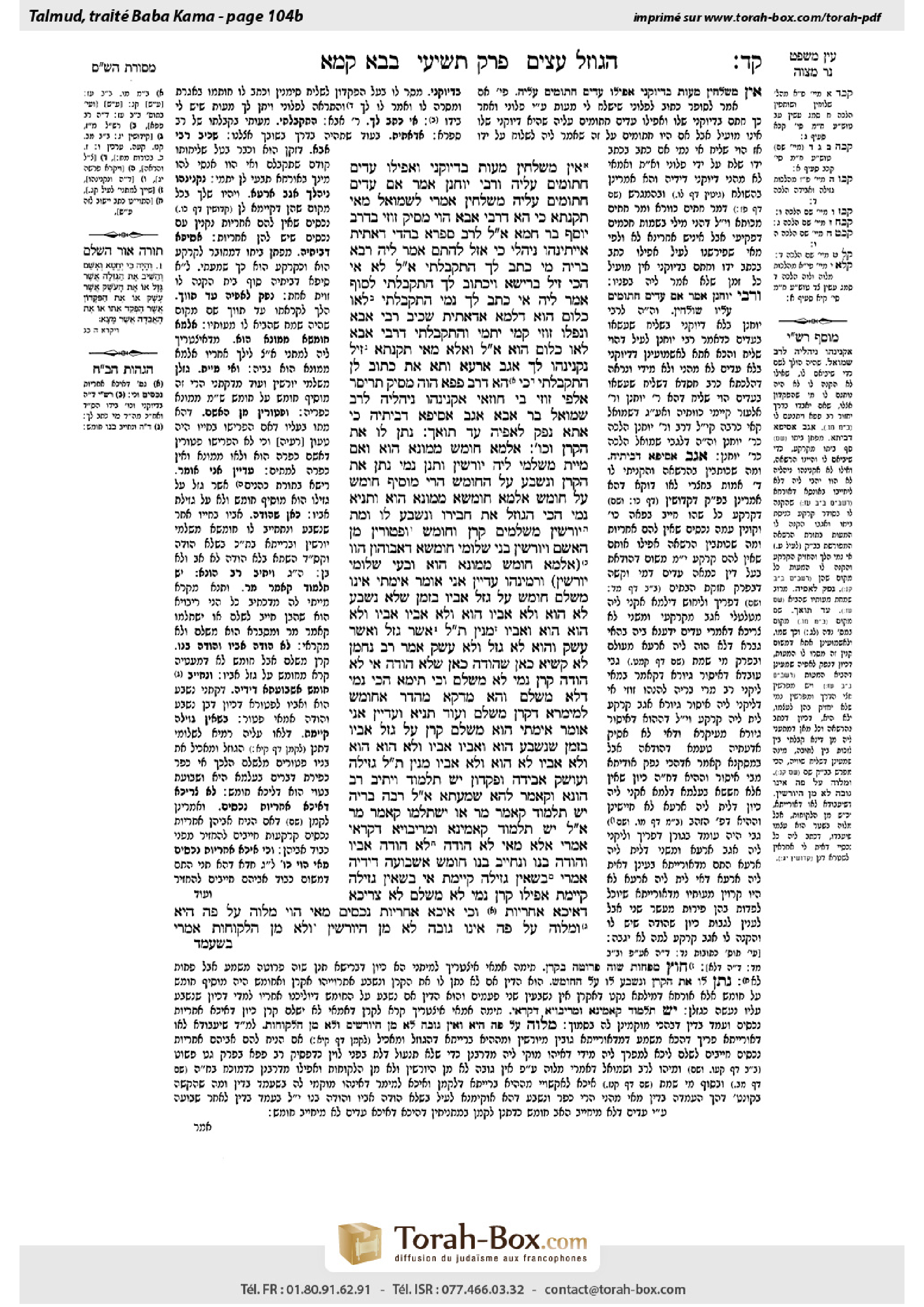
Bava Kamma 104b: Talmud study for Daf Yomi
Study the Talmud for Daf Yomi with scanned pages, Hebrew text, English translations from Sefaria and AI-generated French translations.
Passage selection and English or AI-generated French translation are available where the scan has annotations. Daf Study is independent of Torah-Box and Sefaria.
Browse Bava Kamma · בבא קמא · All tractatesBava Kamma 104b text and translations
This page of Bava Kamma includes the Aramaic text, an English translation and an AI-generated French translation, alongside the scan above.
בבא קמא ק״ד ב · Aramaic and Hebrew text
אֵין מְשַׁלְּחִין מָעוֹת בִּדְיוֹקְנֵי, וַאֲפִילּוּ עֵדִים חֲתוּמִים עָלֶיהָ. וְרַבִּי יוֹחָנָן אָמַר: אִם עֵדִים חֲתוּמִים עָלֶיהָ – מְשַׁלְּחִין.
אָמְרִי: לִשְׁמוּאֵל מַאי תַּקַּנְתָּא? כִּי הָא דְּרַבִּי אַבָּא הָוֵי מַסֵּיק זוּזֵי בִּדְרַב יוֹסֵף בַּר חָמָא, אֲמַר לֵיהּ לְרַב סָפְרָא: בַּהֲדֵי דְּאָתֵית, אַיְיתִינְהוּ נִיהֲלִי. כִּי אֲזַל לְהָתָם, אֲמַר לֵיהּ רָבָא בְּרֵיהּ: מִי כָּתַב לָךְ: ״הִתְקַבַּלְתִּי״? אֲמַר לֵיהּ: לָא. אִי הָכִי, זִיל בְּרֵישָׁא, וְיִכְתּוֹב לָךְ ״הִתְקַבַּלְתִּי״.
לְסוֹף אֲמַר לֵיהּ: אִי כָּתַב לָךְ נָמֵי ״הִתְקַבַּלְתִּי״, לָאו כְּלוּם הוּא; דִּלְמָא אַדְּאָתֵית שָׁכֵיב רַבִּי אַבָּא, וְנָפְלוּ זוּזֵי קַמֵּי יַתְמֵי, וְ״הִתְקַבַּלְתִּי״ דְּרַבִּי אַבָּא לָאו כְּלוּם הוּא. אֲמַר לֵיהּ: וְאֶלָּא מַאי תַּקַּנְתָּא? זִיל נַקְנִינְהוּ לָךְ אַגַּב אַרְעָא, וְתָא אַתְּ כְּתוֹב לַן ״הִתְקַבַּלְתִּי״.
כִּי הָא דְּרַב פָּפָּא הֲוָה מַסֵּיק תְּרֵיסַר אַלְפֵי זוּזֵי בֵּי חוֹזָאֵי, אַקְנִינְהוּ נִיהֲלֵיהּ לְרַב שְׁמוּאֵל בַּר אַבָּא אַגַּב אַסִּיפָּא דְבֵיתֵיהּ. כִּי אֲתָא, נְפַק לְאַפֵּיהּ עַד תְּוָאךְ.
נָתַן לוֹ אֶת הַקֶּרֶן וְכוּ׳. אַלְמָא חוֹמֶשׁ מָמוֹנָא הוּא, וְאִם מָיֵית – מְשַׁלְּמִי לֵיהּ יוֹרְשִׁין.
וּתְנַן נָמֵי: נָתַן אֶת הַקֶּרֶן וְנִשְׁבַּע עַל הַחוֹמֶשׁ – הֲרֵי מוֹסִיף חוֹמֶשׁ עַל חוֹמֶשׁ. אַלְמָא חוּמְשָׁא מָמוֹנָא הוּא.
וְתַנְיָא נָמֵי הָכִי: הַגּוֹזֵל אֶת חֲבֵירוֹ, וְנִשְׁבַּע לוֹ, וָמֵת – יוֹרְשִׁין מְשַׁלְּמִים קֶרֶן וָחוֹמֶשׁ, וּפְטוּרִין מִן הָאָשָׁם.
וְיוֹרְשִׁין בְּנֵי שַׁלּוֹמֵי חוּמְשָׁא דַּאֲבוּהוֹן הָווּ – אַלְמָא חוֹמֶשׁ מָמוֹנָא הוּא, וּבָעֵי שַׁלּוֹמֵי יוֹרְשִׁין. וּרְמִינְהוּ, עֲדַיִין אֲנִי אוֹמֵר: אֵימָתַי אֵינוֹ מְשַׁלֵּם חוֹמֶשׁ עַל גֶּזֶל אָבִיו – בִּזְמַן שֶׁלֹּא נִשְׁבַּע לֹא הוּא וְלֹא אָבִיו;
הוּא וְלֹא אָבִיו, אָבִיו וְלֹא הוּא, הוּא וְאָבִיו – מִנַּיִן? תַּלְמוּד לוֹמַר: ״אֲשֶׁר גָּזָל וַאֲשֶׁר עָשָׁק״ – וְהוּא לֹא גָּזַל וְלֹא עָשַׁק.
אָמַר רַב נַחְמָן: לָא קַשְׁיָא; כָּאן שֶׁהוֹדָה, כָּאן שֶׁלֹּא הוֹדָה.
אִי לֹא הוֹדָה, קֶרֶן נָמֵי לָא מְשַׁלֵּם! וְכִי תֵּימָא: הָכִי נָמֵי דְּלָא מְשַׁלֵּם; וְהָא מִדְּקָא מְהַדַּר אַחוֹמֶשׁ – לְמֵימְרָא דְּקֶרֶן מְשַׁלֵּם!
וְעוֹד תַּנְיָא, וַעֲדַיִין אֲנִי אוֹמֵר: אֵימָתַי הוּא מְשַׁלֵּם קֶרֶן עַל גֶּזֶל אָבִיו – בִּזְמַן שֶׁנִּשְׁבַּע הוּא וְאָבִיו. אָבִיו וְלֹא הוּא, הוּא וְלֹא אָבִיו, לֹא הוּא וְלֹא אָבִיו – מִנַּיִן? תַּלְמוּד לוֹמַר: גְּזֵילָה וָעוֹשֶׁק, אֲבֵידָה וּפִקָּדוֹן – יֵשׁ תַּלְמוּד.
וְיָתֵיב רַב הוּנָא וְקָאָמַר לְהָא שְׁמַעְתָּא. אֲמַר לֵיהּ רַבָּה בְּרֵיהּ: ״יֵשׁ תַּלְמוּד״ קָאָמַר מָר, אוֹ ״יִשְׁתַּלְמוּ״ קָאָמַר מָר? אֲמַר לֵיהּ: ״יֵשׁ תַּלְמוּד״ קָאָמֵינָא, וּמֵרִיבּוּיָא דִּקְרָאֵי אֲמַרִי.
אֶלָּא מַאי ״לֹא הוֹדָה״? לֹא הוֹדָה אָבִיו, וְהוֹדָה בְּנוֹ.
וְנִחַיַּיב בְּנוֹ חוֹמֶשׁ אַשְּׁבוּעָה דִידֵיהּ! אָמְרִי: בְּשֶׁאֵין גְּזֵילָה קַיֶּימֶת. אִי בְּשֶׁאֵין גְּזֵילָה קַיֶּימֶת, אֲפִילּוּ קֶרֶן נָמֵי לָא מְשַׁלֵּם! לָא צְרִיכָא, דְּאִיכָּא אַחְרָיוּת.
וְכִי אִיכָּא אַחְרָיוּת נְכָסִים מַאי הָוֵי? מִלְוָה עַל פֶּה הִיא, וּמִלְוָה עַל פֶּה אֵינוֹ גּוֹבֶה לֹא מִן הַיּוֹרְשִׁין וְלֹא מִן הַלָּקוֹחוֹת!
אָמְרִי:
Bava Kamma 104b · English translation
One who owes a debt may not send money with another to the creditor on the basis of a figure [deyokani] or sign used in place of a signature that is associated with the creditor. The possession of this sign on the part of the other is not sufficient proof that he has been appointed as an agent. And this is the halakha even if witnesses verifying that this is the creditor’s sign are signed on it. And Rabbi Yoḥanan says: If there are witnesses signed on it, one may send the money with the other.
The Sages say: According to Shmuel, what is the rectification, i.e., what recourse is available to one who wishes to collect a debt without traveling to the debtor’s location? The Gemara answers: One may act like that course of action of Rabbi Abba, who was owed money by Rav Yosef bar Ḥama. Rabbi Abba said to Rav Safra: When you come back from Rabbi Yosef bar Ḥama’s locale, bring my money to me. When Rav Safra went there, Rava, Rav Yosef bar Ḥama’s son, said to him: Did Rabbi Abba write you a document stating: I have received payment, so that my father will have proof that he has absolved himself of the debt? Rav Safra said to him: No. Rava responded: If so, first go to him and let him write you a document stating: I have received payment, and then my father will pay you.
Ultimately, Rava said to him: Even if he writes you a document stating: I have received payment, it is nothing, since perhaps by the time you arrive back here, Rabbi Abba will have died and the money will fall before his orphans as an inheritance, and the document stating: I have received payment, that was written by Rabbi Abba, will be nothing, as the debt is no longer owed to him, but rather, to his heirs. Rav Safra said to him: Rather, what is the rectification? Rava replied: Go, and Rabbi Abba will transfer to you the rights to the money owed to him by means of acquisition of land from him, and then you should come and write for us a document stating: I have received payment. Then, we will pay you.
The Gemara notes: And this is like that course of action of Rav Pappa, who was owed twelve thousand dinars by a resident of Bei Ḥozai, and he transferred his claim to the money to Rav Shmuel bar Abba by means of the acquisition of the threshold of his house. When Rav Shmuel bar Abba came from Bei Ḥozai with the money in hand, Rav Pappa went out as far as Tavakh toward him in his excitement to receive the money.
§ The mishna teaches that if the robber gave the robbery victim the principal value of the stolen item, but did not give him the additional one-fifth payment required of a robber, he is not required to pursue the robbery victim in order to return the additional one-fifth payment. The Gemara comments: Apparently, the additional one-fifth payment is considered monetary restitution rather than a fine. And accordingly, if the robber died, the heirs of the robber must pay it to the robbery victim.
And we also learned in the mishna that if the robber gave the robbery victim the principal and takes a false oath to him concerning the additional one-fifth payment, asserting that he had already paid it, the robber adds an additional one-fifth payment apart from the additional one-fifth payment about which he had taken a false oath. Apparently, the additional one-fifth payment is monetary restitution, as one is obligated to pay an additional one-fifth for taking a false oath only with regard to monetary restitution, not with regard to fines.
And this is also taught in a baraita: With regard to one who robs another and takes a false oath to him that he did not rob him, and then dies, his heirs pay the principal and additional one-fifth payments to the robbery victim, but are exempt from the obligation to bring the guilt-offering.
The Gemara asks: But are heirs obligated to pay the additional one-fifth payment of their father, indicating that apparently the additional one-fifth payment is monetary restitution, and therefore the heirs must pay it? But one could raise a contradiction from a baraita. After having stated that one is required to add the additional one-fifth payment only for a robbery he commits himself, and not for a robbery committed by his father, the baraita states: I would still say that when does an heir not pay the additional one-fifth payment for his father’s robbery? It is only when neither he nor his father took a false oath.
But if he took a false oath, but not his father; or if his father took a false oath, but not he; or if he and his father both took false oaths; from where is the heir’s exemption derived? The verse states: “He shall restore the item that he robbed,” and “the item that he has acquired through exploitation” (Leviticus 5:23), and in this case the heir did not rob and did not exploit. Since the verse states the obligation to pay the additional one-fifth payment when discussing one who robbed or exploited another, and the heir has done neither, he is exempt from payment. This baraita states that heirs are not obligated to pay the additional one-fifth payment.
The Gemara answers: Rav Naḥman said that it is not difficult. Here, in the mishna and the first baraita, they discuss a case where the robber admitted his obligation and therefore was required to pay the additional one-fifth payment, and this obligation is transferred to his heir; there, in the latter baraita, it discusses a case where he did not admit his obligation and was never required to pay the additional one-fifth payment.
The Gemara rejects this answer: If the latter baraita discusses a case where he did not admit his obligation, then the halakha would be that the heir would not pay even the principal, as the obligation is not known by anyone. And if you would say that indeed it is so that he does not pay the principal, but isn’t it understood from the fact that the tanna searches for a source to teach the heir’s exemption from only the additional one-fifth payment, that it means to say that he does pay the principal.
The Gemara also proves that the heir must pay the principal from the continuation of the same baraita. And further, it is taught in that baraita: And I would still say: When does the heir pay the principal for his father’s robbery? It is only when he and his father both took false oaths. But if his father took a false oath, and not he; or if he took a false oath, but not his father; or if neither he nor his father took false oaths; from where is the heir’s obligation to pay the principal derived? The verse states the following terms: “Robbery,” and “exploitation,” “lost item,” and “deposit” (Leviticus 5:23); and there is a derivation [yesh talmud] here to derive that the heir is obligated to pay the principal in all of these cases.
The Gemara clarifies: And Rav Huna sat and stated this halakha, and Rabba, his son, said to him: Was the Master saying that there is a derivation [yesh talmud], or was the Master saying that they will be paid [yishtalmu]? Rav Huna said to him: I am saying: There is a derivation, and it is from the additional expressions in the verses that I say it can be derived. It is apparent that an heir is obligated to pay the principal, and this refutes Rav Naḥman’s attempted resolution.
Rather, what did Rav Naḥman mean when he suggested that the second baraita is referring to a case where he did not admit his obligation and exempts his heir from paying the additional one-fifth but obligates him to pay the principal? The baraita is referring to a case where the father did not admit, but his son did admit, and therefore he is obligated to pay the principal.
The Gemara asks: And let his son be liable to pay the additional one-fifth payment for his own false oath. The Sages say: In the case of the baraita, it is where the stolen item is no longer extant. Although the false oath was taken, it is not the type of obligation for which one must pay an additional one-fifth payment. The Gemara asks: If in the case of the baraita it is where the stolen item is no longer extant, the halakha should be that the heir does not pay even the principal, as the halakha is that while heirs must return an item stolen by their father, they are not obligated to compensate the owner if the item is no longer extant. The Gemara answers: No, the ruling is necessary in a case where there is guaranteed property, i.e., land, which the heirs inherited from the robber. Heirs are obligated to compensate the owner of a stolen item with inherited land, even if the stolen item itself is no longer extant.
The Gemara asks: And even when there is guaranteed property, i.e., land, what of it? After all, such a debt is legally considered a loan by oral agreement, and the creditor of a loan by oral agreement cannot collect from the heirs of the debtor, nor can he collect from those who purchased land from the debtor.
The Sages say in response:
Bava Kamma 104b · Traduction française (IA)
Celui qui doit une dette ne peut pas envoyer de l'argent avec un autre vers le créancier sur la base d'un signe [deyokani] ou d'une signature utilisée à la place d'une signature associée au créancier. La possession de ce signe par l'autre n'est pas suffisante pour prouver qu'il a été désigné comme agent. Et c'est la halakha même si des témoins certifiant que c'est le signe du créancier sont signés dessus. Et Rabbi Yoḥanan dit : Si des témoins sont signés dessus, on peut envoyer l'argent avec l'autre.
Les Sages disent : Selon Shmuel, quelle est la solution, c'est-à-dire quel recours est disponible pour celui qui veut récupérer une dette sans se déplacer jusqu'au lieu du débiteur ? La Guemara répond : On peut agir comme la démarche de Rabbi Abba, qui était dû une somme par Rav Yosef bar Ḥama. Rabbi Abba dit à Rav Safra : Quand tu reviens de la région de Rabbi Yosef bar Ḥama, apporte-moi mon argent. Quand Rav Safra alla là-bas, Rava, le fils de Rav Yosef bar Ḥama, dit à lui : Rabbi Abba a-t-il écrit un document te disant : J'ai reçu le paiement, afin que mon père ait la preuve qu'il a exempté lui-même de la dette ? Rav Safra dit à lui : Non. Rava répondit : Si c'est le cas, vas-y d'abord lui demander d'écrire un document disant : J'ai reçu le paiement, et alors mon père te paiera.
Finalement, Rava dit à lui : Même s'il vous écrit un document disant : J'ai reçu le paiement, cela ne vaut rien, car peut-être que lorsqu'il reviendra ici, Rabbi Abba sera mort et l'argent tombera entre ses orphelins comme héritage, et le document disant : J'ai reçu le paiement, écrit par Rabbi Abba, sera sans valeur, car la dette ne sera plus due à lui, mais à ses héritiers. Rav Safra dit à lui : Plutôt, quelle est la solution ? Rava répondit : Va, et Rabbi Abba transférera à toi les droits sur l'argent dû à lui par l'acquisition de terre de lui, et ensuite tu devrais venir et écrire pour nous un document disant : J'ai reçu le paiement. Ensuite, nous paierons toi.
La Guemara note : Et cela est comme la démarche de Rav Pappa, qui était dû douze mille dinars par un résident de Bei Ḥozai, et il transféra son droit sur l'argent à Rav Shmuel bar Abba par l'acquisition du seuil de sa maison. Quand Rav Shmuel bar Abba vint de Bei Ḥozai avec l'argent en main, Rav Pappa sortit jusqu'à Tavakh pour aller vers lui dans son excitation de recevoir l'argent.
§ La mishna enseigne que si le voleur donne à la victime la valeur principale de l'objet volé, mais ne lui donne pas le paiement supplémentaire d'un cinquième requis d'un voleur, il n'est pas tenu de poursuivre la victime pour lui rendre le paiement supplémentaire d'un cinquième. La Guemara commente : Apparemment, le paiement supplémentaire d'un cinquième est considéré comme une restitution monétaire plutôt qu'une amende. Et ainsi, si le voleur meurt, ses héritiers doivent le payer à la victime.
Et nous avons également appris dans la mishna que si le voleur remet à la victime la valeur principale et prétend à tort à la victime concernant le paiement supplémentaire d'un cinquième, affirmant qu'il l'avait déjà payé, le voleur ajoute un autre paiement supplémentaire d'un cinquième en plus du paiement supplémentaire d'un cinquième concernant lequel il a prétendu à tort. Apparemment, le paiement supplémentaire d'un cinquième est une restitution monétaire, car on est tenu de payer un autre cinquième pour prétendre à tort uniquement concernant la restitution monétaire, et non concernant les amendes.
Et cela est également enseigné dans une baraïta : Concernant celui qui vole un autre et prétend à tort à lui qu'il ne l'a pas volé, et meurt ensuite, ses héritiers paient le principal et le paiement supplémentaire d'un cinquième à la victime, mais sont exemptés de l'obligation de présenter le sacrifice de culpabilité.
La Guemara pose la question : Mais les héritiers sont-ils tenus de payer le paiement supplémentaire d'un cinquième de leur père, indiquant que, apparemment, le paiement supplémentaire d'un cinquième est une restitution monétaire, et donc les héritiers doivent le payer ? Mais on pourrait élever une contradiction à partir d'une baraïta. Après avoir dit que l'on est tenu d'ajouter le paiement supplémentaire d'un cinquième uniquement pour un vol qu'il a commis lui-même, et pas pour un vol commis par son père, la baraïta dit : Je dirais encore que quand un héritier ne paie pas le paiement supplémentaire d'un cinquième pour le vol de son père ? C'est seulement quand ni lui ni son père n'ont prétendu à tort.
Mais s'il a prêté serment à tort, mais pas son père ; ou si son père a prêté serment à tort, mais pas lui ; ou s'ils ont tous deux prêté serment à tort ; d'où tire-t-on l'exemption de l'héritier ? La Parashah dit : « Il devra rendre l'objet qu'il a volé », et « l'objet qu'il a acquis par exploitation » (Lévitique 5:23), et dans ce cas l'héritier n'a pas volé et n'a pas exploité. Puisque la Parashah parle de l'obligation de payer le paiement supplémentaire d'un cinquième lorsqu'on parle d'un voleur ou d'un exploiteur, et l'héritier n'a pas fait cela, il est exempt de paiement. Cette baraïta affirme que les héritiers ne sont pas tenus de payer le paiement supplémentaire d'un cinquième.
La Guemara répond : Rav Naḥman dit que cela n'est pas difficile. Ici, dans la Michna et la première baraïta, ils parlent d'un cas où le voleur a admis son obligation et donc était tenu de payer le paiement supplémentaire d'un cinquième, et cette obligation est transférée à son héritier ; là, dans la dernière baraïta, il parle d'un cas où il n'a pas admis son obligation et n'était jamais tenu de payer le paiement supplémentaire d'un cinquième.
La Guemara rejette cette réponse : Si la dernière baraïta parle d'un cas où il n'a pas admis son obligation, alors la halakha serait que l'héritier ne paie même pas le principal, car l'obligation n'est connue par personne. Et si tu dis que c'est ainsi que l'on ne paie pas le principal, n'est-ce pas compris du fait que le tanna cherche une source pour enseigner l'exemption de l'héritier uniquement concernant le paiement supplémentaire d'un cinquième, que cela signifie qu'il paie le principal.
La Guemara démontre également que l'héritier doit payer le principal à partir de la continuation du même baraïta. Et de plus, il est enseigné dans ce baraïta : Et je dirais encore : Quand l'héritier paie le principal pour le vol de son père ? C'est seulement quand lui et son père ont tous deux prêché des serments faux. Mais si son père a prêché un serment faux, et pas lui ; ou si lui a prêché un serment faux, mais pas son père ; ou si ni lui ni son père n'ont prêché de serments faux ; d'où vient l'obligation de l'héritier de payer le principal ? La Parashah dit les termes suivants : « Vol », et « exploitation », « objet perdu », et « dépôt » (Lévitique 5:23) ; et il y a une dérivation [yesh talmud] ici pour déduire que l'héritier est tenu de payer le principal dans tous ces cas.
La Guemara clarifie : Et Rav Huna s'est assis et a dit cette halakha, et Rabba, son fils, lui a dit : Le Maître disait-il qu'il y a une dérivation [yesh talmud], ou le Maître disait-il qu'ils seront payés [yishtalmu] ? Rav Huna lui a répondu : Je dis : Il y a une dérivation, et elle vient des expressions supplémentaires dans les versets que je dis qu'on peut en déduire. Il est évident que l'héritier est tenu de payer le principal, et cela réfute la tentative de résolution de Rav Naḥman.
Au contraire, que voulait dire Rav Naḥman lorsqu'il suggérait que le second baraïta fait référence à un cas où il n'a pas admis son obligation et exemptait son héritier de payer l'additionnel un cinquième mais l'obligeait à payer le principal ? Le baraïta fait référence à un cas où le père n'a pas admis, mais son fils a admis, et donc il est tenu de payer le principal.
La Guemara demande : Et que l'héritier soit tenu de payer l'additionnel un cinquième pour son propre serment faux. Les Sages disent : Dans le cas du baraïta, il s'agit d'une situation où l'objet volé n'existe plus. Bien que le serment faux ait été prononcé, ce n'est pas le type d'obligation pour laquelle on doit payer un additionnel un cinquième. La Guemara demande : Si dans le cas du baraïta, il s'agit d'une situation où l'objet volé n'existe plus, la halakha devrait être que l'héritier ne paie même pas le principal, car la halakha est que les héritiers doivent rendre un objet volé par leur père, mais ils ne sont pas tenus de compenser l'propriétaire si l'objet n'existe plus. La Guemara répond : Non, la décision est nécessaire dans un cas où il y a une propriété assurée, c'est-à-dire une terre, que les héritiers ont héritée du voleur. Les héritiers sont tenus de compenser l'propriétaire d'un objet volé avec la terre héritée, même si l'objet volé lui-même n'existe plus.
La Guemara demande : Et même quand il y a une propriété assurée, c'est-à-dire une terre, que faire ? Après tout, une telle dette est juridiquement considérée comme un prêt par accord oral, et le créancier d'un prêt par accord oral ne peut pas récupérer auprès des héritiers du débiteur, ni auprès de ceux qui ont acheté la terre du débiteur.
Les Sages répondent en disant :
Traduction française générée par IA à partir de l’édition anglaise de Sefaria. Vérifie toujours un passage avec le texte source.
Text from Sefaria: William Davidson Edition - Vocalized Aramaic (CC BY NC); William Davidson Edition - English (CC BY NC).