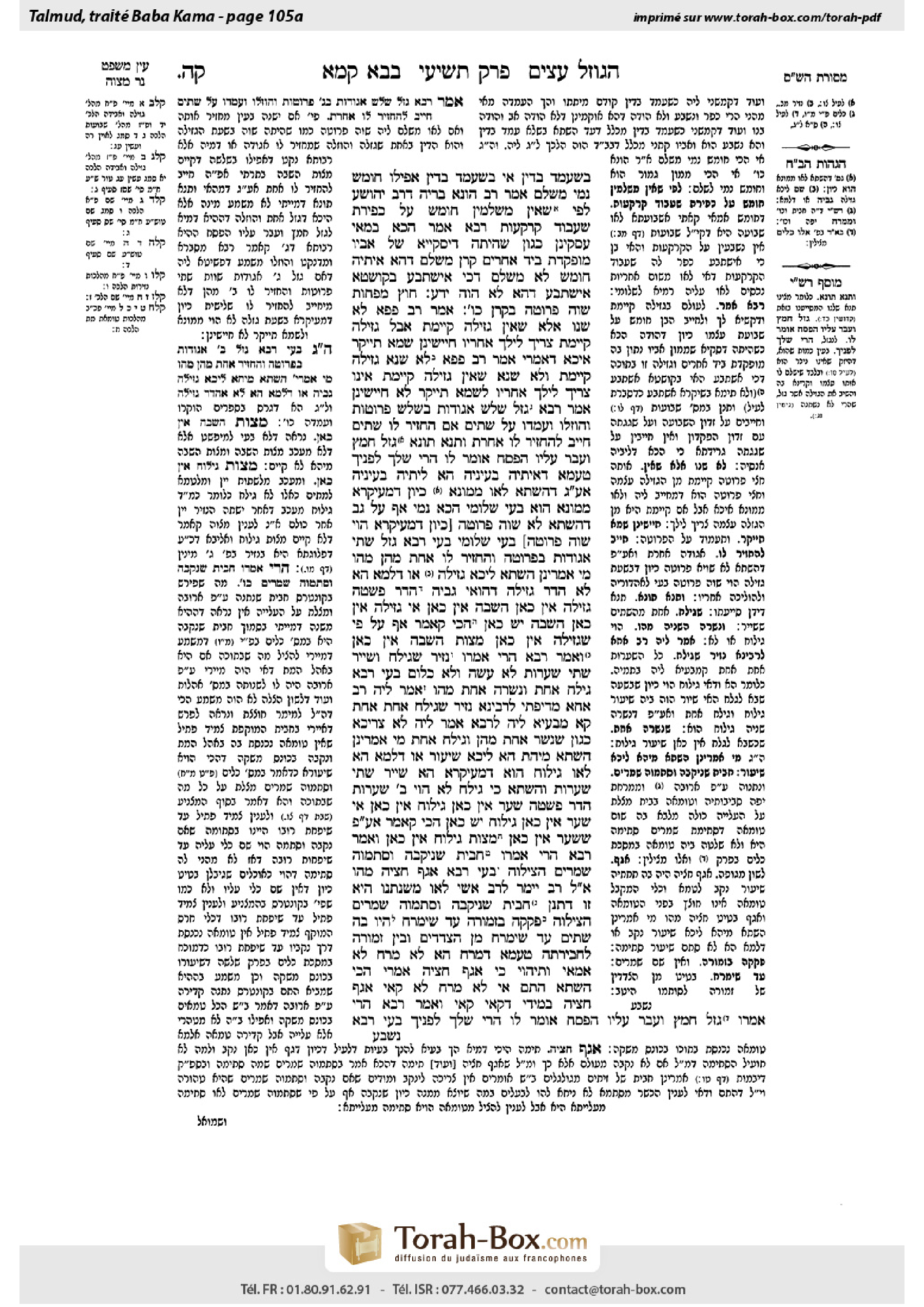
Bava Kamma 105a: Talmud study for Daf Yomi
Study the Talmud for Daf Yomi with scanned pages, Hebrew text, English translations from Sefaria and AI-generated French translations.
Passage selection and English or AI-generated French translation are available where the scan has annotations. Daf Study is independent of Torah-Box and Sefaria.
Browse Bava Kamma · בבא קמא · All tractatesBava Kamma 105a text and translations
This page of Bava Kamma includes the Aramaic text, an English translation and an AI-generated French translation, alongside the scan above.
בבא קמא ק״ה א · Aramaic and Hebrew text
בְּשֶׁעָמַד בַּדִּין. אִי בְּשֶׁעָמַד בַּדִּין, אֲפִילּוּ חוֹמֶשׁ נָמֵי מְשַׁלֵּם! אָמַר רַב הוּנָא בְּרֵיהּ דְּרַב יְהוֹשֻׁעַ: לְפִי שֶׁאֵין מְשַׁלְּמִין חוֹמֶשׁ עַל כְּפִירַת שִׁעְבּוּד קַרְקָעוֹת.
רָבָא אָמַר: הָכָא בְּמַאי עָסְקִינַן – כְּגוֹן שֶׁהָיְתָה דִּיסַקַּיָּיא שֶׁל אָבִיו מוּפְקֶדֶת בְּיַד אֲחֵרִים; קֶרֶן מְשַׁלֵּם – דְּהָא אִיתֵיהּ, חוֹמֶשׁ לָא מְשַׁלֵּם – דְּכִי אִישְׁתְּבַע בְּקוּשְׁטָא אִישְׁתְּבַע, דְּהָא לָא הֲוָה יָדַע.
חוּץ מִפָּחוֹת שָׁוֶה פְּרוּטָה בַּקֶּרֶן כּוּ׳. אָמַר רַב פָּפָּא: לֹא שָׁנוּ אֶלָּא שֶׁאֵין גְּזֵילָה קַיֶּימֶת, אֲבָל גְּזֵילָה קַיֶּימֶת – צָרִיךְ לֵילֵךְ אַחֲרָיו; חָיְישִׁינַן שֶׁמָּא תִּיַּיקֵּר.
אִיכָּא דְּאָמְרִי, אָמַר רַב פָּפָּא: לָא שְׁנָא גְּזֵילָה קַיֶּימֶת וְלָא שְׁנָא שֶׁאֵין גְּזֵילָה קַיֶּימֶת – אֵינוֹ צָרִיךְ לֵילֵךְ אַחֲרָיו; לְשֶׁמָּא תִּיַּיקֵּר לָא חָיְישִׁינַן.
אָמַר רָבָא: גָּזַל שָׁלֹשׁ אֲגוּדּוֹת בְּשָׁלֹשׁ פְּרוּטוֹת, וְהוּזְלוּ וְעָמְדוּ עַל שְׁתַּיִם; אִם הֶחְזִיר לוֹ שְׁתַּיִם – חַיָּיב לְהַחֲזִיר לוֹ אַחֶרֶת. וְתַנָּא תּוּנָא: גָּזַל חָמֵץ וְעָבַר עָלָיו הַפֶּסַח – אוֹמֵר לוֹ: ״הֲרֵי שֶׁלְּךָ לְפָנֶיךָ״.
טַעְמָא דְּאִיתֵיהּ בְּעֵינֵיהּ; הָא לֵיתֵיהּ בְּעֵינֵיהּ, אַף עַל גַּב דְּהַשְׁתָּא לָאו מָמוֹנָא, כֵּיוָן דְּמֵעִיקָּרָא מָמוֹנָא הוּא – בָּעֵי שַׁלּוֹמֵי; הָכָא נָמֵי, אַף עַל גַּב דְּהַשְׁתָּא לֹא שָׁוֶה פְּרוּטָה [כֵּיוָן דְּמֵעִיקָּרָא הָוֵי שָׁוֶה פְּרוּטָה] – בָּעֵי שַׁלּוֹמֵי.
בָּעֵי רָבָא: גָּזַל שְׁתֵּי אֲגוּדּוֹת, בִּפְרוּטָה וְהֶחְזִיר לוֹ אַחַת מֵהֶן – מַהוּ? מִי אָמְרִינַן: הַשְׁתָּא לֵיכָּא גְּזֵילָה; אוֹ דִלְמָא, הָא לָא [אַ]הְדַּר גְּזֵילָה דַּהֲוַאי גַּבֵּיהּ?
הֲדַר פַּשְׁטַהּ: גְּזֵילָה אֵין כָּאן, הֲשָׁבָה אֵין כָּאן. אִי גְּזֵילָה אֵין כָּאן – הֲשָׁבָה יֵשׁ כָּאן! הָכִי קָאָמַר: אַף עַל פִּי שֶׁגְּזֵילָה אֵין כָּאן, מִצְוַת הֲשָׁבָה אֵין כָּאן.
וְאָמַר רָבָא, הֲרֵי אָמְרוּ: נָזִיר שֶׁגִּילַּח וְשִׁיֵּיר שְׁתֵּי שְׂעָרוֹת – לֹא עָשָׂה וְלֹא כְלוּם; בָּעֵי רָבָא: גִּילַּח אַחַת וְנָשְׁרָה אַחַת, מַהוּ? אֲמַר לֵיהּ רַב אַחָא מִדִּיפְתִּי לְרָבִינָא: נָזִיר שֶׁגִּילַּח אַחַת אַחַת קָא מִבַּעְיָא לֵיהּ לְרָבָא?!
אֲמַר לֵיהּ: לָא צְרִיכָא, כְּגוֹן שֶׁנָּשְׁרָ[ה] אַחַת מֵהֶן, וְגִילַּח אַחַת; מִי אָמְרִינַן: הַשְׁתָּא מִיהַת הָא לֵיכָּא שִׁיעוּר; אוֹ דִלְמָא, הָא לָאו גִּילּוּחַ הוּא – דְּמֵעִיקָּרָא הָא שַׁיַּיר שְׁתֵּי שְׂעָרוֹת, וְהַשְׁתָּא כִּי גִּילַּח לָא הָוֵי שְׁתֵּי שְׂעָרוֹת?
הֲדַר פַּשְׁטַהּ: שֵׂעָר אֵין כָּאן, גִּילּוּחַ אֵין כָּאן. אִי שֵׂעָר אֵין כָּאן – גִּילּוּחַ יֵשׁ כָּאן! הָכִי קָאָמַר: אַף עַל פִּי שֶׁשֵּׂעָר אֵין כָּאן, מִצְוַת גִּילּוּחַ אֵין כָּאן.
וְאָמַר רָבָא, הֲרֵי אָמְרוּ: חָבִית שֶׁנִּיקְּבָה, וּסְתָמוּהָ שְׁמָרִים – הִצִּילוּהָ. בָּעֵי רָבָא: אָגַף חֶצְיָהּ, מַהוּ?
אֲמַר לֵיהּ רַב יֵימַר לְרַב אָשֵׁי: לָאו מִשְׁנָתֵנוּ הִיא זוֹ? דִּתְנַן: חָבִית שֶׁנִּיקְּבָה וּסְתָמוּהָ שְׁמָרִים – הִצִּילוּהָ. פְּקָקָהּ בִּזְמוֹרָה – עַד שֶׁיְּמָרַח. הָיוּ בָּהּ שְׁתַּיִם – עַד שֶׁיְּמָרַח מִן הַצְּדָדִים, וּבֵין זְמוֹרָה לַחֲבֶירְתָּהּ.
טַעְמָא דְּמָרַח, הָא לָא מָרַח – לָא; אַמַּאי? וְתִיהְוֵי כִּי אָגַף חֶצְיָהּ!
אָמְרִי: הָכִי הַשְׁתָּא?! הָתָם – אִי לָא מָרַח לָא קָאֵי, אָגַף חֶצְיָהּ – בְּמִידֵּי דְּקָאֵי קָאֵי.
וְאָמַר רָבָא, הֲרֵי אָמְרוּ: גָּזַל חָמֵץ וְעָבַר עָלָיו הַפֶּסַח – אוֹמֵר לוֹ: ״הֲרֵי שֶׁלְּךָ לְפָנֶיךָ״. בָּעֵי רָבָא:
Bava Kamma 105a · English translation
The reference here is to a case in which the father had already stood trial and was obligated to pay. In such a case, the debt is considered like a loan with a promissory note, which a creditor may collect from the debtor’s heirs. The Gemara rejects this: If it is a case in which the father had already stood trial and was obligated to pay, then the heir, who took a false oath and later confessed, would have to pay even the additional one-fifth payment as well, as this would be akin to any monetary obligation; but the baraita rules that he is obligated to pay only the principal. Rav Huna, son of Rav Yehoshua, said: The heir is exempt because one does not pay the additional one-fifth payment for the denial of a debt that is secured by a lien on land.
Rava said a different explanation: With what are we dealing here? We are dealing with a case where the stolen item is still extant, yet the heir is exempt because his father’s sack [disakaya] containing the stolen item was deposited in the possession of others. Accordingly, the heir pays the principal, since the stolen item is extant, but he does not pay the additional one-fifth payment because when he took an oath that it was not in his possession, he took an oath truthfully, as he did not know that his father had stolen the item.
§ The mishna teaches that if the robbery victim forgave the robber concerning both payments, excepting less than the value of one peruta of the principal, he need not pursue him in order to return the remaining debt. Rav Pappa says: They taught that the robber is not obligated to pursue the robbery victim only when the stolen item is not extant, but if the stolen item is still extant, he must pursue him to return it, as we are concerned that perhaps the stolen item will appreciate in value, and the debt he owes will exceed the value of one peruta.
There are those who say that Rav Pappa said: The halakha is not different when the stolen item is extant, and it is not different when the stolen item is not extant. In either case he does not need to pursue him because we are not concerned that perhaps it will appreciate in value.
The Gemara cites another ruling with regard to a stolen item worth less than one peruta. Rava says: If one robbed another of three bundles of goods that were worth three perutot in total, and they depreciated in value and their value stood at two perutot, even if he returned two bundles to the robbery victim he is obligated to return the other bundle. And the tanna of the mishna also taught (96b): If one robbed another of leavened bread, and Passover elapsed over it, and it is therefore prohibited to derive benefit from it, the robber says to the victim: That which is yours is before you, and he is not required to pay compensation, despite the fact that the robbery victim has suffered a monetary loss.
The Gemara explains the proof from the mishna: It may be inferred that the reason that he is not required to pay compensation is that the bread is still there in its unadulterated form; but if it is not there in its unadulterated form, even though now it is not worth money, since it was worth money initially, at the time of the robbery, he is required to pay. Here too, even though the third bundle is not worth one peruta now, since initially it was worth one peruta, he is required to pay.
Rava raises a dilemma: If one robbed another of two bundles of goods that were worth one peruta in total, and he returned one of them to the robbery victim, what is the halakha? Do we say that now there is no longer a stolen item in the possession of the robber, as the remaining bundle is worth less than one peruta, and he has therefore fulfilled his obligation to return the stolen item; or perhaps we say that since the robber did not return the stolen item that was in his possession in its entirety, he is obligated to return the second bundle?
Rava himself then resolves the dilemma: There is no stolen item here, as the remaining bundle is worth less than one peruta; there is no returning of a stolen item here. The Gemara expresses surprise at this expression: If there is no stolen item here, as what remains is insignificant, it follows that there is fulfillment of the mitzva of returning the stolen item here, and the robber ought to be exempt, as he is no longer considered to be in possession of a stolen item. The Gemara explains that this is what Rava is saying: Even though the robber is exempt from returning the second bundle, as there is no stolen item here, there is nevertheless no fulfillment of the mitzva of returning a stolen item here, since the returned bundle was worth less than one peruta as well.
§ Following Rava’s previous dilemma, the Gemara cites a similar dilemma raised by Rava. And Rava says: The Sages said that a nazirite who shaved his head as required but left two hairs uncut has done nothing, and his obligation to shave his head has not been fulfilled. Rava raises a dilemma: If a nazirite shaved and left two hairs, and afterward he shaved one of them, and the other one fell out of its own accord, what is the halakha? Is this considered shaving one’s entire head or not? Rav Aḥa of Difti said to Ravina: Is Rava raising a dilemma as to whether one can shave his head one hair by one hair? How does this case differ from that of one who shaves his entire head one hair at a time, which is a fulfillment of his obligation?
Ravina said to him: No, a resolution to Rava’s dilemma is necessary in a case where one of the hairs fell out first, and then he shaved the other one. Do we say that now, in any event, there is no measure of hair left on his head that requires shaving, as one remaining hair is not significant, and he has therefore fulfilled his obligation; or perhaps we say that this is not considered shaving, as initially he left the significant amount of two hairs uncut, and now when he shaves a second time, there are not two hairs left for him to shave, and this does not qualify as shaving?
Rava himself then resolves the dilemma: There is no hair here; there is no shaving here. The Gemara expresses surprise at this expression: If there is no hair here, then there is shaving here, as no hair remains. The Gemara explains that this is what Rava is saying: Even though there is no hair here, as only one hair remains, nevertheless there is no mitzva of shaving here, as he failed to shave it all on the first attempt, and the second time he shaved less than the required amount.
§ The Gemara cites another dilemma raised by Rava. And Rava says: The Sages said (Kelim 10:6) that with regard to a sealed earthenware barrel that was punctured and was then sealed by sediments from its contents, the sediments have effectively saved the contents of the barrel from contracting ritual impurity if the barrel were to come into contact with an impure item, as it is once again considered a sealed barrel. Rava raises a dilemma: If one sealed half of the hole, what is the halakha? Do we say that since the hole is not currently large enough to allow ritual impurity to penetrate, the barrel is considered sealed; or perhaps we say that since the hole was initially large enough to allow impurity to penetrate, and it has not yet been sealed completely, the barrel retains its status and is not considered sealed?
The Gemara notes that Rav Yeimar said to Rav Ashi: Isn’t this halakha stated explicitly in our mishna, quoted by Rava above? As we learned in the continuation of that mishna: With regard to an earthenware barrel that was punctured and was then sealed by sediments, the sediments have effectively saved the contents of the barrel from contracting ritual impurity. If it was not sealed by sediments and instead one plugged the hole with a vine, its contents remain susceptible to contracting ritual impurity until he smears clay around the uncovered parts of the hole. If there were two vines placed in the hole in order to plug it, its contents remain susceptible to contracting ritual impurity until he smears clay from the sides of the hole inward, and between one vine and the other.
Rav Yeimar explains: The reason its contents become impervious to contracting ritual impurity is that he smeared clay over the uncovered sections of the hole, but if he did not smear clay over the uncovered sections, the contents would not be impervious to contracting ritual impurity. Why should this not be like the case in Rava’s dilemma? But let it be considered, when one plugs the hole with the vine, as though one had sealed half of the hole, since there is no apparent difference between a hole that is half-sealed and a hole that is partially plugged with a vine. Accordingly, Rava should not have stated his dilemma, as it is clear from the mishna that if the hole is only partially covered, the contents of the barrel are susceptible to contracting ritual impurity.
The Sages say in response: How can these cases be compared? There, if he does not smear clay around the vines, the vine will not remain in place. By contrast, in a case where he sealed half of it with a substance that remains in place, as in Rava’s dilemma, the seal remains in place and could be considered a seal. Rava’s dilemma remains unresolved.
§ The Gemara cites another dilemma raised by Rava. And Rava says: The Sages said that if one robbed another of leavened bread, and Passover elapsed over it, and it is therefore prohibited to derive benefit from it, the robber may say to the victim: That which is yours is before you. Rava raises a dilemma:
Bava Kamma 105a · Traduction française (IA)
La référence ici est à un cas où le père avait déjà été jugé et était tenu de payer. Dans ce cas, la dette est considérée comme un prêt avec un billet de change, que le créancier peut récupérer auprès des héritiers du débiteur. La Guemara rejette cette interprétation : si c'est un cas où le père avait déjà été jugé et était tenu de payer, alors l'héritier, qui avait pris un faux serment et a ensuite avoué, devrait payer même la somme supplémentaire d'un cinquième, car cela ressemblerait à toute obligation monétaire ; mais la baraïta stipule qu'il est tenu de payer uniquement le principal. Rav Huna, fils de Rav Yéhoshua, a dit : l'héritier est exempt, car on ne paie pas le supplément d'un cinquième pour le déni d'une dette garantie par un droit de préemption sur la terre.
Rava a dit une autre explication : De quoi sommes-nous en train de parler ici ? Nous parlons d'un cas où l'objet volé est encore en existence, mais l'héritier est exempt car le sac [disakaya] de son père contenant l'objet volé avait été déposé chez d'autres. Ainsi, l'héritier paie le principal, puisque l'objet volé est encore en existence, mais il ne paie pas le supplément d'un cinquième, car lorsqu'il a pris serment qu'il ne le possédait pas, il a pris serment de bonne foi, car il ne savait pas que son père avait volé l'objet.
§ La mitsna enseigne que si la victime du vol a pardonné au voleur concernant les deux paiements, à l'exception de moins que la valeur d'une peruta du principal, il n'a pas besoin de le poursuivre pour récupérer la dette restante. Rav Pappa dit : Ils ont enseigné que le voleur n'est tenu de poursuivre la victime du vol que lorsque l'objet volé n'est plus en existence, mais si l'objet volé est encore en existence, il doit le poursuivre pour le récupérer, car nous craignons que l'objet volé puisse augmenter en valeur et que la dette qu'il doit dépasse la valeur d'une peruta.
Certains disent que Rav Pappa a dit : La halakha ne diffère pas lorsque l'objet volé est présent, et elle ne diffère pas lorsque l'objet volé n'est plus présent. Dans les deux cas, il n'a pas besoin de le poursuivre, car nous ne craignons pas que l'objet volé puisse augmenter en valeur.
La Guemara cite une autre décision concernant un objet volé dont la valeur est inférieure à une peruta. Rava dit : Si l'on a volé à un autre trois ballots de marchandises dont la valeur totale était de trois perutot, et qu'ils ont perdu de leur valeur pour ne valoir que deux perutot, même s'il rend deux ballots à la victime du vol, il est tenu de rendre le troisième ballot. Et le tanna de la mitsna a également enseigné (96b) : Si l'on a volé du pain levé, et que le Pessah est passé sur lui, et qu'il est donc interdit de tirer profit de lui, le voleur dit à la victime : Ce qui est à toi est devant toi, et il n'est pas tenu de payer une compensation, malgré le fait que la victime a subi une perte monétaire.
La Guemara explique la preuve tirée de la mitsna : On peut en déduire que la raison pour laquelle il n'est pas tenu de payer une compensation est que le pain est encore là dans son état pur ; mais si ce n'est pas là dans son état pur, même s'il n'a plus de valeur, puisqu'il avait une valeur à l'époque du vol, il est tenu de payer. Ici aussi, même si le troisième ballot n'a plus une valeur d'une peruta, puisqu'il avait une valeur d'une peruta à l'époque du vol, il est tenu de payer.
Rava soulève un dilemme : Si l'on a volé à un autre deux ballots de marchandises dont la valeur totale était d'une peruta, et qu'on a rendu l'un d'eux à la victime du vol, quelle est la halakha ? Disons-nous que désormais il n'y a plus d'objet volé en possession du voleur, car le ballot restant vaut moins d'une peruta, et qu'il a donc accompli son obligation de rendre l'objet volé ; ou disons-nous que peut-être nous disons qu'étant donné que le voleur n'a pas rendu l'objet volé qui était en son possession en entier, il est tenu de rendre le deuxième ballot ?
Rava lui-même résout ce dilemme : Il n'y a pas d'objet volé ici, car le ballot restant vaut moins d'une peruta ; il n'y a pas de restitution d'objet volé ici. La Guemara exprime une surprise à l'égard de cette expression : Si il n'y a pas d'objet volé ici, car ce qui reste est insignifiant, il en découle que la performance de la mitsva de restitution d'objet volé est accomplie ici, et le voleur devrait être exempt, car il n'est plus considéré comme possédant un objet volé. La Guemara explique que c'est ce que Rava dit : Même si le voleur est exempt de rendre le deuxième ballot, car il n'y a pas d'objet volé ici, il n'y a pas de performance de la mitsva de restitution d'objet volé ici, car le ballot rendu valait moins d'une peruta.
§ Après le dilemme précédent de Rava, la Guemara cite un dilemme similaire soulevé par Rava. Et Rava dit : Les Sages ont dit qu'un nazirite qui a rasé sa tête comme requis mais qui a laissé deux cheveux intacts a fait rien, et son obligation de raser sa tête n'a pas été accomplie. Rava soulève un dilemme : Si un nazirite a rasé sa tête et a laissé deux cheveux, et ensuite il a rasé l'un d'eux, et l'autre est tombé d'eux-mêmes, quelle est la halakha ? Est-ce considéré comme avoir rasé sa tête entière ou non ? Rav Acha de Difti a dit à Ravina : Rava soulève-t-il un dilemme sur la possibilité de raser sa tête un cheveu à la fois ? Comment ce cas diffère-t-il de celui d'une personne qui rase sa tête entière un cheveu à la fois, ce qui constitue l'accomplissement de son obligation ?
Ravina a dit à lui : Non, une résolution du dilemme de Rava est nécessaire dans un cas où l'un des cheveux est tombé d'abord, puis il a rasé l'autre. Disons-nous que désormais, en tout cas, il n'y a plus de mesure de cheveux sur sa tête qui exige d'être rasé, car un seul cheveu est insignifiant, et il a donc accompli son obligation ; ou disons-nous que cela ne constitue pas un rasage, car initialement il a laissé une quantité significative de deux cheveux intacts, et maintenant, lorsqu'il rase une deuxième fois, il n'y a plus deux cheveux à raser, et cela ne constitue pas un rasage ?
Rava lui-même résout alors ce dilemme : Il n'y a pas de cheveux ici ; il n'y a pas de rasage ici. La Guemara exprime une surprise face à cette expression : Si there is no hair here, alors il y a un rasage ici, car aucun cheveu ne reste. La Guemara explique que c'est ce que Rava dit : Même s'il n'y a pas de cheveux ici, car seul un cheveu reste, néanmoins il n'y a pas de mitsva de rasage ici, car il n'a pas réussi à raser tout sur la première tentative, et la deuxième fois il a raser moins que la quantité requise.
§ La Guemara cite un autre dilemme soulevé par Rava. Et Rava dit : Les Sages ont dit (Kelim 10:6) que concernant un tonneau en terre scellé qui a été percé et scellé ensuite par les dépôts provenant de son contenu, les dépôts ont efficacement préservé le contenu du tonneau de la contraction de l'impureté rituelle en cas de contact avec un objet impur, car il est à nouveau considéré comme un tonneau scellé. Rava soulève un dilemme : Si l'on a scellé la moitié du trou, quelle est la halakha ? Disons-nous que puisque le trou n'est pas actuellement assez grand pour permettre à l'impureté rituelle de pénétrer, le tonneau est considéré comme scellé ; ou disons-nous que puisque le trou était initialement assez grand pour permettre à l'impureté rituelle de pénétrer et qu'il n'a pas encore été scellé complètement, le tonneau conserve son statut et n'est pas considéré comme scellé ?
La Guemara note que Rav Yeimar a dit à Rav Ashi : Ce halakha n'est pas explicitement énoncé dans notre mitsva, cité par Rava ci-dessus ? Comme nous avons appris dans la continuation de cette mitsva : Concernant un tonneau en terre percé et scellé par des dépôts, les dépôts ont efficacement préservé le contenu du tonneau de la contraction de l'impureté rituelle. Si ce n'était pas scellé par des dépôts mais qu'on avait bouché le trou avec un raisin, son contenu reste susceptible de contracter de l'impureté rituelle jusqu'à ce qu'on applique de la boue sur les parties non couvertes du trou. Si deux raisins avaient été placés dans le trou pour le boucher, son contenu resterait susceptible de contracter de l'impureté rituelle jusqu'à ce qu'on applique de la boue des côtés du trou vers l'intérieur, et entre un raisin et l'autre.
Rav Yeimar explique : La raison pour laquelle son contenu devient imperméable à la contraction de l'impureté rituelle est qu'il a appliqué de la boue sur les parties non couvertes du trou, mais si il n'avait pas appliqué de la boue sur les parties non couvertes, le contenu ne serait pas imperméable à la contraction de l'impureté rituelle. Pourquoi ne devrait-ce pas être comme le cas dans le dilemme de Rava ? Mais considérons cela, lorsqu'on bouchait le trou avec le raisin, comme si on avait scellé la moitié du trou, car il n'y a pas de différence apparente entre un trou qui est moitié scellé et un trou qui est partiellement bouché avec un raisin. Ainsi, Rava ne devrait pas avoir énoncé son dilemme, car il est clair à partir de la mitsva que si le trou est seulement partiellement couvert, le contenu du tonneau reste susceptible de contracter de l'impureté rituelle.
Les Sages répondent en disant : Comment peuvent ces cas être comparés ? Là, si on n'applique pas de boue autour des raisins, le raisin ne restera pas en place. En revanche, dans le cas où l'on a scellé la moitié avec une substance qui reste en place, comme dans le dilemme de Rava, le scellement reste en place et pourrait être considéré comme un scellement. Le dilemme de Rava reste sans résolution.
§ La Guemara cite un autre dilemme soulevé par Rava. Et Rava dit : Les Sages ont dit que si l'on a volé du pain cuit à quelqu'un, et que le Pessah est passé sur celui-ci, et qu'il est donc interdit de tirer un bénéfice de celui-ci, le voleur peut dire au victime : Ce qui est à toi est devant toi. Rava soulève un dilemme :
Traduction française générée par IA à partir de l’édition anglaise de Sefaria. Vérifie toujours un passage avec le texte source.
Text from Sefaria: William Davidson Edition - Vocalized Aramaic (CC BY NC); William Davidson Edition - English (CC BY NC).