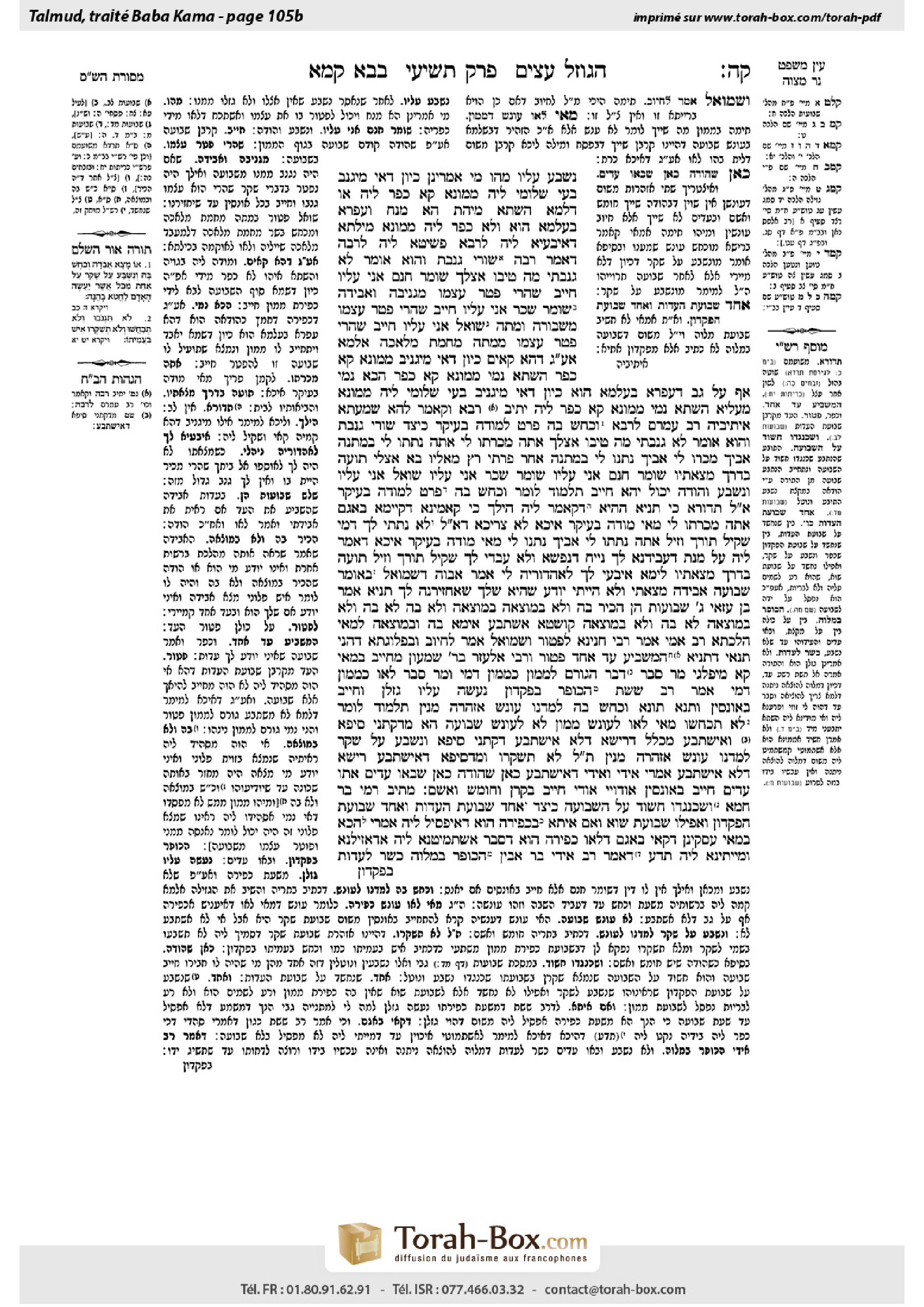
Bava Kamma 105b: Talmud study for Daf Yomi
Study the Talmud for Daf Yomi with scanned pages, Hebrew text, English translations from Sefaria and AI-generated French translations.
Passage selection and English or AI-generated French translation are available where the scan has annotations. Daf Study is independent of Torah-Box and Sefaria.
Browse Bava Kamma · בבא קמא · All tractatesBava Kamma 105b text and translations
This page of Bava Kamma includes the Aramaic text, an English translation and an AI-generated French translation, alongside the scan above.
בבא קמא ק״ה ב · Aramaic and Hebrew text
נִשְׁבַּע עָלָיו, מַהוּ? מִי אָמְרִינַן: כֵּיוָן דְּאִי מִיגְּנֵב בָּעֵי שַׁלּוֹמֵי לֵיהּ – מָמוֹנָא קָא כָפַר לֵיהּ; אוֹ דִלְמָא, הַשְׁתָּא מִיהַת הָא מַנַּח וְעַפְרָא בְּעָלְמָא הוּא, וְלָא כָּפַר לֵיהּ מָמוֹנָא?
מִילְּתָא דְּאִיבַּעְיָא לֵיהּ לְרָבָא, פְּשִׁיטָא לֵיהּ לְרַבָּה – דְּאָמַר רַבָּה: ״שׁוֹרִי גָּנַבְתָּ״, וְהוּא אוֹמֵר: ״לֹא גָּנַבְתִּי״;
״מָה טִיבוֹ אֶצְלְךָ?״ ״שׁוֹמֵר חִנָּם אֲנִי עָלָיו״ – חַיָּיב, שֶׁהֲרֵי פָּטַר עַצְמוֹ מִגְּנֵיבָה וַאֲבֵידָה.
״שׁוֹמֵר שָׂכָר אֲנִי עָלָיו״ – חַיָּיב, שֶׁהֲרֵי פָּטַר עַצְמוֹ מִשְּׁבוּרָה וּמֵתָה.
״שׁוֹאֵל אֲנִי עָלָיו״ – חַיָּיב, שֶׁהֲרֵי פָּטַר עַצְמוֹ מִמֵּתָה מֵחֲמַת מְלָאכָה.
אַלְמָא אַף עַל גַּב דְּהָא קָאֵים – כֵּיוָן דְּאִי מִיגְּנֵיב מָמוֹנָא קָא כָפַר, הַשְׁתָּא נָמֵי מָמוֹנָא קָא כָפַר; הָכָא נָמֵי, אַף עַל גַּב דְּעַפְרָא בְּעָלְמָא הוּא – כֵּיוָן דְּאִי מִיגְּנִיב בָּעֵי שַׁלּוֹמֵי לֵיהּ מָמוֹנָא מְעַלְּיָא, הַשְׁתָּא נָמֵי מָמוֹנָא קָא כָפַר לֵיהּ.
יָתֵיב רָבָא וְקָאָמַר לְהָא שְׁמַעְתָּא. אֵיתִיבֵיהּ רַב עַמְרָם לְרָבָא: ״וְכִחֵשׁ בָּהּ״ – פְּרָט לְמוֹדֶה בָּעִיקָּר.
כֵּיצַד? ״שׁוֹרִי גָּנַבְתָּ״, וְהוּא אוֹמֵר: ״לֹא גָּנַבְתִּי״;
״מָה טִיבוֹ אֶצְלְךָ?״ ״אַתָּה מְכַרְתּוֹ לִי״; ״אַתָּה נְתַתּוֹ לִי בְּמַתָּנָה״; ״אָבִיךָ מְכָרוֹ לִי״; ״אָבִיךָ נְתָנוֹ לִי בְּמַתָּנָה״; ״אַחַר פָּרָתִי רָץ״; ״מֵאֵלָיו בָּא אֶצְלִי״; ״תּוֹעֶה בַּדֶּרֶךְ מְצָאתִיו״; ״שׁוֹמֵר חִנָּם אֲנִי עָלָיו״; ״שׁוֹמֵר שָׂכָר אֲנִי עָלָיו״; ״שׁוֹאֵל אֲנִי עָלָיו״ – וְנִשְׁבַּע וְהוֹדָה; יָכוֹל יְהֵא חַיָּיב? תַּלְמוּד לוֹמַר: ״וְכִחֵשׁ בָּהּ״ – פְּרָט לְמוֹדֶה בָּעִיקָּר.
אֲמַר לֵיהּ: תְּדוֹרָא! כִּי תַּנְיָא הָהִיא – דְּקָאָמַר לֵיהּ: ״הֵילָךְ״, כִּי קָאָמֵינָא – דְּקָיְימָא בַּאֲגַם.
״אַתָּה מְכַרְתּוֹ לִי״ – מַאי מוֹדֶה בָּעִיקָּר אִיכָּא? לָא צְרִיכָא, דְּאָמַר לֵיהּ: ״לֹא נָתַתִּי לְךָ דְּמֵי, שְׁקֹיל תּוֹרָךְ וְזִיל״.
״אַתָּה נְתַתּוֹ לִי״; ״אָבִיךָ נְתָנוֹ לִי״ – מַאי מוֹדֶה בָּעִיקָּר אִיכָּא? דְּאָמַר לֵיהּ: ״עַל מְנָת דְּעָבֵידְנָא לָךְ נְיָיח דְּנַפְשָׁא, וְלָא עֲבַדִי לָךְ, שְׁקֹיל תּוֹרָךְ וְזִיל״.
״תּוֹעֶה בַּדֶּרֶךְ מְצָאתִיו״ – לֵימָא: אִיבְּעִי לָךְ לְאַהֲדוֹרֵיהּ לִי! אָמַר אֲבוּהּ דִּשְׁמוּאֵל, בְּאוֹמֵר: ״שְׁבוּעָה – אֲבֵידָה מָצָאתִי, וְלֹא הָיִיתִי יוֹדֵעַ שֶׁהִיא שֶׁלְּךָ שֶׁאַחְזִירֶנָּה לָךְ״.
תַּנְיָא, אָמַר בֶּן עַזַּאי: שָׁלֹשׁ שְׁבוּעוֹת הֵן – הִכִּיר בָּהּ וְלֹא בְּמוֹצְאָהּ, בְּמוֹצְאָהּ וְלֹא בָּהּ, לֹא בָּהּ וְלֹא בְּמוֹצְאָהּ.
לֹא בָּהּ וְלֹא בְּמוֹצְאָהּ?! קוּשְׁטָא אִשְׁתְּבַע! אֵימָא: בָּהּ וּבְמוֹצְאָהּ.
לְמַאי הִלְכְתָא? רַב אַמֵּי אָמַר רַבִּי חֲנִינָא: לִפְטוּר, וּשְׁמוּאֵל אָמַר: לְחִיּוּב.
וּבִפְלוּגְתָּא דְּהָנֵי תַּנָּאֵי, דְּתַנְיָא: הַמַּשְׁבִּיעַ עֵד אֶחָד – פָּטוּר, וְרַבִּי אֶלְעָזָר בְּרַבִּי שִׁמְעוֹן מְחַיֵּיב.
בְּמַאי קָא מִיפַּלְגִי? מָר סָבַר: דָּבָר הַגּוֹרֵם לְמָמוֹן – כְּמָמוֹן דָּמֵי, וּמָר סָבַר: לָאו כְּמָמוֹן דָּמֵי.
אָמַר רַב שֵׁשֶׁת: הַכּוֹפֵר בְּפִקָּדוֹן – נַעֲשֶׂה עָלָיו גַּזְלָן, וְחַיָּיב בָּאוֹנָסִין. וְתַנָּא תּוּנָא: ״וְכִחֵשׁ בָּהּ״ – לָמַדְנוּ עוֹנֶשׁ. אַזְהָרָה מִנַּיִן? תַּלְמוּד לוֹמַר: ״לֹא תְכַחֲשׁוּ״. מַאי, לָאו לְעוֹנֶשׁ מָמוֹן?
לָא, לְעוֹנֶשׁ שְׁבוּעָה. הָא מִדְּקָתָנֵי סֵיפָא וְאִישְׁתְּבַע, מִכְּלָל דְּרֵישָׁא דְּלָא אִישְׁתְּבַע – דְּקָתָנֵי סֵיפָא: ״וְנִשְׁבַּע עַל שָׁקֶר״ – לָמַדְנוּ עוֹנֶשׁ. אַזְהָרָה מִנַּיִן? תַּלְמוּד לוֹמַר: ״לֹא תְשַׁקְּרוּ״. וּמִדְּסֵיפָא דְּאִישְׁתְּבַע, רֵישָׁא דְּלָא אִישְׁתְּבַע!
אָמְרִי: אִידֵּי וְאִידֵּי דְּאִישְׁתְּבַע; כָּאן שֶׁהוֹדָה, כָּאן שֶׁבָּאוּ עֵדִים. אֲתוֹ עֵדִים – חַיָּיב בְּאוּנְסִין. אוֹדוֹיֵי אוֹדִי – חַיָּיב בְּקֶרֶן וְחוֹמֶשׁ וְאָשָׁם.
מֵתִיב רָמֵי בַּר חָמָא: וְשֶׁכְּנֶגְדּוֹ חָשׁוּד עַל הַשְּׁבוּעָה – כֵּיצַד? אֶחָד שְׁבוּעַת הָעֵדוּת, וְאֶחָד שְׁבוּעַת הַפִּקָּדוֹן, וַאֲפִילּוּ שְׁבוּעַת שָׁוְא.
וְאִם אִיתָא, בִּכְפִירָה הוּא דְּאִיפְּסִיל לֵיהּ!
אָמְרִי: הָכָא בְּמַאי עָסְקִינַן – דְּקָאֵי בַּאֲגַם, דְּלָאו כְּפִירָה הוּא; דְּסָבַר: אִשְׁתְּמִיטְנָא לֵיהּ אַדְּאָזֵילְנָא וּמַיְיתֵינָא לֵיהּ.
תִּדַּע, דְּאָמַר רַב אִידִי בַּר אָבִין: הַכּוֹפֵר בְּמִלְוָה – כָּשֵׁר לְעֵדוּת.
Bava Kamma 105b · English translation
If the robber took a false oath concerning the robbery of the leavened bread, what is the halakha? Do we say that since, if it were to be stolen from the robber, the robber would need to pay the initial value of the bread to the robbery victim, as he can no longer say: That which is yours is before you, and therefore he has denied a claim of a monetary matter to the robbery victim and must consequently pay the additional one-fifth payment and bring a guilt-offering? Or perhaps we say that now, in any event, it is resting in the robber’s possession and it is considered as mere dust, since it is prohibited to derive benefit from it, and as such he has not denied a claim of a monetary matter, and the halakhot concerning a false oath do not apply.
The Gemara comments: The matter that was a dilemma for Rava is obvious to Rabba, as Rabba says that in a scenario where one says to another: You stole my ox, and the other says: I did not steal it.
The first asks: What is the nature of its presence in your possession? The second responds: I am an unpaid bailee over it. If the defendant then takes a false oath to that effect, after which he confesses that he stole the ox, he is liable to bring a guilt-offering for denying a claim of a monetary matter, as he exempted himself from liability in cases of theft and loss.
If he responds instead: I am a paid bailee over it, and takes a false oath to that effect, after which he confesses that he stole the ox, he is liable to bring a guilt-offering for denying a claim of a monetary matter, as he exempted himself from liability in cases of breakage and death.
If he responds instead: I am a borrower of it, and takes a false oath to that effect, after which he confesses that he stole the ox, he is liable to bring a guilt-offering for denying a claim of a monetary matter, as he exempted himself from liability in cases where the ox died due to ordinary labor.
In all of these cases, the ox is in the possession of the one who took the false oath, and he admits that it belongs to the other. The Gemara analyzes Rabba’s statement: Apparently, Rabba holds that even though the ox is now extant and can be returned to its owner, since, if it were to be stolen, the robber would be found to be denying a claim of a monetary matter, as according to his claim he would then be exempt from paying, he is now considered to be denying a claim of a monetary matter as well. Here, in the case of the bread also, even though it is considered mere dust, since, if it were to be stolen, he would be required to pay the robbery victim full-fledged monetary restitution, he is now considered to be denying a claim of a monetary matter as well.
Rava sat and said this halakha, that one who protected himself from potential liability for payment by taking a false oath that he is a bailee is liable to pay the additional one-fifth payment and bring a guilt-offering. Rav Amram raised an objection to Rava from a baraita: The verse states concerning one who is liable for taking a false oath concerning a monetary matter: “And deals falsely with it” (Leviticus 5:22); this serves to exclude one who admits to the primary feature of a claim.
The baraita continues: How is this so? In a scenario where one says to another: You stole my ox, and the latter says: I did not steal it.
The first asks: What is the nature of its presence in your possession? The second responds with any of the following replies: You sold it to me; you gave it to me as a gift; your father sold it to me; your father gave it to me as a gift; it chased after my cow and entered my domain; it came to me on its own; I found it straying on the road and I brought it home; I am an unpaid bailee over it; I am a paid bailee over it; or I am a borrower of it; and the second takes a false oath to that effect, and then admits that he had done so; one might have thought that he should be liable. The verse states: “And deals falsely with it,” which serves to exclude one who admits to the primary feature of a claim. The baraita states explicitly that one who takes a false oath that he is a bailee is not liable; how can Rava state otherwise?
Rava said to him: Fool, when that baraita is taught, it is referring to a case where the robber said to the owner: Here you are, and presented the ox to him immediately, so that he did not profit by claiming that he was a bailee. When I spoke, I was referring to a case where the ox was standing in a different place, such as a swamp, and was not returned to the owner.
Several examples of an oath in which the robber admits to the primary feature of a claim were cited in the baraita above. The Gemara analyzes some of these examples. When the robber says: You sold the ox to me, he has asserted that it belongs to him, so what admission to the primary feature of the claim is there? The Gemara explains: No, it is necessary to teach this in a case where he said to him: You sold the animal to me, but I did not give you the money, take your ox and go.
When the robber says: You gave it to me, or: Your father gave it to me, he has asserted that it belongs to him, so what admission to the primary feature of the claim is there? The Gemara explains: It is a case where he said to him: It was given to me on the condition that I will afford you satisfaction, and I did not do anything for you; take your ox and go.
When the robber says: I found it straying on the road and I brought it home, let the owner say to him: You should have returned it to me. Shmuel’s father said: The baraita is referring to a case in which he says: I take an oath that I found the ox as a lost item, and I did not know that it was yours so that I could return it to you.
§ After discussing a false oath taken by a robber in which he admits to the primary feature of a claim, the Gemara discusses a false oath taken by witnesses. It is taught in a baraita: When a witness takes an oath that he has no knowledge of the status of a lost item, ben Azzai says that there are three possible false oaths, i.e., the oath may be false for one of three reasons: The witness may have recognized the lost item but did not recognize its finder, or he may have recognized its finder but did not recognize the item, or he may have recognized neither the item nor its finder. In each of these cases, the witness took a false oath that he had no knowledge of the lost item, when in fact he had limited knowledge of it.
The Gemara asks: In the third case cited above, where the witnesses recognized neither the item nor its finder, he took his oath in truth when he claimed that he did not have knowledge of the lost item. Why is this cited as an example of a false oath? The Gemara emends the baraita: Say that the reference here is to a case where he recognized both the item and its finder.
The Gemara asks: For which halakha did ben Azzai cite these examples? Rav Ami says that Rabbi Ḥanina says: They were cited to teach that there is exemption in these cases from bringing an offering for taking a false oath of testimony. And Shmuel says that these examples were cited to teach that the witness incurs liability to bring an offering in these cases.
The Gemara comments: And Rav Ami and Shmuel disagree with regard to the issue that is the subject of the dispute between these tanna’im, as it is taught in a baraita: With regard to one who administers an oath to a single witness and the witness takes a false oath that he has no awareness of the monetary matter at hand, the witness is exempt from bringing a sin-offering; and Rabbi Elazar, son of Rabbi Shimon, deems the witness liable to bring a sin-offering.
The Gemara asks: With regard to what do they disagree? One Sage, Rabbi Elazar, son of Rabbi Shimon, holds that an item that causes financial loss is considered to have monetary value. Similarly, the potential monetary benefit that the witness can generate by causing the defendant to admit to the debt and pay the owner is considered to have monetary value. Therefore, the witness is considered to have taken a false oath with regard to a monetary matter. And one Sage, the first tanna, holds that an item that causes financial loss is not considered to have monetary value. Similarly, the potential monetary benefit that the witness can generate by causing the defendant to admit to the debt and pay the owner is not considered to have monetary value. Therefore, the witness is not considered to have taken a false oath with regard to a monetary matter.
§ The Gemara discusses the halakha concerning a bailee who denies having a deposit in his possession. Rav Sheshet says: A bailee who falsely denies a claim concerning a deposit becomes as a robber with regard to it, and he is therefore liable to pay even for damage that is the result of accidents. The Gemara notes that the tanna also taught this halakha in a baraita. The verse states: “And deals falsely with it” (Leviticus 5:22–24), and we learned from this verse the punishment for one who denies having a deposit. From where is the prohibition itself derived? The verse states: “Neither shall you deal falsely” (Leviticus 19:11). The Gemara explains: What, is the baraita not referring to the punishment of having to pay money due to his denial even for accidental damage, in accordance with the statement of Rav Sheshet?
The Gemara rejects this: No, the baraita is referring to the punishment for taking a false oath, i.e., the additional one-fifth payment and the bringing of the offering. The Gemara challenges: From the fact that the latter clause of the baraita teaches a case where he took an oath, it may be inferred that the first clause teaches a case where he did not take an oath, and the punishment referred to by the baraita is the imposition of liability for accidental damage. As the latter clause teaches that the verse states: “And swear to a lie” (Leviticus 5:22), and we learned from this that there is a punishment for taking a false oath. From where is the prohibition itself derived? The verse states: “Nor lie” (Leviticus 19:11). And from the fact that the latter clause teaches the halakha where he took an oath, the first clause must be teaching the halakha in a case where he did not take an oath.
The Gemara answers: The Sages say in response that both this clause and that clause are referring to a case where he took an oath, but here, in the latter clause, it is where the bailee admitted his false oath, while there, in the first clause, it is where witnesses came and testified that the deposit is in his possession. Where witnesses came, he is liable only for damage that is a result of accidents, and where he admitted his false oath, he is obligated to pay for the principal and an additional one-fifth payment, and to bring a guilt-offering. Since the baraita is referring in both clauses to a case where the bailee took an oath, it offers no support for Rav Sheshet’s statement.
After dismissing the attempted proof for Rav Sheshet’s statement that a bailee who denies possession of a deposit is considered a robber even without having taken a false oath, the Gemara now attempts to disprove the statement itself. Rami bar Ḥama raises an objection to Rav Sheshet’s statement: Though it is usually the defendant who is required to take an oath in order to avoid having to pay a claim, there are cases in which the plaintiff takes an oath to receive payment. The mishna in Shevuot (44b) lists these cases: And one such case is where the plaintiff’s opponent, i.e., the defendant, is suspect with regard to an oath, i.e., there is reason for the court to believe that he would take a false oath. How would the defendant have become suspect? It would be by having taken a false oath with regard to either an oath of testimony or an oath on a deposit, or even for an oath taken in vain.
The Gemara comments: Since the mishna states that he becomes suspect only as a result of having taken a false oath, it can be inferred that he does not become suspect by virtue of denial of a claim alone. And if it is so that a bailee who denies having taken the deposit is considered a robber even without having taken an oath, then it is with his denial that he ought to be disqualified, as a robber does not have the credibility to take an oath.
The Sages say in defense of Rav Sheshet’s opinion: With what are we dealing here, in the case of the mishna in Shevuot? We are dealing with a case where the deposit stands in a place not in the bailee’s possession, e.g., a swamp, as in this case his statement is not considered a complete denial, because he thinks to himself: I will evade the owner by claiming that I never took the deposit until I go and bring it to him. Therefore, he is not considered to be a robber. By contrast, Rav Sheshet is referring to a case where the bailee denied responsibility for the item while it was in his possession, as he intended to keep it for himself.
The Gemara adds: Know that one who denies possession of an item only so that he may later return it is not considered a robber, as Rav Idi bar Avin says: One who denies a claim concerning having taken a loan is fit to bear witness,
Bava Kamma 105b · Traduction française (IA)
Si le voleur a pris un faux serment concernant le vol du pain cuit, quelle est la halakha ? Disons-nous que puisque, si le pain cuit était volé du voleur, le voleur devrait payer la valeur initiale du pain au victime du vol, car il ne peut plus dire : Ce qui est à toi est devant toi, et donc il a nié une revendication matérielle au victime du vol et doit donc payer le paiement supplémentaire d'un cinquième et présenter un sacrifice de culpabilité ? Ou peut-être disons-nous que maintenant, de toute évidence, il est en possession du voleur et est considéré comme de la poussière, car il est interdit d'en tirer un bénéfice, et ainsi il n'a pas nié une revendication matérielle, et les halakhot concernant un faux serment ne s'appliquent pas.
Le Guemara commente : La question qui était un dilemme pour Rava est évidente pour Rabba, car Rabba dit que dans un cas où l'un dit à l'autre : Tu as volé mon bœuf, et l'autre dit : Je n'ai pas volé ce bœuf.
Le premier demande : Quelle est la nature de sa présence en votre possession ? Le second répond : Je suis un dépositaire non rémunéré. Si le défendeur prend alors un faux serment à cet égard, puis avoue qu'il a volé le bœuf, il est tenu de présenter un sacrifice de culpabilité pour avoir nié une revendication matérielle, car il s'est exempté de responsabilité dans les cas de vol et de perte.
Si l'on répond au contraire : Je suis un dépositaire rémunéré, et qu'on prend un faux serment à cet égard, puis qu'on avoue avoir volé le bœuf, il est tenu de présenter un sacrifice de culpabilité pour avoir nié une revendication matérielle, car il s'est exempté de responsabilité dans les cas de dégradation et de mort.
Si l'on répond au contraire : Je suis un prêteur, et qu'on prend un faux serment à cet égard, puis qu'on avoue avoir volé le bœuf, il est tenu de présenter un sacrifice de culpabilité pour avoir nié une revendication matérielle, car il s'est exempté de responsabilité dans les cas où le bœuf est mort à cause du travail ordinaire.
Dans tous ces cas, le bœuf est en possession de celui qui a pris le faux serment, et il admet qu'il appartient à l'autre. La Guemara analyse l'affirmation de Rabba : Apparemment, Rabba considère que même si le bœuf existe actuellement et peut être rendu à son propriétaire, puisque, si on le volait, le voleur serait trouvé en train de nier une revendication matérielle, car selon son déclaration il serait exempt de paiement, il est maintenant considéré comme niant une revendication matérielle. Ici, dans le cas du pain également, même s'il est considéré comme de la poussière, puisque, si on le volait, il devrait payer la réparation matérielle complète au victime du vol, il est maintenant considéré comme niant une revendication matérielle.
Rava s'est assis et a dit cette halakha : celui qui s'est protégé d'une responsabilité potentielle de paiement en prenant un faux serment selon lequel il est un dépositaire est tenu de payer le paiement supplémentaire d'un cinquième et de présenter un sacrifice de culpabilité. Rav Amram a soulevé une objection contre Rava à partir d'une baraïta : le texte dit concernant celui qui est tenu de prendre un faux serment concernant une affaire monétaire : « Et il agit de manière trompeuse à son égard » (Lévitique 5:22) ; cela sert à exclure celui qui admet la principale caractéristique d'une revendication.
La baraïta continue : comment est-ce ainsi ? Dans un cas où l'un dit à l'autre : tu as volé mon bœuf, et l'autre dit : je n'ai pas volé ce bœuf.
Le premier demande : quelle est la nature de sa présence en votre possession ? Le second répond avec l'une des réponses suivantes : tu m'as vendu le bœuf ; tu m'as donné le bœuf en cadeau ; ton père t'a vendu le bœuf ; ton père t'a donné le bœuf en cadeau ; il a suivi mon vache et est entré dans mon domaine ; il est venu vers moi tout seul ; j'ai trouvé le bœuf errant sur la route et je l'ai ramené chez moi ; je suis un dépositaire non rémunéré ; je suis un dépositaire rémunéré ; ou je suis un prêteur ; et le second prend un faux serment à cet égard, puis avoue qu'il l'a fait ; on pourrait penser qu'il devrait être tenu responsable. Le texte dit : « Et il agit de manière trompeuse à son égard », ce qui sert à exclure celui qui admet la principale caractéristique d'une revendication. La baraïta dit explicitement que celui qui prend un faux serment selon lequel il est un dépositaire n'est pas tenu ; comment Rava peut-il dire le contraire ?
Rava dit à lui : Crétin, lorsque cette baraïta est enseignée, elle fait référence à un cas où le voleur a dit à l'owner : Ici tu es, et a présenté le bœuf à lui immédiatement, de sorte qu'il n'a pas profité en affirmant qu'il était un dépositaire. Lorsque j'ai parlé, j'étais en train de parler d'un cas où le bœuf était dans un autre lieu, comme un marais, et n'était pas rendu à l'owner.
Plusieurs exemples de serment dans lesquels le voleur admet la principale caractéristique d'une revendication ont été cités dans la baraïta ci-dessus. Le Guemara analyse certains de ces exemples. Lorsque le voleur dit : Tu m'as vendu le bœuf, il a affirmé qu'il appartient à lui, donc quelle est l'admission de la principale caractéristique de la revendication ? Le Guemara explique : Non, il est nécessaire d'enseigner cela dans un cas où il a dit à lui : Tu m'as vendu l'animal, mais je ne t'ai pas donné l'argent, prends ton bœuf et va-t'en.
Lorsque le voleur dit : Tu m'as donné le bœuf, ou : Ton père t'a donné le bœuf, il a affirmé qu'il appartient à lui, donc quelle est l'admission de la principale caractéristique de la revendication ? Le Guemara explique : C'est un cas où il a dit à lui : Il a été donné à moi sous condition que je te fasse la satisfaction, et je n'ai pas fait quoi que ce soit pour toi ; prends ton bœuf et va-t'en.
Lorsque le voleur dit : J'ai trouvé le bœuf errant sur la route et je l'ai ramené chez moi, que l'propriétaire dise à lui : Tu devrais le rendre à moi. Le père de Shmuel a dit : La baraïta fait référence à un cas où il dit : Je prends un serment que j'ai trouvé le bœuf comme objet perdu, et je ne savais pas qu'il était à toi, afin que je puisse te le rendre.
§ Après avoir discuté d'un serment faux pris par un voleur dans lequel il reconnaît la caractéristique principale d'une revendication, le Guemara discute d'un serment faux pris par des témoins. Il est enseigné dans une baraïta : Lorsqu'un témoin prend un serment affirmant qu'il ne connaît pas le statut d'un objet perdu, Ben Azzai dit qu'il y a trois types de serments faux, c'est-à-dire que le serment peut être faux pour l'une des trois raisons suivantes : le témoin pourrait avoir reconnu l'objet perdu mais ne pas avoir reconnu son propriétaire, ou il pourrait avoir reconnu son propriétaire mais ne pas avoir reconnu l'objet, ou il pourrait ne pas avoir reconnu ni l'objet ni son propriétaire. Dans chaque cas, le témoin a pris un serment faux affirmant qu'il ne connaissait pas l'objet perdu, alors qu'en réalité il avait une connaissance limitée de celui-ci.
Le Guemara demande : Dans le troisième cas mentionné ci-dessus, où les témoins ne reconnaissaient ni l'objet ni son propriétaire, il a pris son serment en vérité lorsqu'il affirmait ne pas connaître l'objet perdu. Pourquoi ce cas est-il cité comme exemple de serment faux ? Le Guemara corrige la baraïta : Disons que la référence ici est à un cas où il a reconnu à la fois l'objet et son propriétaire.
Le Guemara demande : Pour quelle halakha Ben Azzai a-t-il cité ces exemples ? Rav Ami dit que Rabbi Ḥanina dit : Ils ont été cités pour enseigner qu'il y a une exemption dans ces cas de présenter un sacrifice pour avoir pris un serment faux de témoignage. Et Shmuel dit que ces exemples ont été cités pour enseigner que le témoin encourt une responsabilité de présenter un sacrifice dans ces cas.
Le Guemara commente : Et Rav Ami et Shmuel sont en désaccord sur la question qui est au centre du débat entre ces tannaïm, comme il est enseigné dans une baraïta : Concernant celui qui administre un serment à un seul témoin et le témoin prend un serment faux affirmant qu'il n'a pas connaissance de la matière monétaire en question, le témoin est exempt de présenter un sacrifice expiatoire ; et Rabbi Elazar, fils de Rabbi Shimon, considère que le témoin est tenu de présenter un sacrifice expiatoire.
Le Guemara demande : Sur quel point s'opposent-ils ? Un sage, Rabbi Elazar, fils de Rabbi Shimon, considère qu'un objet qui cause un préjudice financier est considéré comme ayant une valeur monétaire. De même, le bénéfice monétaire potentiel que le témoin peut générer en faisant admettre la dette par le défendeur et en faisant payer le propriétaire est considéré comme ayant une valeur monétaire. Par conséquent, le témoin est considéré comme ayant pris un serment faux concernant une matière monétaire. Un autre sage, le premier tanna, considère qu'un objet qui cause un préjudice financier n'est pas considéré comme ayant une valeur monétaire. De même, le bénéfice monétaire potentiel que le témoin peut générer en faisant admettre la dette par le défendeur et en faisant payer le propriétaire n'est pas considéré comme ayant une valeur monétaire. Par conséquent, le témoin n'est pas considéré comme ayant pris un serment faux concernant une matière monétaire.
§ Le Guemara discute de la halakha concernant un dépositaire qui nie avoir un dépôt en son possession. Rav Sheshet dit : Un dépositaire qui nie faussement une revendication concernant un dépôt devient comme un voleur concernant celui-ci, et il est donc tenu responsable même des dommages résultant d'accidents. Le Guemara note que le tanna a également enseigné cette halakha dans une baraïta. La versette stipule : « Et il ment à son sujet » (Lévitique 5:22-24), et nous avons appris de cette versette la sanction pour celui qui nie avoir un dépôt. D'où provient la prohibition elle-même ? La versette stipule : « Ni ne mentez » (Lévitique 19:11). Le Guemara explique : Qu'est-ce que la baraïta ne fait pas référence à la sanction de devoir payer de l'argent en raison de sa négation même pour les dommages accidentels, conformément à l'affirmation de Rav Sheshet ?
Le Guemara refuse cela : Non, la baraïta fait référence à la sanction pour prendre un serment faux, c'est-à-dire le paiement supplémentaire de cinquième et la présentation du sacrifice. Le Guemara conteste : D'après le fait que la clause ultérieure de la baraïta enseigne un cas où il a pris un serment, on peut en déduire que la première clause enseigne un cas où il n'a pas pris de serment, et la sanction mentionnée par la baraïta est l'imposition de responsabilité pour les dommages accidentels. Comme la clause ultérieure enseigne que la versette stipule : « Et jure à un mensonge » (Lévitique 5:22), et nous avons appris de cela qu'il y a une sanction pour prendre un serment faux. D'où provient la prohibition elle-même ? La versette stipule : « Ni ne mentez » (Lévitique 19:11). Et d'après le fait que la clause ultérieure enseigne la halakha où il a pris un serment, la première clause doit enseigner la halakha dans un cas où il n'a pas pris de serment.
Le Guemara répond : Les Sages disent que les deux clauses font référence à un cas où il a pris un serment, mais ici, dans la clause ultérieure, il s'agit du cas où le dépositaire a admis son serment faux, tandis que là, dans la première clause, il s'agit du cas où des témoins sont venus témoigner que le dépôt est en son possession. Lorsque des témoins sont venus, il est tenu responsable uniquement des dommages résultant d'accidents, et lorsque l'admission de son serment faux a été faite, il est tenu de payer le principal et un paiement supplémentaire de cinquième, ainsi que de présenter un sacrifice de culpabilité. Puisque la baraïta fait référence dans les deux clauses à un cas où le dépositaire a pris un serment, elle ne fournit pas de soutien à l'affirmation de Rav Sheshet.
Après avoir rejeté la preuve tentée en faveur de l'affirmation de Rav Sheshet selon laquelle un dépositaire qui nie la possession d'un dépôt est considéré comme un voleur même sans avoir pris un serment faux, le Guemara tente maintenant de réfuter l'affirmation elle-même. Rami bar Ḥama émet une objection contre l'affirmation de Rav Sheshet : Bien que ce soit généralement le défendeur qui soit tenu de prendre un serment afin d'éviter de devoir payer une revendication, il existe des cas où le plaignant prend un serment pour recevoir le paiement. La mishna dans Shevuot (44b) liste ces cas : Et l'un de ces cas est celui où l'opposant du plaignant, c'est-à-dire le défendeur, est suspect concernant un serment, c'est-à-dire qu'il y a une raison pour que le tribunal croie qu'il prendra un serment faux. Comment le défendeur est-il devenu suspect ? Cela serait dû à avoir pris un serment faux concernant un serment de témoignage ou un serment sur un dépôt, ou même pour un serment pris à vide.
La Guemara commente : Puisque la Michna indique qu'il devient suspect uniquement en raison d'avoir pris un faux serment, on peut en déduire qu'il ne devient suspect par le simple déni d'une revendication. Et si c'est ainsi que le dépositaire qui nie avoir pris la dépôt est considéré comme un voleur même sans avoir pris d'œuf, alors c'est avec son déni qu'il devrait être disqualifié, car un voleur n'a pas la crédibilité de prendre un serment.
Les Sages disent en défense de l'opinion de Rav Sheshet : De quoi sommes-nous en train de parler ici, dans le cas de la Michna dans Shevuot ? Nous parlons d'un cas où la dépôt est placé dans un lieu non en possession du dépositaire, par exemple un marais, comme dans ce cas, son déni n'est pas considéré comme un déni complet, car il se dit à lui-même : Je vais échapper à l'propriétaire en affirmant que je n'ai jamais pris la dépôt jusqu'à ce que je vais le lui apporter. Ainsi, il n'est pas considéré comme un voleur. À l'inverse, Rav Sheshet fait référence à un cas où le dépositaire a nié la responsabilité sur l'objet alors qu'il était en sa possession, car il avait l'intention de le garder pour lui.
La Guemara ajoute : Sachez que celui qui nie la possession d'un objet uniquement afin de le rendre plus tard n'est pas considéré comme un voleur, car Rav Idi bar Avin dit : Celui qui nie une revendication concernant un prêt est digne de témoigner,
Traduction française générée par IA à partir de l’édition anglaise de Sefaria. Vérifie toujours un passage avec le texte source.
Text from Sefaria: William Davidson Edition - Vocalized Aramaic (CC BY NC); William Davidson Edition - English (CC BY NC).