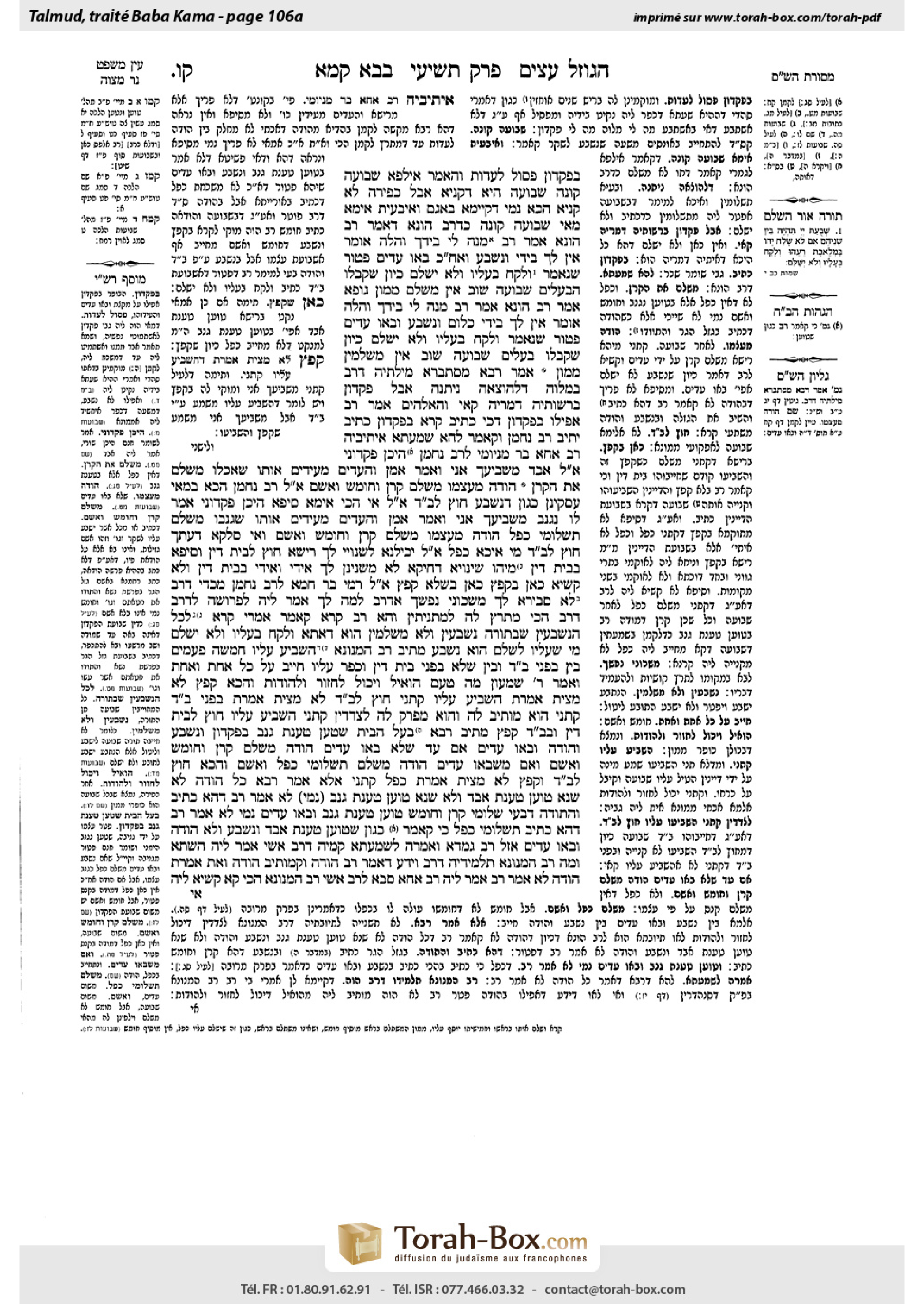
Bava Kamma 106a: Talmud study for Daf Yomi
Study the Talmud for Daf Yomi with scanned pages, Hebrew text, English translations from Sefaria and AI-generated French translations.
Passage selection and English or AI-generated French translation are available where the scan has annotations. Daf Study is independent of Torah-Box and Sefaria.
Browse Bava Kamma · בבא קמא · All tractatesBava Kamma 106a text and translations
This page of Bava Kamma includes the Aramaic text, an English translation and an AI-generated French translation, alongside the scan above.
בבא קמא ק״ו א · Aramaic and Hebrew text
בְּפִקָּדוֹן – פָּסוּל לְעֵדוּת.
וְהָאָמַר אִילְפָא: שְׁבוּעָה קוֹנָה: שְׁבוּעָה הִיא דְּקָנְיָא, אֲבָל כְּפִירָה לָא קָנְיָא! הָכָא נָמֵי – דְּקָיְימָא בַּאֲגַם.
וְאִיבָּעֵית אֵימָא: מַאי ״שְׁבוּעָה קוֹנָה״ – כִּדְרַב הוּנָא; דְּאָמַר רַב הוּנָא אָמַר רַב: ״מָנֶה לִי בְּיָדְךָ״, וְהַלָּה אוֹמֵר: ״אֵין לְךָ בְּיָדִי״; וְנִשְׁבַּע, וְאַחַר כָּךְ בָּאוּ עֵדִים – פָּטוּר, שֶׁנֶּאֱמַר: ״וְלָקַח בְּעָלָיו וְלֹא יְשַׁלֵּם״ – כֵּיוָן שֶׁקִּבְּלוּ הַבְּעָלִים שְׁבוּעָה, שׁוּב אֵין מְשַׁלֵּם מָמוֹן.
גּוּפָא. אָמַר רַב הוּנָא אָמַר רַב: ״מָנֶה לִי בְּיָדְךָ״, וְהַלָּה אוֹמֵר: ״אֵין לְךָ בְּיָדִי כְּלוּם״; וְנִשְׁבַּע, וּבָאוּ עֵדִים – פָּטוּר, שֶׁנֶּאֱמַר: ״וְלָקַח בְּעָלָיו וְלֹא יְשַׁלֵּם״ – כֵּיוָן שֶׁקִּבְּלוּ בְּעָלִים שְׁבוּעָה, שׁוּב אֵין מְשַׁלְּמִין מָמוֹן.
אָמַר רָבָא: מִסְתַּבְּרָא מִילְּתֵיהּ דְּרַב – בְּמִלְוָה, דִּלְהוֹצָאָה נִיתְּנָה; אֲבָל פִּקָּדוֹן – בִּרְשׁוּתֵיהּ דְּמָרֵיהּ קָאֵי. וְהָאֱלֹהִים – אָמַר רַב אֲפִילּוּ בְּפִקָּדוֹן; דְּכִי כְּתִיב קְרָא – בְּפִקָּדוֹן כְּתִיב.
יָתֵיב רַב נַחְמָן וְקָאָמַר לְהָא שְׁמַעְתָּא. אֵיתִיבֵיהּ רַב אַחָא בַּר מִנְיוֹמֵי לְרַב נַחְמָן: ״הֵיכָן פִּקְדוֹנִי?״ אָמַר לוֹ: ״אָבַד״. ״מַשְׁבִּיעֲךָ אֲנִי״, וְאָמַר: ״אָמֵן״, וְהָעֵדִים מְעִידִים אוֹתוֹ שֶׁאֲכָלוֹ – מְשַׁלֵּם אֶת הַקֶּרֶן. הוֹדָה מֵעַצְמוֹ – מְשַׁלֵּם קֶרֶן וָחוֹמֶשׁ וְאָשָׁם!
אֲמַר לֵיהּ רַב נַחְמָן: הָכָא בְּמַאי עָסְקִינַן – כְּגוֹן דְּנִשְׁבַּע חוּץ לְבֵית דִּין. אֲמַר לֵיהּ: אִי הָכִי, אֵימָא סֵיפָא: ״הֵיכָן פִּקְדוֹנִי״? אָמַר לוֹ: ״נִגְנַב״. ״מַשְׁבִּיעֲךָ אֲנִי״, וְאָמַר: ״אָמֵן״, וְהָעֵדִים מְעִידִים אוֹתוֹ שֶׁגְּנָבוֹ – מְשַׁלֵּם תַּשְׁלוּמֵי כֶפֶל. הוֹדָה מֵעַצְמוֹ – מְשַׁלֵּם קֶרֶן וָחוֹמֶשׁ וְאָשָׁם. וְאִי סָלְקָא דַעְתָּךְ חוּץ לְבֵית דִּין, מִי אִיכָּא כֶּפֶל?
אֲמַר לֵיהּ, יָכֵילְנָא לְשַׁנּוֹיֵי לָךְ: רֵישָׁא חוּץ לְבֵית דִּין, וְסֵיפָא בְּבֵית דִּין; מִיהוּ שִׁינּוּיָא דְּחִיקָא לָא מְשַׁנֵּינָא לָךְ. אִידֵּי וְאִידֵּי בְּבֵית דִּין – וְלָא קַשְׁיָא; כָּאן בְּקָפַץ, כָּאן בְּשֶׁלֹּא קָפַץ.
אֲמַר לֵיהּ רָמֵי בַּר חָמָא לְרַב נַחְמָן: מִכְּדֵי דְּרַב לָא סְבִירָא לָךְ, מַשְׁכּוֹנֵי נַפְשָׁךְ אַדְּרַב לְמָה לָךְ? אֲמַר לֵיהּ: לְפָרוֹשַׁהּ לִדְרַב, דְּרַב הָכִי מְתָרֵץ לַהּ לְמַתְנִיתִין.
וְהָא רַב קְרָא קָאָמַר! אָמְרִי: קְרָא לְ״כׇל הַנִּשְׁבָּעִין שֶׁבַּתּוֹרָה – נִשְׁבָּעִין וְלֹא מְשַׁלְּמִין״ הוּא דַּאֲתָא, ״וְלָקַח בְּעָלָיו וְלֹא יְשַׁלֵּם״ – מִי שֶׁעָלָיו לְשַׁלֵּם, הוּא נִשְׁבָּע.
מֵתִיב רַב הַמְנוּנָא: הִשְׁבִּיעַ עָלָיו חֲמִשָּׁה פְּעָמִים, בֵּין בִּפְנֵי בֵּית דִּין וּבֵין שֶׁלֹּא בִּפְנֵי בֵּית דִּין, וְכָפַר עָלָיו – חַיָּיב עַל כׇּל אַחַת וְאַחַת. וְאָמַר רַבִּי שִׁמְעוֹן: מָה טַעַם? הוֹאִיל וְיָכוֹל לַחֲזוֹר וּלְהוֹדוֹת!
וְהָכָא, קָפַץ לָא מָצֵית אָמְרַתְּ – ״הִשְׁבִּיעַ עָלָיו״ קָתָנֵי; חוּץ לְבֵית דִּין לָא מָצֵית אָמְרַתְּ – ״בִּפְנֵי בֵּית דִּין״ קָתָנֵי!
הוּא מוֹתֵיב לַהּ, וְהוּא מְפָרֵק לַהּ; לִצְדָדִין קָתָנֵי: הִשְׁבִּיעַ עָלָיו – חוּץ לְבֵית דִּין, וּבְבֵית דִּין – קָפַץ.
מֵתִיב רָבָא: בַּעַל הַבַּיִת שֶׁטָּעַן טַעֲנַת גַּנָּב בְּפִקָּדוֹן וְנִשְׁבַּע, וְהוֹדָה, וּבָאוּ עֵדִים – אִם עַד שֶׁלֹּא בָּאוּ עֵדִים הוֹדָה, מְשַׁלֵּם קֶרֶן וָחוֹמֶשׁ וְאָשָׁם; וְאִם מִשֶּׁבָּאוּ עֵדִים הוֹדָה, מְשַׁלֵּם תַּשְׁלוּמֵי כֶפֶל וְאָשָׁם.
וְהָכָא חוּץ לְבֵית דִּין וְקָפַץ לָא מָצֵית אָמְרַתְּ – ״כֶּפֶל״ קָתָנֵי!
אֶלָּא אָמַר רָבָא: כֹּל הוֹדָה, לָא שְׁנָא טוֹעֵן טַעֲנַת אָבַד, וְלָא שְׁנָא טוֹעֵן טַעֲנַת גַּנָּב – נָמֵי לָא אָמַר רַב, דְּהָא כְּתִיב ״וְהִתְוַדָּה״ – דְּבָעֵי שַׁלּוֹמֵי קֶרֶן וָחוֹמֶשׁ.
טוֹעֵן טַעֲנַת גַּנָּב וּבָאוּ עֵדִים נָמֵי לָא אָמַר רַב – דְּהָא כְּתִיב תַּשְׁלוּמֵי כֶפֶל. כִּי קָאָמַר, כְּגוֹן שֶׁטּוֹעֵן טַעֲנַת אָבַד, וְנִשְׁבַּע וְלֹא הוֹדָה, וּבָאוּ עֵדִים.
אֲזַל רַב גַּמָּדָא, וְאַמְרַהּ לִשְׁמַעְתָּא קַמֵּיהּ דְּרַב אָשֵׁי. אֲמַר לֵיהּ: הַשְׁתָּא וּמָה רַב הַמְנוּנָא, תַּלְמִידֵיהּ דְּרַב – וְיָדַע דְּאָמַר רַב הוֹדָה, וְקָמוֹתֵיב הוֹדָה; וְאַתְּ אָמְרַתְּ: הוֹדָה לָא אָמַר רַב?!
אֲמַר לֵיהּ רַב אַחָא סָבָא לְרַב אָשֵׁי, רַב הַמְנוּנָא הָכִי קָא קַשְׁיָא לֵיהּ:
Bava Kamma 106a · English translation
but one who denies a claim concerning having taken a deposit is disqualified from bearing witness, because if it is clear that the deposit is in his possession, yet he denies it, he must be lying.
The Gemara raises a further difficulty with regard to Rav Sheshet’s opinion: But didn’t Ilfa say that an oath effects acquisition, meaning that once he testified falsely that he did not become a bailee, the item in question becomes his property, rendering him liable as a robber even for damage or loss resulting from accidents? The Gemara infers: It is the taking of an oath that effects acquisition, but mere denial of having become a bailee does not effect acquisition. The Gemara rejects this distinction: Here too, Ilfa must be referring to a case where the deposit stands in a place not in the bailee’s possession, e.g., a swamp, and as long as he does not take an oath, it can be assumed that his intention is simply to be evasive. But if the animal was standing in his house, then he acquires it as soon as he denies the claim.
And if you wish, say instead: What is the meaning of Ilfa’s statement that an oath effects acquisition? It is in accordance with the statement of Rav Huna, as Rav Huna says that Rav said that if one party says: I have one hundred dinars in your possession, and the other party says: You do not have any money in my possession, and the latter took an oath to that effect, and later, witnesses came and testified that his oath was false, he is exempt, as it is stated: “The oath of the Lord shall be between them both, to see whether he has not put his hand unto his neighbor’s goods; and the owner thereof shall accept it, and he shall not make restitution” (Exodus 22:10); teaching that once the owner received an oath, the one who took the oath no longer pays monetary restitution. Ilfa’s statement that an oath effects acquisition means that the bailee will no longer have to pay monetary restitution, and it does not relate to Rav Sheshet’s statement that the bailee becomes responsible for damage resulting from accidents as soon as he denies the claim.
§ Having mentioned Rav’s ruling, the Gemara addresses the matter itself: Rav Huna says that Rav says that if one party says: I have one hundred dinars in your possession, and the other party says: You do not have any money in my possession, and the latter takes an oath to that effect, and later, witnesses came and testified that his oath was false, he is exempt, as it is stated: “And the owner thereof shall accept it, and he shall not make restitution” (Exodus 22:10); teaching that once the owner received an oath, the one who took the oath no longer pays monetary restitution.
Rava said: Rav’s statement is reasonable in the case of one who denies having taken a loan, which is intended for expenditure. Since the money is no longer in his possession, the Torah exempts him from monetary restitution once he takes an oath. But in the case of one who denies having accepted a deposit, it remains in the owner’s possession and must be returned intact, and it is not considered to be monetary restitution. Rava continues: But, by God, Rav said his statement even in the case of one who denies having accepted a deposit, as when this verse exempting him from payment is written, it is written in the case of one who denies having accepted a deposit.
§ The Gemara relates that Rav Naḥman was sitting and saying this halakha. Rav Aḥa bar Minyumi raised an objection to Rav Naḥman from that which was taught in a mishna (108b): If the owner asked the bailee: Where is my deposit, and the bailee said to him: It is lost, and the owner said: I administer an oath to you, and the bailee said: Amen, thereby accepting the oath, and the witnesses testify about the bailee that he consumed the deposit, then he must pay the principal. If he admitted of his own accord that he had taken a false oath, then he must pay the principal and the additional one-fifth payment, and bring a guilt-offering. This indicates that one is required to pay monetary restitution for a deposit even after taking an oath.
Rav Naḥman said to him: With what are we dealing here? We are dealing with a case where one takes an oath outside of court, which does not exempt him from paying restitution. Rav Aḥa bar Minyumi said to him: If so, say the latter clause of the mishna: If the owner asked the bailee: Where is my deposit, and the bailee said to him: It was stolen, and the owner said: I administer an oath to you, and the bailee said: Amen, thereby accepting the oath; and the witnesses testify about the bailee that he stole it, he must pay the payment of double the principal. If he admitted of his own accord that he had taken a false oath, then he must pay the principal and the additional one-fifth payment, and bring a guilt-offering. And if it enters your mind that this oath was taken outside of court, is there an obligation of double payment in such a circumstance?
Rav Naḥman said to him: I am able to answer you by saying that the first clause of the mishna is referring to one who took an oath outside of court, and the latter clause of the mishna is referring to one who took an oath in court, but we will not answer you with a forced answer. Instead, I will explain it in this manner: Both this clause and that clause are referring to an oath taken in court, and it is not difficult. Here, the ruling of the first clause is with regard to one who leaped to take an oath as soon as the other litigant stated his claim, even though the court had not yet required him to do so, which is not considered a full-fledged oath. There, the ruling of the latter clause is with regard to one who did not leap but took an oath only when required by the court.
Rami bar Ḥama said to Rav Naḥman: After all, you do not hold in accordance with the statement of Rav; why are you pledging yourself to explain the statement of Rav so that it not be contradicted by the mishna? Rav Naḥman said to him: I said this not to justify Rav’s ruling but to clarify the statement of Rav, as Rav would explain the mishna in this manner, as I did.
The Gemara asks: But Rav quoted a verse, so how could Rav Naḥman not agree with his statement? The Sages said in response: This verse was not written to teach the ruling of Rav; rather, it comes to teach the halakha that all those discussed in the Torah who are required to take oaths, take oaths and do not pay; as the verse should be interpreted as follows: “And the owner thereof shall accept it, and he shall not make restitution” (Exodus 22:10), teaching that one who has the obligation to pay is the one who takes an oath, and not the one demanding payment.
Rav Hamnuna raises an objection to Rav’s statement from a different mishna (Shevuot 36b), which states: If an owner requested the return of his deposit and the purported bailee denied having received it, and the owner administered an oath to the bailee about the deposit five times, whether before the court or not before the court, and the bailee denied the claim each time, he is liable for each and every one of the oaths and must pay the additional one-fifth payment and bring a guilt-offering for each one. And Rabbi Shimon says: What is the reason? Since he is able to retract and admit after each oath, at which point he would be liable to pay, therefore each subsequent false oath is a denial of that liability. It can be seen from this mishna that one who admits liability after having taken a false oath is liable to pay, counter to the statement of Rav.
And here, you cannot say that the mishna in Shevuot is referring to a case where the bailee leaped to volunteer his oath, because it teaches explicitly that the owner administered an oath to the bailee about the deposit. And you cannot say that the mishna in Shevuot is referring to a case where the bailee took his oath outside of court, because it teaches explicitly that the halakha applies whether the oath was taken before the court or not before the court.
The Gemara explains: He, Rav Hamnuna, raised the objection and he resolved it: The tanna teaches it disjunctively, i.e., the rulings of the mishna are stated with regard to different circumstances. Where it teaches that the owner administered an oath to the bailee about the deposit, that is referring to outside of court, and when it discusses an oath taken before the court, it is referring to a case where the bailee leaped and volunteered his oath. Therefore, the mishna does not discuss the case with regard to which Rav issued his ruling, where the bailee was forced to take an oath before the court.
Rava raises an objection to Rav’s statement from a baraita: In the case of a homeowner acting as a bailee who falsely claimed, with regard to a deposit, that a thief stole it, and he took an oath to that effect and subsequently admitted that he was lying and that in fact he took the item himself, and witnesses came and testified that the bailee himself indeed took the item, then if he admitted his guilt before the witnesses came and testified, he pays the principal value of the item and the additional one-fifth payment, and he must also bring a guilt-offering. But if he admitted his guilt after the witnesses came and testified, he pays the double payment and brings a guilt-offering. This baraita rules that one who takes an oath is not exempt from payment, counter to the statement of Rav.
And here, in this baraita, you cannot say that it is referring to an oath taken outside of court or that he leaped and volunteered his oath, because double payment is taught in the baraita, and one is obligated to pay double payment only when the accused has an oath administered to him before the court.
Rather, Rava said: In any case where one admits to having taken a false oath, there is no difference whether one falsely states the claim that the deposit was lost, and there is no difference whether one falsely states the claim that a thief stole the deposit as well; in these cases, Rav did not say that taking an oath exempts the bailee from restitution, because it is written in the Torah portion discussing a false oath taken with regard to a deposit: “And they shall confess the sin that they performed, and he shall return the principal for his guilt, and he shall add to it one-fifth, and he gives it to the one with regard to whom he is guilty” (Numbers 5:7), teaching that anyone who admits to a false oath concerning a deposit is required to pay the principal and the additional one-fifth payment.
The Gemara continues Rava's statement: Additionally, in a case where one falsely states the claim that a thief stole the deposit and takes an oath to that effect and witnesses come and say that he had stolen it, as well, Rav did not say that taking an oath exempts the bailee from restitution, because double payment is written in the Torah (see Exodus 22:8). When he says that taking an oath exempts the bailee from restitution, it is in a case where one falsely states the claim that the deposit was lost and takes an oath to that effect, and did not admit it, and witnesses come and testify that he had stolen it.
The Gemara relates that Rav Gamda went and said that halakha before Rav Ashi. Rav Ashi said to him: Now consider: And even Rav Hamnuna, who was Rav’s student and knew that Rav says that one who takes a false oath is exempt from paying restitution even in a case where he admitted it; and Rav Hamnuna therefore challenged him from a mishna that teaches that one is not exempt in a case where he admitted it. And you say that Rav did not say his halakha in a case where one admitted that he took a false oath? Presumably, Rav Hamnuna, as Rav’s student, was aware of the scope of his teacher’s ruling. How, then, can you limit it as being narrower than Rav Hamnuna’s interpretation?
Rav Aḥa the Elder said to Rav Ashi: Rav Hamnuna did not raise a difficulty against Rav with regard to the case of one admitting to having taken a false oath, rather, with regard to the case where witnesses came after he took the oath, and this is what is difficult for him:
Bava Kamma 106a · Traduction française (IA)
mais celui qui nie une revendication concernant un dépôt est inéligible à témoigner, car si c'est clair que le dépôt est en son possession, et qu'il le nie, il doit mentir.
La Guemara soulève une difficulté supplémentaire concernant l'opinion de Rav Sheshet : Mais n’a-t-il pas dit Ilfa que le serment permet l’acquisition, c’est-à-dire que s’il a témoigné faussement qu’il n’était pas devenu un dépositaire, l’objet en question devient sa propriété, ce qui le rend responsable de vol même pour les dommages ou pertes résultant d’accidents ? La Guemara infère : C’est l’adoption d’un serment qui permet l’acquisition, mais la simple négation de devenir dépositaire ne permet pas l’acquisition. La Guemara rejette cette distinction : ici aussi, Ilfa doit parler d’un cas où le dépôt est dans un lieu non en possession du dépositaire, par exemple un marais, et tant qu’il ne prend pas de serment, on peut supposer que son intention est simplement d’être évasif. Mais si l’animal était dans sa maison, alors il l’acquiert dès qu’il nie la revendication.
Et si vous le souhaitez, dites plutôt : Quelle est la signification de l'affirmation d'Ilfa selon laquelle un serment permet l'acquisition ? C'est selon l'affirmation de Rav Huna, car Rav Huna dit que Rav a dit que si l'une des parties dit : J'ai cent dinars en votre possession, et l'autre dit : Vous n'avez pas de monnaie en ma possession, et la seconde prend un serment à cet égard, et plus tard, des témoins viennent témoigner que son serment était faux, il est exempt, car il est dit : « L'œuf du Seigneur sera entre eux deux, pour voir s'il n'a pas mis la main sur les biens de son voisin ; et l'owner acceptera cela, et il ne fera pas de restitution » (Exode 22:10) ; enseignant que dès que l'owner a reçu un serment, celui qui a pris le serment ne doit plus faire de restitution monétaire. L'affirmation d'Ilfa selon laquelle un serment permet l'acquisition signifie que le dépositaire ne doit plus faire de restitution monétaire, et cela ne concerne pas l'affirmation de Rav Sheshet selon laquelle le dépositaire devient responsable des dommages résultant d'accidents dès qu'il nie la revendication.
§ Ayant mentionné la décision de Rav, la Guemara aborde la question elle-même : Rav Huna dit que Rav dit que si l'une des parties dit : J'ai cent dinars en votre possession, et l'autre dit : Vous n'avez pas de monnaie en ma possession, et la seconde prend un serment à cet égard, et plus tard, des témoins viennent témoigner que son serment était faux, il est exempt, car il est dit : « Et l'owner acceptera cela, et il ne fera pas de restitution » (Exode 22:10) ; enseignant que dès que l'owner a reçu un serment, celui qui a pris le serment ne doit plus faire de restitution monétaire.
Rava dit : La déclaration de Rav est raisonnable dans le cas d'une personne qui nie avoir emprunté un prêt, destiné à l'usage. Puisque l'argent n'est plus en son possession, la Torah exempt cette personne de restitution monétaire dès qu'il prend un serment. Mais dans le cas d'une personne qui nie avoir accepté un dépôt, il reste en possession du propriétaire et doit être rendu intact, et cela n'est pas considéré comme une restitution monétaire. Rava continue : Mais, par le Seigneur, Rav a dit cette déclaration même dans le cas d'une personne qui nie avoir accepté un dépôt, car lorsque ce verset exemptant de paiement est écrit, il est écrit dans le cas d'une personne qui nie avoir accepté un dépôt.
§ La Guemara rapporte que Rav Naḥman était assis et disait cette halakha. Rav Aḥa bar Minyumi a soulevé une objection contre Rav Naḥman à partir de ce qui a été enseigné dans une mitsva (108b) : Si l'owner demandait au dépositaire : Où est mon dépôt ? Et le dépositaire lui disait : Il est perdu. Et l'owner disait : Je t'administre un serment. Et le dépositaire disait : Amen, en acceptant ainsi le serment. Et les témoins témoignaient du dépositaire qu'il avait consommé le dépôt, alors il devait payer le principal. Si il avait admis de son propre chef qu'il avait pris un serment faux, alors il devait payer le principal et la restitution supplémentaire d'un cinquième, et offrir un sacrifice de culpabilité. Cela indique que l'on est tenu de payer une restitution monétaire pour un dépôt même après avoir pris un serment.
Rav Naḥman a dit à lui : Avec quoi sommes-nous en train de traiter ici ? Nous traitons d’un cas où l’on prend un serment en dehors du tribunal, ce qui ne dispense pas de la restitution. Rav Aḥa bar Minyumi a dit à lui : Si c’est ainsi, dites la dernière partie de la mitsna : Si l’owner demandait au dépositaire : Où est mon dépôt ? Et le dépositaire lui disait : Il a été volé. Et l’owner disait : Je t’administre un serment. Et le dépositaire disait : Amen, en acceptant ainsi le serment. Et les témoins témoignaient du dépositaire qu’il l’avait volé, il devait payer le double du principal. Si, d’ailleurs, il avait admis de son propre chef qu’il avait pris un serment faux, alors il devait payer le principal et la restitution supplémentaire d’un cinquième, et offrir un sacrifice de culpabilité. Et si cela entre en votre tête que ce serment a été pris en dehors du tribunal, y a-t-il une obligation de double paiement dans de tels cas ?
Rav Naḥman a dit à lui : Je peux vous répondre en disant que la première partie de la mitsna fait référence à celui qui a pris un serment en dehors du tribunal, et la dernière partie de la mitsna fait référence à celui qui a pris un serment en tribunal, mais nous ne répondrons pas à cela avec une réponse forcée. Au lieu de cela, je vais l’expliquer ainsi : à la fois cette clause et celle-ci font référence à un serment pris en tribunal, et cela n’est pas difficile. Ici, la décision de la première clause est concernant celui qui a sauté à prendre un serment dès que l’autre litigeant a déclaré sa revendication, même si le tribunal n’avait pas encore exigé cela, ce qui n’est pas considéré comme un serment complet. Là, la décision de la dernière clause est concernant celui qui n’a pas sauté mais a pris un serment seulement lorsque le tribunal l’a exigé.
Rami bar Ḥama a dit à Rav Naḥman : Après tout, vous ne suivez pas la déclaration de Rav ; pourquoi vous engagez-vous à expliquer la déclaration de Rav afin qu'elle ne soit pas contredite par la Michna ? Rav Naḥman a dit à lui : Je dis cela non pour justifier la décision de Rav mais pour clarifier la déclaration de Rav, car Rav expliquerait la Michna ainsi, comme je l'ai fait.
La Guemara pose la question : Mais Rav a cité un verset, donc comment Rav Naḥman n'aurait-il pas pu être d'accord avec sa déclaration ? Les Sages répondent : Ce verset n'était pas écrit pour enseigner la décision de Rav ; plutôt, il vise à enseigner la halakha selon laquelle tous ceux discutés dans la Torah qui sont tenus de prendre des serments prennent des serments et ne paient pas ; comme le verset doit être interprété ainsi : « Et l'homme qui l'a reçu acceptera cela, et il ne fera pas de restitution » (Exode 22:10), enseignant que celui qui a l'obligation de payer est celui qui prend un serment, et non celui qui exige la restitution.
Rav Hamnuna soulève un objet contre la déclaration de Rav à partir d'une autre mitsva (Shevuot 36b), qui stipule : Si un propriétaire demandait le retour de son dépôt et que le gardien prétendait ne pas l'avoir reçu, et que le propriétaire administrait un serment au gardien concernant le dépôt cinq fois, que ce soit devant le tribunal ou non, et que le gardien niait chaque fois la revendication, il est responsable de chaque serment et doit payer la restitution supplémentaire d'un cinquième et apporter un sacrifice de culpabilité pour chaque fois. Et Rabbi Shimon dit : Quel est le motif ? Parce qu'il est capable de rétracter et d'admettre après chaque serment, auquel cas il serait responsable de payer, donc chaque serment faux ultérieur est une négation de cette responsabilité. On peut voir à partir de cette mitsva que celui qui admet la responsabilité après avoir pris un serment faux est responsable de payer, contrairement à la déclaration de Rav.
Et ici, vous ne pouvez pas dire que la mitsva de Shevuot fait référence à un cas où le gardien s'est précipité pour prendre un serment, car elle enseigne explicitement que le propriétaire administrait un serment au gardien concernant le dépôt. Et vous ne pouvez pas dire que la mitsva de Shevuot fait référence à un cas où le gardien prenait son serment en dehors du tribunal, car elle enseigne explicitement que la halakha s'applique que ce soit devant le tribunal ou non.
La Guemara explique : Rav Hamnuna a soulevé l'objection et l'a résolue : Le tanna enseigne de manière disjunctive, c'est-à-dire que les décisions de la mitsna sont énoncées en fonction de circonstances différentes. Lorsqu'il dit que l'owner administre un serment au gardien concernant le dépôt, cela fait référence à l'extérieur du tribunal, et lorsqu'il discute d'un serment pris devant le tribunal, cela fait référence à un cas où le gardien s'est précipité pour prendre un serment. Ainsi, la mitsna ne discute pas du cas auquel Rav a rendu son jugement, où le gardien était contraint de prendre un serment devant le tribunal.
Rava soulève une objection contre la déclaration de Rav à partir d'une baraïta : Dans le cas d'un propriétaire agissant comme gardien qui a prétendu, concernant un dépôt, que un voleur l'avait volé, et qu'il a pris un serment à cet effet, puis qu'il a avoué qu'il mentait et qu'en fait il avait pris l'objet lui-même, et que des témoins sont venus témoigner que le gardien lui-même avait effectivement pris l'objet, alors si il a avoué sa faute avant que les témoins ne témoignent, il paie la valeur principale de l'objet et la restitution supplémentaire d'un cinquième, et il doit aussi apporter un sacrifice de culpabilité. Mais si il a avoué sa faute après que les témoins aient témoigné, il paie la double restitution et apporte un sacrifice de culpabilité. Cette baraïta règle que celui qui prend un serment n'est pas exempt de restitution, contrairement à la déclaration de Rav.
Et ici, dans cette baraïta, vous ne pouvez pas dire qu'il s'agit d'un serment pris en dehors du tribunal ou qu'il s'est précipité pour prendre un serment, car la double restitution est enseignée dans la baraïta, et l'obligation de payer la double restitution n'est imposée que lorsque l'accusé a un serment administré devant le tribunal.
Plutôt, Rava dit : Dans tout cas où l'on admet avoir pris un serment faux, il n'y a pas de différence entre celui qui prétend que le dépôt a été perdu et celui qui prétend que un voleur a volé le dépôt ; dans ces cas, Rav n'a pas dit que prendre un serment exemptait le gardien de la restitution, car il est écrit dans la portion de la Torah concernant un serment faux concernant un dépôt : « Et ils reconnaîtront le péché qu'ils ont commis, et il rendra le principal pour sa faute, et il ajoutera à cela un cinquième, et il le donnera à celui à qui il est responsable » (Nombres 5:7), enseignant que toute personne qui admet un serment faux concernant un dépôt est tenue de payer le principal et la restitution supplémentaire d'un cinquième.
La Guemara continue la déclaration de Rava : De plus, dans le cas où l'on prétend que un voleur a volé le dépôt et prend un serment à cet effet, et que des témoins disent qu'il l'a volé également, Rav n'a pas dit que prendre un serment exemptait le gardien de la restitution, car la double restitution est écrite dans la Torah (voir Exode 22:8). Lorsqu'il dit que prendre un serment exemptait le gardien de la restitution, c'est dans le cas où l'on prétend que le dépôt a été perdu et prend un serment à cet effet, et n'a pas avoué, et que des témoins témoignent qu'il l'avait volé.
La Guemara rapporte que Rav Gamda est allé dire la halakha devant Rav Ashi. Rav Ashi lui dit : Maintenant, considère : Et même Rav Hamnuna, qui était l'élève de Rav et savait que Rav affirmait que celui qui prend un serment faux est exempt de la restitution même dans le cas où il admet cela ; et Rav Hamnuna a donc relevé un problème à partir d'une mitsva qui enseigne que l'on n'est pas exempt dans le cas où l'on admet cela. Et tu dis que Rav n'a pas dit sa halakha dans le cas où l'on admet qu'on a pris un serment faux ? Probablement, Rav Hamnuna, en tant qu'élève de Rav, était conscient de l'étendue de la décision de son maître. Comment alors peux-tu le limiter à une interprétation plus restreinte que celle de Rav Hamnuna ?
Rav Aḥa le Vieux dit à Rav Ashi : Rav Hamnuna n'a pas soulevé de difficulté contre Rav concernant le cas où l'on admet d'avoir pris un serment faux, mais plutôt concernant le cas où des témoins sont venus après qu'il ait pris le serment, et c'est cela qui est difficile pour lui :
Traduction française générée par IA à partir de l’édition anglaise de Sefaria. Vérifie toujours un passage avec le texte source.
Text from Sefaria: William Davidson Edition - Vocalized Aramaic (CC BY NC); William Davidson Edition - English (CC BY NC).