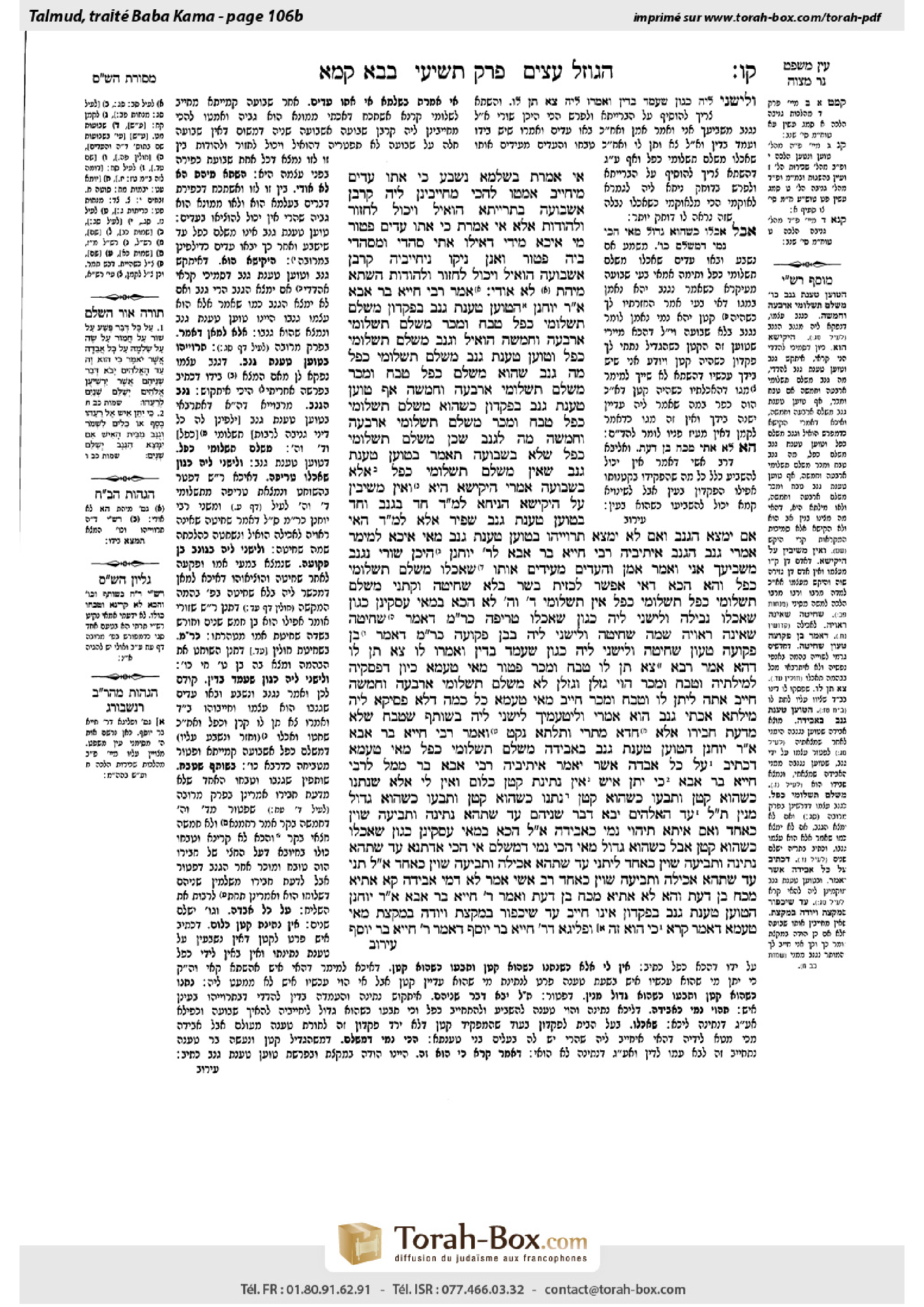
Bava Kamma 106b: Talmud study for Daf Yomi
Study the Talmud for Daf Yomi with scanned pages, Hebrew text, English translations from Sefaria and AI-generated French translations.
Passage selection and English or AI-generated French translation are available where the scan has annotations. Daf Study is independent of Torah-Box and Sefaria.
Browse Bava Kamma · בבא קמא · All tractatesBava Kamma 106b text and translations
This page of Bava Kamma includes the Aramaic text, an English translation and an AI-generated French translation, alongside the scan above.
בבא קמא ק״ו ב · Aramaic and Hebrew text
אִי אָמְרַתְּ בִּשְׁלָמָא נִשְׁבַּע – כִּי אֲתוֹ עֵדִים מִיחַיַּיב, אַמְּטוּ לְהָכִי מְחַיְּיבִינַן לֵיהּ קׇרְבָּן אַשְּׁבוּעָה בָּתְרָיְיתָא, הוֹאִיל וְיָכוֹל לַחֲזוֹר וּלְהוֹדוֹת;
אֶלָּא אִי אָמְרַתְּ כִּי אֲתוֹ עֵדִים פָּטוּר, מִי אִיכָּא מִידֵּי דְּאִילּוּ אָתוּ סָהֲדִי וּמַסְהֲדִי בֵּיהּ – פָּטוּר, וַאֲנַן נֵיקוּ נִיחַיְּיבֵיהּ קׇרְבָּן אַשְּׁבוּעָה הוֹאִיל וְיָכוֹל לַחֲזוֹר וּלְהוֹדוֹת?! הַשְׁתָּא מִיהַת לָא אוֹדִי!
אָמַר רַבִּי חִיָּיא בַּר אַבָּא אָמַר רַבִּי יוֹחָנָן: הַטּוֹעֵן טַעֲנַת גַּנָּב בְּפִקָּדוֹן – מְשַׁלֵּם תַּשְׁלוּמֵי כֶפֶל. טָבַח וּמָכַר – מְשַׁלֵּם תַּשְׁלוּמֵי אַרְבָּעָה וַחֲמִשָּׁה.
הוֹאִיל וְגַנָּב מְשַׁלֵּם תַּשְׁלוּמֵי כֶפֶל, וְטוֹעֵן טַעֲנַת גַּנָּב מְשַׁלֵּם תַּשְׁלוּמֵי כֶפֶל – מָה גַּנָּב, שֶׁהוּא מְשַׁלֵּם כֶּפֶל, טָבַח וּמָכַר מְשַׁלֵּם תַּשְׁלוּמֵי אַרְבָּעָה וַחֲמִשָּׁה; אַף טוֹעֵן טַעֲנַת גַּנָּב בְּפִקָּדוֹן, כְּשֶׁהוּא מְשַׁלֵּם תַּשְׁלוּמֵי כֶפֶל, טָבַח וּמָכַר מְשַׁלֵּם תַּשְׁלוּמֵי אַרְבָּעָה וַחֲמִשָּׁה.
מָה לְגַנָּב – שֶׁכֵּן מְשַׁלֵּם תַּשְׁלוּמֵי כֶפֶל שֶׁלֹּא בִּשְׁבוּעָה, תֹּאמַר בְּטוֹעֵן טַעֲנַת גַּנָּב – שֶׁאֵין מְשַׁלֵּם תַּשְׁלוּמֵי כֶפֶל אֶלָּא בִּשְׁבוּעָה?!
אָמְרִי: הֶיקֵּישָׁא הִיא, וְאֵין מְשִׁיבִין עַל הֶיקֵּישָׁא.
הָנִיחָא לְמַאן דְּאָמַר חַד בְּגַנָּב וְחַד בְּטוֹעֵן טַעֲנַת גַּנָּב, שַׁפִּיר. אֶלָּא לְמַאן דְּאָמַר הַאי ״אִם יִמָּצֵא הַגַּנָּב״, וְ״אִם לֹא יִמָּצֵא״ – תַּרְוַיְיהוּ בְּטוֹעֵן טַעֲנַת גַּנָּב; מַאי אִיכָּא לְמֵימַר?
אָמְרִי: ״גַּנָּב–הַגַּנָּב״.
אֵיתִיבֵיהּ רַבִּי חִיָּיא בַּר אַבָּא לְרַבִּי יוֹחָנָן: ״הֵיכָן שׁוֹרִי?״ ״נִגְנַב״. ״מַשְׁבִּיעֲךָ אֲנִי״, וְאָמַר: ״אָמֵן״, וְהָעֵדִים מְעִידִים אוֹתוֹ שֶׁאֲכָלוֹ – מְשַׁלֵּם תַּשְׁלוּמֵי כֶפֶל. וְהָא הָכָא, דְּאִי אֶפְשָׁר לִכְזַיִת בָּשָׂר בְּלֹא שְׁחִיטָה, וְקָתָנֵי: מְשַׁלֵּם תַּשְׁלוּמֵי כֶפֶל; תַּשְׁלוּמֵי כֶפֶל – אִין, תַּשְׁלוּמֵי אַרְבָּעָה וַחֲמִשָּׁה – לָא!
הָכָא בְּמַאי עָסְקִינַן – כְּגוֹן שֶׁאֲכָלוֹ נְבֵילָה.
וְלִישַׁנֵּי לֵיהּ כְּגוֹן שֶׁאֲכָלוֹ טְרֵיפָה! כְּרַבִּי מֵאִיר, דְּאָמַר: שְׁחִיטָה שֶׁאֵינָהּ רְאוּיָה – שְׁמָהּ שְׁחִיטָה.
וְלִישַׁנֵּי לֵיהּ בְּבֶן פְּקוּעָה! כְּרַבִּי מֵאִיר, דְּאָמַר: בֶּן פְּקוּעָה טָעוּן שְׁחִיטָה.
וְלִישַׁנֵּי לֵיהּ כְּגוֹן שֶׁעָמַד בַּדִּין, וְאָמְרוּ לוֹ: ״צֵא תֵּן לוֹ״! דְּהָא אָמַר רָבָא: ״צֵא תֵּן לוֹ״, טָבַח וּמָכַר – פָּטוּר. מַאי טַעְמָא? כֵּיוָן דְּפַסְקֵיהּ לְמִילְּתֵיהּ, וְטָבַח וּמָכַר – הָוֵי גַּזְלָן, וְגַזְלָן לָא מְשַׁלֵּם תַּשְׁלוּמֵי אַרְבָּעָה וַחֲמִשָּׁה.
״חַיָּיב אַתָּה לִיתֵּן לוֹ״, וְטָבַח וּמָכַר – חַיָּיב. מַאי טַעְמָא? כֹּל כַּמָּה דְּלָא פְּסִיקָא לֵיהּ מִילְּתָא, אַכַּתִּי גַּנָּב הוּא.
אָמְרִי: וְלִיטַעְמָיךְ, לִישַׁנֵּי לֵיהּ בְּשׁוּתָּף שֶׁטָּבַח שֶׁלֹּא מִדַּעַת חֲבֵירוֹ! אֶלָּא חֲדָא מִתְּרֵי וּתְלָתָא נָקֵט.
וְאָמַר רַבִּי חִיָּיא בַּר אַבָּא אָמַר רַבִּי יוֹחָנָן: הַטּוֹעֵן טַעֲנַת גַּנָּב בַּאֲבֵידָה, מְשַׁלֵּם תַּשְׁלוּמֵי כֶפֶל. מַאי טַעְמָא? דִּכְתִיב: ״עַל כׇּל אֲבֵדָה אֲשֶׁר יֹאמַר״.
אֵיתִיבֵיהּ רַבִּי אַבָּא בַּר מֶמֶל לְרַבִּי חִיָּיא בַּר אַבָּא: ״כִּי יִתֵּן אִישׁ״ – אֵין נְתִינַת קָטָן כְּלוּם. וְאֵין לִי אֶלָּא שֶׁנְּתָנוֹ כְּשֶׁהוּא קָטָן, וּתְבָעוֹ כְּשֶׁהוּא קָטָן; נְתָנוֹ כְּשֶׁהוּא קָטָן וּתְבָעוֹ כְּשֶׁהוּא גָּדוֹל – מִנַּיִן? תַּלְמוּד לוֹמַר: ״עַד הָאֱלֹהִים יָבֹא דְּבַר שְׁנֵיהֶם״ – עַד שֶׁתְּהֵא נְתִינָה וּתְבִיעָה שָׁוִין כְּאֶחָד.
וְאִם אִיתָא, תֶּיהְוֵי נָמֵי כַּאֲבֵידָה! אֲמַר לֵיהּ: הָכָא בְּמַאי עָסְקִינַן – כְּגוֹן שֶׁאֲכָלוֹ כְּשֶׁהוּא קָטָן.
אֲבָל כְּשֶׁהוּא גָּדוֹל מַאי, הָכִי נָמֵי דִּמְשַׁלֵּם? אִי הָכִי, אַדִּתְנָא: עַד שֶׁתְּהֵא נְתִינָה וּתְבִיעָה שָׁוִין כְּאֶחָד, לִיתְנֵי: עַד שֶׁתְּהֵא אֲכִילָה וּתְבִיעָה שָׁוִין כְּאֶחָד! אֲמַר לֵיהּ, תְּנִי: עַד שֶׁתְּהֵא אֲכִילָה וּתְבִיעָה שָׁוִין כְּאֶחָד.
רַב אָשֵׁי אָמַר: לָא דָּמֵי; אֲבֵידָה – קָא אָתְיָא מִכֹּחַ בֶּן דַּעַת, וְהָא – לָא אָתְיָא מִכֹּחַ בֶּן דַּעַת.
וְאָמַר רַבִּי חִיָּיא בַּר אַבָּא אָמַר רַבִּי יוֹחָנָן: הַטּוֹעֵן טַעֲנַת גַּנָּב בְּפִקָּדוֹן, אֵינוֹ חַיָּיב עַד שֶׁיִּכְפּוֹר בְּמִקְצָת וְיוֹדֶה בְּמִקְצָת. מַאי טַעְמָא? דְּאָמַר קְרָא: ״כִּי הוּא זֶה״. וּפְלִיגָא דְּרַבִּי חִיָּיא בַּר יוֹסֵף – דְּאָמַר רַבִּי חִיָּיא בַּר יוֹסֵף:
Bava Kamma 106b · English translation
Granted, if you say that when one takes a false oath and then witnesses come, he is liable to pay, that is why we hold him liable for a guilt-offering for the final oath, since he can still retract and admit his liability and incur an obligation to pay. Consequently, the fact that he took another false oath constitutes an additional false denial of his monetary liability.
But if you say, as Rav did, that even when witnesses come he is exempt from paying, then the mishna’s ruling is difficult, as is there any similar case where if witnesses come and testify with regard to it, he would be exempt, and yet we would stand and obligate him to bring a guilt-offering for a later oath, for no reason other than since he can still retract and admit his liability? As of now, in any event, he has not admitted to any liability and has no extant debt, and any further oaths that he takes are not denials of monetary liability. It follows, then, that Rava’s explanation of Rav’s opinion cannot be undermined by Rav Hamnuna’s challenge.
§ The Gemara cites another ruling concerning the topic of a bailee who claims that a deposit in his possession was stolen. Rabbi Ḥiyya bar Abba says that Rabbi Yoḥanan says: One who falsely states the claim, with regard to a deposit, that a thief stole it, and it becomes clear that he stole it himself, pays double payment. If he slaughtered or sold it, he must pay fourfold or fivefold payment.
He explains his ruling by means of a comparison: Since a thief pays double payment, and one who falsely states the claim that a thief stole the deposit also pays double payment, it follows that just as a thief, who ordinarily pays double payment, and if he slaughtered or sold an animal he stole pays fourfold or fivefold payment, so too, one who falsely states the claim that a thief stole a deposit, who ordinarily pays double payment, if he slaughtered or sold the animal he received as a deposit pays fourfold or fivefold payment.
The Gemara asks: What is notable about the halakha of a thief? It is notable in that he pays double payment even without having taken a false oath; will you say that this stringency should apply with regard to one who falsely states the claim that a thief stole the deposit, who pays double payment only upon taking a false oath? Therefore, one cannot derive from the obligation of a thief to pay fourfold or fivefold payment to the case of one who falsely states the claim that the deposit was stolen.
The Sages say in response: Rabbi Yoḥanan did not base his ruling on a logical inference; rather, it is a derivation based upon a juxtaposition, as the verses discussing a thief and one who falsely states the claim that a deposit was stolen are juxtaposed, and one cannot refute through analysis a derivation based upon juxtaposition.
The Gemara asks: This works out well according to the one who says that one verse is stated with regard to a thief and one verse is stated with regard to one who falsely states the claim that a thief stole the deposit. According to him, there is a juxtaposition, and one can well derive one from the other. But according to the one who says that both this verse: “If the thief shall be found, he shall pay double” (Exodus 22:6), and: “If the thief shall not be found” (Exodus 22:7), are referring to one who falsely states the claim that a thief stole the deposit, and neither verse is referring to a thief, what is there to say?
The Sages say in response: Rabbi Yoḥanan’s ruling is derived from an amplification indicated by the verse not employing the term “thief [gannav],” and instead employing the expanded term “the thief [hagannav].” This teaches that the halakha of the fourfold and fivefold payment applies to one who falsely states the claim that the deposit was stolen, as well.
Rabbi Ḥiyya bar Abba raised an objection to the statement of Rabbi Yoḥanan from a baraita: In a scenario where one said to an unpaid bailee: Where is my ox? Then the bailee responded: It was stolen. And the owner said: I administer an oath to you, and the bailee said: Amen. And the witnesses testify about the bailee that he ate it, he pays double payment. But here, the halakha is that it is impossible to eat even an olive-bulk of meat without slaughtering the animal first, indicating that it must have been slaughtered, and nevertheless it teaches that he pays double payment. It can be inferred that double payment, yes, he pays; but fourfold or fivefold payment, no, he does not pay.
Rabbi Yoḥanan answers: With what are we dealing here? We are dealing with a case where he ate it as an unslaughtered animal carcass. Since it was not killed according to the halakhot of ritual slaughter, the thief does not pay the fourfold or fivefold payment.
The Gemara asks: And let Rabbi Yoḥanan answer Rabbi Ḥiyya bar Abba by saying that it is a case such as where he ate it as an animal with a wound that will cause it to die within twelve months [tereifa], in accordance with Rabbi Shimon’s opinion that the legal status of an act of slaughter that is not fit for accomplishing its full ritual purpose is not considered an act of slaughter for which the thief must pay the fourfold or fivefold payment. The Gemara responds that Rabbi Yoḥanan holds in accordance with the opinion of Rabbi Meir, who says that the legal status of an act of slaughter that is not fit for accomplishing its full ritual purpose is considered an act of slaughter, and the thief would pay the fourfold or fivefold payment.
The Gemara further asks: And let Rabbi Yoḥanan answer Rabbi Ḥiyya bar Abba by saying that the ruling of the baraita is stated with regard to an animal removed from its mother’s womb after the mother was ritually slaughtered [ben pekua], which is permitted for consumption without slaughter, so that there is a possibility that the thief ate it without first slaughtering it. The Gemara responds that Rabbi Yoḥanan holds in accordance with the opinion of Rabbi Meir, who says that a ben pekua requires slaughter.
The Gemara further asks: And let Rabbi Yoḥanan answer Rabbi Ḥiyya bar Abba by saying that it is a case where the bailee stood in judgment in court, and the judges said to him: Go out and give him the stolen animal, and he did not do so, and subsequently slaughtered or sold it? In this case he would not pay the fourfold or fivefold payment, as doesn’t Rava say that if the judges instruct a thief: Go out and give him the stolen animal, and he instead slaughtered or sold it, he is exempt from paying the fourfold or fivefold payment. What is the reason for this? Once the court ruled on his matter, requiring him to give the animal to the owner, and he did not heed the court’s ruling but slaughtered or sold the animal, he is considered a robber, and not a thief; and a robber does not pay fourfold or fivefold payment.
Rava continues: But if the judges say only: You are obligated to give the animal to him, and he did not heed the court’s statement but slaughtered or sold the animal, then he is obligated to pay the fourfold or fivefold payment. What is the reason for this? Since the court has not issued a definitive ruling in this matter, he is still considered a thief rather than a robber.
The Sages say in response: And according to your reasoning, let Rabbi Yoḥanan answer Rabbi Ḥiyya bar Abba by saying that the ruling of the baraita is stated with regard to a partner who slaughtered an animal stolen by him and his partner without the other partner’s knowledge, as the halakha is that in such a case, the thief, i.e., the partner who slaughtered the animal, does not pay fourfold or fivefold payment. Rather, Rabbi Yoḥanan selected one of two or three possible answers but did not mean to say that it was the only possible answer.
§ The Gemara cites a related ruling: And Rabbi Ḥiyya bar Abba says that Rabbi Yoḥanan says: With regard to one who falsely states the claim, with regard to a lost item, that a thief stole it, i.e., he found a lost item, and when the owner requested its return, he claimed that it had been stolen from him, and it became known that he lied and had taken the item himself, he pays double payment. What is the reason for this? As it is written in the verse concerning double payment for a thief: “For any matter of trespass, from an ox, for a donkey, for a sheep, for a garment, or for any lost item about which one shall say: This is it, the claims of both of them shall come before the judges; the one whom the judges convict shall pay double to his neighbor” (Exodus 22:8). It can be seen from here that double payment applies to a false claim of theft even with regard to a lost item.
Rabbi Abba bar Memel raised an objection to Rabbi Ḥiyya bar Abba from a baraita: The verse states: “If a man gives his neighbor money or vessels to safeguard, and it was stolen from the house of the man, if the thief shall be found, he shall pay double” (Exodus 22:6). The use of the word “man” indicates that the giving of a deposit by a minor is nothing. And I have derived only a case where he gives the deposit when he is a minor and lodges the claim concerning it against the bailee when he is still a minor. From where is it derived that the halakha would be the same in a case where he gives the deposit when he is a minor and lodges the claim concerning it against the bailee when he is an adult? The verse states: “The claims of both of them shall come before the judges” (Exodus 22:8), i.e., the claim is valid only when the giving of the deposit and the claim are equal, both done when he is an adult.
Based on the ruling of this baraita, Rabbi Abba bar Memel raises his objection: And if it is so that even one who finds a lost item pays double payment for claiming falsely that it was stolen, indicating that the giving of the item as a deposit by the owner is not an essential condition to render the thief liable for double payment, then the claim of a minor should be like a lost item as well, and one who received a deposit from a minor should be liable for double payment. Rabbi Ḥiyya bar Abba said to him: With what are we dealing here? We are dealing with a case where the bailee consumed the deposit when the owner was still a minor, so that at the time it was consumed, the owner had no legal standing. Therefore, the bailee is not obligated to pay.
Rabbi Abba bar Memel questions this answer: But had the bailee consumed it when the owner was already an adult, what is the halakha; indeed, would the halakha be that the bailee pays? If so, rather than teaching: The claim is valid only when the giving of the deposit and the claim are equal, let the baraita teach: The claim is valid only when the consumption of the deposit and the claim are equal, which would be a more precise ruling. Rabbi Ḥiyya bar Abba said to him: Emend the baraita and teach: The claim is valid only when the consumption of the deposit and the claim are equal.
Rav Ashi said a different answer to Rabbi Abba bar Memel’s objection: The two cases are not comparable, so an objection to Rabbi Ḥiyya bar Abba’s statement concerning a lost item cannot be derived from the case of a minor giving a deposit, because the lost item came into the possession of the finder by the power of one who is mentally competent, as the one who lost it is presumed to be an adult, though he did not personally give it to the finder; but this deposit given by a minor did not come into his possession by the power of one who is mentally competent, as from a halakhic perspective, a minor is not considered mentally competent. Therefore, he has no grounds for a claim.
§ The Gemara quotes a related ruling: And Rabbi Ḥiyya bar Abba says that Rabbi Yoḥanan says: With regard to one who falsely states the claim, with regard to a deposit, that a thief stole it, he is not obligated to take an oath, nor to pay double payment, until he denies part of the claim and admits to part of the claim. What is the reason for this? As the verse states: “About which one shall say: This is it” (Exodus 22:8), indicating an admittance of only this part, but no more. The Gemara notes: And this disagrees with the ruling of Rabbi Ḥiyya bar Yosef, as Rabbi Ḥiyya bar Yosef says:
Bava Kamma 106b · Traduction française (IA)
D'accord, si vous dites que lorsqu'une personne prend un serment faux et ensuite des témoins viennent, il est tenu responsable de payer, c'est pourquoi nous le tenons responsable d'un sacrifice de culpabilité pour le dernier serment, car il peut encore rétracter et reconnaître sa responsabilité et s'engager à payer. En conséquence, le fait qu'il ait pris un autre serment faux constitue une dénégation supplémentaire de sa responsabilité financière.
Mais si vous dites, comme le fait Rav, qu'even si des témoins viennent, il est exempt de payer, alors la décision de la mitsva est difficile, car il y a là un cas similaire où, si des témoins viennent et témoignent à ce sujet, il serait exempt, et pourtant nous serions tenus de l'obliger à apporter un sacrifice de culpabilité pour un serment ultérieur, sans autre raison que le fait qu'il peut encore rétracter et reconnaître sa responsabilité ? En tout cas, pour l'instant, il n'a pas reconnu de responsabilité et n'a pas de dette existante, et tout serment ultérieur qu'il prend n'est pas une dénégation de responsabilité financière. Il en suit donc que l'explication de Rava sur l'opinion de Rav ne peut pas être mise en doute par le défi de Rav Hamnuna.
§ La Guemara cite une autre décision concernant le sujet d'un dépositaire qui affirme qu'un dépôt en son possession a été volé. Rabbi Ḥiyya bar Abba dit que Rabbi Yoḥanan dit : Celui qui affirme faussement que le vol a été commis par un voleur, et qui devient clair qu'il a lui-même volé, paie doublement. Si il a sacrifié ou vendu l'animal, il doit payer quatre fois ou cinq fois la valeur.
Il explique sa décision par une comparaison : Puisque un voleur paie doublement, et celui qui affirme faussement que le vol a été commis par un voleur paie également doublement, il suit que tout comme un voleur, qui paie normalement doublement, et si il a sacrifié ou vendu un animal volé paie quatre fois ou cinq fois, de même celui qui affirme faussement que le vol a été commis par un voleur, qui paie normalement doublement, si il a sacrifié ou vendu l'animal qu'il a reçu en dépôt paie quatre fois ou cinq fois.
La Guemara demande : Qu'est-ce qui rend notable la halakha du voleur ? C'est qu'il paie doublement même sans avoir pris un serment faux ; direz-vous que cette stricte application devrait s'appliquer à celui qui affirme faussement que le vol a été commis par un voleur, qui paie doublement seulement après avoir pris un serment faux ? Ainsi, on ne peut pas déduire de l'obligation du voleur de payer quatre fois ou cinq fois à la situation de celui qui affirme faussement que le dépôt a été volé.
Les Sages répondent en disant : Rabbi Yoḥanan n'a pas fondé sa décision sur une déduction logique ; plutôt, c'est une déduction basée sur un juxtaposition, car les versets concernant le voleur et celui qui affirme faussement que le dépôt a été volé sont juxtaposés, et on ne peut pas réfuter une déduction basée sur un juxtaposition par l'analyse.
La Guemara demande : Cela fonctionne bien selon celui qui dit qu'un verset est mentionné concernant le voleur et un autre concernant celui qui affirme faussement que le dépôt a été volé. Selon lui, il y a un juxtaposition, et on peut bien déduire l'un de l'autre. Mais selon celui qui dit que ces versets : « Si le voleur est trouvé, il paiera doublement » (Exode 22:6), et : « Si le voleur n'est pas trouvé » (Exode 22:7), concernent celui qui affirme faussement que le dépôt a été volé, et aucun verset ne concerne le voleur, qu'est-ce que cela signifie ?
Les Sages répondent en disant : La décision de Rabbi Yoḥanan est dérivée d'une amplification indiquée par le verset qui ne mentionne pas le terme « voleur [gannav] », mais utilise le terme étendu « le voleur [hagannav] ». Cela enseigne que la halakha concernant le paiement quatre fois ou cinq fois s'applique également à celui qui affirme faussement que le dépôt a été volé.
Rabbi Ḥiyya bar Abba a soulevé une objection contre la déclaration de Rabbi Yoḥanan à partir d'une baraïta : Dans un cas où l'on a dit à un dépositaire non payé : Où est mon bœuf ? Le dépositaire a répondu : Il a été volé. Et l'owner a dit : Je t'administre un serment, et le dépositaire a dit : Amen. Et les témoins témoignent du dépositaire qu'il l'a mangé, il paie doublement. Mais ici, la halakha est que c'est impossible de manger même une quantité d'olive de viande sans avoir d'abord sacrifié l'animal, indiquant qu'il a dû être sacrifié, et pourtant cela enseigne qu'il paie doublement. On peut en déduire que doublement, oui, il paie ; mais quatre fois ou cinq fois, non, il ne paie pas.
Rabbi Yoḥanan répond : Avec quoi sommes-nous en train de nous occuper ? Nous sommes en train de nous occuper d'un cas où il l'a mangé comme un cadavre non sacrifié. Puisque ce n'était pas tué selon les halakhot de la bataille, le voleur ne paie pas quatre fois ou cinq fois.
La Guemara demande : Et laissez Rabbi Yoḥanan répondre à Rabbi Ḥiyya bar Abba en disant que c'est un cas tel que celui où il l'a mangé comme un animal avec une blessure qui le fera mourir en douze mois [tereifa], selon l'opinion de Rabbi Shimon que le statut juridique d'une action de bataille qui n'est pas adaptée à accomplir pleinement son but rituel n'est pas considérée comme une action de bataille pour laquelle le voleur doit payer quatre fois ou cinq fois. La Guemara répond que Rabbi Yoḥanan suit l'opinion de Rabbi Meir, qui dit que le statut juridique d'une action de bataille qui n'est pas adaptée à accomplir pleinement son but rituel est considérée comme une action de bataille, et le voleur paie quatre fois ou cinq fois.
La Guemara demande de plus : Et laissez Rabbi Yoḥanan répondre à Rabbi Ḥiyya bar Abba en disant que la décision de la baraïta est formulée concernant un animal retiré de son ventre maternel après que la mère ait été sacrifiée rituellement [ben pekua], qui est permis à la consommation sans bataille, de sorte qu'il y a une possibilité que le voleur l'ait mangé sans avoir d'abord sacrifié l'animal. La Guemara répond que Rabbi Yoḥanan suit l'opinion de Rabbi Meir, qui dit qu'un ben pekua nécessite une bataille.
Le Guemara pose une question supplémentaire : Et Rabbi Yoḥanan répondrait à Rabbi Ḥiyya bar Abba en disant que c’est un cas où le porteur de charge a été jugé en cour, et les juges lui dirent : Sortez et donnez-lui l’animal volé, et il ne l’a pas fait, et ensuite il l’a tué ou vendu ? Dans ce cas, il ne paierait pas la réparation quadruple ou quintuple, car n’est-ce pas ce que Rava dit : si les juges ordonnent à un voleur : Sortez et donnez-lui l’animal volé, et s’il le tue ou le vend au lieu de le rendre, il est exempt de payer la réparation quadruple ou quintuple. Pourquoi ? Une fois que la cour a rendu un jugement sur sa cause, exigeant qu’il rende l’animal à l’propriétaire, et qu’il n’ait pas obéi à la décision de la cour mais qu’il l’ait tué ou vendu, il est considéré comme un voleur, et non un voleur ; et un voleur ne paie pas la réparation quadruple ou quintuple.
Rava continue : Mais si les juges disent seulement : Vous êtes tenu de lui rendre l’animal, et qu’il n’ait pas obéi à la déclaration de la cour mais qu’il l’ait tué ou vendu, alors il est tenu de payer la réparation quadruple ou quintuple. Pourquoi ? Parce que la cour n’a pas rendu un jugement définitif sur cette affaire, il est encore considéré comme un voleur plutôt qu’un voleur.
Les Sages répondent en disant : Et selon votre raisonnement, laissez Rabbi Yoḥanan répondre à Rabbi Ḥiyya bar Abba en disant que la décision de la baraïta est formulée concernant un partenaire qui a tué un animal volé par lui et son partenaire sans la connaissance de l’autre partenaire, car la halakha est que dans ce cas, le voleur, c’est-à-dire le partenaire qui a tué l’animal, ne paie pas la réparation quadruple ou quintuple. Plutôt, Rabbi Yoḥanan a sélectionné l’une des deux ou trois réponses possibles, mais n’a pas voulu dire que c’était la seule réponse possible.
§ Le Guemara cite une décision connexe : Rabbi Ḥiyya bar Abba dit que Rabbi Yoḥanan dit : Concernant celui qui fait une déclaration fausse concernant un objet perdu, disant qu’un voleur l’a volé, c’est-à-dire qu’il a trouvé un objet perdu, et quand l’owner a demandé son retour, il a affirmé qu’il avait été volé de lui, et il s’est avéré qu’il mentait et qu’il avait lui-même pris l’objet, il paie la réparation double. Pourquoi ? Parce que l’écriture mentionne la réparation double pour un voleur : « Pour toute affaire de vol, d’un bœuf, d’un âne, d’une brebis, d’un vêtement, ou pour tout objet perdu dont on dira : C’est cela, les revendications des deux doivent venir devant les juges ; celui que les juges condamneront paiera double à son voisin » (Exode 22:8). On peut en voir ici que la réparation double s’applique à une déclaration fausse de vol même concernant un objet perdu.
Rabbi Abba bar Memel souleva une objection contre Rabbi Ḥiyya bar Abba à partir d’une baraïta : L’écriture dit : « Si un homme donne à son voisin de l’argent ou des objets pour les garder, et qu’il ait été volé de la maison de l’homme, si le voleur est trouvé, il paiera double » (Exode 22:6). L’emploi du mot « homme » indique que le don d’un dépôt par un mineur est sans importance. Et j’ai déduit seulement le cas où il donne le dépôt quand il est mineur et porte la revendication contre le gardien quand il est encore mineur. D’où est-il déduit que la halakha serait la même dans le cas où il donne le dépôt quand il est mineur et porte la revendication contre le gardien quand il est adulte ? L’écriture dit : « Les revendications des deux doivent venir devant les juges » (Exode 22:8), c’est-à-dire que la revendication est valide seulement quand le don du dépôt et la revendication sont égaux, tous deux faits quand il est adulte.
D'après la décision de cette baraïta, Rabbi Abba bar Memel soulève son objection : Et si c'est ainsi que même celui qui trouve un objet perdu paie double la réparation pour avoir affirmé faussement qu'il avait été volé, indiquant que le don de l'objet comme dépôt par l'owner n'est pas une condition essentielle pour rendre le voleur responsable de la réparation double, alors la revendication d'un mineur devrait être comme un objet perdu également, et celui qui a reçu un dépôt d'un mineur devrait être responsable de la réparation double. Rabbi Ḥiyya bar Abba lui répond : Avec quoi sommes-nous en train de nous occuper ? Nous sommes en train de nous occuper d'un cas où le gardien a consommé le dépôt quand l'owner était encore mineur, de sorte que lorsqu'il a été consommé, l'owner n'avait pas le droit légal. Par conséquent, le gardien n'est pas tenu de payer.
Rabbi Abba bar Memel questionne cette réponse : Mais si le gardien l'avait consommé quand l'owner était déjà adulte, quelle serait la halakha ; en effet, la halakha serait-elle que le gardien paie ? Si c'est le cas, plutôt que d'enseigner : La revendication est valide seulement quand le don du dépôt et la revendication sont égaux, enseignons plutôt : La revendication est valide seulement quand la consommation du dépôt et la revendication sont égales, ce qui serait une décision plus précise. Rabbi Ḥiyya bar Abba lui répond : Corrigez la baraïta et enseignez : La revendication est valide seulement quand la consommation du dépôt et la revendication sont égales.
Rav Ashi a donné une réponse différente à l’objection de Rabbi Abba bar Memel : Les deux cas ne sont pas comparables, donc une objection contre la déclaration de Rabbi Ḥiyya bar Abba concernant un objet perdu ne peut pas être dérivée du cas d’un mineur qui donne un dépôt, car l’objet perdu est entré en possession du trouver par le pouvoir d’une personne compétente, car celui qui l’a perdu est supposé être adulte, même s’il n’a pas personnellement donné l’objet au trouver ; mais ce dépôt donné par un mineur n’est pas entré en possession de lui par le pouvoir d’une personne compétente, car, du point de vue halakhique, un mineur n’est pas considéré comme compétent. Par conséquent, il n’a pas de fondement pour une revendication.
§ Le Guemara cite une décision connexe : Et Rabbi Ḥiyya bar Abba dit que Rabbi Yoḥanan dit : Concernant celui qui fait une déclaration fausse, concernant un dépôt, disant qu’un voleur l’a volé, il n’est pas tenu de prendre un serment, ni de payer la réparation double, jusqu’à ce qu’il nie une partie de la revendication et admette une autre partie. Pourquoi ? Parce que l’écriture dit : « Concernant lequel on dira : C’est cela » (Exode 22:8), indiquant une admission seulement de cette partie, mais pas plus. Le Guemara note : Et cela contredit la décision de Rabbi Ḥiyya bar Yosef, car Rabbi Ḥiyya bar Yosef dit :
Traduction française générée par IA à partir de l’édition anglaise de Sefaria. Vérifie toujours un passage avec le texte source.
Text from Sefaria: William Davidson Edition - Vocalized Aramaic (CC BY NC); William Davidson Edition - English (CC BY NC).