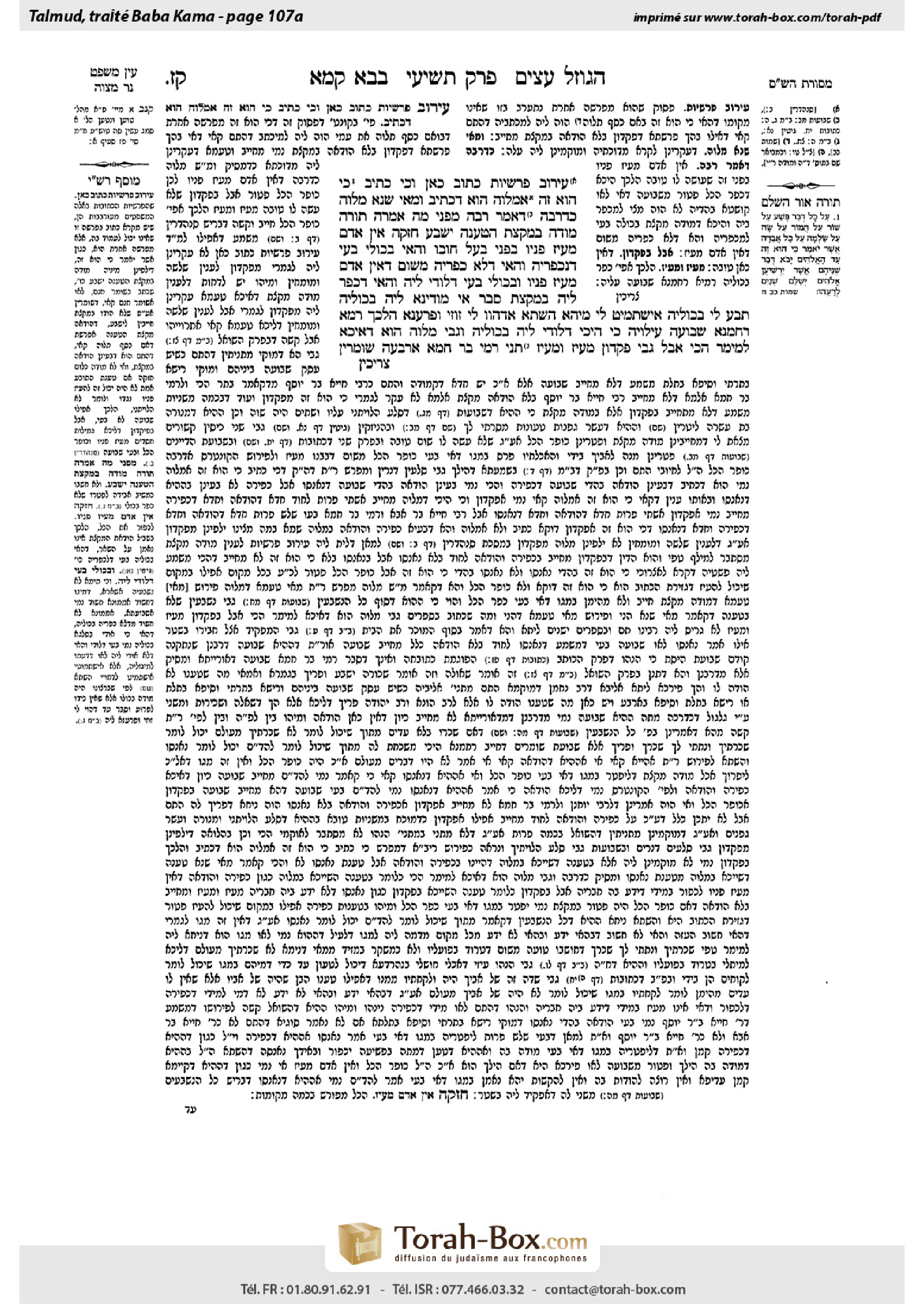
Bava Kamma 107a: Talmud study for Daf Yomi
Study the Talmud for Daf Yomi with scanned pages, Hebrew text, English translations from Sefaria and AI-generated French translations.
Passage selection and English or AI-generated French translation are available where the scan has annotations. Daf Study is independent of Torah-Box and Sefaria.
Browse Bava Kamma · בבא קמא · All tractatesBava Kamma 107a text and translations
This page of Bava Kamma includes the Aramaic text, an English translation and an AI-generated French translation, alongside the scan above.
בבא קמא ק״ז א · Aramaic and Hebrew text
עֵירוּב פָּרָשִׁיּוֹת כָּתוּב כָּאן, וְכִי כְּתִיב: ״כִּי הוּא זֶה״ – אַמִּלְוָה הוּא דִּכְתִיב. וּמַאי שְׁנָא מִלְוָה?
כִּדְרַבָּה – דְּאָמַר רַבָּה, מִפְּנֵי מָה אָמְרָה תּוֹרָה: מוֹדֶה בְּמִקְצָת הַטַּעֲנָה יִשָּׁבַע? חֲזָקָה אֵין אָדָם מֵעִיז פָּנָיו בִּפְנֵי בַּעַל חוֹבוֹ; וְהַאי – בְּכוּלֵּי[הּ] בָּעֵי דְּנִכְפְּרֵיהּ, וְהַאי דְּלָא כַּפְרֵיהּ – מִשּׁוּם דְּאֵין אָדָם מֵעִיז פָּנָיו.
וּבְכוּלֵּי[הּ] בָּעֵי דְּלוֹדֵי לֵיהּ, וְהַאי דִּכְפַר לֵיהּ בְּמִקְצָת – סָבַר: אִי מוֹדֵינָא לֵיהּ בְּכוּלֵּיהּ – תָּבַע לִי בְּכוּלֵּיהּ; אֶישְׁתְּמֵיט לֵי[הּ] מִיהָא הַשְׁתָּא אַדְּהָווּ לִי זוּזֵי, וּפָרַעְנָא. הִלְכָּךְ רְמָא רַחֲמָנָא שְׁבוּעָה עִילָּוֵיהּ – כִּי הֵיכִי דְּלוֹדֵי לֵיהּ בְּכוּלֵּיהּ.
וְגַבֵּי מִלְוָה הוּא דְּאִיכָּא לְמֵימַר הָכִי, אֲבָל גַּבֵּי פִּקָּדוֹן – מֵעִיז וּמֵעִיז.
תָּנֵי רָמֵי בַּר חָמָא: אַרְבָּעָה שׁוֹמְרִין
Bava Kamma 107a · English translation
A merging of Torah portions is written here, and the halakha written in this passage is in fact meant to be applied to a different passage. And when it is written: “This is it,” from which the halakha of a partial admission is derived, it is written concerning a loan, not a deposit. The Gemara asks: And what is different about a loan that this halakha would apply only there?
The Gemara answers: It is in accordance with the statement of Rabba, as Rabba says: For what reason did the Torah say that one who admits to a part of the claim must take an oath? It is because there is a presumption that a person does not exhibit insolence by lying in the presence of his creditor, who had done him a favor by lending money to him. And this person who denies part of the claim actually wants to deny all of the debt, so as to be exempt, and this fact that he does not deny all of it is because a person does not exhibit insolence.
Rabba continues: And in order not to exhibit insolence, he wants to admit to the creditor with regard to all of the debt, and this fact that he denies owing him in part is because he reasons: If I admit to him with regard to all of the debt, he will lodge a claim against me with regard to all of it, and right now I do not have the money to pay. I will evade him at least for now until I have money, and then I will pay him all of it. This rationalization enables one to falsely deny part of a claim. Therefore, the Merciful One imposes an oath on him, in order to ensure that he will admit to him with regard to all of the debt.
The Gemara completes its answer: And it is with regard to a loan that this can be said, as the basis for this explanation is that one will not exhibit insolence before his creditor, who did him a favor by lending him money; but with regard to a deposit, one will certainly exhibit insolence, as the claimant did him no favor. Therefore, there is no reason to say that one who completely denies a claim concerning a deposit is deemed credible any more than one who admitted to part of it, and he is obligated to take an oath in either case.
§ Rami bar Ḥama teaches this baraita: All four types of bailees
Bava Kamma 107a · Traduction française (IA)
Un mélange de portions de la Torah est écrit ici, et la halakha écrite dans ce passage est en réalité censée s'appliquer à un autre passage. Et lorsqu'il est écrit : « C'est cela », à partir duquel on déduit la halakha concernant une admission partielle, il est question d'un prêt, pas d'un dépôt. La Guemara demande : Et en quoi un prêt est-il différent de sorte que cette halakha s'appliquerait uniquement là ?
La Guemara répond : C'est selon la déclaration de Rabba, car Rabba dit : Pourquoi la Torah dit-elle qu'une personne qui admet une partie de la réclamation doit prendre un serment ? C'est parce qu'il y a une présomption selon laquelle une personne ne montre pas d'arrogance en mentant en présence de son créancier, qui lui a fait un bien en lui prêtant de l'argent. Et cette personne qui nie une partie de la réclamation veut effectivement nier toute la dette afin d'être exempt, et le fait qu'elle ne nie pas toute la dette est dû au fait qu'une personne ne montre pas d'arrogance.
Rabba continue : Et afin de ne pas montrer d'arrogance, il veut admettre à son créancier concernant toute la dette, et le fait qu'il nie d'abord d'endettement est dû à ce qu'il raisonne ainsi : Si j'admet à son égard concernant toute la dette, il portera une réclamation contre moi concernant toute la somme, et en ce moment précis je n'ai pas l'argent pour payer. Je vais m'éviter de lui pour l'instant jusqu'à ce que j'ait de l'argent, et alors je paierai toute la somme. Cette rationalisation permet à une personne de nier faussement une partie d'une réclamation. Ainsi, l'Éternel impose un serment sur lui afin de s'assurer qu'il admettra à son égard concernant toute la dette.
La Guemara termine sa réponse : Et c'est concernant un prêt que cela peut être dit, car la base de cette explication est que l'on ne montre pas d'arrogance devant son créancier, qui lui a fait un bien en lui prêtant de l'argent ; mais concernant un dépôt, l'on montre certainement de l'arrogance, car le réclamant lui a fait aucun bien. Ainsi, il n'y a pas de raison de dire qu'une personne qui nie entièrement une réclamation concernant un dépôt est considérée comme crédible à un point égal à celui qui a admis une partie, et il est tenu de prendre un serment dans les deux cas.
§ Rami bar Ḥama enseigne cette baraïta : Tous les quatre types de dépositaires
Traduction française générée par IA à partir de l’édition anglaise de Sefaria. Vérifie toujours un passage avec le texte source.
Text from Sefaria: William Davidson Edition - Vocalized Aramaic (CC BY NC); William Davidson Edition - English (CC BY NC).