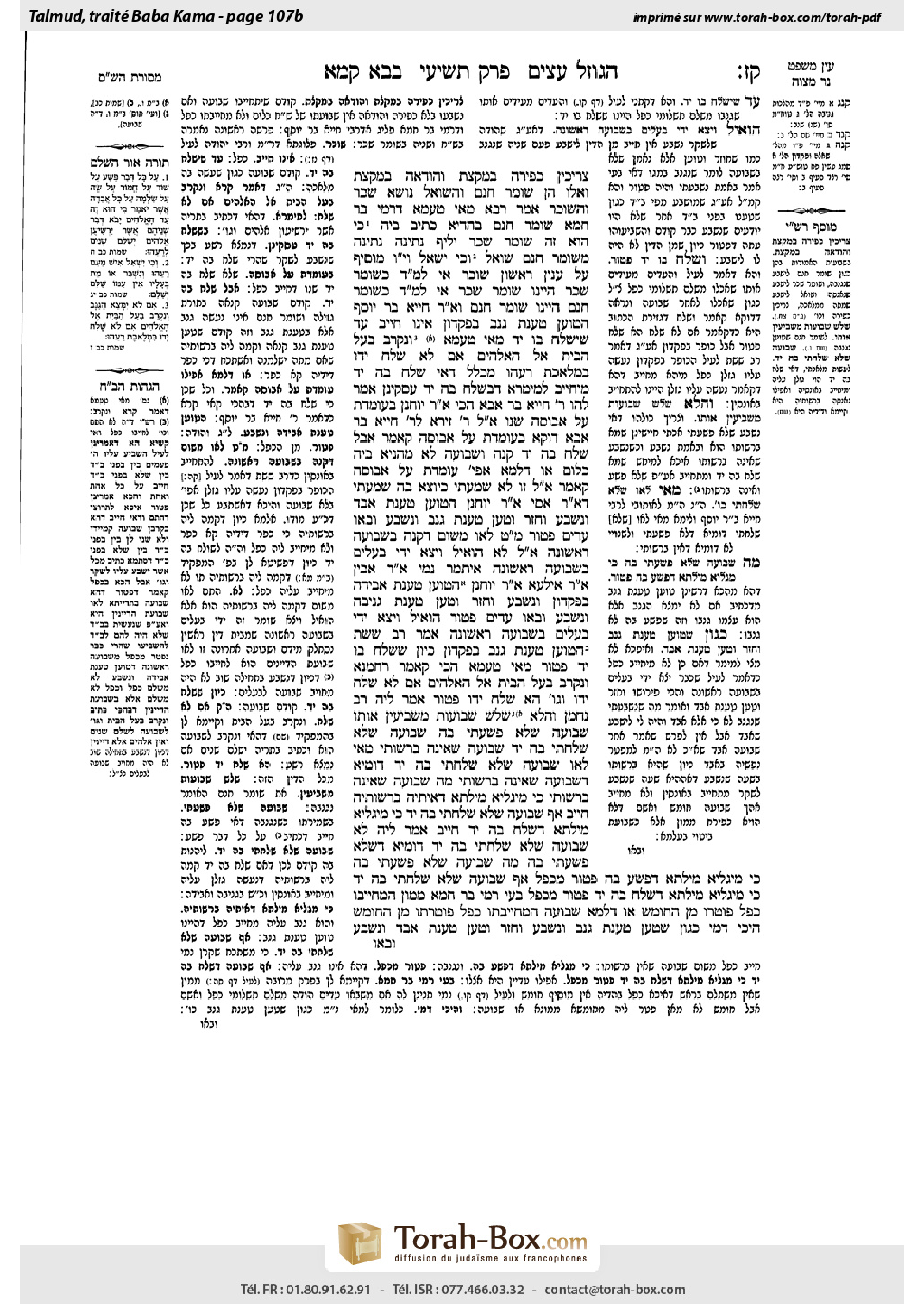
Bava Kamma 107b: Talmud study for Daf Yomi
Study the Talmud for Daf Yomi with scanned pages, Hebrew text, English translations from Sefaria and AI-generated French translations.
Passage selection and English or AI-generated French translation are available where the scan has annotations. Daf Study is independent of Torah-Box and Sefaria.
Browse Bava Kamma · בבא קמא · All tractatesBava Kamma 107b text and translations
This page of Bava Kamma includes the Aramaic text, an English translation and an AI-generated French translation, alongside the scan above.
בבא קמא ק״ז ב · Aramaic and Hebrew text
צְרִיכִין כְּפִירָה בְּמִקְצָת וְהוֹדָאָה בְּמִקְצָת, וְאֵלּוּ הֵן: שׁוֹמֵר חִנָּם וְהַשּׁוֹאֵל, נוֹשֵׂא שָׂכָר וְהַשּׂוֹכֵר.
אָמַר רָבָא: מַאי טַעְמָא דְּרָמֵי בַּר חָמָא? שׁוֹמֵר חִנָּם – בְּהֶדְיָא כְּתִיב בֵּיהּ: ״כִּי הוּא זֶה״. שׁוֹמֵר שָׂכָר – יָלֵיף ״נְתִינָה״–״נְתִינָה״ מִשּׁוֹמֵר חִנָּם.
שׁוֹאֵל – ״וְכִי יִשְׁאַל״, וָיו מוֹסִיף עַל עִנְיָן רִאשׁוֹן. שׂוֹכֵר – אִי לְמַאן דְּאָמַר כְּשׁוֹמֵר שָׂכָר, הַיְינוּ שׁוֹמֵר שָׂכָר; אִי לְמַאן דְּאָמַר כְּשׁוֹמֵר חִנָּם, הַיְינוּ שׁוֹמֵר חִנָּם.
וְאָמַר רַבִּי חִיָּיא בַּר יוֹסֵף: הַטּוֹעֵן טַעֲנַת גַּנָּב בְּפִקָּדוֹן, אֵינוֹ חַיָּיב עַד שֶׁיִּשְׁלַח בּוֹ יָד. מַאי טַעְמָא? ״וְנִקְרַב בַּעַל הַבַּיִת אֶל הָאֱלֹהִים, אִם לֹא שָׁלַח יָדוֹ בִּמְלֶאכֶת רֵעֵהוּ״, מִכְּלָל דְּאִי שָׁלַח בָּהּ יָד – מִיחַיַּיב; לְמֵימְרָא דִּבְשָׁלַח בָּהּ יָד עָסְקִינַן.
אֲמַר לְהוּ רַבִּי חִיָּיא בַּר אַבָּא, הָכִי אָמַר רַבִּי יוֹחָנָן: בְּעוֹמֶדֶת עַל אֲבוּסָהּ שָׁנוּ. אֲמַר לֵיהּ רַבִּי זֵירָא לְרַבִּי חִיָּיא בַּר אַבָּא: דַּוְקָא בְּעוֹמֶדֶת עַל אֲבוּסָהּ קָאָמַר, אֲבָל שָׁלַח בָּהּ יָד – קָנָה, וּשְׁבוּעָה לָא מַהְנְיָא בֵּיהּ כְּלוּם; אוֹ דִלְמָא, אֲפִילּוּ עוֹמֶדֶת עַל אֲבוּסָהּ קָאָמַר?
אֲמַר לֵיהּ: זוֹ לֹא שָׁמַעְתִּי, כַּיּוֹצֵא בָּהּ שָׁמַעְתִּי; דְּאָמַר רַבִּי אַסִּי אָמַר רַבִּי יוֹחָנָן: הַטּוֹעֵן טַעֲנַת אָבַד וְנִשְׁבַּע, וְחָזַר וְטָעַן טַעֲנַת גַּנָּב וְנִשְׁבַּע, וּבָאוּ עֵדִים – פָּטוּר. מַאי טַעְמָא, לָאו מִשּׁוּם דְּקָנָה בִּשְׁבוּעָה רִאשׁוֹנָה?
אֲמַר לֵיהּ: לָא, הוֹאִיל וְיָצָא יְדֵי בְּעָלִים בִּשְׁבוּעָה רִאשׁוֹנָה.
אִיתְּמַר נָמֵי, אָמַר רַבִּי אָבִין אָמַר רַבִּי אִילְעָא אָמַר רַבִּי יוֹחָנָן: הַטּוֹעֵן טַעֲנַת אֲבֵידָה בְּפִקָּדוֹן וְנִשְׁבַּע, וְחָזַר וְטָעַן טַעֲנַת גְּנֵיבָה וְנִשְׁבַּע, וּבָאוּ עֵדִים – פָּטוּר, הוֹאִיל וְיָצָא יְדֵי בְּעָלִים בִּשְׁבוּעָה רִאשׁוֹנָה.
אָמַר רַב שֵׁשֶׁת: הַטּוֹעֵן טַעֲנַת גַּנָּב בְּפִקָּדוֹן, כֵּיוָן שֶׁשָּׁלַח בּוֹ יָד – פָּטוּר. מַאי טַעְמָא? הָכִי קָאָמַר רַחֲמָנָא: ״וְנִקְרַב בַּעַל הַבַּיִת אֶל הָאֱלֹהִים, אִם לֹא שָׁלַח יָדוֹ וְגוֹ׳״, הָא שָׁלַח יָדוֹ – פָּטוּר.
אֲמַר לֵיהּ רַב נַחְמָן, וַהֲלֹא שָׁלֹשׁ שָׁבוּעוֹת מַשְׁבִּיעִין אוֹתוֹ: ״שְׁבוּעָה שֶׁלֹּא פָּשַׁעְתִּי בָּהּ״; ״שְׁבוּעָה שֶׁלֹּא שָׁלַחְתִּי בָּהּ יָד״; ״שְׁבוּעָה שֶׁאֵינָהּ בִּרְשׁוּתִי״. מַאי, לָאו ״שְׁבוּעָה שֶׁלֹּא שָׁלַחְתִּי בָּהּ יָד״ – דֻּומְיָא דִּשְׁבוּעָה שֶׁאֵינָהּ בִּרְשׁוּתִי״? מָה ״שְׁבוּעָה שֶׁאֵינָהּ בִּרְשׁוּתִי״, כִּי מִיגַּלְּיָא מִילְּתָא דְּאִיתֵיהּ בִּרְשׁוּתֵיהּ – חַיָּיב; ״אַף שְׁבוּעָה שֶׁלֹּא שָׁלַחְתִּי בָּהּ יָד״, כִּי מִיגַּלְּיָא מִילְּתָא דִּשְׁלַח בָּהּ יָד – חַיָּיב!
אֲמַר לֵיהּ: לָא; ״שְׁבוּעָה שֶׁלֹּא שָׁלַחְתִּי בָּהּ יָד״ – דּוּמְיָא דְּ״שֶׁלֹּא פָּשַׁעְתִּי בָּהּ״. מָה ״שְׁבוּעָה שֶׁלֹּא פָּשַׁעְתִּי בָּהּ״ – כִּי מִיגַּלְּיָא מִילְּתָא דְּפָשַׁע בָּהּ, פָּטוּר מִכֶּפֶל; אַף ״שְׁבוּעָה שֶׁלֹּא שָׁלַחְתִּי בָּהּ יָד״ – כִּי מִיגַּלְּיָא מִילְּתָא דִּשְׁלַח בָּהּ יָד, פָּטוּר מִכֶּפֶל.
בָּעֵי רָמֵי בַּר חָמָא: מָמוֹן הַמְחַיְּיבוֹ כֶּפֶל פּוֹטְרוֹ מִן הַחוֹמֶשׁ, אוֹ דִלְמָא שְׁבוּעָה הַמְחַיַּיבְתּוֹ כֶּפֶל פּוֹטַרְתּוֹ מִן הַחוֹמֶשׁ?
הֵיכִי דָּמֵי? כְּגוֹן שֶׁטָּעַן טַעֲנַת גַּנָּב וְנִשְׁבַּע, וְחָזַר וְטָעַן טַעֲנַת אָבַד וְנִשְׁבַּע;
Bava Kamma 107b · English translation
require denial of a part of the claim and admittance of a part of the claim in order to be obligated to take an oath when someone claims to have given them an item as a deposit, and these are they: An unpaid bailee, and a borrower, a paid bailee, and a renter.
The Gemara quotes the source for this statement. Rava said: What is the reasoning for the statement of Rami bar Ḥama? Concerning an unpaid bailee, it is explicitly written with regard to him: “This is it,” as explained earlier. Concerning a paid bailee, Rami bar Ḥama learns by means of a verbal analogy to the term giving used with regard to a paid bailee from the term giving used with regard to an unpaid bailee, since the verses about both a paid and an unpaid bailee begin: “If a man gives his neighbor” (Exodus 22:6, 9).
Rava continues: Rami bar Ḥama learns the halakha concerning a borrower from the verse: “And if [vekhi] a man borrow” (Exodus 22:13). There is a principle that the conjunction “and,” represented by the letter vav, adds to the previous topic. Based on this principle, the halakhot of a borrower are connected to those of the subject of the previous verse, the bailee. Concerning a renter, if Rami bar Ḥama is stating his ruling according to the one who says that a renter is like a paid bailee, this is the same as a paid bailee; if he is stating his ruling according to the one who says that a renter is like an unpaid bailee, this is the same as an unpaid bailee.
§ And Rabbi Ḥiyya bar Yosef says: With regard to an unpaid bailee who falsely states the claim, with regard to a deposit, that a thief stole it, and is discovered to have lied, he is not liable to pay double payment unless he misappropriates it, i.e., uses it for his own needs, before taking his oath. What is the reason for this? The verse states: “If the thief shall not be found, the owner of the house shall approach the judges to determine if he misappropriated his neighbor’s goods” (Exodus 22:7), and the following verse concludes: “The one whom the judges convict shall pay double to his neighbor.” By inference, one can learn that if he misappropriated it, he is liable for double payment; that is to say that we are dealing only with a case where he misappropriates it.
Rabbi Ḥiyya bar Abba said to his students: This is what Rabbi Yoḥanan says: They taught this halakha that one who falsely claims that the deposit was stolen is liable for double payment with regard to an animal still standing over its feeding trough, i.e., the bailee is still safeguarding it for its owner. Rabbi Zeira said to Rabbi Ḥiyya bar Abba: Is he stating his ruling specifically with regard to an animal standing over its feeding trough, but if the bailee misappropriated it before taking an oath, he has acquired it, and an oath is not effective for him at all, not even to cause him to be liable to pay double payment? Or perhaps he is stating his ruling even with regard to an animal standing over its feeding trough, in addition to an animal that the bailee misappropriated?
Rabbi Ḥiyya bar Abba said to him: I did not hear this ruling, so I cannot transmit Rabbi Yoḥanan’s opinion, but I did hear something similar to it, as Rabbi Asi says that Rabbi Yoḥanan says: With regard to an unpaid bailee who falsely states the claim that the deposit was lost and takes an oath to that effect, and retracted and falsely states the claim that a thief stole the deposit and takes an oath to that effect, and witnesses came and testified that he lied, he is exempt from double payment for the second claim. What is the reason; is it not due to the fact that he already acquired the item with the first oath, and therefore the second oath is disregarded, which is why he is not liable for double payment for a false claim of theft? So too, one who misappropriates the deposit thereby acquires it and is no longer obligated to take an oath.
Rabbi Zeira said to him: No, there is no proof from there, because one could argue that the reason is not because he acquired the item with the first oath; rather, since it left the owner’s possession with the bailee taking the first oath, he is exempt from taking an additional oath with regard to the same claim, but his oath will be significant even after having misappropriated the item.
It was also stated: Rabbi Avin says that Rabbi Ile’a says that Rabbi Yoḥanan says: With regard to one who falsely states the claim, with regard to a deposit, that it is now lost, and takes an oath to that effect, and retracts and falsely states the claim that the deposit was taken through theft and takes an oath to that effect, and witnesses come and testify that he lied with regard to the claim of theft, he is exempt from double payment for the second claim, since it left the owner’s possession with the bailee taking the first oath.
The Gemara cites an amora who disputes the ruling of Rabbi Ḥiyya bar Yosef. Rav Sheshet says: With regard to an unpaid bailee who falsely states the claim, with regard to a deposit, that a thief stole it, and is discovered to have lied, once he misappropriated it before he took an oath he is exempt. What is the reason for this? This is what the Merciful One is saying, i.e., this is how the verse is to be understood: “If the thief shall not be found, the owner of the house shall approach the judges if he has not misappropriated his neighbor’s goods” (Exodus 22:7), indicating that this verse speaks specifically with regard to a case where he did not misappropriate the deposit; consequently, if he misappropriated it, he is exempt from double payment.
Rav Naḥman said to Rav Sheshet: But aren’t three oaths administered by the court to any unpaid bailee who claims that the deposit was stolen from him? The first is: An oath that I was not negligent in safeguarding it, thereby enabling it to be stolen; the second is: An oath that I did not misappropriate it; the third is: An oath that it is not in my possession. What, is it not so that: An oath that I did not misappropriate it, is similar to: An oath that it is not in my possession, in the following manner: Just as with regard to: An oath that it is not in my possession, when the matter becomes revealed that it is in his possession, he is liable, so too, with regard to: An oath that I did not misappropriate it, when the matter becomes revealed that he did misappropriate it, he should be liable?
Rav Sheshet said to him: No, there is no proof from there, because one could say that the halakha of: An oath that I did not misappropriate it, is similar to the halakha of: An oath that I was not negligent in safeguarding it, in the following manner: Just as with regard to: An oath that I was not negligent in safeguarding it, when the matter becomes revealed that he was negligent in safeguarding it, he is exempt from double payment, so too, with regard to: An oath that I did not misappropriate it, when the matter becomes revealed that he did misappropriate it, he is exempt from double payment. Since the comparison can be made between different pairings of the oaths to suggest opposite conclusions, none of these comparisons are definitive.
§ The baraita quoted earlier (65b) teaches that a bailee who would be liable for double payment if witnesses were to testify that he had in fact stolen a deposit about which he had taken an oath attesting to its theft does not pay the additional one-fifth payment normally imposed upon one who takes a false oath with regard to a monetary claim. The Gemara explores the reason for this halakha. Rami bar Ḥama raises a dilemma: Is it the monetary obligation that renders him liable for double payment which exempts him from the additional one-fifth payment, or perhaps is it the taking of the oath that renders him liable for double payment which exempts him from the additional one-fifth payment?
The Gemara explains: What are the circumstances in which there is a practical difference between these possibilities? It is in a case where he falsely states the claim that a thief stole the deposit and takes an oath to that effect, and retracts and falsely states the claim that it was lost and takes an oath to that effect,
Bava Kamma 107b · Traduction française (IA)
Pour être tenu de prendre un serment lorsqu'une personne affirme avoir donné un objet en dépôt, il faut que la réclamation soit partiellement rejetée et partiellement admise. Ces cas sont les suivants : un dépositaire non rémunéré, un emprunteur, un dépositaire rémunéré et un locataire.
La Guemara cite la source de cette affirmation. Rava dit : Quel est le raisonnement de la déclaration de Rami bar Ḥama ? Concernant le dépositaire non rémunéré, il est explicitement mentionné dans la Torah : « C’est cela », comme expliqué précédemment. Concernant le dépositaire rémunéré, Rami bar Ḥama apprend par analogie verbale du terme « donner » utilisé concernant le dépositaire rémunéré à partir du terme « donner » utilisé concernant le dépositaire non rémunéré, car les versets relatifs à la fois au dépositaire rémunéré et au dépositaire non rémunéré commencent par : « Si un homme donne à son voisin » (Exode 22:6, 9).
Rava continue : Rami bar Ḥama apprend la halakha concernant l'emprunteur à partir du verset : « Et si [vekhi] un homme emprunte » (Exode 22:13). Il existe un principe selon lequel la conjonction « et », représentée par la lettre vav, ajoute au sujet précédent. Selon ce principe, les halakhot de l'emprunteur sont liées à celles du sujet du verset précédent, le dépositaire. Concernant le locataire, si Rami bar Ḥama affirme son jugement selon celui qui considère que le locataire est comme un dépositaire rémunéré, cela équivaut à un dépositaire rémunéré ; si au contraire il affirme son jugement selon celui qui considère que le locataire est comme un dépositaire non rémunéré, cela équivaut à un dépositaire non rémunéré.
§ Rabbi Ḥiyya bar Yosef dit : Concernant un dépositaire non rémunéré qui affirme faussement une réclamation concernant un dépôt, affirmant qu'un voleur l'a volé, et découvrant qu'il a menti, il n'est pas tenu de payer double à moins qu'il n'ait mis à profit le dépôt, c'est-à-dire l'ait utilisé à ses propres besoins avant de prendre son serment. Quelle est la raison de cela ? Le verset dit : « Si le voleur n'est pas trouvé, l'homme du maison s'adressera aux juges pour déterminer s'il a mis à profit les biens de son voisin » (Exode 22:7), et le verset suivant conclut : « Celui que les juges condamnent paiera double à son voisin. » Par déduction, on peut apprendre que s'il a mis à profit le dépôt, il est tenu de payer double ; c'est-à-dire qu'on s'occupe uniquement du cas où il a mis à profit le dépôt.
Rabbi Ḥiyya bar Abba dit à ses élèves : C'est ce que Rabbi Yoḥanan dit : Ils enseignent cette halakha que celui qui affirme faussement que le dépôt a été volé est tenu de payer double concernant un animal encore sur son aliment, c'est-à-dire que le dépositaire est encore en charge de lui. Rabbi Zeira dit à Rabbi Ḥiyya bar Abba : Est-ce qu'il affirme spécifiquement son jugement concernant un animal sur son aliment, mais si le dépositaire a mis à profit le dépôt avant de prendre son serment, il l'a acquis, et le serment ne l'engage pas du tout, pas même pour l'obliger à payer double ? Ou peut-être affirme-t-il son jugement même concernant un animal sur son aliment, en plus d'un animal que le dépositaire a mis à profit ?
Rabbi Ḥiyya bar Abba dit à lui : Je n'ai pas entendu ce jugement, donc je ne peux pas transmettre l'opinion de Rabbi Yoḥanan, mais j'ai entendu quelque chose de similaire, comme dit Rabbi Asi que Rabbi Yoḥanan dit : Concernant un dépositaire non rémunéré qui affirme faussement la réclamation concernant le dépôt, qu'il est maintenant perdu, et prend un serment à cet effet, puis rétracte et affirme faussement que le dépôt a été volé et prend un serment à cet effet, et des témoins viennent témoigner qu'il a menti concernant la réclamation de vol, il est exempt de payer double pour la seconde réclamation. Quelle est la raison ? N'est-ce pas à cause du fait qu'il a acquis l'objet avec le premier serment, et donc le second serment est négligé, ce qui est pourquoi il n'est pas tenu de payer double pour une réclamation fausse de vol ? De même, celui qui met à profit le dépôt l'acquiert et n'est plus tenu de prendre un serment.
Rabbi Zeira dit à lui : Non, il n'y a pas de preuve à partir de là, car on pourrait argumenter que la raison n'est pas qu'il a acquis l'objet avec le premier serment ; plutôt, puisque l'objet a quitté la possession du propriétaire avec le dépositaire prenant le premier serment, il est exempt de prendre un autre serment concernant la même réclamation, mais son serment sera considéré comme significatif même après avoir mis à profit l'objet.
Il a également été dit : Rabbi Avin dit que Rabbi Ile’a dit que Rabbi Yoḥanan dit : Concernant celui qui affirme faussement la réclamation concernant un dépôt, qu'il est maintenant perdu, et prend un serment à cet effet, puis rétracte et affirme faussement que le dépôt a été volé et prend un serment à cet effet, et des témoins viennent témoigner qu'il a menti concernant la réclamation de vol, il est exempt de payer double pour la seconde réclamation, car l'objet a quitté la possession du propriétaire avec le dépositaire prenant le premier serment.
La Guemara cite un amora qui conteste le jugement de Rabbi Ḥiyya bar Yosef. Rav Sheshet dit : Concernant un dépositaire non rémunéré qui affirme faussement une réclamation concernant un dépôt, affirmant qu'un voleur l'a volé, et découvrant qu'il a menti, une fois qu'il a mis à profit le dépôt avant de prendre son serment, il est exempt. Quelle est la raison de cela ? C'est ce que dit l'Éternel, c'est-à-dire c'est ainsi que le verset doit être compris : « Si le voleur n'est pas trouvé, l'homme du maison s'adressera aux juges s'il n'a pas mis à profit les biens de son voisin » (Exode 22:7), indiquant que ce verset parle spécifiquement d'un cas où il n'a pas mis à profit le dépôt ; par conséquent, si il a mis à profit le dépôt, il est exempt de payer double.
Rav Naḥman a dit à Rav Sheshet : Mais ne sont-ils pas administrés par la cour trois serments à tout dépositaire non rétribué qui affirme que le dépôt lui a été volé ? Le premier est : un serment qu'il n'a pas été négligent dans la garde du dépôt, permettant ainsi qu'il soit volé ; le second est : un serment qu'il n'a pas détourné le dépôt ; le troisième est : un serment qu'il ne possède pas le dépôt. Qu'est-ce que cela signifie ? N'est-ce pas ainsi : un serment qu'il n'a pas détourné le dépôt est semblable à un serment qu'il ne possède pas le dépôt, de la manière suivante : Tout comme, concernant un serment qu'il ne possède pas le dépôt, lorsque la situation devient connue qu'il le possède, il est responsable, de même, concernant un serment qu'il n'a pas détourné le dépôt, lorsque la situation devient connue qu'il l'a détourné, il devrait être responsable ?
Rav Sheshet a dit à lui : Non, il n'y a pas de preuve à partir de là, car on pourrait dire que la halakha concernant un serment qu'il n'a pas détourné le dépôt est semblable à la halakha concernant un serment qu'il n'a pas été négligent dans la garde du dépôt, de la manière suivante : Tout comme, concernant un serment qu'il n'a pas été négligent dans la garde du dépôt, lorsque la situation devient connue qu'il a été négligent dans la garde du dépôt, il est exempt de la double réparation, de même, concernant un serment qu'il n'a pas détourné le dépôt, lorsque la situation devient connue qu'il l'a détourné, il est exempt de la double réparation. Puisque la comparaison peut être faite entre différentes paires de serments pour suggérer des conclusions opposées, aucune de ces comparaisons n'est définitive.
§ La baraïta citée plus tôt (65b) enseigne que le dépositaire qui serait responsable de la double réparation si des témoins témoignaient qu'il avait effectivement volé un dépôt concernant lequel il avait pris un serment atténuant le vol ne paie pas la réparation supplémentaire d'un cinquième normalement imposée à celui qui prend un serment faux concernant une affaire monétaire. La Guemara explore la raison de cette halakha. Rami bar Ḥama soulève un dilemme : Est-ce l'obligation monétaire qui rend responsable de la double réparation qui exempt de la réparation supplémentaire d'un cinquième, ou est-ce la prise du serment qui rend responsable de la double réparation qui exempt de la réparation supplémentaire d'un cinquième ?
La Guemara explique : Quelles sont les circonstances où il y a une différence pratique entre ces possibilités ? C'est dans le cas où il affirme faussement la revendication qu'un voleur a volé le dépôt et prend un serment à cet égard, puis retire et affirme faussement la revendication qu'il a été perdu et prend un serment à cet égard,
Traduction française générée par IA à partir de l’édition anglaise de Sefaria. Vérifie toujours un passage avec le texte source.
Text from Sefaria: William Davidson Edition - Vocalized Aramaic (CC BY NC); William Davidson Edition - English (CC BY NC).