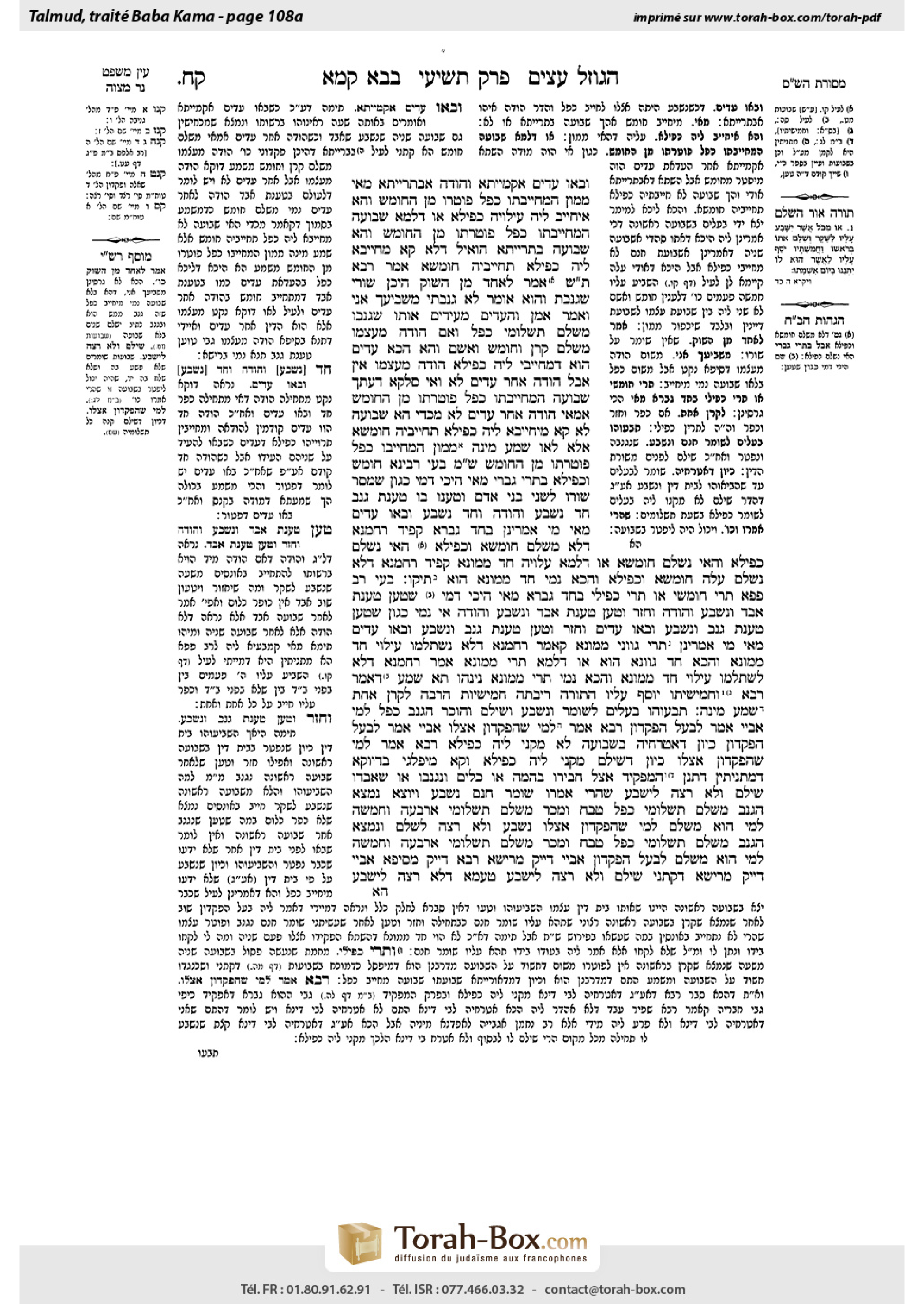
Bava Kamma 108a: Talmud study for Daf Yomi
Study the Talmud for Daf Yomi with scanned pages, Hebrew text, English translations from Sefaria and AI-generated French translations.
Passage selection and English or AI-generated French translation are available where the scan has annotations. Daf Study is independent of Torah-Box and Sefaria.
Browse Bava Kamma · בבא קמא · All tractatesBava Kamma 108a text and translations
This page of Bava Kamma includes the Aramaic text, an English translation and an AI-generated French translation, alongside the scan above.
בבא קמא ק״ח א · Aramaic and Hebrew text
וּבָאוּ עֵדִים אַקַּמַּיְיתָא, וְהוֹדָה אַבָּתְרָיְיתָא. מַאי?
מָמוֹן הַמְחַיְּיבוֹ כֶּפֶל פּוֹטְרוֹ מִן הַחוֹמֶשׁ – וְהָא אִיחַיַּיב לֵיהּ עִילָּוֵיהּ כְּפֵילָא; אוֹ דִלְמָא שְׁבוּעָה הַמְחַיַּיבְתּוֹ כֶּפֶל פּוֹטַרְתּוֹ מִן הַחוֹמֶשׁ – וְהָא שְׁבוּעָה בָּתְרָיְיתָא, הוֹאִיל דְּלָא קָא מְחַיְּיבָא לֵיהּ כְּפֵילָא, תְּחַיְּיבֵיהּ חוּמְשָׁא?
אָמַר רָבָא: תָּא שְׁמַע, אָמַר לְאֶחָד מִן הַשּׁוּק: ״הֵיכָן שׁוֹרִי שֶׁגָּנַבְתָּ?״ וְהוּא אוֹמֵר: ״לֹא גָּנַבְתִּי״. ״מַשְׁבִּיעֲךָ אֲנִי״, וְאָמַר: ״אָמֵן״. וְהָעֵדִים מְעִידִים אוֹתוֹ שֶׁגְּנָבוֹ – מְשַׁלֵּם תַּשְׁלוּמֵי כֶפֶל. וְאִם הוֹדָה מֵעַצְמוֹ – מְשַׁלֵּם קֶרֶן וָחוֹמֶשׁ וְאָשָׁם.
וְהָא הָכָא, עֵדִים הוּא דִּמְחַיְּיבִי לֵיהּ כְּפֵילָא; הוֹדָה מֵעַצְמוֹ – אִין, אֲבָל הוֹדָה אַחַר עֵדִים – לָא;
וְאִי סָלְקָא דַעְתָּךְ שְׁבוּעָה הַמְחַיַּיבְתּוֹ כֶּפֶל פּוֹטַרְתּוֹ מִן הַחוֹמֶשׁ, אַמַּאי הוֹדָה אַחַר עֵדִים לָא? מִכְּדִי הָא שְׁבוּעָה לָא קָא מְיחַיְּיבָא לֵיהּ כְּפֵילָא, תְּחַיְּיבֵיהּ חוּמְשָׁא!
אֶלָּא לָאו שְׁמַע מִינַּהּ: מָמוֹן הַמְחַיְּיבוֹ כֶּפֶל – פּוֹטְר(תּ)וֹ מִן הַחוֹמֶשׁ? שְׁמַע מִינַּהּ.
בָּעֵי רָבִינָא: חוֹמֶשׁ וּכְפֵילָא בִּתְרֵי גַבְרֵי, מַאי? הֵיכִי דָּמֵי? כְּגוֹן שֶׁמָּסַר שׁוֹרוֹ לִשְׁנֵי בְּנֵי אָדָם, וְטָעֲנוּ בּוֹ טַעֲנַת גַּנָּב. חַד נִשְׁבַּע וְהוֹדָה, וְחַד נִשְׁבַּע וּבָאוּ עֵדִים. מַאי?
מִי אָמְרִינַן: בְּחַד גַּבְרָא קָפֵיד רַחֲמָנָא דְּלָא מְשַׁלֵּם חוּמְשָׁא וּכְפֵילָא; הַאי נְשַׁלֵּם כְּפֵילָא, וְהַאי נְשַׁלֵּם חוּמְשָׁא; אוֹ דִלְמָא, עִלָּוֵי חַד מָמוֹנָא קָפֵיד רַחֲמָנָא דְּלָא נְשַׁלֵּם עֲלֵהּ חוּמְשָׁא וּכְפֵילָא – וְהָכָא נָמֵי חַד מָמוֹנָא הוּא? תֵּיקוּ.
בָּעֵי רַב פָּפָּא: תְּרֵי חוּמְשֵׁי אוֹ תְּרֵי כְפֵילֵי בְּחַד גַּבְרָא, מַאי? הֵיכִי דָּמֵי? שֶׁטָּעַן טַעֲנַת אָבַד, וְנִשְׁבַּע, וְהוֹדָה, וְחָזַר וְטָעַן טַעֲנַת אָבַד, וְנִשְׁבַּע, וְהוֹדָה. אִי נָמֵי, כְּגוֹן שֶׁטָּעַן טַעֲנַת גַּנָּב, וְנִשְׁבַּע, וּבָאוּ עֵדִים, וְחָזַר וְטָעַן טַעֲנַת גַּנָּב, וְנִשְׁבַּע, וּבָאוּ עֵדִים, מַאי?
מִי אָמְרִינַן: תְּרֵי גַּוְונֵי מָמוֹנָא קָאָמַר רַחֲמָנָא דְּלָא נִשְׁתַּלְּמוּ עִילָּוֵי חַד מָמוֹנָא – וְהָכָא חַד גַּוְונָא הוּא; אוֹ דִלְמָא, תְּרֵי מָמוֹנֵי אָמַר רַחֲמָנָא דְּלָא לִשְׁתַּלְּמוּ עִילָּוֵי חַד מָמוֹנָא – וְהָכָא נָמֵי תְּרֵי מָמוֹנֵי נִינְהוּ?
תָּא שְׁמַע, דְּאָמַר רָבָא: ״וַחֲמִשִׁתָיו יֹסֵף עָלָיו״ – הַתּוֹרָה רִיבְּתָה חֲמִישִׁיּוֹת הַרְבֵּה לְקֶרֶן אַחַת! שְׁמַע מִינַּהּ.
תְּבָעוּהוּ בְּעָלִים לַשּׁוֹמֵר, וְנִשְׁבַּע, וְשִׁילֵּם, וְהוּכַּר הַגַּנָּב – כֶּפֶל לְמִי? אַבָּיֵי אָמַר: לְבַעַל הַפִּקָּדוֹן, רָבָא אָמַר: לְמִי שֶׁהַפִּקָּדוֹן אֶצְלוֹ.
אַבָּיֵי אָמַר לְבַעַל הַפִּקָּדוֹן – כֵּיוָן דְּאַטְרְחֵיהּ בִּשְׁבוּעָה, לָא מַקְנֵי לֵיהּ כְּפֵילָא. רָבָא אָמַר לְמִי שֶׁהַפִּקָּדוֹן אֶצְלוֹ – כֵּיוָן דְּשִׁילֵּם, מַקְנֵי לֵיהּ כְּפֵילָא.
וְקָא מִיפַּלְגִי בְּדִיּוּקָא דְמַתְנִיתִין, דִּתְנַן: הַמַּפְקִיד אֵצֶל חֲבֵירוֹ בְּהֵמָה אוֹ כֵלִים, וְנִגְנְבוּ אוֹ שֶׁאָבְדוּ; שִׁילֵּם וְלֹא רָצָה לִישָּׁבַע – שֶׁהֲרֵי אָמְרוּ: שׁוֹמֵר חִנָּם נִשְׁבָּע וְיוֹצֵא; נִמְצָא הַגַּנָּב – מְשַׁלֵּם תַּשְׁלוּמֵי כֶפֶל. טָבַח וּמָכַר – מְשַׁלֵּם תַּשְׁלוּמֵי אַרְבָּעָה וַחֲמִשָּׁה. לְמִי הוּא מְשַׁלֵּם? לְמִי שֶׁהַפִּקָּדוֹן אֶצְלוֹ.
נִשְׁבַּע וְלֹא רָצָה לְשַׁלֵּם, וְנִמְצָא הַגַּנָּב – מְשַׁלֵּם תַּשְׁלוּמֵי כֶפֶל. טָבַח וּמָכַר – מְשַׁלֵּם תַּשְׁלוּמֵי אַרְבָּעָה וַחֲמִשָּׁה. לְמִי הוּא מְשַׁלֵּם? לְבַעַל הַפִּקָּדוֹן.
אַבָּיֵי דָּיֵיק מֵרֵישָׁא, רָבָא דָּיֵיק מִסֵּיפָא. אַבָּיֵי דָּיֵיק מֵרֵישָׁא – דְּקָתָנֵי: שִׁילֵּם וְלֹא רָצָה לִישָּׁבַע. טַעְמָא דְּלֹא רָצָה לִישָּׁבַע,
Bava Kamma 108a · English translation
and witnesses come and testify with regard to his first claim that at the time he took an oath that the deposit had been stolen, it was actually in his possession; and he admits with regard to his second claim that it had been a lie and that it had not actually been lost, what is the halakha: Is he obligated to pay the additional one-fifth payment?
The Gemara explains the two possibilities: Is it being obligated in a monetary obligation that renders him liable for double payment which exempts him from the additional one-fifth payment, and in this case he is liable for the double payment for the deposit due to the witness testimony and would therefore be exempt from the additional one-fifth payment? Or perhaps is it admitting to a false oath that renders him liable for double payment which exempts him from the additional one-fifth payment, and with regard to this latter oath that the item was lost, since it does not render him liable for the double payment, as he took an oath that it had been lost, not stolen, will it render him liable for the additional one-fifth payment?
Rava said: Come and hear a solution to this dilemma from a mishna (Shevuot 49b): In a scenario where one said to someone from the marketplace: Where is my ox that you stole? And the accused says in response: I did not steal it; whereupon the owner of the ox said: I administer an oath to you, and the accused said: Amen, accepting the oath; and the witnesses testify about the accused that he stole it, he must pay double payment. And if he admitted of his own accord that he stole it, then he must pay the principal and the additional one-fifth payment, and bring a guilt-offering.
Rava explains the proof: But here, it is witnesses who render him liable for the double payment, as since the accused was not a bailee, the oath does not render him liable, and yet the mishna teaches that if he admitted of his own accord that he stole it, then yes, he must pay the additional one-fifth payment, but if he admitted after witnesses testified, then no, he is not required to pay the additional one-fifth.
Rava continues: And if it enters your mind to say that it is an oath that renders him liable for double payment which exempts him from the additional one-fifth payment, why does he not pay the additional one-fifth payment if he admitted that it was a false oath after witnesses testified? After all, this oath does not render him liable to pay the double payment, as the halakha that one who falsely takes an oath that the item was stolen pays double payment applies only in the case of a bailee; therefore, the oath should render him liable to pay the additional one-fifth payment, as does any false oath taken with regard to a monetary claim.
Rava completes the proof: Rather, must one not conclude from this mishna that it is the monetary obligation that renders him liable to pay the double payment which exempts him from the additional one-fifth payment? The Gemara affirms: Conclude from the mishna that the additional one-fifth payment is dependent upon the type of monetary obligation, and not an oath, resolving Rami bar Ḥama’s dilemma.
§ Concerning the additional one-fifth payment, Ravina raises a dilemma: If the additional one-fifth payment and the double payment are split among two men, what is the halakha? The Gemara explains the dilemma: What are the circumstances? This is referring to a case where one transferred his ox to two people to safeguard, and they stated the claim that a thief stole it from them; one of them took an oath that it had been stolen and subsequently admitted of his own accord that he had lied, and one of them took an oath that it had been stolen and subsequently witnesses came and testified that he had lied. What is the halakha in this case?
Ravina clarifies the possibilities: Do we say that the Merciful One is particular with regard to one man that he does not pay both the additional one-fifth payment and the double payment, whereas in this case, this one about whom the witnesses testified will pay the double payment and that one who admitted of his own accord will pay the additional one-fifth payment? Or perhaps the Merciful One is particular that the additional one-fifth payment and the double payment will not be paid for one monetary obligation, and here too, it is one monetary obligation? The Gemara comments: The dilemma shall stand unresolved.
§ Concerning the additional one-fifth payment, Rav Pappa raises a dilemma: In a case of two additional one-fifth payments or two double payments with regard to one man, what is the halakha; must he pay twice for the same monetary obligation? The Gemara explains: What are the circumstances? This is referring to a case where one stated the claim that the deposit was lost and took an oath and then admitted that it was not lost, and returned and again stated the claim that the same deposit was lost, and took another oath supporting this claim and again admitted that it was not lost. Alternatively, this is referring to a case where one stated the claim that a thief stole the deposit and took an oath and then witnesses came and testified that he had taken it, and he returned and again stated the claim that a thief stole the same deposit and again took an oath and then witnesses came and again testified that he had taken it; what is the halakha?
Rav Pappa clarifies the possibilities: Do we say that the Merciful One states concerning two types of monetary restitution, e.g., double payment and the additional one-fifth payment, that they will not be paid for one monetary obligation, but here, it is only one type, merely doubled; or perhaps the Merciful One states concerning two payments of monetary restitution that they will not be paid for one monetary obligation, and here too, they are two payments of monetary restitution, whether in the case of two additional one-fifth payments or two double payments?
The Gemara suggests a resolution to Rav Pappa’s dilemma. Come and hear, as Rava says: The verse states: “Or anything about which he has sworn falsely, he shall restore it in full, and shall add the fifth part [ḥamishitav] more thereto” (Leviticus 5:24). By employing a plural term, ḥamishitav, and not the singular ḥamishito, the Torah added many additional one-fifths for one principal, meaning that one can become obligated in multiple one-fifth payments for the same principal. The Gemara affirms: Conclude from Rava’s statement that this is the halakha.
§ The Gemara discusses an amoraic dispute concerning a similar case: If an owner demanded of an unpaid bailee that he return a deposit, and he claimed that it had been stolen from him and took an oath to that effect, and despite being exempt from payment, he paid of his own volition, and subsequently the thief was identified, to whom is double payment paid, the owner or the bailee? Abaye says: To the owner of the deposit. Rava says: To the one in whose possession the deposit was when it was stolen, i.e., the bailee.
The Gemara explains their opinions: Abaye says that the double payment is paid to the owner of the deposit; since the bailee troubled him by taking an oath instead of paying immediately, the owner is not willing to grant acquisition of the double payment to the bailee, so it is paid to the owner. Rava says that the double payment is paid to the one in whose possession the deposit was when it was stolen; once he paid, the owner grants acquisition of the double payment to the bailee.
The Gemara explains: And they disagree with regard to the deductive inference to be drawn from the wording of the mishna, as we learned in a mishna (Bava Metzia 33b): In the case of one who deposits with another, i.e., an unpaid bailee, an animal or vessels, and they were stolen or lost, and the bailee paid the owner and did not wish to take an oath, which he may decide to do, as the Sages said that an unpaid bailee takes an oath that he is exempt and is released from the obligation to pay the owner, but may also opt to pay; in such a case the halakha is that if the thief was found he pays double payment, or if the deposited item was a sheep or an ox and the thief slaughtered or sold it he pays the fourfold or fivefold payment. To whom does the thief pay those payments? He pays them to the one in whose possession the deposit was when it was stolen or lost. When the bailee paid the owner for the stolen item, he acquired it and therefore is entitled to any payment of principal or fine paid by the thief.
The mishna continues: If the bailee took an oath and did not wish to pay, and the thief was later found and was required to pay double payment, or he slaughtered or sold the sheep or ox and was required to pay the fourfold or fivefold payment, to whom does the thief pay the money? He pays it to the owner of the deposit, not to the bailee.
The Gemara explains the dispute: Abaye inferred the halakha from the wording of the first clause, and Rava inferred the halakha from the wording of the latter clause. Abaye inferred it from the wording of the first clause, as it teaches: If the bailee paid the owner and did not wish to take an oath, the thief pays the double, fourfold, or fivefold payment to the bailee. Abaye infers from here that the reason the thief pays the bailee is specifically that he did not wish to take an oath,
Bava Kamma 108a · Traduction française (IA)
et des témoins viennent témoigner concernant sa première déclaration que lorsqu'il a pris serment que le dépôt avait été volé, il était en réalité en possession de celui-ci ; et il admet concernant sa deuxième déclaration que c'était une fausse déclaration et qu'il n'avait pas réellement perdu, quelle est la halakha : est-il tenu de payer le paiement supplémentaire d'un cinquième ?
La Guemara explique les deux possibilités : est-ce qu'il est tenu d'une obligation monétaire qui le rend responsable du double paiement, ce qui l'exonère du paiement supplémentaire d'un cinquième, et dans ce cas, il est tenu du double paiement pour le dépôt en raison des témoignages et serait donc exempt du paiement supplémentaire d'un cinquième ? Ou bien est-ce qu'il s'agit d'une admission d'un faux serment qui le rend responsable du double paiement, ce qui l'exonère du paiement supplémentaire d'un cinquième, et concernant ce second serment que l'objet avait été perdu, puisque cela ne le rend pas responsable du double paiement, comme il a pris serment qu'il avait été perdu et non volé, cela le rendra-t-il responsable du paiement supplémentaire d'un cinquième ?
Rava dit : Viens écouter une solution à ce dilemme à partir d'une mitsva (Shevuot 49b) : Dans un cas où l'on dit à quelqu'un du marché : Où est mon bœuf que tu as volé ? Et l'accusé répond : Je ne l'ai pas volé ; et l'propriétaire du bœuf dit : Je t'administre un serment, et l'accusé dit : Amen, acceptant le serment ; et les témoins témoignent à propos de l'accusé qu'il l'avait volé, il doit payer double. Et si il admet volontairement qu'il l'avait volé, alors il doit payer le principal et le paiement supplémentaire d'un cinquième, et offrir un sacrifice de culpabilité.
Rava explique la preuve : Mais ici, c'est les témoins qui le rendent responsable du double paiement, car puisque l'accusé n'était pas un gardien, le serment ne le rend pas responsable, et pourtant la mitsva enseigne que s'il admet volontairement qu'il a volé l'objet, alors oui, il doit payer le paiement supplémentaire d'un cinquième, mais s'il admet après que les témoins aient témoigné, alors non, il n'est pas tenu de payer le paiement supplémentaire d'un cinquième.
Rava continue : Et si cela t'entre en tête de dire que c'est le serment qui le rend responsable du double paiement, ce qui l'exonère du paiement supplémentaire d'un cinquième, pourquoi ne paie-t-il pas le paiement supplémentaire d'un cinquième s'il admet que c'était un faux serment après que les témoins aient témoigné ? Après tout, ce serment ne le rend pas responsable du double paiement, car la halakha qui stipule que celui qui prend un faux serment affirmant que l'objet a été volé paie double s'applique uniquement dans le cas d'un gardien ; donc, le serment devrait le rendre responsable du paiement supplémentaire d'un cinquième, comme tout faux serment concernant une revendication monétaire.
Rava conclut la preuve : Plutôt, ne devons-nous pas conclure à partir de cette mitsva que c'est l'obligation monétaire qui le rend responsable du double paiement, ce qui l'exonère du paiement supplémentaire d'un cinquième ? La Guemara confirme : Concluez à partir de la mitsva que le paiement supplémentaire d'un cinquième dépend du type d'obligation monétaire, et non d'un serment, résolvant ainsi le dilemme de Rami bar Ḥama.
§ Concernant le paiement supplémentaire d'un cinquième, Ravina soulève un dilemme : Si le paiement supplémentaire d'un cinquième et le double paiement sont répartis entre deux hommes, quelle est la halakha ? La Guemara explique le dilemme : Quelles sont les circonstances ? Cela fait référence à un cas où l'on a transféré son bœuf à deux personnes pour le garder, et ils ont déclaré qu'un voleur l'avait volé ; l'un d'eux a pris serment qu'il avait été volé et a ensuite admis volontairement qu'il avait menti, et l'autre a pris serment qu'il avait été volé et ensuite des témoins ont témoigné qu'il avait menti. Quelle est la halakha dans ce cas ?
Ravina clarifie les possibilités : Disons-nous que l'Éternel est exigeant concernant un seul homme qu'il ne paie pas à la fois le paiement supplémentaire d'un cinquième et le double paiement, alors que dans ce cas, celui à qui les témoins ont témoigné paiera le double paiement et celui qui a admis volontairement paiera le paiement supplémentaire d'un cinquième ? Ou bien disons-nous que l'Éternel est exigeant que le paiement supplémentaire d'un cinquième et le double paiement ne soient pas payés pour une seule obligation monétaire, et ici aussi, c'est une seule obligation monétaire ? La Guemara commente : Ce dilemme restera sans solution.
§ Concernant le paiement supplémentaire d'un cinquième, Rav Pappa soulève un dilemme : Dans un cas de deux paiements supplémentaires d'un cinquième ou de deux paiements doubles concernant un seul homme, quelle est la halakha ; doit-il payer deux fois pour la même obligation monétaire ? La Guemara explique : Quelles sont les circonstances ? Il s'agit d'un cas où l'on a déclaré que le dépôt avait été perdu, pris serment et ensuite admis volontairement qu'il n'avait pas été perdu, puis a réitéré la déclaration que le même dépôt avait été perdu, pris un autre serment et à nouveau admis qu'il n'avait pas été perdu. Alternativement, il s'agit d'un cas où l'on a déclaré que le dépôt avait été volé, pris serment et ensuite des témoins ont témoigné qu'il l'avait volé, puis a réitéré la déclaration que le même dépôt avait été volé, pris un autre serment et ensuite des témoins ont à nouveau témoigné qu'il l'avait volé ; quelle est la halakha ?
Rav Pappa clarifie les possibilités : Disons-nous que l'Éternel stipule concernant deux types de restitution monétaire, par exemple le double paiement et le paiement supplémentaire d'un cinquième, qu'ils ne seront pas payés pour une seule obligation monétaire, mais ici, il s'agit seulement d'un seul type, simplement doublé ; ou bien disons-nous que l'Éternel stipule concernant deux paiements de restitution monétaire qu'ils ne seront pas payés pour une seule obligation monétaire, et ici aussi, il s'agit de deux paiements de restitution monétaire, qu'il s'agisse de deux paiements supplémentaires d'un cinquième ou de deux paiements doubles ?
La Guemara suggère une solution au dilemme de Rav Pappa. Viens écouter, comme Rava le dit : La Parashah dit : « Ou toute chose à l'égard de laquelle il a juré faussement, il doit rendre la chose entière, et il doit ajouter la cinquième partie [ḥamishitav] à cela » (Lévitique 5:24). En utilisant un terme pluriel, ḥamishitav, et non le singulier ḥamishito, la Torah a ajouté plusieurs cinquièmes supplémentaires pour une seule chose principale, ce qui signifie qu'on peut être tenu responsable de plusieurs paiements de cinquièmes pour la même chose principale. La Guemara affirme : Conclure de la déclaration de Rava que c'est la halakha.
§ La Guemara discute d'un débat entre les amoraim concernant un cas similaire : Si un propriétaire exigeait d'un bailli non payé qu'il lui rende un dépôt, et qu'il affirmait que cela avait été volé et prit un serment à cet égard, et malgré son exemption de paiement, il paya de son propre gré, et ensuite le voleur fut identifié, à qui est versé le double paiement, le propriétaire ou le bailli ? Abaye dit : Au propriétaire du dépôt. Rava dit : À celui qui possédait le dépôt lorsqu'il a été volé, c'est-à-dire le bailli.
La Guemara explique leurs opinions : Abaye dit que le double paiement est versé au propriétaire du dépôt ; puisque le bailli a importuné le propriétaire en prenant un serment au lieu de payer immédiatement, le propriétaire n'est pas disposé à accorder l'acquisition du double paiement au bailli, donc il est versé au propriétaire. Rava dit que le double paiement est versé à celui qui possédait le dépôt lorsqu'il a été volé ; une fois qu'il a payé, le propriétaire accorde l'acquisition du double paiement au bailli.
La Guemara explique : Et ils divergent concernant l'inférence à tirer du texte de la mitsna, comme nous l'avons appris dans une mitsna (Bava Metzia 33b) : Dans le cas d'une personne qui dépose quelque chose avec une autre, c'est-à-dire un bailli non payé, un animal ou des objets, et qu'ils ont été volés ou perdus, et que le bailli a payé le propriétaire et n'avait pas envie de prendre un serment, ce qu'il peut décider de faire, comme les Sages ont dit qu'un bailli non payé prend un serment qu'il est exempt et est libéré de l'obligation de payer au propriétaire, mais peut aussi choisir de payer ; dans ce cas, la halakha est que si le voleur a été trouvé, il paie le double paiement, ou s'il a tué ou vendu l'animal ou la bête, il paie le quatre fois ou cinq fois paiement. À qui le voleur paie-t-il ces paiements ? Il les paie à celui qui possédait le dépôt lorsqu'il a été volé ou perdu. Lorsque le bailli a payé le propriétaire pour l'objet volé, il a acquis l'objet et donc est donc dû à tout paiement principal ou d'amende versé par le voleur.
La mitsna continue : Si le bailli a pris un serment et n'avait pas envie de payer, et que le voleur a été trouvé plus tard et a été obligé de payer le double paiement, ou s'il a tué ou vendu l'agneau ou la bête et a été obligé de payer le quatre fois ou cinq fois paiement, à qui le voleur paie-t-il l'argent ? Il le paie au propriétaire du dépôt, pas au bailli.
La Guemara explique le débat : Abaye a inféré la halakha du texte de la première clause, et Rava a inféré la halakha du texte de la dernière clause. Abaye a inféré cela de la première clause, comme il enseigne : Si le bailli a payé le propriétaire et n'avait pas envie de prendre un serment, le voleur paie le double, le quatre fois ou le cinq fois paiement au bailli. Abaye infère d'ici que la raison pour laquelle le voleur paie le bailli est spécifiquement parce qu'il n'avait pas envie de prendre un serment,
Traduction française générée par IA à partir de l’édition anglaise de Sefaria. Vérifie toujours un passage avec le texte source.
Text from Sefaria: William Davidson Edition - Vocalized Aramaic (CC BY NC); William Davidson Edition - English (CC BY NC).