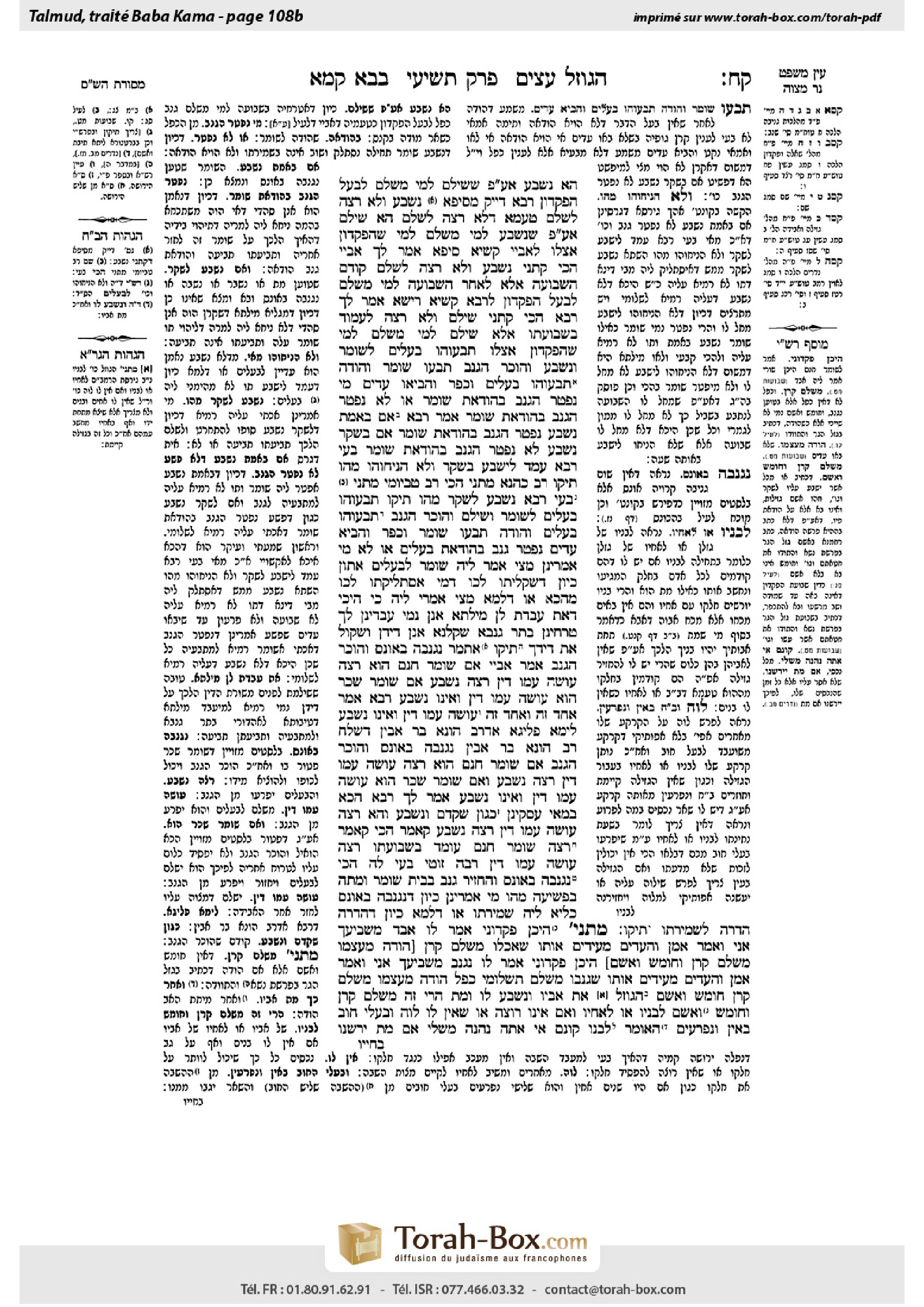
Bava Kamma 108b: Talmud study for Daf Yomi
Study the Talmud for Daf Yomi with scanned pages, Hebrew text, English translations from Sefaria and AI-generated French translations.
Passage selection and English or AI-generated French translation are available where the scan has annotations. Daf Study is independent of Torah-Box and Sefaria.
Browse Bava Kamma · בבא קמא · All tractatesBava Kamma 108b text and translations
This page of Bava Kamma includes the Aramaic text, an English translation and an AI-generated French translation, alongside the scan above.
בבא קמא ק״ח ב · Aramaic and Hebrew text
הָא נִשְׁבַּע – אַף עַל פִּי שֶׁשִּׁילֵּם; לְמִי מְשַׁלֵּם? לְבַעַל הַפִּקָּדוֹן.
רָבָא דָּיֵיק מִסֵּיפָא – נִשְׁבַּע וְלֹא רָצָה לְשַׁלֵּם. טַעְמָא דְּלֹא רָצָה לְשַׁלֵּם, הָא שִׁילֵּם – אַף עַל פִּי שֶׁנִּשְׁבַּע; לְמִי מְשַׁלֵּם? לְמִי שֶׁהַפִּקָּדוֹן אֶצְלוֹ.
לְאַבָּיֵי, קַשְׁיָא סֵיפָא! אָמַר לָךְ אַבָּיֵי, הָכִי קָתָנֵי: נִשְׁבַּע, וְלֹא רָצָה לְשַׁלֵּם קוֹדֶם הַשְּׁבוּעָה אֶלָּא לְאַחַר הַשְּׁבוּעָה, לְמִי מְשַׁלֵּם? לְבַעַל הַפִּקָּדוֹן. לְרָבָא, קַשְׁיָא רֵישָׁא! אָמַר לָךְ רָבָא, הָכִי קָתָנֵי: שִׁילֵּם, וְלֹא רָצָה לַעֲמוֹד בִּשְׁבוּעָתוֹ אֶלָּא שִׁילֵּם, לְמִי מְשַׁלֵּם? לְמִי שֶׁהַפִּקָּדוֹן אֶצְלוֹ.
תְּבָעוּהוּ בְּעָלִים לַשּׁוֹמֵר, וְנִשְׁבַּע, וְהוּכַּר הַגַּנָּב; תְּבָעוֹ שׁוֹמֵר, וְהוֹדָה; תְּבָעוּהוּ בְּעָלִים, וְכָפַר, וְהֵבִיאוּ עֵדִים – מִי נִפְטַר הַגַּנָּב בְּהוֹדָאַת שׁוֹמֵר, אוֹ לֹא נִפְטַר הַגַּנָּב בְּהוֹדָאַת שׁוֹמֵר?
אָמַר רָבָא: אִם בֶּאֱמֶת נִשְׁבַּע – נִפְטַר הַגַּנָּב בְּהוֹדָאַת שׁוֹמֵר. אִם בְּשֶׁקֶר נִשְׁבַּע – לֹא נִפְטַר הַגַּנָּב בְּהוֹדָאַת שׁוֹמֵר.
בָּעֵי רָבָא: עָמַד לִישָּׁבַע בְּשֶׁקֶר וְלֹא הִנִּיחוּהוּ, מַהוּ? תֵּיקוּ. רַב כָּהֲנָא מַתְנֵי הָכִי; רַב טָבְיוֹמֵי מַתְנֵי – בָּעֵי רָבָא: נִשְׁבַּע לַשֶּׁקֶר, מַהוּ? תֵּיקוּ.
תְּבָעוּהוּ בְּעָלִים לַשּׁוֹמֵר – וְשִׁילֵּם, וְהוּכַּר הַגַּנָּב, תְּבָעוּהוּ בְּעָלִים – וְהוֹדָה, תְּבָעוֹ שׁוֹמֵר – וְכָפַר, וְהֵבִיא עֵדִים; נִפְטַר גַּנָּב בְּהוֹדָאַת בְּעָלִים, אוֹ לֹא?
מִי אָמְרִינַן מָצֵי אָמַר לֵיהּ שׁוֹמֵר לִבְעָלִים: ״אַתּוּן, כֵּיוָן דְּשָׁקְלִיתוּ לְכוּ דְּמֵי – אִסְתְּלִיקְתּוּ לְכוּ מֵהָכָא״; אוֹ דִלְמָא, מָצֵי אָמְרִי לֵיהּ: ״כִּי הֵיכִי דְּאַתְּ עֲבַדְתְּ לַן מִילְּתָא, אֲנַן נָמֵי עָבְדִינַן לָךְ – טָרְחִינַן בָּתַר גַּנָּבָא; (שָׁקֵלְנָא) [שָׁקְלִינַן] אֲנַן דִּידַן, וּשְׁקוֹל אַתְּ דִּידָךְ״? תֵּיקוּ.
אִתְּמַר: נִגְנְבָה בְּאוֹנֶס וְהוּכַּר הַגַּנָּב, אָמַר אַבָּיֵי: אִם שׁוֹמֵר חִנָּם הוּא – רָצָה עוֹשֶׂה עִמּוֹ דִּין, רָצָה נִשְׁבָּע. אִם שׁוֹמֵר שָׂכָר הוּא – עוֹשֶׂה עִמּוֹ דִּין, וְאֵינוֹ נִשְׁבָּע. רָבָא אָמַר: אֶחָד זֶה וְאֶחָד זֶה – עוֹשֶׂה עִמּוֹ דִּין וְאֵינוֹ נִשְׁבָּע.
לֵימָא פְּלִיגָא אַדְּרַב הוּנָא בַּר אָבִין? דִּשְׁלַח רַב הוּנָא בַּר אָבִין: נִגְנְבָה בְּאוֹנֶס וְהוּכַּר הַגַּנָּב, אִם שׁוֹמֵר חִנָּם הוּא – רָצָה עוֹשֶׂה עִמּוֹ דִּין, רָצָה נִשְׁבָּע; וְאִם שׁוֹמֵר שָׂכָר הוּא – עוֹשֶׂה עִמּוֹ דִּין וְאֵינוֹ נִשְׁבָּע.
אָמַר לָךְ רָבָא: הָכָא בְּמַאי עָסְקִינַן – כְּגוֹן שֶׁקָּדַם וְנִשְׁבַּע. וְהָא ״רָצָה עוֹשֶׂה עִמּוֹ דִּין, רָצָה נִשְׁבָּע״ קָאָמַר! הָכִי קָאָמַר: רָצָה שׁוֹמֵר חִנָּם – עוֹמֵד בִּשְׁבוּעָתוֹ, רָצָה – עוֹשֶׂה עִמּוֹ דִּין.
רַבָּה זוּטֵי בָּעֵי לַהּ הָכִי: נִגְנְבָה בְּאוֹנֶס, וְהֶחְזִיר גַּנָּב בְּבֵית שׁוֹמֵר, וּמֵתָה בִּפְשִׁיעָה, מַהוּ? מִי אָמְרִינַן: כֵּיוָן דְּנִגְנְבָה בְּאוֹנֶס – כָּלְיָא לֵיהּ שְׁמִירָתוֹ, אוֹ דִלְמָא כֵּיוָן דְּ[אַ]הְדְּרַהּ – הֲדַרָה לִשְׁמִירָתוֹ? תֵּיקוּ.
מַתְנִי׳ ״הֵיכָן פִּקְדוֹנִי?״ אָמַר לוֹ: ״אָבַד״. ״מַשְׁבִּיעֲךָ אֲנִי״, וְאָמַר ״אָמֵן״, וְהָעֵדִים מְעִידִים אוֹתוֹ שֶׁאֲכָלוֹ – מְשַׁלֵּם קֶרֶן. [הוֹדָה מֵעַצְמוֹ – מְשַׁלֵּם קֶרֶן וָחוֹמֶשׁ וְאָשָׁם.]
״הֵיכָן פִּקְדוֹנִי?״ אָמַר לוֹ: ״נִגְנַב״. ״מַשְׁבִּיעֲךָ אֲנִי״, וְאָמַר: ״אָמֵן״, וְהָעֵדִים מְעִידִים אוֹתוֹ שֶׁגְּנָבוֹ – מְשַׁלֵּם תַּשְׁלוּמֵי כֶפֶל. הוֹדָה מֵעַצְמוֹ – מְשַׁלֵּם קֶרֶן, חוֹמֶשׁ וְאָשָׁם.
הַגּוֹזֵל אֶת אָבִיו, וְנִשְׁבַּע לוֹ, וָמֵת – הֲרֵי זֶה מְשַׁלֵּם קֶרֶן וָחוֹמֶשׁ וְאָשָׁם לְבָנָיו אוֹ לְאֶחָיו. וְאִם אֵינוֹ רוֹצֶה אוֹ שֶׁאֵין לוֹ – לֹוֶה וּבַעֲלֵי חוֹב בָּאִין וְנִפְרָעִים.
הָאוֹמֵר לִבְנוֹ: ״קוּנָּם אִי אַתָּה נֶהֱנֶה מִשֶּׁלִּי״, אִם מֵת – יִירָשֶׁנּוּ.
Bava Kamma 108b · English translation
but if he took an oath, even though he subsequently paid, to whom does the thief pay double payment? To the owner of the deposit.
Rava inferred the halakha from the wording of the latter clause. It teaches: If the bailee took an oath and did not want to pay, the thief must pay the penalty to the owner of the deposit. Rava infers from here that the reason the thief pays the owner is specifically that he did not want to pay, but if he did pay, even though he took an oath previously, to whom does the thief pay double payment? To the one in whose possession the deposit was when it was lost.
The Gemara notes: The inference from the latter clause is difficult for the opinion of Abaye. The Gemara explains. Abaye could have said to you: This is what the latter clause of the mishna is teaching: If the bailee took an oath and did not want to pay initially before taking the oath, but rather wanted to pay only after having taken the oath, in this case to whom does the thief pay double payment? To the owner of the deposit. Similarly, the Gemara notes: The inference from the first clause is difficult for the opinion of Rava. The Gemara explains. Rava could have said to you: This is what the first clause of the mishna is teaching: If he paid, meaning he had taken an oath and did not want to stand by his oath, but instead paid in order to nullify the oath he had taken, to whom does the thief pay double payment? To the one in whose possession the deposit was when it was lost.
§ The Gemara relates another dilemma concerning the status of a bailee and stolen deposits. If the owner of a deposit demanded from a bailee that he return their deposit, and he claimed that it had been stolen from him and took an oath to that effect; and then the thief was recognized, and the bailee demanded of the thief to pay and he admitted to having stolen it; and then the owner demanded of the thief to pay and he denied the claim, and the owner brought witnesses that he had stolen it, did the thief become exempt from double payment through his admission to the bailee, as is the halakha when one admits liability to a penalty? Does the bailee have standing vis-à-vis the thief despite having exempted himself by taking an oath to the owner, or did the thief not become exempt through his admission to the bailee?
Rava says: If he took an oath truthfully, i.e., if it now becomes clear through the testimony of witnesses that the bailee’s oath was true, he is assumed to be someone the owner would rely on to collect the stolen item for him, and he remains a bailee. Therefore, the thief became exempt through his admission to the bailee. If his oath was taken falsely, e.g., he took an oath that the animal given as a deposit died naturally and it is now clear that his oath was false, he is assumed to be someone whom the owner would not rely on to collect the stolen item for them, and he is no longer a bailee. In this case, the thief did not become exempt through his admission to the bailee.
Rava raises a dilemma concerning the previous ruling: If a bailee rose to take a false oath but the owner did not let him, what is the halakha? Should he be considered as one who had taken a false oath, as that was his intention, and he is no longer a bailee; or, since he never actually took the false oath, he is still a bailee? The Gemara comments: The question shall stand unresolved. The Gemara notes that Rav Kahana would teach Rava’s question like this, as quoted above. Rav Tavyumei would teach Rava’s question differently: Rava raises a dilemma: If he actually took a false oath, what is the halakha? Is he still a bailee or not? The Gemara comments: The question shall stand unresolved.
The Gemara relates another dilemma concerning the status of a bailee and stolen deposits: If the owners of a deposit demanded from a bailee that he return their deposit and he paid them instead of taking an oath, and then the thief was recognized, and the owners demanded of the thief to pay and he admitted to having stolen it; and then the bailee demanded of the thief to pay and he denied the claim, and the bailee brought witnesses that he had stolen it, did the thief become exempt from double payment through his admission to the owners, as is the halakha when one admits liability to a penalty, or not?
The Gemara explains: Do we say that the bailee can say to the owners: Once you took your money from me you removed yourselves from here and have no further connection to this deposit. Therefore, I am now considered the owner of the stolen item and the right to the double payment is mine, and the thief’s admission to you is meaningless. Or perhaps the owners can say to him: Just as you performed a service for us by paying us when you were not obligated, we performed a service for you as well. Instead of granting acquisition of the double payment to you, to enable you to be repaid we took the trouble to search after the thief. We will take what is ours, i.e., the stolen item, and you take what is yours, the money you paid us. The Gemara comments: The question shall stand unresolved.
§ It was stated: If an animal given as a deposit was stolen in circumstances beyond the control of the bailee, who is therefore exempt from liability regardless of whether he was paid, and the thief was recognized, Abaye says: If he is an unpaid bailee, then if he so desires he can choose to enter into judgment with the thief, i.e., the bailee will pay the owner and then get reimbursed by the thief; and if he so desires he can take an oath that he was not responsible and the owner can demand his money from the thief. If he is a paid bailee he enters into judgment with the thief and does not have the option to take an oath to become exempt, as the responsibility to collect payment from the thief is part of his duty as a paid bailee. Rava says: Whether this unpaid bailee or that paid bailee enters into judgment with the thief, he does not have the option to take an oath.
The Gemara suggests: Shall we say that Rava disagrees with the ruling of Rav Huna bar Avin? As Rav Huna bar Avin sent this ruling: If an animal given as a deposit was stolen in circumstances beyond the control of the bailee and the thief was recognized, if he is an unpaid bailee, then if he so desires he can choose to enter into judgment with the thief; and if he so desires he can take an oath that he was not responsible, and the owner can demand his money from the thief. And if he is a paid bailee, then he enters into judgment with the thief and does not have the option to take an oath.
The Gemara responds: Rava could have said to you: With what are we dealing here? We are dealing with a case where it happened that first the bailee took an oath, before the thief was recognized. The Gemara questions this explanation: But Rav Huna bar Avin says: If he so desires he can choose to enter into judgment with the thief; and if he so desires he can take an oath that he was not responsible, indicating that the bailee had not yet taken an oath. The Gemara answers: Rather, this is what Rav Huna bar Avin is saying: Having first taken an oath before the thief was recognized, if an unpaid bailee so desires he can remain with his oath and not pay the owner, and if he so desires he can choose to enter into judgment with the thief.
Rabba Zuti raises the dilemma like this: If an animal given as a deposit was stolen in circumstances beyond the control of the bailee, and the thief returned the animal to the place from where he had stolen it, and it is now in the house of the bailee, and it then died through the bailee’s negligence, what is the halakha? Do we say that once it was stolen in circumstances beyond the bailee’s control his guardianship is completed and he has no more responsibility for the animal, even for subsequent negligence? Or perhaps once it was returned, it returned to his guardianship, and an unpaid bailee is liable for loss resulting from negligence? The Gemara comments: The question shall stand unresolved.
MISHNA: If the owner asked the bailee: Where is my deposit? And the bailee said to him: It was lost. And the owner said: I administer an oath to you, and the bailee said: Amen, therefore accepting the oath; and the witnesses testify about the bailee that he consumed it, then he must pay the principal. If the bailee admitted on his own that he had taken a false oath, then he must pay the principal and the additional one-fifth payment, and bring a guilt-offering.
If the owner asked the bailee: Where is my deposit, and the bailee said to him: It was stolen; and the owner said: I administer an oath to you, and the bailee said: Amen, therefore accepting the oath; and the witnesses testify about the bailee that he stole it, he must pay the payment of double the principal. If the bailee admitted on his own that he had taken a false oath, then he must pay the principal, the additional one-fifth payment, and bring a guilt-offering.
The mishna continues: In the case of one who robs his father and the father demands that he return the stolen item, and he takes an oath to his father that he did not rob him; and then the father dies; and then the son admits that he robbed him and took a false oath, necessitating the return of the principal and the giving of the additional one-fifth payment to his father’s heirs, of which he is either one of several or the only one; what should he do? This son pays the principal and the additional one-fifth payment to his father’s sons or brothers, and brings a guilt-offering and does not keep his own share. And if he does not want to forfeit his share or where he does not have sufficient funds to pay the other heirs while forfeiting his share, he borrows money in the amount of the value of the stolen item and the creditors come and are repaid in part from his share in the stolen item.
In the case of one who says to his son in a vow: It is forbidden like an offering [konam], and for that reason you may not derive benefit from my property, if the father then dies the son inherits from him, because it is no longer the father’s property once he dies.
Bava Kamma 108b · Traduction française (IA)
mais s'il avait pris un serment, même s'il a ensuite payé, à qui le voleur paie-t-il le double ? À l'propriétaire du dépôt.
Rava déduit la halakha du wording de la clause ultérieure. Il enseigne : Si le dépositaire avait pris un serment et ne voulait pas payer, le voleur doit payer la peine à l'propriétaire du dépôt. Rava déduit de là que la raison pour laquelle le voleur paie l'propriétaire est spécifiquement parce qu'il ne voulait pas payer, mais si il a payé, même s'il avait pris un serment auparavant, à qui le voleur paie-t-il le double ? À celui qui possédait le dépôt lorsqu'il a été perdu.
La Guemara note : L'inférence de la clause ultérieure est difficile pour l'opinion d'Abaye. La Guemara explique. Abaye pourrait avoir dit à vous : C'est ce que la clause ultérieure de la mitsna enseigne : Si le dépositaire avait pris un serment et ne voulait pas payer initialement avant de prendre le serment, mais voulait plutôt payer seulement après avoir pris le serment, dans ce cas à qui le voleur paie-t-il le double ? À l'propriétaire du dépôt. De même, la Guemara note : L'inférence de la première clause est difficile pour l'opinion de Rava. La Guemara explique. Rava pourrait avoir dit à vous : C'est ce que la première clause de la mitsna enseigne : Si il a payé, c'est-à-dire s'il avait pris un serment et ne voulait pas rester fidèle à son serment, mais a payé afin d'annuler le serment qu'il avait pris, à qui le voleur paie-t-il le double ? À celui qui possédait le dépôt lorsqu'il a été perdu.
§ La Guemara rapporte un autre dilemme concernant le statut d'un dépositaire et des dépôts volés. Si l'owner d'un dépôt demandait à un dépositaire de lui rendre son dépôt, et il affirmait qu'il avait été volé et prenait un serment à cet effet ; et ensuite le voleur était reconnu, et le dépositaire demandait au voleur de payer et il avouait avoir volé ; et ensuite l'owner demandait au voleur de payer et il niait la prétention, et l'owner apportait des témoins qu'il avait volé, le voleur devient-il exempt de double paiement grâce à son avouement au dépositaire, comme c'est la halakha lorsque l'on admet la responsabilité à une peine ? Le dépositaire a-t-il le droit vis-à-vis du voleur malgré avoir exempté lui-même par un serment à l'owner, ou le voleur n'a-t-il pas deviné exempt par son avouement au dépositaire ?
Rava dit : Si il a pris un serment sincèrement, c'est-à-dire si il devient clair grâce aux témoignages que le serment du dépositaire était vrai, il est considéré comme quelqu'un que l'owner peut compter pour récupérer l'objet volé, et il reste un dépositaire. Par conséquent, le voleur est exempt grâce à son avouement au dépositaire. Si son serment était faux, par exemple s'il avait prétendu que l'animal donné en dépôt était mort naturellement et il devient clair que son serment était faux, il est considéré comme quelqu'un que l'owner ne peut pas compter pour récupérer l'objet volé, et il n'est plus un dépositaire. Dans ce cas, le voleur n'est pas exempt grâce à son avouement au dépositaire.
Rava soulève un dilemme concernant la décision précédente : Si un dépositaire s'est levé pour prendre un serment faux mais l'owner ne lui a pas permis, quelle est la halakha ? Doit-il être considéré comme quelqu'un qui a pris un serment faux, comme c'était son intention, et il n'est plus un dépositaire ; ou, puisqu'il n'a jamais effectivement pris le serment faux, il reste un dépositaire ? La Guemara commente : La question restera sans réponse. La Guemara note que Rav Kahana enseignerait la question de Rava ainsi, comme mentionné ci-dessus. Rav Tavyumei enseignerait la question de Rava différemment : Rava soulève un dilemme : Si il a effectivement pris un serment faux, quelle est la halakha ? Est-il encore un dépositaire ou non ? La Guemara commente : La question restera sans réponse.
La Guemara rapporte un autre dilemme concernant le statut d'un dépositaire et des dépôts volés : Si les propriétaires d'un dépôt demandaient à un dépositaire de leur rendre leur dépôt et il les payait plutôt que de prendre un serment, et ensuite le voleur était reconnu, et les propriétaires demandaient au voleur de payer et il avouait avoir volé ; et ensuite le dépositaire demandait au voleur de payer et il niait la prétention, et le dépositaire apportait des témoins qu'il avait volé, le voleur devient-il exempt de double paiement grâce à son avouement aux propriétaires, comme c'est la halakha lorsque l'on admet la responsabilité à une peine, ou non ?
La Guemara explique : Disons-nous que le dépositaire peut dire aux propriétaires : Une fois que vous avez pris votre argent de moi, vous vous êtes éloignés et n'avez plus de lien avec ce dépôt. Par conséquent, je suis maintenant considéré comme propriétaire de l'objet volé et le droit au double paiement est à moi, et l'avouement du voleur auprès de vous est sans valeur. Ou peut-être les propriétaires peuvent dire à lui : Comme vous avez effectué un service en me payant lorsque vous n'étiez pas obligé, nous avons également effectué un service pour vous. Au lieu de vous donner la propriété du double paiement, afin de vous permettre d'être réparé, nous avons pris la peine de rechercher le voleur. Nous prendrons ce qui est à nous, c'est-à-dire l'objet volé, et vous prendrez ce qui est à vous, l'argent que vous nous avez payé. La Guemara commente : La question restera sans réponse.
§ Il a été dit : Si un animal donné en dépôt avait été volé dans des circonstances hors du contrôle du dépositaire, qui est donc exempt de responsabilité indépendamment de ce qu'il avait été payé, et le voleur était reconnu, Abaye dit : Si c'est un dépositaire non payé, alors s'il le désire, il peut choisir d'entrer en jugement avec le voleur, c'est-à-dire le dépositaire paiera l'owner et puis sera réparé par le voleur ; et s'il le désire, il peut prendre un serment qu'il n'était pas responsable et l'owner peut exiger son argent du voleur. Si c'est un dépositaire payé, il entre en jugement avec le voleur et n'a pas l'option de prendre un serment pour s'écarter, car la responsabilité de récupérer le paiement du voleur est partie de son devoir en tant que dépositaire payé. Rava dit : Quel que soit le dépositaire non payé ou le dépositaire payé, s'il entre en jugement avec le voleur, il n'a pas l'option de prendre un serment.
La Guemara suggère : Doit-on dire que Rava est en désaccord avec la décision de Rav Huna bar Avin ? Comme Rav Huna bar Avin a rendu cette décision : Si un animal donné en dépôt a été volé dans des circonstances hors du contrôle du dépositaire et du voleur, et que le voleur a été reconnu, si c'est un dépositaire non rémunéré, alors s'il le désire, il peut choisir d'entrer en jugement avec le voleur ; et s'il le désire, il peut prendre un serment qu'il n'était pas responsable, et l'owner peut exiger son argent du voleur. Et si c'est un dépositaire rémunéré, alors il entre en jugement avec le voleur et n'a pas l'option de prendre un serment.
La Guemara répond : Rava aurait pu dire à vous : Avec quoi sommes-nous en train de traiter ici ? Nous traitons d'un cas où il s'est produit que d'abord le dépositaire a pris un serment, avant que le voleur ne soit reconnu. La Guemara questionne cette explication : Mais Rav Huna bar Avin dit : S'il le désire, il peut choisir d'entrer en jugement avec le voleur ; et s'il le désire, il peut prendre un serment qu'il n'était pas responsable, indiquant que le dépositaire n'avait pas encore pris un serment. La Guemara répond : Plutôt, c'est ce que Rav Huna bar Avin dit : Ayant d'abord pris un serment avant que le voleur ne soit reconnu, si un dépositaire non rémunéré le désire, il peut rester avec son serment et ne pas payer à l'owner, et s'il le désire, il peut choisir d'entrer en jugement avec le voleur.
Rabba Zuti soulève le dilemme comme suit : Si un animal donné en dépôt a été volé dans des circonstances hors du contrôle du dépositaire, et que le voleur a rendu l'animal au lieu d'où il l'avait volé, et qu'il est maintenant chez le dépositaire, et qu'il est ensuite mort à cause de la négligence du dépositaire, quelle est la halakha ? Disons-nous que dès qu'il a été volé dans des circonstances hors du contrôle du dépositaire, sa garde est achevée et il n'a plus de responsabilité pour l'animal, même pour la négligence ultérieure ? Ou peut-être que dès qu'il a été rendu, il est revenu sous sa garde, et un dépositaire non rémunéré est responsable des pertes résultant de la négligence ? La Guemara commente : La question restera sans réponse.
MICHNA : Si l'owner demande au dépositaire : Où est mon dépôt ? Et le dépositaire lui dit : Il a été perdu. Et l'owner dit : Je t'administre un serment, et le dépositaire dit : Amen, donc acceptant le serment ; et les témoins témoignent du dépositaire qu'il l'a consommé, alors il doit payer le principal. Si le dépositaire admet lui-même qu'il a pris un serment faux, alors il doit payer le principal et le paiement supplémentaire d'un cinquième, et apporter un sacrifice de culpabilité.
Si l'owner demande au dépositaire : Où est mon dépôt, et le dépositaire lui dit : Il a été volé ; et l'owner dit : Je t'administre un serment, et le dépositaire dit : Amen, donc acceptant le serment ; et les témoins témoignent du dépositaire qu'il l'a volé, il doit payer le double du principal. Si le dépositaire admet lui-même qu'il a pris un serment faux, alors il doit payer le principal, le paiement supplémentaire d'un cinquième, et apporter un sacrifice de culpabilité.
La Michna continue : Dans le cas d'une personne qui vole son père et que le père exige qu'il rende l'objet volé, et qu'il prenne un serment auprès de son père qu'il ne l'a pas volé ; et ensuite le père meurt ; et ensuite le fils admet qu'il a volé et a pris un serment faux, nécessitant le remboursement du principal et le paiement supplémentaire d'un cinquième aux héritiers du père, dont il est soit l'un de plusieurs soit le seul ; que doit-il faire ? Ce fils paie le principal et le paiement supplémentaire d'un cinquième aux fils ou frères du père, et apporte un sacrifice de culpabilité et ne garde pas sa part. Et s'il ne veut pas perdre sa part ou s'il n'a pas suffisamment d'argent pour payer les autres héritiers tout en perdant sa part, il emprunte de l'argent équivalent à la valeur de l'objet volé, et les créanciers viennent et sont rétribués en partie à partir de sa part dans l'objet volé.
Dans le cas d'une personne qui dit à son fils en un vœu : Il est interdit comme un sacrifice [konam], et pour cette raison tu ne peux pas tirer profit de ma propriété, si le père meurt alors le fils hérite de lui, car ce n'est plus la propriété du père une fois qu'il est mort.
Traduction française générée par IA à partir de l’édition anglaise de Sefaria. Vérifie toujours un passage avec le texte source.
Text from Sefaria: William Davidson Edition - Vocalized Aramaic (CC BY NC); William Davidson Edition - English (CC BY NC).