Bava Kamma 109a: Talmud study for Daf Yomi
Study the Talmud for Daf Yomi with scanned pages, Hebrew text, English translations from Sefaria and AI-generated French translations.
Passage selection and English or AI-generated French translation are available where the scan has annotations. Daf Study is independent of Torah-Box and Sefaria.
Browse Bava Kamma · בבא קמא · All tractatesBava Kamma 109a text and translations
This page of Bava Kamma includes the Aramaic text, an English translation and an AI-generated French translation, alongside the scan above.
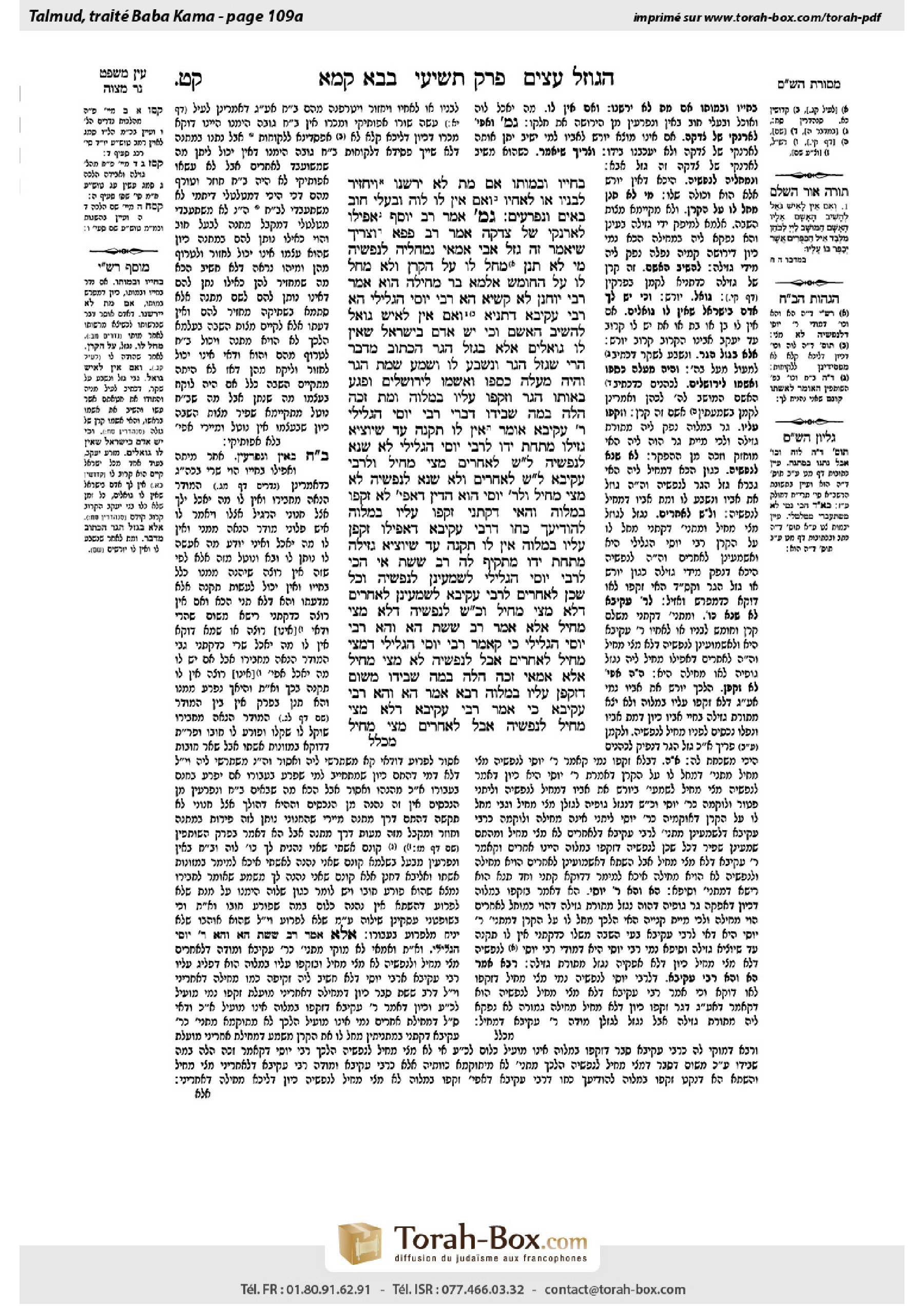
בבא קמא ק״ט א · Aramaic and Hebrew text
בְּחַיָּיו וּבְמוֹתוֹ, אִם מֵת – לֹא יִירָשֶׁנּוּ, וְיַחְזִיר לְבָנָיו אוֹ לְאֶחָיו. וְאִם אֵין לוֹ – לֹוֶה וּבַעֲלֵי חוֹב בָּאִים וְנִפְרָעִים.
גְּמָ׳ אָמַר רַב יוֹסֵף: אֲפִילּוּ לְאַרְנָקִי שֶׁל צְדָקָה. אָמַר רַב פָּפָּא: וְצָרִיךְ שֶׁיֹּאמַר: ״זֶה גֶּזֶל אָבִי״.
אַמַּאי? נִמְחֲלֵיהּ לְנַפְשֵׁיהּ! מִי לָא תְּנַן: מָחַל לוֹ עַל הַקֶּרֶן וְלֹא מָחַל לוֹ עַל הַחוֹמֶשׁ? אַלְמָא בַּר מְחִילָה הוּא!
אָמַר רַבִּי יוֹחָנָן: לָא קַשְׁיָא; הָא רַבִּי יוֹסֵי הַגְּלִילִי, הָא רַבִּי עֲקִיבָא.
דְּתַנְיָא: ״וְאִם אֵין לָאִישׁ גֹּאֵל לְהָשִׁיב הָאָשָׁם״ – וְכִי יֵשׁ אָדָם בְּיִשְׂרָאֵל שֶׁאֵין לוֹ גּוֹאֲלִים? אֶלָּא בְּגֶזֶל הַגֵּר הַכָּתוּב מְדַבֵּר –
הֲרֵי שֶׁגָּזַל הַגֵּר, וְנִשְׁבַּע לוֹ; וְשָׁמַע שֶׁמֵּת הַגֵּר, וְהָיָה מַעֲלֶה כַּסְפּוֹ וַאֲשָׁמוֹ לִירוּשָׁלַיִם; וּפָגַע בְּאוֹתוֹ הַגֵּר, וּזְקָפוֹ עָלָיו בְּמִלְוָה, וּמֵת – זָכָה הַלָּה בְּמַה שֶּׁבְּיָדוֹ, דִּבְרֵי רַבִּי יוֹסֵי הַגְּלִילִי. רַבִּי עֲקִיבָא אוֹמֵר: אֵין לוֹ תַּקָּנָה עַד שֶׁיּוֹצִיא גְּזֵילוֹ מִתַּחַת יָדוֹ.
לְרַבִּי יוֹסֵי הַגְּלִילִי – לָא שְׁנָא לְנַפְשֵׁיהּ לָא שְׁנָא לַאֲחֵרִים, מָצֵי מָחֵיל; וּלְרַבִּי עֲקִיבָא – לָא שְׁנָא לַאֲחֵרִים וְלָא שְׁנָא לְנַפְשֵׁיהּ, לָא מָצֵי מָחֵיל.
וּלְרַבִּי יוֹסֵי – הוּא הַדִּין דַּאֲפִילּוּ לֹא זְקָפוֹ בְּמִלְוָה, וְהַאי דְּקָתָנֵי ״זְקָפוֹ עָלָיו בְּמִלְוָה״ – לְהוֹדִיעֲךָ כֹּחוֹ דְּרַבִּי עֲקִיבָא, דַּאֲפִילּוּ זְקָפָן עָלָיו בְּמִלְוָה, אֵין לוֹ תַּקָּנָה עַד שֶׁיּוֹצִיא גְּזֵילָה מִתַּחַת יָדוֹ.
מַתְקֵיף לַהּ רַב שֵׁשֶׁת: אִי הָכִי, לְרַבִּי יוֹסֵי הַגְּלִילִי – לַשְׁמְעִינַן לְנַפְשֵׁיהּ, וְכׇל שֶׁכֵּן לַאֲחֵרִים! לְרַבִּי עֲקִיבָא – לַשְׁמְעִינַן לַאֲחֵרִים דְּלָא מָצֵי מָחֵיל, וְכׇל שֶׁכֵּן לְנַפְשֵׁיהּ דְּלָא מָצֵי מָחֵיל!
אֶלָּא אָמַר רַב שֵׁשֶׁת: הָא וְהָא רַבִּי יוֹסֵי הַגְּלִילִי; כִּי קָאָמַר רַבִּי יוֹסֵי הַגְּלִילִי דְּמָצֵי מָחֵיל – לַאֲחֵרִים, אֲבָל לְנַפְשֵׁיהּ – לָא מָצֵי מָחֵיל. אֶלָּא אַמַּאי זָכָה הַלָּה בְּמַה שֶּׁבְּיָדוֹ? מִשּׁוּם דִּזְקָפָן עָלָיו בְּמִלְוָה.
רָבָא אָמַר: הָא וְהָא רַבִּי עֲקִיבָא; כִּי אָמַר רַבִּי עֲקִיבָא דְּלָא מָצֵי מָחֵיל – לְנַפְשֵׁיהּ, אֲבָל לַאֲחֵרִים – מָצֵי מָחֵיל.
Bava Kamma 109a · English translation
The mishna continues: If the father stated in his vow that his son may not derive benefit from his property in his life and in his death, then even if the father then dies the son does not inherit from him, as the prohibition is still in effect. And instead of taking his inheritance, he returns his portion in the estate to his sons or to his brothers. And if he does not have sufficient funds to subsist without his inheritance, he borrows money in the amount of the value of his share in the inheritance and the creditors come and are repaid from his share.
GEMARA: With regard to the halakha written in the mishna that one who robs his father pays the principal and the additional one-fifth payment to the father’s heirs, Rav Yosef says: One may even put this money in a charity purse if he so chooses. Rav Pappa says: And when giving the money he must say: This is what was robbed from my father.
§ The Gemara questions the mishna’s ruling that one who robs his father must return the stolen item to others even if he is the sole heir. Why must he do this? Let him forgive the debt to himself; as the heir, to whom payment is due, he should be able to forgive it. Didn’t we learn in a mishna (103a) that in the case of a robber who took a false oath claiming to be innocent and later admitted his liability: If the owner forgave him concerning the principal, but did not forgive him concerning the additional one-fifth payment, he need not pursue him to repay the remaining debt. Apparently, even the principal is subject to forgiveness, so why doesn’t he forgive the obligation to himself?
Rabbi Yoḥanan said: This is not difficult. That mishna is in accordance with the opinion of Rabbi Yosei HaGelili, who says that this obligation can be forgiven, while this mishna, ruling that a son who robbed his father and is his sole heir cannot forgive the obligation to himself, is in accordance with the opinion of Rabbi Akiva, who holds that this obligation cannot be forgiven.
Rabbi Yoḥanan explains: As it is taught in a baraita (Tosefta 10:16) that the verse states with regard to one who steals from one who then died: “But if the man has no kinsman to whom restitution may be made for the guilt, the restitution for guilt that is made shall be the Lord’s, even the priest’s” (Numbers 5:8). The baraita asks: But is there any Jewish person who has no kinsmen? Since every Jew descends from Jacob our forefather, all Jews have relatives to inherit from them. Rather, it must be that the verse is speaking of robbery of a convert who never married or had children as a Jew, and in any case is no longer legally related to his gentile family; he has no heirs. In this situation the Torah instructs one who robbed from a now-deceased convert to return the stolen item to a priest.
The baraita continues: In the case of one who robbed a convert and took a false oath to him saying that he did not rob him, and then heard that the convert died; and he was bringing his money, for the principal and the additional one-fifth payment, and his guilt-offering up to Jerusalem to pay his debt to the priests and sacrifice his offering, and he encountered that same convert, who in fact had not died; and, instead of having the robber pay the money right away the convert established it as a loan for the robber, and then the convert died, leaving his property ownerless, as he had no heirs; this robber acquires all that is in his possession, as it is now a loan, not money to pay back the theft; this is the statement of Rabbi Yosei HaGelili. Rabbi Akiva says: The robber has no remedy until he will remove his stolen item from his possession.
Rabbi Yoḥanan explains their respective opinions. According to the opinion of Rabbi Yosei HaGelili, there is no difference if the one to whom payment is due forgives the return of a stolen item to himself, such as in this case of a convert who died or in the case of the mishna where a son robbed his father who then died, and there is no difference if he forgives the return of a stolen item to others. In either case, he can forgive payment. And according to the opinion of Rabbi Akiva, there is no difference if the one to whom payment is due forgives the return of a stolen item to others and there is no difference if he forgives the return of a stolen item to himself. In either case, he cannot forgive payment.
Rabbi Yoḥanan continues his analysis: And according to the opinion of Rabbi Yosei HaGelili, the same is true, i.e., the halakha would also be, that no liability would remain in the case of the convert even had he not established the robbery debt as a loan, as the robber could forgive the obligation to himself once the convert died. And the fact that the baraita teaches its halakha in a case where he established it as a loan for the robber is to convey to you the far-reaching nature of the opinion of Rabbi Akiva: That even if he established it as a loan for him, in which case it could be considered as though the robber had returned the stolen item and now has a standard loan debt, nevertheless, the robber has no remedy until he will remove his stolen item from his possession, so as to not benefit from his act of robbery.
Rav Sheshet objects to this interpretation of the baraita: If so, then according to the opinion of Rabbi Yosei HaGelili, let the mishna on 103a, which indicates that one can forgive the principal payment of a robbery, teach us instead that the robbery victim can forgive the obligation to himself, and it would be understood that all the more so one can forgive the obligation to others. And according to the opinion of Rabbi Akiva, which Rabbi Yoḥanan explains to be the opinion stated in the mishna here, let it teach us that one cannot forgive the obligation to others, and it would be understood all the more so with regard to the robber, that he cannot forgive the obligation to himself.
Rather, Rav Sheshet said: That mishna and this mishna are both in accordance with the opinion of Rabbi Yosei HaGelili. When Rabbi Yosei HaGelili is saying that one can forgive the return of a stolen item, he meant specifically forgiving the obligation to others, but he cannot forgive the obligation to himself. The Gemara asks: But if that is the halakha, why did this one who robbed a convert who subsequently died acquire all that is in his possession? Because the convert established it as a loan for him, and henceforth it is no longer considered stolen property, but a standard loan debt.
The Gemara offers a different explanation. Rava said: That mishna and this mishna are both in accordance with the opinion of Rabbi Akiva. When Rabbi Akiva says that he cannot forgive the return of a stolen item he meant specifically forgiving the obligation to himself, as in the case of the convert, but he can forgive the obligation to others.
Bava Kamma 109a · Traduction française (IA)
La Michna continue : Si le père a formulé un vœu selon lequel son fils ne peut pas tirer profit de ses biens tant vivant que décédé, alors même que le père meurt, le fils ne hérite pas de lui, car l'interdiction reste en vigueur. Et au lieu de prendre sa part de l'héritage, il restitue sa part dans l'actif à ses fils ou à ses frères. Et si celui-ci n'a pas de fonds suffisants pour subsister sans son héritage, il emprunte de l'argent équivalent à la valeur de sa part dans l'héritage, et les créanciers viennent et sont remboursés à partir de sa part.
GUEMARA : En ce qui concerne la halakha écrite dans la Michna selon laquelle celui qui vole à son père doit payer le principal et le cinquième supplémentaire aux héritiers du père, Rav Yosef dit : On peut même mettre cet argent dans un sac de charité si l'on le souhaite. Rav Pappa dit : Et lors de la remise de l'argent, il doit dire : C'est ce qui a été volé à mon père.
§ La Guemara questionne la décision de la Michna selon laquelle celui qui vole à son père doit restituer l'objet volé à d'autres même s'il est l'héritier unique. Pourquoi doit-il le faire ? Laissons-le pardonner la dette à lui-même ; étant l'héritier à qui la réparation est due, il devrait pouvoir le pardonner. N'avons-nous pas appris dans une Michna (103a) que dans le cas d'un voleur qui a prétendu être innocent sous serment et a ensuite admis sa responsabilité : Si l'owner a pardonné concernant le principal, mais n'a pas pardonné concernant le cinquième supplémentaire, il n'a pas besoin de le poursuivre pour régler la dette restante. Apparemment, même le principal est soumis au pardon, donc pourquoi ne pardonne-t-il pas l'obligation à lui-même ?
Rabbi Yoḥanan dit : Ce n'est pas difficile. Cette Michna est selon l'opinion de Rabbi Yosei HaGelili, qui dit que cette obligation peut être pardonnée, tandis que cette Michna, qui déclare que le fils ayant volé son père et étant l'héritier unique ne peut pas pardonner l'obligation à lui-même, est selon l'opinion de Rabbi Akiva, qui considère que cette obligation ne peut pas être pardonnée.
Rabbi Yoḥanan explique : Comme il est enseigné dans une baraïta (Tosefta 10:16) que la parabole dit concernant celui qui vole à celui qui est ensuite décédé : « Mais si l'homme n'a pas de parent à qui on puisse faire la réparation pour la faute, la réparation pour la faute sera du Seigneur, même du prêtre » (Nombres 5:8). La baraïta pose la question : Mais y a-t-il un Juif qui n'a pas de parents ? Puisque tout Juif descend de Jacob notre père, tous les Juifs ont des parents à hériter. En revanche, il doit être que la parabole parle de la voleterie d'un converti qui n'a jamais épousé ou n'a pas eu d'enfants en tant que Juif, et dans tous les cas n'est plus légalement lié à sa famille gentilienne ; il n'a pas d'héritiers. Dans ce cas, la Torah ordonne à celui qui a volé un converti décédé de restituer l'objet volé à un prêtre.
La baraïta continue : Dans le cas d'un voleur qui a volé un converti et a prétendu sous serment qu'il ne l'avait pas volé, et ensuite a appris que le converti était décédé ; et il apportait son argent, pour le principal et le cinquième supplémentaire, ainsi que son sacrifice expiatoire à Jérusalem pour régler sa dette envers les prêtres et offrir son sacrifice, et il a rencontré ce même converti, qui en réalité n'était pas décédé ; et, au lieu de faire payer l'argent immédiatement, le converti l'a établi comme un prêt pour le voleur, et ensuite le converti est décédé, laissant son patrimoine sans propriétaire, car il n'avait pas d'héritiers ; ce voleur acquiert tout ce qui est en son possession, car il s'agit maintenant d'un prêt, pas d'argent à rembourser pour le vol ; c'est l'opinion de Rabbi Yosei HaGelili. Rabbi Akiva dit : Le voleur n'a pas de recours jusqu'à ce qu'il retire l'objet volé de ses possessions.
Rabbi Yoḥanan explique leurs opinions respectives. Selon l'opinion de Rabbi Yosei HaGelili, il n'y a pas de différence si celui à qui la réparation est due pardonne la restitution d'un objet volé à lui-même, comme dans ce cas du converti décédé ou dans le cas de la Michna où un fils a volé son père qui est ensuite décédé, et il n'y a pas de différence si celui-ci pardonne la restitution d'un objet volé à d'autres. Dans les deux cas, il peut pardonner la réparation. Et selon l'opinion de Rabbi Akiva, il n'y a pas de différence si celui à qui la réparation est due pardonne la restitution d'un objet volé à d'autres et il n'y a pas de différence si celui-ci pardonne la restitution d'un objet volé à lui-même. Dans les deux cas, il ne peut pas pardonner la réparation.
Rabbi Yoḥanan continue son analyse : Et selon l'opinion de Rabbi Yosei HaGelili, la même chose est vraie, c'est-à-dire la halakha serait aussi que aucune obligation ne resterait dans le cas du converti même s'il n'avait pas établi la dette de la voleterie comme un prêt, car le voleur pouvait pardonner l'obligation à lui-même une fois que le converti était décédé. Et le fait que la baraïta enseigne sa halakha dans un cas où il l'a établi comme un prêt pour le voleur est pour vous faire comprendre la portée de l'opinion de Rabbi Akiva : Que même s'il l'a établi comme un prêt pour lui, dans ce cas il pourrait être considéré comme si le voleur avait restitué l'objet volé et maintenant a une dette normale de prêt, néanmoins, le voleur n'a pas de recours jusqu'à ce qu'il retire l'objet volé de ses possessions, afin de ne pas bénéficier de son acte de voleterie.
Rav Sheshet s'oppose à cette interprétation de la baraïta : Si c'est ainsi, alors selon l'opinion de Rabbi Yosei HaGelili, la Michna sur 103a, qui indique que l'on peut pardonner le paiement principal d'une voleterie, enseigne plutôt que le victime de la voleterie peut pardonner l'obligation à lui-même, et il serait compris que cela est encore plus vrai pour l'obligation à d'autres. Et selon l'opinion de Rabbi Akiva, qui Rabbi Yoḥanan explique être l'opinion énoncée dans la Michna ici, il enseigne que l'on ne peut pas pardonner l'obligation à d'autres, et il serait compris encore plus pour le voleur, qu'il ne peut pas pardonner l'obligation à lui-même.
Plutôt, Rav Sheshet a dit : Cette mésorah et celle-ci sont selon l'opinion de Rabbi Yosei HaGelili. Lorsque Rabbi Yosei HaGelili dit qu'on peut pardonner le retour d'un objet volé, il entendait spécifiquement pardonner l'obligation envers autrui, mais on ne peut pas pardonner l'obligation envers soi-même. La Guemara pose la question : Mais si c'est ainsi la halakha, pourquoi celui qui a volé un converti, qui est ensuite décédé, a-t-il acquis tout ce qui est en son possession ? Parce que le converti l'avait établi comme un prêt, et désormais cela n'est plus considéré comme un objet volé, mais comme une dette normale de prêt.
La Guemara propose une autre explication. Rava a dit : Cette mésorah et celle-ci sont selon l'opinion de Rabbi Akiva. Lorsque Rabbi Akiva dit qu'on ne peut pas pardonner le retour d'un objet volé, il entendait spécifiquement pardonner l'obligation envers soi-même, comme dans le cas du converti, mais on peut pardonner l'obligation envers autrui.
Traduction française générée par IA à partir de l’édition anglaise de Sefaria. Vérifie toujours un passage avec le texte source.
Text from Sefaria: William Davidson Edition - Vocalized Aramaic (CC BY NC); William Davidson Edition - English (CC BY NC).