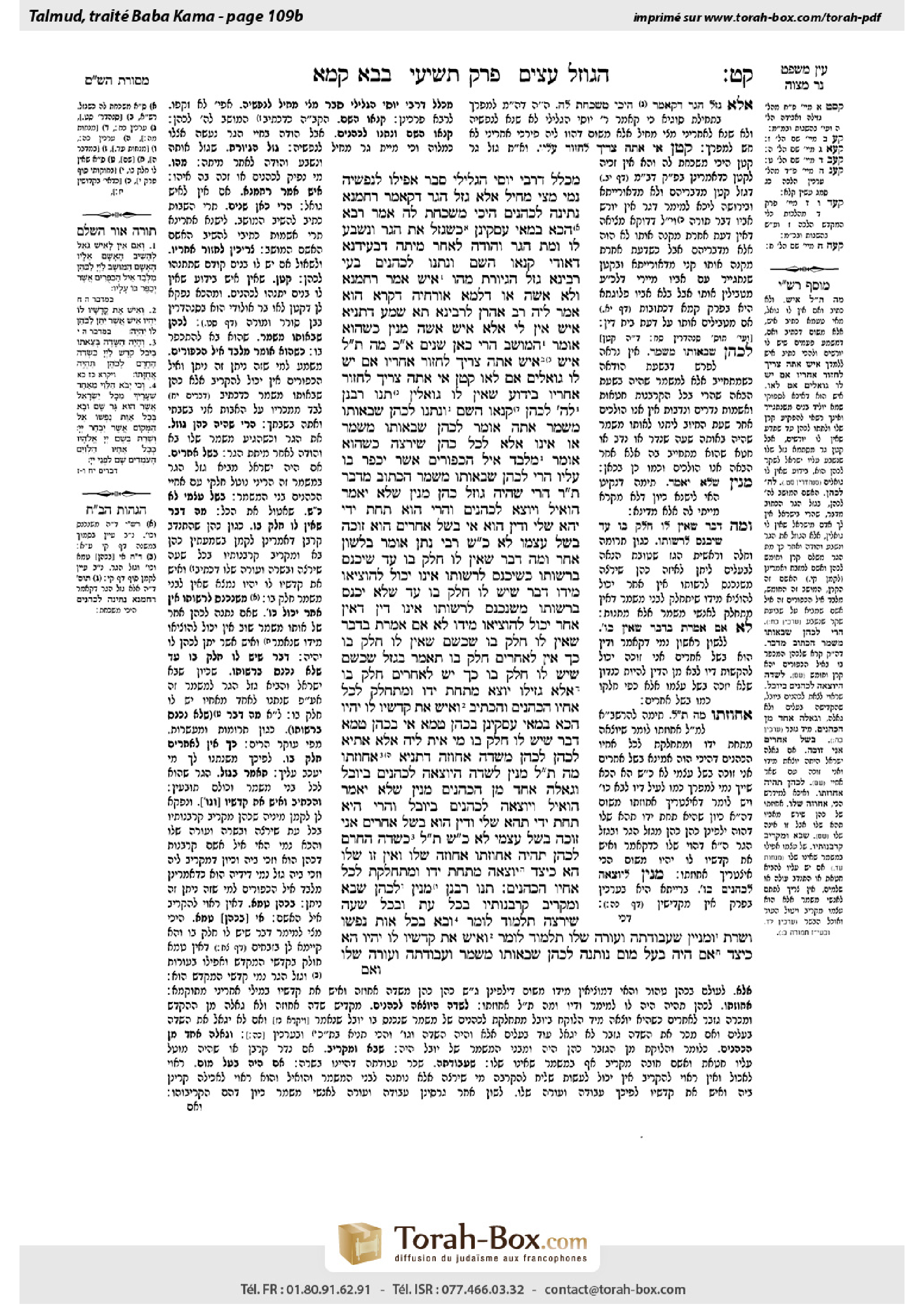
Bava Kamma 109b: Talmud study for Daf Yomi
Study the Talmud for Daf Yomi with scanned pages, Hebrew text, English translations from Sefaria and AI-generated French translations.
Passage selection and English or AI-generated French translation are available where the scan has annotations. Daf Study is independent of Torah-Box and Sefaria.
Browse Bava Kamma · בבא קמא · All tractatesBava Kamma 109b text and translations
This page of Bava Kamma includes the Aramaic text, an English translation and an AI-generated French translation, alongside the scan above.
בבא קמא ק״ט ב · Aramaic and Hebrew text
מִכְּלָל דְּרַבִּי יוֹסֵי הַגְּלִילִי סָבַר: אֲפִילּוּ לְנַפְשֵׁיהּ נָמֵי מָצֵי מָחֵיל?! אֶלָּא גֶּזֶל הַגֵּר דְּקָאָמַר רַחֲמָנָא נְתִינָה לְכֹהֲנִים, הֵיכִי מַשְׁכַּחַתְּ לַהּ?
אָמַר רָבָא: הָכָא בְּמַאי עָסְקִינַן – כְּשֶׁגָּזַל אֶת הַגֵּר, וְנִשְׁבַּע לוֹ, וּמֵת הַגֵּר, וְהוֹדָה לְאַחַר מִיתָה; דִּבְעִידָּנָא דְּאוֹדִי – קְנָאוֹ הַשֵּׁם וּנְתָנוֹ לְכֹהֲנִים.
בָּעֵי רָבִינָא: גֶּזֶל הַגִּיּוֹרֶת, מַהוּ? ״אִישׁ״ אָמַר רַחֲמָנָא – וְלֹא אִשָּׁה, אוֹ דִלְמָא אוֹרְחֵיהּ דִּקְרָא הוּא?
אֲמַר לֵיהּ רַב אַהֲרֹן לְרָבִינָא: תָּא שְׁמַע, דְּתַנְיָא: ״אִישׁ״ – אֵין לִי אֶלָּא אִישׁ; אִשָּׁה מִנַּיִן? כְּשֶׁהוּא אוֹמֵר ״הַמּוּשָׁב״ – הֲרֵי כָּאן שְׁנַיִם,
אִם כֵּן מָה תַּלְמוּד לוֹמַר ״אִישׁ״? אִישׁ אַתָּה צָרִיךְ לַחֲזוֹר אַחֲרָיו אִם יֵשׁ לוֹ גּוֹאֲלִים אִם לָאו, קָטָן אִי אַתָּה צָרִיךְ לַחֲזוֹר אַחֲרָיו; בְּיָדוּעַ שֶׁאֵין לוֹ גּוֹאֲלִין.
תָּנוּ רַבָּנַן: ״לַה׳ לַכֹּהֵן״ – קְנָאוֹ הַשֵּׁם, וּנְתָנוֹ לַכֹּהֵן שֶׁבְּאוֹתוֹ מִשְׁמָר. אַתָּה אוֹמֵר לַכֹּהֵן שֶׁבְּאוֹתוֹ מִשְׁמָר; אוֹ אֵינוֹ אֶלָּא לְכׇל כֹּהֵן שֶׁיִּרְצֶה? כְּשֶׁהוּא אוֹמֵר ״מִלְּבַד אֵיל הַכִּפֻּרִים אֲשֶׁר יְכַפֶּר בּוֹ עָלָיו״ – הֲרֵי לַכֹּהֵן שֶׁבְּאוֹתוֹ מִשְׁמָר הַכָּתוּב מְדַבֵּר.
תָּנוּ רַבָּנַן: הֲרֵי שֶׁהָיָה גּוֹזֵל כֹּהֵן, מִנַּיִן שֶׁלֹּא יֹאמַר: הוֹאִיל וְיוֹצֵא לַכֹּהֲנִים, וַהֲרֵי הוּא תַּחַת יָדִי – יְהֵא שֶׁלִּי? וְדִין הוּא – אִי בְּשֶׁל אֲחֵרִים הוּא זוֹכֶה, בְּשֶׁל עַצְמוֹ לֹא כׇּל שֶׁכֵּן?
רַבִּי נָתָן אוֹמֵר בְּלָשׁוֹן אַחֵר: וּמָה דָּבָר שֶׁאֵין לוֹ חֵלֶק בּוֹ עַד שֶׁיִּכָּנֵס בִּרְשׁוּתוֹ – כְּשֶׁיִּכָּנֵס לִרְשׁוּתוֹ אֵינוֹ יָכוֹל לְהוֹצִיאוֹ מִיָּדוֹ; דָּבָר שֶׁיֵּשׁ לוֹ חֵלֶק בּוֹ עַד שֶׁלֹּא יִכָּנֵס בִּרְשׁוּתוֹ – מִשֶּׁנִּכְנַס לִרְשׁוּתוֹ אֵינוֹ דִּין דְּאֵין אַחֵר יָכוֹל לְהוֹצִיאוֹ מִיָּדוֹ?
לֹא; אִם אָמַרְתָּ בְּדָבָר שֶׁאֵין לוֹ חֵלֶק בּוֹ – שֶׁכְּשֵׁם שֶׁאֵין לוֹ חֵלֶק בּוֹ כָּךְ אֵין לַאֲחֵרִים חֵלֶק בּוֹ, תֹּאמַר בְּגָזֵל – שֶׁכְּשֵׁם שֶׁיֵּשׁ לוֹ חֵלֶק בּוֹ, כָּךְ יֵשׁ לַאֲחֵרִים חֵלֶק בּוֹ?! אֶלָּא גְּזֵילוֹ יוֹצֵא מִתַּחַת יָדוֹ, וּמִתְחַלֵּק לְכׇל אֶחָיו הַכֹּהֲנִים.
וְהָכְתִיב: ״וְאִישׁ אֶת קֳדָשָׁיו לוֹ יִהְיוּ״! הָכָא בְּמַאי עָסְקִינַן – בְּכֹהֵן טָמֵא.
אִי בְּכֹהֵן טָמֵא, ״דָּבָר שֶׁיֵּשׁ לוֹ חֵלֶק בּוֹ״ מִי אִית לֵיהּ?! אֶלָּא אָתְיָא ״לַכֹּהֵן״–״לַכֹּהֵן״ מִשְּׂדֵה אֲחוּזָּה.
דְּתַנְיָא: ״אֲחֻזָּתוֹ״ – מָה תַּלְמוּד לוֹמַר? מִנַּיִן לְשָׂדֶה הַיּוֹצְאָה לַכֹּהֲנִים בַּיּוֹבֵל – וּגְאָלָהּ אֶחָד מִן הַכֹּהֲנִים, מִנַּיִן שֶׁלֹּא יֹאמַר: הוֹאִיל וְיוֹצְאָה לַכֹּהֲנִים בַּיּוֹבֵל, וַהֲרֵי הִיא תַּחַת יָדִי, תְּהֵא שֶׁלִּי?
וְדִין הוּא – בְּשֶׁל אֲחֵרִים אֲנִי זוֹכֶה, בְּשֶׁל עַצְמִי לֹא כׇּל שֶׁכֵּן?!
תַּלְמוּד לוֹמַר: ״כִּשְׂדֵה הַחֵרֶם לַכֹּהֵן תִּהְיֶה אֲחֻזָּתוֹ״ – אֲחוּזָּה שֶׁלּוֹ, וְאֵין זוֹ שֶׁלּוֹ. הָא כֵּיצַד? יוֹצְאָה מִתַּחַת יָדוֹ, וּמִתְחַלֶּקֶת לְכׇל אֶחָיו הַכֹּהֲנִים.
תָּנוּ רַבָּנַן: מִנַּיִן לְכֹהֵן – שֶׁבָּא וּמַקְרִיב קׇרְבְּנוֹתָיו בְּכׇל עֵת וּבְכׇל שָׁעָה שֶׁיִּרְצֶה? תַּלְמוּד לוֹמַר: ״וּבָא בְּכׇל אַוַּת נַפְשׁוֹ״, ״וְשֵׁרֵת״.
וּמִנַּיִין שֶׁעֲבוֹדָתָהּ וְעוֹרָהּ שֶׁלּוֹ? תַּלְמוּד לוֹמַר: ״וְאִישׁ אֶת קֳדָשָׁיו לוֹ יִהְיוּ״. הָא כֵּיצַד? אִם הָיָה בַּעַל מוּם – נוֹתְנָהּ לְכֹהֵן שֶׁבְּאוֹתוֹ מִשְׁמָר, וַעֲבוֹדָתָהּ וְעוֹרָהּ שֶׁלּוֹ.
Bava Kamma 109b · English translation
The Gemara questions Rava’s explanation: By inference does it follow that Rabbi Yosei HaGelili holds that he can forgive the return of the stolen item even to himself? But if so, payment for robbery of a convert who dies without heirs, about which the Merciful One says that it requires giving repayment to the priests, how can you find these circumstances if in every case where one robs a convert and the convert dies the robber can forgive the return of the item to himself?
Rava said: With what are we dealing here? With a case where one robbed the convert and took an oath to him that he did not rob him, and then the convert died, and the robber admitted his false oath after the convert’s death, such that at the time that he admitted to it, the Name, i.e., God, acquired the principal and the additional one-fifth payment and gave it to the priests. Once the right to the payment is transferred to the priests the robber can no longer forgive it. By contrast, if he admitted his false oath while the convert was still alive and then the convert dies, the convert can forgive the obligation to himself, since he already took ownership of it.
§ Ravina raises a dilemma: With regard to payment for robbery of a female convert, what is the halakha? The Merciful One states in the Torah: “But if the man has no kinsman” (Numbers 5:8), indicating that the halakha applies to a male convert, but not to a woman, i.e., a female convert; if she dies after being robbed, payment is not given to the priests. Or perhaps it is the manner of the verse to employ masculine wording, but the halakha applies in the case of a female convert as well?
Rav Aharon said to Ravina: Come and hear a solution to your dilemma, as it is taught in a baraita that the verse states in its entirety: “But if the man has no kinsman to whom restitution may be made for the guilt, the restitution for guilt that is made shall be the Lord’s, even the priest’s; besides the ram of the atonement, whereby atonement shall be made for him.” I have derived only that it is referring to a man; from where is it derived that this applies equally to a woman? When it states: “The restitution for guilt that is made,” there are two instances of the phrase “that is made” here, as the verse mentions making restitution twice, to include a female convert in this halakha.
The baraita continues: If so, what is the meaning when the verse states specifically “man”? The baraita explains: To pay a convert who is a man, you need to investigate concerning him to determine if he has a kinsman or not, but to pay a convert who is a minor you do not need to investigate concerning him. It is known that he has no kinsman, since as a convert he has no kin among his birth family, and as a minor he does not have children.
§ With regard to the payment to priests in the case of one who robbed a convert who then died without heirs, the Sages taught: The verse states: “Restitution for guilt that is made shall be the Lord’s, even the priest’s” (Numbers 5:8), teaching that the Name, i.e., God, acquired it and gave it to the priest who is in that priestly watch. Do you say that it is given only to the priest who is on that priestly watch? Or perhaps that is not the case, and rather he may give it to any priest that he wishes? When it says in that verse: “Besides the ram of the atonement, whereby atonement shall be made for him,” this teaches that the verse speaks of giving it to the priest who is on that priestly watch. Just as the ram that the robber brings is given only to the priest on duty who sacrifices it, so too, the money is also given only to the priest on duty.
Concerning this payment, the Sages taught: In a case where the one who robs the convert was a priest, from where is it derived that he shall not say: Since the payment usually is removed from the robber and given to the priests and it is now in my possession, it should be mine. And there is a logical derivation to support this reasoning, as follows: If a priest has the right to acquire the payment belonging to others who stole from a convert, then with regard to payment belonging to himself, which is already in his possession, is it not all the more so that he should keep it?
The baraita continues: Rabbi Natan states this logical inference with different wording: And just as with regard to a matter in which a priest has no portion until it enters his possession, e.g., teruma, which can be given to any priest, once it enters his possession another priest cannot remove it from his possession; so too, with regard to a matter in which a priest has a portion even before it enters his possession, e.g., an item stolen from a convert, in which he has a portion as one of the priests on the priestly watch, isn’t it logical that another priest cannot remove it from his possession once it is in his possession?
The baraita continues, countering that this logical inference is not correct: No, if you said this concerning a matter in which a priest has no portion, where the reason why once it enters his possession another priest cannot remove it from his possession is that just as he has no portion in it, so too, others have no portion in it; would you say the same concerning an item robbed from a convert? As there it could be said that just as the priest who robbed him has a portion in it as one of the priests on the priestly watch, so too, other priests on that watch have a portion in it. Rather, the halakha is that the item he stole is removed from his possession and is distributed to all of his brethren, the priests.
The Gemara raises an objection: But isn’t it written: “And every man’s hallowed things shall be his; whatsoever any man gives to the priest, it shall be his” (Numbers 5:10), indicating that a priest is not required to give to the other priests the offerings he sacrifices? Therefore, just as he has the right to the flesh of the guilt-offering that he brings to atone for robbing the convert, shouldn’t he also have the right to the payment? The Gemara answers: With what are we dealing here, in this case? We are dealing with a ritually impure priest, who is unfit to sacrifice the guilt-offering and therefore does not have rights to the flesh of the offering. In this case, he will not be able to keep the payment for himself.
The Gemara asks: If the baraita states its ruling specifically with regard to an impure priest, how can it describe the payment as a matter in which the priest has a portion? Does he have a portion in it? Therefore, the baraita must not be referring to an impure priest. Rather, there is another reason why he has no right to the payment. This halakha is derived through a verbal analogy between the phrase “even the priest’s [lakohen]” (Numbers 5:8) written in this context, and the phrase “to the priest [lakohen]” (Leviticus 27:21) from the verse stated concerning an ancestral field, which, if consecrated and then redeemed by another does not revert to its original owner in the Jubilee Year, but is given to the priests, as the baraita will now explain.
As it is taught in a baraita that the verse states: “But the field, when it goes out in the Jubilee, shall be holy unto the Lord, as a field dedicated; the possession thereof shall be to the priest” (Leviticus 27:21). The baraita asks: What is the meaning when the verse states the term: “The possession thereof”? From where is it derived that with regard to a field that goes out to the priests in the Jubilee Year and one of the priests redeemed it before the Jubilee Year, from where is it derived that a priest shall not say: Since a field that is redeemed by another goes out to the priests in the Jubilee Year, and the field that I redeemed is now in my possession, it should be mine, and not be given to the priests in general?
The baraita continues: And there is a logical derivation to support this reasoning, as follows: If I acquire the field belonging to others, who consecrated it and it was then redeemed, then with regard to a field belonging to me, which is already in my possession, is it not all the more so that I should keep it?
The baraita continues, countering that this logical inference is not correct. The verse states: “As a field dedicated; the possession thereof shall be to the priest” (Leviticus 27:21), indicating that a field of which the priest has possession from his ancestors is his, but this field that he redeemed is not his. How so? It is removed from his possession and is distributed to all of his brethren, the priests.
§ The Gemara records another baraita concerning the rights of a priest to offerings he sacrifices. The Sages taught (Tosefta, Menaḥot 13:17): From where is it derived that a priest may come and sacrifice his offerings at any time and at any hour that he wishes and does not have to wait for his priestly watch to serve in the Temple? The verse states: “And if a Levite comes from any of your gates out of all Israel, where he sojourns, and comes with all the desire of his soul unto the place that the Lord shall choose; then he shall minister in the name of the Lord his God” (Deuteronomy 18:6–7).
The baraita continues: And from where is it derived that the performance of the offering’s service, i.e., eating the meat of the animal he sacrifices, and the offering’s hide, belong to him? The verse states: “And every man’s hallowed things shall be his” (Numbers 5:10). How so? If this priest was blemished, he gives his offering to another priest that is on the same priestly watch as him to sacrifice it, but the performance of its service and its hide belong to him.
Bava Kamma 109b · Traduction française (IA)
La Guemara questionne l'explication de Rava : Par déduction, cela implique-t-il que Rabbi Yosei HaGelili considère qu'il peut pardonner le retour de l'objet volé même à lui-même ? Mais si c'est le cas, comment peut-on trouver ces circonstances, sachant que lors de chaque cas où l'on vole un converti et que ce dernier meurt sans héritiers, et que l'Éternel dit qu'il faut remettre la réparation aux prêtres, comment peut-on trouver ces circonstances, si dans chaque cas où l'on vole un converti et que ce dernier meurt, le voleur peut pardonner le retour de l'objet à lui-même ?
Rava dit : De quoi sommes-nous en train de parler ? D'un cas où l'on a volé un converti et qu'on a pris un serment envers lui affirmant ne pas l'avoir volé, puis que le converti est mort, et que le voleur a avoué son faux serment après la mort du converti, de sorte que lorsqu'il a avoué, le Nom, c'est-à-dire Dieu, a acquis le principal et le cinquième supplémentaire, et l'a donné aux prêtres. Une fois que le droit au paiement est transféré aux prêtres, le voleur ne peut plus pardonner ce paiement. À l'inverse, si le voleur a avoué son faux serment alors que le converti était encore vivant, et que ce dernier meurt ensuite, le converti peut pardonner l'obligation à lui-même, car il a déjà acquis la propriété.
§ Ravina soulève un dilemme : En ce qui concerne le paiement pour le vol d'une femme convertie, quelle est la halakha ? L'Éternel dit dans la Torah : « Mais s'il n'a pas de parent à qui on puisse faire la réparation pour la faute » (Nombres 5:8), indiquant que la halakha s'applique à un homme converti, mais pas à une femme, c'est-à-dire une femme convertie ; si elle meurt après avoir été volée, le paiement n'est pas donné aux prêtres. Ou peut-être que c'est la manière de la parole du verset qui utilise un langage masculin, mais la halakha s'applique également à une femme convertie ?
Rav Aharon dit à Ravina : Viens écouter une solution à ton dilemme, car il est enseigné dans une baraïta que le verset dit en entier : « Mais s'il n'a pas de parent à qui on puisse faire la réparation pour la faute, la réparation pour la faute qui est faite sera de l'Éternel, même du prêtre ; en dehors du bouc de l'atonement, par lequel on fera l'atonement pour lui. » J'ai déduit seulement qu'il s'agit d'un homme ; d'où déduit-on que cela s'applique également à une femme ? Lorsqu'il dit : « La réparation pour la faute qui est faite », il y a deux occurrences du mot « qui est faite » ici, car le verset mentionne la réparation deux fois, afin d'inclure une femme convertie dans cette halakha.
La baraïta continue : Si c'est ainsi, quelle est la signification lorsque le verset dit spécifiquement « homme » ? La baraïta explique : Pour payer un converti qui est un homme, il faut enquêter sur lui afin de déterminer s'il a un parent ou non, mais pour payer un converti qui est un mineur, il n'est pas nécessaire d'enquêter sur lui. On sait qu'il n'a pas de parent, car comme un converti, il n'a pas de parent dans sa famille d'origine, et comme un mineur, il n'a pas d'enfants.
§ En ce qui concerne le paiement aux prêtres dans le cas où l'on a volé un converti qui est ensuite mort sans héritiers, les Sages ont enseigné : Le verset dit : « La réparation pour la faute qui est faite sera de l'Éternel, même du prêtre » (Nombres 5:8), enseignant que le Nom, c'est-à-dire Dieu, a acquis cela et l'a donné au prêtre qui est en ce service de prêtrise. Dis-tu qu'il est donné uniquement au prêtre qui est sur ce service de prêtrise ? Ou peut-être que ce n'est pas le cas, et qu'il peut donner à n'importe quel prêtre qu'il souhaite ? Lorsqu'il dit dans ce verset : « En dehors du bouc de l'atonement, par lequel on fera l'atonement pour lui », cela enseigne que le verset parle de donner à celui qui est sur ce service de prêtrise. Tout comme le bouc que le voleur apporte est donné uniquement au prêtre en service qui le sacrifie, de même, l'argent est aussi donné uniquement au prêtre en service.
Concernant ce paiement, les Sages ont enseigné : Dans le cas où le voleur du converti était un prêtre, d'où déduit-on qu'il ne doit pas dire : Puisque le paiement est généralement retiré du voleur et donné aux prêtres, et qu'il est maintenant en ma possession, il m'appartient. Et il y a une déduction logique pour soutenir cette raison, comme suit : Si un prêtre a le droit d'acquérir le paiement appartenant à d'autres qui ont volé un converti, alors, concernant un paiement appartenant à lui-même, qui est déjà en sa possession, n'est-ce pas encore plus certain qu'il doive le garder ?
La baraïta continue : Rabbi Natan énonce cette déduction logique avec un autre wording : Et tout comme, concernant une affaire où un prêtre n'a pas de part jusqu'à ce qu'il entre en possession, par exemple la terouma, qui peut être donnée à n'importe quel prêtre, une fois qu'il entre en possession, un autre prêtre ne peut pas le retirer de sa possession ; tout comme, concernant une affaire où un prêtre a une part même avant qu'il entre en possession, par exemple un objet volé par un converti, où il a une part comme l'un des prêtres en service, n'est-ce pas logique que d'autres prêtres ne puissent pas le retirer de sa possession une fois qu'il est en sa possession ?
La baraïta continue, contredisant cette déduction logique : Non, si tu dis cela concernant une affaire où un prêtre n'a pas de part, où la raison pourquoi une fois qu'il entre en possession un autre prêtre ne peut pas le retirer de sa possession est que tout comme il n'a pas de part en cela, de même les autres n'ont pas de part en cela ; dirais-tu la même chose concernant un objet volé par un converti ? Car là, on pourrait dire que tout comme le prêtre qui l'a volé a une part en cela comme l'un des prêtres en service, de même, d'autres prêtres sur cette prêtrise ont une part en cela. En réalité, la halakha est que l'objet volé est retiré de sa possession et est distribué à tous ses frères, les prêtres.
La Guemara soulève un objet : Mais n’est-il pas écrit : « Et les choses saintes de chaque homme seront à lui ; ce que quelqu’un donnera au prêtre, ce sera à lui » (Nombres 5:10), indiquant que le prêtre n’est pas tenu de donner aux autres prêtres les offrandes qu’il sacrifie ? Ainsi, puisque le prêtre a le droit à la viande de l’offrande de culpabilité qu’il apporte pour expier le vol du converti, ne devrait-il pas aussi avoir le droit à la récompense ? La Guemara répond : De quoi sommes-nous en train de parler ici ? Nous parlons d’un prêtre impur, qui n’est pas apte à sacrifier l’offrande de culpabilité et n’a donc pas le droit à la viande de l’offrande. Dans ce cas, il ne pourra pas conserver la récompense pour lui-même.
La Guemara demande : Si la baraïta énonce sa décision spécifiquement concernant un prêtre impur, comment peut-elle décrire la récompense comme quelque chose dont le prêtre a une part ? A-t-il une part en cela ? Ainsi, la baraïta ne doit pas parler d’un prêtre impur. Plutôt, il y a une autre raison pour laquelle il n’a pas le droit à la récompense. Cette halakha est dérivée par analogie verbale entre la phrase « même le prêtre [lakohen] » (Nombres 5:8) écrite dans ce contexte, et la phrase « au prêtre [lakohen] » (Lévitique 27:21) du verset concernant un champ ancestral, qui, si il est consacré et ensuite racheté par un autre, ne revient pas à son propriétaire originel pendant l’année sabbatique, mais est donné aux prêtres, comme le baraïta l’expliquera maintenant.
Comme il est enseigné dans une baraïta que le verset dit : « Mais le champ, lorsqu’il sort en l’année sabbatique, sera saint à l’Éternel, comme un champ consacré ; la possession de celui-ci appartiendra au prêtre » (Lévitique 27:21). La baraïta demande : Quel est le sens de la phrase « la possession de celui-ci » ? D’où est-il dérivé que concernant un champ qui sort aux prêtres en l’année sabbatique et que l’un des prêtres l’a racheté avant l’année sabbatique, d’où est-il dérivé que le prêtre ne puisse pas dire : Puisque un champ racheté par un autre sort aux prêtres en l’année sabbatique, et que le champ que j’ai racheté est maintenant en ma possession, il devrait être à moi, et non être donné aux prêtres en général ?
La baraïta continue : Et il y a une déduction logique pour soutenir cette raisonnement, comme suit : Si je achète un champ appartenant à autrui, qui a été consacré et racheté, alors concernant un champ appartenant à moi, déjà en ma possession, n’est-ce pas encore plus certain que je le garde ?
La baraïta continue, contredisant que cette déduction logique n’est pas correcte. Le verset dit : « Comme un champ consacré ; la possession de celui-ci appartiendra au prêtre » (Lévitique 27:21), indiquant qu’un champ dont le prêtre a la possession depuis ses ancêtres est à lui, mais ce champ qu’il a racheté n’est pas à lui. Comment cela ? Il est retiré de sa possession et est distribué à tous ses frères, les prêtres.
§ La Guemara enregistre une autre baraïta concernant les droits du prêtre sur les offrandes qu’il sacrifie. Les Sages enseignent (Tosefta, Menaḥot 13:17) : D’où est-il dérivé que le prêtre peut venir et sacrifier ses offrandes à tout moment et à toute heure qu’il le souhaite, sans avoir à attendre son tour de service dans le Temple ? Le verset dit : « Et si un Lévite vient d’une de vos portes, de tout Israël, où il demeure, et vient avec toute la soif de son âme vers le lieu que l’Éternel aura choisi ; alors il servira en nom de l’Éternel, son Dieu » (Lévitique 18:6–7).
La baraïta continue : Et d’où est-il dérivé que la performance du service de l’offrande, c’est-à-dire la consommation de la viande de l’animal qu’il sacrifie et de la peau de l’offrande, appartient à lui ? Le verset dit : « Et les choses saintes de chaque homme seront à lui » (Nombres 5:10). Comment cela ? Si ce prêtre était bâti, il donne son offrande à un autre prêtre qui est sur le même tour de service que lui pour le sacrifier, mais la performance du service et la peau de l’offrande appartiennent à lui.
Traduction française générée par IA à partir de l’édition anglaise de Sefaria. Vérifie toujours un passage avec le texte source.
Text from Sefaria: William Davidson Edition - Vocalized Aramaic (CC BY NC); William Davidson Edition - English (CC BY NC).