Bava Kamma 110a: Talmud study for Daf Yomi
Study the Talmud for Daf Yomi with scanned pages, Hebrew text, English translations from Sefaria and AI-generated French translations.
Passage selection and English or AI-generated French translation are available where the scan has annotations. Daf Study is independent of Torah-Box and Sefaria.
Browse Bava Kamma · בבא קמא · All tractatesBava Kamma 110a text and translations
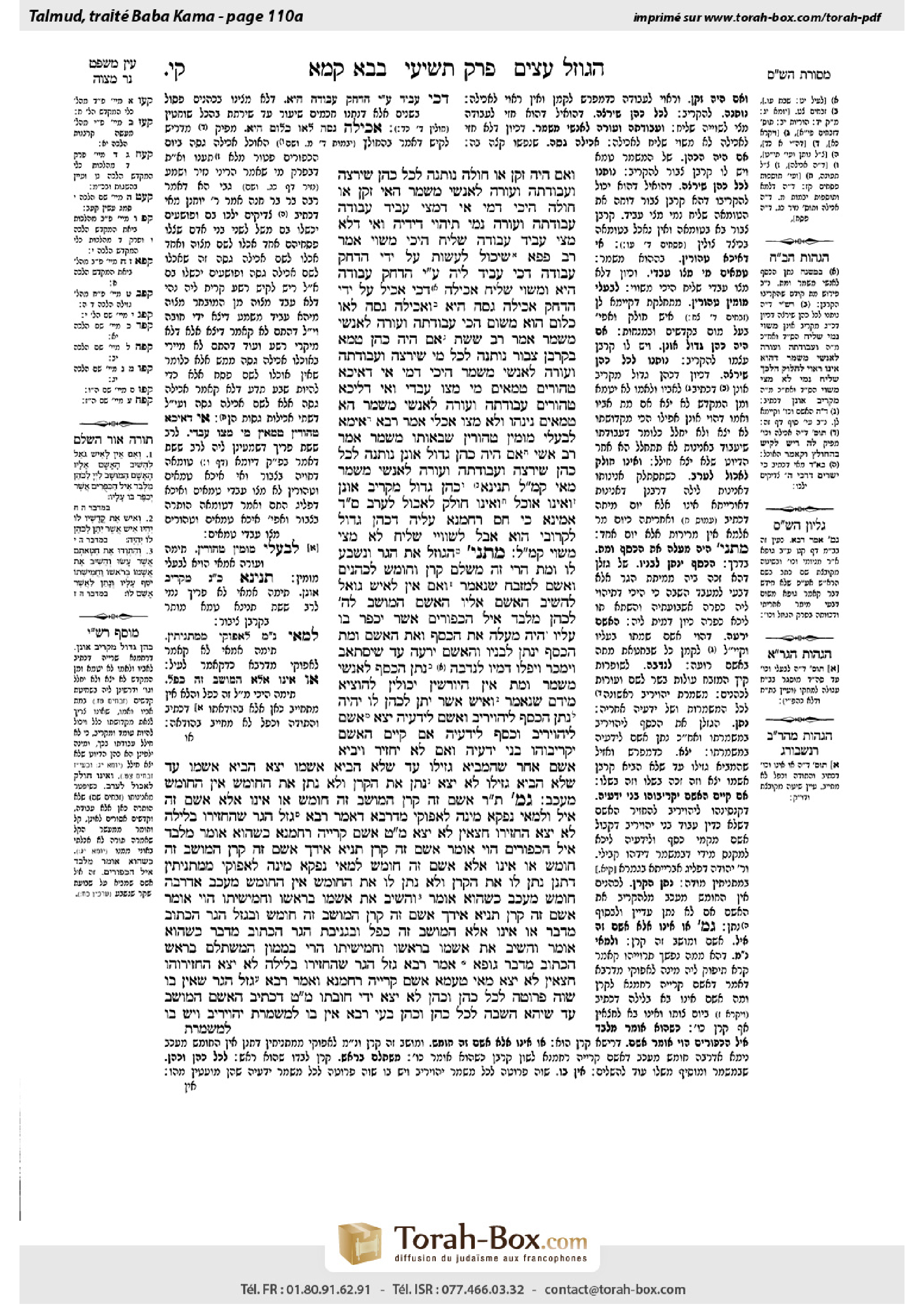
This page of Bava Kamma includes the Aramaic text, an English translation and an AI-generated French translation, alongside the scan above.
בבא קמא ק״י א · Aramaic and Hebrew text
וְאִם הָיָה זָקֵן אוֹ חוֹלֶה – נוֹתְנָהּ לְכׇל כֹּהֵן שֶׁיִּרְצֶה, וַעֲבוֹדָתָהּ וְעוֹרָהּ לְאַנְשֵׁי מִשְׁמָר.
הַאי זָקֵן אוֹ חוֹלֶה, הֵיכִי דָמֵי? אִי דְּמָצֵי עָבֵיד עֲבוֹדָה – עֲבוֹדָתָהּ וְעוֹרָהּ נָמֵי תֶּיהְוֵי דִּידֵיהּ! וְאִי דְּלָא מָצֵי עָבֵיד עֲבוֹדָה – שָׁלִיחַ הֵיכִי מְשַׁוֵּי?
אָמַר רַב פָּפָּא: שֶׁיָּכוֹל לַעֲשׂוֹת עַל יְדֵי הַדְּחָק. עֲבוֹדָה – דְּכִי עָבֵיד לֵיהּ עַל יְדֵי הַדְּחָק עֲבוֹדָה הִיא, וּמְשַׁוֵּי שָׁלִיחַ; אֲכִילָה – דְּכִי אָכֵיל עַל יְדֵי הַדְּחָק אֲכִילָה גַּסָּה הִיא, וַאֲכִילָה גַּסָּה לָאו כְּלוּם הוּא; מִשּׁוּם הָכִי עֲבוֹדָתָהּ וְעוֹרָהּ לְאַנְשֵׁי מִשְׁמָר.
אָמַר רַב שֵׁשֶׁת: אִם הָיָה כֹּהֵן טָמֵא בְּקׇרְבַּן צִבּוּר – נוֹתְנָהּ לְכׇל מִי שֶׁיִּרְצֶה, וַעֲבוֹדָתָהּ וְעוֹרָהּ לְאַנְשֵׁי מִשְׁמָר. הֵיכִי דָמֵי? אִי דְּאִיכָּא טְהוֹרִים, טְמֵאִים מִי מָצוּ עָבְדִי?! וְאִי דְּלֵיכָּא טְהוֹרִים, עֲבוֹדָתָהּ וְעוֹרָהּ לְאַנְשֵׁי מִשְׁמָר?! הָא טְמֵאִים נִינְהוּ, וְלָא מָצוּ אָכְלִי!
אָמַר רָבָא, אֵימָא: לְבַעֲלֵי מוּמִין טְהוֹרִין שֶׁבְּאוֹתוֹ מִשְׁמָר.
אָמַר רַב אָשֵׁי: אִם הָיָה כֹּהֵן גָּדוֹל אוֹנֵן – נוֹתְנָהּ לְכׇל כֹּהֵן שֶׁיִּרְצֶה, וַעֲבוֹדָתָהּ וְעוֹרָהּ לְאַנְשֵׁי מִשְׁמָר. מַאי קָא מַשְׁמַע לַן? תְּנֵינָא: כֹּהֵן גָּדוֹל מַקְרִיב אוֹנֵן, וְאֵינוֹ אוֹכֵל, וְאֵינוֹ חוֹלֵק לֶאֱכוֹל לָעֶרֶב!
סָלְקָא דַּעְתָּךְ אָמֵינָא: כִּי חָס רַחֲמָנָא עֲלֵיהּ דְּכֹהֵן גָּדוֹל – לְקָרוֹבֵי הוּא, אֲבָל לְשַׁוּוֹיֵי שָׁלִיחַ – לָא מָצֵי מְשַׁוֵּי; קָא מַשְׁמַע לַן.
מַתְנִי׳ הַגּוֹזֵל אֶת הַגֵּר, וְנִשְׁבַּע לוֹ, וָמֵת – הֲרֵי זֶה מְשַׁלֵּם קֶרֶן וָחוֹמֶשׁ לַכֹּהֲנִים, וְאָשָׁם לַמִּזְבֵּחַ; שֶׁנֶּאֱמַר: ״וְאִם אֵין לָאִישׁ גּוֹאֵל לְהָשִׁיב הָאָשָׁם אֵלָיו, הָאָשָׁם הַמּוּשָׁב לַה׳ לַכֹּהֵן, מִלְּבַד אֵיל הַכִּפֻּרִים אֲשֶׁר יְכַפֶּר בּוֹ עָלָיו״.
הָיָה מַעֲלֶה אֶת הַכֶּסֶף וְאֶת הָאָשָׁם, וָמֵת – הַכֶּסֶף יִנָּתֵן לְבָנָיו, וְהָאָשָׁם יִרְעֶה עַד שֶׁיִּסְתָּאֵב – וְיִמָּכֵר, וְיִפְּלוּ דָּמָיו לִנְדָבָה. נָתַן הַכֶּסֶף לְאַנְשֵׁי מִשְׁמָר, וָמֵת – אֵין הַיּוֹרְשִׁין יְכוֹלִין לְהוֹצִיא מִיָּדָם, שֶׁנֶּאֱמַר: ״וְאִישׁ אֲשֶׁר יִתֵּן לַכֹּהֵן – לוֹ יִהְיֶה״.
נָתַן הַכֶּסֶף לִיהוֹיָרִיב, וְאָשָׁם לִידַעְיָה – יָצָא. אָשָׁם לִיהוֹיָרִיב וְכֶסֶף לִידַעְיָה – אִם קַיָּים הָאָשָׁם, יַקְרִיבוּהוּ בְּנֵי יְדַעְיָה; וְאִם לֹא, יַחֲזִיר וְיָבִיא אָשָׁם אַחֵר. שֶׁהַמֵּבִיא גְּזֵילוֹ עַד שֶׁלֹּא הֵבִיא אֲשָׁמוֹ – יָצָא; הֵבִיא אֲשָׁמוֹ עַד שֶׁלֹּא הֵבִיא גְּזֵילוֹ – לֹא יָצָא.
נָתַן אֶת הַקֶּרֶן וְלֹא נָתַן אֶת הַחוֹמֶשׁ – אֵין הַחוֹמֶשׁ מְעַכֵּב.
גְּמָ׳ תָּנוּ רַבָּנַן: ״אָשָׁם״ – זֶה קֶרֶן, ״הַמּוּשָׁב״ – זֶה חוֹמֶשׁ. אוֹ אֵינוֹ אֶלָּא: ״אָשָׁם״ – זֶה אַיִל?
וּלְמַאי נָפְקָא מִינַּהּ? לְאַפּוֹקֵי מִדְּרָבָא, דְּאָמַר רָבָא: גֶּזֶל הַגֵּר שֶׁהֶחְזִירוֹ בַּלַּיְלָה – לֹא יָצָא. הֶחְזִירוֹ חֲצָאִין – לֹא יָצָא. מַאי טַעְמָא? ״אָשָׁם״ קַרְיֵיהּ רַחֲמָנָא.
כְּשֶׁהוּא אוֹמֵר ״מִלְּבַד אֵיל הַכִּפֻּרִים״, הֱוֵי אוֹמֵר: ״אָשָׁם״ – זֶה קֶרֶן.
תַּנְיָא אִידַּךְ: ״אָשָׁם״ – זֶה קֶרֶן, ״הַמּוּשָׁב״ – זֶה חוֹמֶשׁ. אוֹ אֵינוֹ אֶלָּא: ״אָשָׁם״ – זֶה חוֹמֶשׁ? לְמַאי נָפְקָא מִינַּהּ? לְאַפּוֹקֵי מִמַּתְנִיתִין, דִּתְנַן: נָתַן לוֹ אֶת הַקֶּרֶן וְלֹא נָתַן לוֹ אֶת הַחוֹמֶשׁ – אֵין הַחוֹמֶשׁ מְעַכֵּב. אַדְּרַבָּה, חוֹמֶשׁ מְעַכֵּב.
כְּשֶׁהוּא אוֹמֵר: ״וְהֵשִׁיב אֶת אֲשָׁמוֹ בְּרֹאשׁוֹ, וַחֲמִישִׁתוֹ״, הֱוֵי אוֹמֵר: ״אָשָׁם״ – זֶה קֶרֶן.
תַּנְיָא אִידַּךְ: ״אָשָׁם״ – זֶה קֶרֶן, ״הַמּוּשָׁב״ – זֶה חוֹמֶשׁ; וּבְגֶזֶל הַגֵּר הַכָּתוּב מְדַבֵּר. אוֹ אֵינוֹ אֶלָּא: ״הַמּוּשָׁב״ – זֶה כֶּפֶל, וּבִגְנֵיבַת הַגֵּר הַכָּתוּב מְדַבֵּר? כְּשֶׁהוּא אוֹמֵר: ״וְהֵשִׁיב אֶת אֲשָׁמוֹ בְּרֹאשׁוֹ, וַחֲמִישִׁתוֹ״ – הֲרֵי בְּמָמוֹן הַמִּשְׁתַּלֵּם בָּרֹאשׁ הַכָּתוּב מְדַבֵּר.
גּוּפָא – אָמַר רָבָא: גֶּזֶל הַגֵּר שֶׁהֶחְזִירוֹ בַּלַּיְלָה – לֹא יָצָא. הֶחְזִירוּהוּ חֲצָאִין – לֹא יָצָא. מַאי טַעְמָא? ״אָשָׁם״ קַרְיֵיהּ רַחֲמָנָא.
וְאָמַר רָבָא: גֶּזֶל הַגֵּר שֶׁאֵין בּוֹ שָׁוֶה פְּרוּטָה לְכׇל כֹּהֵן וְכֹהֵן – לֹא יָצָא יְדֵי חוֹבָתוֹ. מַאי טַעְמָא? דִּכְתִיב: ״הָאָשָׁם הַמּוּשָׁב״ – עַד שֶׁיְּהֵא הֲשָׁבָה לְכׇל כֹּהֵן וְכֹהֵן.
בָּעֵי רָבָא: אֵין בּוֹ לְמִשְׁמֶרֶת יְהוֹיָרִיב וְיֵשׁ בּוֹ
Bava Kamma 110a · English translation
The baraita continues: And if he was old or sick, so that he cannot perform the Temple service or eat from the offering, he gives it to any priest he wishes to sacrifice it, even to one not on his priestly watch, and performance of its service and its hide are given to the members of the priestly watch.
The Gemara clarifies: What are the circumstances of this old or sick priest? If he is in a condition that he is able to perform the Temple service, then performance of its service and its hide should be his as well, as the priest that sacrificed it was acting as his agent. And if he is in a condition that he is not able to perform the Temple service, how can he appoint an agent? The baraita stated that he may give it to any priest he wishes, indicating that he chooses which priest he will appoint as his agent.
Rav Pappa said: The baraita is referring to a case where he is able to do it with difficulty. With regard to the Temple service, where the halakha is that if he performs it with difficulty it is still considered performance of the Temple service, he is therefore able to appoint an agent to do it for him. With regard to eating the offering, where the halakha says that if he eats it with difficulty it is excessive eating, and excessive eating is nothing, i.e., he does not thereby fulfill the mitzva to eat the sacrificial portion, he is not able to appoint an agent to eat it for him. Due to that reason, performance of its service and its hide are given to the members of the priestly watch.
Rav Sheshet says: If a priest of the priestly watch was ritually impure, then with regard to a communal offering he gives it to any priest he wishes, and performance of its service and its hide are given to the members of the priestly watch. The Gemara asks: What are the circumstances where this halakha applies? If there are ritually pure priests available, then can impure ones perform the Temple service, and by extension appoint an agent to perform it in their stead? And if there are no ritually pure priests there, as all members of the priestly watch are impure, is the performance of its service and its hide given to the members of the priestly watch? Even though communal offerings are sacrificed in such a circumstance, the priests are impure and are not able to eat the offering, even though they may sacrifice it.
Rava said in explanation: Say that they are given to blemished but ritually pure priests who are on that priestly watch. Even though blemished priests are disqualified from performing the Temple service and therefore the offering must be sacrificed by impure priests, the blemished priests are permitted to eat the sacrifice, as they are ritually pure.
Rav Ashi says: If a High Priest was an acute mourner, i.e., one whose immediate relative died on that day but had yet to be buried, and he had an offering to sacrifice on his own behalf, he gives the offering to any priest that he wishes to sacrifice it, and performance of its service and its hide are given to the members of the priestly watch. The Gemara asks: What is Rav Ashi’s statement teaching us? We already learned in a baraita (Tosefta, Zevaḥim 11:3): A High Priest may sacrifice an offering even when he is an acute mourner, but he does not eat it during that day while he is an acute mourner and does not receive a portion of the sacrifice to eat at night after his acute mourning is finished. It follows from this baraita that since he sacrifices it by himself he is able to appoint another priest in his stead, and since he may not eat it, it is given to the priestly watch to eat. What, then, was the novelty of Rav Ashi’s statement?
The Gemara answers: It might enter your mind to say that when the Merciful One had compassion on the High Priest, permitting him to continue serving in the Temple even while in a state of acute mourning, it was for him to sacrifice; but with regard to appointing an agent, he is not able to appoint one. Therefore, Rav Ashi teaches us that he is able to appoint an agent, since he himself is permitted to perform the Temple service.
MISHNA: With regard to one who robs a convert and takes a false oath denying having done so, and then the convert dies, the robber, in order to achieve repentance, pays the principal, i.e., the stolen item or, if it is no longer extant, its monetary value, and an additional one-fifth of its value to the priests, and presents a guilt-offering to the altar, as it is stated: “But if the man has no kinsman to whom restitution may be made for the guilt, the restitution for guilt that is made shall be the Lord’s, even the priest’s; besides the ram of the atonement, whereby atonement shall be made for him” (Numbers 5:8).
The mishna continues: If the robber was bringing the money and the guilt-offering up to Jerusalem and he died before paying the priests and bringing his offering, the money shall be given to the robber’s children, and the animal designated for the guilt-offering shall graze until it becomes blemished and consequently disqualified from being sacrificed. And the animal shall then be sold and the money received for it shall be allocated for communal gift offerings. If the robber gave the money to the members of the priestly watch and then died before they sacrificed his guilt-offering, the heirs cannot remove the money from the priests’ possession, as it is stated: “And every man’s hallowed things shall be his; whatsoever any man gives to the priest, it shall be his” (Numbers 5:10).
The mishna continues: If the robber gave the money to the priestly watch of Joiarib and then gave the guilt-offering to the priestly watch of Jedaiah, the following priestly watch, to sacrifice on his behalf, he has fulfilled his obligation. By contrast, if he first gave the guilt-offering to the priestly watch of Joiarib and then gave the money to the priestly watch of Jedaiah, if the animal designated for the guilt-offering is extant, then members of the priestly watch of Jedaiah, who received the money, should sacrifice it. But if it is no longer extant because the priestly watch of Joiarib had already sacrificed it, he should return and bring another guilt-offering; for one who brings his stolen item to the priests before he brings his guilt-offering has fulfilled his obligation, but one who brings his guilt-offering before he brings his stolen item has not fulfilled his obligation.
Although he cannot sacrifice the offering before paying the principal, if he gave the principal but did not yet give the additional one-fifth payment, the lack of having given the additional one-fifth payment does not preclude sacrificing the offering.
GEMARA: The Sages taught in explanation of the verse cited in the mishna: “But if the man has no kinsman…the restitution for guilt that is made shall be the Lord’s, even the priest’s” (Numbers 5:8): With regard to the word “guilt,” this is referring to the principal, i.e., the stolen item itself or its equivalent value; “the restitution…that is made,” this is referring to the additional one-fifth payment. Or perhaps this is not the proper interpretation of the verse. Rather, it should be interpreted: “Guilt,” this is referring to the ram of the guilt-offering.
Before continuing the baraita the Gemara interrupts to clarify: And for what purpose does the baraita distinguish between the two interpretations of guilt, as in any event, both the principal and the guilt-offering must be brought? The Gemara explains: To exclude that which Rava holds, as Rava says: With regard to the stolen item of a convert that the robber returned at night, the robber did not fulfill his obligation. And similarly, if he returned it to him in halves, he did not fulfill his obligation. What is the reason? The Merciful One labeled the stolen item with the term “guilt,” teaching that just as a guilt-offering cannot be offered at night or in halves, so too, the stolen item cannot be returned at night or in halves.
The baraita continues: When it says in that verse: “Besides the ram of the atonement” (Numbers 5:8), referring to the offering, you must say concerning the word “guilt” written earlier in the verse that this is referring to the principal.
It is taught in another baraita: With regard to the word “guilt,” this is referring to the principal; “the restitution…that is made,” this is referring to the additional one-fifth payment. Or perhaps this is not the proper interpretation of the verse. Rather, it should be interpreted: “Guilt,” this is referring to the additional one-fifth payment. Before continuing the baraita, the Gemara interrupts to clarify: For what purpose does the baraita distinguish between the two interpretations? The Gemara explains: To exclude that which the mishna teaches, as we learned in the mishna: If he gave him the principal but did not yet give him the additional one-fifth payment, the lack of having given the additional one-fifth payment does not preclude sacrificing the offering. If “guilt” is referring to the additional one-fifth payment, then, on the contrary, it would follow that the lack of having given the additional one-fifth payment precludes sacrificing the offering.
The baraita continues: When it says in the previous verse: “And he shall make restitution for his guilt in full, and add unto it the fifth part thereof” (Numbers 5:7), you must say concerning the word “guilt” that this is referring to the principal.
It is taught in another baraita: With regard to the word “guilt,” this is referring to the principal; “the restitution…that is made,” this is referring to the additional one-fifth payment, and the verse is speaking of robbery of a convert. Or perhaps this is not the proper interpretation of the verse. Rather, it should be interpreted: “The restitution…that is made,” this is referring to double payment that a thief must pay, and the verse is speaking of theft from a convert. When it says in the previous verse: “And he shall make restitution for his guilt in full, and add unto it the fifth part thereof” (Numbers 5:7), the verse is speaking of money that is paid exactly according to the principal, and not double payment.
§ Having quoted Rava’s statement, the Gemara returns to discuss the matter itself. Rava says: With regard to the stolen item of a convert that the robber returned at night, the robber did not fulfill his obligation. And similarly, if he returned it to him in halves, he did not fulfill his obligation. What is the reason? The Merciful One labeled the stolen item with the term “guilt,” teaching that just as a guilt-offering cannot be offered at night or in halves, so too, the stolen item cannot be returned at night or in halves.
And Rava says: With regard to the stolen item of a convert that does not have the value of one peruta for each and every priest on the priestly watch, the robber did not fulfill his obligation by giving it to the priestly watch. What is the reason? As it is written: “The restitution for guilt that is made,” meaning that the robber has not fulfilled his obligation to return the stolen item until there will be halakhically significant restitution made to each and every priest, minimally one peruta. If the stolen item was of less value than can be distributed with each priest in the watch receiving at least one peruta, the robber must add to the payment so that each priest receives one peruta.
Based on this halakha, Rava raises a dilemma: If the stolen item does not have the value of one peruta for each priest on the priestly watch of Joiarib, which had many priests, but it has
Bava Kamma 110a · Traduction française (IA)
La baraïta continue : Et s'il était âgé ou malade, de sorte qu'il ne pouvait pas accomplir le service du Temple ou manger de l'offrande, il le donnait à tout prêtre qu'il souhaitait pour qu'il le sacrifie, même à un prêtre non affecté à son service, et l'accomplissement du service et la peau étaient donnés aux membres de la garde sacerdotale.
La Guemara clarifie : Quelles sont les circonstances de ce prêtre âgé ou malade ? Si c'était dans un état où il pouvait accomplir le service du Temple, alors l'accomplissement du service et la peau lui appartenaient également, car le prêtre qui l'avait sacrifié agissait en son nom. Et si c'était dans un état où il ne pouvait pas accomplir le service du Temple, comment pouvait-il désigner un agent ? La baraïta indique qu'il pouvait le donner à tout prêtre qu'il souhaitait, ce qui signifie qu'il choisissait quel prêtre désigner comme son agent.
Rav Pappa dit : La baraïta fait référence à un cas où il pouvait le faire avec difficulté. En ce qui concerne le service du Temple, où la halakha stipule que si l'on le fait avec difficulté, cela est considéré comme un accomplissement du service du Temple, il pouvait donc désigner un agent pour le faire à sa place. En ce qui concerne la consommation de l'offrande, où la halakha dit que si l'on le mange avec difficulté, cela constitue un excès, et un excès est considéré comme nul, c'est-à-dire qu'il ne remplissait pas ainsi la mitsva de manger la part sacrée, il ne pouvait donc désigner un agent pour le manger à sa place. C'est pourquoi l'accomplissement du service et la peau étaient donnés aux membres de la garde sacerdotale.
Rav Sheshet dit : Si un prêtre de la garde sacerdotale était impur, alors en ce qui concerne une offrande communautaire, il le donne à tout prêtre qu'il souhaite, et l'accomplissement du service et la peau sont donnés aux membres de la garde sacerdotale. La Guemara pose la question : Quelles sont les circonstances où cette halakha s'applique ? Si des prêtres purs sont disponibles, peut-on permettre aux impurs d'accomplir le service du Temple et, par extension, de désigner un agent pour le faire à leur place ? Et si aucun prêtre pur n'est disponible, puisque tous les membres de la garde sacerdotale sont impurs, l'accomplissement du service et la peau sont-ils donnés aux membres de la garde sacerdotale ? Même si les offrandes communautaires sont sacrifiées dans de tels cas, les prêtres sont impurs et ne peuvent pas manger l'offrande, même s'ils peuvent le sacrifier.
Rava explique : Disons qu'ils sont donnés aux prêtres blemis mais purs qui sont sur cette garde sacerdotale. Même si les prêtres blemis sont exclus du service du Temple et donc l'offrande doit être sacrifiée par des prêtres impurs, les prêtres blemis sont autorisés à manger la victime, car ils sont purs.
Rav Ashi dit : Si un Grand Prêtre était un veuf aigu, c'est-à-dire celui dont un proche parent est mort ce jour-là mais n'a pas encore été enterré, et il avait une offrande à sacrifier à son propre compte, il donne l'offrande à tout prêtre qu'il souhaite pour qu'il la sacrifie, et l'accomplissement du service et la peau sont donnés aux membres de la garde sacerdotale. La Guemara pose la question : Qu'enseigne la déclaration de Rav Ashi ? Nous avons déjà appris dans une baraïta (Tosefta, Zevaḥim 11:3) : Un Grand Prêtre peut sacrifier une offrande même s'il est un veuf aigu, mais il ne peut pas en manger durant ce jour où il est un veuf aigu et ne reçoit pas une part de l'offrande à manger la nuit après que son deuil aigu est terminé. Il en découle de cette baraïta que puisqu'il sacrifie lui-même, il peut désigner un autre prêtre à sa place, et puisqu'il ne peut pas en manger, il est donné à la garde sacerdotale pour en manger. Quel est donc le point nouveau de la déclaration de Rav Ashi ?
La Guemara répond : Il pourrait entrer en votre esprit de dire que lorsque l'Éternel a eu pitié du Grand Prêtre, permettant qu'il continue de servir dans le Temple même en état de deuil aigu, c'était pour qu'il sacrifie ; mais en ce qui concerne la désignation d'un agent, il ne peut pas en désigner un. C'est pourquoi Rav Ashi nous enseigne qu'il peut désigner un agent, car lui-même est autorisé à accomplir le service du Temple.
MICHNA : En ce qui concerne celui qui vole un converti et prend un faux serment en niant avoir fait cela, et ensuite le converti meurt, le voleur, afin d'atteindre la repentance, paie le principal, c'est-à-dire l'objet volé ou, si celui-ci n'existe plus, sa valeur monétaire, et un cinquième de sa valeur aux prêtres, et présente un sacrifice de culpabilité à l'autel, comme il est dit : « Mais si l'homme n'a pas de parent à qui il puisse faire restitution pour la culpabilité, la restitution de la culpabilité sera de l'Éternel, même du prêtre ; outre le bouc de l'expiation, par lequel l'expiation sera faite pour lui » (Nombres 5:8).
La mishna continue : Si le voleur était en train d'apporter l'argent et le sacrifice de culpabilité à Jérusalem et qu'il est mort avant de payer les prêtres et d'apporter son offrande, l'argent sera donné à ses enfants, et l'animal désigné pour le sacrifice de culpabilité paîtra jusqu'à ce qu'il devienne blemi et donc inéligible à être sacrifié. Et l'animal sera ensuite vendu et l'argent reçu sera alloué aux offrandes communes. Si le voleur avait donné l'argent aux membres de la garde sacerdotale et est mort avant qu'ils ne sacrifient son sacrifice de culpabilité, les héritiers ne peuvent pas retirer l'argent de la possession des prêtres, car il est dit : « Et toutes les choses saintes d'un homme sont à lui ; ce que tout homme donne au prêtre est à lui » (Nombres 5:10).
La Michna continue : Si le voleur a donné l'argent au groupe de prêtres de Joiarib et ensuite a donné l'offrande de culpabilité au groupe de prêtres de Jédahya, le groupe de prêtres suivant, celui qui doit sacrifier à sa place, a accompli son obligation. En revanche, si il a d'abord donné l'offrande de culpabilité au groupe de prêtres de Joiarib et ensuite a donné l'argent au groupe de prêtres de Jédahya, si l'animal désigné pour l'offrande de culpabilité est encore présent, alors les membres du groupe de prêtres de Jédahya, qui ont reçu l'argent, doivent le sacrifier. Mais si l'animal n'est plus présent car le groupe de prêtres de Joiarib l'a déjà sacrifié, il doit revenir et apporter une autre offrande de culpabilité ; car celui qui apporte son objet volé aux prêtres avant d'avoir apporté son offrande de culpabilité a accompli son obligation, mais celui qui apporte son offrande de culpabilité avant d'avoir apporté son objet volé n'a pas accompli son obligation.
Bien qu'il ne puisse pas sacrifier l'offrande avant de payer le principal, si il a donné le principal mais n'a pas encore donné le paiement supplémentaire d'un cinquième, l'absence de paiement supplémentaire d'un cinquième ne bloque pas la sacrifice de l'offrande.
GUEMARA : Les Sages ont enseigné en expliquant la verset cité dans la Michna : « Mais si l'homme n'a pas de parent… la réparation de la culpabilité qui est faite sera du Seigneur, même du prêtre » (Nombres 5:8) : En ce qui concerne le mot « culpabilité », cela fait référence au principal, c'est-à-dire à l'objet volé lui-même ou à sa valeur équivalente ; « la réparation… qui est faite », cela fait référence au paiement supplémentaire d'un cinquième. Ou peut-être cette n'est pas l'interprétation correcte du verset. Plutôt, il devrait être interprété ainsi : « Culpabilité », cela fait référence au bélier de l'offrande de culpabilité.
Avant de continuer la baraïta, la Guemara interrompt pour clarifier : Et à quel effet la baraïta distingue-t-elle entre les deux interprétations de « culpabilité », puisque, en tout cas, à la fois le principal et l'offrande de culpabilité doivent être apportés ? La Guemara explique : Pour exclure ce que Rava maintient, car Rava dit : En ce qui concerne l'objet volé d'un converti que le voleur a rendu la nuit, le voleur n'a pas accompli son obligation. Et de même, si il l'a rendu en deux moitiés, il n'a pas accompli son obligation. Quelle est la raison ? L'Éternel a marqué l'objet volé avec le terme « culpabilité », enseignant que tout comme l'offrande de culpabilité ne peut être sacrifiée la nuit ou en deux moitiés, de même l'objet volé ne peut être rendu la nuit ou en deux moitiés.
La baraïta continue : Lorsqu'il dit dans ce verset : « En plus du bélier de l'atonement » (Nombres 5:8), faisant référence à l'offrande, tu dois dire concernant le mot « culpabilité » écrit précédemment dans le verset que cela fait référence au principal.
Il est enseigné dans une autre baraïta : En ce qui concerne le mot « culpabilité », cela fait référence au principal ; « la réparation… qui est faite », cela fait référence au paiement supplémentaire d'un cinquième. Ou peut-être cette n'est pas l'interprétation correcte du verset. Plutôt, il devrait être interprété ainsi : « Culpabilité », cela fait référence au paiement supplémentaire d'un cinquième. Avant de continuer la baraïta, la Guemara interrompt pour clarifier : À quel effet la baraïta distingue-t-elle entre les deux interprétations ? La Guemara explique : Pour exclure ce que la Michna enseigne, car nous avons appris dans la Michna : Si il a donné le principal mais n'a pas encore donné le paiement supplémentaire d'un cinquième, l'absence de paiement supplémentaire d'un cinquième ne bloque pas la sacrifice de l'offrande. Si « culpabilité » fait référence au paiement supplémentaire d'un cinquième, alors, au contraire, il suivrait que l'absence de paiement supplémentaire d'un cinquième bloque la sacrifice de l'offrande.
La baraïta continue : Lorsqu'il dit dans le verset précédent : « Et il doit faire la réparation de sa culpabilité en entier, et ajouter à cela la cinquième partie » (Nombres 5:7), tu dois dire concernant le mot « culpabilité » que cela fait référence au principal.
Il est enseigné dans une autre baraïta : En ce qui concerne le mot « culpabilité », cela fait référence au principal ; « la réparation… qui est faite », cela fait référence au paiement supplémentaire d'un cinquième, et le verset parle de vol d'un converti. Ou peut-être cette n'est pas l'interprétation correcte du verset. Plutôt, il devrait être interprété ainsi : « La réparation… qui est faite », cela fait référence au paiement double que le voleur doit payer, et le verset parle de vol d'un converti. Lorsqu'il dit dans le verset précédent : « Et il doit faire la réparation de sa culpabilité en entier, et ajouter à cela la cinquième partie » (Nombres 5:7), le verset parle d'argent payé exactement selon le principal, et non du paiement double.
§ Ayant cité l'affirmation de Rava, la Guemara retourne à discuter de la question elle-même. Rava dit : En ce qui concerne l'objet volé d'un converti que le voleur a rendu la nuit, le voleur n'a pas accompli son obligation. Et de même, si il l'a rendu en deux moitiés, il n'a pas accompli son obligation. Quelle est la raison ? L'Éternel a marqué l'objet volé avec le terme « culpabilité », enseignant que tout comme l'offrande de culpabilité ne peut être sacrifiée la nuit ou en deux moitiés, de même l'objet volé ne peut être rendu la nuit ou en deux moitiés.
Et Rava dit : En ce qui concerne l'objet volé d'un converti qui n'a pas la valeur d'un peruta pour chaque prêtre du groupe de prêtres, le voleur n'a pas accompli son obligation en donnant l'objet au groupe de prêtres. Quelle est la raison ? Comme il est écrit : « La réparation de la culpabilité qui est faite », c'est-à-dire que le voleur n'a pas accompli son obligation de rendre l'objet volé jusqu'à ce qu'il y ait une réparation halakhiquement significative pour chaque prêtre, au moins un peruta. Si l'objet volé avait une valeur inférieure à ce qui peut être distribué de sorte que chaque prêtre du groupe reçoive au moins un peruta, le voleur doit ajouter au paiement afin que chaque prêtre reçoive un peruta.
En se basant sur cette halakha, Rava soulève un dilemme : Si l'objet volé n'a pas la valeur d'un peruta pour chaque prêtre du groupe de prêtres de Joiarib, qui avait beaucoup de prêtres, mais il a la valeur d'un peruta pour chaque prêtre du groupe de prêtres de Chelak, qui avait peu de prêtres, que doit-on faire ?
Traduction française générée par IA à partir de l’édition anglaise de Sefaria. Vérifie toujours un passage avec le texte source.
Text from Sefaria: William Davidson Edition - Vocalized Aramaic (CC BY NC); William Davidson Edition - English (CC BY NC).