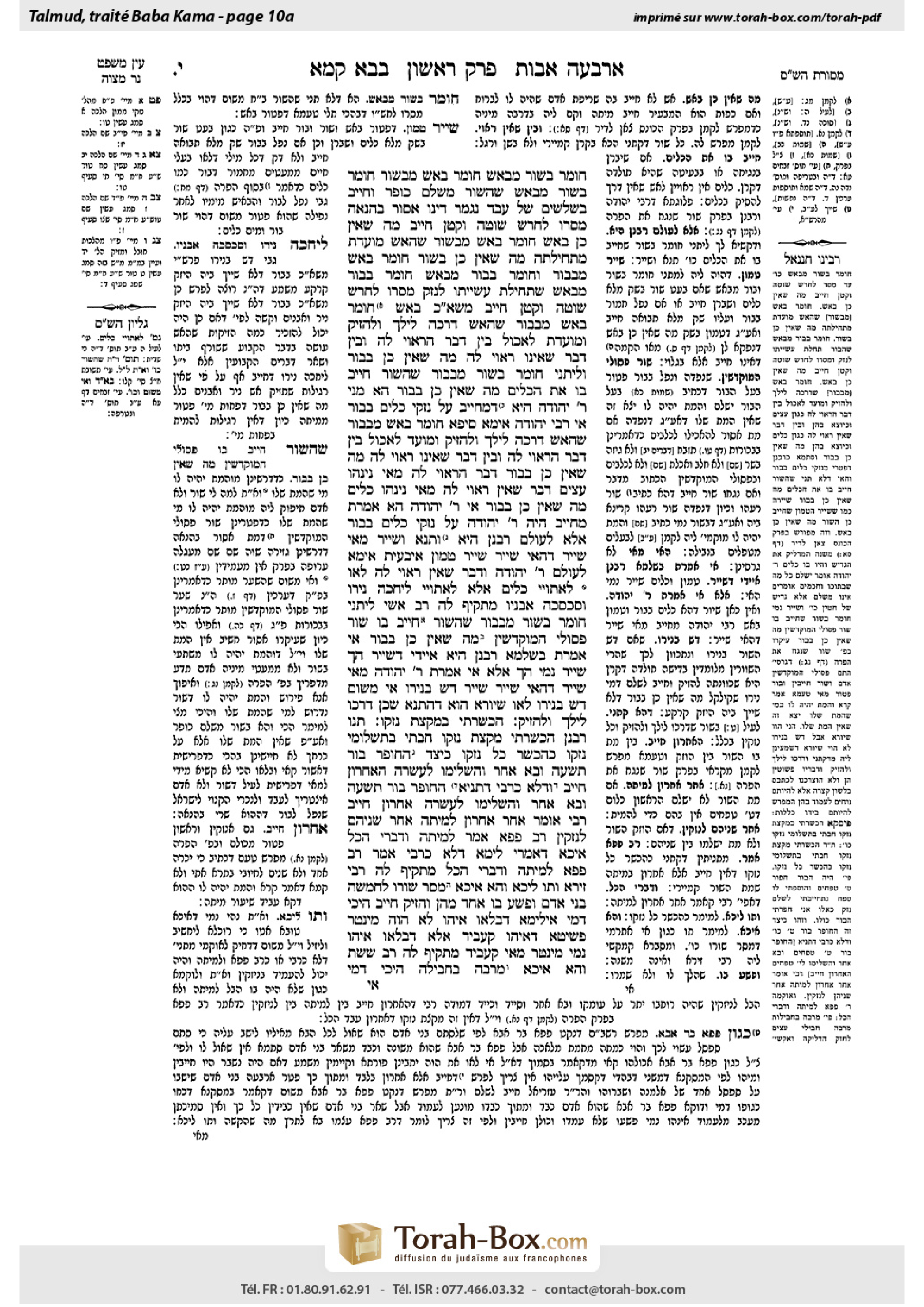
Bava Kamma 10a: Talmud study for Daf Yomi
Study the Talmud for Daf Yomi with scanned pages, Hebrew text, English translations from Sefaria and AI-generated French translations.
Passage selection and English or AI-generated French translation are available where the scan has annotations. Daf Study is independent of Torah-Box and Sefaria.
Browse Bava Kamma · בבא קמא · All tractatesBava Kamma 10a text and translations
This page of Bava Kamma includes the Aramaic text, an English translation and an AI-generated French translation, alongside the scan above.
בבא קמא י׳ א · Aramaic and Hebrew text
חוֹמֶר בְּשׁוֹר מִבְּאֵשׁ, חוֹמֶר בְּאֵשׁ מִבְּשׁוֹר.
חוֹמֶר בְּשׁוֹר מִבְּאֵשׁ – שֶׁהַשּׁוֹר מְשַׁלֵּם כּוֹפֶר, וְחַיָּיב בִּשְׁלֹשִׁים שֶׁל עֶבֶד, נִגְמַר דִּינוֹ – אָסוּר בַּהֲנָאָה, מְסָרוֹ לְחֵרֵשׁ שׁוֹטֶה וְקָטָן – חַיָּיב; מַה שֶּׁאֵין כֵּן בְּאֵשׁ. חוֹמֶר בְּאֵשׁ מִבְּשׁוֹר – שֶׁהָאֵשׁ מוּעֶדֶת מִתְּחִילָּתָהּ, מַה שֶּׁאֵין כֵּן בְּשׁוֹר.
חוֹמֶר בְּאֵשׁ מִבְּבוֹר, וְחוֹמֶר בְּבוֹר מִבְּאֵשׁ.
חוֹמֶר בְּבוֹר מִבְּאֵשׁ – שֶׁתְּחִילַּת עֲשִׂיָּיתוֹ לְנֵזֶק, מְסָרוֹ לְחֵרֵשׁ שׁוֹטֶה וְקָטָן – חַיָּיב; מַה שֶּׁאֵין כֵּן בְּאֵשׁ. חוֹמֶר בְּאֵשׁ מִבְּבוֹר – שֶׁהָאֵשׁ דַּרְכָּהּ לֵילֵךְ וּלְהַזִּיק, וּמוּעֶדֶת לֶאֱכוֹל בֵּין דָּבָר הָרָאוּי לָהּ, וּבֵין דָּבָר שֶׁאֵינוֹ רָאוּי לָהּ; מָה שֶּׁאֵין כֵּן בְּבוֹר.
וְלִיתְנֵי חוֹמֶר בְּשׁוֹר מִבְּבוֹר – שֶׁהַשּׁוֹר חִיֵּיב בּוֹ אֶת הַכֵּלִים, מַה שֶּׁאֵין כֵּן בְּבוֹר!
הָא מַנִּי – רַבִּי יְהוּדָה הִיא, דִּמְחַיֵּיב עַל נִזְקֵי כֵלִים בְּבוֹר.
אִי רַבִּי יְהוּדָה, אֵימָא סֵיפָא: חוֹמֶר בְּאֵשׁ מִבְּבוֹר – שֶׁהָאֵשׁ דַּרְכָּהּ לֵילֵךְ וּלְהַזִּיק, וּמוּעֶדֶ[ת] לֶאֱכוֹל בֵּין דָּבָר הָרָאוּי לָהּ וּבֵין דָּבָר שֶׁאֵינוֹ רָאוּי לָהּ, מַה שֶּׁאֵין כֵּן בְּבוֹר. ״דָּבָר הָרָאוּי לָהּ״ מַאי נִינְהוּ – עֵצִים; ״דָּבָר שֶׁאֵין רָאוּי לָהּ״ מַאי נִינְהוּ – כֵּלִים; ״מַה שֶּׁאֵין כֵּן בְּבוֹר״. אִי רַבִּי יְהוּדָה – הָא אָמְרַתְּ מְחַיֵּיב הָיָה רַבִּי יְהוּדָה עַל נִזְקֵי כֵלִים בְּבוֹר!
אֶלָּא לְעוֹלָם רַבָּנַן הִיא, וּתְנָא וְשַׁיַּיר. מַאי שַׁיַּיר דְּהַאי שַׁיַּיר? שַׁיַּיר טָמוּן.
אִיבָּעֵית אֵימָא: לְעוֹלָם רַבִּי יְהוּדָה, וְ״דָבָר שֶׁאֵין רָאוּי לָהּ״ לָאו לְאֵתוֹיֵי כֵּלִים, אֶלָּא לְאֵתוֹיֵי לִיחֲכָה נִירוֹ וְסִכְסְכָה אֲבָנָיו.
מַתְקֵיף לַהּ רַב אָשֵׁי: לִיתְנֵי חוֹמֶר בְּשׁוֹר מִבְּבוֹר – שֶׁהַשּׁוֹר חִיֵּיב בּוֹ שׁוֹר פְּסוּלֵי הַמּוּקְדָּשִׁין, מַה שֶּׁאֵין כֵּן בְּבוֹר!
אִי אָמְרַתְּ בִּשְׁלָמָא רַבָּנַן הִיא, אַיְּידֵי דְּשַׁיַּיר הָךְ – שַׁיַּיר נָמֵי הָךְ. אֶלָּא אִי אָמְרַתְּ רַבִּי יְהוּדָה, מַאי שַׁיַּיר דְּהַאי שַׁיַּיר?
שַׁיַּיר דָּשׁ בְּנִירוֹ. אִי מִשּׁוּם דָּשׁ בְּנִירוֹ – לָאו שִׁיּוּרָא הוּא, דְּהָ[קָ]תָנֵא: שֶׁכֵּן דַּרְכּוֹ לֵילֵךְ וּלְהַזִּיק!
הִכְשַׁרְתִּי בְּמִקְצָת נִזְקוֹ.
תָּנוּ רַבָּנַן: הִכְשַׁרְתִּי מִקְצָת נִזְקוֹ – חַבְתִּי בְּתַשְׁלוּמֵי נִזְקוֹ כְּהֶכְשֵׁר כׇּל נִזְקוֹ. כֵּיצַד? הַחוֹפֵר בּוֹר תִּשְׁעָה, וּבָא אַחֵר וְהִשְׁלִימוֹ לַעֲשָׂרָה – הָאַחֲרוֹן חַיָּיב.
וּדְלָא כְּרַבִּי – דְּתַנְיָא: הַחוֹפֵר בּוֹר תִּשְׁעָה, וּבָא אַחֵר וְהִשְׁלִימוֹ לַעֲשָׂרָה – אַחֲרוֹן חַיָּיב. רַבִּי אוֹמֵר: אַחַר אַחֲרוֹן לְמִיתָה, אַחַר שְׁנֵיהֶם לִנְזָקִין.
רַב פָּפָּא אָמַר: לְמִיתָה, וְדִבְרֵי הַכֹּל.
אִיכָּא דְאָמְרִי: לֵימָא דְּלָא כְּרַבִּי? אָמַר רַב פָּפָּא: לְמִיתָה, וְדִבְרֵי הַכֹּל.
מַתְקֵיף לָהּ רַבִּי זֵירָא: וְתוּ לֵיכָּא? וְהָא אִיכָּא: מָסַר שׁוֹרוֹ לַחֲמִשָּׁה בְּנֵי אָדָם, וּפָשַׁע בּוֹ אֶחָד מֵהֶן – וְהִזִּיק, חַיָּיב.
הֵיכִי דָמֵי? אִילֵּימָא דִּבְלָאו אִיהוּ לָא הֲוָה מִינְּטַר, פְּשִׁיטָא דְּאִיהוּ קָעָבֵיד! אֶלָּא דִּבְלָאו אִיהוּ נָמֵי מִינְּטַר? מַאי קָעָבֵיד?
מַתְקֵיף לָהּ רַב שֵׁשֶׁת: וְהָא אִיכָּא מַרְבֶּה בַּחֲבִילָה!
הֵיכִי דָּמֵי?
Bava Kamma 10a · English translation
There is a stringency that applies to the category of Ox as opposed to Fire, and conversely, there is a stringency that applies to Fire as opposed to Ox.
The baraita elucidates: The stringency that applies to the category of Ox as opposed to the category of Fire is that if an ox kills a Jew the owner is liable to pay a ransom, and for killing a slave the owner is liable to pay thirty sela. Furthermore, in such a case, once the court hears the evidence and the verdict of the ox is complete and the court rules that the ox must be killed, it is prohibited to derive any benefit from the ox. And if one transfers his ox to the care of a deaf-mute, an imbecile, or a minor, and it causes damage, he is liable. All of this is not so with regard to a fire. And the stringency that applies to Fire as opposed to Ox is that the one responsible for the fire is considered forewarned from its inception, which is not so with regard to an ox.
There is a stringency that applies to the category of Fire as opposed to the category of Pit, and conversely, there is a stringency that applies to Pit as opposed to Fire.
The baraita elucidates: The stringency that applies to the category of Pit as opposed to the category of Fire is that its initial formation, e.g., its digging, is done in a manner that can result in damage, and if one transfers it to the care of a deaf-mute, an imbecile, or a minor and it causes damage, one is liable. This is not so with regard to a fire. The stringency that applies to Fire as opposed to Pit is that the typical manner of a fire is to proceed and cause damage. And the one responsible for it is considered forewarned with regard to its consuming both something that is fitting for it and something that is not fitting for it, i.e., both flammable and non-flammable items. This is not so with regard to a pit.
The Gemara asks: But let the baraita also teach the following additional stringency: A stringency that applies to Ox as opposed to Pit is that if the ox damages vessels, the ox’s owner is liable to pay for the vessels, which is not so with regard to a pit, which incurs liability for its owner only for damage it causes to people and to animals but not to vessels.
The Gemara explains: In accordance with whose opinion is this baraita taught? It is taught in accordance with the opinion of Rabbi Yehuda, who deems one liable also for damage caused to vessels by his pit.
The Gemara challenges this: If the baraita is in accordance with Rabbi Yehuda, try to say and explain accordingly the latter clause, which states: The stringency that applies to Fire as opposed to Pit is that the typical manner of a fire is to proceed and cause damage. And the one responsible for it is considered forewarned with regard to its consuming both something that is fitting for it and something that is not fitting for it. This is not so with regard to a pit. The Gemara clarifies: Something that is fitting for it, what are these? Pieces of wood. Something that is not fitting for it, what are these? Vessels. And yet the baraita concludes: This is not so with regard to a pit, which indicates that liability is not incurred for damage done to vessels by one’s pit. The Gemara presents the difficulty: If the baraita is in accordance with the opinion of Rabbi Yehuda, didn’t you say that Rabbi Yehuda deems one liable for damage caused to vessels by his pit?
Rather, actually, the baraita is in accordance with the opinion of the Rabbis, and the additional stringency mentioned is true but was not mentioned because the tanna taught certain cases and omitted others. The Gemara asks: What else did he omit that makes it reasonable to assume that he omitted this? As a tanna would never omit just a single case, perforce there must be more. The Gemara explains: He also omitted the case of damage done to a concealed item. Liability is incurred for damage done to a concealed item only when it was caused through a category of damage other than fire. If it is damaged by a fire that one lit, he is exempt.
The Gemara suggests another explanation of the baraita: If you wish, say that actually the baraita is in accordance with the opinion of Rabbi Yehuda, and explain that the term: Something that is not fitting for it, in the baraita, does not serve to include vessels; with regard to vessels there is no distinction between Fire and Pit. Rather, it serves to include a case where a fire scorched another person’s plowed field or singed [sikhsekha] his stones, which are ways of causing damage that cannot be caused by a pit.
Rav Ashi objects to this suggestion: If so, let the baraita also teach the following additional stringency: A stringency that applies to Ox as opposed to Pit is that in the primary category of Ox one is liable if his ox damages another’s ox that is in the category of disqualified consecrated animals, i.e., an animal set aside to be an offering that was disqualified from use and then redeemed. He is liable despite the fact that even after being redeemed it retains a degree of sanctity. This is not so with regard to damage caused by a pit to a disqualified consecrated animal, as in that case he is not liable for the damage caused.
Rav Ashi explains his objection: Granted, if you say that the baraita is in accordance with the opinion of the Rabbis, then since the tanna omitted that case of damage done to vessels, he also omitted this case of damage done to disqualified consecrated animals. But if you say that the baraita is in accordance with Rabbi Yehuda, what else did he omit that makes it reasonable to assume that he omitted this?
The Gemara answers: He omitted the case of an ox that intentionally trampled on a plowed field of another person in order to cause damage. Since the damage was intentional it is included in the primary category of Goring and so one is liable. This manner of causing damage cannot be done by a pit. The Gemara rejects this: If one claims that the tanna omitted the case of damage done to disqualified consecrated animals only due to the fact that he also omitted the case of an ox that intentionally trampled on a plowed field of another person, that is not a sufficient justification. The latter case is not an additional independent omission, as it is included in that which is taught in that baraita: The stringency that applies to Fire as opposed to Pit is that the typical manner of a fire is to proceed and cause damage. The fact that there is no case in the category of Pit corresponding to an ox that intentionally trampled on a plowed field is addressed by this clause.
§ The mishna states: In any case in which I facilitated part of the damage it caused, I am liable for payments of restitution for damage it caused, as if I were the one who facilitated the entire damage it caused.
The Sages taught a baraita that elucidates the mishna’s ruling: In any case in which I facilitated part of the damage it caused, I am liable for payments of restitution for damage it caused, as if I were the one who facilitated the entire damage it caused. How so? In the case of one who digs a pit to a depth of nine handbreadths, and another person comes along and completes the digging to a depth of ten handbreadths, the depth at which a pit, according to halakha, can cause death, only the latter individual is liable for injuries and death caused by the pit. Although the pit was already able to cause injury before the second individual deepened it, since by deepening it he increased its capacity to cause damage, he becomes liable for any damage it causes.
The Gemara suggests: And this is not in accordance with the opinion of Rabbi Yehuda HaNasi, as it is taught in a baraita: In the case of one who digs a pit to a depth of nine handbreadths, and another person comes along and completes the digging to a depth of ten handbreadths, only the latter individual is liable for both injuries and death caused by the pit. Rabbi Yehuda HaNasi says: With regard to death caused by the pit, the responsibility is ascribed to the latter individual. With regard to damage caused by the pit, the responsibility is ascribed to the two of them.
Rav Pappa said: The baraita refers only to a digger’s liability for death caused by a pit, and then the ruling of the baraita is unanimous, i.e., it is in accordance with the opinions of both the first tanna and Rabbi Yehuda HaNasi.
There are those who say that the preceding discussion took a slightly different form: The Gemara asks: Shall we say that the baraita is not in accordance with the opinion of Rabbi Yehuda HaNasi? Rav Pappa answered and said: The baraita refers only to a digger’s liability for death caused by a pit, and then the ruling of the baraita is unanimous.
Rabbi Zeira objects to the explanation of the baraita, that the mishna is referring only to one specific case: But are there no more cases? But isn’t there the case of one who transferred his ox to five individuals in order for them to safeguard it, and one of them was negligent in his duties and the ox caused damage? Isn’t this individual liable for all the damage? This seems to be an additional example of the principle in the mishna that if one facilitated part of the damage caused, he is liable for payments of restitution for the damage caused, as if he were the one who facilitated the entire damage, so the baraita should have mentioned it.
The Gemara rejects the possibility that the mishna could be referring to this case: What are the circumstances in which the negligent watchman bears full liability? If we say that without him the ox would not have been properly safeguarded because the ox was particularly strong and it took all five individuals to safeguard it, it is obvious that the negligent individual is liable for all the damage. The reason is that he alone, through his negligence, caused all the damage, not just part of it. Rather, the case must be where even without him the ox would still have been sufficiently safeguarded. The Gemara asks: But if that is the case, what did he do by not safeguarding it? It was still safeguarded without him, so he should not be liable for even part of the damage. It is apparent, then, that the mishna is not referring to this case.
Rav Sheshet objects to the explanation of the baraita, that the mishna is referring only to one specific case: But isn’t there also the case of a fire that was left unattended by its owner and someone else augmented the fire by adding a bundle of wood to it, thereby increasing the capacity of the fire to cause damage to another’s field? Even though he only increased the fire’s capacity to damage, he is liable for any damage it causes. Seemingly, this is an additional example of the mishna’s principle that if one facilitated part of the damage caused, he is liable for payments of restitution for the damage caused, as if he were one who facilitated the entire damage, so the baraita should have mentioned it.
The Gemara rejects this suggestion: What are the circumstances?
Bava Kamma 10a · Traduction française (IA)
Il existe une stricte rigueur applicable à la catégorie de l'ox par rapport au feu, et inversement, il existe une stricte rigueur applicable au feu par rapport à l'ox.
La baraïta éclaire : La stricte rigueur applicable à la catégorie de l'ox par rapport à la catégorie du feu est que si un ox tue un Juif, le propriétaire est tenu de payer une rançon, et s'il tue un esclave, il est tenu de payer trente sela. De plus, dans ce cas, une fois que le tribunal entend les témoignages et que le verdict de l'ox est accompli et que le tribunal décide que l'ox doit être tué, il est interdit d'en tirer quelque bénéfice que ce soit. Et si l'on confie son ox à la garde d'un sourd-muet, d'un imbécile ou d'un mineur et qu'il cause un préjudice, il est tenu responsable. Tout cela ne s'applique pas au feu. La stricte rigueur applicable au feu par rapport à l'ox est que la personne responsable du feu est considérée comme avertie dès le début, ce qui n'est pas le cas pour l'ox.
Il existe une stricte rigueur applicable à la catégorie du feu par rapport à la catégorie du trou, et inversement, il existe une stricte rigueur applicable au trou par rapport au feu.
La baraïta éclaire : La stricte rigueur applicable à la catégorie du trou par rapport à la catégorie du feu est que sa formation initiale, par exemple son creusement, est faite d'une manière pouvant entraîner un préjudice, et si l'on confie ce trou à la garde d'un sourd-muet, d'un imbécile ou d'un mineur et qu'il cause un préjudice, l'on est tenu responsable. Cela ne s'applique pas au feu. La stricte rigueur applicable au feu par rapport au trou est que la manière typique d'un feu est de se propager et de causer un préjudice. La personne responsable est considérée comme avertie concernant sa consommation des choses qui lui conviennent et des choses qui ne lui conviennent pas, c'est-à-dire à la fois des objets combustibles et des objets non combustibles. Cela ne s'applique pas au trou.
Le Guemara pose la question : Mais la baraïta devrait aussi enseigner une autre stricte rigueur : une stricte rigueur applicable à l'ox par rapport au trou est que si l'ox endommage des objets, le propriétaire de l'ox est tenu de payer pour ces objets, ce qui n'est pas le cas pour un trou, qui est tenu responsable uniquement du préjudice qu'il cause aux personnes et aux animaux, mais pas aux objets.
Le Guemara explique : Selon quel avis est-ce que cette baraïta est enseignée ? C'est selon l'avis de Rabbi Yéhuda, qui considère que l'on est tenu responsable du préjudice causé aux objets par son trou.
Le Guemara soulève un défi : Si la baraïta est selon l'avis de Rabbi Yéhuda, essayez de dire et d'expliquer selon ce même avis la dernière partie, qui stipule : La stricte rigueur applicable au feu par rapport au trou est que la manière typique d'un feu est de se propager et de causer un préjudice. La personne responsable est considérée comme avertie concernant sa consommation des choses qui lui conviennent et des choses qui ne lui conviennent pas. Cela ne s'applique pas au trou. Le Guemara clarifie : Ce qui lui convient, qu'est-ce que cela signifie ? Des morceaux de bois. Ce qui ne lui convient pas, qu'est-ce que cela signifie ? Des objets. Et pourtant, la baraïta conclut : Cela ne s'applique pas au trou, ce qui indique que la responsabilité n'est pas engagée pour le préjudice causé aux objets par son trou. Le Guemara présente la difficulté : Si la baraïta est selon l'avis de Rabbi Yéhuda, n'avez-vous pas dit que Rabbi Yéhuda considère que l'on est tenu responsable du préjudice causé aux objets par son trou ?
Plutôt, en réalité, la baraïta est selon l'avis des Rabbins, et la stricte rigueur mentionnée est vraie mais n'a pas été mentionnée car le tanna a enseigné certains cas et a omis d'autres. Le Guemara pose la question : Quel autre cas a-t-il omis qui rendrait raisonnable d'imaginer qu'il l'a omis ? Comme un tanna ne omettrait jamais qu'un seul cas, il faut nécessairement qu'il en existe d'autres. Le Guemara explique : Il a également omis le cas du préjudice causé à un objet caché. La responsabilité est engagée pour le préjudice causé à un objet caché uniquement lorsqu'il a été causé par une catégorie de préjudice autre que le feu. Si l'objet est endommagé par un feu que l'on a allumé, il est exempt.
Le Guemara suggère une autre interprétation de la baraïta : Si vous le souhaitez, dites que, en réalité, la baraïta est selon l'avis de Rabbi Yéhuda, et expliquez que le terme : Ce qui ne lui convient pas, dans la baraïta, ne sert pas à inclure les objets ; concernant les objets, il n'y a pas de distinction entre le feu et le trou. Plutôt, il sert à inclure un cas où un feu a brûlé un champ cultivé d'une autre personne ou a brûlé ses pierres, ce qui sont des manières de causer un préjudice que le trou ne peut pas causer.
Rav Ashi s'oppose à cette suggestion : Si c'est ainsi, la baraïta devrait aussi enseigner une autre stricte rigueur : une stricte rigueur applicable à l'ox par rapport au trou est que dans la catégorie principale de l'ox, l'on est tenu responsable si son ox endommage un autre ox qui appartient à la catégorie des animaux consacrés non admissibles, c'est-à-dire un animal désigné pour être un sacrifice qui a été disqualifié de l'usage et puis racheté. Il est tenu responsable malgré le fait que même après avoir été racheté, il conserve un degré de sanctité. Cela n'est pas le cas pour le préjudice causé par un trou à un animal consacré non admissible, car dans ce cas, il n'est pas tenu responsable du préjudice causé.
Rav Ashi explique son objection : Cela étant, si vous dites que la baraïta est selon l'avis des Rabbins, alors puisque le tanna a omis ce cas de préjudice causé à un objet, il a également omis ce cas de préjudice causé à un animal consacré non admissible. Mais si vous dites que la baraïta est selon l'avis de Rabbi Yéhuda, qu'est-ce que d'autre a-t-il omis qui rendrait raisonnable d'imaginer qu'il l'a omis ?
La Guemara répond : Il a omis le cas d’un bœuf qui, de manière intentionnelle, a foulé un champ labouré d’un autre à des fins de dommage. Puisque le dommage était intentionnel, il est inclus dans la catégorie principale de l’attaque, et donc l’auteur est responsable. Ce type de dommage ne peut être causé par un trou. La Guemara rejette cette idée : Si l’on affirme que le tanna a omis le cas de dommage causé à des animaux consacrés non admissibles uniquement en raison du fait qu’il a également omis le cas d’un bœuf qui, de manière intentionnelle, a foulé un champ labouré d’un autre, cela ne constitue pas une justification suffisante. Ce dernier cas n’est pas une omission indépendante, car il est inclus dans ce qui est enseigné dans cette baraïta : La stricteur qui s’applique au feu par rapport au trou est que la manière typique d’un feu est de se propager et de causer des dommages. Le fait qu’il n’y ait pas de cas dans la catégorie du trou correspondant à un bœuf qui a foulé intentionnellement un champ labouré est abordé par cette clause.
§ La mitsna stipule : Dans tout cas où j’ai facilité une partie du dommage qu’il a causé, je suis responsable des paiements de réparation pour le dommage qu’il a causé, comme si j’étais celui qui avait facilité l’intégralité du dommage qu’il a causé.
Les Sages ont enseigné une baraïta qui éclaire la décision de la mitsna : Dans tout cas où j’ai facilité une partie du dommage qu’il a causé, je suis responsable des paiements de réparation pour le dommage qu’il a causé, comme si j’étais celui qui avait facilité l’intégralité du dommage qu’il a causé. Comment cela se passe-t-il ? Dans le cas d’une personne qui creuse un trou à une profondeur de neuf paumes, et une autre personne vient ensuite et termine le creusement à une profondeur de dix paumes, la profondeur à laquelle un trou, selon la halakha, peut causer la mort, seul le second individu est responsable des blessures et de la mort causées par le trou. Bien que le trou ait déjà pu causer des blessures avant que le second individu ne le profonde, puisqu’en le profondissant il a augmenté sa capacité à causer des dommages, il devient responsable de tout dommage qu’il cause.
La Guemara suggère : Cela ne correspond pas à l’opinion de Rabbi Yehuda HaNasi, car il est enseigné dans une baraïta : Dans le cas d’une personne qui creuse un trou à une profondeur de neuf paumes, et une autre personne vient ensuite et termine le creusement à une profondeur de dix paumes, seul le second individu est responsable des blessures et de la mort causées par le trou. Rabbi Yehuda HaNasi dit : En ce qui concerne la mort causée par le trou, la responsabilité est attribuée au second individu. En ce qui concerne le dommage causé par le trou, la responsabilité est attribuée aux deux individus.
Rav Pappa dit : La baraïta fait référence uniquement à la responsabilité du creuseur en cas de mort causée par un trou, et ensuite la décision de la baraïta est unanime, c’est-à-dire qu’elle correspond aux opinions à la fois du premier tanna et de Rabbi Yehuda HaNasi.
Certains disent que la discussion précédente avait une forme légèrement différente : La Guemara pose la question : Devons-nous dire que la baraïta ne correspond pas à l’opinion de Rabbi Yehuda HaNasi ? Rav Pappa répondit et dit : La baraïta fait référence uniquement à la responsabilité du creuseur en cas de mort causée par un trou, et ensuite la décision de la baraïta est unanime.
Rabbi Zeira s’oppose à l’explication de la baraïta, selon laquelle la mitsna fait référence à un cas spécifique uniquement : Mais n’y a-t-il pas d’autres cas ? N’y a-t-il pas le cas d’une personne qui a transféré son bœuf à cinq individus afin qu’ils le surveillent, et l’un d’entre eux a été négligent dans ses fonctions et le bœuf a causé des dommages ? N’est-ce pas cette personne qui est responsable de tous les dommages ? Cela semble être un exemple supplémentaire du principe de la mitsna selon lequel si l’on a facilité une partie du dommage causé, l’on est responsable des paiements de réparation pour le dommage causé, comme si l’on avait facilité l’intégralité du dommage, donc la baraïta devrait avoir mentionné cela.
La Guemara rejette la possibilité que la mitsna puisse faire référence à ce cas : Quelles sont les circonstances dans lesquelles le gardien négligent supporte pleinement la responsabilité ? Si l’on dit que sans lui le bœuf n’aurait pas été suffisamment surveillé car le bœuf était particulièrement fort et il fallait les cinq individus pour le surveiller, il est évident que l’individu négligent est responsable de tous les dommages. La raison est qu’il seul, par sa négligence, a causé tous les dommages, pas seulement une partie. Plutôt, le cas doit être celui où même sans lui le bœuf aurait été suffisamment surveillé. La Guemara pose la question : Mais si c’est le cas, que faisait-il en ne surveillant pas le bœuf ? Il était encore surveillé sans lui, donc il ne devrait pas être responsable même d’une partie des dommages. Il est donc évident que la mitsna ne fait pas référence à ce cas.
Rav Sheshet s’oppose à l’explication de la baraïta, selon laquelle la mitsna fait référence à un cas spécifique uniquement : Mais n’y a-t-il pas aussi le cas d’un feu laissé sans surveillance par son propriétaire et une autre personne a augmenté le feu en ajoutant un faisceau de bois, augmentant ainsi la capacité du feu à causer des dommages à un autre champ ? Même s’il a seulement augmenté la capacité du feu à causer des dommages, il est responsable de tout dommage qu’il cause. Apparemment, cela constitue un exemple supplémentaire du principe de la mitsna selon lequel si l’on a facilité une partie du dommage causé, l’on est responsable des paiements de réparation pour le dommage causé, comme si l’on avait facilité l’intégralité du dommage, donc la baraïta devrait avoir mentionné cela.
La Guemara rejette cette suggestion : Quelles sont les circonstances ?
Traduction française générée par IA à partir de l’édition anglaise de Sefaria. Vérifie toujours un passage avec le texte source.
Text from Sefaria: William Davidson Edition - Vocalized Aramaic (CC BY NC); William Davidson Edition - English (CC BY NC).