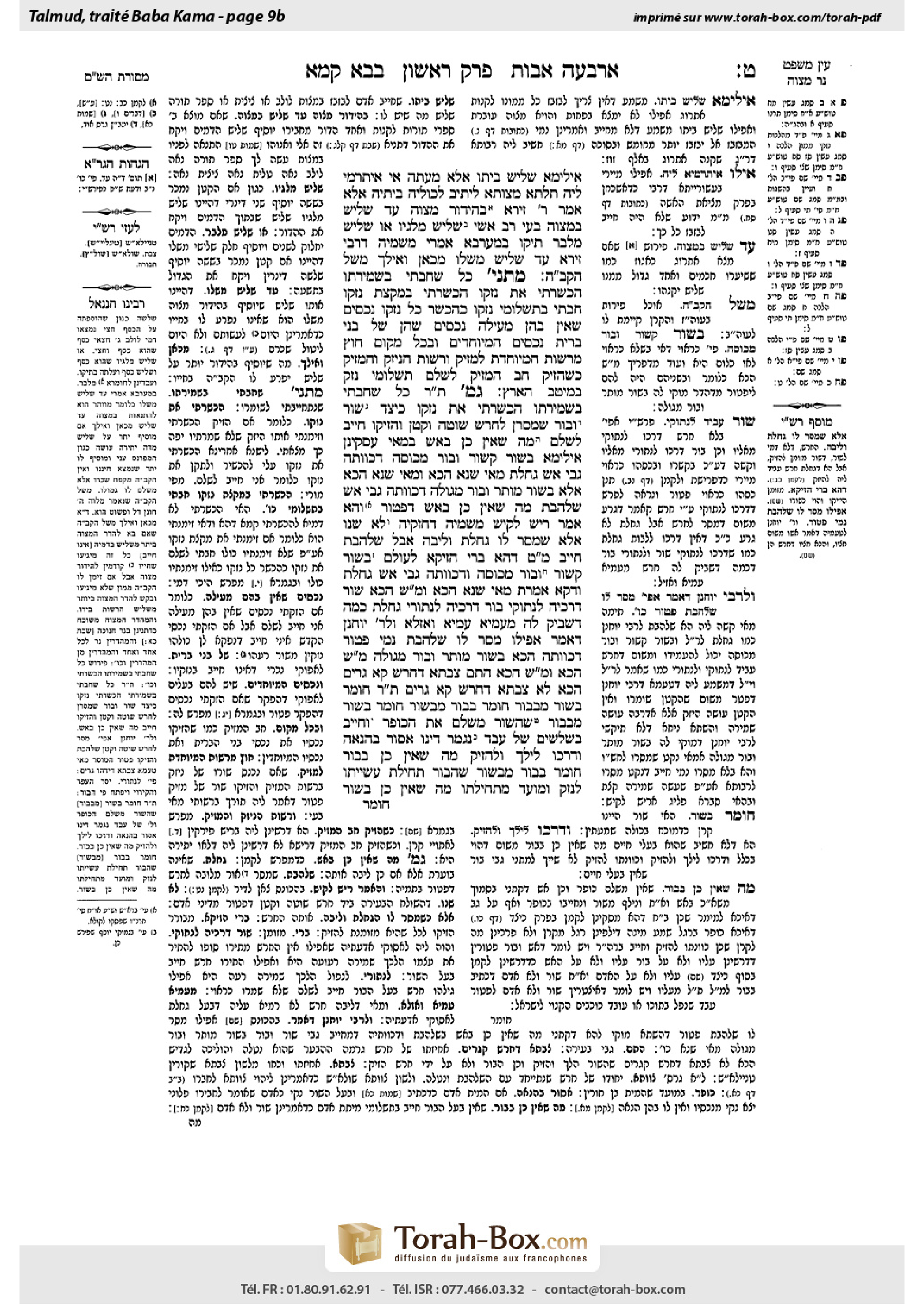
Bava Kamma 9b: Talmud study for Daf Yomi
Study the Talmud for Daf Yomi with scanned pages, Hebrew text, English translations from Sefaria and AI-generated French translations.
Passage selection and English or AI-generated French translation are available where the scan has annotations. Daf Study is independent of Torah-Box and Sefaria.
Browse Bava Kamma · בבא קמא · All tractatesBava Kamma 9b text and translations
This page of Bava Kamma includes the Aramaic text, an English translation and an AI-generated French translation, alongside the scan above.
בבא קמא ט׳ ב · Aramaic and Hebrew text
אִילֵּימָא שְׁלִישׁ בֵּיתוֹ, אֶלָּא מֵעַתָּה, אִי אִיתְרְמִי לֵיהּ תְּלָתָא מִצְוָתָא – לִיתֵּיב לְכוּלֵּיהּ בֵּיתֵיהּ?!
אֶלָּא אָמַר רַבִּי זֵירָא: בְּהִידּוּר מִצְוָה – עַד שְׁלִישׁ בְּמִצְוָה.
בָּעֵי רַב אָשֵׁי: שְׁלִישׁ מִלְּגָיו, אוֹ שְׁלִישׁ מִלְּבַר? תֵּיקוּ.
בְּמַעְרְבָא אָמְרִי מִשְּׁמֵיהּ דְּרַבִּי זֵירָא: עַד שְׁלִישׁ – מִשֶּׁלּוֹ. מִכָּאן וְאֵילָךְ – מִשֶּׁל הַקָּדוֹשׁ בָּרוּךְ הוּא.
מַתְנִי׳ כֹּל שֶׁחַבְתִּי בִּשְׁמִירָתוֹ – הִכְשַׁרְתִּי אֶת נִזְקוֹ. הִכְשַׁרְתִּי בְּמִקְצָת נִזְקוֹ – חַבְתִּי בְּתַשְׁלוּמֵי נִזְקוֹ כְּהֶכְשֵׁר כׇּל נִזְקוֹ.
נְכָסִים שֶׁאֵין בָּהֶן מְעִילָה, נְכָסִים שֶׁהֵן שֶׁל בְּנֵי בְּרִית, נְכָסִים הַמְיוּחָדִים.
וּבְכׇל מָקוֹם, חוּץ מֵרְשׁוּת הַמְיוּחֶדֶת לַמַּזִּיק,
וּרְשׁוּת הַנִּיזָּק וְהַמַּזִּיק.
כְּשֶׁהִזִּיק חָב הַמַּזִּיק לְשַׁלֵּם תַּשְׁלוּמֵי נֶזֶק בְּמֵיטַב הָאָרֶץ.
גְּמָ׳ תָּנוּ רַבָּנַן: כֹּל שֶׁחַבְתִּי בִּשְׁמִירָתוֹ – הִכְשַׁרְתִּי אֶת נִזְקוֹ. כֵּיצַד? שׁוֹר וּבוֹר שֶׁמְּסָרָן לְחֵרֵשׁ שׁוֹטֶה וְקָטָן, וְהִזִּיקוּ – חַיָּיב לְשַׁלֵּם. מַה שֶּׁאֵין כֵּן בְּאֵשׁ.
בְּמַאי עָסְקִינַן? אִילֵימָא בְּשׁוֹר קָשׁוּר וּבוֹר מְכוּסֶּה, דִּכְווֹתַהּ גַּבֵּי אֵשׁ – גַּחֶלֶת; מַאי שְׁנָא הָכָא וּמַאי שְׁנָא הָכָא?
אֶלָּא בְּשׁוֹר מוּתָּר וּבוֹר מְגוּלֶּה, דִּכְווֹתַהּ גַּבֵּי אֵשׁ – שַׁלְהֶבֶת; ״מַה שֶּׁאֵין כֵּן בְּאֵשׁ״ – דְּפָטוּר?! וְהָא אָמַר רֵישׁ לָקִישׁ מִשְּׁמֵיהּ דְּחִזְקִיָּה: לֹא שָׁנוּ אֶלָּא שֶׁמָּסַר לוֹ גַּחֶלֶת – וְלִיבָּהּ, אֲבָל שַׁלְהֶבֶת – חַיָּיב! מַאי טַעְמָא? דְּהָא בָּרִי הֶזֵּיקָא.
לְעוֹלָם בְּשׁוֹר קָשׁוּר וּבוֹר מְכוּסֶּה, וְדִכְווֹתַהּ גַּבֵּי אֵשׁ – גַּחֶלֶת. וּדְקָא אָמְרַתְּ: מַאי שְׁנָא הָכָא וּמַאי שְׁנָא הָכָא?
שׁוֹר – דַּרְכֵּיהּ לְנַתּוֹקֵי; בּוֹר – דַּרְכֵּיהּ לְנַתּוֹרֵי; גַּחֶלֶת – כַּמָּה דְּשָׁבֵיק לַהּ, מִעְמָיא עָמְיָא וְאָזְלָא.
וּלְרַבִּי יוֹחָנָן דְּאָמַר: אֲפִילּוּ מָסַר לוֹ שַׁלְהֶבֶת – נָמֵי פָּטוּר, דִּכְווֹתַהּ הָכָא – בְּשׁוֹר מוּתָּר וּבוֹר מְגוּלֶּה; מַאי שְׁנָא הָכָא וּמַאי שְׁנָא הָכָא?
הָתָם – צְבָתָא דְחֵרֵשׁ קָא גָּרֵים, הָכָא – לָא צְבָתָא דְחֵרֵשׁ קָא גָּרֵים.
תָּנוּ רַבָּנַן: חוֹמֶר בְּשׁוֹר מִבְּבוֹר, חוֹמֶר בְּבוֹר מִבְּשׁוֹר.
חוֹמֶר בְּשׁוֹר מִבְּבוֹר – שֶׁהַשּׁוֹר מְשַׁלֵּם אֶת הַכּוֹפֶר, וְחַיָּיב בִּשְׁלֹשִׁים שֶׁל עֶבֶד, נִגְמַר דִּינוֹ – אָסוּר בַּהֲנָאָה, וְדַרְכּוֹ לֵילֵךְ וּלְהַזִּיק; מַה שֶּׁאֵין כֵּן בְּבוֹר. חוֹמֶר בְּבוֹר מִבְּשׁוֹר – שֶׁהַבּוֹר תְּחִילַּת עֲשִׂיָּיתוֹ לְנֵזֶק, וּמוּעָד מִתְּחִילָּתוֹ; מַה שֶּׁאֵין כֵּן בְּשׁוֹר.
Bava Kamma 9b · English translation
If we say it means that one should spend up to one-third of his estate to perform a mitzva, but if that is so, and if it happened to him that he became obligated in three mitzvot at the same time, should he give his entire estate away in order to fulfill those mitzvot? One is certainly not required to do so.
Rather, what Rabbi Zeira said is that for the embellishment of the performance of a mitzva, e.g., to purchase a more beautiful item used in the performance of a mitzva, one should spend up to one-third more than the cost of the standard item used to perform the mitzva.
Rav Ashi raises a dilemma: How is this one-third calculated? Is it one-third from within, i.e., he calculates the cost of a standard item, adds one-third of that value, and spends the total on purchasing a more beautiful item; or is it one-third from without, i.e., one-third of the sum he ultimately spends should be the additional sum added in order to purchase a more beautiful item? The Gemara concludes: The dilemma shall stand unresolved.
In the West, Eretz Yisrael, they say in the name of Rabbi Zeira: Of the money one spends on purchasing a more beautiful item to perform a mitzva, up to one-third more than the cost of a standard item comes from his own finances, but from this point forward, any additional sum spent on purchasing a more beautiful item comes from the largesse of the Holy One, Blessed be He, i.e., God will reimburse him for spending that additional sum.
MISHNA: With regard to anything for which I became responsible for safeguarding it to prevent it from causing damage, if it in fact causes damage, it is considered as if I actively facilitated that damage, and accordingly I must pay for it. In any case in which I facilitated part of the damage it caused, I am liable for payments of restitution for damage it caused, as if I were the one who facilitated the entire damage it caused.
One is liable only with regard to damage caused to property for which, were he to use it for a non-sacred purpose, he would not be liable for the misuse of consecrated property; with regard to damage caused to property that belongs to members of the covenant, i.e., Jews; and with regard to assigned property, the meaning of which the Gemara will explain.
And one is liable for damage caused in any place except for a domain designated exclusively for the use of the one responsible for the damage.
And one is liable for damage caused in a domain designated for the joint use of the injured party and the one liable for the damage.
When an animal or item one is responsible to safeguard causes damage, the one liable for the damage caused by insufficiently safeguarding it is obligated to pay payments of restitution for damage with his best-quality land.
GEMARA: The Sages taught a baraita that elucidates the mishna’s ruling: With regard to anything for which I became responsible for safeguarding it to prevent it from causing damage, if it in fact causes damage, it is considered as if I actively facilitated that damage and accordingly must pay for it. How so? In the case of an ox or a pit that one transferred to the care of a deaf-mute, an imbecile, or a minor, whose presumed limited intellectual capacity means they are deemed incapable of sufficiently safeguarding them from causing damage, and the ox or pit caused damage, the halakha is that since the owner of the ox or pit did not fulfill his duty to safeguard them, he is liable to pay for the damage, which is not so in a corresponding case where the damage is caused by a fire.
The Gemara elucidates: With what are we dealing? If we say that the baraita deals with a tethered ox or a covered pit, which cannot cause damage in the manner in which the owner left them, then the case in the corresponding situation of fire, where he is not liable, is where one transferred an ember to one of limited halakhic competence, which, had it been left alone, would not have erupted into a fire and caused damage. This cannot be correct, because if so, what is different here in the case of an ox and a pit, where one is liable, and what is different there in the case of the fire, that exempts him from liability? There seems to be no reason to differentiate between them.
Rather, the baraita must be dealing with an untethered ox or an exposed pit, which can cause damage in the manner in which the owner left them. If so, then the case in the corresponding situation of fire, where he is not liable, is where one transferred a flame to one of limited halakhic competence, which can also cause damage in this form. The Gemara rejects this suggestion: But if so, why does the baraita state: Which is not so in the case of damage caused by a fire, as one is exempt from paying damages? But this is untenable, as didn’t Reish Lakish say in the name of Ḥizkiyya: They taught that one is exempt from damage caused by a fire only in a case where he transferred an ember to one of limited halakhic competence who then fanned it into a flame. But if he transferred a flame to him, the one who transferred the flame to him is liable for any damage caused. What is the reason? He is responsible because the capacity for it to cause damage is certain.
The Gemara returns to its initial suggestion: Actually, the ruling of the baraita is stated with regard to a tethered ox or a covered pit, and the case in the corresponding situation of fire, where he is not liable, is where one transferred an ember to one of limited halakhic competence. And with regard to that which you said in order to reject this: What is different here in the case of an ox and a pit that causes him to be liable and what is different there in the case of the fire, that exempts him from liability? Seemingly, in all these cases the item was not able to cause damage in its current form, so he is exempt from liability.
The Gemara explains: You could answer as follows: The typical manner of an ox is to free itself from being tethered and the typical manner of a pit is for its cover to become dislodged. Therefore, as it is negligent to transfer an ox or pit to someone who is incapable of sufficiently safeguarding them, the one who transferred the ox or flame to them is liable. By contrast, with regard to an ember, as long as he leaves it alone it progressively dims, and the only way in which it will cause damage is if someone else actively fans it into a flame; therefore, he is not liable.
The Gemara asks: And according to Rabbi Yoḥanan, who says: Even if the halakha is that if one transferred a flame to one of limited halakhic competence he is exempt, it is possible to say that the case in the corresponding situation here in the first clause of the baraita is stated with regard to an untethered ox or an exposed pit. The Gemara asks: But if so, what is different here in the case of an ox and a pit that causes him to be liable and what is different there in the case of the fire that exempts him from liability? Seemingly, in all these cases the item that was transferred is capable of causing damage in its current form, so he would be expected to be liable.
The Gemara explains: There, in the case of fire, ultimately the deaf-mute’s handling [tzevata] of the flame causes the damage, as if it were not for him moving the flame no damage would have been caused. Here, in the case of the ox and the pit, the deaf-mute’s handling of them does not cause the damage. Rather, the damage was caused even though they remained in exactly the same dangerous state in which the one who had transferred them to the deaf-mute did so. Therefore, the damage is a result of that person’s negligence, and he is liable.
§ The Sages taught: There is a stringency that applies to the category of Ox as opposed to the category of Pit, and conversely, there is a stringency that applies to Pit as opposed to Ox.
The baraita elucidates: The stringency that applies to Ox as opposed to Pit is that if the ox kills a Jew, the owner is liable to pay a ransom to the victim’s heirs. And for killing a slave the owner of the ox is liable to pay thirty sela to the slave’s master. Furthermore, in such a case, once the court hears the evidence and the verdict of the ox is complete and the court rules that the ox must be killed, it is prohibited to derive any benefit from the ox. And from then, it is considered that the typical manner of the ox is to proceed and cause damage. All of this is not so in the case of a pit that caused damage. And the stringency, i.e., the reason to be stringent, that applies to Pit as opposed to Ox is that with regard to the primary category of Pit, its initial formation, e.g., its digging, is done in a manner that can result in damage, and the one responsible for it is considered forewarned from its inception. This is not so with regard to Ox.
Bava Kamma 9b · Traduction française (IA)
Si nous disons que cela signifie qu'on doit dépenser jusqu'à un tiers de son patrimoine pour accomplir une mitsva, mais si c'est ainsi, et si cela lui arrive de devenir obligé de trois mitsvot en même temps, devrait-il donner tout son patrimoine pour accomplir ces mitsvot ? On n'est certainement pas tenu de le faire.
Plutôt, ce que Rabbi Zeira a dit est que pour l'embellissement de l'accomplissement d'une mitsva, par exemple pour acheter un objet plus beau utilisé dans l'accomplissement d'une mitsva, on doit dépenser jusqu'à un tiers de plus que le coût de l'objet standard utilisé pour accomplir la mitsva.
Rav Ashi soulève un dilemme : Comment est-ce que ce tiers est calculé ? Est-ce un tiers à partir de l'intérieur, c'est-à-dire qu'il calcule le coût de l'objet standard, ajoute un tiers de cette valeur, et dépense le total pour acheter un objet plus beau ; ou est-ce un tiers à partir de l'extérieur, c'est-à-dire que un tiers de la somme qu'il finit par dépenser devrait être la somme supplémentaire ajoutée pour acheter un objet plus beau ? La Guemara conclut : Ce dilemme restera sans solution.
Au West, en Terre d'Israël, ils disent en nom de Rabbi Zeira : De l'argent que l'on dépense pour acheter un objet plus beau pour accomplir une mitsva, jusqu'à un tiers de plus que le coût de l'objet standard provient de ses finances propres, mais à partir de ce point, toute somme supplémentaire dépensée pour acheter un objet plus beau provient de la largesse du Saint, le Très Haut, c'est-à-dire que Dieu rembourse cette somme supplémentaire.
MICHNA : Concernant toute chose pour laquelle j'ai été responsable de la garder afin de l'empêcher de causer des dommages, si elle cause effectivement des dommages, on considère cela comme si j'avais activement facilité ces dommages, et par conséquent je dois payer pour cela. Dans tout cas où j'ai facilité une partie des dommages causés, je suis tenu de payer des dommages-intérêts pour les dommages causés, comme si j'avais facilité l'ensemble des dommages causés.
On est tenu seulement concernant les dommages causés à une propriété pour laquelle, s'il l'utilisait à un but non sacré, il ne serait pas tenu responsable de l'usage de la propriété sacrée ; concernant les dommages causés à une propriété appartenant aux membres de l'Alliance, c'est-à-dire les Juifs ; et concernant une propriété assignée, dont la signification sera expliquée par la Guemara.
Et on est tenu responsable des dommages causés en tout lieu sauf dans un domaine désigné exclusivement à l'usage de la personne responsable des dommages.
Et on est tenu responsable des dommages causés dans un domaine désigné à l'usage commun de la personne blessée et de la personne responsable des dommages.
Lorsqu'un animal ou un objet dont on est tenu de veiller cause des dommages, la personne responsable des dommages causés par une garde insuffisante est tenue de payer des dommages-intérêts avec ses terres de meilleure qualité.
GUEMARA : Les Sages ont enseigné une baraïta qui éclaire la décision de la Michna : Concernant toute chose pour laquelle j'ai été responsable de la garder afin de l'empêcher de causer des dommages, si elle cause effectivement des dommages, on considère cela comme si j'avais activement facilité ces dommages et par conséquent je dois payer pour cela. Comment cela se passe-t-il ? Dans le cas d'un bœuf ou d'un trou que l'on a confié à la garde d'un sourd-muet, d'un imbécile ou d'un mineur, dont la capacité intellectuelle limitée signifie qu'ils sont considérés comme incapables de suffisamment les garder pour éviter les dommages, et que le bœuf ou le trou a causé des dommages, la halakha est que puisque l'propriétaire du bœuf ou du trou n'a pas rempli son devoir de garde, il est tenu de payer les dommages, ce qui n'est pas le cas dans un cas correspondant où les dommages sont causés par un feu.
La Guemara éclaire : Avec quels cas sommes-nous en train de parler ? Si nous disons que la baraïta parle d'un bœuf attaché ou d'un trou couvert, qui ne peuvent pas causer des dommages de la manière dont l'propriétaire les a laissés, alors le cas correspondant dans le cas du feu, où il n'est pas tenu, est celui où l'on a transféré une étincelle à une personne de capacité halakhique limitée, qui, laissée seule, ne serait pas entrée en flammes et n'aurait pas causé de dommages. Cela ne peut pas être correct, car si c'est ainsi, qu'est-ce qui diffère ici dans le cas du bœuf et du trou, où l'on est tenu, et qu'est-ce qui diffère dans le cas du feu, qui exempt de responsabilité ? Il semble qu'il n'y ait pas de raison de différencier entre eux.
Plutôt, la baraïta doit parler d'un bœuf non attaché ou d'un trou exposé, qui peut causer des dommages de la manière dont l'owner les a laissés. Si c'est ainsi, alors le cas correspondant dans le cas du feu, où il n'est pas tenu, est celui où l'on a transféré une flamme à une personne de capacité halakhique limitée, qui peut aussi causer des dommages sous cette forme. La Guemara rejette cette suggestion : Mais si c'est ainsi, pourquoi la baraïta dit-elle : Ce n'est pas le cas dans le cas des dommages causés par un feu, comme l'on est exempt de payer les dommages ? Mais cela est inacceptable, car n'a-t-on pas dit Reish Lakish en nom de Chizkiyya : Ils ont enseigné que l'on est exempt des dommages causés par un feu uniquement dans le cas où l'on a transféré une étincelle à une personne de capacité halakhique limitée, qui l'a ensuite allumée en feu. Mais si l'on a transféré une flamme à lui, celui qui a transféré la flamme à lui est tenu de tout dommage causé. Quelle est la raison ? Il est responsable car la capacité à causer des dommages est certaine.
La Guemara revient à sa suggestion initiale : En réalité, la décision de la baraïta est formulée concernant un bœuf attaché ou un trou couvert, et le cas correspondant dans le cas du feu, où il n'est pas tenu, est celui où l'on a transféré une étincelle à une personne de capacité halakhique limitée. Et concernant ce que vous avez dit pour rejeter cela : Qu'est-ce qui diffère ici dans le cas du bœuf et du trou qui le rend tenu et qu'est-ce qui diffère dans le cas du feu qui l'exempte ? Apparemment, dans tous ces cas, l'objet ne pouvait pas causer de dommages sous sa forme actuelle, donc il est exempt de responsabilité.
La Guemara explique : On pourrait répondre ainsi : La manière habituelle d’un bœuf est de se libérer de son attache, et la manière habituelle d’un puits est que son couvercle s’écroule. Ainsi, il est négligent de transférer un bœuf ou un puits à quelqu’un qui n’est pas capable de les garder suffisamment en sécurité, donc celui qui a transféré le bœuf ou le feu à cette personne est responsable. En revanche, concernant une étincelle, tant qu’il la laisse en paix, elle s’estompe progressivement, et la seule façon qu’elle puisse causer un préjudice est si quelqu’un d’autre l’excite activement en feu ; donc, il n’est pas responsable.
La Guemara pose la question : Et selon Rabbi Yoḥanan, qui dit : Même si la halakha est que si l’on transfère une flamme à quelqu’un de faible compétence halakhique, il est exempt, on pourrait dire que le cas mentionné dans la première clause de la baraïta correspondant à ce cas-ci est celui d’un bœuf non attelé ou d’un puits exposé. La Guemara pose la question : Mais si c’est ainsi, qu’est-ce qui diffère ici dans le cas du bœuf et du puits qui rend celui-ci responsable, et qu’est-ce qui diffère dans le cas du feu qui exempt de responsabilité ? Apparemment, dans tous ces cas, l’objet transféré est capable de causer un préjudice dans sa forme actuelle, donc on s’attendrait à ce qu’il soit responsable.
La Guemara explique : Là, dans le cas du feu, finalement, la manipulation du sourd-muet [tzevata] de la flamme cause le préjudice, comme si ce n’était pas pour lui déplacer la flamme que le préjudice n’aurait pas été causé. Ici, dans le cas du bœuf et du puits, la manipulation du sourd-muet n’est pas la cause du préjudice. Plutôt, le préjudice a été causé même si les deux restent dans le même état dangereux dans lequel celui qui les a transférés au sourd-muet les avait laissés. Ainsi, le préjudice est le résultat de la négligence de cette personne, et il est responsable.
§ Les Sages enseignent : Il y a une stricte application qui s'applique à la catégorie du bœuf par rapport à la catégorie du puits, et inversement, il y a une stricte application qui s'applique à la catégorie du puits par rapport à la catégorie du bœuf.
La baraïta éclaire : La stricte application qui s'applique au bœuf par rapport au puits est que si le bœuf tue un Juif, l'owner est responsable de payer une rançon aux héritiers de la victime. Et pour tuer un esclave, l'owner du bœuf est responsable de payer trente sela au maître de l'esclave. De plus, dans ce cas, une fois que le tribunal entend les témoignages et que la décision du bœuf est accomplie et que le tribunal décide que le bœuf doit être tué, il est interdit d'exploiter quelque bénéfice que ce soit à partir du bœuf. À partir de ce moment, on considère que la manière habituelle du bœuf est de causer un préjudice. Toutes ces choses ne s'appliquent pas dans le cas d'un puits qui a causé un préjudice. Et la stricte application, c'est-à-dire la raison d'être strict, qui s'applique au puits par rapport au bœuf est que concernant la catégorie principale du puits, sa formation initiale, par exemple, son creusement, est faite d'une manière qui peut causer un préjudice, et la personne responsable est considérée comme avertie dès le début. Ce n'est pas le cas pour le bœuf.
Traduction française générée par IA à partir de l’édition anglaise de Sefaria. Vérifie toujours un passage avec le texte source.
Text from Sefaria: William Davidson Edition - Vocalized Aramaic (CC BY NC); William Davidson Edition - English (CC BY NC).