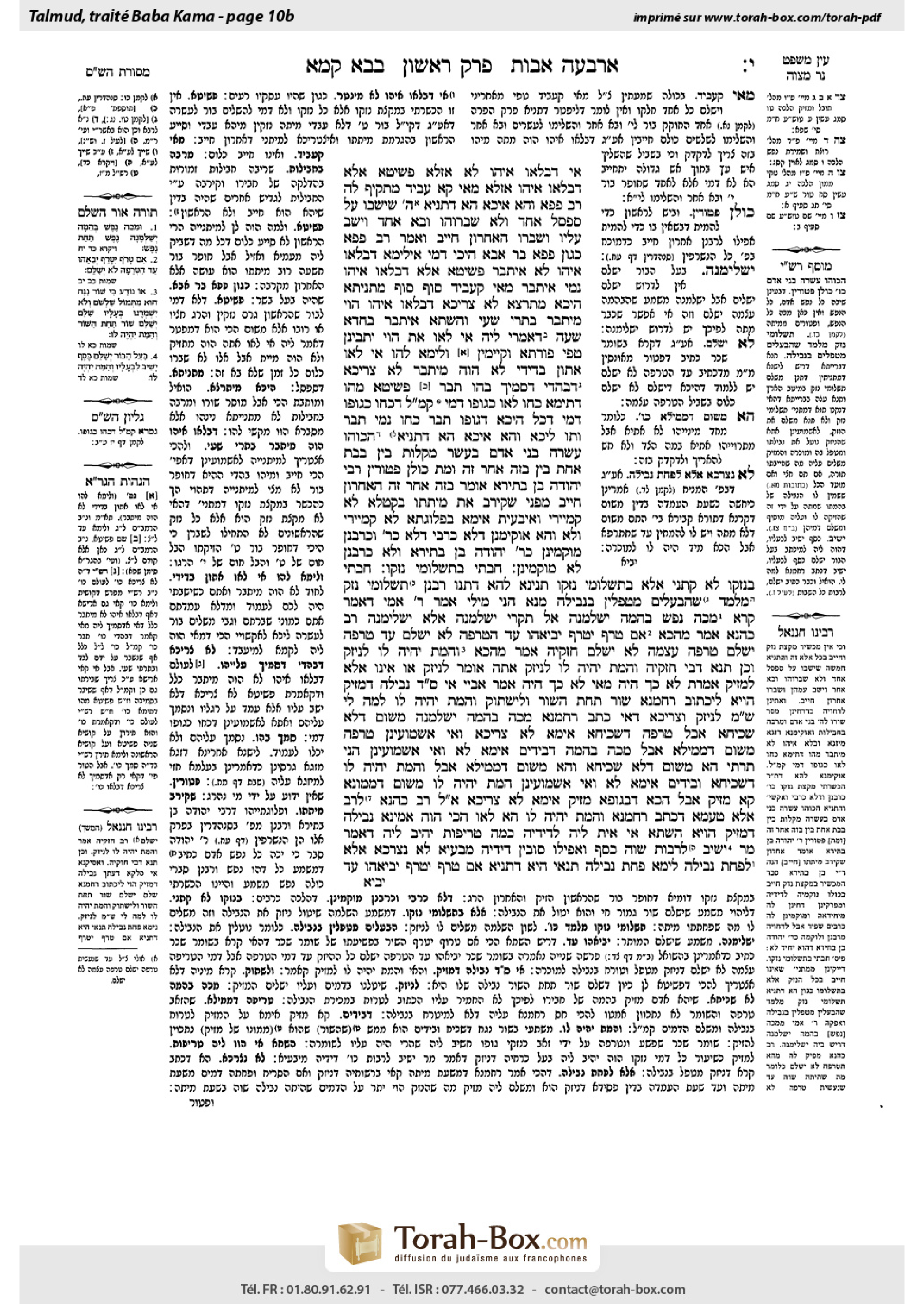
Bava Kamma 10b: Talmud study for Daf Yomi
Study the Talmud for Daf Yomi with scanned pages, Hebrew text, English translations from Sefaria and AI-generated French translations.
Passage selection and English or AI-generated French translation are available where the scan has annotations. Daf Study is independent of Torah-Box and Sefaria.
Browse Bava Kamma · בבא קמא · All tractatesBava Kamma 10b text and translations
This page of Bava Kamma includes the Aramaic text, an English translation and an AI-generated French translation, alongside the scan above.
בבא קמא י׳ ב · Aramaic and Hebrew text
אִי דִּבְלָאו אִיהוּ לָא אָזְלָא – פְּשִׁיטָא! אֶלָּא דִּבְלָאו אִיהוּ אָזְלָא – מַאי קָא עָבֵיד?
מַתְקֵיף לָהּ רַב פָּפָּא, וְהָא אִיכָּא הָא דְּתַנְיָא: חֲמִשָּׁה שֶׁיָּשְׁבוּ עַל סַפְסָל אֶחָד וְלֹא שְׁבָרוּהוּ, וּבָא אֶחָד וְיָשַׁב עָלָיו וּשְׁבָרוֹ – הָאַחֲרוֹן חַיָּיב. וְאָמַר רַב פָּפָּא: כְּגוֹן פָּפָּא בַּר אַבָּא.
הֵיכִי דָמֵי? אִילֵּימָא דִּבְלָאו אִיהוּ לָא אִיתְּבַר – פְּשִׁיטָא. אֶלָּא דִּבְלָאו אִיהוּ נָמֵי אִיתְּבַר – מַאי קָעָבֵיד?
סוֹף סוֹף, מַתְנִיתָא הֵיכָא מִתָּרְצָא?
לָא צְרִיכָא; דִּבְלָאו אִיהוּ הָוֵי מִיתְּבַר בִּתְרֵי שָׁעֵי, וְהַשְׁתָּא אִיתְּבַר בַּחֲדָא שָׁעָה; דְּאָמְרִי לֵיהּ: אִי לָאו אַתְּ – הָוֵי יָתְבִינַן טְפֵי פּוּרְתָּא, וְקָיְימִין.
וְלֵימָא לְהוּ: אִי לָאו אַתּוּן – בְּדִידִי לָא הֲוָה מִיתְּבַר!
לָא צְרִיכָא, דְּבַהֲדֵי דְּסָמֵיךְ בְּהוּ, תְּבַר.
פְּשִׁיטָא!
מַהוּ דְּתֵימָא, כֹּחוֹ – לָאו כְּגוּפוֹ דָּמֵי; קָא מַשְׁמַע לַן דְּכֹחוֹ כְּגוּפוֹ דָּמֵי, דְּכֹל הֵיכָא דְּגוּפוֹ תָּבַר – כֹּחוֹ נָמֵי תָּבַר.
וְתוּ לֵיכָּא? וְהָא אִיכָּא הָא דְּתַנְיָא: הִכּוּהוּ עֲשָׂרָה בְּנֵי אָדָם בְּעֶשֶׂר מַקְלוֹת, בֵּין בְּבַת אַחַת בֵּין בָּזֶה אַחַר זֶה, וָמֵת – כּוּלָּן פְּטוּרִין. רַבִּי יְהוּדָה בֶּן בְּתֵירָא אוֹמֵר: בְּזֶה אַחַר זֶה – הָאַחֲרוֹן חַיָּיב, מִפְּנֵי שֶׁקֵּירַב אֶת מִיתָתוֹ!
בִּקְטָלָא לָא קָמַיְירֵי.
וְאִיבָּעֵית אֵימָא: בִּפְלוּגְתָּא לָא קָמַיְירֵי. וְלָא?! וְהָא אוֹקֵימְנַן דְּלָא כְּרַבִּי! דְּלָא כְּרַבִּי – וּכְרַבָּנַן, מוֹקְמִינַן; כְּרַבִּי יְהוּדָה בֶּן בְּתֵירָא – וְלָא כְּרַבָּנַן, לָא מוֹקְמִינַן.
חַבְתִּי בְּתַשְׁלוּמֵי נִזְקוֹ. ״חַבְתִּי בְּנִזְקוֹ״ לָא קָתָנֵי, אֶלָּא ״בְּתַשְׁלוּמֵי נִזְקוֹ״,
תְּנֵינָא לְהָא דְּתָנוּ רַבָּנַן: תַּשְׁלוּמֵי נֶזֶק – מְלַמֵּד שֶׁהַבְּעָלִים מִטַּפְּלִין בַּנְּבֵילָה.
מְנָא הָנֵי מִילֵּי? אָמַר רַבִּי אַמֵּי, דְּאָמַר קְרָא: ״מַכֵּה נֶפֶשׁ בְּהֵמָה, יְשַׁלְּמֶנָּה״ – אַל תִּקְרֵי ״יְשַׁלְּמֶנָּה״, אֶלָּא ״יַשְׁלִימֶנָּה״.
רַב כָּהֲנָא אָמַר, מֵהָכָא: ״אִם טָרֹף יִטָּרֵף יְבִאֵהוּ עֵד, הַטְּרֵפָה לֹא יְשַׁלֵּם״ – ״עַד טְרֵפָה יְשַׁלֵּם״, טְרֵפָה עַצְמָהּ לֹא יְשַׁלֵּם.
חִזְקִיָּה אָמַר, מֵהָכָא: ״וְהַמֵּת יִהְיֶה לוֹ״ – לַנִּיזָּק.
וְכֵן תָּנָא דְּבֵי חִזְקִיָּה: ״וְהַמֵּת יִהְיֶה לוֹ״ – לַנִּיזָּק. אַתָּה אוֹמֵר לַנִּיזָּק, אוֹ אֵינוֹ אֶלָּא לַמַּזִּיק? אָמַרְתָּ: לֹא כָּךְ הָיָה.
מַאי ״לֹא כָּךְ הָיָה״?
אָמַר אַבָּיֵי: אִי סָלְקָא דַעְתָּךְ נְבֵילָה דְּמַזִּיק הָוְיָא, לִיכְתּוֹב רַחֲמָנָא ״שׁוֹר תַּחַת הַשּׁוֹר״, וְלִישְׁתּוֹק; ״וְהַמֵּת יִהְיֶה לוֹ״ לְמָה לִי? שְׁמַע מִינַּהּ – לַנִּיזָּק.
וּצְרִיכָא; דְּאִי כְּתַב רַחֲמָנָא ״מַכֵּה בְּהֵמָה יְשַׁלְּמֶנָּה״ – מִשּׁוּם דְּלָא שְׁכִיחָא; אֲבָל טְרֵפָה, דִּשְׁכִיחָא – אֵימָא לָא; צְרִיכָא.
וְאִי אַשְׁמוֹעִינַן טְרֵפָה – מִשּׁוּם דְּמִמֵּילָא; אֲבָל מַכֵּה בְּהֵמָה, דִּבְיָדַיִם – אֵימָא לָא.
וְאִי אַשְׁמוֹעִינַן הָנֵי תַּרְתֵּי – הָא מִשּׁוּם דְּלָא שְׁכִיחָא, וְהָא מִשּׁוּם דְּמִמֵּילָא; אֲבָל ״וְהַמֵּת יִהְיֶה לוֹ״ – דִּשְׁכִיחָא וּבְיָדַיִם, אֵימָא לָא.
וְאִי אַשְׁמוֹעִינַן ״הַמֵּת יִהְיֶה לוֹ״ – מִשּׁוּם דְּמָמוֹנָא קָא מַזֵּיק; אֲבָל הָכָא, דִּבְגוּפָא מַזֵּיק – אֵימָא לָא, צְרִיכָא.
אֲמַר לֵיהּ רַב כָּהֲנָא לְרַב: אֶלָּא טַעְמָא דִּכְתַב רַחֲמָנָא ״וְהַמֵּת יִהְיֶה לוֹ״, הָא לָאו הָכִי הֲוָה אָמֵינָא: נְבֵילָה – דְּמַזִּיק הָוְיָא?
הַשְׁתָּא אִי אִית לֵיהּ לְדִידֵיהּ כַּמָּה טְרֵיפוֹת – יָהֵיב לֵיהּ, דְּאָמַר מָר: ״יָשִׁיב״ – לְרַבּוֹת שָׁוֶה כֶּסֶף, וַאֲפִילּוּ סוּבִּין; דִּידֵיהּ מִבַּעְיָא?!
לֹא נִצְרְכָא אֶלָּא לִפְחַת נְבֵילָה.
לֵימָא פְּחַת נְבֵילָה תַּנָּאֵי הִיא? דְּתַנְיָא: ״אִם טָרֹף יִטָּרֵף יְבִיאֵהוּ עֵד״ –
Bava Kamma 10b · English translation
If the fire would not have spread to another person’s field without him adding bundles the fire, it is obvious that he alone is liable for the damage because he alone did everything that led to the damage. Rather, the case must be one where the fire would have spread even without him. The Gemara asks: But if that is the case, what did he do by adding bundles of wood? The fire would have spread without him, so he did not cause even part of the damage. It is apparent, then, that the mishna is not referring to this case.
Rav Pappa objects to the claim of the baraita that the mishna refers only to one specific case: But isn’t there also that which is taught in a baraita: With regard to a case in which five people were sitting on one bench [safsal] and it did not break, and then one additional person came and sat upon it and broke it with his added weight, the latter individual is liable for all the damage. And Rav Pappa said by way of clarification that this applies in a case where the last individual to sit down was as heavy as Pappa bar Abba. Since he could have potentially broken it even on his own, he had no right to use it. In this case, even though the weight of the first five individuals was presumably a contributing factor in causing the damage, since the damage was ultimately caused by the additional weight of the last individual, he is liable for all of the damage. Seemingly, this is an additional example of the mishna’s principle, and the baraita should have mentioned it.
The Gemara rejects this suggestion: What are the circumstances? If we say that without him the bench would never have broken under the weight of the first five people, then it is obvious that the last individual is liable for all the damage, as ultimately it was his action alone that caused the damage. Rather, it must be that even without him the bench would have broken under the weight of the first five people, and the last individual sat down just as it was about to break. The Gemara asks: But if that is the case, what did he do, i.e., why should he be liable at all? It is apparent, then, that the mishna is not referring to this case.
The Gemara asks: Ultimately, how is the baraita cited by Rav Pappa to be explained? As the Gemara explained, the ruling of the baraita is understandable only if it is referring to a case where the bench would not have broken without him. But if that is the case, as the Gemara noted, it is obvious and therefore unnecessary to state it.
The Gemara explains: No, it is necessary in a case where without him it would have broken in two hours, and now it broke in one hour. The baraita teaches that the last individual alone is liable and not the first five, as they can say to the last individual: Were it not for you, we would have sat a little bit more and then stood up; consequently, the bench would never have broken. Therefore, it was ultimately you who caused the bench to break, and therefore only you are liable.
The Gemara rejects this suggestion, because in that situation the last individual would have a valid counterclaim: But let him say to them: Were it not for you continuing to sit on the bench after I sat down, the bench would not have broken, as under my weight alone it would not have broken. Accordingly, we should share the liability for damaging it.
The Gemara offers a different suggestion: No, it is necessary in a case where instantaneously, as he was leaning upon the other five people, the bench broke.
The Gemara asks: If so, it is obvious that he alone is liable, as his action alone caused the damage, and the other five could not have done anything to prevent it as he was leaning upon them.
The Gemara explains: The ruling is necessary lest you say that when one causes damage with one’s direct force it is not equivalent to a situation where one causes damage with one’s body. If he broke the bench by actually sitting down upon it, his action would be considered a direct act of damage completed with his body and he alone would be liable even though the other peoples’ weight was a contributing factor. In this case, since he broke the bench by merely leaning upon the others sitting there, it is his force that led to the damage, not his body, and one might have thought that since the weight of the others certainly contributed to the breakage they should share liability. Therefore, the baraita teaches us that causing damage with one’s direct force is equivalent to causing damage with one’s body. And it teaches that the halakha is that anywhere that one would be liable if his body broke something, one is also liable if his force broke something.
The Gemara continues to consider the possibility that there are additional cases covered by the mishna’s ruling aside from the one listed in the baraita: And are there not more cases? But isn’t there also the case of that which is taught in a baraita: If one was beaten by ten people with ten sticks, whether they beat him simultaneously or one after the other, and he died, they are all exempt from liability for killing him. Rabbi Yehuda ben Beteira says: Where they beat him sequentially, the last individual to beat him alone is liable, because he hastened his death. In this case, the other individuals contributed to the man’s death, but the last one alone is liable. Why didn’t the baraita also mention this case?
The Gemara explains: The baraita is not speaking of one’s liability to receive the death penalty, only of one’s liability to pay damages.
And if you wish, say instead that the baraita is not speaking of an issue that is the subject of a dispute. The Gemara asks: But isn’t it? But didn’t we uphold that the case stated in the baraita concerning a pit is subject to a dispute, and it is not in accordance with the opinion of Rabbi Yehuda HaNasi, but of the Rabbis? The Gemara explains: We will interpret the baraita to be in accordance with the opinion of the Rabbis and not to be in accordance with the opinion of Rabbi Yehuda HaNasi, but we will not interpret it to be in accordance with the opinion of Rabbi Yehuda ben Beteira and not in accordance with the opinion of the Rabbis. In other words, although we will interpret the baraita as referring to a case that is subject to a dispute, that applies only if it is in accordance with the majority opinion in that dispute.
§ The mishna teaches: In any case in which I facilitated part of the damage it caused, I am liable for payments of restitution for damage it caused, as if I were the one who facilitated the entire damage. The Gemara notes that the mishna does not teach: I am liable for the damage it caused, rather: I am liable for payments of restitution for damage it caused. The Hebrew terms: Payments of restitution [tashlumim], and: To complete [lehashlim], share the same Hebrew root. This alludes to the halakha that the payment of damages is required only in order to complete the injured party’s compensation, which is already partially accounted for, as the injured party is able to recover his dead animal’s current value by selling its carcass. Accordingly, the one liable for the damage is not required to pay the animal’s prior value; rather, he must pay only the difference in its value from before it was damaged and its current state.
The Gemara notes: We already learned this, as the Sages taught in a baraita: The mishna uses the term: Payments of restitution for damage, as opposed to simply stating: One is liable for the damage caused, to allude to the halakha that the one who is liable must pay only for the decrease in the value of the animal. This assumes that the injured party is able to recover his animal’s current value by selling the carcass. Therefore, the mishna teaches that the owner of the injured animal attends to, i.e., retains ownership of, the animal carcass so that, if he wishes to, he may sell it and keep the proceeds.
The Gemara asks: From where are these matters derived? Rabbi Ami said: As the verse states: “One who strikes an animal shall pay for it [yeshallemenna]” (Leviticus 24:18). Do not read the final word yeshallemenna, meaning he shall pay for it; rather, read it as though it were vocalized as yashlimenna, meaning he shall complete it, to teach that he shall complete the injured party’s compensation, which is already partially accounted for by the injured party’s right to sell his animal’s carcass.
Rav Kahana said that this halakha is derived from here: The verse states with regard to a case where an animal was entrusted with a paid bailee who did not fulfill his duty to safeguard it, and the animal was attacked by a wild beast: “If it be torn in pieces, let him bring a witness, the torn animal he shall not pay” (Exodus 22:12). Rav Kahana expounds the verse to mean that he shall pay only up until the value of the torn animal; but he shall not pay for the torn animal itself. In other words, he pays only the difference in value between the animal before it was injured and its current torn state. If the owner of the injured animal wishes to fully recover his loss he must sell the animal’s carcass and keep the proceeds.
Ḥizkiyya said that this halakha is derived from here: The verse states with regard to a person’s ox that fatally gored another ox: “He shall pay an ox for the ox, and the carcass shall be his” (Exodus 21:36), meaning the carcass belongs to the injured party, the owner of the gored animal.
And similarly, the school of Ḥizkiyya taught in a baraita: The verse states: “And the carcass shall be his” (Exodus 21:36). The verse means the carcass belongs to the injured party. Do you say it belongs to the injured party? Or perhaps it belongs only to the one liable for the damage? To this suggestion, you should say: It could not have been that.
The Gemara asks: What does the baraita mean by: It could not have been that?
Abaye said: If it enters your mind to say that the animal carcass is the property of the one liable for the damage, let the Merciful One write: “He shall pay an ox for the ox,” and then be silent and state no more. Why do I need the verse to continue: “And the carcass shall be his”? Conclude from it that the carcass belongs to the injured party.
The Gemara notes: And it is necessary to have multiple sources for this halakha, as if the Merciful One wrote only: “One who strikes an animal shall pay for it,” I could claim that only in that case does one have to pay for only part of the damage because it is an uncommon occurrence. But in the case of a torn animal, which is a common occurrence, I will say that his liability should not be limited to the difference in value between what the animal had been worth and the carcass, but he should pay for the entire value of the injured animal. Therefore, it is necessary to explicitly state the halakha also in that case.
And if the Torah had taught us only the case of a torn animal, I could claim that only in that case does one have to pay for only part of the damage because the damage occurred by itself, i.e., it was not directly caused by the one liable for it. But in the case of one who strikes an animal, who does so by direct action, I will say that his liability should not be limited. Therefore, it is necessary to explicitly state the halakha also in that case.
And if the Torah had taught us only these two cases, I could claim that only in those cases does one have to pay for only part of the damage, this one because it is an uncommon occurrence, and that one because the damage occurred by itself. But in a case where one’s ox gores another’s ox, of which the Torah states: “And the carcass shall be his,” which is a common occurrence, and the damage is considered to have been inflicted by its owner’s direct action, since it was under his guard, I will say his liability should not be limited.
And if the Torah had taught us only the case in the verse “And the carcass shall be his,” I could claim that only in that case does one have to pay for only part of the damage because it is one’s property that causes damage. But here, in the case of one who strikes another’s animal, where one causes damage with one’s own body, I will say his liability should not be limited. Therefore, it is necessary to explicitly state the halakha in each case.
Rav Kahana said to Rav: But according to the statement of Ḥizkiyya, as explained by Abaye, the only reason the injured party retains ownership of the carcass is that the Merciful One wrote: “And the carcass shall be his,” but were it not for that I would say that the carcass is the property of the one liable for the damage.
Rav Kahana questions the need for the Torah to teach this: Now, if the one liable for the damage had in his possession the carcasses of several torn animals, he could give the injured party a carcass as payment, as the Master said above (7a): The verse states: “He shall recompense” (Exodus 21:34), to include items worth money, and even bran, a relatively inferior commodity, as valid items with which to pay restitution. Is it necessary for the Torah to teach that he can pay restitution with his, i.e., the injured party’s, animal carcass? Granting ownership of the carcass to the injured party seems pointless, because even had the Torah granted it to the one liable for the damage, he could give it to the injured party as payment.
The Gemara explains: It is necessary only for the issue of who sustains the loss due to the diminishing value of the carcass between its death and when the case is brought before the court. By granting ownership of the carcass to the injured party from the moment of the animal’s death, the Torah limits the damages to the difference between the value of the animal when it was alive and its value immediately after it is killed, irrespective of what happens to the carcass afterward.
The Gemara asks: Shall we say that the issue of the diminishing value of the carcass is a dispute between tanna’im? As it is taught in a baraita: The verse states with regard to a case where an animal was entrusted with a paid bailee and was attacked by a wild beast: “If it be torn in pieces, let him bring a witness [ed]” (Exodus 22:12).
Bava Kamma 10b · Traduction française (IA)
Si le feu n'aurait pas atteint le champ d'une autre personne sans qu'il ajoute des fagots, il est évident qu'il est seul responsable du préjudice, car c'est lui seul qui a fait tout ce qui a conduit au préjudice. Cependant, le cas doit être celui où le feu aurait pu se propager même sans lui. La Guemara pose la question : Mais si c'est le cas, que faisait-il en ajoutant des fagots ? Le feu se serait propagé sans lui, donc il n'a pas causé même une partie du préjudice. Il est donc évident que la mitsna ne fait référence pas à ce cas.
Rav Pappa s'oppose à l'affirmation du baraïta selon laquelle la mitsna fait référence à un seul cas spécifique : Mais n'y a-t-il pas aussi ce qui est enseigné dans un baraïta : Dans un cas où cinq personnes étaient assises sur une même banquette [safsal] et elle ne s'est pas cassée, et ensuite une personne supplémentaire est montée dessus et l'a cassée avec son poids supplémentaire, la dernière personne est responsable de tout le préjudice. Et Rav Pappa a dit en clarifiant que cela s'applique dans un cas où la dernière personne à s'asseoir était aussi lourde que Pappa bar Abba. Comme il aurait pu briser la banquette seul, il n'avait pas le droit d'utiliser celle-ci. Dans ce cas, même si le poids des cinq premières personnes était probablement un facteur contributif à la destruction, puisque le préjudice a été finalement causé par le poids supplémentaire de la dernière personne, elle est responsable de tout le préjudice. Apparemment, c'est un autre exemple du principe de la mitsna, et le baraïta aurait dû le mentionner.
La Guemara rejette cette suggestion : Quelles sont les circonstances ? Si nous disons que sans lui la banquette ne se serait pas cassée sous le poids des cinq premières personnes, alors il est évident que la dernière personne est responsable de tout le préjudice, car c'est finalement son action seule qui a causé le préjudice. Cependant, il faut dire que même sans lui la banquette se serait cassée sous le poids des cinq premières personnes, et la dernière personne s'est assise juste au moment où elle allait se briser. La Guemara pose la question : Mais si c'est le cas, que faisait-il, c'est-à-dire pourquoi devrait-il être responsable ? Il est donc évident que la mitsna ne fait pas référence à ce cas.
La Guemara pose la question : Finalement, comment expliquer le baraïta cité par Rav Pappa ? Comme la Guemara l'a expliqué, le jugement du baraïta est compréhensible uniquement si il fait référence à un cas où la banquette ne se serait pas cassée sans lui. Mais si c'est le cas, comme la Guemara l'a noté, c'est évident et donc inutile de le mentionner.
La Guemara explique : Non, il est nécessaire dans un cas où sans lui la banquette se serait cassée en deux heures, et maintenant elle s'est cassée en une heure. Le baraïta enseigne que la dernière personne seule est responsable et non les cinq premières, car ils peuvent dire à la dernière personne : S'il n'y avait pas eu vous, nous aurions continué à rester assis un peu plus et ensuite nous serions levés ; par conséquent, la banquette ne se serait pas cassée. Ainsi, c'est finalement vous qui avez causé la cassure de la banquette, et donc seul vous êtes responsable.
La Guemara rejette cette suggestion, car dans ce cas la dernière personne aurait un contre-argument valide : Mais qu'il dise à ceux-ci : S'il n'y avait pas eu vous qui restiez assis sur la banquette après que j'ai été assis, la banquette ne se serait pas cassée, car sous mon seul poids elle ne se serait pas cassée. Ainsi, nous devrions partager la responsabilité du préjudice.
La Guemara propose une autre suggestion : Non, il est nécessaire dans un cas où instantanément, en se penchant sur les cinq autres personnes, la banquette s'est cassée.
La Guemara pose la question : Si c'est ainsi, il est évident qu'il est seul responsable, car c'est son action seule qui a causé le préjudice, et les cinq autres ne pouvaient pas empêcher cela en le penchant sur eux.
La Guemara explique : Ce jugement est nécessaire pour éviter de dire que quand on cause un préjudice avec sa force directe, cela n'est pas équivalent à un cas où on cause un préjudice avec son corps. Si l'on a cassé la banquette en s'asseyant dessus, son action serait considérée comme un acte direct de préjudice accompli avec son corps, et il serait seul responsable même si le poids des autres était un facteur contributif. Dans ce cas, puisqu'il a cassé la banquette en se penchant simplement sur les autres assis là, c'est sa force qui a causé le préjudice, pas son corps, et on pourrait penser que puisque le poids des autres a certainement contribué à la cassure, ils devraient partager la responsabilité. Ainsi, le baraïta nous enseigne que causer un préjudice avec sa force directe est équivalent à causer un préjudice avec son corps. Et il enseigne que la halakha est que partout où l'on est responsable si son corps a causé un préjudice, on est aussi responsable si sa force a causé un préjudice.
La Guemara continue à considérer la possibilité qu'il y ait d'autres cas couverts par le jugement de la mitsna outre celui mentionné dans le baraïta : Et n'y a-t-il pas d'autres cas ? Mais n'y a-t-il pas aussi le cas enseigné dans un baraïta : Si une personne a été battue par dix personnes avec dix bâtons, qu'ils l'aient battu en même temps ou l'un après l'autre, et qu'il soit mort, ils sont tous exemptés de responsabilité pour avoir tué. Rabbi Yehuda ben Beteira dit : Dans le cas où ils l'ont battu séquentiellement, seul celui qui a battu en dernier est responsable, car il a accéléré sa mort. Dans ce cas, les autres personnes ont contribué à la mort de la personne, mais seul celui qui a battu en dernier est responsable. Pourquoi le baraïta n'a-t-il pas mentionné ce cas ?
La Guemara explique : Le baraïta ne parle pas de la responsabilité à recevoir la peine de mort, mais seulement de la responsabilité à payer des dommages.
Et si tu veux, dis plutôt que la baraïta ne parle pas d’une question soumise à un débat. La Guemara demande : Mais n’est-ce pas le cas ? Mais n’avons-nous pas confirmé que le cas mentionné dans la baraïta concernant un trou est soumis à un débat, et qu’il ne correspond pas à l’opinion de Rabbi Yehuda HaNasi, mais à celle des Rabbins ? La Guemara explique : Nous interpréterons la baraïta selon l’opinion des Rabbins et non selon celle de Rabbi Yehuda HaNasi, mais nous ne l’interpréterons pas selon celle de Rabbi Yehuda ben Beteira et non selon celle des Rabbins. En d’autres termes, bien que nous interpréterons la baraïta comme faisant référence à un cas soumis à un débat, cela s’applique uniquement si ce cas correspond à l’opinion majoritaire dans ce débat.
§ La Michna enseigne : Dans tout cas où j’ai facilité une partie des dommages causés, je suis tenu de payer des tashlumim pour les dommages causés, comme si j’étais celui qui avait facilité l’intégralité des dommages. La Guemara note que la Michna ne dit pas : Je suis tenu des dommages causés, mais : Je suis tenu de payer des tashlumim pour les dommages causés. Les termes hébreux : Tashlumim, et : Compléter [lehashlim], partagent le même racine hébraïque. Cela fait référence à la halakha selon laquelle le paiement des dommages est requis uniquement pour compléter la compensation de la partie blessée, qui est déjà partiellement couverte, car la partie blessée peut récupérer la valeur actuelle de son animal en vendant son cadavre. Ainsi, la personne tenu responsable des dommages n’est pas tenu de payer la valeur antérieure de l’animal ; il doit payer uniquement la différence de valeur entre l’état antérieur de l’animal et son état actuel.
La Guemara note : Nous avons déjà appris cela, car les Sages ont enseigné dans une baraïta : La Michna utilise le terme : Tashlumim pour les dommages causés, contrairement à simplement dire : On est tenu des dommages causés, pour faire référence à la halakha selon laquelle la personne tenu responsable doit payer uniquement la baisse de valeur de l’animal. Cela suppose que la partie blessée peut récupérer la valeur actuelle de son animal en vendant son cadavre. Ainsi, la Michna enseigne que l’propriétaire de l’animal blessé s’occupe de lui, c’est-à-dire qu’il conserve la propriété du cadavre, de sorte qu’il puisse le vendre s’il le souhaite et conserver les recettes.
La Guemara demande : D’où ces matières sont-elles dérivées ? Rabbi Ami dit : Comme le verset dit : « Celui qui frappe un animal paiera pour lui [yeshallemenna] » (Lévitique 24:18). Ne lis pas le dernier mot yeshallemenna, signifiant qu’il paiera pour lui ; lis-le plutôt comme yashlimenna, signifiant qu’il complétera, pour enseigner qu’il doit compléter la compensation de la partie blessée, qui est déjà partiellement couverte par le droit de la partie blessée de vendre le cadavre de son animal.
Rav Kahana dit que cette halakha est dérivée d’ici : Le verset dit concernant un cas où un animal a été confié à un dépositaire payé qui n’a pas rempli son devoir de le protéger, et l’animal a été attaqué par un animal sauvage : « Si il est déchiré, qu’il apporte un témoin, l’animal déchiré il ne paiera pas » (Exode 22:12). Rav Kahana interprète le verset pour signifier qu’il paiera uniquement jusqu’à la valeur de l’animal déchiré ; mais il ne paiera pas pour l’animal déchiré lui-même. En d’autres termes, il paie uniquement la différence de valeur entre l’animal avant qu’il ne soit blessé et son état actuel. Si l’propriétaire de l’animal blessé souhaite récupérer pleinement sa perte, il doit vendre le cadavre de l’animal et conserver les recettes.
Ḥizkiyya dit que cette halakha est tirée d’ici : Le verset dit concernant un bœuf d’un homme qui a tué un autre bœuf : « Il paiera un bœuf pour le bœuf, et le cadavre sera le sien » (Exode 21:36), signifiant que le cadavre appartient à la partie blessée, l’propriétaire du bœuf blessé.
Et de même, l’école de Ḥizkiyya a enseigné dans une baraïta : Le verset dit : « Et le cadavre sera le sien » (Exode 21:36). Le verset signifie que le cadavre appartient à la partie blessée. Dis-tu qu’il appartient à la partie blessée ? Ou peut-être appartient-il uniquement à celui tenu responsable des dommages ? À cette suggestion, tu devrais dire : Cela ne pouvait pas être ainsi.
La Guemara demande : De quoi la baraïta veut-elle dire par : Cela ne pouvait pas être ainsi ?
Abaye dit : Si tu penses que le cadavre de l’animal appartient à celui tenu responsable des dommages, laisse le Miséricordieux écrire : « Il paiera un bœuf pour le bœuf », et ensuite être silencieux et ne dire plus rien. Pourquoi ai-je besoin du verset de continuer : « Et le cadavre sera le sien » ? Conclure de cela que le cadavre appartient à la partie blessée.
La Guemara note : Et il est nécessaire d’avoir plusieurs sources pour cette halakha, car si le Miséricordieux avait écrit seulement : « Celui qui frappe un animal paiera pour lui », je pourrais affirmer que cela s’applique uniquement dans ce cas, car il s’agit d’une occurrence rare. Mais dans le cas d’un animal déchiré, qui est une occurrence courante, je dirais que la responsabilité ne devrait pas être limitée à la différence de valeur entre l’animal avant qu’il ne soit blessé et son état actuel, mais qu’il devrait payer la valeur totale de l’animal blessé. Ainsi, il est nécessaire d’affirmer explicitement cette halakha dans ce cas également.
Et si la Torah nous avait enseigné uniquement le cas d’un animal déchiré, je pourrais affirmer que cela s’applique uniquement dans ce cas, car la blessure s’est produite d’elle-même, c’est-à-dire qu’elle n’a pas été directement causée par celui tenu responsable. Mais dans le cas d’un homme qui frappe un animal, qui le fait par une action directe, je dirais que sa responsabilité ne devrait pas être limitée. Ainsi, il est nécessaire d’affirmer explicitement cette halakha dans ce cas également.
Et si la Torah nous avait appris seulement ces deux cas, je pourrais affirmer que seul dans ces cas-là on doit payer seulement une partie du préjudice, celui-ci parce qu'il est un cas rare, et celui-là parce que le préjudice s'est produit tout seul. Mais dans le cas où un bœuf d'une personne blesse un bœuf d'une autre personne, dont la Torah dit : « Et la carcasse sera la sienne », qui est un cas courant, et le préjudice est considéré comme ayant été causé par l'action directe de son propriétaire, puisque l'animal était sous sa garde, je dirais que sa responsabilité ne devrait pas être limitée.
Et si la Torah nous avait appris seulement le cas mentionné dans la versette « Et la carcasse sera la sienne », je pourrais affirmer que seul dans ce cas-là on doit payer seulement une partie du préjudice, parce que c'est sa propriété qui cause le préjudice. Mais ici, dans le cas où l'on frappe un animal d'une autre personne, où l'on cause le préjudice avec son propre corps, je dirais que sa responsabilité ne devrait pas être limitée. Ainsi, il est nécessaire d'expliquer explicitement la halakha dans chaque cas.
Rav Kahana dit à Rav : Mais selon la déclaration de Ḥizkiyya, comme l'explique Abaye, la seule raison pour laquelle la partie blessée conserve la propriété de la carcasse est que le Très Miséricordieux a écrit : « Et la carcasse sera la sienne », mais sans cela, je dirais que la carcasse est la propriété de celui qui est responsable du préjudice.
Rav Kahana questionne la nécessité pour la Torah d'enseigner cela : Maintenant, si celui qui est responsable du préjudice possédait les carcasses de plusieurs animaux déchirés, il pourrait donner à la partie blessée une carcasse comme réparation, comme le Maître a dit plus haut (7a) : La versette dit : « Il devra réparer » (Exode 21:34), pour inclure des objets ayant de la valeur, même du foin, un produit relativement inférieur, comme des objets valables pour réparer le préjudice. Est-ce nécessaire que la Torah enseigne que l'on peut réparer avec sa propre carcasse, c'est-à-dire la carcasse de la partie blessée ? Donner la propriété de la carcasse à la partie blessée semble inutile, car même si la Torah avait donné la propriété de la carcasse à celui qui est responsable du préjudice, il pourrait la donner à la partie blessée comme réparation.
La Guemara explique : Il est nécessaire uniquement pour l'issue de qui subit la perte due à la diminution de la valeur de la carcasse entre son décès et l'instance devant le tribunal. En donnant la propriété de la carcasse à la partie blessée dès le moment du décès de l'animal, la Torah limite les dommages à la différence entre la valeur de l'animal lorsqu'il était vivant et sa valeur immédiatement après sa mort, indépendamment de ce qui arrive à la carcasse ensuite.
La Guemara pose la question : Devons-nous dire que l'issue de la diminution de la valeur de la carcasse est un débat entre les tannaïm ? Comme il est enseigné dans une baraïta : La versette parle d'un cas où un animal a été confié à un bailee payé et a été attaqué par un animal sauvage : « Si elle est déchirée, qu'il apporte un témoin [ed] » (Exode 22:12).
Traduction française générée par IA à partir de l’édition anglaise de Sefaria. Vérifie toujours un passage avec le texte source.
Text from Sefaria: William Davidson Edition - Vocalized Aramaic (CC BY NC); William Davidson Edition - English (CC BY NC).