Bava Kamma 11a: Talmud study for Daf Yomi
Study the Talmud for Daf Yomi with scanned pages, Hebrew text, English translations from Sefaria and AI-generated French translations.
Passage selection and English or AI-generated French translation are available where the scan has annotations. Daf Study is independent of Torah-Box and Sefaria.
Browse Bava Kamma · בבא קמא · All tractatesBava Kamma 11a text and translations
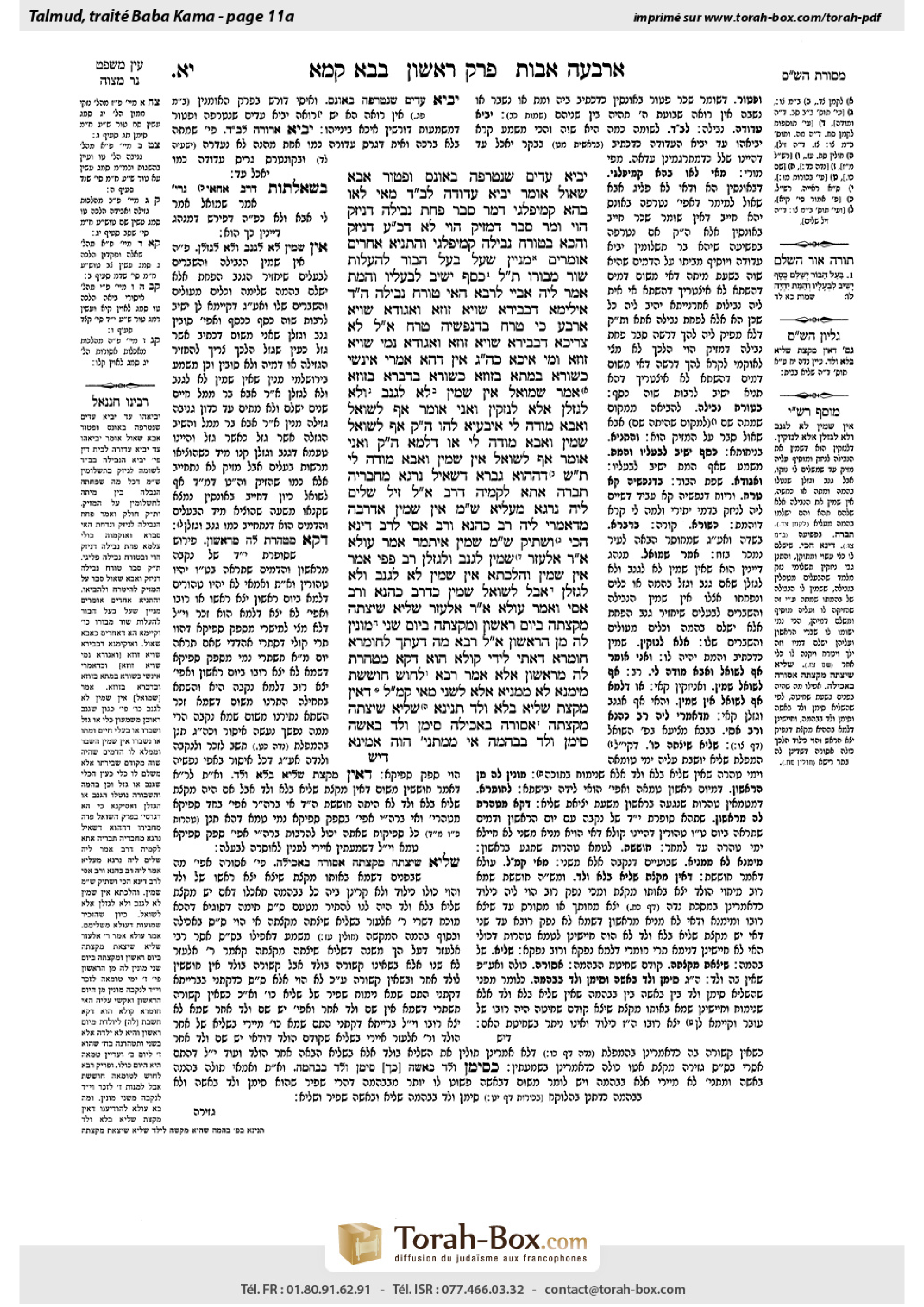
This page of Bava Kamma includes the Aramaic text, an English translation and an AI-generated French translation, alongside the scan above.
בבא קמא י״א א · Aramaic and Hebrew text
יָבִיא עֵדִים שֶׁנִּטְרְפָה בְּאוֹנֶס, וּפָטוּר. אַבָּא שָׁאוּל אוֹמֵר: יָבִיא עֲדוּדָה לְבֵית דִּין.
מַאי, לָאו בְּהָא קָמִיפַּלְגִי – דְּמָר סָבַר: פְּחַת נְבֵילָה דְּנִיזָּק הָוֵי, וּמָר סָבַר: דְּמַזִּיק הָוֵי?
לָא, דְּכוּלֵּי עָלְמָא דְּנִיזָּק, וְהָכָא בְּטוֹרַח נְבֵילָה קָמִיפַּלְגִי;
וְהָתַנְיָא, אֲחֵרִים אוֹמְרִים: מִנַּיִין שֶׁעַל בַּעַל הַבּוֹר לְהַעֲלוֹת שׁוֹר מִבּוֹרוֹ – תַּלְמוּד לוֹמַר: ״כֶּסֶף יָשִׁיב לִבְעָלָיו, וְהַמֵּת״.
אֲמַר לֵיהּ אַבָּיֵי לְרָבָא: הַאי טוֹרַח נְבֵילָה, הֵיכִי דָּמֵי?
אִילֵימָא דִּבְבֵירָא שָׁוְיָא זוּזָא, וְאַגּוּדָּא שָׁוְיָא אַרְבַּע; כִּי טָרַח – בִּדְנַפְשֵׁיהּ טָרַח!
אֲמַר לֵיהּ: לָא צְרִיכָא, דִּבְבֵירָא שָׁוְיָא זוּזָא, וְאַגּוּדָּא נָמֵי שָׁוְיָא זוּזָא.
וּמִי אִיכָּא כְּהַאי גַוְונָא? אִין, דְּהָא אָמְרִי אִינָשֵׁי: כְּשׁוּרָא בְּמָתָא בְּזוּזָא, כְּשׁוּרָא בְּדַבְרָא בְּזוּזָא.
אָמַר שְׁמוּאֵל: אֵין שָׁמִין לֹא לְגַנָּב וְלֹא לְגַזְלָן, אֶלָּא לְנִזָּקִין. וַאֲנִי אוֹמֵר: אַף לְשׁוֹאֵל. וְאַבָּא מוֹדֶה לִי.
אִיבַּעְיָא לְהוּ: הָכִי קָאָמַר – אַף לְשׁוֹאֵל שָׁמִין, וְאַבָּא מוֹדֶה לִי; אוֹ דִלְמָא, הָכִי קָאָמַר – וַאֲנִי אוֹמֵר: אַף לְשׁוֹאֵל אֵין שָׁמִין, וְאַבָּא מוֹדֶה לִי?
תָּא שְׁמַע, דְּהָהוּא גַּבְרָא דִּשְׁאֵיל נַרְגָּא מֵחַבְרֵיהּ, תַּבְרֵהּ. אֲתָא לְקַמֵּיהּ דְּרַב, אֲמַר לֵיהּ: זִיל שַׁלֵּים לֵיהּ נַרְגָּא מְעַלְּיָא. שְׁמַע מִינַּהּ אֵין שָׁמִין!
אַדְּרַבָּה, מִדְּאָמְרִי לֵיהּ רַב כָּהֲנָא וְרַב אַסִּי לְרַב: ״דִּינָא הָכִי?!״ וּשְׁתֵיק, שְׁמַע מִינַּהּ שָׁמִין.
אִיתְּמַר, אָמַר עוּלָּא אָמַר רַבִּי אֶלְעָזָר: שָׁמִין לְגַנָּב וּלְגַזְלָן. רַב פַּפֵּי אָמַר: אֵין שָׁמִין. וְהִלְכְתָא: אֵין שָׁמִין לֹא לְגַנָּב וְלֹא לְגַזְלָן, אֲבָל לְשׁוֹאֵל שָׁמִין – כִּדְרַב כָּהֲנָא וְרַב אַסִּי.
וְאָמַר עוּלָּא אָמַר רַבִּי אֶלְעָזָר: שִׁלְיָא שֶׁיָּצְתָה מִקְצָתָהּ בְּיוֹם רִאשׁוֹן וּמִקְצָתָהּ בְּיוֹם שֵׁנִי, מוֹנִין לָהּ מִן הָרִאשׁוֹן.
אֲמַר לֵיהּ רָבָא: מָה דַעְתָּךְ, לְחוּמְרָא?!
חוּמְרָא דְּאָתֵי לִידֵי קוּלָּא הוּא – דְּקָא מְטַהֲרַתְּ לַהּ מֵרִאשׁוֹן!
אֶלָּא אָמַר רָבָא: לָחוֹשׁ – חוֹשֶׁשֶׁת; מִימְנָא לָא (מ)מָנְיָא אֶלָּא לְשֵׁנִי.
מַאי קָא מַשְׁמַע לַן – דְּאֵין מִקְצָת שִׁלְיָא בְּלֹא וָלָד? תְּנֵינָא: שִׁלְיָא שֶׁיָּצְתָה מִקְצָתָהּ – אֲסוּרָה בַּאֲכִילָה; סִימָן וָלָד בְּאִשָּׁה, סִימָן וָלָד בִּבְהֵמָה!
אִי מִמַּתְנִיתָא, הֲוָה אָמֵינָא
Bava Kamma 11a · English translation
This means that the bailee should bring witnesses that the animal was mauled through circumstances beyond his control, and based on their testimony he is exempt from liability. Abba Shaul says: The word ed should not be interpreted as witness, but as carcass. Accordingly, the bailee should immediately bring the carcass [aduda] to court in order to appraise its current value.
What, is it not so that they disagree about this matter: That one Sage, Abba Shaul, holds that the loss due to the diminishing value of the carcass is sustained by the injured party, and so there is a need to appraise its value immediately in order to correctly assess how much the one liable for the damage must pay, and the other Sage, the first tanna, holds that the loss due to the diminishing value of the carcass is sustained by the one liable for the damage because the Torah granted him ownership of it.
The Gemara rejects this: No, everyone agrees that the loss due to the diminishing value of the carcass is sustained by the injured party, since he owns it, and here they disagree concerning who must go to the effort of retrieving the carcass and transporting it to the court to be appraised.
And so it is taught in a baraita: Others say: From where is it derived that it is incumbent upon the owner of the pit to raise the ox from his pit after it was killed by falling into it? The verse states: “The owner of the pit shall pay; he shall restore money to its owner, and the carcass shall be his” (Exodus 21:34). They read the term “and the carcass” as a second subject of the term “he shall restore.” It therefore indicates that the one liable for the damage must restore the carcass to the injured party by retrieving it. The fact that this opinion is introduced with the phrase: Others say, suggests that it stands in opposition to another opinion. That other opinion apparently holds that the owner of the injured animal is responsible for retrieving the carcass.
Abaye said to Rava: What are the circumstances in which the one liable for the damage is required to go to this effort, to retrieve the carcass from the pit?
If we say that while still inside the pit, the carcass is worth a dinar, and when it is at the edge of the pit, since it is more accessible, its market value increases and is worth four dinars, then when the one liable for the damage expends the effort to retrieve the carcass, he is expending the effort for his own sake, since by increasing the value of the carcass he reduces his own liability. Therefore, he will certainly retrieve it of his own accord, and it is not necessary for the Torah to require him to do so.
Rava said to him: No, it is necessary to require him to retrieve the carcass in a case where, while still inside the pit the carcass is worth one dinar, and when it is at the edge of the pit, despite being more accessible, it is still worth one dinar. Since it is of no benefit to him to retrieve it, the Torah had to require him to do so.
The Gemara asks: But is there ever a case like this, where despite being more accessible its market value does not change? The Gemara answers: Yes, as people say, a beam of wood in the city sells for a dinar, and a beam of wood in the field also sells for a dinar, despite the fact that it needs to be transported from there to the city.
§ Shmuel says: The practice of the court is that when an animal or other item is stolen and then is damaged or dies, the court does not appraise its current value and assign ownership of it to its owner, in order that the perpetrator should have to pay only the difference between its prior value and its current value, neither for the sake of a thief nor for the sake of a robber. Rather, the thief or robber acquires ownership of the carcass or damaged item and compensates the owner for its prior value. The court appraises the item or carcass only for damages, as the Gemara explained above. And I say that they appraise the item or animal even for a borrower who borrowed an item and while it was in his possession it became damaged, or who borrowed an animal and while it was in his possession it died, and Abba, i.e., Rav, concedes to me.
A dilemma was raised before them: Is this what Shmuel is saying: The court appraises the value of an item or a carcass even for the sake of a borrower, and Abba concedes to me; or perhaps, this is what Shmuel is saying: And I say that the court does not appraise its value even for a borrower, and Abba concedes to me?
Come and hear a resolution from the following incident: There was a certain man who borrowed an ax from another and he broke it. He came before Rav to rule if, and how much, he was liable to pay for it. Rav said to him: Go and pay him with a full-fledged ax, i.e., you must compensate the owner for the full value of the ax that you broke. The Gemara suggests: Conclude from it that the court does not appraise its value for the sake of a borrower.
The Gemara rejects this: On the contrary, from the fact that Rav Kahana and Rav Asi said to Rav on that occasion: Is this the halakha? And Rav remained silent, this suggests that he conceded to their opinion that the borrower should not have had to pay the full value of the ax. Accordingly, conclude from it that the court appraises an item’s value for the sake of a borrower.
An amoraic dispute was stated: Ulla says that Rabbi Elazar says: The court appraises a stolen item’s value for a thief and for a robber. Rav Pappi says: It does not appraise its value for them. The Gemara concludes: And the halakha is that the court does not appraise value either for a thief or for a robber; but it appraises value for a borrower, in accordance with the opinion of Rav Kahana and Rav Asi.
§ The Gemara cites additional halakhot taught by Ulla, citing Rabbi Elazar: When a woman gives birth or miscarries a fetus she is thereby rendered ritually impure (see Leviticus 12:1–5). Even if she delivers only the afterbirth, with no discernible fetus, she is rendered ritually impure due to the possibility that the fetus was dissolved in the afterbirth, and it is therefore considered as though she delivered it (Nidda 24b). The length of the period of impurity depends on the sex of the child. In the case where it is unclear what the sex is, she must observe the longer period of fourteen days (Nidda 29a). At the end of that period she may purify herself by immersing in a ritual bath. And Ulla says that Rabbi Elazar says: If part of the afterbirth [shilya] emerged on the first day of a woman’s miscarriage and part of it emerged on the second day, one counts the period of ritual impurity from the first day.
Rava said to him, to Ulla: What is the rationale for your opinion to begin counting from the first day? It would appear to be based on the following: Ritual impurity is engendered only once the woman has delivered the fetus. This is defined as the emergence of the majority of the fetus or its head. Since in this case the fetus is not discernible, one must consider the possibility that it had already emerged on the first day, and therefore one is required to act stringently and regard her as impure from the first day.
Rava questions the propriety of acting stringently in this case, as it is a stringency that results in a leniency, because if she begins counting from the first day, you will also render her fit to immerse and become pure from fourteen days after the first day. This is a leniency because it is possible that the majority of the fetus emerged only on the second day and therefore her period of impurity began only then. She will therefore remain impure until the fifteenth day.
Rather, Rava said: With regard to being concerned for the possibility that she is impure from the first day, she should be concerned. But with regard to counting the period of impurity, one counts only from the second day.
The Gemara asks: What is Ulla teaching us through this halakha? Does he mean to teach us that part of the afterbirth does not emerge without part of the fetus inside? But we already learned that in a mishna (Ḥullin 77a): When an animal is ritually slaughtered, the animal and everything inside it becomes permitted for consumption. This applies to an unborn fetus as well. If prior to the slaughter the majority of the fetus emerged, it is considered to have been born, and therefore the entire fetus, even the part that is still within its mother, is not rendered permitted for consumption by the slaughter. Accordingly, if part of the afterbirth emerged prior to the slaughter, it is prohibited to eat it, because an afterbirth is a sign of a fetus in a woman and a sign of a fetus in an animal.
The Gemara explains: If I would know this only from the mishna, I would say
Bava Kamma 11a · Traduction française (IA)
Cela signifie que le dépositaire doit présenter des témoins attestant que l'animal a été blessé par des circonstances hors de son contrôle, et, fondé sur leur témoignage, il est exempt de responsabilité. Abba Shaul dit : Le mot « ed » ne doit pas être interprété comme témoins, mais comme carcasse. Ainsi, le dépositaire doit immédiatement présenter la carcasse [aduda] devant le tribunal afin d'en évaluer la valeur actuelle.
Qu'est-ce que cela signifie, ne serait-ce pas que l'on discute sur ce point : un sage, Abba Shaul, affirme que la perte due à la baisse de valeur de la carcasse est supportée par la partie blessée, et donc il est nécessaire d'évaluer sa valeur immédiatement afin de déterminer correctement le montant que la partie responsable doit payer, et l'autre sage, le premier tanna, affirme que la perte due à la baisse de valeur de la carcasse est supportée par la partie responsable du dommage, car la Torah lui a conféré la propriété de la carcasse.
La Guemara rejette cette interprétation : Non, tout le monde convient que la perte due à la baisse de valeur de la carcasse est supportée par la partie blessée, puisqu'il en est propriétaire, et ici ils discutent de savoir qui doit entreprendre la récupération de la carcasse et la transporter devant le tribunal pour être évaluée.
Et cela est enseigné dans une baraïta : D'autres disent : D'où tire-t-on que c'est à l'propriétaire du trou de ramener l'animal de son trou après qu'il ait été tué en tombant dedans ? La Sainte Écriture dit : « L'propriétaire du trou doit payer ; il doit restituer de l'argent à son propriétaire, et la carcasse sera la sienne » (Exode 21:34). Ils lisent le terme « et la carcasse » comme un second sujet du terme « il doit restituer ». Cela indique donc que la partie responsable du dommage doit restituer la carcasse au propriétaire blessé en la récupérant. Le fait que cette opinion soit introduite par la phrase « D'autres disent » suggère qu'elle s'oppose à une autre opinion. Cette autre opinion semble tenir que l'propriétaire de l'animal blessé est responsable de récupérer la carcasse.
Abaye dit à Rava : Quelles sont les circonstances dans lesquelles la partie responsable du dommage est tenue de faire cet effort, de récupérer la carcasse du trou ?
Si nous disons que, pendant qu'elle est encore dans le trou, la carcasse vaut un dinar, et que, lorsqu'elle est au bord du trou, puisqu'elle est plus accessible, sa valeur marchande augmente et vaut quatre dinars, alors, lorsqu'il faut que la partie responsable du dommage fasse l'effort de récupérer la carcasse, il fait cet effort pour son propre compte, puisque, en augmentant la valeur de la carcasse, il réduit sa propre responsabilité. Ainsi, il récupérera certainement la carcasse de son propre chef, et il n'est pas nécessaire que la Torah exige qu'il le fasse.
Rava répondit à lui : Non, il est nécessaire que la Torah exige qu'il récupère la carcasse dans le cas où, pendant qu'elle est encore dans le trou, la carcasse vaut un dinar, et que, lorsqu'elle est au bord du trou, malgré qu'elle soit plus accessible, elle vaut toujours un dinar. Puisque cela ne lui apporte aucun avantage de la récupérer, la Torah a dû exiger qu'il le fasse.
La Guemara demande : Mais y a-t-il jamais un cas comme celui-ci, où, malgré qu'elle soit plus accessible, sa valeur marchande ne change pas ? La Guemara répond : Oui, comme les gens disent, un morceau de bois dans la ville vaut un dinar, et un morceau de bois dans le champ vaut aussi un dinar, malgré le fait qu'il faut le transporter de là vers la ville.
§ Shmuel dit : La pratique du tribunal est que lorsqu'un animal ou un autre objet est volé et ensuite endommagé ou meurt, le tribunal ne juge pas sa valeur actuelle et ne confère la propriété à son propriétaire, afin que le coupable doive payer la différence entre sa valeur antérieure et sa valeur actuelle, ni pour le compte d'un voleur ni pour celui d'un voleur. Plutôt, le voleur ou le voleur acquiert la propriété de la carcasse ou de l'objet endommagé et indemne le propriétaire de sa valeur antérieure. Le tribunal juge la valeur de l'objet ou de la carcasse uniquement pour les dommages, comme la Guemara l'a expliqué ci-dessus. Et je dis que le tribunal juge la valeur de l'objet ou de l'animal même pour un prêteur qui a emprunté un objet et qui, pendant qu'il était en son possession, l'a endommagé, ou qui a emprunté un animal et qui, pendant qu'il était en son possession, l'a fait mourir, et Abba, c'est-à-dire Rav, reconnaît ma opinion.
Un dilemme a été soulevé devant eux : Ce que Shmuel dit, c'est que le tribunal juge la valeur de l'objet ou de la carcasse même pour le compte d'un prêteur, et Abba reconnaît ma opinion ; ou bien, ce que Shmuel dit, c'est que je dis que le tribunal ne juge pas la valeur de l'objet ou de la carcasse même pour le compte d'un prêteur, et Abba reconnaît ma opinion ?
Venez écouter une résolution tirée de l'incident suivant : Il y avait un certain homme qui avait emprunté un marteau à un autre et l'avait cassé. Il s'était présenté devant Rav pour qu'il décide s'il était tenu responsable et de quelle manière. Rav lui a dit : Allez et payez-lui avec un marteau complet, c'est-à-dire que vous devez indemner le propriétaire de la valeur complète du marteau que vous avez cassé. La Guemara suggère : Concluez-en que le tribunal ne juge pas la valeur de l'objet pour le compte d'un prêteur.
La Guemara rejette cela : Au contraire, du fait que Rav Kahana et Rav Asi ont dit à Rav à cette occasion : C'est-ce qui est la halakha ? Et Rav a gardé le silence, cela suggère qu'il a reconnu leur opinion selon laquelle le prêteur ne devait pas payer la valeur complète du marteau. Ainsi, concluez-en que le tribunal juge la valeur de l'objet pour le compte d'un prêteur.
Un débat entre les amoraim a été énoncé : Ulla dit que Rabbi Elazar dit : Le tribunal juge la valeur d'un objet volé pour un voleur et pour un voleur. Rav Pappi dit : Il ne juge pas sa valeur pour eux. La Guemara conclut : Et la halakha est que le tribunal ne juge pas la valeur pour un voleur ou pour un voleur ; mais il juge la valeur pour un prêteur, conformément à l'opinion de Rav Kahana et de Rav Asi.
§ La Guemara cite des halakhot supplémentaires enseignées par Ulla, en citant Rabbi Elazar : Lorsqu'une femme accouche ou subit un avortement, elle devient impure rituellement (cf. Lévitique 12 : 1–5). Même si elle ne délivre que le placenta, sans qu'on puisse identifier un fœtus, elle devient impure rituellement en raison de la possibilité que le fœtus ait été dissous dans le placenta, et il est donc considéré comme si elle avait accouché (Nidda 24b). La durée de la période d'impureté dépend du sexe de l'enfant. Dans le cas où le sexe n'est pas clair, elle doit observer la période plus longue de quatorze jours (Nidda 29a). À la fin de cette période, elle peut se purifier en se baignant dans un bain rituel. Et Ulla dit que Rabbi Elazar dit : Si une partie du placenta [shilya] est sortie le premier jour de l'avortement et une autre partie le deuxième jour, on compte la période d'impureté à partir du premier jour.
Rava dit à Ulla : Quel est le fondement de votre opinion de commencer à compter à partir du premier jour ? Il semble que cela soit basé sur le suivant : L'impureté rituelle est engendrée uniquement une fois que la femme a délivré le fœtus. Cela est défini comme l'émergence de la majorité du fœtus ou de sa tête. Puisque dans ce cas le fœtus n'est pas identifiable, il faut considérer la possibilité qu'il ait déjà émergé le premier jour, et donc il faut agir avec rigueur et considérer qu'elle est impure dès le premier jour.
Rava questionne la justesse d'agir avec rigueur dans ce cas, car c'est une rigueur qui aboutit à une allègement, car si elle commence à compter à partir du premier jour, vous rendrez également elle propre à se baigner et à devenir pure quatorze jours après le premier jour. C'est une allègement car il est possible que la majorité du fœtus soit sortie seulement le deuxième jour et donc sa période d'impureté a commencé seulement alors. Elle restera donc impure jusqu'au quinzième jour.
Plutôt, Rava dit : En ce qui concerne l'inquiétude que l'on ait à considérer qu'elle est impure dès le premier jour, elle devrait être inquiète. Mais en ce qui concerne le comptage de la période d'impureté, on compte uniquement à partir du deuxième jour.
La Guemara pose la question : Qu'enseigne Ulla à travers cette halakha ? Voulait-il nous enseigner que partie du placenta ne sort pas sans partie du fœtus à l'intérieur ? Mais nous avons déjà appris cela dans une mitsva (Ḥullin 77a) : Lorsqu'un animal est sacrifié rituellement, l'animal et tout ce qui est à l'intérieur devient permis à la consommation. Cela s'applique également à un fœtus non né. Si la majorité du fœtus est sortie avant la sacrifice, il est considéré comme né, et donc l'ensemble du fœtus, même la partie qui est encore à l'intérieur de sa mère, n'est pas rendu permis à la consommation par la sacrifice. Ainsi, si une partie du placenta est sortie avant la sacrifice, il est interdit de le manger, car le placenta est un signe du fœtus chez la femme et un signe du fœtus chez l'animal.
La Guemara explique : Si je savais cela uniquement à partir de la mitsva, je dirais
Traduction française générée par IA à partir de l’édition anglaise de Sefaria. Vérifie toujours un passage avec le texte source.
Text from Sefaria: William Davidson Edition - Vocalized Aramaic (CC BY NC); William Davidson Edition - English (CC BY NC).