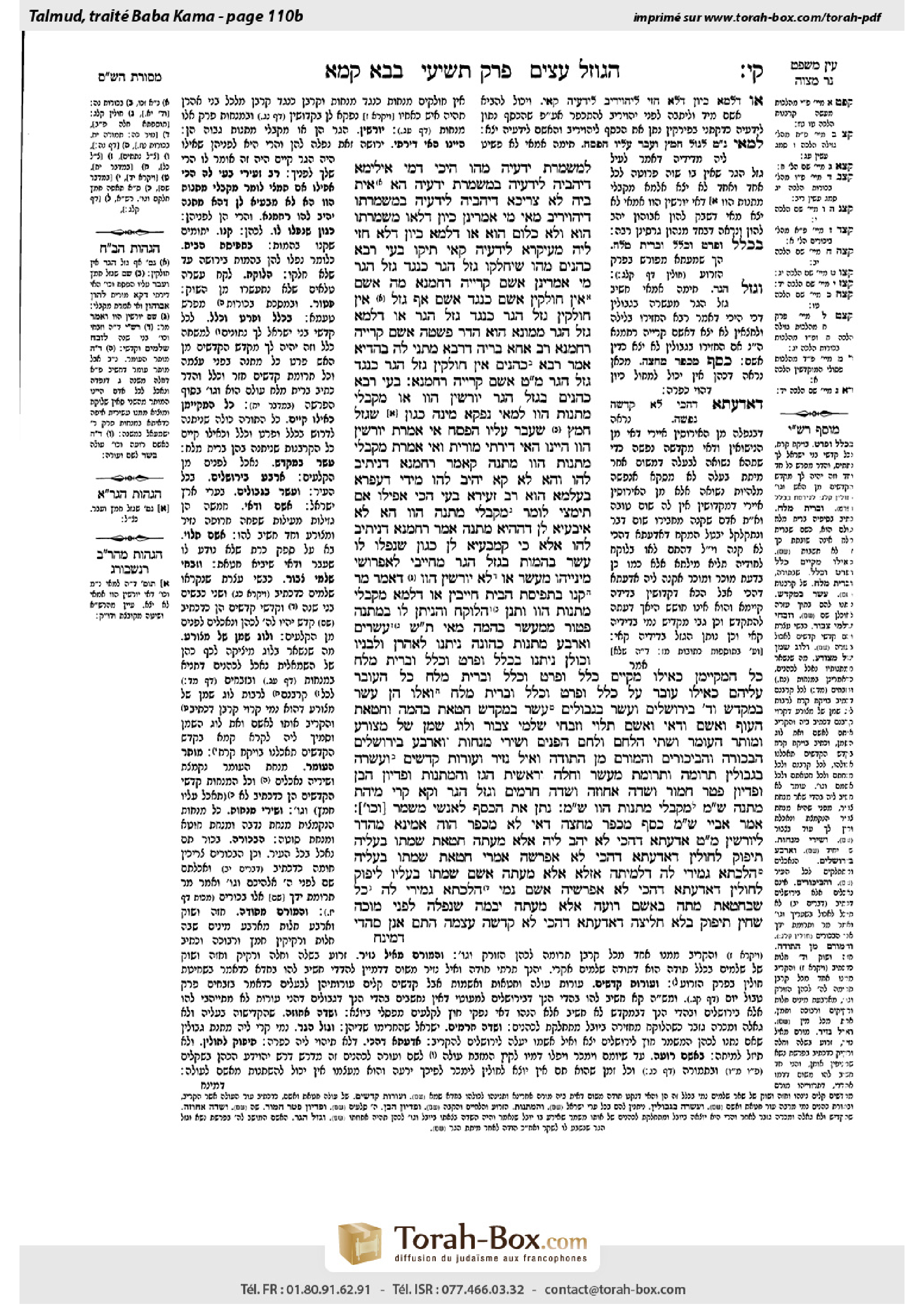
Bava Kamma 110b: Talmud study for Daf Yomi
Study the Talmud for Daf Yomi with scanned pages, Hebrew text, English translations from Sefaria and AI-generated French translations.
Passage selection and English or AI-generated French translation are available where the scan has annotations. Daf Study is independent of Torah-Box and Sefaria.
Browse Bava Kamma · בבא קמא · All tractatesBava Kamma 110b text and translations
This page of Bava Kamma includes the Aramaic text, an English translation and an AI-generated French translation, alongside the scan above.
בבא קמא ק״י ב · Aramaic and Hebrew text
לְמִשְׁמֶרֶת יְדַעְיָה, מַהוּ?
הֵיכִי דָמֵי? אִילֵּימָא דְּיַהֲבֵיהּ לִידַעְיָה בְּמִשְׁמֶרֶת יְדַעְיָה – הָא אִית בֵּיהּ!
לָא צְרִיכָא, דְּיַהֲבֵיהּ לִידַעְיָה בְּמִשְׁמַרְתּוֹ דִּיהוֹיָרִיב. מַאי? מִי אָמְרִינַן: כֵּיוָן דְּלָאו מִשְׁמַרְתּוֹ הוּא – וְלָא כְּלוּם הוּא; אוֹ דִלְמָא, כֵּיוָן דְּלָא חֲזֵי לֵיהּ מֵעִיקָּרָא – לִידַעְיָה קָאֵי? תֵּיקוּ.
בָּעֵי רָבָא: כֹּהֲנִים, מַהוּ שֶׁיַּחְלְקוּ גֶּזֶל הַגֵּר כְּנֶגֶד גֶּזֶל הַגֵּר?
מִי אָמְרִינַן: ״אָשָׁם״ קַרְיֵיהּ רַחֲמָנָא – מָה אָשָׁם אֵין חוֹלְקִין אָשָׁם כְּנֶגֶד אָשָׁם, אַף גֶּזֶל אֵין חוֹלְקִין גֶּזֶל הַגֵּר כְּנֶגֶד גֶּזֶל הַגֵּר; אוֹ דִּלְמָא, גֶּזֶל הַגֵּר מָמוֹנָא הוּא?
הֲדַר פַּשְׁטַהּ: ״אָשָׁם״ קַרְיֵיהּ רַחֲמָנָא. רַב אַחָא בְּרֵיהּ דְּרָבָא מַתְנֵי לַהּ בְּהֶדְיָא – אָמַר רָבָא: כֹּהֲנִים אֵין חוֹלְקִין גֶּזֶל הַגֵּר כְּנֶגֶד גֶּזֶל הַגֵּר. מַאי טַעְמָא? ״אָשָׁם״ קַרְיֵיהּ רַחֲמָנָא.
בָּעֵי רָבָא: כֹּהֲנִים בְּגֶזֶל הַגֵּר – יוֹרְשִׁין הָווּ, אוֹ מְקַבְּלֵי מַתָּנוֹת הָווּ?
לְמַאי נָפְקָא מִינַּהּ? כְּגוֹן שֶׁגָּזַל חָמֵץ שֶׁעָבַר עָלָיו הַפֶּסַח. אִי אָמְרַתְּ יוֹרְשִׁין הָווּ – הַיְינוּ הַאי דְּיָרְתִי מוֹרֵית. וְאִי אָמְרַתְּ מְקַבְּלֵי מַתָּנוֹת הָווּ – מַתָּנָה קָאָמַר רַחֲמָנָא דְּנִיתֵּיב לְהוּ, וְהָא לָא קָא יָהֵיב לְהוּ מִידֵּי – דְּעַפְרָא בְּעָלְמָא הוּא.
רַב זְעֵירָא בָּעֵי הָכִי: אֲפִילּוּ אִם תִּימְצֵי לוֹמַר מְקַבְּלֵי מַתָּנָה הָווּ, הָא – לָא אִיבַּעְיָא לַן, דְּהַהִיא מַתָּנָה אָמַר רַחֲמָנָא דְּנִיתֵּיב לְהוּ.
אֶלָּא כִּי קָמִבַּעְיָא לַן – כְּגוֹן שֶׁנָּפְלוּ לוֹ עֶשֶׂר בְּהֵמוֹת בְּגֶזֶל הַגֵּר. [מִי] מִחַיְּיבִי לְאַפְרוֹשֵׁי מִינַּיְיהוּ מַעֲשֵׂר, אוֹ לָא?
יוֹרְשִׁין הָווּ – דְּאָמַר מָר: קָנוּ בִּתְפִיסַת הַבַּיִת – חַיָּיבִין; אוֹ דִלְמָא מְקַבְּלֵי מַתָּנוֹת הָווּ – וּתְנַן: הַלּוֹקֵחַ וְהַנִּיתָּן לוֹ בְּמַתָּנָה – פָּטוּר מִמַּעְשַׂר בְּהֵמָה. מַאי?
תָּא שְׁמַע: עֶשְׂרִים וְאַרְבַּע מַתְּנוֹת כְּהוּנָּה נִיתְּנוּ לְאַהֲרֹן וּלְבָנָיו, וְכוּלָּן נִיתְּנוּ בִּכְלָל וּפְרָט וּכְלָל, וּבְרִית מֶלַח.
כׇּל הַמְקַיְּימָן – כְּאִילּוּ מְקַיֵּים כְּלָל וּפְרָט וּכְלָל וּבְרִית מֶלַח, כׇּל הָעוֹבֵר עֲלֵיהֶם – כְּאִילּוּ עוֹבֵר עַל כְּלָל וּפְרָט וּכְלָל וּבְרִית מֶלַח.
וְאֵלּוּ הֵן: עֶשֶׂר בַּמִּקְדָּשׁ, וְאַרְבַּע בִּירוּשָׁלַיִם, וְעֶשֶׂר בַּגְּבוּלִים. עֶשֶׂר בַּמִּקְדָּשׁ – חַטַּאת בְּהֵמָה, וְחַטַּאת הָעוֹף, וְאָשָׁם וַדַּאי, וְאָשָׁם תָּלוּי, וְזִבְחֵי שַׁלְמֵי צִבּוּר, וְלוֹג שֶׁמֶן שֶׁל מְצוֹרָע, וּמוֹתַר הָעוֹמֶר, וּשְׁתֵּי הַלֶּחֶם, וְלֶחֶם הַפָּנִים, וּשְׁיָרֵי מְנָחוֹת.
וְאַרְבַּע בִּירוּשָׁלַיִם – הַבְּכוֹרָה, וְהַבִּיכּוּרִים, וְהַמּוּרָם מִן הַתּוֹדָה וְאֵיל נָזִיר, וְעוֹרוֹת קֳדָשִׁים.
וַעֲשָׂרָה בַּגְּבוּלִין: תְּרוּמָה, וּתְרוּמַת מַעֲשֵׂר, וְחַלָּה, וְרֵאשִׁית הַגֵּז, וְהַמַּתָּנוֹת, וּפִדְיוֹן הַבֵּן, וּפִדְיוֹן פֶּטֶר חֲמוֹר, וּשְׂדֵה אֲחוּזָּה, וּשְׂדֵה חֲרָמִים, וְגֶזֶל הַגֵּר.
וְקָא קָרֵי מִיהַת ״מַתָּנָה״ – שְׁמַע מִינַּהּ מְקַבְּלֵי מַתָּנוֹת הָווּ! שְׁמַע מִינַּהּ.
נָתַן אֶת הַכֶּסֶף לְאַנְשֵׁי מִשְׁמָר [וְכוּ׳]. אָמַר אַבָּיֵי: שְׁמַע מִינַּהּ, כֶּסֶף מְכַפֵּר מֶחֱצָה. דְּאִי לָא מְכַפֵּר, הֲוָה אָמֵינָא: מַהְדַּר לְיוֹרְשִׁין. מַאי טַעְמָא? אַדַּעְתָּא דְּהָכִי לָא יְהַב לֵיהּ.
אֶלָּא מֵעַתָּה, חַטָּאת שֶׁמֵּתוּ בְּעָלֶיהָ תִּיפּוֹק לְחוּלִּין – דְּאַדַּעְתָּא דְּהָכִי לָא אַפְרְשַׁהּ! אָמְרִי: חַטָּאת שֶׁמֵּתוּ בְּעָלֶיהָ, הִלְכְתָא גְּמִירִי לַהּ דִּלְמִיתָה אָזְלָא.
אֶלָּא מֵעַתָּה, אָשָׁם שֶׁמֵּתוּ בְּעָלָיו לִיפּוֹק לְחוּלִּין – דְּאַדַּעְתָּא דְּהָכִי לָא אַפְרְשֵׁיהּ! אָשָׁם נָמֵי הִלְכְתָא גְּמִירִי לָהּ – כֹּל שֶׁבַּחַטָּאת מֵתָה, בְּאָשָׁם רוֹעֶה.
אֶלָּא מֵעַתָּה, יְבָמָה שֶׁנָּפְלָה לִפְנֵי מוּכֵּה שְׁחִין תִּיפּוֹק בְּלָא חֲלִיצָה, דְּאַדַּעְתָּא דְּהָכִי לֹא קִדְּשָׁה עַצְמָהּ! הָתָם אֲנַן סָהֲדִי
Bava Kamma 110b · English translation
the value of one peruta for each priest on the priestly watch of Jedaiah, which had fewer priests, what is the halakha?
The Gemara asks: What are the circumstances with regard to which Rava raised his dilemma? If we say that the dilemma is raised in a case where he gave the money to the priestly watch of Jedaiah, during the time of the Temple service of the priestly watch of Jedaiah, there would be no dilemma. There is in this payment enough value for each priest to receive one peruta.
The Gemara explains: No, it is necessary to raise the dilemma in a case where he gave it to the Jedaiah priestly watch during the time of the Temple service of the priestly watch of Joiarib; in that case, what is the halakha? The Gemara explains the two possibilities: Do we say that since it is not during Jedaiah’s priestly watch, it is nothing, i.e., it is not a fulfillment of the mitzva to return the stolen item? Or perhaps we say that since it was not fit for the Joiarib priestly watch, as it was of insufficient value, from the outset it stands ready for the Jedaiah priestly watch, and by giving it to them he fulfilled the mitzva? The Gemara comments: The question shall stand unresolved.
Rava raises another dilemma: With regard to priests, what is the halakha concerning whether they may divide among themselves the restitution for robbery of a convert, with some priests taking a larger share in exchange for taking a smaller share in the restitution for another robbery of a convert? In other words, can the priests arrange that one priest or several priests will receive the restitution for one robbery and another priest or several priests will receive the restitution for a different robbery another time?
He explains the two possibilities: Do we say that the Merciful One labeled the stolen item with the term “guilt,” and therefore, just as with a guilt-offering the priests may not divide portions of a guilt-offering, with some priests taking a larger share in exchange for taking a smaller share in other portions of a guilt-offering, but rather all priests of the watch share in the sacrificial flesh, so too with the restitution for robbery: The priests may not divide the restitution for robbery of a convert, with some priests taking a larger share in exchange for taking a smaller share in the restitution for another robbery of a convert? Or perhaps the restitution for robbery of a convert paid to priests is not in fact an offering, but it is monetary restitution, and monetary restitution may be divided in this manner among the priests?
Rava then resolves it himself: The Merciful One labeled the stolen item with the term “guilt,” so it may not be divided in this manner. Rav Aḥa, son of Rava, teaches it explicitly as a ruling, and not as a dilemma and solution, that Rava says: Priests may not divide the restitution for robbery of a convert with some priests taking a larger share in exchange for taking a smaller share in the restitution for another robbery of a convert. What is the reason? The Merciful One labeled the stolen item with the term “guilt.”
§ Rava raises a dilemma: What is the status of priests with regard to the restitution for robbery of a convert? Are they considered heirs of the convert or are they recipients of gifts?
The Gemara asks: What is the practical difference? The Gemara answers: The difference would be in a case where one robbed a convert of leavened bread, and then Passover elapsed over it, rendering it an item from which one is prohibited to derive benefit and therefore valueless. If you say that the priests are heirs, this is what they inherit: Only that which the robber bequeaths to them, and the priests receive the valueless leavened bread as is. And if you say that they are recipients of gifts, it is a gift that the Merciful One is saying that the robber should give to them, and this robber is not giving them anything, for it is merely dust. Therefore, the robber should have to pay the priests what the value of the bread had been at the time of the robbery.
Rav Zeira raises the dilemma like this: Even if you say that they are recipients of gifts, this question, i.e., whether a robber of leavened bread over which Passover then elapsed fulfills the mitzva to return the stolen item even in this devalued state, is not our dilemma, as this is certainly a fulfillment of the obligation. For this stolen item is the gift with regard to which the Merciful One states in the Torah that the robber should give it to the priests.
Rav Zeira continues: Rather, when we have a dilemma whether the priests are considered as heirs or as recipients of gifts, the practical difference arises in a case where ten animals came into the priest’s possession for payment of robbery of a convert. The dilemma is: Are they obligated to separate tithe from them, or not?
The Gemara explains the two possibilities: Perhaps they are heirs, in which case they will be obligated, for the Master said in a mishna (Bekhorot 56b) that if heirs acquired animals in the jointly held property of the estate, i.e., the heirs jointly owned the animals as the inheritance had yet to be divided, they are obligated to separate tithes from animals born to those animals, and the same will apply to the priests. Or perhaps they are recipients of gifts, and we learned in a mishna (Bekhorot 55b): One who purchases an animal or one who has an animal given to him as a gift is exempt from the obligation to separate the animal tithe, and the same will apply to the priests. What is the halakha in this case?
The Gemara answers: Come and hear a resolution to this dilemma from a baraita (Tosefta, Ḥalla 2:7–10): Twenty-four priestly gifts were given to Aaron and to his sons, and all of them were given with a derivation from a generalization, and a detail, and a generalization; and with a covenant of salt. The verses in the book of Numbers, chapter 18, detail the gifts of the priesthood. The first verse (18:8) is written in general terms, followed by verses listing the actual gifts (9–18), followed by a final verse written in general terms. The method of interpreting verses written in this manner is one of the thirteen hermeneutical principles. Additionally, the phrase: “Covenant of salt,” is written in the final verse (18:19), and is referring to all of the gifts of the priesthood.
This serves to teach that anyone who fulfills the mitzva of giving the gifts of the priesthood is considered as if he fulfills the entire Torah, which is interpreted using the principle of a generalization, and a detail, and a generalization; and as if he has brought all of the offerings, concerning which there is a covenant of salt. And anyone who violates the mitzva of giving the gifts of the priesthood is considered as if he violates the entire Torah, which is interpreted using the principle of a generalization, and a detail, and a generalization; and as if he has not brought all of the offerings, concerning which there is a covenant of salt.
The baraita continues: And these are the twenty-four gifts: There are ten in the Temple, and four in Jerusalem, and ten in the boundaries of Eretz Yisrael. The ten gifts that the priests consume only in the Temple are an animal sin-offering; and a bird sin-offering; and a definite guilt-offering; and a provisional guilt-offering; and communal peace-offerings, i.e., lambs offered on Shavuot; and a log of oil that accompanies the guilt-offering of a recovered leper; and the surplus of the omer, i.e., what remains of the measure of barley brought as a communal offering on the sixteenth of Nisan; and the two loaves, i.e., the public offering of two loaves from the new wheat offered on Shavuot; and the shewbread; and the leftovers of grain-offerings, after the priests have offered the required handful.
The baraita continues: And the four gifts that the priests consume anywhere in Jerusalem: The firstborn of kosher animals; and the first fruits; and the portions separated for the priests from the thanks-offering and the nazirite’s ram; and hides of consecrated animals.
The baraita continues: And ten gifts that the priests consume anywhere in the boundaries of Eretz Yisrael: Teruma, i.e., the portion of the produce designated for the priest; and teruma of the tithe, which the Levite separates from the tithe he receives and gives to a priest; and ḥalla, i.e., the portion of dough of the five main grains designated for the priest; and the first of the sheared wool; and the gifts of non-sacrificial, slaughtered animals, namely, the right foreleg, the cheeks, and the maw; and money given for the redemption of the firstborn son; and a sheep or goat given as redemption of the firstborn donkey; and a consecrated ancestral field the priests receive in the Jubilee Year; and a dedicated field; and payment for robbery of a convert who died without heirs.
The Gemara infers from the wording of the baraita: And this baraita, in any event, labels the payment for robbery of a convert a gift. The Gemara suggests: Conclude from this baraita that the priests who receive it are considered recipients of gifts, and not heirs. The Gemara affirms: Conclude from it that this is so.
§ The mishna teaches: If he gave the money to the members of the priestly watch and then died before they sacrificed his guilt-offering, the heirs cannot remove the money from the priests’ possession. Abaye said: Learn from this mishna that monetary restitution for the robbery atones for half of the sin, for if it does not atone at all, and atonement is not achieved until the guilt-offering is sacrificed, I would say that in the case of robbery of a convert, if the guilt-offering is not brought the priest returns the money to the robber’s heirs. What is the reason I would say this? Because he did not give the money to the priests with this intention of giving the money and not achieving atonement at all, and it would be a mistaken transaction.
The Gemara asks: If that is so, it would follow that a sin-offering whose owners have died, leaving no one to bring the offering, should be transferred to non-sacred status, as the robber did not separate the animal as an offering with this intention of its not being sacrificed to atone for his sin. The Sages say in response: In the case of a sin-offering whose owners have died, the Sages learned this halakha through tradition that the animal is left to die.
The Gemara asks: If that is so, a guilt-offering whose owner has died should be transferred to non-sacred status, as the owner did not separate the animal as an offering with this intention of it not being sacrificed to atone for his sin. The Gemara answers: With regard to a guilt-offering, the Sages also learned this halakha through tradition: Any occurrence that, if it occurs with regard to a sin-offering the animal is placed in isolation for it to die, if it occurs with regard to a guilt-offering the animal is left to graze until it develops a blemish precluding its use as an offering, at which point it can be redeemed.
The Gemara asks: If that is so, then in the case of a woman whose husband died childless [yevama], who happened before her late husband’s brother who was afflicted with boils to enter levirate marriage with him, should go out free to marry without being required to perform the ritual through which the yavam frees the yevama of her levirate bonds [ḥalitza]. For she did not betroth herself to this man’s deceased brother with this intention of having a levirate bond with a man afflicted with boils. The Gemara answers: There, it is clear to us
Bava Kamma 110b · Traduction française (IA)
la valeur d'un peruta pour chaque prêtre du service de Jédah, qui comptait moins de prêtres, quelle est la halakha ?
La Guemara pose la question : Quelles sont les circonstances dans lesquelles Rava a soulevé son dilemme ? Si nous disons que le dilemme est soulevé dans un cas où il a donné l'argent au service de Jédah, pendant le service du temple du service de Jédah, il n'y aurait pas de dilemme. Il y a dans ce paiement assez de valeur pour que chaque prêtre reçoive un peruta.
La Guemara explique : Non, il faut soulever le dilemme dans un cas où il a donné l'argent au service de Jédah pendant le service du temple du service de Joiarib ; dans ce cas, quelle est la halakha ? La Guemara explique les deux possibilités : Disons-nous que puisque ce n'est pas pendant le service de Jédah, c'est rien, c'est-à-dire qu'il ne s'agit pas d'une accomplissement de la mitsva de rendre l'objet volé ? Ou peut-être disons-nous que puisque cela n'était pas adapté au service de Joiarib, car il avait une valeur insuffisante, depuis le début il était prêt pour le service de Jédah, et en donnant l'argent à ceux-ci, il a accompli la mitsva ? La Guemara commente : La question restera sans réponse.
Rava soulève un autre dilemme : En ce qui concerne les prêtres, quelle est la halakha concernant le fait qu'ils puissent diviser entre eux la restitution d'un vol d'un converti, certains prêtres prenant une part plus grande en échange de prendre une part plus petite dans la restitution d'un autre vol d'un converti ? En d'autres termes, peuvent les prêtres organiser le fait qu'un prêtre ou plusieurs prêtres reçoivent la restitution d'un vol et un autre prêtre ou plusieurs prêtres reçoivent la restitution d'un autre vol à une autre occasion ?
Il explique les deux possibilités : Disons-nous que l'Éternel a marqué l'objet volé du terme « culpabilité », et donc, tout comme avec un sacrifice expiatoire les prêtres ne peuvent pas diviser les portions d'un sacrifice expiatoire, certains prêtres prenant une part plus grande en échange de prendre une part plus petite dans d'autres portions d'un sacrifice expiatoire, mais plutôt tous les prêtres du service partagent la chair du sacrifice, de même avec la restitution d'un vol : les prêtres ne peuvent pas diviser la restitution d'un vol d'un converti, certains prêtres prenant une part plus grande en échange de prendre une part plus petite dans la restitution d'un autre vol d'un converti ? Ou peut-être la restitution d'un vol d'un converti versée aux prêtres n'est pas en fait un sacrifice, mais une restitution monétaire, et la restitution monétaire peut être divisée ainsi parmi les prêtres ?
Rava résout alors lui-même ce dilemme : L'Éternel a marqué l'objet volé du terme « culpabilité », donc il ne peut pas être divisé ainsi. Rav Acha, fils de Rava, l'enseigne explicitement comme un jugement, et non comme un dilemme et une solution, que Rava dit : les prêtres ne peuvent pas diviser la restitution d'un vol d'un converti avec certains prêtres prenant une part plus grande en échange de prendre une part plus petite dans la restitution d'un autre vol d'un converti. Quelle est la raison ? L'Éternel a marqué l'objet volé du terme « culpabilité ».
§ Rava soulève un dilemme : Quel est le statut des prêtres concernant la restitution d'un vol commis contre un converti ? Sont-ils considérés comme des héritiers du converti ou comme des bénéficiaires de dons ?
La Guemara pose la question : Quelle est la différence pratique ? La Guemara répond : La différence serait dans le cas où l'on avait volé du pain aisé à un converti, et ensuite la Pâque était passée, rendant l'objet inutilisable et donc sans valeur. Si vous dites que les prêtres sont des héritiers, ce qu'ils héritent est seulement ce que le voleur leur a légué, et les prêtres reçoivent le pain aisé sans valeur. Et si vous dites qu'ils sont des bénéficiaires de dons, c'est un don que l'Éternel dit que le voleur doit leur donner, et ce voleur ne leur donne rien, car c'est seulement de la poussière. Donc le voleur devrait payer aux prêtres la valeur du pain au moment du vol.
Rav Zéira soulève le dilemme ainsi : Même si vous dites qu'ils sont des bénéficiaires de dons, cette question, c'est-à-dire si un voleur de pain aisé sur lequel la Pâque est passée accompli la mitsva de rendre l'objet volé même dans cet état déprécié, n'est pas notre dilemme, car cela est certainement un accomplissement de l'obligation. Car cet objet volé est le don concernant lequel l'Éternel dit dans la Torah que le voleur doit le donner aux prêtres.
Rav Zéira continue : Plutôt, lorsque nous avons un dilemme sur le fait que les prêtres sont considérés comme des héritiers ou comme des bénéficiaires de dons, la différence pratique surgit dans le cas où dix bêtes sont entrées en possession du prêtre pour le paiement du vol d'un converti. Le dilemme est : Sont-ils obligés de séparer la dîme, ou non ?
La Guemara explique les deux possibilités : Peut-être sont-ils des héritiers, dans ce cas ils seront obligés, car le Maître a dit dans une mitsva (Bekhorot 56b) que si des héritiers ont acquis des bêtes dans la propriété commune de l'héritage, c'est-à-dire que les héritiers possédaient ensemble les bêtes jusqu'à ce que l'héritage soit divisé, ils sont obligés de séparer la dîme des bêtes nées de ces bêtes, et de même les prêtres seront soumis à cette obligation. Ou peut-être sont-ils des bénéficiaires de dons, et nous avons appris dans une mitsva (Bekhorot 55b) : Celui qui achète une bête ou celui qui a une bête donnée à lui comme don est exempt de l'obligation de séparer la dîme de la bête, et de même les prêtres seront soumis à cette exemption. Quelle est la halakha dans ce cas ?
La Guemara répond : Viens écouter une résolution à ce dilemme tirée d'une baraïta (Tosefta, Ḥalla 2:7–10) : Vingt-quatre dons sacrés furent donnés à Aaron et à ses fils, et tous furent donnés à partir d'une généralisation, d'un détail et d'une généralisation ; et avec un pacte de sel. Les versets du livre des Nombres, chapitre 18, détaillent les dons du sacerdoce. Le premier verset (18:8) est écrit de manière générale, suivi de versets listant les dons réels (9–18), puis d'un dernier verset écrit de manière générale. La méthode d'interprétation des versets écrits ainsi est l'une des treize principes herméneutiques. De plus, la phrase : « Pacte de sel », est écrite dans le dernier verset (18:19), et fait référence à tous les dons du sacerdoce.
Cela sert à enseigner que celui qui accompli la mitsva de donner les dons du sacerdoce est considéré comme s'il accomplissait toute la Torah, qui est interprétée selon le principe de généralisation, de détail et de généralisation ; et comme s'il avait offert toutes les offrandes, concernant lesquelles il y a un pacte de sel. Et celui qui transgresse la mitsva de donner les dons du sacerdoce est considéré comme s'il transgresse toute la Torah, qui est interprétée selon le principe de généralisation, de détail et de généralisation ; et comme s'il n'avait pas offert toutes les offrandes, concernant lesquelles il y a un pacte de sel.
La baraïta continue : Et ces sont les vingt-quatre dons : Il y en a dix dans le Temple, quatre à Jérusalem, et dix dans les limites de la Terre d'Israël. Les dix dons que les prêtres consomment uniquement dans le Temple sont un sacrifice expiatoire d'animaux ; et un sacrifice expiatoire d'oiseaux ; et un sacrifice de culpabilité déterminé ; et un sacrifice de culpabilité provisoire ; et des offrandes de paix communautaires, c'est-à-dire des agnelles offertes pendant la fête des Pâques ; et un tonneau d'huile qui accompagne le sacrifice de culpabilité d'un lépreux guéri ; et le surplus de l'omer, c'est-à-dire ce qui reste de la mesure de blé offerte comme offrande communautaire le seizième du Nisan ; et les deux pains, c'est-à-dire l'offrande publique de deux pains de blé nouveau offerts pendant la fête des Pâques ; et le pain de proposition ; et les restes des offrandes de blé, après que les prêtres aient offert la quantité requise.
La baraïta continue : Et les quatre dons que les prêtres consomment partout à Jérusalem : Le premier-né des animaux kasher ; et les premiers fruits ; et les parts réservées aux prêtres des offrandes de remerciement et du bouc du nazir ; et les peaux des animaux consacrés.
La baraïta continue : Et les dix dons que les prêtres consomment partout dans les limites de la Terre d'Israël : La terouma, c'est-à-dire la part du produit désignée pour le prêtre ; et la terouma de la dîme, qui le lévite sépare de la dîme qu'il reçoit et donne à un prêtre ; et la ḥalla, c'est-à-dire la part de la pâte des cinq céréales principales désignée pour le prêtre ; et les premiers du laine tondue ; et les dons des animaux non sacrés, tués, à savoir le premier avant-train, les joues et la gueule ; et l'argent donné pour la rançon du premier-né ; et un agneau ou une chèvre donnée comme rançon du premier-bien de chameau ; et un champ ancestral consacré que les prêtres reçoivent dans l'année du Jubilé ; et un champ dédié ; et le paiement pour le vol d'un converti mort sans héritiers.
La Guemara déduit de la formulation de la baraïta : Et cette baraïta, en tout cas, désigne le paiement pour le vol d'un converti comme un don. La Guemara suggère : Conclure de cette baraïta que les prêtres qui reçoivent cela sont considérés comme des bénéficiaires de dons, et non comme des héritiers. La Guemara affirme : Conclure de cela que c'est ainsi.
§ La mitsna enseigne : Si l'on a donné l'argent aux membres de la garde sacerdotale et qu'on est mort avant qu'ils n'offrent son sacrifice de culpabilité, les héritiers ne peuvent pas retirer l'argent des mains des prêtres. Abaye dit : Apprendre de cette mitsna que la restitution monétaire pour le vol expie la moitié du péché, car si elle ne expie pas du tout, et que l'expiation n'est pas accomplie jusqu'à l'offrande de culpabilité est sacrée, je dirais que dans le cas du vol d'un converti, si l'offrande de culpabilité n'est pas offerte, le prêtre rend l'argent aux héritiers du voleur. Quelle est la raison pour laquelle je dirais cela ? Parce qu'il n'a pas donné l'argent aux prêtres avec l'intention de donner l'argent et de ne pas accomplir l'expiation du péché, et cela serait une transaction erronée.
La Guemara pose la question : Si c'est ainsi, il en suivrait que, dans le cas d'un sacrifice expiatoire dont les propriétaires sont morts, laissant personne pour offrir l'offrande, il devrait être transféré à un statut non sacré, car le voleur n'avait pas séparé l'animal comme offrande avec l'intention qu'il ne soit pas sacrifié pour expier son péché. Les Sages disent en réponse : Dans le cas d'un sacrifice expiatoire dont les propriétaires sont morts, les Sages ont appris cette halakha par tradition que l'animal est laissé mourir.
La Guemara pose la question : Si c'est ainsi, un sacrifice de culpabilité dont l'propriétaire est mort devrait être transféré à un statut non sacré, car l'propriétaire n'avait pas séparé l'animal comme offrande avec l'intention qu'il ne soit pas sacrifié pour expier son péché. La Guemara répond : En ce qui concerne un sacrifice de culpabilité, les Sages ont également appris cette halakha par tradition : Tout cas où, s'il se produit concernant un sacrifice expiatoire, l'animal est laissé en isolement pour mourir, si cela se produit concernant un sacrifice de culpabilité, l'animal est laissé paître jusqu'à ce qu'il développe une imperfection empêchant son utilisation comme offrande, à ce moment-là il peut être racheté.
La Guemara pose la question : Si c'est ainsi, alors dans le cas d'une femme dont l'époux est mort sans enfants [yevama], qui s'est produite avant son frère cadet atteint de maladies cutanées qui a entré en mariage levirat avec lui, elle devrait être libre pour se marier sans être tenue de faire la cérémonie par laquelle le yavam libère la yevama de ses liens levirats [ḥalitza]. Car elle n'avait pas contracté mariage avec ce homme décédé avec l'intention d'avoir un lien levirat avec un homme atteint de maladies cutanées. La Guemara répond : Là, nous savons clairement
Traduction française générée par IA à partir de l’édition anglaise de Sefaria. Vérifie toujours un passage avec le texte source.
Text from Sefaria: William Davidson Edition - Vocalized Aramaic (CC BY NC); William Davidson Edition - English (CC BY NC).