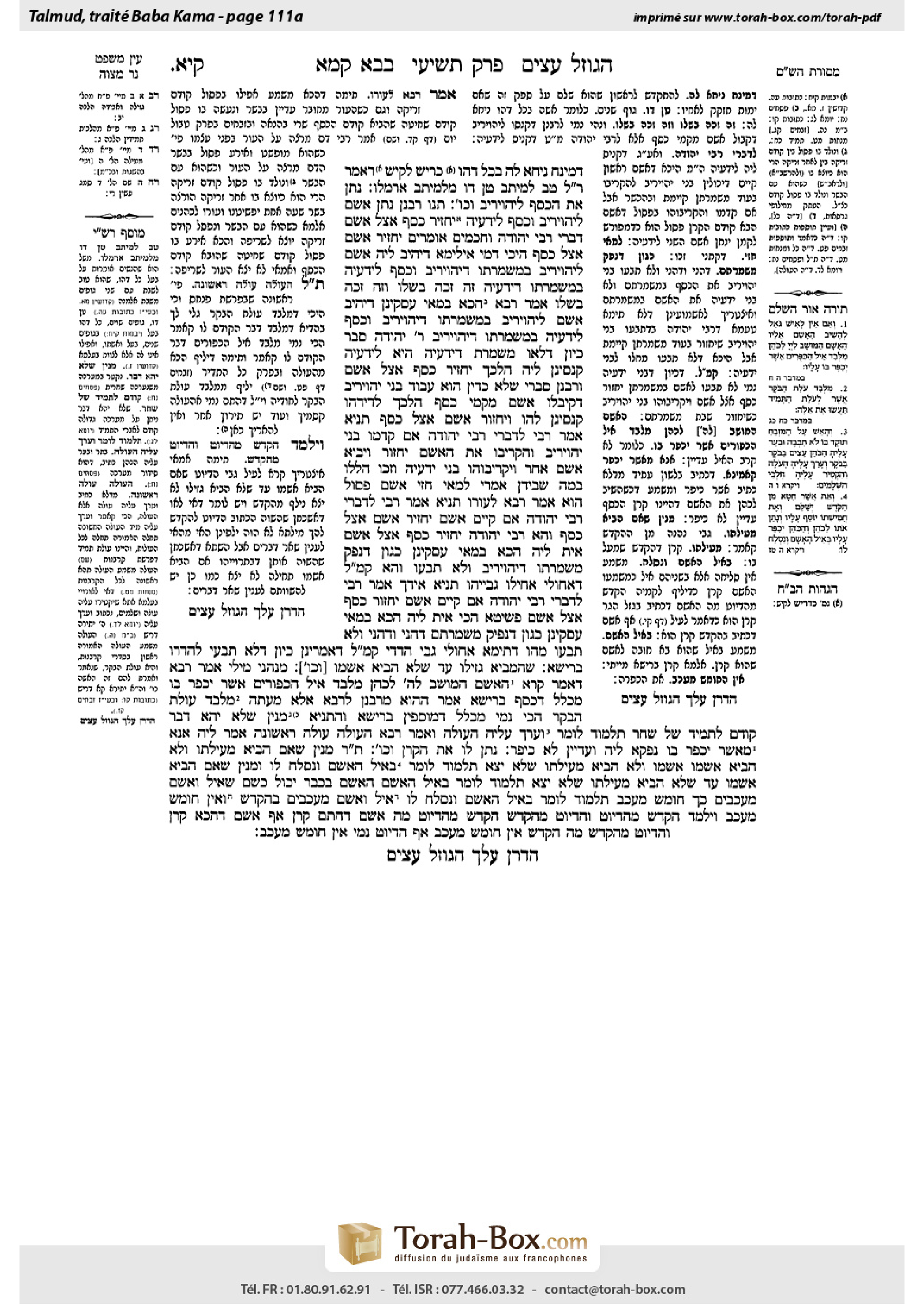
Bava Kamma 111a: Talmud study for Daf Yomi
Study the Talmud for Daf Yomi with scanned pages, Hebrew text, English translations from Sefaria and AI-generated French translations.
Passage selection and English or AI-generated French translation are available where the scan has annotations. Daf Study is independent of Torah-Box and Sefaria.
Browse Bava Kamma · בבא קמא · All tractatesBava Kamma 111a text and translations
This page of Bava Kamma includes the Aramaic text, an English translation and an AI-generated French translation, alongside the scan above.
בבא קמא קי״א א · Aramaic and Hebrew text
דְּמֵינָח נִיחָא לַהּ בְּכֹל דְּהוּ – כְּרֵישׁ לָקִישׁ, דְּאָמַר רֵישׁ לָקִישׁ: טָב לְמֵיתַב טַן דּוּ, מִלְּמֵיתַב אַרְמְלוּ.
נָתַן אֶת הַכֶּסֶף לִיהוֹיָרִיב וְכוּ׳. תָּנוּ רַבָּנַן: נָתַן אָשָׁם לִיהוֹיָרִיב וְכֶסֶף לִידַעְיָה – יַחֲזִיר כֶּסֶף אֵצֶל אָשָׁם, דִּבְרֵי רַבִּי יְהוּדָה. וַחֲכָמִים אוֹמְרִים: יַחֲזִיר אָשָׁם אֵצֶל כֶּסֶף.
הֵיכִי דָמֵי? אִילֵּימָא דְּיָהֵיב לֵיהּ אָשָׁם לִיהוֹיָרִיב בְּמִשְׁמַרְתּוֹ דִיהוֹיָרִיב, וְכֶסֶף לִידַעְיָה בְּמִשְׁמַרְתּוֹ דִידַעְיָה – זֶה זָכָה בְּשֶׁלּוֹ וְזֶה זָכָה בְּשֶׁלּוֹ!
אָמַר רָבָא: הָכָא בְּמַאי עָסְקִינַן – דְּיָהֵיב אָשָׁם לִיהוֹיָרִיב בְּמִשְׁמַרְתּוֹ דִיהוֹיָרִיב, וְכֶסֶף לִידַעְיָה בְּמִשְׁמַרְתּוֹ דִיהוֹיָרִיב. רַבִּי יְהוּדָה סָבַר: כֵּיוָן דְּלָאו מִשְׁמַרְתּ[וֹ] דִּידַעְיָה הִיא – לִידַעְיָה קָנְסִינַן לֵיהּ, הִלְכָּךְ יַחֲזִיר כֶּסֶף אֵצֶל אָשָׁם; וְרַבָּנַן סָבְרִי: שֶׁלֹּא כַּדִּין (הוּא) עֲבוּד בְּנֵי יְהוֹיָרִיב דְּקַיבִּלוּ אָשָׁם מִקַּמֵּי כֶסֶף, הִלְכָּךְ לְדִידְהוּ קָנְסִינַן לְהוּ, וְיַחְזוֹר אָשָׁם אֵצֶל כֶּסֶף.
תַּנְיָא, אָמַר רַבִּי: לְדִבְרֵי רַבִּי יְהוּדָה, אִם קָדְמוּ בְּנֵי יְהוֹיָרִיב וְהִקְרִיבוּ אֶת הָאָשָׁם – יַחְזוֹר וְיָבִיא אָשָׁם אַחֵר וְיַקְרִיבוּהוּ בְּנֵי יְדַעְיָה, וְזָכוּ הַלָּלוּ בְּמַה שֶּׁבְּיָדָן.
אָמְרִי: לְמַאי חֲזֵי? אָשָׁם פָּסוּל הוּא! אָמַר רָבָא: לְעוֹרוֹ.
תַּנְיָא, אָמַר רַבִּי: לְדִבְרֵי רַבִּי יְהוּדָה, אִם קַיָּים אָשָׁם – יַחֲזִיר אָשָׁם אֵצֶל כֶּסֶף.
וְהָא רַבִּי יְהוּדָה – יַחֲזִיר כֶּסֶף אֵצֶל אָשָׁם אִית לֵיהּ! הָכָא בְּמַאי עָסְקִינַן – כְּגוֹן דִּנְפַק מִשְׁמַרְתּוֹ דִיהוֹיָרִיב, וְלָא תְּבַעוּ. וְהָא קָא מַשְׁמַע לַן – דְּאַחוֹלֵי אַחִילוּ גַּבַּיְיהוּ.
תַּנְיָא אִידַּךְ, אָמַר רַבִּי: לְדִבְרֵי רַבִּי יְהוּדָה, אִם קַיָּים אָשָׁם – יַחְזוֹר כֶּסֶף אֵצֶל אָשָׁם. פְּשִׁיטָא – הָכִי אִית לֵיהּ!
הָכָא בְּמַאי עָסְקִינַן – כְּגוֹן דִּנְפַק מִשְׁמַרְתָּם דְּהָנֵי וּדְהָנֵי, וְלָא תְּבַעוּ. מַהוּ דְּתֵימָא אַחוֹלֵי גַּבֵּי הֲדָדֵי, קָא מַשְׁמַע לַן דְּאָמְרִינַן: כֵּיוָן דְּלָא תָּבְעִי, לִהְדְּרוּ בְּרֵישָׁא.
שֶׁהַמֵּבִיא גְּזֵילוֹ עַד שֶׁלֹּא הֵבִיא אֲשָׁמוֹ [וְכוּ׳]. מְנָהָנֵי מִילֵּי? אָמַר רָבָא, דְּאָמַר קְרָא: ״הָאָשָׁם הַמּוּשָׁב לַה׳ לַכֹּהֵן, מִלְּבַד אֵיל הַכִּפֻּרִים אֲשֶׁר יְכַפֶּר בּוֹ״ – מִכְּלָל דְּכֶסֶף בְּרֵישָׁא.
אָמַר הָהוּא מֵרַבָּנַן לְרָבָא: אֶלָּא מֵעַתָּה, ״מִלְּבַד עֹלַת הַבֹּקֶר״ – הָכִי נָמֵי מִכְּלָל דְּמוּסָפִין בְּרֵישָׁא?
וְהָתַנְיָא: מִנַּיִן שֶׁלֹּא יְהֵא דָּבָר קוֹדֵם לְתָמִיד שֶׁל שַׁחַר? תַּלְמוּד לוֹמַר: ״וְעָרַךְ עָלֶיהָ הָעֹלָה״, וְאָמַר רָבָא: ״הָעוֹלָה״ – עוֹלָה רִאשׁוֹנָה!
אֲמַר לֵיהּ: אֲנָא מֵ״אֲשֶׁר יְכַפֵּר בּוֹ״ נָפְקָא לֵיהּ, וַעֲדַיִין לֹא כִּיפֵּר.
נָתַן לוֹ אֶת הַקֶּרֶן וְכוּ׳. תָּנוּ רַבָּנַן: מִנַּיִן שֶׁאִם הֵבִיא מְעִילָתוֹ וְלֹא הֵבִיא אֲשָׁמוֹ; אֲשָׁמוֹ וְלֹא הֵבִיא מְעִילָתוֹ – שֶׁלֹּא יָצָא?
תַּלְמוּד לוֹמַר: ״בְּאֵיל הָאָשָׁם וְנִסְלַח לוֹ״.
וּמִנַּיִן שֶׁאִם הֵבִיא אֲשָׁמוֹ עַד שֶׁלֹּא הֵבִיא מְעִילָתוֹ, שֶׁלֹּא יָצָא? תַּלְמוּד לוֹמַר: ״בְּאֵיל הָאָשָׁם״ – הָאָשָׁם בִּכְבָר.
יָכוֹל כְּשֵׁם שֶׁאַיִל וְאָשָׁם מְעַכְּבִים, כָּךְ חוֹמֶשׁ מְעַכֵּב? תַּלְמוּד לוֹמַר: ״בְּאֵיל הָאָשָׁם וְנִסְלַח לוֹ״ – אַיִל וְאָשָׁם מְעַכְּבִים בְּהֶקְדֵּשׁ, וְאֵין חוֹמֶשׁ מְעַכֵּב.
וְיִלְמַד הֶקְדֵּשׁ מֵהֶדְיוֹט, וְהֶדְיוֹט מֵהֶקְדֵּשׁ.
הֶקְדֵּשׁ מֵהֶדְיוֹט – מָה ״אָשָׁם״ דְּהָתָם קֶרֶן, אַף ״אָשָׁם״ דְּהָכָא קֶרֶן. וְהֶדְיוֹט מֵהֶקְדֵּשׁ – מָה הֶקְדֵּשׁ אֵין חוֹמֶשׁ מְעַכֵּב, אַף הֶדְיוֹט נָמֵי אֵין חוֹמֶשׁ מְעַכֵּב.
הֲדַרַן עֲלָךְ הַגּוֹזֵל עֵצִים.
Bava Kamma 111a · English translation
that it is satisfactory for her to have any kind of marital arrangement, and even had she taken into consideration the possibility of entering a levirate bond with this yavam who is afflicted with boils she still would have accepted betrothal to her husband. This is in accordance with the statement of Reish Lakish, as Reish Lakish says that women have a saying: It is better to sit as two bodies [tan du], i.e., to be married, than to sit lonely like a widow.
§ The mishna teaches: If the robber gave the money to the priestly watch of Joiarib and then gave the guilt-offering to the priestly watch of Jedaiah, the following priestly watch, to sacrifice on his behalf, he has fulfilled his obligation. By contrast, if he first gave the guilt-offering to the priestly watch of Joiarib and then gave the money to the priestly watch of Jedaiah, if the guilt-offering is extant, then members of the priestly watch of Jedaiah, who received the money, should sacrifice it. The Gemara quotes a baraita that records a dispute between tanna’im concerning this case. The Sages taught (Tosefta 10:18): If the robber gave the guilt-offering to the priestly watch of Joiarib and then gave the money to the priestly watch of Jedaiah, they should return the money to be with the guilt-offering, i.e., with the priestly watch of Joiarib; this is the statement of Rabbi Yehuda. And the Rabbis say the opposite: They should return the guilt-offering to be with the money, and the priestly watch of Jedaiah will sacrifice it.
The Gemara asks: What are the circumstances of this dispute? If we say that he gave the guilt-offering to the priestly watch of Joiarib during the priestly watch of Joiarib and the money to the priestly watch of Jedaiah during the priestly watch of Jedaiah, then this one acquired that which belongs to it and that one acquired that which belongs to it. Why would the court remove what was given lawfully to the priestly watch?
Rava said: With what are we dealing here? We are dealing with a case where he gave the guilt-offering to the priestly watch of Joiarib during the priestly watch of Joiarib and the money to the priestly watch of Jedaiah also during the priestly watch of Joiarib, and the dispute is as follows: Rabbi Yehuda holds that since this is not the priestly watch of Jedaiah, we penalize Jedaiah; therefore, the priestly watch of Jedaiah must return the money in their possession to be with the guilt-offering held by the Joiarib watch. And the Rabbis hold that the members of the priestly watch of Joiarib acted unlawfully when they accepted the guilt-offering before the robber paid the money, since payment for the robbery must be given before the guilt-offering can be offered. Therefore, we penalize them, and the guilt-offering in their possession returns to be with the money held by the Jedaiah watch.
It is taught in a baraita on this topic (Tosefta 10:18): Rabbi Yehuda HaNasi says: According to the statement of Rabbi Yehuda, that if during the Joiarib watch the robber gave the guilt-offering to the Joiarib watch and the money to the Jedaiah watch, the money should return to the priestly watch of Joiarib, if the members of the priestly watch of Joiarib went first and sacrificed the guilt-offering before receiving the money from the priestly watch of Jedaiah, then the robber should go back and bring another guilt-offering, and the members of the priestly watch of Jedaiah, who are already in possession of the money, should offer it, and those members of the priestly watch of Joiarib acquired that offering that is in their possession.
The Sages say: For what purpose is that offering useful? It is a disqualified guilt-offering, since it was sacrificed before the payment for the robbery was given, and had to be entirely burned on the altar. Rava said: The baraita is referring to acquiring its hide, which the members of the priestly watch of Joiarib keep.
It is taught in a baraita that Rabbi Yehuda HaNasi says: According to the statement of Rabbi Yehuda, if the guilt-offering is still extant, i.e., if the priestly watch of Joiarib did not already sacrifice it, then the priestly watch of Joiarib should return the guilt-offering to be with the money, and the priestly watch of Jedaiah will sacrifice it.
The Gemara questions this: But Rabbi Yehuda holds that they should return the money to be with the guilt-offering. The Gemara explains: With what are we dealing here? With a case where it happened that the priestly watch of Joiarib exited at the close of their Temple service and they did not demand the money from the priestly watch of Jedaiah. And this statement of Rabbi Yehuda HaNasi teaches us this: That by doing so, the members of the priestly watch of Joiarib waived their rights to the money in favor of the priestly watch of Jedaiah. Consequently, they are required to give the guilt-offering to the priestly watch of Jedaiah to sacrifice.
It is taught in another baraita that Rabbi Yehuda HaNasi says: According to the statement of Rabbi Yehuda, if the guilt-offering is still extant, i.e., if the priestly watch of Joiarib did not already sacrifice it, the money must return to be with the guilt-offering. The Gemara asks: Isn’t that obvious? This is what Rabbi Yehuda holds explicitly; what novelty did Rabbi Yehuda HaNasi teach?
The Gemara explains: With what are we dealing here? With a case where it happened that the priestly watch of these and of those, i.e., both Joiarib and Jedaiah, exited at the end of their Temple service, and they did not demand of the other the item in possession of the other watch. Lest you say that they waived their rights in favor of each other, so that the money stays in possession of the Jedaiah watch, Rabbi Yehuda HaNasi teaches us that we say: Since the Jedaiah watch did not demand the guilt-offering from the Joiarib watch after the latter exited, let them go back to the first, standard scenario, returning the money to Joiarib to be with the guilt-offering.
§ The mishna teaches: For one who brings his stolen item to the priests before he brings his guilt-offering has fulfilled his obligation, but one who brings his guilt-offering before he brings his stolen item has not fulfilled his obligation. The Gemara asks: From where are these matters derived? Rava said: This is as the verse states: “But if the man has no kinsman to whom restitution may be made for the guilt, the restitution for guilt that is made shall be the Lord’s, even the priest’s; besides the ram of the atonement, whereby atonement shall be made for him” (Numbers 5:8). Learn by inference that the money must be returned first, before the guilt-offering is brought.
Having understood that the inference is that the wording “besides the ram of the atonement” indicates that the ram must be brought after the money is given, one of the Sages said to Rava: If that is so, then in a different verse, which states concerning the additional offerings sacrificed on the first day of Passover: “You shall offer these besides the burnt-offering of the morning, which is for a continual burnt-offering” (Numbers 28:23), so too should one learn by inference that the additional offerings are brought first, before the morning burnt-offering?
But isn’t it taught in a baraita: From where is it derived that no sacrifice shall precede the daily morning offering? The verse states: “And the fire on the altar shall be kept burning on it, it shall not be extinguished; and the priest shall kindle wood upon it every morning, and he shall prepare the burnt-offering upon it and shall cause the fats of the peace-offerings to go up in smoke upon it” (Leviticus 6:5). And Rava says: “The burnt-offering,” with the definite article, is referring to the first burnt-offering, i.e., the daily morning offering, which is first both chronologically and in terms of importance.
Rava said to him: I do not hold that the tanna derives this halakha from the wording of: “Besides the ram of the atonement,” but I hold that the tanna derives it from the phrase in the same verse: “Whereby atonement shall be made for him” (Numbers 5:8), which is written in the future tense, indicating that he will achieve atonement in the future by bringing the ram of atonement, but as of now, when he is giving payment for the robbery, the offering did not yet atone for his sin.
§ The mishna teaches: If he gave the principal to him but did not yet give the additional one-fifth payment, his not giving it does not preclude sacrificing the offering. The Gemara now clarifies the source of this halakha. The Sages taught in a baraita on the topic of the guilt-offering brought by one who misuses consecrated property, which is accompanied by repayment of the value of the item and an additional fifth of its value: From where is it derived that if he brought his payment for his benefit from misuse of consecrated property but did not bring his guilt-offering, or if he brought his guilt-offering but did not bring his payment for his benefit from misuse of consecrated property, that he did not fulfill his obligation?
The baraita continues: The verse states: “With the ram of the guilt-offering [ha’asham], and he shall be forgiven” (Leviticus 5:16). The baraita interprets the phrase: “The ram of the guilt-offering,” to be referring to two entities: The ram, i.e., the offering, and the payment, represented by the words “the guilt-offering”; this teaches that forgiveness and atonement are achieved only after both the ram of the guilt-offering is sacrificed and the restitution of the monetary payment is given.
The baraita continues: And from where is it derived that if he brought his guilt-offering before bringing his payment for his benefit from misuse of consecrated property that he did not fulfill his obligation? The verse states: “With the ram of the guilt-offering,” indicating that the guilt-offering was already brought.
The baraita continues: One might have thought that just as the ram and guilt-offering, i.e., payment, preclude his achieving atonement, so too, payment of the additional one-fifth of the value precludes his achieving it. Therefore, the verse states: “With the ram of the guilt-offering, and he shall be forgiven,” which teaches that the ram and guilt-offering, i.e., payment, preclude his achieving atonement with regard to consecrated property, but the payment of the additional one-fifth does not preclude his achieving it.
The Gemara clarifies: And let the halakha of misuse of consecrated property be learned from the halakha of common money, i.e., payment for robbery of a convert who died without heirs, and let the halakha of common money be learned from the halakha of misuse of consecrated property.
In what manner? The halakha of misuse of consecrated property can be learned from the halakha of common money as follows: Just as the word “guilt” that is written there, in the context of robbery of a convert, is referring to the principal, i.e., the payment itself, so too, the word “guilt” that is written here, in the context of misuse of consecrated property, is referring to the principal. And the halakha of common money can be learned from the halakha of misuse of consecrated property as follows: Just as with regard to the halakha of misuse of consecrated property the additional one-fifth payment does not preclude his achieving atonement, so too, with regard to the halakha of common money as well, the additional one-fifth payment does not preclude his achieving atonement.
Bava Kamma 111a · Traduction française (IA)
que ce soit satisfaisant pour elle d'avoir un arrangement marital de n'importe quel genre, et même si elle avait pris en considération la possibilité d'entrer en lien levirat avec ce yavam qui souffre de cloques, elle aurait tout de même accepté l'engagement avec son mari. Cela correspond à la déclaration de Reish Lakish, car Reish Lakish dit que les femmes disent : Il est préférable de s'asseoir comme deux corps [tan du], c'est-à-dire d'être mariées, plutôt que de s'asseoir seule comme une veuve.
§ La mitsva enseigne : Si le voleur a donné l'argent au groupe sacré de Joiarib et a ensuite donné l'offrande expiatoire au groupe sacré de Jedaiah, le groupe sacré suivant, qui doit sacrifier à sa place, a accompli son obligation. En revanche, si d'abord il a donné l'offrande expiatoire au groupe sacré de Joiarib et ensuite l'argent au groupe sacré de Jedaiah, et que l'offrande expiatoire existe, alors les membres du groupe sacré de Jedaiah, qui ont reçu l'argent, doivent le sacrifier. La Guemara cite une baraïta qui rapporte un débat entre les tannaïm concernant ce cas. Les Sages enseignent (Tosefta 10:18) : Si le voleur a donné l'offrande expiatoire au groupe sacré de Joiarib et ensuite l'argent au groupe sacré de Jedaiah, ils doivent rendre l'argent pour être avec l'offrande expiatoire, c'est-à-dire avec le groupe sacré de Joiarib ; c'est la déclaration de Rabbi Yehuda. Et les Rabbins disent le contraire : Ils doivent rendre l'offrande expiatoire pour être avec l'argent, et le groupe sacré de Jedaiah sacrifiera ce dernier.
La Guemara pose la question : Quelles sont les circonstances de ce débat ? Si nous disons qu'il a donné l'offrande expiatoire au groupe sacré de Joiarib pendant le groupe sacré de Joiarib et l'argent au groupe sacré de Jedaiah pendant le groupe sacré de Jedaiah, alors celui-ci a acquis ce qui lui appartient et celui-là a acquis ce qui lui appartient. Pourquoi alors la cour retire-t-elle ce qui a été légitimement donné au groupe sacré ?
Rava dit : Avec quels cas sommes-nous en train de traiter ? Nous traitons d'un cas où il a donné l'offrande de culpabilité au groupe sacré de Joiarib pendant le groupe sacré de Joiarib et l'argent au groupe sacré de Jedaiah également pendant le groupe sacré de Joiarib, et le débat est le suivant : Rabbi Yehuda considère que puisque ce n'est pas le groupe sacré de Jedaiah, nous pénalisons Jedaiah ; donc, le groupe sacré de Jedaiah doit rendre l'argent qu'il possède pour être avec l'offrande de culpabilité tenu par le groupe sacré de Joiarib. Et les Rabbins considèrent que les membres du groupe sacré de Joiarib ont agi illégalement en acceptant l'offrande de culpabilité avant que le voleur ne paie l'argent, car le paiement pour le vol doit être donné avant que l'offrande de culpabilité ne puisse être offerte. Ainsi, nous pénalisons eux, et l'offrande de culpabilité qu'ils possèdent retourne pour être avec l'argent tenu par le groupe sacré de Jedaiah.
Il est enseigné dans une baraïta sur ce sujet (Tosefta 10:18) : Rabbi Yehuda HaNasi dit : Selon la déclaration de Rabbi Yehuda, si pendant le groupe sacré de Joiarib le voleur a donné l'offrande de culpabilité au groupe sacré de Joiarib et l'argent au groupe sacré de Jedaiah, l'argent doit retourner au groupe sacré de Joiarib, si les membres du groupe sacré de Joiarib sont sortis d'abord et ont sacrifié l'offrande de culpabilité avant de recevoir l'argent du groupe sacré de Jedaiah, alors le voleur doit retourner et apporter une autre offrande de culpabilité, et les membres du groupe sacré de Jedaiah, qui sont déjà en possession de l'argent, doivent l'offrir, et ceux des membres du groupe sacré de Joiarib qui ont acquis cette offrande qui est en leur possession.
Les Sages disent : À quel usage cet offrande est-elle utile ? C'est une offrande de culpabilité inéligible, car elle a été sacrifiée avant que le paiement pour le vol ne soit donné, et devait être entièrement brûlée sur l'autel. Rava dit : La baraïta fait référence à l'acquisition de sa peau, que les membres du groupe sacré de Joiarib conservent.
Il est enseigné dans une baraïta que Rabbi Yehuda HaNasi dit : Selon la déclaration de Rabbi Yehuda, si l'offrande de culpabilité est encore intacte, c'est-à-dire si le groupe sacré de Joiarib n'a pas déjà sacrifié l'offrande de culpabilité, alors le groupe sacré de Joiarib doit rendre l'offrande de culpabilité pour être avec l'argent, et le groupe sacré de Jedaiah sacrifiera celle-ci.
La Guemara questionne cela : Mais Rabbi Yehuda considère qu'ils doivent rendre l'argent pour être avec l'offrande de culpabilité. La Guemara explique : Avec quels cas sommes-nous en train de traiter ? Avec un cas où il s'est produit que le groupe sacré de Joiarib est sorti à la fin de leur service du Temple et qu'ils n'ont pas demandé l'argent au groupe sacré de Jedaiah. Et cette déclaration de Rabbi Yehuda HaNasi nous enseigne cela : Que par cela, les membres du groupe sacré de Joiarib ont renoncé à leurs droits sur l'argent en faveur du groupe sacré de Jedaiah. Ainsi, ils sont tenus de donner l'offrande de culpabilité au groupe sacré de Jedaiah pour qu'il la sacrifie.
Il est enseigné dans une autre baraïta que Rabbi Yehuda HaNasi dit : Selon la déclaration de Rabbi Yehuda, si l'offrande de culpabilité est encore intacte, c'est-à-dire si le groupe sacré de Joiarib n'a pas déjà sacrifié l'offrande de culpabilité, l'argent doit retourner pour être avec l'offrande de culpabilité. La Guemara pose la question : N'est-ce pas évident ? C'est ce que Rabbi Yehuda considère explicitement ; quelle nouveauté Rabbi Yehuda HaNasi a-t-il enseigné ?
La Guemara explique : Avec quels cas sommes-nous en train de traiter ? Avec un cas où il s'est produit que les groupes sacrés de ces et de ceux, c'est-à-dire à la fois Joiarib et Jedaiah, sont sortis à la fin de leur service du Temple, et qu'ils n'ont pas demandé à l'autre l'objet en possession de l'autre groupe sacré. De peur que vous disiez qu'ils ont renoncé à leurs droits en faveur de l'autre, de sorte que l'argent reste en possession du groupe sacré de Jedaiah, Rabbi Yehuda HaNasi nous enseigne que nous disons : Puisque le groupe sacré de Jedaiah n'a pas demandé l'offrande de culpabilité au groupe sacré de Joiarib après que ce dernier est sorti, qu'ils retournent au scénario standard, rendant l'argent à Joiarib pour être avec l'offrande de culpabilité.
§ La Michna enseigne : Celui qui apporte son objet volé aux prêtres avant d'apporter son sacrifice de culpabilité a accompli son obligation, mais celui qui apporte son sacrifice de culpabilité avant d'apporter son objet volé n'a pas accompli son obligation. La Guemara pose la question : D'où sont-ils dérivés ces enseignements ? Rava dit : Cela est comme la Parashia qui dit : « Mais si l'homme n'a pas de parent à qui il puisse faire la restitution pour la culpabilité, la restitution de la culpabilité qui est faite sera du Seigneur, même du prêtre ; outre le bouc de l'expiation, par lequel l'expiation sera faite pour lui » (Nombres 5:8). Apprends par déduction que l'argent doit être rendu d'abord, avant que le sacrifice de culpabilité ne soit apporté.
Ayant compris que la déduction est que l'expression « outre le bouc de l'expiation » indique que le bouc doit être apporté après que l'argent ait été donné, l'un des Sages dit à Rava : Si c'est ainsi, alors dans une autre Parashia, qui parle des offrandes supplémentaires sacrifiées le premier jour de la Pessah : « Vous offrirez ces offrandes outre le holocauste du matin, qui est pour un holocauste continu » (Nombres 28:23), devrait-on aussi déduire par là que les offrandes supplémentaires sont apportées d'abord, avant le holocauste du matin ?
Mais n'est-ce pas enseigné dans une baraïta : D'où est-il dérivé que aucun sacrifice ne précède l'offrande matinale quotidienne ? La Parashia dit : « Et le feu sur l'autel doit être maintenu brûlant dessus, il ne doit pas s'éteindre ; et le prêtre doit allumer du bois dessus chaque matin, et il doit préparer le holocauste dessus et faire monter les graisses des offrandes de paix en fumée dessus » (Lévitique 6:5). Et Rava dit : « Le holocauste », avec l'article défini, fait référence au premier holocauste, c'est-à-dire l'offrande matinale quotidienne, qui est le premier à l'ordre du temps et en importance.
Rava dit à lui : Je ne considère pas que le tanna dérive cette halakha de l'expression « outre le bouc de l'expiation », mais je considère qu'il dérive cette halakha de la phrase dans la même parashia : « par lequel l'expiation sera faite pour lui » (Nombres 5:8), qui est écrite au futur, indiquant qu'il atteindra l'expiation à l'avenir en apportant le bouc de l'expiation, mais pour l'instant, lorsqu'il rend l'argent pour le vol, l'offrande n'a pas encore expié son péché.
§ La Michna enseigne : S'il a donné le principal à l'autre mais n'a pas encore donné le paiement supplémentaire de cinquième, son non-paiement ne bloque pas l'apport de l'offrande. La Guemara clarifie maintenant la source de cette halakha. Les Sages ont enseigné dans une baraïta sur le sujet de l'offrande de culpabilité apportée par celui qui abuser de la propriété consacrée, accompagnée du paiement de la valeur de l'objet et d'un cinquième supplémentaire de sa valeur : D'où est-il dérivé que si l'on a apporté son paiement pour son propre bénéfice à cause de l'abus de la propriété consacrée mais n'a pas apporté son offrande de culpabilité, ou si l'on a apporté son offrande de culpabilité mais n'a pas apporté son paiement pour son propre bénéfice à cause de l'abus de la propriété consacrée, il n'a pas accompli son obligation ?
La baraïta continue : La parashia dit : « Avec le bouc de l'offrande de culpabilité [ha'asham], et il sera pardonné » (Lévitique 5:16). La baraïta interprète la phrase : « Le bouc de l'offrande de culpabilité », pour faire référence à deux entités : Le bouc, c'est-à-dire l'offrande, et le paiement, représenté par les mots « l'offrande de culpabilité » ; cela enseigne que la grâce et l'expiation sont obtenues seulement après que le bouc de l'offrande de culpabilité ait été sacrifié et que le paiement monétaire ait été rendu.
La baraïta continue : Et d'où est-il dérivé que si l'on a apporté son sacrifice de culpabilité avant d'apporter son paiement pour son propre bénéfice à cause de l'abus de la propriété consacrée, il n'a pas accompli son obligation ? La Parashia dit : « Avec le bouc du sacrifice de culpabilité », indiquant que le sacrifice de culpabilité avait déjà été apporté.
La baraïta continue : On pourrait penser que justement comme le bouc et le sacrifice de culpabilité, c'est-à-dire le paiement, empêchent l'atteinte de l'expiation, ainsi aussi le paiement du cinquième supplémentaire empêche l'atteinte de l'expiation. Par conséquent, la Parashia dit : « Avec le bouc du sacrifice de culpabilité, et il sera pardonné », ce qui enseigne que le bouc et le sacrifice de culpabilité, c'est-à-dire le paiement, empêchent l'atteinte de l'expiation concernant la propriété consacrée, mais le paiement du cinquième supplémentaire ne l'empêche pas.
La Guemara clarifie : Et apprends la halakha de l'abus de la propriété consacrée de la halakha de l'argent commun, c'est-à-dire le paiement pour le vol d'un converti décédé sans héritiers, et apprends la halakha de l'argent commun de la halakha de l'abus de la propriété consacrée.
De quelle manière ? La halakha de l'abus de la propriété consacrée peut être apprise de la halakha de l'argent commun comme suit : Juste comme le mot « culpabilité » qui est écrit là, dans le contexte du vol d'un converti, fait référence au principal, c'est-à-dire au paiement lui-même, ainsi aussi le mot « culpabilité » qui est écrit ici, dans le contexte de l'abus de la propriété consacrée, fait référence au principal. Et la halakha de l'argent commun peut être apprise de la halakha de l'abus de la propriété consacrée comme suit : Juste comme concernant la halakha de l'abus de la propriété consacrée, le paiement du cinquième supplémentaire ne bloque pas l'atteinte de l'expiation, ainsi aussi concernant la halakha de l'argent commun, le paiement du cinquième supplémentaire ne bloque pas l'atteinte de l'expiation.
Traduction française générée par IA à partir de l’édition anglaise de Sefaria. Vérifie toujours un passage avec le texte source.
Text from Sefaria: William Davidson Edition - Vocalized Aramaic (CC BY NC); William Davidson Edition - English (CC BY NC).