Bava Kamma 111b: Talmud study for Daf Yomi
Study the Talmud for Daf Yomi with scanned pages, Hebrew text, English translations from Sefaria and AI-generated French translations.
Passage selection and English or AI-generated French translation are available where the scan has annotations. Daf Study is independent of Torah-Box and Sefaria.
Browse Bava Kamma · בבא קמא · All tractatesBava Kamma 111b text and translations
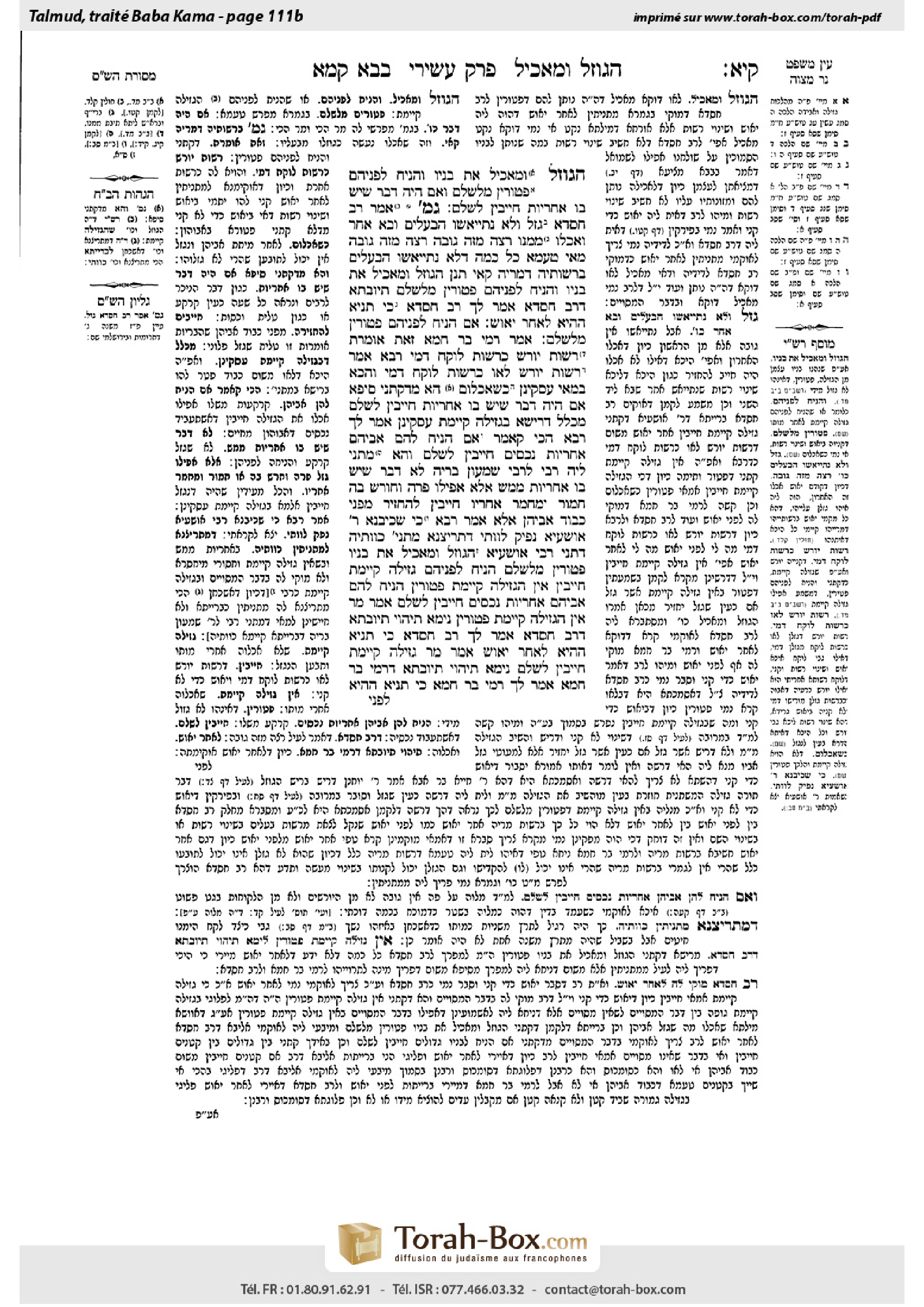
This page of Bava Kamma includes the Aramaic text, an English translation and an AI-generated French translation, alongside the scan above.
בבא קמא קי״א ב · Aramaic and Hebrew text
מַתְנִי׳ הַגּוֹזֵל וּמַאֲכִיל אֶת בָּנָיו, וְהִנִּיחַ לִפְנֵיהֶם – פְּטוּרִין מִלְּשַׁלֵּם. וְאִם הָיָה דָּבָר שֶׁיֵּשׁ בּוֹ אַחְרָיוּת – חַיָּיבִין לְשַׁלֵּם.
גְּמָ׳ אָמַר רַב חִסְדָּא: גָּזַל וְלֹא נִתְיָיאֲשׁוּ הַבְּעָלִים, וּבָא אַחֵר וַאֲכָלוֹ מִמֶּנּוּ – רָצָה מִזֶּה גּוֹבֶה, רָצָה מִזֶּה גּוֹבֶה. מַאי טַעְמָא? כֹּל כַּמָּה דְּלֹא נִתְיָיאֲשׁוּ הַבְּעָלִים – בִּרְשׁוּתֵיהּ דְּמָרֵיהּ קָאֵי.
תְּנַן: הַגּוֹזֵל וּמַאֲכִיל אֶת בָּנָיו, וְהִנִּיחַ לִפְנֵיהֶם – פְּטוּרִין מִלְּשַׁלֵּם. תְּיוּבְתָּא דְּרַב חִסְדָּא! אָמַר לְךָ רַב חִסְדָּא: כִּי תַּנְיָא הָהִיא – לְאַחַר יֵאוּשׁ.
אִם הִנִּיחַ לִפְנֵיהֶם – פְּטוּרִין מִלְּשַׁלֵּם. אָמַר רָמֵי בַּר חָמָא, זֹאת אוֹמֶרֶת: רְשׁוּת יוֹרֵשׁ כִּרְשׁוּת לוֹקֵחַ דָּמֵי.
רָבָא אָמַר: רְשׁוּת יוֹרֵשׁ לָאו כִּרְשׁוּת לוֹקֵחַ דָּמֵי, וְהָכָא בְּמַאי עָסְקִינַן – כְּשֶׁאֲכָלוּם.
הָא מִדְּקָתָנֵי סֵיפָא: אִם הָיָה דָּבָר שֶׁיֵּשׁ בּוֹ אַחְרָיוּת – חַיָּיבִין לְשַׁלֵּם, מִכְּלָל דְּרֵישָׁא בִּגְזֵילָה קַיֶּימֶת עָסְקִינַן! אָמַר לָךְ רָבָא, הָכִי קָאָמַר: אִם הִנִּיחַ לָהֶם אֲבִיהֶם אַחְרָיוּת נְכָסִים, חַיָּיבִין לְשַׁלֵּם.
וְהָא מַתְנֵי לֵיהּ רַבִּי לְרַבִּי שִׁמְעוֹן בְּרֵיהּ: לֹא דָּבָר שֶׁיֵּשׁ בּוֹ אַחְרָיוּת מַמָּשׁ; אֶלָּא אֲפִילּוּ פָּרָה וְחוֹרֵשׁ בָּהּ, חֲמוֹר וּמְחַמֵּר אַחֲרָיו – חַיָּיבִין לְהַחְזִיר, מִפְּנֵי כְּבוֹד אֲבִיהֶן.
אֶלָּא אָמַר רָבָא: כִּי שָׁכֵיבְנָא – רַבִּי אוֹשַׁעְיָא נָפֵיק לְווֹתִי, דְּתָרֵיצְנָא מַתְנִיתִין כְּווֹתֵיהּ. דְּתָנֵי רַבִּי אוֹשַׁעְיָא: הַגּוֹזֵל וּמַאֲכִיל אֶת בָּנָיו – פְּטוּרִין מִלְּשַׁלֵּם. הִנִּיחַ לִפְנֵיהֶם – גְּזֵילָה קַיֶּימֶת, חַיָּיבִין; אֵין הַגְּזֵילָה קַיֶּימֶת, פְּטוּרִין. הִנִּיחַ לָהֶם אֲבִיהֶם אַחְרָיוּת נְכָסִים – חַיָּיבִין לְשַׁלֵּם.
אָמַר מָר: אֵין הַגְּזֵילָה קַיֶּימֶת – פְּטוּרִין. נֵימָא תֶּיהְוֵי תְּיוּבְתָּא דְּרַב חִסְדָּא? אָמַר לָךְ רַב חִסְדָּא: כִּי תַּנְיָא הָהִיא – לְאַחַר יֵאוּשׁ.
אָמַר מָר: גְּזֵילָה קַיֶּימֶת – חַיָּיבִין לְשַׁלֵּם. נֵימָא תֶּיהְוֵי תְּיוּבְתָּא דְּרָמֵי בַּר חָמָא? אָמַר לָךְ רָמֵי בַּר חָמָא: כִּי תַּנְיָא הָהִיא –
Bava Kamma 111b · English translation
MISHNA: In the case of one who robs another of food and feeds it to his children, or who left a stolen item to them and then died, the children are exempt from paying the victim of the robbery after their father’s death. But if the stolen item was something that serves as a legal guarantee of a loan, the heirs are obligated to pay.
GEMARA: Rav Ḥisda says: If one robbed another, and the owners of the stolen item have not yet despaired of retrieving it, and another person came, took it from the robber and ate it, if the owner wishes he may collect from this one, i.e., the first robber, and if he wishes he may collect from that one, i.e., the second robber. What is the reason that he may collect from whomever he chooses? It is because as long as the owners did not despair of retrieving it, it remains the possession of its owner, so that when the second robber stole it from the first, he was in fact stealing from the original owner. Nevertheless, since the first robber was already obligated to return the item, his obligation remains in force and the owner may demand payment from him if he wishes.
The Gemara questions this opinion based on what we learned in the mishna: In the case of one who robs another of food and feeds it to his children, or one who left a stolen item to them as an inheritance, the children are exempt from paying the victim of the robbery after their father’s death. This appears to be a conclusive refutation of the opinion of Rav Ḥisda, who holds that one who steals from a thief is obligated to pay the owner. The Gemara answers: Rav Ḥisda could have said to you: When that mishna is taught, it is addressing a case where it is after the owners had already despaired of retrieving the item, whereas Rav Ḥisda was referring to a case where the owners had not yet despaired.
§ The mishna stated that if one left a stolen item to his children as an inheritance, the children are exempt from paying the owner. Rami bar Ḥama said: That is to say that the domain of an heir is comparable to the domain of a purchaser. Just as an item that is purchased leaves the domain of the seller, an item that is inherited leaves the domain of the deceased and is considered the property of the heir. Since the owner has despaired of retrieving the item and the item has changed domains, it is entirely the property of the new owner, and he is exempt from payment.
Rava disagreed and said that the domain of an heir is not comparable to the domain of a purchaser. Consequently, the item has not undergone a complete change of ownership and the heir would be required to return it. And as for the explanation of the mishna, here we are dealing with a case where they had already consumed the stolen goods, so there is nothing to return to the owner.
The Gemara questions the opinion of Rava: From the fact that the latter clause teaches: If it was something that serves as a legal guarantee, and is, therefore, an existing commodity, the heirs are obligated to pay, it may be inferred that in the first clause we are also dealing with a stolen item that is extant. This is contrary to Rava’s statement that the mishna is discussing stolen goods that have been consumed. The Gemara answers: Rava could have said to you that this is what the mishna is saying: If their father left them guaranteed property, i.e., land, they are obligated to pay from that property, even if the stolen item is not extant.
The Gemara asks: But didn’t Rabbi Yehuda HaNasi teach Rabbi Shimon, his son, that this mishna is not referring only to something that may actually serve as a legal guarantee, i.e., land? Rather, it is referring even to a cow that he plows with, or a donkey that he drives by directing it from behind, which the heirs are obligated to return because of the honor of their father. This indicates that the mishna is referring to stolen property that is extant, and not to land.
Rather, Rava said: When I die, Rabbi Oshaya will come toward me from his place in heaven in order to greet me, as I explain the mishna in accordance with his opinion and thereby honor him. As Rabbi Oshaya taught in a baraita: In a case of one who robs another and feeds the stolen goods to his children, the latter are exempt from paying the owner. If he left a stolen item to them as an inheritance, if the stolen item is extant, the heirs are obligated to return it to the owner; if it is not extant, they are exempt. If their father left them guaranteed property, i.e., land, they are obligated to pay the owner. Rava explains the mishna as being consistent with the baraita of Rabbi Oshaya, although this explanation is not consistent with Rabbi Yehuda HaNasi’s interpretation.
The Gemara analyzes the baraita of Rabbi Oshaya. The Master said in the baraita that if the stolen item is not extant, the heirs are exempt from payment. Let us say that this baraita is a conclusive refutation of the opinion of Rav Ḥisda, who says that heirs are obligated to pay for stolen goods that they consumed. The Gemara answers: Rav Ḥisda could have said to you that when that baraita is taught, it is referring to a case where it is after the owners had already despaired of retrieving the item, whereas Rav Ḥisda was referring to a case in which the owners had not yet despaired.
The Gemara continues: The Master said in the baraita that if the stolen item is extant, the heirs are obligated to pay. Let us say that this baraita is a conclusive refutation of the opinion of Rami bar Ḥama, since according to his understanding, the heirs should be exempt from payment because the stolen item is considered to have changed ownership when they inherited it. The Gemara answers: Rami bar Ḥama could have said to you that when that baraita is taught,
Bava Kamma 111b · Traduction française (IA)
MICHNA : Dans le cas d'une personne qui vole de la nourriture à un autre et la donne à ses enfants, ou qui laisse un objet volé à ses enfants et meurt ensuite, les enfants sont dispensés de payer la victime du vol après la mort de leur père. Mais si l'objet volé était quelque chose qui servait de garantie juridique pour un prêt, les héritiers sont tenus de payer.
GUEMARA : Rav Ḥisda dit : Si une personne vole à une autre, et que les propriétaires de l'objet volé n'ont pas encore désespéré de le récupérer, et qu'une autre personne arrive, le prend de la part du voleur et le mange, si le propriétaire le souhaite, il peut récupérer auprès de celui-ci, c'est-à-dire le premier voleur, et si il le souhaite, il peut récupérer auprès de celui-là, c'est-à-dire le second voleur. Pourquoi peut-il récupérer auprès de qui il le souhaite ? C'est parce que tant que les propriétaires n'ont pas désespéré de récupérer l'objet, il reste la propriété de son propriétaire, de sorte que lorsque le second voleur l'a volé au premier, il a en réalité volé au propriétaire original. Cependant, puisque le premier voleur était déjà tenu de rendre l'objet, son obligation reste en vigueur et le propriétaire peut exiger le paiement auprès de lui s'il le souhaite.
La Guemara questionne cet avis en se basant sur ce que nous avons appris dans la mishna : Dans le cas d'une personne qui vole de la nourriture à un autre et la donne à ses enfants, ou qui laisse un objet volé à ses enfants en héritage, les enfants sont dispensés de payer la victime du vol après la mort de leur père. Cela semble être une réfutation concluante de l'opinion de Rav Ḥisda, qui considère que celui qui vole à un voleur est tenu de payer au propriétaire. La Guemara répond : Rav Ḥisda aurait pu dire à vous : Lorsque cette mishna est enseignée, elle s'adresse à un cas où les propriétaires avaient déjà désespéré de récupérer l'objet, alors que Rav Ḥisda faisait référence à un cas où les propriétaires n'avaient pas encore désespéré.
§ La mishna indique que si une personne laisse un objet volé à ses enfants en héritage, les enfants sont dispensés de payer au propriétaire. Rami bar Ḥama a dit : Cela signifie que le domaine d'un héritier est comparable à celui d'un acheteur. Tout comme un objet acheté quitte le domaine du vendeur, un objet hérité quitte le domaine du défunt et est considéré comme la propriété de l'héritier. Puisque le propriétaire a désespéré de récupérer l'objet et que l'objet a changé de domaine, il est entièrement la propriété du nouveau propriétaire, et il est dispensé de paiement.
Rava s'est opposé et a dit que le domaine d'un héritier n'est pas comparable à celui d'un acheteur. Par conséquent, l'objet n'a pas subi un changement complet de propriété et l'héritier serait tenu de le rendre. Et concernant l'explication de la mishna, ici nous sommes dans un cas où ils ont déjà consommé les biens volés, donc il n'y a rien à rendre au propriétaire.
La Guemara questionne l'opinion de Rava : D'après le fait que la clause ultérieure enseigne : Si c'était quelque chose qui servait de garantie juridique et était donc un bien existant, les héritiers sont tenus de payer, on peut en déduire que dans la première clause nous sommes également dans un cas d'objet volé existant. Cela contredit l'affirmation de Rava selon laquelle la mishna discute de biens volés consommés. La Guemara répond : Rava aurait pu dire à vous que c'est ce que la mishna dit : Si leur père leur a laissé une propriété garantie, c'est-à-dire une terre, ils sont tenus de payer à partir de cette propriété, même si l'objet volé n'existe pas.
La Guemara pose la question : Mais n’a-t-il pas enseigné Rabbi Yehuda HaNasi à Rabbi Shimon, son fils, que cette Michna ne fait pas référence uniquement à quelque chose qui peut effectivement servir de garantie juridique, c’est-à-dire la terre ? Mais plutôt, elle fait référence même à une vache qu’il utilise pour labourer, ou un âne qu’il conduit en le dirigeant depuis l’arrière, dont les héritiers sont obligés de le rendre en raison de l’honneur de leur père. Cela indique que la Michna fait référence à un bien volé existant, et non à la terre.
Plutôt, Rava a dit : Lorsque je mourrai, Rabbi Oshaya viendra vers moi depuis son lieu au ciel pour me saluer, car je explique la Michna selon son opinion et honore ainsi lui. Comme Rabbi Oshaya a enseigné dans une baraïta : Dans le cas d’une personne qui vole à une autre et nourrit les biens volés à ses enfants, les derniers sont dispensés de payer au propriétaire. Si il a laissé un objet volé à ses enfants en héritage, si l’objet volé existe, les héritiers sont obligés de le rendre au propriétaire ; si il n’existe pas, ils sont dispensés. Si leur père leur a laissé une propriété garantie, c’est-à-dire une terre, ils sont obligés de payer au propriétaire. Rava explique la Michna comme étant cohérente avec la baraïta de Rabbi Oshaya, bien que cette explication ne soit pas cohérente avec l’interprétation de Rabbi Yehuda HaNasi.
La Guemara analyse la baraïta de Rabbi Oshaya. Le Maître a dit dans la baraïta que si l’objet volé n’existe pas, les héritiers sont dispensés de paiement. Disons que cette baraïta est une réfutation concluante de l’opinion de Rav Ḥisda, qui dit que les héritiers sont obligés de payer pour les biens volés qu’ils ont consommés. La Guemara répond : Rav Ḥisda aurait pu dire à vous que lorsque cette baraïta est enseignée, elle fait référence à un cas où les propriétaires avaient déjà désespéré de récupérer l’objet, alors que Rav Ḥisda faisait référence à un cas où les propriétaires n’avaient pas encore désespéré.
La Guemara continue : Le Maître a dit dans la baraïta que si l'objet volé existe, les héritiers sont tenus de payer. Disons que cette baraïta est une réfutation concluante de l'opinion de Rami bar Ḥama, puisque selon son interprétation, les héritiers devraient être dispensés de paiement car l'objet volé est considéré comme ayant changé de propriété lorsqu'ils l'ont hérité. La Guemara répond : Rami bar Ḥama aurait pu dire à vous que lorsque cette baraïta est enseignée,
Traduction française générée par IA à partir de l’édition anglaise de Sefaria. Vérifie toujours un passage avec le texte source.
Text from Sefaria: William Davidson Edition - Vocalized Aramaic (CC BY NC); William Davidson Edition - English (CC BY NC).