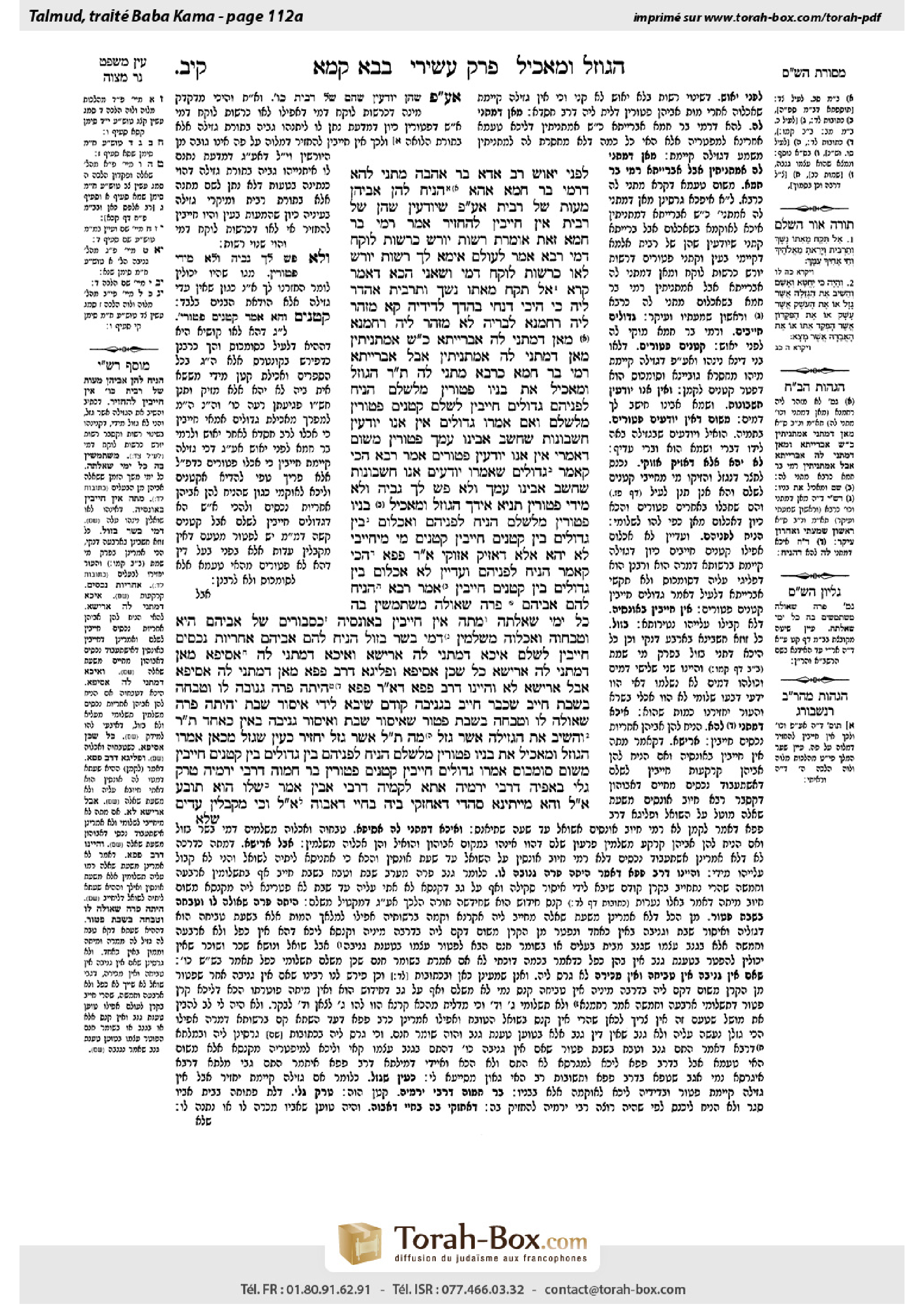
Bava Kamma 112a: Talmud study for Daf Yomi
Study the Talmud for Daf Yomi with scanned pages, Hebrew text, English translations from Sefaria and AI-generated French translations.
Passage selection and English or AI-generated French translation are available where the scan has annotations. Daf Study is independent of Torah-Box and Sefaria.
Browse Bava Kamma · בבא קמא · All tractatesBava Kamma 112a text and translations
This page of Bava Kamma includes the Aramaic text, an English translation and an AI-generated French translation, alongside the scan above.
בבא קמא קי״ב א · Aramaic and Hebrew text
לִפְנֵי יֵאוּשׁ.
רַב אַדָּא בַּר אַהֲבָה מַתְנֵי לְהָא דְּרָמֵי בַּר חָמָא אַהָא: הִנִּיחַ לָהֶן אֲבִיהֶן מָעוֹת שֶׁל רִבִּית, אַף עַל פִּי שֶׁיּוֹדְעִין שֶׁהֵן שֶׁל רִבִּית – אֵין חַיָּיבִין לְהַחְזִיר. אָמַר רָמֵי בַּר חָמָא, זֹאת אוֹמֶרֶת: רְשׁוּת יוֹרֵשׁ כִּרְשׁוּת לוֹקֵחַ דָּמֵי.
רָבָא אָמַר: לְעוֹלָם אֵימָא לָךְ רְשׁוּת יוֹרֵשׁ לָאו כִּרְשׁוּת לוֹקֵחַ דָּמֵי, וְשָׁאנֵי הָכָא דְּאָמַר קְרָא: ״אַל תִּקַּח מֵאִתּוֹ נֶשֶׁךְ וְתַרְבִּית״ – אַהְדַּר לֵיהּ, כִּי הֵיכִי דְּנֵחֵי בַּהֲדָךְ; לְדִידֵיהּ קָא מַזְהַר לֵיהּ רַחֲמָנָא, לִבְרֵיהּ לָא מַזְהַר לֵיהּ רַחֲמָנָא.
מַאן דְּמַתְנֵי לַהּ אַבָּרַיְיתָא – כׇּל שֶׁכֵּן אַמַּתְנִיתִין. מַאן דְּמַתְנֵי לַהּ אַמַּתְנִיתִין – אֲבָל אַבָּרַיְיתָא, רָמֵי בַּר חָמָא כְּרָבָא מַתְנֵי לַהּ.
תָּנוּ רַבָּנַן: הַגּוֹזֵל וּמַאֲכִיל אֶת בָּנָיו – פְּטוּרִין מִלְּשַׁלֵּם. הִנִּיחַ לִפְנֵיהֶם – גְּדוֹלִים, חַיָּיבִין לְשַׁלֵּם; קְטַנִּים, פְּטוּרִין מִלְּשַׁלֵּם. וְאִם אָמְרוּ גְּדוֹלִים: אֵין אָנוּ יוֹדְעִין חֶשְׁבּוֹנוֹת שֶׁחִשֵּׁב אָבִינוּ עִמָּךְ – פְּטוּרִין.
מִשּׁוּם דְּאָמְרִי: ״אֵין אָנוּ יוֹדְעִין״ – פְּטוּרִים?! אָמַר רָבָא: הָכִי קָאָמַר, גְּדוֹלִים שֶׁאָמְרוּ: יוֹדְעִים אָנוּ חֶשְׁבּוֹנוֹת שֶׁחִשֵּׁב אָבִינוּ עִמָּךְ, וְלָא פָּשׁ לָךְ גַּבֵּיהּ וְלָא מִידֵּי – פְּטוּרִין.
תַּנְיָא אִידַּךְ: הַגּוֹזֵל וּמַאֲכִיל בָּנָיו – פְּטוּרִין מִלְּשַׁלֵּם. הִנִּיחַ לִפְנֵיהֶם וַאֲכָלוּם – בֵּין גְּדוֹלִים בֵּין קְטַנִּים, חַיָּיבִין. קְטַנִּים מִי מִיחַיְּיבִי?! לֹא יְהֵא אֶלָּא דְּאַזֵּיק אַזּוֹקֵי! אָמַר רַב פָּפָּא, הָכִי קָאָמַר: הִנִּיחַ לִפְנֵיהֶם וַעֲדַיִין לֹא אֲכָלוּם – בֵּין גְּדוֹלִים בֵּין קְטַנִּים, חַיָּיבִין.
אָמַר רָבָא: הִנִּיחַ לָהֶם אֲבִיהֶם פָּרָה שְׁאוּלָה – מִשְׁתַּמְּשִׁין בָּהּ כׇּל יְמֵי שְׁאֵלָתָהּ. מֵתָה – אֵין חַיָּיבִין בְּאוֹנְסֶיהָ. כִּסְבוּרִים שֶׁל אֲבִיהֶם הִיא, וּטְבָחוּהָ וַאֲכָלוּהָ – מְשַׁלְּמִין דְּמֵי בָשָׂר בְּזוֹל. הִנִּיחַ לָהֶם אֲבִיהֶם אַחְרָיוּת נְכָסִים – חַיָּיבִין לְשַׁלֵּם.
אִיכָּא דְּמַתְנֵי לַהּ אַרֵישָׁא, וְאִיכָּא דְּמַתְנֵי לַהּ אַסֵּיפָא.
מַאן דְּמַתְנֵי לַהּ אַרֵישָׁא – כׇּל שֶׁכֵּן אַסֵּיפָא, וּפְלִיגָא דְּרַב פָּפָּא. מַאן דְּמַתְנֵי לַהּ אַסֵּיפָא – אֲבָל אַרֵישָׁא לָא, וְהַיְינוּ דְּרַב פָּפָּא.
דְּאָמַר רַב פָּפָּא: הָיְתָה פָּרָה גְּנוּבָה לוֹ, וּטְבָחָהּ בְּשַׁבָּת – חַיָּיב; שֶׁכְּבָר חַיָּיב בִּגְנֵיבָה, קוֹדֶם שֶׁיָּבֹא לִידֵי אִיסּוּר שַׁבָּת. הָיְתָה פָּרָה שְׁאוּלָה לוֹ, וּטְבָחָהּ בְּשַׁבָּת – פָּטוּר; שֶׁאִיסּוּר שַׁבָּת וְאִיסּוּר גְּנֵיבָה בָּאִין כְּאֶחָד.
תָּנוּ רַבָּנַן: ״וְהֵשִׁיב אֶת הַגְּזֵילָה אֲשֶׁר גָּזָל״; מָה תַּלְמוּד לוֹמַר ״אֲשֶׁר גָּזָל״? יַחֲזִיר כְּעֵין שֶׁגָּזַל.
מִכָּאן אָמְרוּ: הַגּוֹזֵל וּמַאֲכִיל אֶת בָּנָיו – פְּטוּרִין מִלְּשַׁלֵּם. הִנִּיחַ לִפְנֵיהֶן – בֵּין גְּדוֹלִים בֵּין קְטַנִּים, חַיָּיבִין. מִשּׁוּם סוֹמְכוֹס אָמְרוּ: גְּדוֹלִים חַיָּיבִין, קְטַנִּים פְּטוּרִין.
בַּר חֲמוּהּ דְּרַבִּי יִרְמְיָה טְרַק גַּלָּא בְּאַפֵּיהּ דְּרַבִּי יִרְמְיָה. אֲתָא לְקַמֵּיהּ דְּרַבִּי אָבִין,
אָמַר: שֶׁלּוֹ הוּא תּוֹבֵעַ. אֲמַר לֵיהּ: וְהָא מַיְיתִינָא סָהֲדִי דְּאַחְזַקִי בֵּיהּ בְּחַיֵּי דַּאֲבוּהּ! אֲמַר לֵיהּ: וְכִי מְקַבְּלִין עֵדִים
Bava Kamma 112a · English translation
it is referring to a case where it is before the owners have despaired of retrieving their property. Consequently, the heirs have not acquired the stolen property, and it must be returned.
Rav Adda bar Ahava teaches that statement of Rami bar Ḥama cited above with regard to this baraita: If their father left them money that he obtained by taking interest, which is prohibited, even if they are aware that the money is from interest, they are not obligated to return the money to the debtor who paid it. Rami bar Ḥama said: That is to say that the domain of an heir is comparable to the domain of a purchaser, and because the money has changed domains, the heirs have acquired it.
Rava said: Actually, I will say to you that the domain of an heir is not comparable to the domain of a purchaser. And the reason they do not have to return the money is because it is different here, as the verse states: “Take no interest of him or increase, but fear your God, that your brother may live with you” (Leviticus 25:36), which teaches that you must return the interest to him so that he may live with you. Since the interest is returned for this reason and not because it is considered stolen goods, it is apparent that the Merciful One is cautioning him, the lender, to return it, but the Merciful One is not cautioning his son to return it.
The Gemara points out: The one who teaches Rami bar Ḥama’s statement with regard to the baraita, i.e., Rav Adda bar Ahava, all the more so would apply it to the mishna, since there is no other explanation for why the heirs are exempt from payment. Conversely, according to the one who teaches Rami bar Ḥama’s statement with regard to the mishna, it is limited to that case. But with regard to the baraita, he holds that Rami bar Ḥama teaches it as explained by Rava, that the heirs are not exempt from payment because the domain of an heir is comparable to the domain of a purchaser, but rather because heirs are never required to return interest.
§ The Sages taught in a baraita (Tosefta 10:21): With regard to one who robs another of food and feeds it to his children, the children are exempt from paying the owner. In a case where he left the stolen items to them as an inheritance, if the heirs are adults they are obligated to pay, and if they are minors they are exempt from paying. If the adult heirs said: We do not know what calculations our father made with you and whether he paid you for the stolen goods, they are exempt.
The Gemara expresses surprise: Because they say: We do not know, they are exempt? Since it is clear that they are in possession of stolen property, how can they be exempt due to the uncertain claim that perhaps their father repaid the owner after the theft? Rava said that the heirs are certain about their claim and that the baraita should be formulated differently, and this is what the baraita is saying: In the case of adult heirs who said to the claimant: We know the calculations our father made with you and there is nothing of yours left with him, as he paid his debt to you, they are exempt.
It is taught in another baraita: With regard to one who robs another of food and feeds it to his children, the children are exempt from paying. If he left stolen items to them as an inheritance and they consumed them, whether they are adults or minors, they are obligated to pay the owner. The Gemara asks: Are minors obligated to pay? Let it be only like a case where one caused damage, and a minor who causes damage is exempt. Rav Pappa said that the baraita should be formulated differently, and this is what the baraita is saying: If he left the stolen items to them as an inheritance and they did not yet consume them, whether they are adults or minors, they are obligated to return the stolen items, since the items are still extant.
Rava says: In the case of children whose father died and left them a cow that he had borrowed, they may use it for the entire duration of its loan. Nevertheless, if it died, they are not liable to pay if its death was caused by an unavoidable accident, despite the fact that a borrower is liable for damage caused by an unavoidable accident. This is because liability for accidental damage pertains only to the actual borrower, i.e., the deceased father. If the children thought that it actually belonged to their father and they slaughtered it and ate it, they are liable to pay the owner the value of inexpensive meat. Rava adds: If their father left them guaranteed property, i.e., land, they are liable to pay.
The Gemara comments: Some teach this final statement of Rava with regard to the first clause, which states that the heirs are exempt from payment for accidental damage. According to this interpretation, if the father left them land, they are obligated to pay for the cow if it dies due to unavoidable accident. And some teach it with regard to the latter clause, which states that heirs who slaughter and consume a cow must pay the owner the value of inexpensive meat. According to this interpretation, if the father left them land, they must pay for the full value of the cow.
The one who teaches it with regard to the first clause holds it to be true all the more so with regard to the latter clause, where the heirs actually consumed the meat themselves. And, accordingly, this understanding differs with the forthcoming opinion of Rav Pappa. By contrast, the one who teaches it with regard to the latter clause holds it to be true in that clause exclusively, but with regard to the first clause, it is not true. And this is consistent with the forthcoming opinion of Rav Pappa.
As Rav Pappa says: If he had a stolen cow in his possession, and he slaughtered it on Shabbat, he is liable to pay because he was already rendered liable for the theft before he came to transgress the Shabbat prohibition of slaughtering an animal on Shabbat. But if he had a borrowed cow in his possession and he slaughtered it on Shabbat, he is exempt from payment, as the transgression of the Shabbat prohibition of slaughtering an animal on Shabbat and the prohibition against theft occur as one, as the act of slaughter is tantamount to the theft of the animal. This indicates that according to Rav Pappa, a borrower’s liability to pay for accidental damage is initiated only when the damage is inflicted. Accordingly, in the case discussed by Rava, since the damage was not inflicted during the father’s lifetime, the deceased’s property was never liened to the cow’s owner, and consequently the heirs are not obligated to pay for any accidental damage.
After having cited two baraitot that express different opinions with regard to the obligation of heirs to pay for property stolen by their deceased father, the Gemara cites a third baraita that presents both opinions. The Sages taught with regard to the verse: “Then it shall be, if he has sinned, and is guilty, that he shall restore the item that he robbed” (Leviticus 5:23); what is the meaning when the verse states “that he robbed”? It means that the robber must return the same item that he robbed.
From here, based on this exposition, the Sages stated: In a case of one who robs another of food and feeds it to his children, the children are exempt from paying the owner. If he left stolen goods to them as an inheritance, whether they are adults or minors, they are obligated to return the stolen goods. They said in the name of Sumakhos: If the heirs are adults they are obligated, but if they are minors they are exempt.
The Gemara recounts a related incident: The son of Rabbi Yirmeya’s father-in-law, i.e., his wife’s brother, who was a minor, shut the doors of his father’s house before Rabbi Yirmeya in order to prevent Rabbi Yirmeya from establishing legal possession of the house or a chamber that he claimed belonged to him. Rabbi Yirmeya came before Rabbi Avin to file a legal claim against his brother-in-law.
Rabbi Avin said to Rabbi Yirmeya: Your brother-in-law is claiming ownership of that which is his, since he retains the presumptive ownership of his father’s house upon his father’s death. Rabbi Yirmeya said to him: But I can bring witnesses who can testify that I took possession of it during his father’s lifetime. Rabbi Avin said to him: But does the court accept witnesses
Bava Kamma 112a · Traduction française (IA)
il s'agit d'un cas où les propriétaires n'ont pas encore perdu espoir de récupérer leur propriété. Ainsi, les héritiers n'ont pas acquis la propriété volée et doivent la rendre.
Rav Adda bar Ahava enseigne que la déclaration de Rami bar Ḥama citée ci-dessus concernant ce baraïta est la suivante : Si leur père leur a laissé de l'argent qu'il avait acquis en prenant de l'intérêt, ce qui est interdit, même s'ils savent que cet argent provient d'intérêt, ils ne sont pas tenus de le rendre au débiteur qui l'a payé. Rami bar Ḥama dit : Cela signifie que le domaine d'un héritier est comparable à celui d'un acheteur, et comme l'argent a changé de domaine, les héritiers l'ont acquis.
Rava dit : En réalité, je vais vous dire que le domaine d'un héritier n'est pas comparable à celui d'un acheteur. Et la raison pour laquelle ils n'ont pas à rendre l'argent est différente ici, car la Parashah dit : « Ne prenez pas d'intérêt de lui ni d'augmentation, mais craignez votre Dieu, afin que votre frère demeure avec vous » (Lévitique 25:36), ce qui enseigne que vous devez rendre l'intérêt à lui afin qu'il demeure avec vous. Puisque l'intérêt est rendu pour cette raison et non parce qu'il est considéré comme des biens volés, il est évident que l'Éternel avertit le prêteur de le rendre, mais l'Éternel n'avertit pas son fils de le rendre.
Le Guemara souligne que celui qui enseigne la déclaration de Rami bar Ḥama concernant le baraïta, c'est-à-dire Rav Adda bar Ahava, appliquerait encore davantage cette déclaration à la mitsna, car il n'y a pas d'autre explication pour justifier l'exonération des héritiers. À l'inverse, celui qui enseigne la déclaration de Rami bar Ḥama concernant la mitsna la limite à ce cas précis. En ce qui concerne le baraïta, il considère que Rami bar Ḥama l'enseigne comme l'explique Rava, à savoir que les héritiers ne sont pas exonérés du paiement parce que le domaine d'un héritier est comparable à celui d'un acheteur, mais plutôt parce que les héritiers ne sont jamais tenus de rendre l'intérêt.
§ Les Sages ont enseigné dans un baraïta (Tosefta 10:21) : Concernant celui qui vole de la nourriture à un autre et la donne à ses enfants, les enfants sont exonérés de payer au propriétaire. Dans le cas où il a laissé les objets volés à ses héritiers en héritage, si les héritiers sont adultes, ils sont tenus de payer, et si ce sont des mineurs, ils sont exonérés de payer. Si les héritiers adultes disent : Nous ne savons pas les calculs que notre père a faits avec vous et si celui-ci a payé pour les objets volés, ils sont exonérés.
Le Guemara exprime une surprise : Puisqu'ils disent : Nous ne savons pas, ils sont exonérés ? Puisque c'est clair qu'ils possèdent des biens volés, comment peuvent-ils être exonérés en raison de la revendication incertaine selon laquelle peut-être leur père a payé le propriétaire après le vol ? Rava dit que les héritiers sont certains de leur revendication et que le baraïta devrait être formulé différemment, et c'est ce que le baraïta dit : Dans le cas d'héritiers adultes qui disent au réclamant : Nous savons les calculs que notre père a faits avec vous et il ne reste plus rien de vôtre chez lui, car il a payé sa dette, ils sont exonérés.
Il est enseigné dans un autre baraïta : Concernant celui qui vole de la nourriture à un autre et la donne à ses enfants, les enfants sont exonérés de payer. Si l'on a laissé des objets volés à ses héritiers en héritage et qu'ils les ont consommés, qu'ils soient adultes ou mineurs, ils sont tenus de payer au propriétaire. Le Guemara pose la question : Les mineurs sont-ils tenus de payer ? Que ce soit seulement dans le cas où l'on a causé un préjudice, et un mineur qui cause un préjudice est exonéré. Rav Pappa dit que le baraïta devrait être formulé différemment, et c'est ce que le baraïta dit : Si l'on a laissé les objets volés à ses héritiers en héritage et qu'ils n'ont pas encore les consommés, qu'ils soient adultes ou mineurs, ils sont tenus de rendre les objets volés, car les objets sont encore présents.
Rava dit : Dans le cas d'enfants dont le père est décédé et a laissé à ses enfants une vache qu'il avait empruntée, ils peuvent l'utiliser pendant toute la durée du prêt. Cependant, si la vache est morte, ils ne sont pas tenus de payer si sa mort a été causée par un accident inévitable, malgré le fait qu'un emprunteur est tenu responsable des dommages causés par un accident inévitable. Cela est dû au fait que la responsabilité pour les dommages accidentels appartient uniquement à l'emprunteur réel, c'est-à-dire au père décédé. Si les enfants pensaient qu'il appartenait réellement à leur père et qu'ils l'ont sacrifié et mangé, ils sont tenus de payer au propriétaire la valeur de la viande bon marché. Rava ajoute : Si leur père leur a laissé une propriété garantie, c'est-à-dire une terre, ils sont tenus de payer.
Le Guemara commente : Certains enseignent cette dernière déclaration de Rava concernant la première clause, qui stipule que les héritiers sont exonérés du paiement pour les dommages accidentels. Selon cette interprétation, si le père leur a laissé une terre, ils sont tenus de payer pour la vache si elle meurt en raison d'un accident inévitable. Et d'autres l'enseignent concernant la seconde clause, qui stipule que les héritiers qui sacrifient et consomment une vache doivent payer au propriétaire la valeur de la viande bon marché. Selon cette interprétation, si le père leur a laissé une terre, ils doivent payer la valeur totale de la vache.
Celui qui l'enseigne concernant la première clause considère qu'il est vrai encore davantage concernant la seconde clause, où les héritiers ont eux-mêmes consommé la viande. Ainsi, cette compréhension diffère de l'opinion suivante de Rav Pappa. À l'inverse, celui qui l'enseigne concernant la seconde clause le considère comme vrai exclusivement dans cette clause, mais pas dans la première. Et cela est cohérent avec l'opinion suivante de Rav Pappa.
Comme Rav Pappa le dit : Si l'on possédait un taureau volé et qu'on l'a sacrifié le sabbat, on est tenu de payer, car on était déjà tenu pour responsable du vol avant d'avoir enfreint l'interdiction sabbatique de sacrifier un animal. Mais si l'on possédait un taureau emprunté et qu'on l'a sacrifié le sabbat, on est exempt de paiement, car l'interdiction sabbatique de sacrifier un animal et l'interdiction de vol sont considérées comme une seule et même transgression, car l'acte de sacrifice équivaut au vol de l'animal. Cela montre que selon Rav Pappa, la responsabilité du prêteur à payer pour un dommage accidentel commence seulement lorsque le dommage est causé. Ainsi, dans le cas discuté par Rava, puisque le dommage n'a pas été causé pendant la vie du père, la propriété du défunt n'était pas liée à celle du propriétaire du taureau, et par conséquent les héritiers ne sont pas tenus de payer pour tout dommage accidentel.
Après avoir cité deux baraitot qui expriment des opinions différentes concernant l'obligation des héritiers de payer pour un bien volé par leur père décédé, la Guemara cite une troisième baraïta qui présente les deux opinions. Les Sages enseignent, en rapport avec la parole : « Et il sera, s'il a péché et est coupable, qu'il rendra l'objet qu'il a volé » (Lévitique 5:23) ; que signifie la parole « qu'il a volé » ? Cela signifie que le voleur doit rendre l'objet même qu'il a volé.
D'après cela, en se fondant sur cette explication, les Sages ont dit : Dans le cas d'une personne qui vole de la nourriture à un autre et la donne à ses enfants, les enfants sont exemptés de payer à l'owner. Si il a laissé des biens volés à ses héritiers, qu'ils soient adultes ou mineurs, ils sont tenus de rendre les biens volés. Ils ont dit en nom de Sumakhos : Si les héritiers sont adultes, ils sont tenus, mais si ils sont mineurs, ils sont exemptés.
La Guemara rapporte un incident lié : Le fils du père de la femme de Rabbi Yirmeya, c'est-à-dire son oncle, qui était mineur, a fermé les portes de la maison de son père devant Rabbi Yirmeya afin de l'empêcher de prétendre une possession légale de la maison ou d'une pièce qu'il affirmait lui appartenir. Rabbi Yirmaya est venu devant Rabbi Avin pour présenter une réclamation contre son neveu.
Rabbi Avin a dit à Rabbi Yirmeya : Votre neveu prétend posséder ce qui lui appartient, car il conserve la possession présumée de la maison de son père après la mort de ce dernier. Rabbi Yirmeya a répondu à lui : Mais je peux apporter des témoins qui peuvent témoigner que j'ai pris possession de cela pendant la vie de son père. Rabbi Avin a dit à lui : Mais la cour accepte-t-elle les témoins ?
Traduction française générée par IA à partir de l’édition anglaise de Sefaria. Vérifie toujours un passage avec le texte source.
Text from Sefaria: William Davidson Edition - Vocalized Aramaic (CC BY NC); William Davidson Edition - English (CC BY NC).