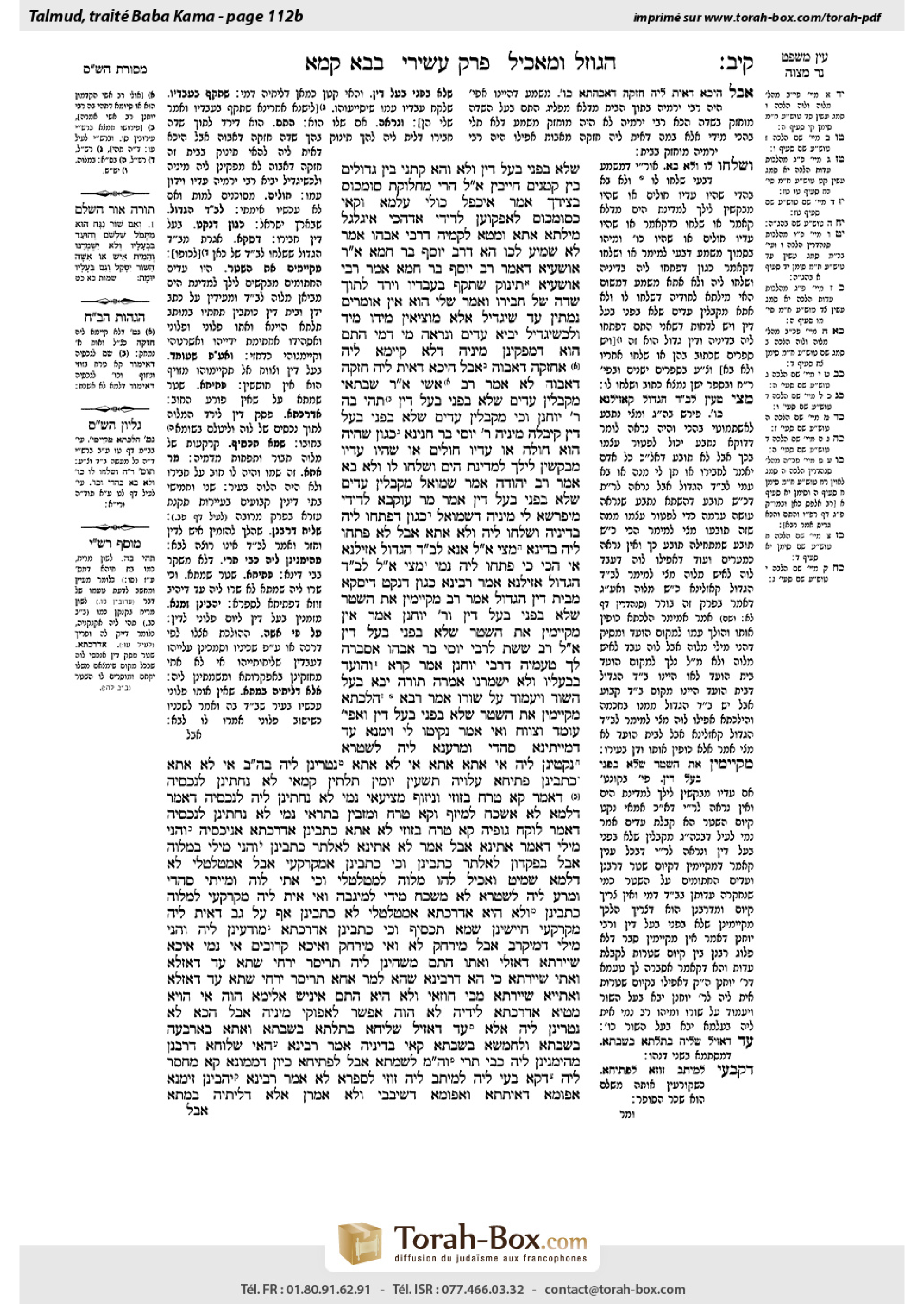
Bava Kamma 112b: Talmud study for Daf Yomi
Study the Talmud for Daf Yomi with scanned pages, Hebrew text, English translations from Sefaria and AI-generated French translations.
Passage selection and English or AI-generated French translation are available where the scan has annotations. Daf Study is independent of Torah-Box and Sefaria.
Browse Bava Kamma · בבא קמא · All tractatesBava Kamma 112b text and translations
This page of Bava Kamma includes the Aramaic text, an English translation and an AI-generated French translation, alongside the scan above.
בבא קמא קי״ב ב · Aramaic and Hebrew text
שֶׁלֹּא בִּפְנֵי בַּעַל דִּין?! וְלָא? וְהָא קָתָנֵי: בֵּין גְּדוֹלִים בֵּין קְטַנִּים, חַיָּיבִין! אֲמַר לֵיהּ: הֲרֵי מַחְלוֹקֶת סוֹמְכוֹס בְּצִידָּךְ. אֲמַר: אִיכְּפַל כּוּלֵּי עָלְמָא וְקָאֵי כְּסוֹמְכוֹס – לְאַפְקוֹעַן לְדִידִי?
אַדְּהָכִי אִיגַּלְגַּל מִילְּתָא, אֲתָא וּמְטָא לְקַמֵּיהּ דְּרַבִּי אֲבָהוּ. אָמַר: לָא שְׁמִיעַ לְכוּ הָא דְּרַב יוֹסֵף בַּר חָמָא אָמַר רַבִּי אוֹשַׁעְיָא? דְּאָמַר רַב יוֹסֵף בַּר חָמָא אָמַר רַבִּי אוֹשַׁעְיָא: תִּינוֹק שֶׁתָּקַף בַּעֲבָדָיו, וְיָרַד לְתוֹךְ שָׂדֶה שֶׁל חֲבֵירוֹ וְאָמַר ״שֶׁלִּי הוּא״, אֵין אוֹמְרִים: נַמְתִּין עַד שֶׁיַּגְדִּיל; אֶלָּא מוֹצִיאִין מִיָּדוֹ מִיָּד, וְלִכְשֶׁיַּגְדִּיל יָבִיא עֵדִים וְנִרְאֶה!
מִי דָּמֵי? הָתָם הוּא דְּמַפְּקִינַן מִינֵּיהּ – דְּלָא קָיְימָא לֵיהּ אַחֲזָקָה דַּאֲבוּהּ; אֲבָל הֵיכָא דְּאִית לֵיהּ חֲזָקָה דַּאֲבוּהּ, לָא.
אָמַר רַב אָשֵׁי אָמַר רַבִּי שַׁבְּתַאי: מְקַבְּלִין עֵדִים שֶׁלֹּא בִּפְנֵי בַּעַל דִּין. תָּהֵי בַּהּ רַבִּי יוֹחָנָן, וְכִי מְקַבְּלִין עֵדִים שֶׁלֹּא בִּפְנֵי בַּעַל דִּין?!
קַיבְּלַהּ מִינֵּיהּ רַבִּי יוֹסֵי בַּר חֲנִינָא: כְּגוֹן שֶׁהָיָה הוּא חוֹלֶה אוֹ עֵדָיו חוֹלִים, אוֹ שֶׁהָיוּ עֵדָיו מְבַקְּשִׁין לֵילֵךְ לִמְדִינַת הַיָּם, וְשָׁלְחוּ לוֹ וְלֹא בָּא.
אָמַר רַב יְהוּדָה אָמַר שְׁמוּאֵל: מְקַבְּלִין עֵדִים שֶׁלֹּא בִּפְנֵי בַּעַל דִּין. אָמַר מָר עוּקְבָא, לְדִידִי מִיפָּרְשָׁא לִי מִינֵּיהּ דִּשְׁמוּאֵל: כְּגוֹן דִּפְתַחוּ לֵיהּ בְּדִינֵיהּ, וּשְׁלַחוּ לֵיהּ וְלָא אֲתָא. אֲבָל לָא פְּתַחוּ לֵיהּ בְּדִינָא, מָצֵי אָמַר לֵיהּ: אֲנָא לְבֵית דִּין הַגָּדוֹל אָזֵילְנָא.
אִי הָכִי, כִּי פָתְחוּ לֵיהּ נָמֵי, מָצֵי אָמַר לֵיהּ: לְבֵית דִּין הַגָּדוֹל אָזֵילְנָא! אָמַר רָבִינָא: כְּגוֹן דְּנָקֵט דִּיסְקָא מִבֵּית דִּין הַגָּדוֹל.
אָמַר רַב: מְקַיְּימִין אֶת הַשְּׁטָר שֶׁלֹּא בִּפְנֵי בַּעַל דִּין. וְרַבִּי יוֹחָנָן אָמַר: אֵין מְקַיְּימִין אֶת הַשְּׁטָר שֶׁלֹּא בִּפְנֵי בַּעַל דִּין. אֲמַר לֵיהּ רַב שֵׁשֶׁת לְרַבִּי יוֹסֵי בַּר אֲבָהוּ: אַסְבְּרַהּ לָךְ טַעְמֵיהּ דְּרַבִּי יוֹחָנָן – אָמַר קְרָא: ״וְהוּעַד בִּבְעָלָיו וְלֹא יִשְׁמְרֶנּוּ״, אָמְרָה תּוֹרָה: יָבֹא בַּעַל הַשּׁוֹר, וְיַעֲמוֹד עַל שׁוֹרוֹ.
אָמַר רָבָא, הִלְכְתָא: מְקַיְּימִין אֶת הַשְּׁטָר שֶׁלֹּא בִּפְנֵי בַּעַל דִּין, וַאֲפִילּוּ עוֹמֵד וְצוֹוֵחַ. וְאִי אָמַר: נְקִיטוּ לִי זִימְנָא עַד דְּמַיְיתֵינָא סָהֲדִי וּמַרַעְנָא לֵיהּ לִשְׁטָרָא – נָקְטִינַן לֵיהּ. אִי אֲתָא – אֲתָא, אִי לָא אֲתָא – נָטְרִינַן לֵיהּ שֵׁנִי וַחֲמִישִׁי וְשֵׁנִי;
אִי לָא אֲתָא – כָּתְבִינַן פְּתִיחָא עִלָּוֵיהּ תִּשְׁעִין יוֹמִין. תְּלָתִין קַמָּאֵי לָא נָחֲתִינַן לְנִכְסֵיהּ, דְּאָמְרִינַן: קָא טָרַח בְּזוּזֵי וְנֵיזוֹף. מְצִיעָאֵי נָמֵי לָא נָחֲתִינַן לֵיהּ לְנִכְסֵיהּ, דְּאָמַר: דִּלְמָא לָא אַשְׁכַּח לְמֵיזַף, וְקָא טָרַח וּמְזַבֵּין. בָּתְרָאֵי נָמֵי לָא נָחֲתִינַן לְנִכְסֵיהּ, דְּאָמַר: לוֹקֵחַ גּוּפֵיהּ קָא טָרַח בְּזוּזֵי.
לָא אֲתָא – כָּתְבִינַן אַדְרַכְתָּא אַנִּיכְסֵיהּ. וְהָנֵי מִילֵּי דַּאֲמַר ״אָתֵינָא״, אֲבָל אָמַר ״לָא אָתֵינָא״ – לְאַלְתַּר כָּתְבִינַן.
וְהָנֵי מִילֵּי בְּמִלְוֶה, אֲבָל בְּפִקָּדוֹן – לְאַלְתַּר כָּתְבִינַן.
וְכִי כָּתְבִינַן – אַמְּקַרְקְעֵי, אֲבָל אַמִּטַּלְטְלִי – לָא; דִּלְמָא שָׁמֵיט וְאָכֵיל לְהוּ מַלְוֶה לְמִטַּלְטְלֵי, וְכִי אָתֵי לֹוֶה וּמַיְיתֵי סָהֲדִי וּמַרַע לֵיהּ לִשְׁטָרָא – לָא מַשְׁכַּח מִידֵּי לְמִיגְבֵּה.
וְאִי אִית לֵיהּ מְקַרְקְעֵי לְמַלְוֶה – כָּתְבִינַן. וְלָא הִיא; אַדְרַכְתָּא אַמִּטַּלְטְלִי לָא כָּתְבִינַן, אַף עַל גַּב דְּאִית לֵיהּ מְקַרְקְעֵי; חָיְישִׁינַן שֶׁמָּא תַּכְסִיף.
וְכִי כָּתְבִינַן אַדְרַכְתָּא – מוֹדְעִינַן לֵיהּ. וְהָנֵי מִילֵּי דִּמְיקָרַב, אֲבָל מְרַחַק – לָא.
וְאִי מְרַחַק וְאִיכָּא קְרוֹבִים, אִי נָמֵי אִיכָּא שְׁיָירָתָא דְּאָזְלִי וְאָתוּ הָתָם, מְשַׁהֵינַן לֵיהּ תְּרֵיסַר יַרְחֵי שַׁתָּא עַד דְּאָזְלָא וְאָתֵי שְׁיָירָא. כִּי הָא דְּרָבִינָא שְׁהָא לְמָר אַחָא תְּרֵיסַר יַרְחֵי שַׁתָּא, עַד דְּאָזְלָא וְאָתְיָיא שְׁיָירָא מִבֵּי חוֹזָאֵי.
וְלָא הִיא; הָתָם – אִינִישׁ אַלִּימָא הֲוָה, אִי הַוְיָא מָטְיָא אַדְרַכְתָּא לִידֵיהּ לָא הֲוָה אֶפְשָׁר לְאַפּוֹקֵי מִינֵּיהּ. אֲבָל הָכָא – לָא נָטְרִינַן לֵיהּ אֶלָּא עַד דְּאָזֵיל שְׁלִיחָא בִּתְלָתָא בְּשַׁבְּתָא וְאָתֵי בְּאַרְבְּעָה בְּשַׁבְּתָא, וּלְחַמְשָׁא בְּשַׁבְּתָא קָאֵי בְּדִינֵיהּ.
אָמַר רָבִינָא: הַאי שְׁלוּחָא דְרַבָּנַן, מְהֵימְנִינַן לֵיהּ כְּבֵי תְרֵי. וְהָנֵי מִילֵּי לְשַׁמְתָּא, אֲבָל לִפְתִיחָא – כֵּיוָן דְּמָמוֹנָא קָא מְחַסַּר לֵיהּ, דְּקָא בָעֵי לֵיהּ לְמִיתַּב לֵיהּ זוּזֵי לְסָפְרָא – לָא.
אָמַר רָבִינָא: יָהֲבִינַן זִימְנָא אַפּוּמָּא דְאִיתְּתָא וְאִפּוּמָא דְשִׁיבָבֵי. וְלָא אֲמַרַן אֶלָּא דְּלֵיתֵיהּ בְּמָתָא,
Bava Kamma 112b · English translation
who testify in the absence of a litigant? Since the defendant is a minor his presence is not legally recognized, and the court does not accept testimony against him. Rabbi Yirmeya questioned this assertion: And is it so that the court does not accept such testimony? But isn’t it taught that if a robber leaves stolen goods to his children, whether they are adults or minors, they are obligated to pay the owner? If the court obligates minors to pay, it must accept testimony about them. Rabbi Avin said to Rabbi Yirmeya: Sumakhos’s dispute is at your side, i.e., Sumakhos disagrees with this ruling and holds that the minors are exempt from paying. Rabbi Yirmeya said to him: Did the whole world go to the effort to hold in accordance with the opinion of Sumakhos in order to seize what is mine?
In the meantime, the matter circulated and eventually came before Rabbi Abbahu, who said: Did you not hear that which Rav Yosef bar Ḥama says that Rabbi Oshaya says? As Rav Yosef bar Ḥama says that Rabbi Oshaya says: With regard to a child who took his slaves and descended into the field of another and said: It is mine, the court does not say: Let us wait until he matures before we assess his claims. Rather, the court removes it from his possession immediately, and when he matures he may bring witnesses to attest to his claim and we will see how to judge the case. Similarly, Rabbi Yirmeya should be awarded the disputed property until his minor brother-in-law may litigate in court.
The Gemara rejects Rabbi Abbahu’s assertion: Is the case that Rav Yosef bar Ḥama discusses comparable to the case of Rabbi Yirmeya? It is there, in Rav Yosef bar Ḥama’s case, that we seize the property from him, because there is no presumption of ownership from his father; but where he does have a presumption of ownership from his father, no, we do not seize his property. Since Rabbi Yirmeya’s brother-in-law has a presumption of ownership due to the fact that the property belonged to his father, he retains control of the property.
§ Having mentioned the issue of testimony in the absence of a litigant, the Gemara discusses this matter in greater detail. Rav Ashi said that Rabbi Shabbtai says: The court accepts witnesses even in the absence of a litigant. Rabbi Yoḥanan wondered at this statement of Rav Ashi, and said: Does the court in fact accept witnesses in the absence of a litigant?
Rabbi Yosei bar Ḥanina received the following guideline from Rabbi Yoḥanan: The court accepts testimony in the absence of the defendant only in a case where the plaintiff was ill, or his witnesses were ill, or his witnesses wished to travel overseas and the judges sent for the defendant and he did not come. Since there is a concern that the plaintiff will not be able to present his claims at a later date, the testimony is accepted even in the absence of the defendant.
Rav Yehuda says that Shmuel says: The court accepts witnesses in the absence of a litigant. Mar Ukva said: This statement was explained to me personally by Shmuel himself, and he said that it applies in a case where the court opened his case and sent for him, but he did not appear. But if it did not yet open the case for him, he may say to the plaintiff: I am going to the High Court to resolve this case and will not appear in the local court.
The Gemara asks: If so, then even when the court already opened the case for him, he should also be able to say to them: I am going to the High Court to resolve this case. The Gemara answers that Ravina said: The defendant may not defer an opened case to the High Court if, for example, the local court obtained a license from the High Court authorizing it to adjudicate the case.
§ Having discussed testimony in the absence of a litigant, the Gemara addresses a similar matter. Rav says: The court ratifies a document in the absence of a litigant. And Rabbi Yoḥanan says: The court does not ratify a document in the absence of a litigant. Rav Sheshet said to Rabbi Yosei bar Abbahu: I will explain Rabbi Yoḥanan’s reasoning to you. The verse states with regard to an ox that gored: “And warning has been given to its owner and he has not secured it” (Exodus 21:29). The Torah means to say: Let the owner of the ox come and stand by his ox when the testimony about the ox is provided. Similarly, a document may be ratified only in the presence of the individual it implicates.
Rava said: The halakha is that the court ratifies a document in the absence of a litigant, and this is the case even if the other litigant stands and screams in protest that the document is a forgery. And if he said: Give me time until I bring witnesses and disqualify the document, we give him time before forcing him to pay. If he has come with witnesses within the time allotted to him, he has come, and the court reviews the case accordingly. If he does not come within the time allotted to him, we give him an additional three days on which to bring witnesses, when the court is in session: Monday, Thursday, and Monday.
If he still has not come, we write a document of ostracism against him for ninety days. During the first thirty days we do not descend to his property to collect his debt, as the court says: Perhaps he is occupied with borrowing money to pay his debt. During the middle period of thirty days as well, we do not descend to his property, as the court says: Perhaps he did not find someone to borrow from and he is now occupied with selling his property in order to pay his debt. During the final thirty days as well, we do not descend to his property, as the court says: Perhaps the debtor has found a purchaser and the purchaser himself is occupied with obtaining the money so that he can pay the debtor for the sale, and the debtor will then pay his debt.
If the debtor still did not come to pay his debt after ninety days, we write a document of authorization [adrakhta] allowing the creditor to collect his due from any property belonging to the debtor. And this statement applies only in a case where the debtor said: I am coming to pay and then he does not actually make an appearance. But if he said: I am not coming, we immediately write a document of authorization without waiting for ninety days to pass.
Furthermore, this matter of a ninety-day waiting period applies only with regard to a loan, as the debtor requires time in order to obtain the money to pay it back. But with regard to a deposit that the owner demands back from a bailee, we write a document of authorization immediately. Since a bailee should have immediate access to the deposit, there is no reason to grant him an extension.
The Gemara adds: When we write a document of authorization, the document applies only to the borrower’s land, but with regard to movable property, the court does not draft such a document. The reason for this is that perhaps the creditor will seize and consume the borrower’s movable property, and when the borrower later comes and brings witnesses and thereby invalidates the creditor’s document, he will not find anything to collect in order to retrieve his money.
And if the creditor owns land, we write a document authorizing the creditor to collect from any property that belongs to the borrower, including movable property. Since the creditor owns land, there is no concern that if the borrower manages to overturn the ruling he will have nothing from which to collect. The Gemara comments: And that is not so. The court does not draft a document of authorization with regard to movable property even if the creditor has land. This is because we are concerned lest the creditor’s land depreciate in value and the borrower will be unable to retrieve his money.
The Gemara teaches another halakha with regard to this matter: When we write the document of authorization, we inform the party that is liable to pay, as a final warning before authorizing a creditor to locate and take possession of his property in repayment of the debt. And this matter applies only when he is nearby, but if he is distant, the court does not notify him before authorizing the creditor.
And if he is distant but there are relatives of his nearby, or if there are caravans that go to the borrower’s current location and return, we delay issuing his document of authorization for the twelve months of the year, until the caravan goes and returns, so that if he wishes to make a claim, he can do so. This is like that incident where Ravina delayed for the twelve months of the year before issuing a document of authorization for Mar Aḥa, until a caravan went to and returned from Bei Ḥozai.
The Gemara comments: And that is not so. There, Ravina delayed issuing the document because the creditor was a violent man, and if a document of authorization would come into his possession, it would not be possible to take it from him if the borrower would prove that the original document was invalid. But here, i.e., in general, we wait for the defendant to be informed only if he is close enough to be informed within a day. Consequently, if the court decided the issue on Monday, a messenger would go inform the defendant on Tuesday, and he could come from his location to the court on Wednesday and stand trial on Thursday. If a debtor is more than a day’s travel away, however, the court does not trouble itself to notify him.
§ Apropos the Gemara’s discussion of summoning an individual to court by means of a messenger, the Gemara discusses this issue in a more general manner. Ravina said: We deem the agent of the Rabbis, who was sent to summon an individual to court, as credible as two witnesses if he says that the defendant refuses to come to court. And this matter applies only with regard to excommunication, but with regard to issuing a document of ostracism, since it causes the defendant loss of money, as he must give money to the scribe for drafting the document, no, the agent is not deemed credible.
Additionally, Ravina said: We may give a defendant a particular time to appear in court by informing him of the trial by word of mouth from a woman or from his neighbors, as these people are trusted to notify the defendant of the court’s summons. The Gemara comments: And we said this only when the defendant is not in the city.
Bava Kamma 112b · Traduction française (IA)
Qui témoignent en l'absence d'un litigant ? Puisque le défendeur est mineur, sa présence n'est pas reconnue légalement, et la cour ne considère pas les témoignages contre lui. Rabbi Yirmeya a questionné cette affirmation : Et est-ce que la cour ne considère pas de tels témoignages ? Mais n'est-ce pas enseigné que si un voleur laisse des biens volés à ses enfants, qu'ils soient adultes ou mineurs, ils sont tenus de payer au propriétaire ? Si la cour impose aux mineurs de payer, elle doit accepter des témoignages à leur sujet. Rabbi Avin a dit à Rabbi Yirmeya : La dispute de Sumakhos est du côté de Sumakhos, c'est-à-dire que Sumakhos conteste cette décision et considère que les mineurs sont exemptés de payer. Rabbi Yirmeya a dit à lui : Le monde a-t-il eu l'effort de suivre l'opinion de Sumakhos pour s'approprier ce qui m'appartient ?
En attendant, l'affaire a circulé et est finalement parvenue à Rabbi Abbahu, qui a dit : N'avez-vous pas entendu ce que Rav Yosef bar Ḥama dit que Rabbi Oshaya dit ? Comme Rav Yosef bar Ḥama dit que Rabbi Oshaya dit : En ce qui concerne un enfant qui a pris ses serviteurs et est descendu dans le champ d'un autre et a dit : C'est à moi, la cour ne dit pas : Attendons qu'il majeure avant d'évaluer ses revendications. Plutôt, la cour retire les biens de son possession immédiatement, et lorsqu'il majeure, il peut présenter des témoins pour attester sa revendication et nous verrons comment juger l'affaire. De même, Rabbi Yirmeya devrait être récompensé avec la propriété contestée jusqu'à ce que son frère ou sœur mineur puisse se présenter devant la cour.
La Guemara réfute l'affirmation de Rabbi Abbahu : Est-ce que le cas que discute Rav Yosef bar Ḥama est comparable à celui de Rabbi Yirmeya ? Il y a là, dans le cas de Rav Yosef bar Ḥama, que nous confisquons la propriété à lui, car il n'y a pas de présomption d'appartenance de la part de son père ; mais là où il y a une présomption d'appartenance de la part de son père, non, nous ne confisquons pas sa propriété. Puisque le frère ou sœur de Rabbi Yirmeya a une présomption d'appartenance en raison du fait que la propriété appartenait à son père, il garde le contrôle de la propriété.
§ Ayant mentionné la question des témoins en l'absence d'un litigeant, la Guemara discute ce sujet plus en détail. Rav Ashi a dit que Rabbi Shabbtai dit : La cour accepte les témoins même en l'absence d'un litigeant. Rabbi Yoḥanan a été étonné par cette déclaration de Rav Ashi, et a dit : La cour accepte-t-elle effectivement les témoins en l'absence d'un litigeant ?
Rabbi Yosei bar Ḥanina a reçu le suivant guide de Rabbi Yoḥanan : La cour accepte les témoins en l'absence du défendeur uniquement dans un cas où le plaignant était malade, ou ses témoins étaient malades, ou ses témoins souhaitaient voyager à l'étranger et les juges ont envoyé le défendeur et il n'est pas venu. Puisque il y a une crainte que le plaignant ne puisse présenter ses revendications ultérieurement, les témoins sont acceptés même en l'absence du défendeur.
Rav Yehuda dit que Shmuel dit : La cour accepte les témoins en l'absence d'un litigant. Mar Ukva a dit : Cette déclaration m'a été expliquée personnellement par Shmuel lui-même, et il a dit qu'elle s'applique à un cas où la cour a ouvert l'affaire et a envoyé le défendeur, mais il n'est pas venu. Mais si la cour n'a pas encore ouvert l'affaire pour lui, il peut dire au plaignant : Je vais au Grand Tribunal pour résoudre cette affaire et ne viendrai pas devant le tribunal local.
La Guemara pose la question : Si c'est ainsi, alors même lorsque la cour a déjà ouvert l'affaire pour lui, il devrait également pouvoir dire à la cour : Je vais au Grand Tribunal pour résoudre cette affaire. La Guemara répond que Ravina a dit : Le défendeur ne peut pas reporter un cas ouvert au Grand Tribunal si, par exemple, le tribunal local a obtenu une autorisation du Grand Tribunal autorisant ce tribunal à résoudre l'affaire.
§ Ayant discuté des témoins en l'absence d'un litigant, la Guemara aborde une question similaire. Rav dit : La cour valide un document en l'absence d'un litigant. Et Rabbi Yoḥanan dit : La cour ne valide pas un document en l'absence d'un litigant. Rav Sheshet a dit à Rabbi Yosei bar Abbahu : Je vais vous expliquer la raison de Rabbi Yoḥanan. La Bible dit concernant un bœuf qui a blessé : « Et avertissement a été donné à son propriétaire et il n'a pas sécurisé son bœuf » (Exode 21:29). La Torah veut dire : Que le propriétaire du bœuf vienne et se tienne à côté de son bœuf lorsqu'on présente les témoins sur le bœuf. De même, un document peut être validé uniquement en présence de la personne qu'il implique.
Rava a dit : La halakha est que la cour valide un document en l'absence d'un litigant, et cela s'applique même si l'autre litigant se lève et crie en protestant que le document est un faux. Et s'il dit : Donnez-moi du temps jusqu'à ce que je ramène des témoins et dénonce le document, nous lui donnons du temps avant de le forcer à payer. Si l'autre est venu avec des témoins dans le temps imparti, il est venu, et la cour examine l'affaire selon les circonstances. Si l'autre n'est pas venu dans le temps imparti, nous lui donnons trois jours supplémentaires pour ramener des témoins, lorsque la cour est en session : lundi, jeudi et lundi.
Si l'autre n'est toujours pas venu, nous écrivons un document d'isolement contre lui pendant quatre-vingt-dix jours. Pendant les premiers trente jours, nous ne descendons pas chez lui pour récupérer sa dette, car la cour dit : Peut-être qu'il est occupé à emprunter de l'argent pour payer sa dette. Pendant la période intermédiaire de trente jours également, nous ne descendons pas chez lui, car la cour dit : Peut-être qu'il n'a pas trouvé quelqu'un à emprunter et il est maintenant occupé à vendre ses biens pour payer sa dette. Pendant les derniers trente jours également, nous ne descendons pas chez lui, car la cour dit : Peut-être que le débiteur a trouvé un acheteur et que l'acheteur lui-même est occupé à obtenir de l'argent afin de payer le débiteur pour la vente, et le débiteur paiera alors sa dette.
Si le débiteur n’est pas venu payer sa dette après quatre-vingt-dix jours, nous rédigeons un document d’autorisation [adrakhta] permettant au créancier de récupérer sa créance sur tout bien appartenant au débiteur. Et cette déclaration s’applique uniquement dans le cas où le débiteur disait : Je viens payer et ensuite il ne vient pas effectivement. Mais si il disait : Je ne viens pas, nous rédigeons immédiatement un document d’autorisation sans attendre que quatre-vingt-dix jours passent.
De plus, cette question du délai de quatre-vingt-dix jours s’applique uniquement en ce qui concerne un prêt, car le débiteur a besoin de temps pour obtenir l’argent afin de le rembourser. En ce qui concerne un dépôt que l’owner exige de la part d’un dépositaire, nous rédigeons immédiatement un document d’autorisation. Puisque le dépositaire doit avoir un accès immédiat au dépôt, il n’y a pas de raison de lui accorder un délai.
La Guemara ajoute : Lorsque nous rédigeons un document d’autorisation, ce document s’applique uniquement au terrain du débiteur, mais en ce qui concerne les biens mobiliers, la cour ne rédige pas un tel document. La raison en est que peut-être le créancier saisira et consommera les biens mobiliers du débiteur, et lorsque le débiteur viendra plus tard avec des témoins et invalidera ainsi le document du créancier, il ne trouvera rien à récupérer pour récupérer son argent.
Et si le créancier possède un terrain, nous rédigeons un document d’autorisation permettant au créancier de récupérer tout bien appartenant au prêteur, y compris les biens mobiliers. Puisque le créancier possède un terrain, il n’y a pas de crainte que si le prêteur parvient à annuler le jugement, il ne trouvera rien à récupérer. La Guemara commente : Et cela n’est pas vrai. La cour ne rédige pas un document d’autorisation concernant les biens mobiliers même si le créancier possède un terrain. Cela est dû à la crainte que le terrain du créancier s’affaiblisse en valeur et que le prêteur ne puisse pas récupérer son argent.
La Guemara enseigne une autre halakha concernant cette question : Lorsque nous rédigeons le document d’autorisation, nous informons la partie qui doit payer, comme un dernier avertissement avant d’autoriser le créancier à localiser et à prendre possession de ses biens en paiement de la dette. Et cette question s’applique uniquement lorsque la personne est proche, mais si elle est éloignée, la cour ne l’informe pas avant d’autoriser le créancier.
Et si la personne est éloignée mais qu’il y a des parents proches ou si des caravanes partent vers la localisation actuelle du prêteur et reviennent, nous différions l’émission du document d’autorisation pendant les douze mois de l’année, jusqu’à ce que la caravane aille et revienne, afin que si la personne souhaite présenter une réclamation, elle puisse le faire. C’est comme l’incident où Ravina a différé pendant les douze mois avant d’émettre un document d’autorisation pour Mar Aḥa, jusqu’à ce qu’une caravane aille et revienne de Bei Ḥozai.
La Guemara commente : Et cela n’est pas ainsi. Là-bas, Ravina a reporté l’émission du document car le créancier était un homme violent, et si le document d’autorisation tombait entre ses mains, il ne serait pas possible de le lui retirer si le prêteur prouvait que le document original était invalide. Mais ici, c’est-à-dire en général, nous attendons que le défendeur soit informé uniquement s’il est suffisamment proche pour être informé en un jour. Ainsi, si la cour a décidé l’affaire un lundi, un messager irait informer le défendeur un mardi, et il pourrait venir de sa localisation à la cour un mercredi et se présenter à l’audience jeudi. Cependant, si le débiteur est plus d’un jour de voyage éloigné, la cour ne se donne pas la peine de l’informer.
§ En ce qui concerne la discussion de la Guemara sur l’envoi d’un messager pour convier une personne à l’audience, la Guemara discute cette question d’une manière plus générale. Ravina a dit : Nous considérons l’agent des Sages, qui a été envoyé pour convier une personne à l’audience, comme crédible comme deux témoins s’il dit que le défendeur refuse de venir à l’audience. Et cette question s’applique uniquement en ce qui concerne l’excommunication, mais en ce qui concerne l’émission d’un document d’ostracisme, puisque cela cause une perte financière au défendeur, car il doit donner de l’argent au scribe pour rédiger le document, non, l’agent n’est pas considéré comme crédible.
De plus, Ravina a dit : Nous pouvons donner à un défendeur un moment particulier pour se présenter en audience en informant oralement de l’audience par une femme ou par ses voisins, car ces personnes sont considérées comme fiables pour informer le défendeur de l’appel de la cour. La Guemara commente : Et nous avons dit cela uniquement lorsque le défendeur n’est pas dans la ville.
Traduction française générée par IA à partir de l’édition anglaise de Sefaria. Vérifie toujours un passage avec le texte source.
Text from Sefaria: William Davidson Edition - Vocalized Aramaic (CC BY NC); William Davidson Edition - English (CC BY NC).