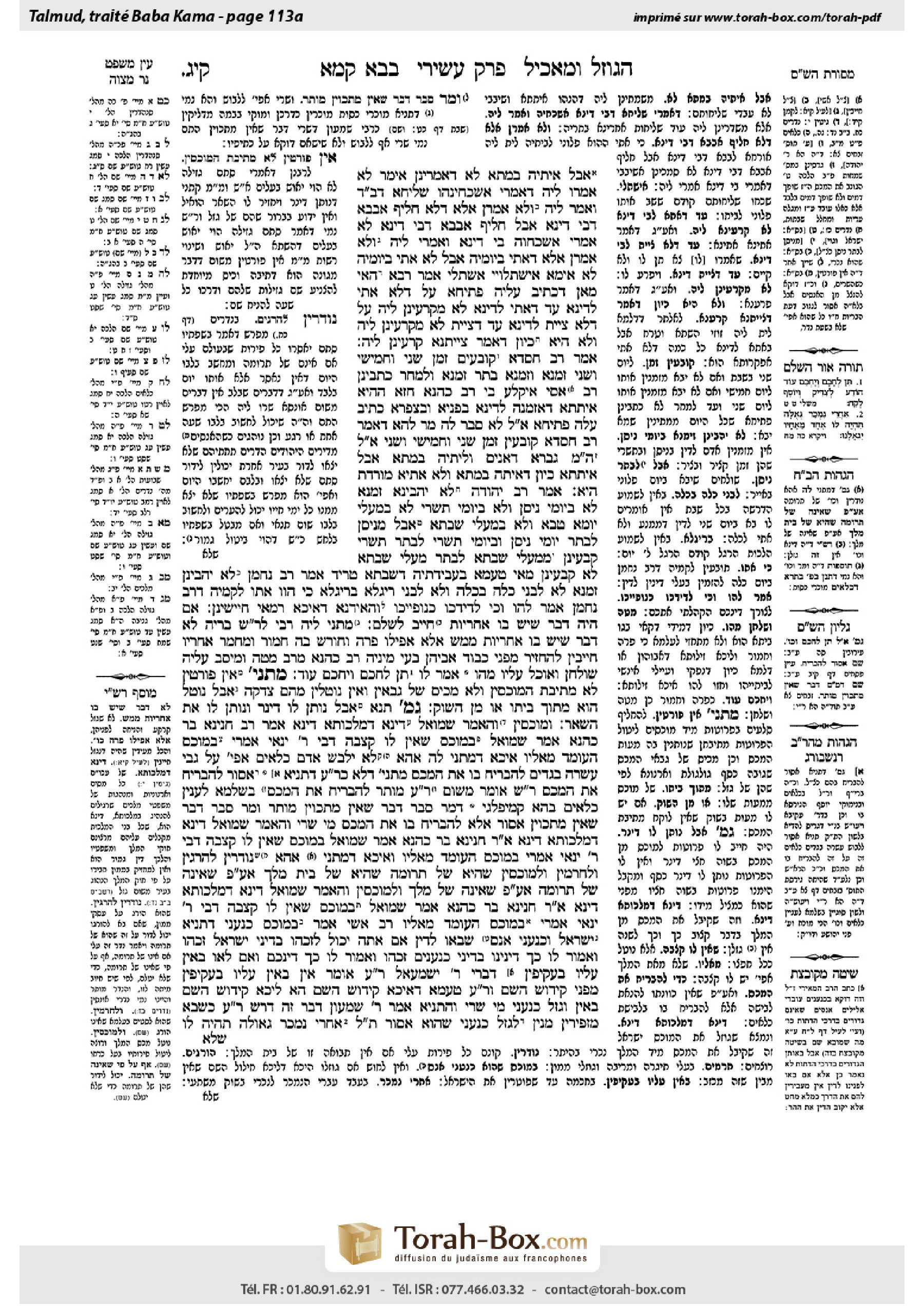
Bava Kamma 113a: Talmud study for Daf Yomi
Study the Talmud for Daf Yomi with scanned pages, Hebrew text, English translations from Sefaria and AI-generated French translations.
Passage selection and English or AI-generated French translation are available where the scan has annotations. Daf Study is independent of Torah-Box and Sefaria.
Browse Bava Kamma · בבא קמא · All tractatesBava Kamma 113a text and translations
This page of Bava Kamma includes the Aramaic text, an English translation and an AI-generated French translation, alongside the scan above.
בבא קמא קי״ג א · Aramaic and Hebrew text
אֲבָל אִיתֵיהּ בְּמָתָא – לָא; דְּאָמְרִינַן: אֵימַר לָא אֲמַרוּ לֵיהּ, דְּאָמְרִי: (אַשְׁכְּחִינְהוּ) [אַשְׁכְּחֵיהּ] שְׁלִיחָא דְּבֵית דִּין, וַאֲמַר לֵיהּ.
וְלָא אֲמַרַן אֶלָּא דְּלָא חָלֵיף אַבָּבָא דְּבֵי דִּינָא, אֲבָל חָלֵיף אַבָּבָא דְּבֵי דִינָא – לָא; אָמְרִי: אַשְׁכְּחוּהּ בֵּי דִינָא, וְאָמְרִי לֵיהּ.
וְלָא אֲמַרַן אֶלָּא דְּאָתֵי בְּיוֹמֵיהּ, אֲבָל לָא אָתֵי בְּיוֹמֵיהּ – לָא; אֵימָא אִישְׁתְּלוֹיֵי אִשְׁתְּלִי.
אָמַר רָבָא: הַאי מַאן דִּכְתִיב עֲלֵיהּ פְּתִיחָא עַל דְּלָא אָתֵי לְדִינָא – עַד דְּאָתֵי לְדִינָא, לָא מְקָרְעִינַן לֵיהּ. עַל דְּלָא צָיֵית לְדִינָא – עַד דְּצָיֵית, לָא מְקָרְעִינַן לֵיהּ. וְלָא הִיא, כֵּיוָן דְּאָמַר: ״צָיֵיתְנָא״ – קָרְעִינַן לֵיהּ.
אָמַר רַב חִסְדָּא: קוֹבְעִים זְמַן שֵׁנִי וַחֲמִישִׁי וְשֵׁנִי – זִמְנָא וְזִמְנָא בָּתַר זִמְנָא, וּלְמָחָר כָּתְבִינַן.
רַב אַסִּי אִיקְּלַע בֵּי רַב כָּהֲנָא. חֲזָא הָהִיא אִיתְּתָא דְּאַזְמְנַהּ לְדִינָא בְּפַנְיָא, וּבְצַפְרָא כְּתֻיב עֲלַהּ פְּתִיחָא. אֲמַר לֵיהּ, לָא סָבַר לַהּ מָר לְהָא דְּאָמַר רַב חִסְדָּא: קוֹבְעִין זְמַן שֵׁנִי וַחֲמִישִׁי וְשֵׁנִי?
אֲמַר לֵיהּ: הָנֵי מִילֵּי גַּבְרָא, דַּאֲנִיס וְלֵיתֵיהּ בְּמָתָא; אֲבָל אִיתְּתָא, כֵּיוָן דְּאִיתַהּ בְּמָתָא וְלָא אָתְיָא – מוֹרֶדֶת הִיא.
אָמַר רַב יְהוּדָה: לָא (יָהֲבִינָא) [יָהֲבִינַן] זִמְנָא לָא בְּיוֹמֵי נִיסָן וְלָא בְּיוֹמֵי תִּשְׁרֵי, לָא בְּמַעֲלֵי יוֹמָא טָבָא וְלָא בְּמַעֲלֵי שַׁבְּתָא. אֲבָל מִנִּיסָן לְבָתַר יוֹמֵי נִיסָן, וּבְיוֹמֵי תִּשְׁרֵי לְבָתַר תִּשְׁרֵי – קָבְעִינַן. מִמַּעֲלֵי שַׁבְּתָא לְבָתַר מַעֲלֵי שַׁבְּתָא – לָא קָבְעִינַן. מַאי טַעְמָא? בַּעֲבִידְתֵּיהּ דְּשַׁבְּתָא טְרִיד.
אָמַר רַב נַחְמָן: לָא יָהֲבִינַן זִמְנָא לָא לִבְנֵי כַלָּה בְּכַלָּה, וְלָא לִבְנֵי רִיגְלָא בְּרִיגְלָא. כִּי הֲווֹ אָתוּ לְקַמֵּיהּ דְּרַב נַחְמָן, אֲמַר לְהוּ: וְכִי לְדִידְכוּ כִּנּוּפַיְיכוּ?! וְהָאִידָּנָא דְּאִיכָּא רַמָּאֵי – חָיְישִׁינַן.
אִם הָיָה דְבַר שֶׁיֵּשׁ בּוֹ אַחְרָיוּת – חַיָּיב לְשַׁלֵּם. מַתְנֵי לֵיהּ רַבִּי לְרַבִּי שִׁמְעוֹן בְּרֵיהּ: לֹא דָּבָר שֶׁיֵּשׁ בּוֹ אַחְרָיוּת מַמָּשׁ, אֶלָּא אֲפִילּוּ פָּרָה וְחוֹרֵשׁ בָּהּ, חֲמוֹר וּמְחַמֵּר אַחֲרָיו – חַיָּיבִין לְהַחֲזִיר, מִפְּנֵי כְּבוֹד אֲבִיהֶן.
בָּעֵי מִינֵּיהּ רַב כָּהֲנָא מֵרַב: מִטָּה וּמֵיסֵב עָלֶיהָ, שׁוּלְחָן וְאוֹכֵל עָלָיו, מַהוּ? אָמַר לוֹ: ״תֵּן לְחָכָם וְיֶחְכַּם עוֹד״.
מַתְנִי׳ אֵין פּוֹרְטִין לֹא מִתֵּיבַת הַמּוֹכְסִין, וְלֹא מִכִּיס שֶׁל גַּבָּאִין, וְאֵין נוֹטְלִין מֵהֶם צְדָקָה. אֲבָל נוֹטֵל הוּא מִתּוֹךְ בֵּיתוֹ אוֹ מִן הַשּׁוּק.
גְּמָ׳ תָּנָא: אֲבָל נוֹתֵן לוֹ דִּינָר, וְנוֹתֵן לוֹ אֶת הַשְּׁאָר.
וּמוֹכְסִין. וְהָאָמַר שְׁמוּאֵל: דִּינָא דְמַלְכוּתָא דִּינָא!
אָמַר רַבִּי חֲנִינָא בַּר כָּהֲנָא אָמַר שְׁמוּאֵל: בְּמוֹכֵס שֶׁאֵין לוֹ קִצְבָה. דְּבֵי רַבִּי יַנַּאי אָמְרִי: בְּמוֹכֵס הָעוֹמֵד מֵאֵלָיו.
אִיכָּא דְּמַתְנֵי לַהּ אַהָא: לֹא יִלְבַּשׁ אָדָם כִּלְאַיִם אֲפִילּוּ עַל גַּבֵּי עֲשָׂרָה בְּגָדִים, לְהַבְרִיחַ בּוֹ אֶת הַמֶּכֶס. מַתְנִיתִין דְּלָא כְּרַבִּי עֲקִיבָא. דְּתַנְיָא: אָסוּר לְהַבְרִיחַ אֶת הַמֶּכֶס. רַבִּי שִׁמְעוֹן אוֹמֵר מִשּׁוּם רַבִּי עֲקִיבָא: מוּתָּר לְהַבְרִיחַ אֶת הַמֶּכֶס.
בִּשְׁלָמָא לְעִנְיַן כִּלְאַיִם, בְּהָא קָמִיפַּלְגִי – דְּמָר סָבַר: דָּבָר שֶׁאֵין מִתְכַּוֵּין מוּתָּר, וּמָר סָבַר: דָּבָר שֶׁאֵין מִתְכַּוֵּין אָסוּר. אֶלָּא לְהַבְרִיחַ בּוֹ אֶת הַמֶּכֶס – מִי שְׁרֵי? וְהָאָמַר שְׁמוּאֵל: דִּינָא דְמַלְכוּתָא דִּינָא!
אָמַר רַבִּי חֲנִינָא בַּר כָּהֲנָא אָמַר שְׁמוּאֵל: בְּמוֹכֵס שֶׁאֵין לוֹ קִצְבָה. דְּבֵי רַבִּי יַנַּאי אָמְרִי: בְּמוֹכֵס הָעוֹמֵד מֵאֵלָיו.
וְאִיכָּא דְּמַתְנֵי אַהָא: נוֹדְרִין לֶהָרָגִין וְלֶחָרָמִין וְלַמּוֹכְסִין – שֶׁהִיא שֶׁל תְּרוּמָה, שֶׁהִיא שֶׁל בֵּית מֶלֶךְ; אַף עַל פִּי שֶׁאֵינָהּ שֶׁל תְּרוּמָה, אַף עַל פִּי שֶׁאֵינָהּ שֶׁל מֶלֶךְ: וְלַמּוֹכְסִין?! וְהָאָמַר שְׁמוּאֵל: דִּינָא דְמַלְכוּתָא דִּינָא!
אָמַר רַבִּי חֲנִינָא בַּר כָּהֲנָא אָמַר שְׁמוּאֵל: בְּמוֹכֵס שֶׁאֵין לוֹ קִצְבָה. דְּבֵי רַבִּי יַנַּאי אָמְרִי: בְּמוֹכֵס הָעוֹמֵד מֵאֵלָיו.
רַב אָשֵׁי אָמַר: בְּמוֹכֵס גּוֹי. דְּתַנְיָא: יִשְׂרָאֵל וְגוֹי שֶׁבָּאוּ לַדִּין, אִם אַתָּה יָכוֹל לְזַכּוֹתוֹ בְּדִינֵי יִשְׂרָאֵל – זַכֵּהוּ, וֶאֱמוֹר לוֹ: כָּךְ דִּינֵינוּ. בְּדִינֵי גּוֹיִם – זַכֵּהוּ וֶאֱמוֹר לוֹ: כָּךְ דִּינְכֶם. וְאִם לָאו, בָּאִין עָלָיו בַּעֲקִיפִין; דִּבְרֵי רַבִּי יִשְׁמָעֵאל. רַבִּי עֲקִיבָא אוֹמֵר: אֵין בָּאִין עָלָיו בַּעֲקִיפִין, מִפְּנֵי קִידּוּשׁ הַשֵּׁם.
וְרַבִּי עֲקִיבָא – טַעְמָא דְּאִיכָּא קִידּוּשׁ הַשֵּׁם, הָא לֵיכָּא קִידּוּשׁ הַשֵּׁם – בָּאִין;
וְגֶזֶל גּוֹי מִי שְׁרֵי? וְהָתַנְיָא: אָמַר רַבִּי שִׁמְעוֹן, דְּבַר זֶה דָּרַשׁ רַבִּי עֲקִיבָא כְּשֶׁבָּא מִזְּפִירִין: מִנַּיִן לְגֶזֶל גּוֹי שֶׁהוּא אָסוּר? תַּלְמוּד לוֹמַר: ״אַחֲרֵי נִמְכַּר, גְּאֻלָּה תִּהְיֶה לּוֹ״ –
Bava Kamma 113a · English translation
But if the defendant is in the city, the court does not ostracize him for failing to respond to a summons conveyed through a woman or a neighbor, as we say: Perhaps they did not tell him of the court’s summons, as they said to themselves: Since the defendant is in the city, a court agent has already found him and told him. As a result, these unofficial messengers will not deliver the court’s summons to the defendant at all.
And similarly, we said that the court will ostracize one who does not respond to a summons conveyed through a woman or a neighbor only in a case where he does not pass by the court’s entrance on his way home, but if he does pass by the court’s entrance, the court does not ostracize him. This is because it is possible that the unofficial messengers will say to themselves: Since he passes by the courthouse, the court has already found him and told him.
And furthermore, we said that the court will ostracize one who does not respond to a summons only in a case where he comes home on the same day that the woman or neighbor is sent to deliver the court summons. But if he does not come home on the same day, he is not ostracized, because it is possible to say that they forgot to notify him.
Rava said: With regard to one who had a document of ostracism written about him due to the fact that he did not come to court, we do not tear up the document for him until he actually comes to court, and it is not enough for him to simply commit to appearing. Similarly, if the document of ostracism was written due to the fact that he did not obey the ruling of the court, we do not tear it up for him until he actually obeys the ruling. The Gemara comments: This second statement is not so. Rather, once he has acquiesced and said: I will obey, we immediately tear up the document for him.
Rav Ḥisda said: The court sets a date for an individual to appear in court on the upcoming Monday. And if he does not appear, they set a date for that Thursday, and if he does not appear, they set a date for the following Monday, so that he has a second date and then a third date after the first date. And if he does not appear in court by the third date, then on the next day we write a document of ostracism.
The Gemara relates that Rav Asi happened to come to the house of Rav Kahana. He saw that there was a certain woman whom Rav Kahana had summoned to appear in court in the evening, but she did not appear, and in the morning Rav Kahana wrote a document of ostracism concerning her. Rav Asi said to him: Does the Master not hold in accordance with that which Rav Ḥisda says, that the court sets a date for the coming Monday, and then Thursday, and then the following Monday before it issues a document of ostracism?
Rav Kahana said to him: That matter applies only with regard to a man, as he is a victim of circumstance and is not always in the city due to his vocational activities. But in the case of a woman, since she is always in the city, when she does not come to court the first time she is immediately considered rebellious, and the court may issue a document of ostracism right away.
Continuing the discussion of court dates, Rav Yehuda says: The court does not set a date for legal proceedings during the days of Nisan, nor during the days of Tishrei, and also not on the eve of a Festival nor the eve of Shabbat because these are busy times. But during Nisan we may set a court date to take place after Nisan, and likewise, during Tishrei we may set a court date to take place after Tishrei. By contrast, on the eve of Shabbat we do not set a court date to take place after the eve of Shabbat. What is the reason for this? It is because one is preoccupied with his work in preparation for Shabbat and it is possible that he will forget about the court summons.
Rav Naḥman says: We do not set a court date for participants in the kalla, the gatherings for Torah study during Elul and Adar, during the months of the kalla, nor for participants in the public discourses prior to the Festival during the period leading up to the Festival. The Gemara relates: When people would come before Rav Naḥman during the kalla period in order to make legal claims against others, he would say to them: Did I gather you here for your own needs? No, I gathered you to participate in Torah study. The Gemara adds: But now that there are scoundrels, who do not come to study Torah but rather to avoid trial, we are concerned that they will continue to evade prosecution, and therefore we summon them to court even during these time periods.
§ The mishna teaches, with regard to one who left a stolen item to his children, if the item was something that may serve as a legal guarantee of a loan, the heirs are obligated to pay the owner. The Gemara states that Rabbi Yehuda HaNasi would teach this mishna to Rabbi Shimon, his son, and explain that it does not refer only to something that can actually serve as a guarantee for a loan, i.e., land. Rather, it refers even to a cow that he plows with, or a donkey that he drives by directing it from behind, which the heirs are obligated to return because of the honor of their father, so that people will not continually point out that the inheritance was stolen and thereby disgrace their deceased parent.
Rav Kahana raises a dilemma before Rav: If the robber left his heirs a stolen item that is used in relative privacy, such as a bed that he lies on or a table upon which he eats, rather than something as conspicuous as a large animal, what is the halakha? Are the heirs obligated to return it to its owner? Rav said to him: “Give to a wise man, and he will be yet wiser” (Proverbs 9:9), meaning that from the fact that the heirs must return a cow and a donkey, one can infer that they must also return a bed and a table.
MISHNA: One may not exchange larger coins for smaller ones from the trunk of customs collectors nor from the purse of tax collectors, and one may not take charity from them, as they are assumed to have obtained their funds illegally. But one may take money from the collector’s house or from money he has with him in the market that he did not take from his collection trunk or purse.
GEMARA: It was taught in a baraita with regard to the prohibition against exchanging money from the trunk of a customs collector: But one may give the customs collector a dinar as payment for a debt that amounts to less than a dinar, and when the collector gives him change, he may accept it.
It was taught in the mishna that one may not exchange money from the trunks of customs collectors, which are assumed to include stolen funds. The Gemara questions this ruling: But doesn’t Shmuel say that the law of the kingdom is the law, i.e., halakha requires Jews to obey the laws of the state in which they live. Accordingly, the customs are collected legally and it should be permitted to make use of the funds.
The Gemara answers: Rabbi Ḥanina bar Kahana said that Shmuel says: The mishna is discussing a customs collector who does not have a limitation placed by the governor on the amount he may collect, and he collects as he pleases. Alternatively, the Sages of the school of Rabbi Yannai said: The mishna is discussing a customs collector who stands on his own, i.e., he was not appointed by the government but, on his own, he forces people to give him money.
The Gemara notes: There are those who teach the statements of Rabbi Ḥanina bar Kahana and the Sages of the school of Rabbi Yannai with regard to this following mishna (Kilayim 9:2) and its attendant discussion. The customs collectors would not levy a duty for the garments one was wearing. In light of this, the mishna teaches: A person may not wear a garment made of diverse kinds, i.e., a combination of wool and linen, even if he wears it on top of ten garments, in order to avoid paying customs. It was noted that this mishna is not in accordance with the opinion of Rabbi Akiva, as it is taught in a baraita: It is prohibited to avoid paying customs by wearing a garment of diverse kinds. Rabbi Shimon says in the name of Rabbi Akiva: It is permitted to avoid paying customs in this manner.
The Gemara comments: Granted, with regard to the prohibition of diverse kinds, they disagree about this: One Sage, i.e., Rabbi Akiva, holds that an unintentional act is permitted. In this case, the prohibition is to benefit from wearing the garment, and that is not his intent, as his intention is merely to avoid paying the customs duties. Therefore, it is permitted. And one Sage, i.e., the first tanna in the baraita, holds that an unintentional act is prohibited. But is it ever permitted to avoid customs? Doesn’t Shmuel say: The law of the kingdom is the law?
In answer to this question, Rabbi Ḥanina bar Kahana said that Shmuel says: The dispute in the baraita is with regard to a customs collector who does not have a limitation placed on the amount he may collect. Alternatively, Sages of the school of Rabbi Yannai said: The dispute is with regard to a customs collector who stands on his own, i.e., who is self-appointed.
The Gemara notes: And there are those who teach the statements of Rabbi Ḥanina bar Kahana and the Sages of the school of Rabbi Yannai with regard to this mishna (Nedarim 27b): One may vow before murderers, plunderers, and customs collectors in order to reinforce the claim that a certain item that is being commandeered is teruma, or that it belongs to the king’s house, and thereby avoid its seizure, despite the fact that it is not teruma or that it does not belong to the king’s house. It was asked: Can it be that it is permitted to pronounce such a vow before customs collectors? But doesn’t Shmuel say: The law of the kingdom is the law? It should therefore be prohibited to state such a vow before the customs collectors.
Rabbi Ḥanina bar Kahana said that Shmuel says: The mishna in Nedarim issues its ruling with regard to a customs collector who does not have a limitation placed on the amount he may collect. Alternatively, the Sages of the school of Rabbi Yannai say: The mishna issues its ruling with regard to a customs collector who stands on his own.
Rav Ashi said: The mishna issues its ruling with regard to a gentile customs collector, whom one may deceive, as it is taught in a baraita: In the case of a Jew and a gentile who approach the court for judgment in a legal dispute, if you can vindicate the Jew under Jewish law, vindicate him, and say to the gentile: This is our law. If he can be vindicated under gentile law, vindicate him, and say to the gentile: This is your law. And if it is not possible to vindicate him under either system of law, one approaches the case circuitously, seeking a justification to vindicate the Jew. This is the statement of Rabbi Yishmael. Rabbi Akiva disagrees and says: One does not approach the case circuitously in order to vindicate the Jew due to the sanctification of God’s name, as God’s name will be desecrated if the Jewish judge employs dishonest means.
The Gemara infers from this baraita: And even according to Rabbi Akiva, the reason that the court does not employ trickery in order to vindicate the Jew is only because there is the consideration of the sanctification of God’s name. Consequently, if there is no consideration of the sanctification of God’s name, the court does approach the case circuitously. Apparently, it is permitted to deceive a gentile.
The Gemara challenges this assertion: But is robbery from a gentile permitted? Isn’t it taught in a baraita: Rabbi Shimon said that Rabbi Akiva taught this matter when he came from Zephirin: From where is it derived that it is prohibited to rob a gentile? It is from the fact that the verse states with regard to a Jew who has been sold as a slave to a gentile: “After he is sold he may be redeemed” (Leviticus 25:48),
Bava Kamma 113a · Traduction française (IA)
Mais si le défendeur est en ville, la cour ne l'exile pas pour avoir omis de répondre à une convocation transmise par une femme ou un voisin, car nous disons : Peut-être qu'ils n'ont pas informé le défendeur de la convocation de la cour, car ils se sont dit : Puisque le défendeur est en ville, un agent de la cour l'a déjà trouvé et lui a parlé. Par conséquent, ces messagers informels ne transmettront pas du tout la convocation de la cour au défendeur.
Et de même, nous avons dit que la cour exilera celui qui ne répond pas à une convocation transmise par une femme ou un voisin uniquement dans le cas où il ne passe pas par l'entrée de la cour en rentrant chez lui, mais si il passe par l'entrée de la cour, la cour ne l'exile pas. Cela est dû au fait qu'il est possible que ces messagers informels se disent : Puisque il passe par le tribunal, la cour l'a déjà trouvé et lui a parlé.
Et de plus, nous avons dit que la cour exilera celui qui ne répond pas à une convocation uniquement dans le cas où il rentre chez lui le même jour que la femme ou le voisin est envoyé pour transmettre la convocation de la cour. Mais si il ne rentre pas chez lui le même jour, il n'est pas exilé, car il est possible de dire qu'ils ont oublié de l'informer.
Rava a dit : En ce qui concerne celui qui a eu un document d'exil rédigé à son encontre en raison du fait qu'il n'est pas venu en cour, nous ne détruisons pas ce document pour lui jusqu'à ce qu'il vienne effectivement en cour, et il n'est pas suffisant qu'il s'engage simplement à venir. De même, si le document d'exil avait été rédigé en raison du fait qu'il n'avait pas obéi à l'arrêt de la cour, nous ne détruisons pas ce document pour lui jusqu'à ce qu'il obéisse effectivement à l'arrêt. La Guemara commente : Cette deuxième déclaration n'est pas ainsi. Plutôt, dès qu'il a acquiescé et dit : Je ferai obéir, nous détruisons immédiatement le document pour lui.
Rav Ḥisda a dit : La cour fixe une date pour une personne de se présenter en cour le lendemain de lundi. Et si elle n'arrive pas, ils fixent une date pour ce jeudi, et si elle n'arrive pas, ils fixent une date pour le lendemain de lundi, de sorte qu'elle ait une deuxième date et puis une troisième date après la première date. Et si elle n'arrive pas en cour jusqu'à la troisième date, alors le lendemain nous rédigeons un document d'exil.
La Guemara rapporte que Rav Asi est tombé par hasard chez Rav Kahana. Il a vu qu'il y avait une certaine femme que Rav Kahana avait convoquée à se présenter en cour en soirée, mais elle n'était pas venue, et le lendemain matin Rav Kahana avait rédigé un document d'exil concernant elle. Rav Asi a dit à lui : Le Maître ne tient-il pas en conformité avec ce que Rav Ḥisda dit, à savoir que la cour fixe une date pour le lendemain de lundi, puis le jeudi, puis le lendemain de lundi avant d'émettre un document d'exil ?
Rav Kahana dit à lui : Cette affaire s'applique uniquement en ce qui concerne un homme, car il est victime des circonstances et n'est pas toujours en ville en raison de ses activités professionnelles. Mais dans le cas d'une femme, puisqu'elle est toujours en ville, lorsqu'elle ne vient pas en cour la première fois, elle est immédiatement considérée comme rebelle, et la cour peut émettre un document d'exil dès maintenant.
En poursuivant la discussion sur les dates de tribunal, Rav Yehuda dit : La cour ne fixe pas de date pour des affaires juridiques pendant les jours de Nisan, ni pendant les jours de Tishrei, et encore moins le soir d'un festival ni le soir du Shabbat, car ces sont des moments occupés. Mais pendant Nisan, nous pouvons fixer une date de tribunal à avoir après Nisan, et de même, pendant Tishrei, nous pouvons fixer une date de tribunal à avoir après Tishrei. En revanche, le soir du Shabbat, nous ne fixons pas une date de tribunal à avoir après le soir du Shabbat. Quelle est la raison de cela ? C'est parce qu'on est occupé avec son travail de préparation pour le Shabbat et il est possible qu'il oublie la convocation du tribunal.
Rav Naḥman dit : Nous ne fixons pas de date de tribunal pour les participants à la kalla, les réunions d'étude de la Torah durant Elul et Adar, durant les mois de la kalla, ni pour les participants aux discours publics avant le festival durant la période précédant le festival. La Guemara rapporte : Lorsque les gens venaient devant Rav Naḥman durant la période de la kalla pour présenter des revendications juridiques contre d'autres, il leur disait : Ai-je réuni vous ici pour vos propres besoins ? Non, je vous ai réuni pour participer à l'étude de la Torah. La Guemara ajoute : Mais maintenant que des vauriens existent, qui n'ont pas venu étudier la Torah mais plutôt pour éviter l'audience, nous sommes préoccupés qu'ils continuent à échapper à la poursuite, et donc nous les convoquons en cour même durant ces périodes.
§ La mitsva enseigne que, concernant celui qui a laissé un objet volé à ses enfants, si l'objet pouvait servir de garantie juridique pour un prêt, les héritiers sont obligés de payer au propriétaire. La Guemara indique que Rabbi Yehuda HaNasi enseignait cette mitsva à Rabbi Shimon, son fils, et expliquait qu'il ne s'agissait pas uniquement d'un objet qui pouvait effectivement servir de garantie pour un prêt, c'est-à-dire la terre. Mais il s'agissait aussi d'une vache qu'il utilisait pour labourer, ou d'un âne qu'il conduisait en le dirigeant depuis l'arrière, que les héritiers étaient obligés de rendre en raison de l'honneur de leur père, afin que les gens ne continuent pas à dire que l'héritage avait été volé et ainsi déshonorer leur parent décédé.
Rav Kahana soulève un dilemme devant Rav : Si le voleur a laissé à ses héritiers un objet volé utilisé en privé, comme un lit sur lequel il dort ou une table sur laquelle il mange, plutôt qu'un objet aussi évident qu'un grand animal, quelle est la halakha ? Les héritiers sont-ils obligés de le rendre à son propriétaire ? Rav a dit à lui : « Donnez à un homme sage, et il sera encore plus sage » (Proverbes 9:9), c'est-à-dire que du fait que les héritiers doivent rendre une vache et un âne, on peut en déduire qu'ils doivent aussi rendre un lit et une table.
MICHNA: On ne peut pas échanger des pièces plus grandes contre des pièces plus petites provenant du tronc des collecteurs de taxes, ni de la bourse des collecteurs de taxes, et on ne peut pas prendre de charité auprès d'eux, car on suppose qu'ils ont obtenu leurs fonds de manière illégale. Mais on peut prendre de l'argent de la maison du collecteur ou de l'argent qu'il a avec lui sur le marché, qu'il n'ait pas pris de son tronc ou de sa bourse.
GUEMARA: Il a été enseigné dans une baraïta concernant l'interdiction d'échanger de l'argent provenant du tronc d'un collecteur de taxes : Mais on peut donner à un collecteur de taxes un dinar comme paiement pour une dette qui ne dépasse pas un dinar, et lorsque le collecteur lui rend l'argent, on peut l'accepter.
Il a été enseigné dans la mishna que l'on ne peut pas échanger de l'argent provenant des troncs des collecteurs de taxes, ce qui inclut supposément des fonds volés. La Guemara questionne cette décision : Mais ne dit pas Shmuel que la loi du royaume est la loi, c'est-à-dire que la halakha exige que les Juifs obéissent aux lois de l'État où ils habitent. Ainsi, les taxes sont collectées légalement et il devrait être permis d'utiliser ces fonds.
La Guemara répond : Rabbi Ḥanina bar Kahana a dit que Shmuel dit : La Michna parle d'un collecteur de taxes qui n'a pas de limite fixée par le gouverneur sur la quantité qu'il peut collecter, et il collecte comme il veut. Alternativement, les Sages de l'école de Rabbi Yannai ont dit : La Michna parle d'un collecteur de taxes qui est seul, c'est-à-dire qu'il n'a pas été nommé par le gouvernement mais qu'il force les gens à lui donner de l'argent de lui-même.
La Guemara note : Certains enseignent les déclarations de Rabbi Ḥanina bar Kahana et des Sages de l'école de Rabbi Yannai concernant cette Michna (Kilayim 9:2) et sa discussion associée. Les collecteurs de taxes ne prélevaient pas de droits sur les vêtements que l'on portait. En lumière de cela, la Michna enseigne : Une personne ne peut pas porter un vêtement composé de diverses sortes, c'est-à-dire une combinaison de laine et de lin, même s'il le porte sur dix vêtements, afin d'éviter de payer les droits de douane. On a noté que cette Michna ne correspond pas à l'opinion de Rabbi Akiva, car il est enseigné dans une baraïta : Il est interdit d'éviter les droits de douane en portant un vêtement composé de diverses sortes. Rabbi Shimon cite Rabbi Akiva : Il est permis d'éviter les droits de douane ainsi.
La Guemara commente : D'accord, concernant l'interdiction des diverses sortes, ils divergent sur cela : Un Sage, c'est-à-dire Rabbi Akiva, considère que l'acte non intentionnel est permis. Dans ce cas, l'interdiction est de bénéficier du port du vêtement, et cela n'est pas son intention, car son intention est simplement d'éviter de payer les droits de douane. Ainsi, cela est permis. Et un autre Sage, c'est-à-dire le premier tanna de la baraïta, considère que l'acte non intentionnel est interdit. Mais est-il jamais permis d'éviter les droits de douane ? Ne dit-il pas Shmuel : La loi du Royaume des Cieux est la loi ?
En réponse à cette question, Rabbi Ḥanina bar Kahana a dit que Shmuel dit : Le débat dans la baraïta est concernant un collecteur de taxes qui n'a pas de limite fixée sur la quantité qu'il peut collecter. Alternativement, les Sages de l'école de Rabbi Yannai ont dit : Le débat est concernant un collecteur de taxes qui est seul, c'est-à-dire qui est auto-nommé.
La Guemara note : Et il y a ceux qui enseignent les déclarations de Rabbi Ḥanina bar Kahana et des Sages de l'école de Rabbi Yannai concernant cette mishna (Nedarim 27b) : On peut jurer devant des assassins, des voleurs et des collecteurs de taxes afin de renforcer la revendication d'un objet qui est saisi, soit terouma, soit qui appartient à la maison du roi, et ainsi éviter sa saisie, même si cet objet n'est pas terouma ou s'il n'appartient pas à la maison du roi. On a demandé : Peut-il être permis de prononcer un tel vœu devant les collecteurs de taxes ? Mais ne dit-il pas Shmuel : La loi du royaume est la loi ? Il devrait donc être interdit de prononcer un tel vœu devant les collecteurs de taxes.
Rabbi Ḥanina bar Kahana a dit que Shmuel dit : La mishna dans Nedarim émet son jugement concernant un collecteur de taxes qui n'a pas de limite fixée sur la quantité qu'il peut collecter. Alternativement, les Sages de l'école de Rabbi Yannai disent : La mishna émet son jugement concernant un collecteur de taxes qui est seul.
Rav Ashi a dit : La Michna émet son jugement concernant un collecteur de taxes gentil, que l'on peut tromper, car il est enseigné dans une baraïta : Dans le cas d'un Juif et d'un gentil qui s'adressent au tribunal pour un litige juridique, si vous pouvez justifier le Juif selon la loi juive, justifiez-le, et dites au gentil : C'est notre loi. Si l'on peut le justifier selon la loi des gentils, justifiez-le, et dites au gentil : C'est votre loi. Et si cela n'est pas possible de le justifier selon l'une ou l'autre loi, on aborde le cas de manière détournée, cherchant une justification pour justifier le Juif. C'est l'opinion de Rabbi Yishmael. Rabbi Akiva désaccorde et dit : On ne aborde pas le cas de manière détournée afin de justifier le Juif en raison de la sanctification du nom de Dieu, car le nom de Dieu sera profané si le juge juif utilise des moyens trompeurs.
La Guemara déduit de cette baraïta : Et même selon Rabbi Akiva, la raison pour laquelle le tribunal ne recourt pas à la tromperie afin de justifier le Juif est uniquement en raison de la considération de la sanctification du nom de Dieu. Ainsi, si il n'y a pas de considération de la sanctification du nom de Dieu, le tribunal aborde le cas de manière détournée. Apparemment, il est permis de tromper un gentil.
La Guemara conteste cette affirmation : Mais est-il permis de voler un gentil ? Ne dit-il pas dans une baraïta : Rabbi Shimon a dit que Rabbi Akiva a enseigné cette question lorsqu'il est revenu de Zephirin : D'où est-il dérivé que c'est interdit de voler un gentil ? C'est à partir du fait que le verset mentionne un Juif vendu comme esclave à un gentil : « Après qu'il ait été vendu, il peut être racheté » (Lévitique 25:48),
Traduction française générée par IA à partir de l’édition anglaise de Sefaria. Vérifie toujours un passage avec le texte source.
Text from Sefaria: William Davidson Edition - Vocalized Aramaic (CC BY NC); William Davidson Edition - English (CC BY NC).