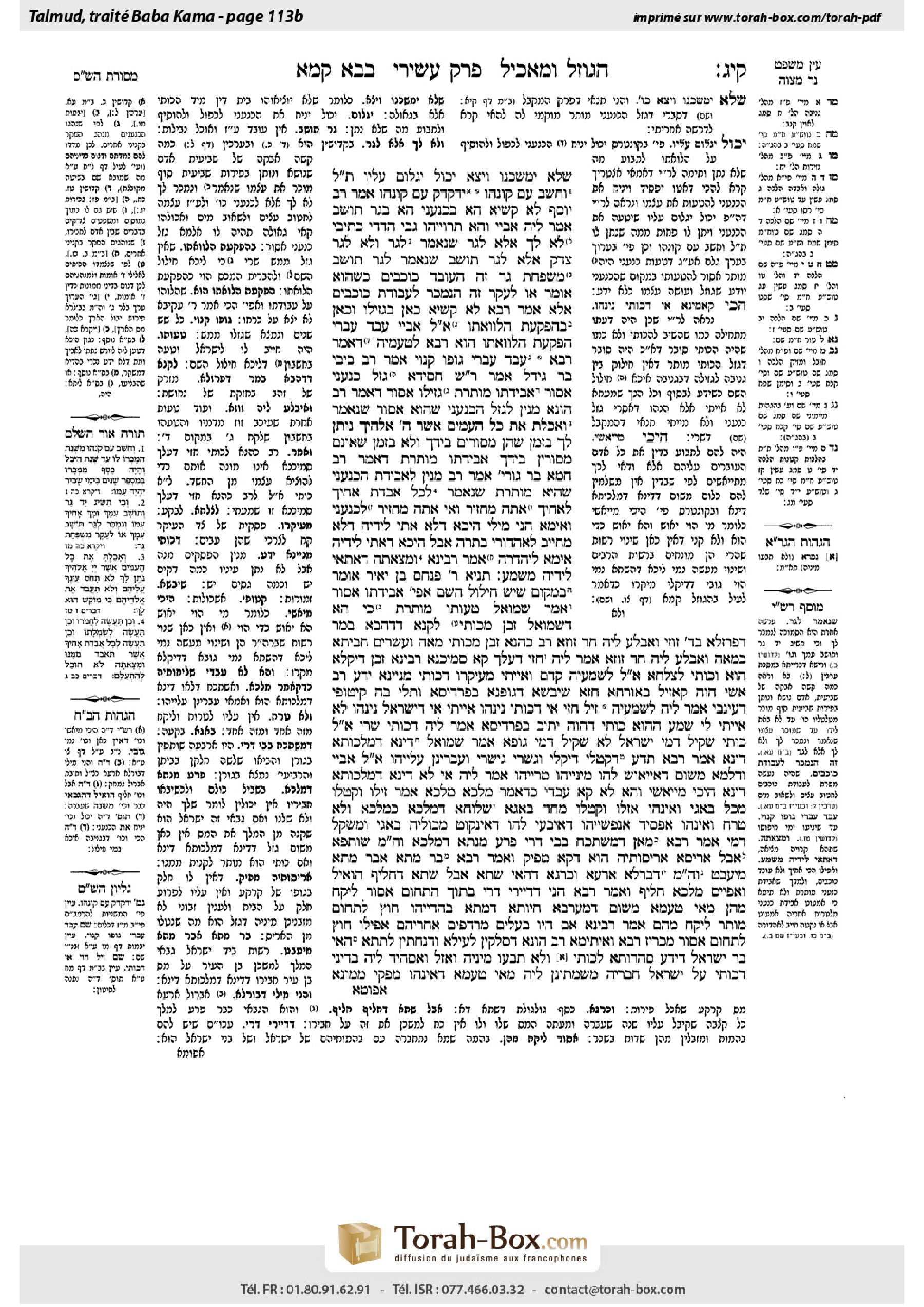
Bava Kamma 113b: Talmud study for Daf Yomi
Study the Talmud for Daf Yomi with scanned pages, Hebrew text, English translations from Sefaria and AI-generated French translations.
Passage selection and English or AI-generated French translation are available where the scan has annotations. Daf Study is independent of Torah-Box and Sefaria.
Browse Bava Kamma · בבא קמא · All tractatesBava Kamma 113b text and translations
This page of Bava Kamma includes the Aramaic text, an English translation and an AI-generated French translation, alongside the scan above.
בבא קמא קי״ג ב · Aramaic and Hebrew text
שֶׁלֹּא יִמְשְׁכֶנּוּ וְיֵצֵא. יָכוֹל יִגְלוֹם עָלָיו? תַּלְמוּד לוֹמַר: ״וְחִשַּׁב עִם קֹנֵהוּ״ – יְדַקְדֵּק עִם קוֹנֵהוּ!
אָמַר רַב יוֹסֵף: לָא קַשְׁיָא; הָא, בְּגוֹי, הָא בְּגֵר תּוֹשָׁב.
אֲמַר לֵיהּ אַבָּיֵי, וְהָא תַּרְוַיְיהוּ גַּבֵּי הֲדָדֵי כְּתִיבִי: לֹא לְךָ, אֶלָּא לְגֵר – שֶׁנֶּאֱמַר: ״לְגֵר״. וְלֹא לְגֵר צֶדֶק, אֶלָּא לְגֵר תּוֹשָׁב – שֶׁנֶּאֱמַר: ״לְגֵר תּוֹשָׁב״.
״מִשְׁפַּחַת גֵּר״ – זֶה הַגּוֹי; כְּשֶׁהוּא אוֹמֵר: ״אוֹ לְעֵקֶר״ – זֶה הַנִּמְכָּר לַעֲבוֹדָה זָרָה!
אֶלָּא אָמַר רָבָא: לָא קַשְׁיָא; כָּאן בִּגְזֵילוֹ, וְכָאן בְּהַפְקָעַת הַלְווֹאָתוֹ.
אֲמַר לֵיהּ אַבָּיֵי: עֶבֶד עִבְרִי – הַפְקָעַת הַלְווֹאָתוֹ הוּא! רָבָא לְטַעְמֵיהּ, דְּאָמַר רָבָא: עֶבֶד עִבְרִי גּוּפוֹ קָנוּי.
אָמַר רַב בִּיבִי בַּר גִּידֵּל אָמַר רַבִּי שִׁמְעוֹן חֲסִידָא: גֶּזֶל גּוֹי אָסוּר, אֲבֵידָתוֹ מוּתֶּרֶת. גְּזֵילוֹ אָסוּר – דְּאָמַר רַב הוּנָא: מִנַּיִן לְגֶזֶל הַגּוֹי שֶׁהוּא אָסוּר? שֶׁנֶּאֱמַר: ״וְאָכַלְתָּ אֶת כׇּל הָעַמִּים אֲשֶׁר ה׳ אֱלֹהֶיךָ נֹתֵן לָךְ״ – בִּזְמַן שֶׁהֵן מְסוּרִים בְּיָדְךָ, וְלֹא בִּזְמַן שֶׁאֵינָם מְסוּרִין בְּיָדְךָ.
אֲבֵידָתוֹ מוּתֶּרֶת – דְּאָמַר רַב חָמָא בַּר גּוּרְיָא אָמַר רַב: מִנַּיִן לַאֲבֵידַת הַגּוֹי שֶׁהִיא מוּתֶּרֶת? שֶׁנֶּאֱמַר: ״לְכׇל אֲבֵדַת אָחִיךָ״ – לְאָחִיךָ אַתָּה מַחְזִיר, וְאִי אַתָּה מַחְזִיר לְגוֹי.
וְאֵימָא הָנֵי מִילֵּי הֵיכָא דְּלָא אֲתַי לִידֵיהּ, דְּלָא מִחַיַּיב לְאַהְדּוֹרֵי בָּתְרַהּ; אֲבָל הֵיכָא דְּאָתֵי לִידֵיהּ, אֵימָא לַיהְדְּרַהּ! אָמַר רָבִינָא: ״וּמְצָאתָהּ״ – דַּאֲתַאי לִידֵיהּ מַשְׁמַע. תַּנְיָא, רַבִּי פִּנְחָס בֶּן יָאִיר אוֹמֵר: בְּמָקוֹם שֶׁיֵּשׁ חִילּוּל הַשֵּׁם, אֲפִילּוּ אֲבֵידָתוֹ אָסוּר.
אָמַר שְׁמוּאֵל: טָעוּתוֹ מוּתֶּרֶת. כִּי הָא דִּשְׁמוּאֵל זְבַן מִגּוֹי לָקָנָא דְּדַהֲבָא בְּמַר דְּפַרְזְלָא – בְּאַרְבַּע זוּזֵי, וְאַבְלַע לֵיהּ חַד זוּזָא.
רַב כָּהֲנָא זְבַן מִגּוֹי מְאָה וְעֶשְׂרִין חָבְיָתָא בִּמְאָה, וְאַבְלַע לֵיהּ חַד זוּזָא; אֲמַר לֵיהּ: חֲזִי, דַּעֲלָךְ קָא סָמֵיכְנָא. רָבִינָא זְבַן דִּיקְלָא הוּא וְגוֹי לְצַלָּחָא, אֲמַר לֵיהּ לְשַׁמָּעֵיהּ: קְדֵם וְאַיְיתִי מֵעִיקָּרוֹ, דְּגוֹי מִנְיָינָא יָדַע.
רַב אָשֵׁי הֲוָה קָאָזֵיל בְּאוֹרְחָא, חֲזָא שִׁיבְשָׁא דְגוּפְנָא בְּפַרְדֵּיסָא, וּתְלוּ בַּהּ קִיטּוּפֵי דְּעִינְבֵי. אֲמַר לֵיהּ לְשַׁמָּעֵיהּ: זִיל חֲזִי, אִי דְּגוֹי נִינְהוּ – אַיְיתִי. אִי דְּיִשְׂרָאֵל נִינְהוּ – לָא אַיְיתִי לִי. שְׁמַע הָהוּא גּוֹי דַּהֲוָה יָתֵיב בְּפַרְדֵּיסָא, אֲמַר לֵיהּ: דְּגוֹי שְׁרֵי?! אֲמַר לֵיהּ: גּוֹי שָׁקֵיל דְּמֵי, יִשְׂרָאֵל לָא שָׁקֵיל דְּמֵי.
גּוּפָא – אָמַר שְׁמוּאֵל: דִּינָא דְמַלְכוּתָא דִּינָא. אָמַר רָבָא: תִּדַּע, דְּקָטְלִי דִּיקְלֵי וְגָשְׁרִי גִּישְׁרֵי – וְעָבְרִינַן עֲלַיְיהוּ.
אֲמַר לֵיהּ אַבָּיֵי: וְדִלְמָא מִשּׁוּם דְּאִיַּיאוּשׁ לְהוּ מִינַּיְיהוּ מָרַיְיהוּ! אֲמַר לֵיהּ: אִי לָא דִּינָא דְמַלְכוּתָא דִּינָא, הֵיכִי מִיָּיאֲשִׁי?
וְהָא לָא קָא עָבְדִי כִּדְאָמַר מַלְכָּא – מַלְכָּא אָמַר: זִילוּ וּקְטֻלוּ מִכֹּל בָּאגֵי, וְאִינְהוּ אָזְלוּ וְקָטְלוּ מֵחַד בָּאגָא!
שְׁלוּחָא דְמַלְכָּא – כְּמַלְכָּא, וְלָא טָרַח; וְאִינְהוּ אַפְסִיד אַנַּפְשַׁיְיהוּ – דְּאִיבְּעִי לְהוּ (דְּאִינְקוּט) [לְמִינְקַט] מִכּוּלֵּיהּ בָּאגֵי, וּמִשְׁקַל דְּמֵי.
אָמַר רָבָא: מַאן דְּמִשְׁתְּכַח בְּבֵי דָרֵי, פָּרַע מְנָתָא דְּמַלְכָּא. וְהָנֵי מִילֵּי שׁוּתָּפָא, אֲבָל אֲרִיסָא – אֲרִיסוּתֵיהּ הוּא דְּקָא מַפֵּיק.
וְאָמַר רָבָא: בַּר מָתָא אַבַּר מָתָא מִיעֲבָט. וְהָנֵי מִילֵּי דְּבֹרָלָא אַרְעָא וּכְרָגָא דְּהַאי שַׁתָּא, אֲבָל שַׁתָּא דַּחֲלֵיף – הוֹאִיל וְאִפַּיַּיס מַלְכָּא, חֲלֵיף.
וְאָמַר רָבָא: הָנֵי דְּדָיְירִי דָּרֵי בְּתוֹךְ הַתְּחוּם – אָסוּר לִיקַּח מֵהֶן. מַאי טַעְמָא? מִשּׁוּם דִּמְעָרְבָא חֵיוְתָא דְמָתָא בַּהֲדַיְיהוּ.
חוּץ לַתְּחוּם – מוּתָּר לִיקַּח מֵהֶם. אָמַר רָבִינָא: אִם הָיוּ בְּעָלִים מְרַדְּפִים אַחֲרֵיהֶם, אֲפִילּוּ חוּץ לַתְּחוּם אָסוּר.
מַכְרֵיז רָבָא, וְאִיתֵּימָא רַב הוּנָא: דְּסָלְקִין לְעֵילָּא וּדְנָחֲתִין לְתַתָּא – הַאי בַּר יִשְׂרָאֵל דְּיָדַע סָהֲדוּתָא דְגוֹי (וְלֹא תְּבָעוֹ מִינֵּיהּ), וְאָזֵיל וּמַסְהֵיד לֵיהּ בְּדִינָא דְגוֹיִם עַל יִשְׂרָאֵל חַבְרֵיהּ – מְשַׁמְּתִינַן לֵיהּ. מַאי טַעְמָא? דְּאִינְהוּ מַפְּקִי מָמוֹנָא
Bava Kamma 113b · English translation
indicating that one should not take a Hebrew slave by force and thereby allow him to leave the gentile’s jurisdiction. Rather, the Jew must be freed by legal means. One might have thought that it is permitted to deceive him in order to free the Jew. Therefore, the verse states: “And he shall reckon with him that bought him” (Leviticus 25:50), in order to teach that one must be precise in the financial dealings with the purchaser of a Hebrew slave, and one must pay him the appropriate sum without employing any form of deception. This indicates that it is prohibited to steal from a gentile.
The Gemara answers that Rav Yosef said: It is not difficult, as this ruling that permits the court to deceive a gentile is issued with regard to a regular gentile, whereas that verse, which teaches that it is prohibited to deceive a gentile, is stated with regard to a gentile who resides in Eretz Yisrael and observes the seven Noahide mitzvot [ger toshav].
Abaye said to Rav Yosef: How is it possible to differentiate between a gentile and a ger toshav? Aren’t both of them written next to each other, indicating that the same halakha pertains to both? As it is taught in a baraita: One who violates the prohibitions of the Sabbatical Year will be punished by having to resort to selling himself as a slave. And he will sell himself not to you, but to a stranger, as it is stated: “And sell himself unto the stranger” (Leviticus 25:47), and not to a stranger who is a convert, but to a ger toshav, as it is stated: “And sell himself unto the stranger who is a settler [ger toshav] with you” (Leviticus 25:47).
The verse continues and states: “Or to the offshoot of a stranger’s family.” When it says “a stranger’s family,” this is referring to the gentile family members of a ger toshav, who are idolaters. When it says “or to the offshoot,” this is referring to a Jew who is sold to idol worship, i.e., to work in a temple dedicated to idolatry. Since it is subsequently stated: “He shall reckon with him that bought him” (Leviticus 25:50), it is apparent that this reckoning applies equally to each of the above, including the gentile. This contradicts Rav Yosef’s answer.
Rather, Rava said: It is not difficult because here, in the case of the slave, the halakha is stated with regard to an actual act of robbery committed against a gentile, but there, in the case of the baraita, where it would be permitted to employ deception if not for the desecration of God’s name, the halakha is stated with regard to abrogating his loan. Abrogating a loan owed to a gentile is permitted because it does not entail actually taking money.
Abaye said to Rava: The release of a Hebrew slave from his gentile master is akin to the abrogation of his loan. The purchase price paid by the master is considered as a loan that the slave pays back over the years of his servitude until he goes free at the Jubilee. Consequently, deceptively bringing about his early release is akin to abrogating a loan, yet Rabbi Akiva derives from the verse that it is prohibited to do so. The Gemara answers that Rava conforms to his standard line of reasoning, as Rava says: The body of a Hebrew slave is owned by his master, and retaking him from the gentile by deceptive means would therefore constitute actual robbery.
The Gemara cites another statement related to stealing from a gentile. Rav Beivai bar Giddel says that Rabbi Shimon Ḥasida says: It is prohibited to rob a gentile, but it is permitted to retain his lost item, i.e., one is not required to return it to him. The Gemara examines the basis for each of these rulings: It is prohibited to rob a gentile, as Rav Huna says: From where is it derived that it is prohibited to rob a gentile? It is derived from a verse, as it is stated: “And you shall consume all the peoples that the Lord your God shall deliver unto you” (Deuteronomy 7:16), indicating that it is permitted to consume the other nations’ property only when they are delivered into your hand, i.e., in times of war, but not when they are not delivered into your hand.
It is permitted to retain his lost item, as Rav Ḥama bar Gurya says that Rav says: From where is it derived that it is permitted to retain the lost item of a gentile? It is derived from a verse, as it is stated with regard to the mitzva of returning a lost item: “With every lost thing of your brother’s” (Deuteronomy 22:3), indicating that it is only to your brother that you return a lost item, but you do not return a lost item to a gentile.
The Gemara questions this derivation: But say that this applies only where the item has not yet come into the Jew’s hand, as he is not obligated to pursue it in an effort to find the lost item and return it. But in a case where the item had already come into his hand, say that he must return it to the gentile. The Gemara answers that Ravina said: It is understood from the verse itself, as it states: “And so shall you do with every lost thing of your brother’s, which he has lost, and you have found” (Deuteronomy 22:3), which indicates that the verse refers even to an item that has already come into one’s hand. It is taught in a baraita that Rabbi Pineḥas ben Ya’ir says: In a case where there is a concern that retention of an article lost by a gentile will result in the desecration of God’s name, it is prohibited even to retain a gentile’s lost item.
The Gemara adds: Shmuel says that it is permitted to financially benefit from a business error of a gentile, i.e., it need not be returned. The Gemara notes that this is like that incident where Shmuel purchased a golden bowl [lakna] from a gentile in exchange [bemar] for the price of an iron bowl, which was four dinars, and Shmuel included one additional dinar in the payment so that the gentile would not realize his mistake.
The Gemara relates another incident: Rav Kahana purchased one hundred and twenty barrels from a gentile for the price of one hundred barrels, and he included one additional dinar in the payment. Rav Kahana said to him: Take note that I am relying upon you to check that the transaction has been carried out properly. The Gemara records a third episode: Ravina and a gentile purchased a palm tree together in order to chop it up and split the wood between them. Ravina said to his attendant: Hurry and precede the gentile so that you can bring my share of the wood from the trunk of the tree, which is thicker than the upper part of the tree, as the gentile knows only the number of logs that he is due to receive and will not realize that you are taking thicker pieces.
The Gemara relates a final anecdote: Rav Ashi was traveling on the road and he saw a branch of a grapevine in an orchard, and there were clusters of grapes hanging on it. He said to his attendant: Go see to whom these clusters belong. If they are owned by a gentile, bring some to me, but if they are owned by a Jew, do not bring me any. A certain gentile who was sitting in the orchard overheard Rav Ashi’s instructions. The gentile said to him: Is it permitted to steal the property of a gentile? Rav Ashi said to him: A gentile takes money for his grapes, and I intended to pay for them, but a Jew does not take money for his grapes and I did not want to take them without paying for them.
§ The Gemara relates to the matter of civil law itself. Shmuel says: The law of the kingdom is the law, and the halakhic principle is that Jews must obey the laws of the state in which they reside. Rava said: Know that this principle is true from the fact that the municipal authorities cut down palm trees without the consent of their owners and construct bridges from them, and yet we cross over them. Evidently, the wood is not considered stolen property, which one is prohibited from using, because the law of the kingdom is the law.
Abaye said to Rava: Perhaps the reason the bridges may be used is because their owners despaired of retrieving them and not because the law of the kingdom is the law. Rava said to Abaye: If not for the fact that the law of the kingdom is the law, how would the despair of the owners of the trees allow us to use the bridges? The fact that the owners have despaired of retrieving their wood does not effect a transfer of property, and it therefore still belongs to them.
The Gemara questions Rava’s understanding: But the municipal authorities do not act as the king said. The king said: Go and cut down a bit of wood from all the valleys in the area so that each individual loses only a small amount of wood. They, however, disobey the king and go and cut down all the wood needed for the bridge from one valley. Therefore, even if the law of the kingdom is the law, this cannot be the reason that the halakha permits Jews to cross over such bridges, as the authorities are not enforcing the law of the kingdom, but rather their own unlawful inclinations.
The Gemara answers: An agent of a king is like the king himself, and he is not expected to trouble himself to collect wood proportionally from each valley. They, the owners of the land where the wood is cut, cause themselves a loss, as they should collect compensation from all the other residents of the valleys and take money from them for this purpose. Since the land owners whose wood was used have permission to collect compensation from all the residents in the area, the authorities are acting within their rights by confiscating wood from a single location.
Similarly, Rava says: When the king’s agents come to collect the king’s share of the grain from a field owned by several partners, the one who is found in the granary must pay the king’s share for the entire property, as the agents are not expected to locate and exact payment from each individual proprietor separately. The partner who paid may later claim reimbursement from the other owners for covering their share of the tax. And this statement applies only to partners who share ownership of the field. But a sharecropper collects his portion from the crop but does not own a share of the land. Consequently, the tax may not be collected from his produce, and doing so would constitute robbery.
And Rava also says: Property that belongs to a town dweller may be taken as security for the tax owed by another town dweller. And this statement applies only to the property tax and head tax of that year, but with regard to taxes from the previous year, since the king has already been appeased, the ability to take property belonging to someone else has passed. The tax collector has already paid the entire amount he must pay the king for the previous year, and everything else he collects is his own profit. Although he has the right to collect this extra amount, he may not take property for one person as security for the taxes of someone else.
And Rava says: With regard to those gentiles who construct pens for their animals inside the city limits and charge a fee to bring their animals through the fields around the city to fertilize the fields, it is prohibited to purchase animals from them. What is the reason? It is because the livestock of the Jewish residents of the town become intermingled with their livestock, and it is possible that the animal one would buy is actually stolen property.
Rava adds: If the pens were outside the city limits, it is permitted to purchase livestock from them, as it is unlikely that a Jew’s livestock became intermingled with the seller’s livestock. Ravina said: If the owners of the livestock were pursuing the animals, then even if the pens were outside the city limits, it is prohibited to purchase livestock from the owners of the pens.
§ Apropos the discussion of legal dealings between Jews and gentiles, the Gemara relates: Rava declared, and some say that it was Rav Huna who declared: All who ascend upward to Eretz Yisrael and all who descend downward to Babylonia agree that in the case of a Jew who knows of evidence concerning the legal claim of a gentile, and the gentile did not demand from him that he testify, and the Jew nevertheless went and testified for him in a gentile court, against his fellow Jew, we excommunicate him. What is the reason that we excommunicate him? It is because they, the gentile courts, expropriate money
Bava Kamma 113b · Traduction française (IA)
indiquant que l'on ne doit pas prendre un serviteur juif par la force et ainsi permettre à l'homme de sortir de la juridiction du non-Juif. Plutôt, le Juif doit être libéré par des moyens légaux. On aurait pu penser qu'il était permis de le tromper afin de libérer le Juif. Ainsi, la Sainte Écriture dit : « Et il comptera avec celui qui l'a acheté » (Lévitique 25:50), afin d'enseigner que l'on doit être précis dans les affaires financières avec celui qui a acheté un serviteur juif, et l'on doit lui payer la somme appropriée sans recourir à aucune forme de tromperie. Cela indique que c'est interdit de voler à un non-Juif.
La Guemara répond que Rav Yosef a dit : Ce n'est pas difficile, car cette décision qui permet au tribunal de tromper un non-Juif est émise en référence à un non-Juif ordinaire, tandis que cette versette, qui enseigne qu'il est interdit de tromper un non-Juif, est formulée en référence à un non-Juif résidant en Terre d'Israël et observant les sept commandements de Noé [ger toshav].
Abaye a dit à Rav Yosef : Comment peut-on distinguer entre un non-Juif et un ger toshav ? Ne sont-ils pas tous deux mentionnés côte à côte, indiquant que la même halakha s'applique à tous les deux ? Comme il est enseigné dans une baraïta : Celui qui transgresse les prohibitions de l'année sainte sera puni en ayant à vendre son corps comme esclave. Et il vendra son corps non à vous, mais à un étranger, comme il est dit : « Et il vendra son corps à l'étranger » (Lévitique 25:47), et non à un étranger qui est un converti, mais à un ger toshav, comme il est dit : « Et il vendra son corps à l'étranger qui est un résident [ger toshav] avec vous » (Lévitique 25:47).
La versette continue et dit : « Ou à l'offspring d'une famille étrangère. » Lorsqu'elle dit « une famille étrangère », cela fait référence aux membres de la famille du ger toshav, qui sont des idolâtres. Lorsqu'elle dit « ou à l'offspring », cela fait référence à un Juif vendu à l'idolâtrie, c'est-à-dire à travailler dans un temple dédié à l'idolâtrie. Puisqu'il est ensuite dit : « Il comptera avec celui qui l'a acheté » (Lévitique 25:50), il est évident que cette comptabilité s'applique également à chacun des cas mentionnés ci-dessus, y compris le non-Juif. Cela contredit la réponse de Rav Yosef.
Plutôt, Rava a dit : Ce n'est pas difficile, car ici, dans le cas de l'esclave, la halakha est formulée en référence à un acte réel de vol commis contre un non-Juif, tandis que là, dans le cas de la baraïta, où il serait permis d'utiliser la tromperie si ce n'était pas pour la profanation du Nom de Dieu, la halakha est formulée en référence à l'annulation d'un prêt. L'annulation d'un prêt dû à un non-Juif est permise car elle ne consiste pas à prendre effectivement de l'argent.
Abaye a dit à Rava : La libération d'un esclave juif de son maître non-Juif est semblable à l'annulation de son prêt. Le prix de rachat payé par le maître est considéré comme un prêt que l'esclave rembourse année après année jusqu'à ce qu'il soit libéré au Jubilé. Ainsi, provoquer de manière trompeuse sa libération précoce est semblable à l'annulation d'un prêt, mais Rabbi Akiva dérive de la versette que cela est interdit. La Guemara répond que Rava suit sa ligne de raisonnement habituelle, car Rava dit : Le corps d'un esclave juif appartient à son maître, et reprendre cet esclave du non-Juif par des moyens trompeurs constituerait donc un vol réel.
La Guemara cite une autre déclaration concernant le vol d'un non-Juif. Rav Beivai bar Giddel dit que Rabbi Shimon Ḥasida dit : Il est interdit de voler un non-Juif, mais il est permis de conserver son objet perdu, c'est-à-dire qu'on n'est pas tenu de le lui rendre. La Guemara examine la base de chaque décision : Il est interdit de voler un non-Juif, comme Rav Huna dit : D'où est dérivé le fait qu'il est interdit de voler un non-Juif ? Il est dérivé d'une versette, comme il est dit : « Et vous mangerez tous les peuples que l'Éternel votre Dieu vous livrera » (Dt 7:16), indiquant que c'est permis de consommer la propriété des autres nations uniquement lorsqu'ils sont livrés en votre main, c'est-à-dire en temps de guerre, mais pas lorsqu'ils ne sont pas livrés en votre main.
Il est permis de conserver son objet perdu, comme Rav Ḥama bar Gurya dit que Rav dit : D'où est dérivé le fait qu'il est permis de conserver l'objet perdu d'un non-Juif ? Il est dérivé d'une versette, comme il est dit concernant la mitsva de rendre un objet perdu : « Avec tout objet perdu de votre frère » (Dt 22:3), indiquant que c'est uniquement à votre frère que vous rendez un objet perdu, mais pas à un non-Juif.
La Guemara questionne cette dérivation : Mais disons que cela s'applique uniquement lorsque l'objet n'a pas encore été en possession du Juif, car il n'est pas tenu de le rechercher pour le retrouver et le rendre. Mais dans le cas où l'objet a déjà été en sa possession, disons qu'il doit le rendre au non-Juif. La Guemara répond que Ravina a dit : On le comprend à partir de la versette elle-même, comme elle dit : « Et ainsi tu feras avec tout objet perdu de ton frère, que ton frère a perdu et que tu as trouvé » (Dt 22:3), ce qui indique que la versette s'applique même à un objet déjà en possession d'une personne. Il est enseigné dans une baraïta que Rabbi Pineḥas ben Ya’ir dit : Dans le cas où il y a un danger que la conservation d'un objet perdu par un non-Juif entraîne la profanation du Nom de Dieu, il est interdit même de conserver un objet perdu d'un non-Juif.
La Guemara ajoute : Shmuel dit que c'est permis de bénéficier financièrement d'une erreur d'un non-Juif, c'est-à-dire qu'il n'a pas besoin d'être rendu. La Guemara note que cela ressemble à l'incident où Shmuel a acheté un bol d'or [lakna] d'un non-Juif en échange [bemar] du prix d'un bol d'acier, qui était quatre dinars, et Shmuel a inclus un dinar supplémentaire dans le paiement afin que le non-Juif ne réalise pas son erreur.
Le Guemara rapporte un autre incident : Rav Kahana acheta cent vingt barils à un non-Juif au prix de cent barils, et il ajouta un dinar supplémentaire au paiement. Rav Kahana dit à l'acheteur : Prends note que je compte sur toi pour vérifier que la transaction a été réalisée correctement. Le Guemara rapporte un troisième épisode : Ravina et un non-Juif achetèrent ensemble un palmier afin de le couper en morceaux et de partager le bois entre eux. Ravina dit à son serviteur : Vite, précède le non-Juif afin que tu puisses apporter ma part du bois provenant du tronc du palmier, qui est plus épais que la partie supérieure du palmier, car le non-Juif ne connaît que le nombre de tronçons qu'il est dû de recevoir et ne réalisera pas que tu prends des morceaux plus épais.
Le Guemara rapporte un dernier récit : Rav Ashi voyageait sur la route et il vit une branche de vigne dans un jardin, avec des grappes de raisin suspendues. Il dit à son serviteur : Va voir à qui appartiennent ces grappes. Si elles appartiennent à un non-Juif, apporte-en quelques-unes à moi, mais si elles appartiennent à un Juif, ne m'en apporte pas. Un non-Juif qui était assis dans le jardin entendit les instructions de Rav Ashi. Le non-Juif dit à l'autre : Est-ce permis de voler la propriété d'un non-Juif ? Rav Ashi dit à lui : Un non-Juif reçoit de l'argent pour ses raisins, et j'intendais payer pour eux, mais un Juif ne reçoit pas d'argent pour ses raisins et je ne voulais pas les prendre sans payer pour eux.
§ Le Guemara aborde la question du droit civil lui-même. Shmuel dit : La loi du royaume est la loi, et le principe halakhique est que les Juifs doivent obéir aux lois de l'État où ils résident. Rava dit : Sache que ce principe est vrai du fait que les autorités municipales coupent les palmiers sans le consentement de leurs propriétaires et construisent des ponts à partir d'eux, et pourtant nous traversons ces ponts. Évidemment, le bois n'est pas considéré comme une propriété volée, que l'on est interdit d'utiliser, car la loi du royaume est la loi.
Abaye dit à Rava : Peut-être que la raison pour laquelle les ponts peuvent être utilisés est que leurs propriétaires ont désespéré de les récupérer et non parce que la loi du royaume est la loi. Rava dit à Abaye : Si ce n'était pas pour le fait que la loi du royaume est la loi, comment le désespoir des propriétaires des arbres permettrait-il d'utiliser les ponts ? Le fait que les propriétaires aient désespéré de récupérer leur bois ne constitue pas un transfert de propriété, et il appartient donc toujours à eux.
Le Guemara questionne la compréhension de Rava : Mais les autorités municipales ne font pas comme le roi l'a dit. Le roi dit : Va et coupe un peu de bois dans toutes les vallées de la région afin que chaque individu perde seulement une petite quantité de bois. Ils, cependant, enfreignent la volonté du roi et vont couper tout le bois nécessaire pour le pont d'une seule vallée. Par conséquent, même si la loi du royaume est la loi, cela ne peut pas être la raison pour laquelle la halakha permet aux Juifs de traverser de tels ponts, car les autorités ne respectent pas la loi du royaume, mais plutôt leurs propres inclinations illégales.
Le Guemara répond : Un agent du roi est comme le roi lui-même, et il n'est pas attendu de s'employer à collecter du bois proportionnellement de chaque vallée. Ils, les propriétaires des terres où le bois est coupé, causent eux-mêmes une perte, car ils devraient collecter une compensation de tous les autres habitants des vallées et prendre de l'argent de leur part pour cela. Puisque les propriétaires des terres dont le bois a été utilisé ont le droit de collecter une compensation de tous les habitants de la région, les autorités agissent dans leur droit en confisquant du bois d'une seule localisation.
De même, Rava dit : Lorsque les agents du roi viennent collecter la part du roi dans un champ appartenant à plusieurs partenaires, celui qui est trouvé dans le grenier doit payer la part du roi pour l'ensemble de la propriété, car les agents ne sont pas attendus de localiser et d'exiger le paiement de chaque propriétaire individuel séparément. Le partenaire qui a payé peut ensuite réclamer un remboursement aux autres propriétaires pour couvrir leur part de l'impôt. Et cette déclaration s'applique uniquement aux partenaires qui partagent la propriété du champ. Mais un cultivateur en partage ne collecte sa part du récolte mais ne possède pas une part de la terre. Par conséquent, l'impôt ne peut pas être collecté à partir de ses produits, et faire cela constituerait un vol.
Et Rava dit aussi : La propriété appartenant à un habitant de la ville peut être prise en garantie pour l'impôt dû par un autre habitant de la ville. Et cette déclaration s'applique uniquement à l'impôt foncier et à l'impôt capiteux de cette année, mais concernant les impôts de l'année précédente, puisque le roi a déjà été rassuré, la capacité de prendre la propriété d'une autre personne a disparu. Le récolteur d'impôts a déjà payé l'intégralité de la somme qu'il devait payer au roi pour l'année précédente, et tout ce qu'il collecte d'autre est son propre bénéfice. Bien qu'il ait le droit de collecter cette somme supplémentaire, il ne peut pas prendre la propriété d'une personne comme garantie pour les impôts d'une autre personne.
Et Rava dit : Concernant ceux des non-Juifs qui construisent des enclos pour leurs animaux à l'intérieur des limites de la ville et facturent un frais pour amener leurs animaux à travers les champs autour de la ville afin d'engraisser les champs, il est interdit d'acheter des animaux auprès d'eux. Quelle est la raison ? C'est parce que les bêtes des habitants juifs de la ville s'entremêlent avec leurs bêtes, et il est possible que l'animal que l'on achète soit en réalité une propriété volée.
Rava ajoute : Si les enclos étaient en dehors des limites de la ville, il est permis d'acheter des bêtes auprès d'eux, car il est peu probable que les bêtes des Juifs aient s'entremêlé avec les bêtes du vendeur. Ravina dit : Si les propriétaires des bêtes étaient en chasse après les animaux, alors même si les enclos étaient en dehors des limites de la ville, il est interdit d'acheter des bêtes auprès des propriétaires des enclos.
§ En ce qui concerne la discussion sur les transactions juridiques entre Juifs et non-Juifs, la Guemara rapporte : Rava a déclaré, et certains disent que c'était Rav Huna qui l'avait déclaré : Tous ceux qui montent vers la Terre d'Israël et tous ceux qui descendent vers Babylone s'accordent sur le fait que, dans le cas d'un Juif qui connaît des preuves concernant la revendication juridique d'un non-Juif, et que le non-Juif n'a pas demandé à lui qu'il témoigne, et que le Juif a tout de même témoigné en faveur de lui devant un tribunal non-Juif, contre son propre Juif, nous le mettons sous le joug du Royaume des Cieux. Pourquoi nous le mettons-nous sous le joug ? C'est parce que ces tribunaux non-Juifs exproprièrent de l'argent.
Traduction française générée par IA à partir de l’édition anglaise de Sefaria. Vérifie toujours un passage avec le texte source.
Text from Sefaria: William Davidson Edition - Vocalized Aramaic (CC BY NC); William Davidson Edition - English (CC BY NC).