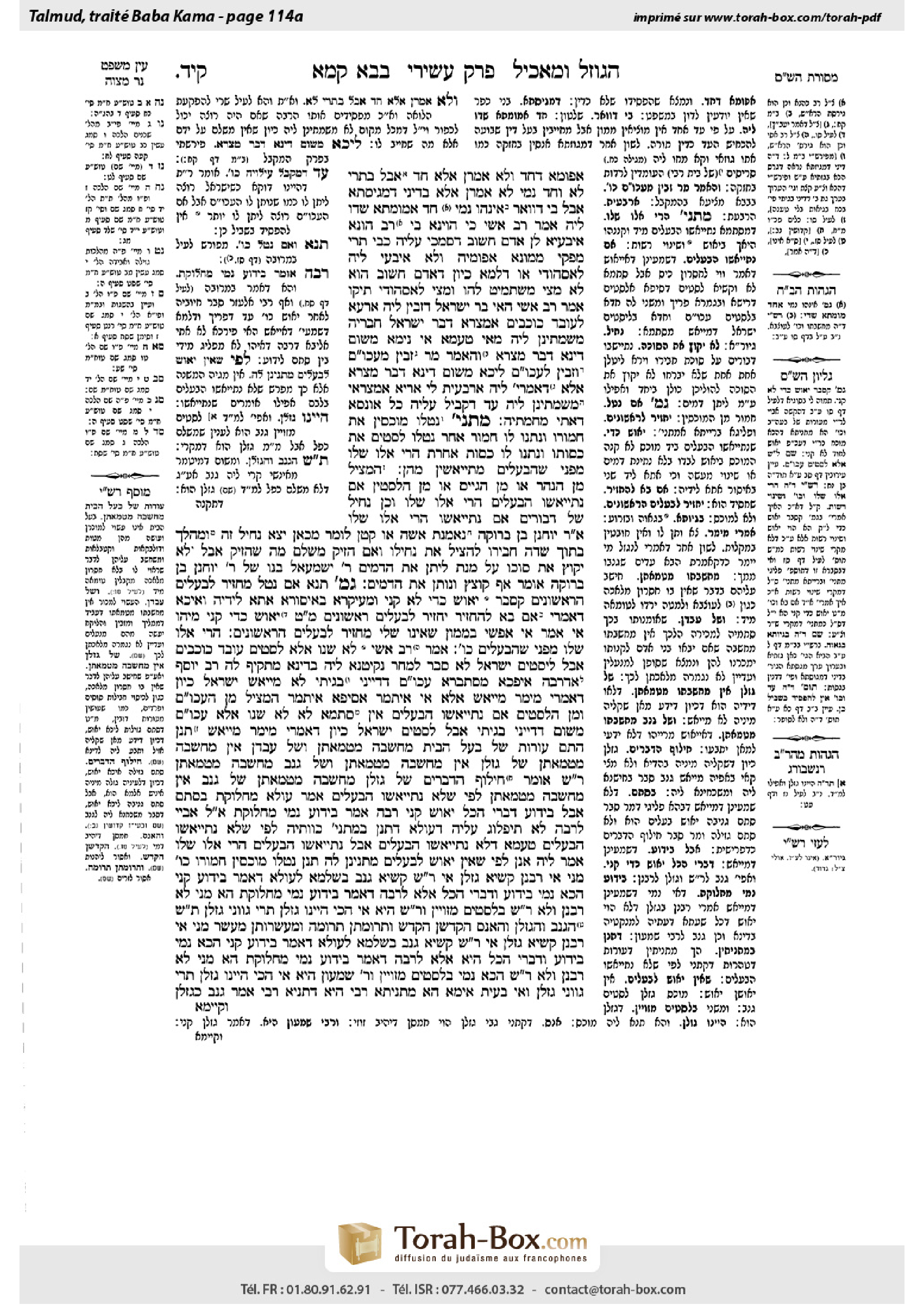
Bava Kamma 114a: Talmud study for Daf Yomi
Study the Talmud for Daf Yomi with scanned pages, Hebrew text, English translations from Sefaria and AI-generated French translations.
Passage selection and English or AI-generated French translation are available where the scan has annotations. Daf Study is independent of Torah-Box and Sefaria.
Browse Bava Kamma · בבא קמא · All tractatesBava Kamma 114a text and translations
This page of Bava Kamma includes the Aramaic text, an English translation and an AI-generated French translation, alongside the scan above.
בבא קמא קי״ד א · Aramaic and Hebrew text
אַפּוּמָּא דְחַד. וְלָא אֲמַרַן אֶלָּא חַד, אֲבָל בִּתְרֵי לָא. וְחַד נָמֵי לָא אֲמַרַן אֶלָּא בְּדִינֵי דְמָגִיסְתָּא, אֲבָל בֵּי דַוּוֹאר – אִינְהוּ נָמֵי חַד אַמּוֹמְתָא שָׁדוּ לֵיהּ.
אָמַר רַב אָשֵׁי: כִּי הֲוֵינָא בֵּי רַב הוּנָא, אִיבַּעְיָא לַן: אָדָם חָשׁוּב דְּסָמְכִי עֲלֵיהּ כְּבֵי תְרֵי – מַפְּקִי מָמוֹנָא אַפּוּמֵּיהּ, וְלָא אִיבְּעִי לֵיהּ לְאַסְהוֹדֵי; אוֹ דִלְמָא כֵּיוָן דְּאָדָם חָשׁוּב הוּא – לָא מָצֵי מִשְׁתְּמִיט לְהוּ, וּמָצֵי לְאַסְהוֹדֵי? תֵּיקוּ.
אָמַר רַב אָשֵׁי: הַאי בַּר יִשְׂרָאֵל דְּזַבֵּין לֵיהּ אַרְעָא לְגוֹי אַמִּצְרָא דְּבַר יִשְׂרָאֵל חַבְרֵיהּ – מְשַׁמְּתִינַן לֵיהּ. מַאי טַעְמָא? אִי נֵימָא מִשּׁוּם דִּינָא דְּבַר מִצְרָא, וְהָאָמַר מָר: זְבַן מִגּוֹי, וְזַבֵּין לְגוֹי, לֵיכָּא מִשּׁוּם דִּינָא דְּבַר מִצְרָא!
אֶלָּא דְּאָמְרִינַן לֵיהּ: אַרְבַּעְתְּ לִי אַרְיָא אַמִּצְרַאי. מְשַׁמְּתִינַן לֵיהּ עַד דְּקַבֵּיל עֲלֵיהּ כֹּל אוּנְסָא דְּאָתֵי מֵחֲמָתֵיהּ.
מַתְנִי׳ נָטְלוּ מוֹכְסִין אֶת חֲמוֹרוֹ וְנָתְנוּ לוֹ חֲמוֹר אַחֵר, נָטְלוּ לִסְטִים אֶת כְּסוּתוֹ וְנָתְנוּ לוֹ כְּסוּת אַחֶרֶת – הֲרֵי אֵלּוּ שֶׁלּוֹ, מִפְּנֵי שֶׁהַבְּעָלִים מִתְיָיאֲשִׁין מֵהֶן. הַמַּצִּיל מִן הַנָּהָר אוֹ מִן הַגַּיִיס אוֹ מִן הַלִּסְטִין, אִם נִתְיָיאֲשׁוּ הַבְּעָלִים – הֲרֵי אֵלּוּ שֶׁלּוֹ. וְכֵן נְחִיל שֶׁל דְּבוֹרִים, אִם נִתְיָיאֲשׁוּ – הֲרֵי אֵלּוּ שֶׁלּוֹ.
אָמַר רַבִּי יוֹחָנָן בֶּן בְּרוֹקָה: נֶאֱמֶנֶת אִשָּׁה אוֹ קָטָן לוֹמַר: מִכָּאן יָצָא נְחִיל זֶה. וּמְהַלֵּךְ בְּתוֹךְ שְׂדֵה חֲבֵירוֹ לְהַצִּיל אֶת נְחִילוֹ, וְאִם הִזִּיק – מְשַׁלֵּם מַה שֶּׁהִזִּיק. אֲבָל לֹא יָקוֹץ אֶת סוֹכוֹ עַל מְנָת לִיתֵּן אֶת הַדָּמִים. רַבִּי יִשְׁמָעֵאל בְּנוֹ שֶׁל רַבִּי יוֹחָנָן בֶּן בְּרוֹקָה אוֹמֵר: אַף קוֹצֵץ וְנוֹתֵן אֶת הַדָּמִים.
גְּמָ׳ תָּנָא: אִם נָטַל – מַחְזִיר לִבְעָלִים הָרִאשׁוֹנִים. קָסָבַר: יֵאוּשׁ כְּדִי לָא קְנֵי, וּמֵעִיקָּרָא בְּאִיסּוּרָא אֲתָא לִידֵיהּ.
וְאִיכָּא דְּאָמְרִי: אִם בָּא לְהַחְזִיר – יַחְזִיר לִבְעָלִים רִאשׁוֹנִים. מַאי טַעְמָא? יֵאוּשׁ כְּדִי קָנֵי. מִיהוּ אִי אָמַר: אִי אֶפְשִׁי בְּמָמוֹן שֶׁאֵינוֹ שֶׁלִּי – מַחְזִיר לִבְעָלִים הָרִאשׁוֹנִים.
הֲרֵי אֵלּוּ שֶׁלּוֹ, מִפְּנֵי שֶׁהַבְּעָלִים כּוּ׳. אָמַר רַב אָשֵׁי: לֹא שָׁנוּ אֶלָּא לִסְטִים גּוֹי, אֲבָל לִיסְטִים יִשְׂרָאֵל – לָא; סָבַר: לִמְחַר נָקֵיטְנָא לֵיהּ בְּדִינָא.
מַתְקֵיף לַהּ רַב יוֹסֵף: אַדְּרַבָּה, אִיפְּכָא מִסְתַּבְּרָא! גּוֹיִם, דְּדָיְינִי בְּגֵיתֵי – לָא מִיָּיאַשׁ; יִשְׂרָאֵל, כֵּיוָן דְּאָמְרִי מֵימָר – מִיָּיאַשׁ!
אֶלָּא אִי אִיתְּמַר, אַסֵּיפָא אִיתְּמַר: הַמַּצִּיל מִן הַגּוֹיִם וּמִן הַלִּסְטִים, אִם נִתְיָיאֲשׁוּ הַבְּעָלִים – אִין, סְתָמָא – לָא.
לֹא שָׁנוּ אֶלָּא גּוֹי, מִשּׁוּם דְּדָיְינִי בְּגֵיתֵי; אֲבָל לִסְטִים יִשְׂרָאֵל, כֵּיוָן דְּאָמְרִי מֵימָר – מִיָּיאַשׁ.
תְּנַן הָתָם: עוֹרוֹת שֶׁל בַּעַל הַבַּיִת, מַחְשָׁבָה מְטַמְּאָתָן;
וְשֶׁל עַבְּדָן, אֵין מַחְשָׁבָה מְטַמְּאָתָן.
שֶׁל גַּזְלָן, אֵין מַחְשָׁבָה מְטַמְּאָתָן; וְשֶׁל גַּנָּב, מַחְשָׁבָה מְטַמְּאָתָן.
רַבִּי שִׁמְעוֹן אוֹמֵר: חִילּוּף הַדְּבָרִים – שֶׁל גַּזְלָן מַחְשָׁבָה מְטַמְּאָתָן, שֶׁל גַּנָּב אֵין מַחְשָׁבָה מְטַמְּאָתָן; לְפִי שֶׁלֹּא נִתְיָיאֲשׁוּ הַבְּעָלִים.
אָמַר עוּלָּא: מַחֲלוֹקֶת בִּסְתָם, אֲבָל בְּיָדוּעַ – דִּבְרֵי הַכֹּל יֵאוּשׁ קָנֵי. רַבָּה אָמַר: בְּיָדוּעַ נָמֵי מַחֲלוֹקֶת.
אֲמַר לֵיהּ אַבָּיֵי לְרַבָּה: לָא תִּיפְלוֹג עֲלֵיהּ דְּעוּלָּא, דִּתְנַן בְּמַתְנִיתִין כְּווֹתֵיהּ – ״לְפִי שֶׁלֹּא נִתְיָיאֲשׁוּ הַבְּעָלִים״. טַעְמָא דְּלֹא נִתְיָיאֲשׁוּ הַבְּעָלִים, אֲבָל נִתְיָיאֲשׁוּ הַבְּעָלִים – הֲרֵי אֵלּוּ שֶׁלּוֹ!
אֲמַר לֵיהּ: אֲנַן, ״לְפִי שֶׁאֵין יֵאוּשׁ לַבְּעָלִים״ מַתְנִינַן לַהּ.
תְּנַן: נָטְלוּ מוֹכְסִין חֲמוֹרוֹ כּוּ׳. מַנִּי?
אִי רַבָּנַן – קַשְׁיָא גַּזְלָן, אִי רַבִּי שִׁמְעוֹן – קַשְׁיָא גַּנָּב!
בִּשְׁלָמָא לְעוּלָּא, דְּאָמַר: בְּיָדוּעַ – קָנֵי; הָכָא נָמֵי בְּיָדוּעַ, וְדִבְרֵי הַכֹּל.
אֶלָּא לְרַבָּה, דְּאָמַר: בְּיָדוּעַ נָמֵי מַחְלוֹקֶת; הָא מַנִּי? לָא רַבָּנַן וְלָא רַבִּי שִׁמְעוֹן! בְּלִסְטִים מְזוּיָּין, וְרַבִּי שִׁמְעוֹן הִיא.
אִי הָכִי, הַיְינוּ גַּזְלָן! תְּרֵי גַּוְונֵי גַּזְלָן.
תָּא שְׁמַע: הַגַּנָּב וְהַגַּזְלָן וְהָאַנָּס – הֶקְדֵּשָׁן הֶקְדֵּשׁ, וּתְרוּמָתָן תְּרוּמָה, וּמַעְשְׂרוֹתָן מַעֲשֵׂר.
מַנִּי? אִי רַבָּנַן – קַשְׁיָא גַּזְלָן, אִי רַבִּי שִׁמְעוֹן – קַשְׁיָא גַּנָּב!
בִּשְׁלָמָא לְעוּלָּא, דְּאָמַר בְּיָדוּעַ קָנֵי; הָכָא נָמֵי בְּיָדוּעַ, וְדִבְרֵי הַכֹּל הִיא. אֶלָּא לְרַבָּה, דְּאָמַר בְּיָדוּעַ נָמֵי מַחְלוֹקֶת; הָא מַנִּי? לָא רַבָּנַן וְלָא רַבִּי שִׁמְעוֹן!
הָכָא נָמֵי – בְּלִסְטִים מְזוּיָּין, וְרַבִּי שִׁמְעוֹן הִיא. אִי הָכִי, הַיְינוּ גַּזְלָן! תְּרֵי גַּוְונֵי גַּזְלָן.
וְאִי בָּעֵית אֵימָא: הָא מַתְנִיתָא – רַבִּי הִיא; דְּתַנְיָא, רַבִּי אָמַר: גַּנָּב – כְּגַזְלָן,
Bava Kamma 114a · English translation
based on the word of one witness, which is insufficient evidence according to Jewish law. And we said that this is so only when one individual testifies alone against his fellow Jew, but when two witnesses testify against a Jew, we do not excommunicate them, as their testimony is sufficient evidence according to Jewish law as well, and they have not caused the defendant any unjustified financial loss even according to halakha. And in a case of a single witness also, we said that we excommunicate him only if he testified in a court of villagers [demagista], but if he testified in the official government courthouse [bei davar], he is not excommunicated. This is because they also prescribe an oath to the defendant based on the testimony of a single witness, but they do not expropriate money, in accordance with Jewish law.
The Gemara relates that Rav Ashi said: When I was in the academy of Rav Huna, the following dilemma was raised before us: What is the halakha with regard to an important person, whose testimony is relied upon by the gentile courts as if it were the testimony of two witnesses? Since the gentile court will expropriate money based on his word, should the halakha be that he should not testify? Or perhaps, since he is an important person, he cannot escape the authorities who demand his testimony, and he may therefore testify. The Gemara concludes: The dilemma shall stand unresolved.
§ The Gemara cites another situation where a Jew is excommunicated for causing harm to another Jew. Rav Ashi said: In the case of a Jewish man who sells a gentile a plot of land that is on the border of the property of his fellow Jew, we excommunicate him. What is the reason? If we say it is because he has ignored the right of one whose field borders the field of his neighbor to be the first one offered the purchase of the field, but doesn’t the Master say: With regard to one who purchases land from a gentile, and one who sells land to a gentile, there is no right of one whose field borders the field of his neighbor to be the first one offered the purchase of the field?
Rather, it is because we say to him on behalf of the owner of the adjacent field: You have placed a lion, i.e., a dangerous individual, on my border, as the gentile might now cause me harm. Consequently, we excommunicate him until he accepts upon himself responsibility for all harm that comes upon the neighbor due to the gentile’s activities.
MISHNA: If customs collectors took one’s donkey and gave him a different donkey that was taken from another Jew in its stead, or if bandits took his garment and gave him a different garment that was taken from a Jew in its stead, these items are now his because the owners despaired of retrieving them when they were stolen, and they may therefore be acquired by another. In a case of one who salvages items from a river, or from a troop [hagayis] of soldiers, or from bandits, if the owners of the items despaired of retrieving them, they are his, i.e., they belong to the one who salvaged them. And so too, with regard to a swarm of bees, if the owners despaired of retrieving the bees, they are his, i.e., they belong to the one who found them.
Rabbi Yoḥanan ben Beroka said: A woman or a minor, whose testimony is not generally accepted by the court, is deemed credible to say: It was from here that this swarm emerged, and it therefore belongs to a certain individual. And one may walk into another’s field in order to salvage his own swarm of bees that has relocated there, and if he damaged some property in the process, he must pay for what he has damaged. But if the bees settled on a branch of a tree, he may not cut off the other’s branch in order to take the bees, even on the condition that he will later give him the money for it. Rabbi Yishmael, son of Rabbi Yoḥanan ben Beroka, says: He may even cut off the branch and later give him the money for it as compensation.
GEMARA: The mishna teaches that one who is given an item by a customs collector or a bandit may keep the item. It was taught in a baraita: If he took a donkey from the customs collector, he must return it to the original owners. The Gemara explains: The tanna of this baraita holds that despair alone does not effect legal acquisition. Consequently, the customs collector did not acquire the donkey, and it initially came into the possession of the individual to whom the customs collector gave it illegally, and he is therefore required to return it to the original owner.
And there are those who say that the baraita means that if he wants to act beyond the letter of the law and comes to return it voluntarily, he should return it to the original owners, but he is not required to return it. What is the reason that he is not required to return it? It is because despair alone effects legal acquisition and the donkey was, therefore, acquired by the Jew when the customs collector gave it to him. Nevertheless, if he said: I do not want to accept money that is not mine, he returns it to the original owners.
§ The mishna teaches that if customs collectors or bandits replaced one’s item with one taken from another Jew, these items are now his because the owners despaired of retrieving them when they were stolen. In this regard, Rav Ashi says: They taught that the owners certainly despaired of recovering their property only when it was stolen by a gentile bandit, but if it was taken by a Jewish bandit, no, the owner did not necessarily despair of recovering it. This is because the victim of the theft might reason: Tomorrow, I will take him to court and force him to return what he stole.
Rav Yosef objects to this: On the contrary, the opposite is more reasonable: When dealing with gentiles, who judge a case and impose their verdicts with force, he does not despair because he realizes that the gentile court will enforce the law. By contrast, when dealing with a Jew, since Jewish courts merely pronounce a verbal decision but do not have the authority to enforce it, the victim despairs of recovering his property.
Rather, if Rav Ashi’s distinction was stated, it was stated with regard to the latter clause of the mishna, which states: In the case of one who salvages an item from gentiles or from bandits, if the owners despaired of retrieving it, the one who finds it may keep it. The Gemara infers: If it is known that the owners despaired of retrieving it, yes, the finder may keep the item; but in an unspecified situation, where it is not known whether the owners despaired, the finder may not keep the item.
Concerning this, Rav Ashi said: They taught this only when the item was stolen by a gentile bandit, because the gentile court judges a case and imposes its verdict with force, and therefore it cannot be assumed that the owners despair. But if the robbery was committed by a Jewish bandit, since Jewish courts merely pronounce a verbal decision but do not have the authority to enforce it, the victim despairs of recovering his property.
§ Apropos the discussion with regard to an owner’s despair of retrieving a lost or stolen item, the Gemara notes that we learned in a mishna there (Kelim 26:8): With regard to hides that are tanned by the owner himself, thought renders them susceptible to ritual impurity. Hides and leather are susceptible to contracting impurity only if they are in a finished state. If a private individual uses a piece of hide or leather for a certain purpose, e.g., as a cot or a table top, and decides that this will be its fixed purpose, it is considered a finished product and is susceptible to contracting impurity.
But with regard to hides belonging to a leatherworker, thought does not render them susceptible to ritual impurity. Since this individual sells leather to others, when he uses a piece of leather for a household purpose and decides that this will be its fixed purpose, it is not considered a finished state, as he is likely to change his mind and sell the leather to one who will process it further and put it to a different use.
The mishna continues: If they are those of a robber, his thought does not render them susceptible to ritual impurity, because he is not considered the owner of the hide. If the hides are those of a thief, who has stolen them from another, the thief’s thought renders them susceptible to ritual impurity. The difference is that unlike the case of a thief, who steals items stealthily, the identity of a robber, who takes the item openly, is known to the owner, and he harbors hope of finding him and getting the item back. Consequently, he does not despair of recovering his property.
Rabbi Shimon says that the matters are reversed: In the case of a robber, the robber’s thought renders them susceptible to ritual impurity. If the hides are those of a thief, thought does not render them susceptible to ritual impurity, because the owners have not despaired of recovering them and the thief has not acquired the hide. Rabbi Shimon’s reasoning is that a robber, who seizes items brazenly, is a more difficult criminal to apprehend and bring to justice than a thief.
The Gemara analyzes the scope of the dispute between Rabbi Shimon and the first tanna. Ulla says: The dispute is only with regard to an unspecified case, where it is unknown whether or not the owners despaired, but where it is known that the owners despaired, all agree that their despair effects legal acquisition. By contrast, Rabba says: Even in cases where it is known that the owners despaired, there is also a dispute, because although the owner may have expressed despair verbally, he may still hope to retrieve the item.
Abaye said to Rabba: Do not disagree with Ulla, as the formulation of the halakha that we learned in the mishna is in accordance with his opinion. The mishna states that according to Rabbi Shimon, thought does not render the hides of a thief susceptible to ritual impurity because the owners did not despair of retrieving them, and therefore the hides do not belong to the thief. This indicates that the reason the thought of the thief does not render the hides susceptible to ritual impurity is that the owners did not despair of retrieving them. But if the owners had despaired of retrieving them, then these items would be his, and his thoughts would render the hides susceptible to ritual impurity.
Rabba said to him: We learned the mishna as saying: A thief cannot render the hides susceptible to ritual impurity because there is no true despair for owners of stolen goods, even if they state they have despaired.
We learned in the mishna here that if customs collectors took one’s donkey and replaced it with a donkey taken from another Jew, or if bandits took his garment and replaced it with a garment taken from another Jew, he may keep these items because the owners despaired of retrieving them when they were stolen. The Gemara asks: Whose opinion is expressed in this mishna?
If it is in accordance with the Rabbis, who hold that the owner despairs only in the case of a thief who steals secretly, it is difficult, because the mishna indicates that the victim of a robber also despairs of retrieving his property, as in the case of a customs collector. And if it is in accordance with Rabbi Shimon, who holds that the owner despairs only in the case of a robber, it is difficult, because the mishna indicates that the victim of a thief also despairs of retrieving his property, as in the case of bandits.
Granted, according to Ulla, who says that all agree that if it is known that the owners despaired, the individual in possession of the items acquires them, here too it is possible to explain that the mishna is discussing a case where it is known that the owners despaired, and all agree that the recipient of the stolen property may keep it.
But according to Rabba, who says that even in cases where it is known that the owners despaired, there is also a dispute, in accordance with whose opinion is this mishna written? It is not in accordance with the opinion of the Rabbis, and it is not in accordance with the opinion of Rabbi Shimon. The Gemara answers that the mishna is discussing a case of an armed bandit, who is similar to a robber in that he steals using force and aggression. And it is in accordance with the opinion of Rabbi Shimon, who holds that the victim of a robber despairs of recovering his property.
The Gemara asks: If so, this is identical to the case of a robber, i.e., the customs collector, and there is no reason for the mishna to teach the same halakha twice. The Gemara answers that the mishna in fact teaches the halakha with regard to two different types of robbers, the customs collector and the armed bandit.
The Gemara suggests another proof with regard to the dispute between Ulla and Rabba. Come and hear the following baraita: With regard to a thief, a robber, and one who forces another to sell him something, their consecrated items are considered consecrated, and their teruma, the portion of the produce designated for the priest, is considered teruma, and their tithes are considered tithes.
The Gemara asks: Whose opinion is expressed in this baraita? If it is in accordance with the Rabbis, it is difficult because the baraita assumes that even the victim of a robber despairs of retrieving his property, as seen from the halakha that the robber’s act of consecration or separation of teruma or tithes is valid. This contradicts the opinion of the Rabbis, who hold that the thoughts of a robber do not render the hides susceptible to ritual impurity, because he is not considered the owner of the hides. Conversely, if it is in accordance with Rabbi Shimon, it is difficult because the baraita assumes that the victim of a thief despairs of retrieving his property, as seen from the halakha that the thief's act of consecration or separation of teruma or tithes is valid. This contradicts the opinion of Rabbi Shimon, as he holds that the thoughts of a thief do not render the hides susceptible to ritual impurity, because he is not considered the owner of the hides.
Granted, according to Ulla, who says that all agree that if it is known that the owners despaired of recovering their property, the individual in possession of the items acquires them, here too, it is possible to explain that the mishna is discussing a case where it is known that the owners despaired. But according to Rabba, who says that even in cases where it is known that the owners despaired, there is also a dispute, in accordance with whose opinion is this baraita written? It is not written in accordance with the opinion of the Rabbis, and it is not in accordance with the opinion of Rabbi Shimon.
The Gemara answers: Here too, when the baraita mentions a thief it is actually referring to an armed bandit, who is considered a robber because he steals using force and aggression. And it is in accordance with the opinion of Rabbi Shimon, who holds that the victim of a robber despairs of recovering his property. The Gemara asks: If so, this case of a thief is identical to the case of a robber, and there is no reason for the baraita to teach the same halakha twice. The Gemara answers that the baraita wishes to teach the halakha with regard to two different types of robbers.
The Gemara offers an alternative explanation: And if you wish, say instead that this baraita is referring to an actual thief, and it is written in accordance the opinion of Rabbi Yehuda HaNasi. As it is taught in a baraita that Rabbi Yehuda HaNasi said: A thief is like a robber.
Bava Kamma 114a · Traduction française (IA)
basé sur le témoignage d'un seul témoin, ce qui constitue une preuve insuffisante selon la loi juive. Et nous avons dit que c'est ainsi uniquement lorsque un seul individu témoigne contre son concitoyen juif, mais lorsque deux témoins témoignent contre un Juif, nous ne l'excluons pas de la communauté, car leur témoignage constitue une preuve suffisante selon la loi juive également, et ils n'ont pas causé à l'accusé de perte financière injustifiée même selon la halakha. Et dans le cas d'un seul témoin également, nous avons dit que nous l'excluons de la communauté uniquement s'il a témoigné devant un tribunal de villageois [demagista], mais s'il a témoigné devant le tribunal officiel [bei davar], il n'est pas exclu. Cela est dû au fait qu'ils prescrivent également un serment à l'accusé en vertu du témoignage d'un seul témoin, mais ils ne confisquent pas d'argent, conformément à la loi juive.
La Guemara rapporte que Rav Ashi a dit : Lorsque j'étais dans l'académie de Rav Huna, le dilemme suivant a été soulevé devant nous : Quelle est la halakha concernant une personne importante, dont le témoignage est considéré par les tribunaux païens comme celui de deux témoins ? Puisque le tribunal païen confisque de l'argent en vertu de son témoignage, devrait-il être interdit de témoigner ? Ou peut-être, puisque c'est une personne importante, il ne peut échapper aux autorités qui exigent son témoignage, et il peut donc témoigner. La Guemara conclut : Ce dilemme restera sans solution.
§ La Guemara cite une autre situation où un Juif est excommunié pour avoir causé un préjudice à un autre Juif. Rav Ashi a dit : Dans le cas d'un homme juif qui vend un terrain à un païen, qui est situé à la frontière de la propriété de son concitoyen juif, nous l'excluons de la communauté. Quelle est la raison ? Si nous disons que c'est parce qu'il a ignoré le droit de celui dont le champ est adjacent à celui de son voisin d'être le premier offert à l'achat du champ, ne dit-il pas le Maître : Concernant celui qui achète un terrain d'un païen et celui qui vend un terrain à un païen, il n'y a pas de droit de celui dont le champ est adjacent à celui de son voisin d'être le premier offert à l'achat du champ ?
Au contraire, c'est parce que nous disons au propriétaire du champ adjacent : Tu as placé un lion, c'est-à-dire une personne dangereuse, à ma frontière, car le païen pourrait maintenant me causer un préjudice. Par conséquent, nous l'excluons jusqu'à ce qu'il assume la responsabilité de tout préjudice qui pourrait survenir au voisin en raison des activités du païen.
MICHNA : Si des collecteurs de taxes ont pris un âne d'une personne et lui ont donné un autre âne qui avait été pris à un autre Juif à la place, ou si des bandits ont pris sa robe et lui ont donné une autre robe qui avait été prise à un autre Juif à la place, ces objets lui appartiennent désormais, car les propriétaires ont désespéré de les récupérer lorsqu'ils avaient été volés, et ils peuvent donc être acquis par un autre. Dans le cas d'une personne qui récupère des objets d'un fleuve, ou d'une troupe [hagayis] de soldats, ou de bandits, si les propriétaires des objets ont désespéré de les récupérer, ils lui appartiennent, c'est-à-dire qu'ils appartiennent à celui qui les a récupérés. Et de même, concernant une colonie d'abeilles, si les propriétaires ont désespéré de récupérer les abeilles, elles lui appartiennent, c'est-à-dire qu'elles appartiennent à celui qui les a trouvées.
Rabbi Yoḥanan ben Beroka a dit : Une femme ou un mineur, dont le témoignage n'est généralement pas accepté par le tribunal, est considérée comme crédible lorsqu'elle dit : C'est d'ici que cette colonie est sortie, et elle appartient donc à un individu particulier. Et l'on peut entrer dans le champ d'autrui afin de récupérer sa colonie d'abeilles qui s'est déplacée là, et si l'on a endommagé quelque chose en cours de route, il doit payer pour ce qu'il a endommagé. Mais si les abeilles se sont établies sur une branche d'un arbre, il ne peut pas couper la branche d'autrui afin de prendre les abeilles, même s'il est conditionné à lui donner l'argent plus tard. Rabbi Yishmael, fils de Rabbi Yoḥanan ben Beroka, dit : Il peut même couper la branche et lui donner l'argent plus tard comme compensation.
GUEMARA : La mishna enseigne que celui qui reçoit un objet d'un collecteur de taxes ou d'un bandit peut le garder. Il a été enseigné dans une baraïta : S'il a pris un âne du collecteur de taxes, il doit le rendre aux propriétaires originels. La Guemara explique : Le tanna de cette baraïta considère que le désespoir seul ne produit pas une acquisition légale. Par conséquent, le collecteur de taxes n'a pas acquis l'âne, et il est resté en possession de la personne à qui le collecteur de taxes l'avait donné illégalement, et il doit donc le rendre aux propriétaires originels.
Et il y a ceux qui disent que la baraïta signifie que s'il veut agir au-delà de la lettre de la loi et veut volontairement le rendre, il devrait le rendre aux propriétaires originels, mais il n'est pas tenu de le faire. Quelle est la raison pour laquelle il n'est pas tenu de le rendre ? C'est parce que le désespoir seul produit une acquisition légale et l'âne a donc été acquis par le Juif lorsque le collecteur de taxes lui l'avait donné. Cependant, s'il dit : Je ne veux pas accepter de l'argent qui n'est pas le mien, il le rend aux propriétaires originels.
§ La Michna enseigne que si des collecteurs de taxes ou des bandits ont remplacé un objet d'une personne par un objet pris à un autre Juif, ces objets lui appartiennent désormais car les propriétaires ont désespéré de les récupérer lorsqu'ils avaient été volés. À ce sujet, Rav Ashi dit : Ils ont enseigné que les propriétaires désespèrent certainement de récupérer leur propriété uniquement lorsqu'elle a été volée par un bandit païen, mais si elle a été prise par un bandit juif, non, le propriétaire n'a pas nécessairement désespéré de la récupérer. Cela est dû au fait que la victime du vol pourrait raisonner : Demain, je le porterai devant un tribunal et je le forcerai à me rendre ce qu'il a volé.
Rav Yosef s'oppose à cela : Au contraire, l'opposé est plus raisonnable : Lorsqu'on traite avec des païens, qui jugent une affaire et imposent leur verdict par la force, il ne désespère pas car il sait que le tribunal païen exécutera la loi. À l'inverse, lorsqu'on traite avec un Juif, puisque les tribunaux juifs n'ont que des décisions verbales et n'ont pas l'autorité d'appliquer la loi, la victime désespère de récupérer sa propriété.
Plutôt, si la distinction de Rav Ashi a été énoncée, elle a été énoncée concernant la seconde clause de la mitsna, qui stipule : Dans le cas d'une personne qui récupère un objet des non-Juifs ou des bandits, si les propriétaires ont perdu espoir de le récupérer, celui qui le trouve peut le garder. La Guemara déduit : Si on sait que les propriétaires ont perlu espoir de le récupérer, oui, celui qui le trouve peut le garder ; mais dans un cas indéterminé, où on ne sait pas si les propriétaires ont perdu espoir, celui qui le trouve ne peut pas le garder.
Concernant cela, Rav Ashi a dit : Ils ont enseigné cela uniquement lorsque l'objet a été volé par un bandit non-Juif, car le tribunal non-Juif juge une affaire et applique sa décision par la force, et donc on ne peut pas supposer que les propriétaires aient perdu espoir. Mais si le vol a été commis par un bandit Juif, puisque les tribunaux Juifs n'appliquent qu'une décision verbale sans pouvoir l'appliquer, la victime perd espoir de récupérer son bien.
§ En ce qui concerne la discussion concernant l'espoir perdu des propriétaires pour récupérer un objet perdu ou volé, la Guemara note que nous avons appris dans une mitsna là (Kelim 26:8) : Concernant les peaux tannées par le propriétaire lui-même, la pensée les rend susceptibles de souillure rituelle. Les peaux et le cuir sont susceptibles de contracter la souillure uniquement s'ils sont en état fini. Si un individu privé utilise une pièce de cuir ou de peau à un certain usage, par exemple comme un lit ou une surface de table, et décide que cela sera son usage fixe, il est considéré comme un produit fini et est susceptible de contracter la souillure.
Mais concernant les peaux appartenant à un tannier, la pensée ne les rend pas susceptibles de souillure rituelle. Puisque cette personne vend du cuir à d'autres, lorsqu'il utilise une pièce de cuir à un usage domestique et décide que cela sera son usage fixe, il n'est pas considéré comme un produit fini, car il est probable qu'il change d'avis et vende le cuir à quelqu'un qui le traitera davantage et l'utilisera à un autre usage.
La mitsva continue : Si ce sont celles d'un voleur, sa pensée ne les rend pas susceptibles de souillure rituelle, car il n'est pas considéré comme le propriétaire des peaux. Si les peaux sont celles d'un voleur, qui les a volées à un autre, la pensée du voleur les rend susceptibles de souillure rituelle. La différence est que, contrairement au cas d'un voleur, qui vole discrètement, l'identité d'un voleur, qui prend l'objet ouvertement, est connue du propriétaire, et il espère trouver ce dernier et récupérer l'objet. Par conséquent, il ne perd pas espoir de récupérer son bien.
Rabbi Shimon dit que les choses sont inversées : Dans le cas d'un voleur, la pensée du voleur rend les peaux susceptibles de souillure rituelle. Si les peaux sont celles d'un voleur, la pensée ne les rend pas susceptibles de souillure rituelle, car les propriétaires n'ont pas perdu espoir de les récupérer et le voleur n'a pas acquis les peaux. La raison de Rabbi Shimon est que le voleur, qui s'empare des objets ouvertement, est un criminel plus difficile à arrêter et à juger que le voleur.
La Guemara examine l'étendue du désaccord entre Rabbi Shimon et le premier tanna. Ulla dit : Le désaccord porte uniquement sur un cas indéterminé, où on ne sait pas si les propriétaires ont perdu espoir, mais où on sait qu'ils ont perdu espoir, tous s'accordent sur le fait que leur espoir perdu a un effet juridique. À l'inverse, Rabba dit : Même dans les cas où on sait que les propriétaires ont perdu espoir, il y a un désaccord, car bien que le propriétaire puisse avoir exprimé son espoir perdu verbalement, il peut encore espérer récupérer l'objet.
Abaye a dit à Rabba : Ne dis pas que tu es en désaccord avec Ulla, car la formulation de la halakha que nous avons apprise dans la mitsna est conforme à son opinion. La mitsna stipule que selon Rabbi Shimon, la pensée du voleur ne rend pas les peaux susceptibles de souillure rituelle, car les propriétaires n'ont pas perdu espoir de les récupérer, et donc les peaux n'appartiennent pas au voleur. Cela indique que la raison pour laquelle la pensée du voleur ne rend pas les peaux susceptibles de souillure rituelle est que les propriétaires n'ont pas perdu espoir de les récupérer. Mais si les propriétaires avaient perdu espoir de les récupérer, alors ces objets appartiendraient à lui, et sa pensée rendrait les peaux susceptibles de souillure rituelle.
Rabba a dit à lui : Nous avons appris la mitsna comme disant : Un voleur ne peut pas rendre les peaux susceptibles de souillure rituelle, car les propriétaires d'objets volés n'ont pas de véritable espoir perdu, même s'ils déclarent avoir perdu espoir.
Nous avons appris dans la Michna ici que si des collecteurs de taxes ont pris un âne et l'ont remplacé par un âne pris à un autre Juif, ou si des bandits ont pris sa robe et l'ont remplacé par une robe prise à un autre Juif, il peut garder ces objets, car les propriétaires ont perdu espoir de les récupérer. La Guemara pose la question : Quel est l'avis exprimé dans cette Michna ?
Si c'est selon les Rabbins, qui considèrent que le propriétaire perd espoir uniquement dans le cas d'un voleur qui vole discrètement, cela est difficile, car la Michna indique que la victime d'un voleur perd également espoir de récupérer son bien, comme dans le cas des collecteurs de taxes. Et si c'est selon Rabbi Shimon, qui considère que le propriétaire perd espoir uniquement dans le cas d'un voleur, cela est difficile, car la Michna indique que la victime d'un voleur perd également espoir de récupérer son bien, comme dans le cas des bandits.
D'accord, selon Ulla, qui dit que tous s'accordent sur le fait que si on sait que les propriétaires ont perdu espoir, la personne en possession des objets les acquiert, ici aussi on peut expliquer que la Michna discute d'un cas où on sait que les propriétaires ont perdu espoir, et tous s'accordent sur le fait que celui qui possède les objets volés peut les garder.
Mais selon Rabba, qui affirme que même dans les cas où il est connu que les propriétaires ont désespéré, il y a également un désaccord, selon quel avis est-ce que cette mitsna a été rédigée ? Ce n'est pas selon l'avis des Rabbins, et ce n'est pas selon l'avis de Rabbi Shimon. La Guemara répond que la mitsna discute d'un bandit armé, qui est semblable au voleur dans la mesure où il vole par la force et l'agression. Et c'est selon l'avis de Rabbi Shimon, qui considère que la victime d'un voleur désespère de récupérer ses biens.
La Guemara demande : Si c'est ainsi, cela est identique au cas du voleur, c'est-à-dire le percepteur des impôts, et il n'y a pas de raison pour que la mitsna enseigne la même halakha deux fois. La Guemara répond que la mitsna enseigne en réalité la halakha concernant deux types différents de voleurs, le percepteur des impôts et le bandit armé.
La Guemara suggère une autre preuve concernant le désaccord entre Ulla et Rabba. Venez écouter la suivante baraïta : Concernant un voleur, un brigand, et celui qui force un autre à lui vendre quelque chose, leurs objets consacrés sont considérés comme consacrés, et leur terouma, la part des produits destinée au prêtre, est considérée comme terouma, et leurs dîmes sont considérées comme dîmes.
La Guemara demande : Quel est l'avis exprimé dans cette baraïta ? Si c'est selon les Rabbins, cela est difficile, car la baraïta suppose que même la victime d'un voleur désespère de récupérer ses biens, comme on le voit à partir de la halakha selon laquelle l'acte de consécration ou de séparation de terouma ou de dîmes du voleur est valide. Cela contredit l'avis des Rabbins, qui considèrent que les pensées du voleur ne rendent pas les peaux sujets à la souillure rituelle, car il n'est pas considéré comme le propriétaire des peaux. À l'inverse, si c'est selon l'avis de Rabbi Shimon, cela est difficile, car la baraïta suppose que la victime d'un voleur désespère de récupérer ses biens, comme on le voit à partir de la halakha selon laquelle l'acte de consécration ou de séparation de terouma ou de dîmes du voleur est valide. Cela contredit l'avis de Rabbi Shimon, qui considère que les pensées du voleur ne rendent pas les peaux sujets à la souillure rituelle, car il n'est pas considéré comme le propriétaire des peaux.
D'accord, selon Ulla, qui affirme que tous s'accordent sur le fait que si l'on sait que les propriétaires ont désespéré de récupérer leurs biens, la personne en possession des objets les acquiert, ici aussi, on peut expliquer que la mitsna discute d'un cas où l'on sait que les propriétaires ont désespéré. Mais selon Rabba, qui affirme que même dans les cas où l'on sait que les propriétaires ont désespéré, il y a également un désaccord, selon quel avis est-ce que cette baraïta a été rédigée ? Ce n'est pas selon l'avis des Rabbins, et ce n'est pas selon l'avis de Rabbi Shimon.
La Guemara répond : ici aussi, lorsque la baraïta mentionne un voleur, elle fait référence en réalité à un bandit armé, qui est considéré comme un voleur car il vole par la force et l'agression. Et c'est selon l'avis de Rabbi Shimon, qui considère que la victime d'un voleur désespère de récupérer ses biens. La Guemara demande : si c'est ainsi, le cas du voleur est identique à celui du voleur, et il n'y a pas de raison pour que la baraïta enseigne la même halakha deux fois. La Guemara répond que la baraïta souhaite enseigner la halakha concernant deux types différents de voleurs.
La Guemara propose une autre explication : et si vous le souhaitez, dites plutôt que cette baraïta fait référence à un voleur réel, et qu'elle est rédigée selon l'avis de Rabbi Yéhuda HaNasi. Comme il est enseigné dans une baraïta que Rabbi Yéhuda HaNasi a dit : un voleur est comme un voleur.
Traduction française générée par IA à partir de l’édition anglaise de Sefaria. Vérifie toujours un passage avec le texte source.
Text from Sefaria: William Davidson Edition - Vocalized Aramaic (CC BY NC); William Davidson Edition - English (CC BY NC).