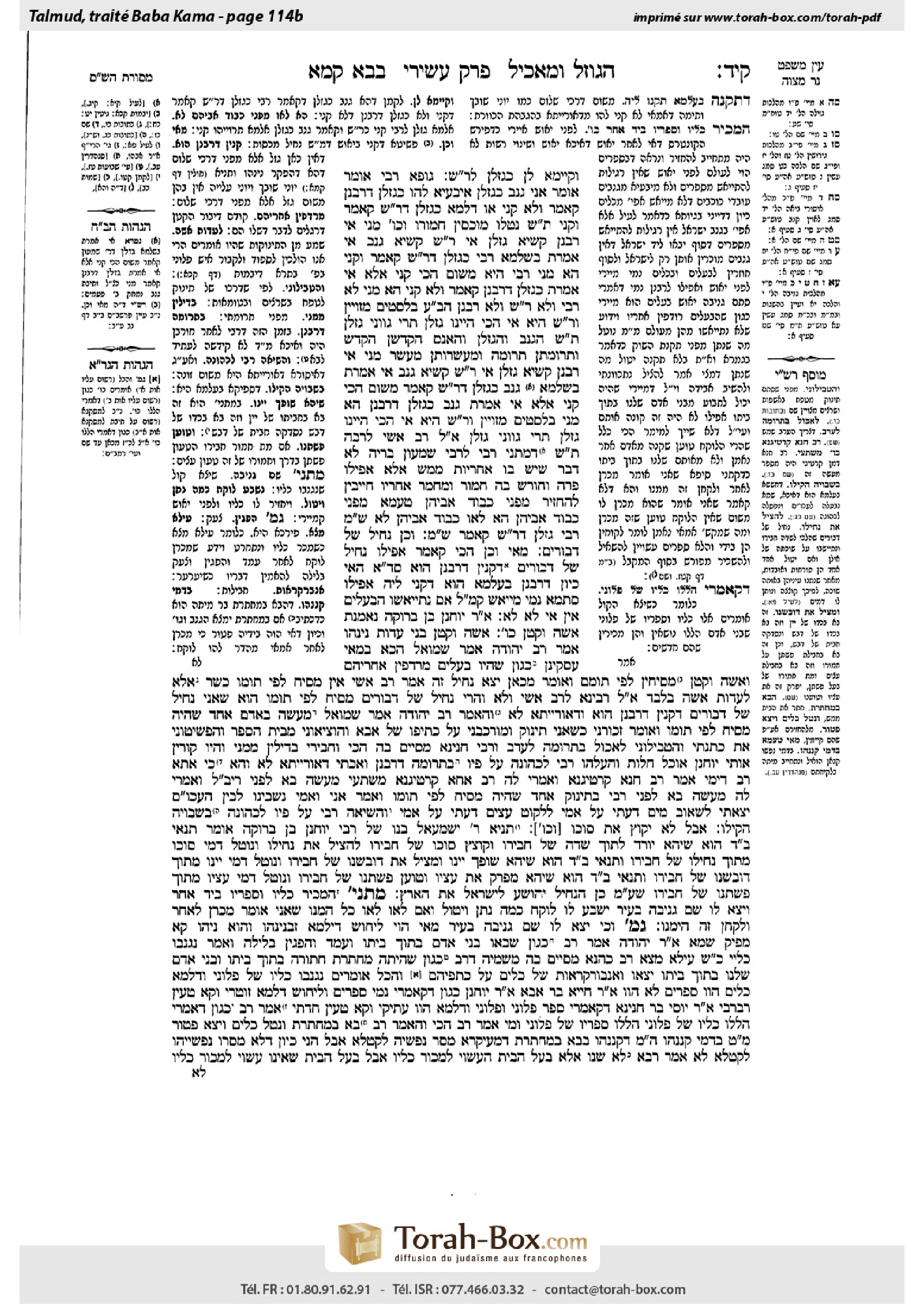
Bava Kamma 114b: Talmud study for Daf Yomi
Study the Talmud for Daf Yomi with scanned pages, Hebrew text, English translations from Sefaria and AI-generated French translations.
Passage selection and English or AI-generated French translation are available where the scan has annotations. Daf Study is independent of Torah-Box and Sefaria.
Browse Bava Kamma · בבא קמא · All tractatesBava Kamma 114b text and translations
This page of Bava Kamma includes the Aramaic text, an English translation and an AI-generated French translation, alongside the scan above.
בבא קמא קי״ד ב · Aramaic and Hebrew text
וְקַיְמָא לַן כְּגַזְלָן לְרַבִּי שִׁמְעוֹן.
גּוּפָא – רַבִּי אוֹמֵר, אוֹמֵר אֲנִי: גַּנָּב – כְּגַזְלָן. אִיבַּעְיָא לְהוּ: כְּגַזְלָן דְּרַבָּנַן קָאָמַר – וְלָא קָנֵי; אוֹ דִלְמָא כְּגַזְלָן דְּרַבִּי שִׁמְעוֹן קָאָמַר, וּקְנֵי?
תָּא שְׁמַע: נָטְלוּ מוֹכְסִין חֲמוֹרוֹ וְכוּ׳.
מַנִּי? אִי רַבָּנַן, קַשְׁיָא גַּזְלָן! אִי רַבִּי שִׁמְעוֹן, קַשְׁיָא גַּנָּב!
אִי אָמְרַתְּ בִּשְׁלָמָא רַבִּי – כְּגַזְלָן דְּרַבִּי שִׁמְעוֹן קָאָמַר, וְקָנֵי; הָא מַנִּי – רַבִּי הִיא, מִשּׁוּם הָכִי קָנֵי.
אֶלָּא אִי אָמְרַתְּ כְּגַזְלָן דְּרַבָּנַן קָאָמַר, וְלָא קָנֵי; הָא מַנִּי? לָא רַבִּי וְלָא רַבִּי שִׁמְעוֹן וְלָא רַבָּנַן!
הָכָא בְּמַאי עָסְקִינַן? בְּלִסְטִים מְזוּיָּין, וְרַבִּי שִׁמְעוֹן הִיא. אִי הָכִי, הַיְינוּ גַּזְלָן! תְּרֵי גַּוְונֵי גַּזְלָן.
תָּא שְׁמַע: הַגַּנָּב וְהַגַּזְלָן וְהָאַנָּס – הֶקְדֵּשָׁן הֶקְדֵּשׁ, וּתְרוּמָתָן תְּרוּמָה, וּמַעְשְׂרוֹתָן מַעֲשֵׂר.
מַנִּי? אִי רַבָּנַן – קַשְׁיָא גַּזְלָן, אִי רַבִּי שִׁמְעוֹן – קַשְׁיָא גַּנָּב!
אִי אָמְרַתְּ בִּשְׁלָמָא גַּנָּב כְּגַזְלָן דְּרַבִּי שִׁמְעוֹן קָאָמַר, מִשּׁוּם הָכִי קָנֵי; אֶלָּא אִי אָמְרַתְּ גַּנָּב כְּגַזְלָן דְּרַבָּנַן, הָא מַנִּי?
בְּלִסְטִים מְזוּיָּין, וְרַבִּי שִׁמְעוֹן הִיא. אִי הָכִי, הַיְינוּ גַּזְלָן! תְּרֵי גַּוְונֵי גַּזְלָן.
אֲמַר לֵיהּ רַב אָשֵׁי לְרַבָּה: תָּא שְׁמַע, דְּמַתְנֵי רַבִּי לְרַבִּי שִׁמְעוֹן בְּרֵיהּ: לֹא דָּבָר שֶׁיֵּשׁ בּוֹ אַחְרָיוּת מַמָּשׁ; אֶלָּא אֲפִילּוּ פָּרָה וְחוֹרֵשׁ בָּהּ, חֲמוֹר וּמְחַמֵּר אַחֲרָיו – חַיָּיבִין לְהַחְזִיר, מִפְּנֵי כְּבוֹד אֲבִיהֶן.
טַעְמָא מִפְּנֵי כְּבוֹד אֲבִיהֶן, הָא לָאו כְּבוֹד אֲבִיהֶן – לָא; שְׁמַע מִינַּהּ: רַבִּי – גַּזְלָן דְּרַבִּי שִׁמְעוֹן קָאָמַר! שְׁמַע מִינַּהּ.
וְכֵן נְחִיל שֶׁל דְּבוֹרִים. מַאי ״וְכֵן״?
הָכִי קָאָמַר: אֲפִילּוּ נְחִיל שֶׁל דְּבוֹרִים, דְּקִנְיָן דְּרַבָּנַן הוּא. סָלְקָא דַּעְתָּךְ אָמֵינָא: הַאי, כֵּיוָן דְּרַבָּנַן בְּעָלְמָא הוּא דְּקָנֵי לֵיהּ – אֲפִילּוּ סְתָמָא נָמֵי מִיָּיאַשׁ; קָא מַשְׁמַע לַן: אִם נִתְיָיאֲשׁוּ הַבְּעָלִים – אֵין, אִי לָא – לָא.
אָמַר רַבִּי יוֹחָנָן בֶּן בְּרוֹקָה: נֶאֱמֶנֶת אִשָּׁה וְקָטָן כּוּ׳.
אִשָּׁה וְקָטָן בְּנֵי עֵדוּת נִינְהוּ? אָמַר רַב יְהוּדָה אָמַר שְׁמוּאֵל: הָכָא בְּמַאי עָסְקִינַן – כְּגוֹן שֶׁהָיוּ בְּעָלִים מְרַדְּפִין אַחֲרֵיהֶם, וְאִשָּׁה וְקָטָן מַסִּיחִין לְפִי תּוּמָּם, וְאוֹמֵר: מִכָּאן יָצָא נְחִיל זֶה.
אָמַר רַב אָשֵׁי: אֵין מֵסִיחַ לְפִי תּוּמּוֹ כָּשֵׁר – אֶלָּא לְעֵדוּת אִשָּׁה בִּלְבָד.
אֲמַר לֵיהּ רָבִינָא לְרַב אָשֵׁי: וְלָא? וַהֲרֵי נְחִיל שֶׁל דְּבוֹרִים – מֵסִיחַ לְפִי תּוּמּוֹ הוּא! שָׁאנֵי נְחִיל שֶׁל דְּבוֹרִים, דְּקִנְיַן דְּרַבָּנַן הוּא.
וּדְאוֹרָיְיתָא לָא? וְהָאָמַר רַב יְהוּדָה אָמַר שְׁמוּאֵל: מַעֲשֶׂה בְּאָדָם אֶחָד שֶׁהָיָה מֵסִיחַ לְפִי תּוּמּוֹ, וְאוֹמֵר: ״זְכוּרַנִי כְּשֶׁאֲנִי תִּינוֹק, וּמוּרְכָּבַנִי עַל כְּתֵיפוֹ שֶׁל אַבָּא, וְהוֹצִיאוּנִי מִבֵּית הַסֵּפֶר, וְהִפְשִׁיטוּנִי אֶת כֻּתׇּנְתִּי, וְהִטְבִּילוּנִי לֶאֱכוֹל בִּתְרוּמָה לָעֶרֶב״.
וְרַבִּי חֲנִינָא מְסַיֵּים בַּהּ הָכִי: ״וַחֲבֵירַי בְּדֵילִין מִמֶּנִּי, וְהָיוּ קוֹרִין אוֹתִי: יוֹחָנָן אוֹכֵל חַלּוֹת״. וְהֶעֱלָהוּ רַבִּי לַכְּהוּנָּה עַל פִּיו!
בִּתְרוּמָה דְּרַבָּנַן.
וְאַכַּתִּי, דְּאוֹרָיְיתָא לָא? וְהָא כִּי אֲתָא רַב דִּימִי אָמַר רַב חָנָא קַרְטִיגָנָא, וְאָמְרִי לַהּ רַב אַחָא קַרְטִיגָנָא מִשְׁתַּעֵי: מַעֲשֶׂה בָּא לִפְנֵי רַבִּי יְהוֹשֻׁעַ בֶּן לֵוִי, וְאָמְרִי לַהּ מַעֲשֶׂה בָּא לִפְנֵי רַבִּי, בְּתִינוֹק אֶחָד שֶׁהָיָה מֵסִיחַ לְפִי תּוּמּוֹ, וְאָמַר: ״אֲנִי וְאִמִּי נִשְׁבִּינוּ לְבֵין הַגּוֹיִם, יָצָאתִי לִשְׁאוֹב מַיִם – דַּעְתִּי עַל אִמִּי, לִלְקוֹט עֵצִים – דַּעְתִּי עַל אִמִּי״.
וְהִשִּׂיאָהּ רַבִּי עַל פִּיו לַכְּהוּנָּה!
בִּשְׁבוּיָה הֵקֵילּוּ.
אֲבָל לֹא יָקוֹץ אֶת סוֹכוֹ [וְכוּ׳]. תַּנְיָא, רַבִּי יִשְׁמָעֵאל בְּנוֹ שֶׁל רַבִּי יוֹחָנָן בֶּן בְּרוֹקָה אוֹמֵר: תְּנַאי בֵּית דִּין הוּא, שֶׁיְּהֵא יוֹרֵד לְתוֹךְ שָׂדֶה שֶׁל חֲבֵירוֹ וְקוֹצֵץ סוֹכוֹ שֶׁל חֲבֵירוֹ, לְהַצִּיל אֶת נְחִילוֹ. וְנוֹטֵל דְּמֵי סוֹכוֹ מִתּוֹךְ נְחִילוֹ שֶׁל חֲבֵירוֹ.
וּתְנַאי בֵּית דִּין הוּא, שֶׁיְּהֵא שׁוֹפֵךְ יֵינוֹ וּמַצִּיל אֶת דּוּבְשָׁנוֹ שֶׁל חֲבֵירוֹ, וְנוֹטֵל דְּמֵי יֵינוֹ מִתּוֹךְ דּוּבְשָׁנוֹ שֶׁל חֲבֵירוֹ. וּתְנַאי בֵּית דִּין הוּא, שֶׁיְּהֵא מְפָרֵק אֶת עֵצָיו וְטוֹעֵן פִּשְׁתָּנוֹ שֶׁל חֲבֵירוֹ, וְנוֹטֵל דְּמֵי עֵצָיו מִתּוֹךְ פִּשְׁתָּנוֹ שֶׁל חֲבֵירוֹ. שֶׁעַל מְנָת כֵּן הִנְחִיל יְהוֹשֻׁעַ לְיִשְׂרָאֵל אֶת הָאָרֶץ.
מַתְנִי׳ הַמַּכִּיר כֵּלָיו וּסְפָרָיו בְּיַד אַחֵר, וְיָצָא לוֹ שֵׁם גְּנֵיבָה בָּעִיר – יִשָּׁבַע לוֹ לוֹקֵחַ כַּמָּה נָתַן, וְיִטּוֹל. וְאִם לָאו – לָאו כֹּל הֵימֶנּוּ, שֶׁאֲנִי אוֹמֵר: מְכָרָן לְאַחֵר, וּלְקָחָן זֶה הֵימֶנּוּ.
גְּמָ׳ וְכִי יָצָא לוֹ שֵׁם גְּנֵיבָה בָּעִיר – מַאי הָוֵי? לֵיחוּשׁ דִּילְמָא זַבְּנִינְהוּ, וְהוּא נִיהוּ קָא מַפֵּיק שְׁמָא!
אָמַר רַב יְהוּדָה אָמַר רַב: כְּגוֹן שֶׁבָּאוּ בְּנֵי אָדָם בְּתוֹךְ בֵּיתוֹ, וְעָמַד וְהִפְגִּין בַּלַּיְלָה, וְאָמַר: נִגְנְבוּ כֵלַיִי. כׇּל שֶׁכֵּן עִילָּא מָצָא!
רַב כָּהֲנָא מְסַיֵּים בַּהּ מִשְּׁמֵיהּ דְּרַב: כְּגוֹן שֶׁהָיְתָה מַחְתֶּרֶת חֲתוּרָה בְּתוֹךְ בֵּיתוֹ, וּבְנֵי אָדָם שֶׁלָּנוּ בְּתוֹךְ בֵּיתוֹ – יָצְאוּ, וְאַנְבּוּרְקְרָאוֹת שֶׁל כֵּלִים עַל כִּתְפֵיהֶם, וְהַכֹּל אוֹמְרִים: ״נִגְנְבוּ כֵּלָיו שֶׁל פְּלוֹנִי״.
וְדִלְמָא כֵּלִים הֲווֹ, סְפָרִים לָא הֲווֹ! אָמַר רַבִּי חִיָּיא בַּר אַבָּא אָמַר רַבִּי יוֹחָנָן: כְּגוֹן דְּקָאָמְרִי נָמֵי סְפָרִים.
וְלֵיחוּשׁ דִּלְמָא זוּטְרֵי, וְקָא טָעֵין רַבְרְבֵי! אָמַר רַבִּי יוֹסֵי בַּר חֲנִינָא, דְּקָאָמְרִי: סֵפֶר פְּלוֹנִי וּפְלוֹנִי.
וְדִלְמָא הֲווֹ עַתִּיקֵי, וְקָא טָעֵין חַדְתֵי! אָמַר רַב, כְּגוֹן דְּאָמְרִי: ״הַלָּלוּ כֵּלָיו שֶׁל פְּלוֹנִי, הַלָּלוּ סְפָרָיו שֶׁל פְּלוֹנִי״.
וּמִי אָמַר רַב הָכִי? וְהָאָמַר רַב: בָּא בַּמַּחְתֶּרֶת, וְנָטַל כֵּלִים וְיָצָא – פָּטוּר. מַאי טַעְמָא? בִּדְמֵי קְנָנְהוּ!
הָנֵי מִילֵּי דִּקְנָנְהוּ – בְּבָא בַּמַּחְתֶּרֶת, דְּמֵעִיקָּרָא מְסַר נַפְשֵׁיהּ לִקְטָלָא; אֲבָל הָנֵי, כֵּיוָן דְּלָא מְסַרוּ נַפְשַׁיְיהוּ לִקְטָלָא – לָא.
אָמַר רָבָא: לֹא שָׁנוּ אֶלָּא בַּעַל הַבַּיִת הֶעָשׂוּי לִמְכּוֹר כֵּלָיו, אֲבָל בַּעַל הַבַּיִת שֶׁאֵינוֹ עָשׂוּי לִמְכּוֹר כֵּלָיו –
Bava Kamma 114b · English translation
And we maintain, as the Gemara concludes below, that Rabbi Yehuda HaNasi means that the halakha that applies to a thief is like the halakha that applies to a robber according to the opinion of Rabbi Shimon, who holds that the owner despairs of recovering his item once it is stolen by a robber.
§ The Gemara examines the matter itself. Rabbi Yehuda HaNasi says: I say that the halakha that applies to a thief is like the halakha that applies to a robber. A dilemma was raised before the Sages: Was Rabbi Yehuda HaNasi saying that the halakha that applies to a thief is like the halakha that applies to a robber according to the opinion of the Rabbis, who hold that the owners do not despair of recovering their item, and a thief therefore does not acquire the items he steals? Or perhaps he was saying that the halakha that applies to a thief is like the halakha that applies to a robber according to the opinion of Rabbi Shimon, who holds that the owners despair of recovering their property, and a thief therefore acquires the stolen items.
The Gemara attempts to resolve the dilemma. Come and hear a proof from the mishna: If customs collectors took one’s donkey and gave him a different donkey that was taken from another Jew in its stead, or if bandits took his garment and gave him a different garment that was taken from a Jew in its stead, these items are now his because the owners despaired of retrieving them when they were stolen. It is therefore apparent that despair is assumed both in the case of a robber, i.e., the customs collector, and in the case of a thief, i.e., the bandits.
The Gemara clarifies: Whose opinion is expressed in this mishna? If it is in accordance with the opinion of the Rabbis, who assume that the owners despair only in the case of a thief, it is difficult because the mishna assumes that the victim of a robber also despairs of retrieving his property. And if it is in accordance with the opinion of Rabbi Shimon, who assumes that the owners despair only in the case of a robber, it is difficult because the mishna assumes that the victim of a thief also despairs of retrieving his property.
The Gemara presents the proof: Granted, if you say that Rabbi Yehuda HaNasi was saying that the halakha that applies to a thief is like the halakha that applies to a robber according to the opinion of Rabbi Shimon, who holds that the owners despair of recovering their property, and a thief therefore acquires the stolen items, in accordance with whose opinion is this mishna? It is in accordance with the opinion of Rabbi Yehuda HaNasi, and it is due to that reason that a thief acquires the stolen goods.
But if you say that Rabbi Yehuda HaNasi was saying that the halakha that applies to a thief is like the halakha that applies to a robber according to the opinion of the Rabbis, and a thief therefore does not acquire the stolen goods, in accordance with whose opinion is this mishna? Since the mishna rules that the owners have presumably despaired with regard to both a thief and a robber, it is not in accordance with the opinion of Rabbi Yehuda HaNasi, and it is not in accordance with the opinion of Rabbi Shimon, and it is not in accordance with the opinion of the Rabbis.
The Gemara responds: With what are we dealing here? We are dealing with an armed bandit, who is considered a robber because he steals using force and aggression, and the mishna is in accordance with the opinion of Rabbi Shimon, who holds that despair is assumed in the case of a robber. The Gemara asks: If so, this is identical to the case of a robber, i.e., the mishna’s first case of the customs collector, and there is no reason for the mishna to teach the same halakha twice. The Gemara answers: The mishna wishes to teach the halakha with regard to two different types of robbers.
Come and hear a different proof based upon the aforementioned baraita: With regard to a thief, a robber, and one who forces another to sell him something, their consecrated items are considered consecrated, and their teruma, the portion of the produce designated for the priest, is considered teruma, and their tithes are considered tithes.
Whose opinion is expressed in this baraita? If it is in accordance with the Rabbis, it is difficult because the baraita assumes that the victim of a robber also despairs of retrieving his property, and therefore the robber’s act of consecration or separation of teruma or tithes is valid. Conversely, if it is in accordance with Rabbi Shimon, it is difficult because the baraita assumes that the victim of a thief despairs of retrieving his property.
Granted, if you say that Rabbi Yehuda HaNasi was saying that the halakha that applies to a thief is like the halakha that applies to a robber according to the opinion of Rabbi Shimon, who holds that the owner despairs of recovering his property, it is due to that reason that a thief therefore acquires the stolen items. But if you say that the halakha that applies to a thief is like the halakha that applies to a robber according to the opinion of the Rabbis, in accordance with whose opinion is this baraita written?
The Gemara responds: When the baraita refers to a thief, it is actually referring to an armed bandit, who is legally considered a robber, and it is in accordance with the opinion of Rabbi Shimon, who holds that victims of a robber despair of recovering their property. The Gemara asks: If so, this is identical to the case of a robber that is mentioned in the baraita. The Gemara answers: The baraita wishes to teach the halakha with regard to two different types of robbers.
Rav Ashi said to Rabba: Come and hear a proof from Rabbi Yehuda HaNasi’s own interpretation of the mishna (111b) that states that children who inherit an item that was stolen by their father are obligated to return it to the owner if it is something that serves as a legal guarantee of a loan, e.g., land. Rabbi Yehuda HaNasi would teach Rabbi Shimon, his son, that the mishna is not referring only to something that may actually serve as a legal guarantee, i.e., land. Rather, it is referring even to a cow that he plows with, or a donkey that he drives by directing it from behind, which the heirs are obligated to return because of the honor of their father.
The Gemara infers: The reason that the heirs must return the stolen item is due to the honor of their father. But if it were not for the honor of their father, they would not be required to return it. Conclude from it that Rabbi Yehuda HaNasi was saying that the halakha that applies to a thief is like the halakha that applies to a robber according to the opinion of Rabbi Shimon. The Gemara affirms: Conclude from it that this is so.
§ The mishna teaches: And so too, with regard to a swarm of bees, if the owners despaired of retrieving the bees, they belong to the one who found them. The Gemara inquires: What is the reason that the mishna includes the case of the bees, which begins with the term: And so too?
The Gemara explains: This is what it is saying: The halakha stated by the mishna applies even to a swarm of bees, which is the property of the owners via a rabbinic form of acquisition due to the fact that one cannot effect a legal acquisition of bees by Torah law. It might enter your mind to say that in this case, since one acquires the swarm of bees only by rabbinic law, even where the owners’ response is unspecified it can be assumed that they despair of recovering the bees, and the finder may keep them. To counter this, the mishna teaches us that if it is known that the owners of the bees despaired of recovering them, yes, the finder may keep the bees; if they did not despair, no, he may not keep them.
§ The mishna teaches that Rabbi Yoḥanan ben Beroka said: A woman or a minor is deemed credible to say: It was from here that this swarm emerged, and it therefore belongs to a certain individual.
The Gemara asks: Are a woman and a minor eligible for testimony? The halakha is that women and minors cannot present testimony in court, so how can Rabbi Yoḥanan ben Beroka rule that they are deemed credible? The Gemara explains that Rav Yehuda said that Shmuel said: Here, we are dealing with a case where the owners were pursuing the bees, and the woman and the minor were speaking offhandedly and saying: It was from here that this swarm emerged. In this context, it can be assumed that the individual identified as the owner is the real owner of the bees, even in the absence of formal testimony in court.
Having mentioned a case of offhand remarks, the Gemara states that Rav Ashi says: Information gleaned from one who speaks offhandedly is valid only with regard to testimony enabling a woman to remarry, as the Sages were lenient and decreed that the incidental remarks of certain individuals who are not eligible to serve as witnesses may be relied upon in such a case.
Ravina said to Rav Ashi: And is it so that one does not rely upon offhand remarks in other situations? But the case in the mishna of a swarm of bees is a case of one who speaks offhandedly, and the halakha is that he is deemed credible. Rav Ashi answered: A swarm of bees is different, as it is the property of its owners via a rabbinic form of acquisition. Consequently, the Sages relied on offhand remarks.
The Gemara asks: And is there no case where offhand remarks expressed by those who are ineligible to testify in court would be accepted by Torah law? But doesn’t Rav Yehuda say that Shmuel says: There was an incident involving a certain person who was speaking offhandedly and saying: I remember when I was a child and I would still ride on father’s shoulder. And they took me from school, and removed my tunic, and immersed me in a ritual bath so that I would be able to partake of teruma that evening.
And Rabbi Ḥanina would conclude his retelling of the incident as follows: That individual then went on to say: And my friends would separate themselves from me, and they would call me: Yoḥanan, eater of ḥallot, a reference to the portion of dough given to the priests, which has the same status as teruma. And after hearing this anecdote, Rabbi Yehuda HaNasi elevated him to the priesthood and granted him the right to partake of teruma based on his statement. Since it is prohibited for non-priests to consume teruma by Torah law, it is apparent that offhand remarks may be relied upon even with regard to Torah law, even in cases unrelated to enabling a woman to remarry.
Rav Ashi answers: Rabbi Yehuda HaNasi granted him the right to partake of produce that is teruma only by rabbinic law, as he holds that the requirement to separate teruma after the destruction of the Temple is by rabbinic law. One can still posit that offhand remarks made by individuals who are ineligible to testify in court are not deemed credible with regard to Torah law.
The Gemara asks: And still, is there no other case where offhand remarks made by those who are ineligible to testify in court would be accepted by Torah law? But when Rav Dimi came from Eretz Yisrael, didn’t he say that Rav Ḥana of Carthage [Kartigna], and some say that it was Rav Aḥa of Carthage, related: An incident came before Rabbi Yehoshua ben Levi, and some say that this incident came before Rabbi Yehuda HaNasi, with regard to a certain child who was speaking offhandedly and said: My mother and I were captured and held among the gentiles. When I would go out to draw water, my mind was on my mother, and when I would go out to gather wood, my mind was on my mother. Since the child was always conscious of his mother, he was aware that she was not violated by her captors.
The Gemara concludes the statement of Rav Dimi and explains the challenge: And Rabbi Yehuda HaNasi married her to a priest based on his statement. Since it is prohibited by Torah law for a priest to marry a woman who has engaged in sexual intercourse with a man forbidden to her by Torah law and with whom she cannot establish a marital bond, e.g., a gentile, it is clear that Rabbi Yehuda HaNasi relied on an offhand remark even with regard to a prohibition by Torah law.
The Gemara answers: The Sages were lenient with regard to a captured woman. By Torah law, a woman taken captive may be presumed to remain permitted to a priest, and it is the Sages who decreed that she is forbidden due to the concern that she was raped. It is this rabbinic decree that may be disregarded on the basis of offhand remarks.
§ The mishna teaches: But if the bees settled on a branch of a tree, he may not cut off the other’s branch in order to take the bees, even on the condition that he will later give him the money for it. It is taught in a baraita that Rabbi Yishmael, son of Rabbi Yoḥanan ben Beroka, says: It is a stipulation of the court, which takes effect even without being confirmed by individuals, that one will be permitted to enter another’s field and cut off another’s branch in order to salvage his own swarm of bees. And the owner of the field then collects the value of his branch from his fellow’s swarm.
And it is also a stipulation of the court that one who sees another’s honey barrel break should pour out his own wine and then use the empty wine barrel to salvage the other’s honey, which is more expensive than wine. And the owner of the wine then collects the value of his wine from the other’s honey. And it is also a stipulation of the court that one who sees that another’s donkey has fallen should unload his own wood from his own donkey and load the other’s flax, which is more expensive than wood, in its place. And the owner of the wood then collects the value of his wood from the other’s flax. These stipulations take effect as it was on this condition that Joshua apportioned Eretz Yisrael to the Jewish people.
MISHNA: In a case of one who recognizes his stolen vessels and scrolls in another’s possession, and a rumor had spread in the city that the former had been the victim of theft, the purchaser, i.e., the one in possession of these items, must take an oath to the victim as to how much money he spent on the purchase, and he then takes that sum of money in exchange for returning the items. And if no such rumor had spread, it is not in the purported victim’s power to assert that the items were stolen, and he is not entitled to demand their return, as I could say: The items were never stolen; rather, the purported victim sold them to another, and this individual who currently possesses the item purchased them from that other person.
GEMARA: The Gemara asks: And if a rumor spread in the city that he had been the victim of theft, what of it? Let us suspect that perhaps he sold the items and he himself is spreading the rumor that they were stolen so that he will be able to buy them back.
The Gemara answers that Rav Yehuda said that Rav said: The mishna is discussing a case where people, i.e., guests, came into his house, and he arose at night and shouted [vehifgin], and said: My vessels have been stolen, in which case it seems clear that he was the victim of theft. The Gemara rejects this rationale: On the contrary, the suspicion that he is lying should apply all the more so, as he has found a pretext for claiming that his property was stolen, and it should be suspected that he is taking advantage of the situation dishonestly.
Rav Kahana would conclude this halakha by stating in the name of Rav: The mishna is discussing a case where a group of people spent the night in his house. And there was a tunnel that had been burrowed into his house, and the people that stayed overnight as guests in his house left with bundles of vessels on their shoulders, and everyone says: So-and-so’s vessels were stolen. In such a case, there is clear evidence that the homeowner was the victim of theft.
The Gemara questions this explanation: But perhaps only vessels were stolen but scrolls were not. Why must the purchaser return the scrolls as well as the vessels? The Gemara answers that Rabbi Ḥiyya bar Abba said that Rabbi Yoḥanan said: The mishna is discussing a case where everyone is saying that scrolls were also stolen.
The Gemara asks: But let us suspect that perhaps only small scrolls were taken, while he is claiming that large scrolls were stolen. If this is the case, he is claiming scrolls that do not belong to him. The Gemara answers that Rabbi Yosei bar Ḥanina said: The mishna is discussing a case where people are saying: Such and such a scroll and such and such a scroll were stolen, i.e., it is known which scrolls were taken from the homeowner.
The Gemara questions this as well: But perhaps the scrolls that were stolen were old and had therefore depreciated in value, while he is claiming that new scrolls were taken. If so, he is claiming scrolls that do not belong to him. Rav said: The mishna is discussing a case where people say explicitly: These are so-and-so’s vessels and these are so-and-so’s scrolls. In this case it is known exactly which items were stolen.
The Gemara asks: And did Rav actually say this? But doesn’t Rav himself say that a burglar who came in and took vessels and left is exempt from paying for those items? What is the reason for this exemption? It is because he purchases them with his blood. Since a homeowner is allowed to kill a burglar, a burglar is exempt from returning the stolen items, based on the principle: One receives the greater punishment. Consequently, if the burglar himself is exempt, how can one who purchases an item from the burglar be required to return it?
The Gemara explains: This matter, that one who steals acquires what he stole, applies only to a burglar, as he initially subjected himself to be killed when he broke into the house. But concerning these thieves, who stayed overnight as guests of the homeowner, since they did not break into the house and thereby subject themselves to being killed, they are not exempt from returning the stolen item.
The Gemara notes that Rava says: We taught that all of these conditions must be met before the purchaser can be forced to return the item only with regard to a homeowner who is wont to sell his vessels, but with regard to a homeowner who is not wont to sell his vessels,
Bava Kamma 114b · Traduction française (IA)
Et nous maintenons, comme conclut la Guemara plus bas, que Rabbi Yehuda HaNasi veut dire que la halakha applicable au voleur est comme la halakha applicable au voleur selon l'opinion de Rabbi Shimon, qui considère que l'owner désespère de récupérer son objet une fois volé par un voleur.
§ La Guemara examine la question elle-même. Rabbi Yehuda HaNasi dit : Je dis que la halakha applicable au voleur est comme la halakha applicable au voleur. Un dilemme a été soulevé devant les Sages : Rabbi Yehuda HaNasi voulait-il dire que la halakha applicable au voleur est comme la halakha applicable au voleur selon l'opinion des Rabbins, qui considèrent que les propriétaires ne désespèrent pas de récupérer leur objet, et que le voleur ne récupère donc pas les objets qu'il vole ? Ou bien voulait-il dire que la halakha applicable au voleur est comme la halakha applicable au voleur selon l'opinion de Rabbi Shimon, qui considère que les propriétaires désespèrent de récupérer leur propriété, et que le voleur récupère donc les objets volés.
La Guemara tente de résoudre ce dilemme. Viens écouter une preuve tirée de la Michna : Si des collecteurs de taxes ont pris un âne d'un homme et lui ont donné un autre âne qui avait été volé à un autre Juif à la place, ou si des bandits avaient pris sa robe et lui avaient donné une autre robe volée à un Juif à la place, ces objets sont maintenant à lui, car les propriétaires avaient désespéré de les récupérer lorsqu'ils avaient été volés. Il est donc évident que le désespoir est supposé tant dans le cas d'un voleur, c'est-à-dire les collecteurs de taxes, que dans le cas d'un voleur, c'est-à-dire les bandits.
La Guemara clarifie : De quel opinion s'agit-il dans cette Michna ? Si c'est selon l'opinion des Rabbins, qui supposent que les propriétaires désespèrent uniquement dans le cas d'un voleur, cela est difficile, car la Michna suppose que la victime d'un voleur aussi désespère de récupérer son objet. Et si c'est selon l'opinion de Rabbi Shimon, qui suppose que les propriétaires désespèrent uniquement dans le cas d'un voleur, cela est difficile, car la Michna suppose que la victime d'un voleur aussi désespère de récupérer son objet.
La Guemara présente la preuve : Admettons que tu dis que Rabbi Yehuda HaNasi voulait dire que la halakha applicable au voleur est comme la halakha applicable au voleur selon l'opinion de Rabbi Shimon, qui considère que les propriétaires désespèrent de récupérer leur propriété, et que le voleur récupère donc les objets volés. Selon quelle opinion est cette Michna ? C'est selon l'opinion de Rabbi Yehuda HaNasi, et c'est pour cette raison que le voleur récupère les objets volés.
Mais si tu dis que Rabbi Yehuda HaNasi voulait dire que la halakha applicable au voleur est comme la halakha applicable au voleur selon l'opinion des Rabbins, et que le voleur ne récupère donc pas les objets volés, selon quelle opinion est cette Michna ? Puisque la Michna règle que les propriétaires ont désespéré à l'égard des voleurs et des voleurs, cela n'est pas selon l'opinion de Rabbi Yehuda HaNasi, ni selon l'opinion de Rabbi Shimon, ni selon l'opinion des Rabbins.
La Guemara répond : Avec quels cas nous sommes ici ? Nous sommes ici avec un bandit armé, qui est considéré comme un voleur car il vole par la force et l'agression, et la Michna est selon l'opinion de Rabbi Shimon, qui considère que le désespoir est supposé dans le cas d'un voleur. La Guemara demande : Si c'est ainsi, cela est identique au cas d'un voleur, c'est-à-dire le premier cas de la Michna concernant les collecteurs de taxes, et il n'y a pas de raison pour que la Michna enseigne la même halakha deux fois. La Guemara répond : La Michna veut enseigner la halakha concernant deux types différents de voleurs.
Viens écouter une autre preuve basée sur la baraïta mentionnée précédemment : Concernant un voleur, un voleur, et celui qui force un autre à lui vendre quelque chose, leurs objets consacrés sont considérés comme consacrés, et leur terouma, la part des produits destinée au prêtre, est considérée comme terouma, et leurs dîmes sont considérées comme dîmes.
De quel opinion s'agit-il dans cette baraïta ? Si c'est selon l'opinion des Rabbins, cela est difficile, car la baraïta suppose que la victime d'un voleur aussi désespère de récupérer son objet, et donc l'acte de consécration ou de séparation de terouma ou de dîmes du voleur est valide. À l'inverse, si c'est selon l'opinion de Rabbi Shimon, cela est difficile, car la baraïta suppose que la victime d'un voleur désespère de récupérer son objet.
Admettons que tu dis que Rabbi Yehuda HaNasi affirmait que la halakha applicable au voleur est comme la halakha applicable au voleur selon l'opinion de Rabbi Shimon, qui considère que l'owner désespère de récupérer son objet, c'est pour cette raison que le voleur acquiert donc les objets volés. Mais si tu dis que la halakha applicable au voleur est comme la halakha applicable au voleur selon l'opinion des Rabbins, selon quelle opinion est cette baraïta écrite ?
La Guemara répond : Lorsque la baraïta mentionne un voleur, elle désigne en réalité un bandit armé, qui est juridiquement considéré comme un voleur, et elle est selon l'opinion de Rabbi Shimon, qui considère que les victimes d'un voleur désespèrent de récupérer leur propriété. La Guemara demande : Si c'est ainsi, cela est identique au cas d'un voleur mentionné dans la baraïta. La Guemara répond : La baraïta veut enseigner la halakha concernant deux types différents de voleurs.
Rav Ashi dit à Rabba : Viens écouter une preuve tirée de l'interprétation de Rabbi Yehuda HaNasi sur la mitsna (111b) qui stipule que les enfants qui héritent d'un objet volé par leur père sont tenus de le rendre à l'owner si cet objet sert de garantie légale d'un prêt, par exemple, une terre. Rabbi Yehuda HaNasi enseignait à Rabbi Shimon, son fils, que la mitsna ne se réfère pas uniquement à quelque chose qui peut effectivement servir de garantie légale, c'est-à-dire la terre. Mais elle se réfère également à un bœuf qu'il utilise pour labourer ou à un âne qu'il conduit en le dirigeant depuis l'arrière, que les héritiers sont tenus de rendre en raison de l'honneur de leur père.
La Guemara déduit : La raison pour laquelle les héritiers doivent rendre l'objet volé est due à l'honneur de leur père. Mais si ce n'était pas pour l'honneur de leur père, ils ne seraient pas tenus de le rendre. Concluez-en que Rabbi Yehuda HaNasi disait que la halakha applicable au voleur est comme celle applicable au voleur selon l'opinion de Rabbi Shimon. La Guemara confirme : Concluez-en que c'est ainsi.
§ La mitsna enseigne : De même, concernant une colonie d'abeilles, si les propriétaires ont perdu espoir de récupérer les abeilles, elles appartiennent à celui qui les a trouvées. La Guemara interroge : Quelle est la raison pour laquelle la mitsna inclut le cas des abeilles, qui commence par le terme : De même ?
La Guemara explique : Ce que cela signifie est que la halakha énoncée par la Michna s'applique également à une colonie d'abeilles, qui est la propriété des propriétaires par une acquisition rabbinique, en raison du fait qu'on ne peut acquérir légalement des abeilles par la Torah. Il pourrait entrer en vous l'idée de dire que dans ce cas, puisque l'on acquiert la colonie d'abeilles uniquement par la loi rabbinique, même si la réponse des propriétaires n'est pas spécifiée, on peut supposer qu'ils ont perdu espoir de récupérer les abeilles, et le trouver peut les garder. Pour contrecarrer cela, la Michna nous enseigne que si on sait que les propriétaires des abeilles ont perdu espoir de les récupérer, oui, le trouver peut les garder ; si ce n'est pas le cas, non, il ne peut pas les garder.
§ La Michna enseigne que Rabbi Yoḥanan ben Beroka a dit : Une femme ou un mineur est considéré comme crédible pour dire : C'est d'ici que cette colonie est sortie, et elle appartient donc à un certain individu.
La Guemara interroge : Les femmes et les mineurs sont-ils éligibles à témoigner ? La halakha est que les femmes et les mineurs ne peuvent pas présenter de témoignage en cour, donc comment Rabbi Yoḥanan ben Beroka peut-il dire qu'ils sont considérés comme crédibles ? La Guemara explique que Rav Yehuda a dit que Shmuel a dit : Ici, nous sommes en présence d'un cas où les propriétaires poursuivaient les abeilles, et la femme et le mineur parlaient à la légère en disant : C'est d'ici que cette colonie est sortie. Dans ce contexte, on peut supposer que l'individu identifié comme propriétaire est le véritable propriétaire des abeilles, même en l'absence de témoignage formel en cour.
Ayant mentionné un cas de paroles à la légère, la Guemara affirme que Rav Ashi dit : L'information tirée de celui qui parle à la légère est valable uniquement concernant le témoignage permettant à une femme de se remarier, car les Sages étaient indulgents et ont décrété que les paroles à la légère de certains individus qui ne sont pas éligibles à témoigner peuvent être retenues dans ce cas.
Ravina dit à Rav Ashi : Et est-ce ainsi que l'on ne repose pas sur les paroles à la légère dans d'autres cas ? Mais le cas de la mitsva concernant une colonie d'abeilles est un cas de paroles à la légère, et la halakha est qu'il est considéré comme crédible. Rav Ashi répondit : Une colonie d'abeilles est différente, car elle est la propriété de ses propriétaires par une acquisition rabbinique. Par conséquent, les Sages ont reposé sur les paroles à la légère.
La Guemara interroge : Et n'y a-t-il pas de cas où les paroles à la légère exprimées par ceux qui ne sont pas éligibles à témoigner en cour seraient acceptées par la loi divine ? Mais ne dit-on pas que Rav Yehuda a dit que Shmuel a dit : Il y avait un incident concernant une certaine personne qui parlait à la légère et disait : Je me souviens quand j'étais enfant et je montais encore sur l'épaule de mon père. Et ils m'ont enlevé de l'école, et ils m'ont ôté ma tunique, et ils m'ont immergé dans un bain rituel afin que je puisse participer à la terouma ce soir-là.
Et Rabbi Ḥanina concluait son récit de l'incident ainsi : Cette personne a ensuite dit : Et mes amis se sont détachés de moi, et ils m'appelaient : Yoḥanan, mangeur de ḥallot, référence à la portion de farine donnée aux prêtres, qui a le même statut que la terouma. Et après avoir entendu cette anecdote, Rabbi Yehuda HaNasi a élevé cette personne au sacerdoce et lui a donné le droit de consommer la terouma en se basant sur sa déclaration. Puisque c'est interdit aux non-prêtres de consommer la terouma par la loi divine, il est évident que les paroles à la légère peuvent être retenues même concernant la loi divine, même dans des cas non liés à l'autorisation de remariage d'une femme.
Rav Ashi répondit : Rabbi Yehuda HaNasi a donné à cette personne le droit de consommer les produits de terouma uniquement par la loi rabbinique, car il considère que la séparation de la terouma après la destruction du Temple est par la loi rabbinique. On peut encore affirmer que les paroles à la légère prononcées par des individus non éligibles à témoigner en cour ne sont pas considérées comme crédibles concernant la loi divine.
La Guemara interroge : Et toutefois, n'y a-t-il pas d'autre cas où les paroles à la légère prononcées par ceux qui ne sont pas éligibles à témoigner en cour seraient acceptées par la loi divine ? Mais quand Rav Dimi est venu d'Eretz Yisrael, n'a-t-il pas dit que Rav Ḥana de Carthage [Kartigna], et certains disent que c'était Rav Aḥa de Carthage, a rapporté : Un incident est venu devant Rabbi Yehoshua ben Levi, et certains disent que cet incident est venu devant Rabbi Yehuda HaNasi, concernant un certain enfant qui parlait à la légère et a dit : Ma mère et moi avons été capturés et tenus parmi les païens. Quand je sortais pour tirer de l'eau, mon esprit était sur ma mère, et quand je sortais pour ramasser du bois, mon esprit était sur ma mère. Puisque l'enfant était toujours conscient de sa mère, il savait qu'elle n'avait pas été violée par ses ravisseurs.
La Guemara conclut la déclaration de Rav Dimi et explique le défi : Et Rabbi Yéhuda HaNasi a marié celle-ci à un prêtre selon son discours. Puisque c'est interdit par la loi torahique qu'un prêtre épouse une femme ayant eu des relations sexuelles avec un homme interdit à elle par la loi torahique et avec lequel elle ne peut pas établir un lien marital, par exemple un non-Juif, il est clair que Rabbi Yéhuda HaNasi s'est appuyé sur une remarque à la légère même concernant une interdiction par la loi torahique.
La Guemara répond : Les Sages ont été cléments concernant une femme capturée. Selon la loi torahique, une femme capturée peut être considérée comme permise à un prêtre, et c'est les Sages qui ont décrété qu'elle est interdite en raison de la crainte qu'elle ait été violée. C'est cette déclaration rabbinique qui peut être ignorée sur la base d'une remarque à la légère.
§ La mitsva enseigne : Mais si les abeilles se sont posées sur une branche d'un arbre, il ne peut pas couper la branche de l'autre pour prendre les abeilles, même s'il promet ultérieurement de lui donner l'argent. Il est enseigné dans une baraïta que Rabbi Yishmael, fils de Rabbi Yoḥanan ben Beroka, dit : C'est une stipulation du tribunal, qui s'applique même sans être confirmée par des individus, qui permet à l'un d'entrer dans le champ de l'autre et de couper sa branche pour sauvegarder sa colonie d'abeilles. Et l'propriétaire du champ récupère la valeur de sa branche auprès de la colonie de l'autre.
Et c'est aussi une stipulation du tribunal que celui qui voit un tonneau de miel d'autrui se briser doive verser son propre vin et utiliser le tonneau vide pour sauvegarder le miel, qui est plus cher que le vin. Et l'propriétaire du vin récupère la valeur de son vin auprès du miel. Et c'est aussi une stipulation du tribunal que celui qui voit que l'âne d'autrui est tombé doive décharger son bois de son âne et charger la laine d'autrui, qui est plus cher que le bois, à sa place. Et l'propriétaire du bois récupère la valeur de son bois auprès de la laine. Ces stipulations s'appliquent comme si c'était sur cette condition que Josué a divisé la Terre d'Israël aux Juifs.
MICHNA : Dans un cas où l'un reconnaît ses objets volés et ses scrolls chez l'autre, et qu'un bruit s'est répandu dans la ville que l'ancien avait été la victime d'un vol, l'acheteur, c'est-à-dire celui qui possède ces objets, doit prendre un serment envers la victime concernant la somme qu'il a dépensée pour l'achat, et il récupère cette somme en échange de la restitution des objets. Et si aucun tel bruit n'avait circulé, il n'est pas dans le pouvoir du prétendu victime d'affirmer que les objets avaient été volés, et il n'est pas autorisé à demander leur restitution, car je pourrais dire : Les objets n'ont jamais été volés ; plutôt, le prétendu victime les a vendus à un autre, et cette personne qui possède actuellement l'objet les a achetés à ce autre personne.
GUÉMARA : La Guemara pose la question : Et si un bruit s'était répandu dans la ville qu'il avait été la victime d'un vol, qu'y a-t-il ? Faisons l'hypothèse qu'il a vendu les objets et qu'il-même répand ce bruit pour pouvoir les racheter.
La Guemara répond que Rav Yéhuda a dit que Rav a dit : La mitsna parle d’un cas où des gens, c’est-à-dire des invités, sont entrés dans sa maison, et il est sorti la nuit et a crié [vehifgin], et a dit : Mes objets ont été volés, dans ce cas il semble clair qu’il était la victime d’un vol. La Guemara rejette cette raisonnement : Au contraire, la suspicion qu’il ment devrait s’appliquer encore plus, car il a trouvé un prétexte pour affirmer que ses biens avaient été volés, et il devrait être suspecté d’abuser de la situation de manière malhonnête.
Rav Kahana conclurait cette halakha en disant au nom de Rav : La mitsna parle d’un cas où un groupe de personnes a passé la nuit dans sa maison. Et il y avait un tunnel qui avait été creusé dans sa maison, et les personnes qui avaient passé la nuit en tant qu’invités dans sa maison sont sorties avec des ballots d’objets sur leurs épaules, et tout le monde disait : Les objets de tel et tel ont été volés. Dans ce cas, il y a des preuves claires que le propriétaire de la maison était la victime d’un vol.
La Guemara questionne cette explication : Mais peut-être seulement des objets ont été volés mais pas les scrolls. Pourquoi le acheteur doit-il rendre les scrolls ainsi que les objets ? La Guemara répond que Rabbi Ḥiyya bar Abba a dit que Rabbi Yoḥanan a dit : La mitsna parle d’un cas où tout le monde dit que les scrolls ont aussi été volés.
La Guemara pose la question : Mais faisons l'hypothèse que seulement des petits scrolls ont été pris, tandis qu'il affirme que des grands scrolls ont été volés. Si c'est le cas, il affirme des scrolls qui n'appartiennent pas à lui. La Guemara répond que Rabbi Yosei bar Ḥanina a dit : La mitsna parle d'un cas où les gens disent : Tels et tels scrolls ont été volés, c'est-à-dire qu'il est connu quels scrolls ont été pris du propriétaire de la maison.
La Guemara questionne cela aussi : Mais peut-être les scrolls volés étaient vieux et avaient donc perdu de leur valeur, tandis qu'il affirme que des nouveaux scrolls ont été pris. Si c'est le cas, il affirme des scrolls qui n'appartiennent pas à lui. Rav a dit : La mitsna parle d'un cas où les gens disent explicitement : Ces sont les objets de tel et tel et ces sont les scrolls de tel et tel. Dans ce cas, il est connu exactement quels objets ont été volés.
La Guemara pose la question : Et Rav a-t-il vraiment dit cela ? Mais ne dit-il pas lui-même que le voleur qui est entré et a pris des objets et est parti est exempt de payer pour ces objets ? Quelle est la raison de cette exemption ? C'est parce qu'il les achète avec son sang. Puisque le propriétaire est autorisé à tuer un voleur, le voleur est exempt de rendre les objets volés, selon le principe : On reçoit la punition plus grande. Ainsi, si le voleur lui-même est exempt, comment peut-on exiger que celui qui achète un objet du voleur le rende ?
La Guemara explique que cette affaire, selon laquelle celui qui vole acquiert ce qu'il a volé, s'applique uniquement au voleur, car il s'est initialement soumis à la mort lorsqu'il est entré dans la maison. Concernant ces voleurs, qui sont restés toute la nuit comme hôtes chez le propriétaire, puisqu'ils n'ont pas pénétré dans la maison et n'ont donc pas suivi la mort, ils ne sont pas dispensés de rendre l'objet volé.
La Guemara note que Rava dit : Nous avons enseigné que toutes ces conditions doivent être remplies avant que l'acheteur ne puisse être contraint de rendre l'objet, uniquement en ce qui concerne un propriétaire qui a l'habitude de vendre ses ustensiles, mais en ce qui concerne un propriétaire qui n'a pas l'habitude de vendre ses ustensiles,
Traduction française générée par IA à partir de l’édition anglaise de Sefaria. Vérifie toujours un passage avec le texte source.
Text from Sefaria: William Davidson Edition - Vocalized Aramaic (CC BY NC); William Davidson Edition - English (CC BY NC).