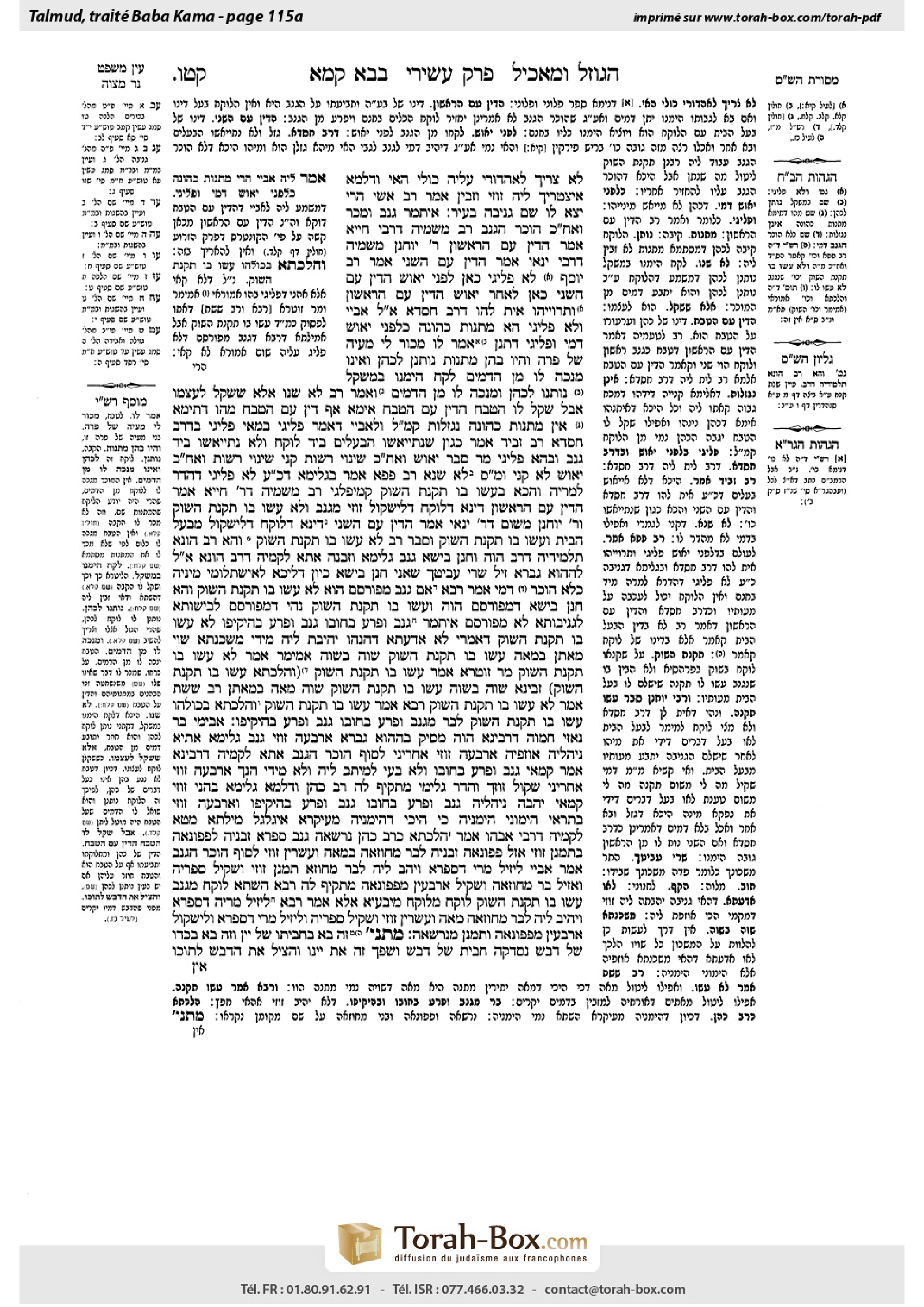
Bava Kamma 115a: Talmud study for Daf Yomi
Study the Talmud for Daf Yomi with scanned pages, Hebrew text, English translations from Sefaria and AI-generated French translations.
Passage selection and English or AI-generated French translation are available where the scan has annotations. Daf Study is independent of Torah-Box and Sefaria.
Browse Bava Kamma · בבא קמא · All tractatesBava Kamma 115a text and translations
This page of Bava Kamma includes the Aramaic text, an English translation and an AI-generated French translation, alongside the scan above.
בבא קמא קי״ה א · Aramaic and Hebrew text
לָא צָרִיךְ לְאַהְדּוֹרֵי עֲלֵיהּ כּוּלֵּי הַאי.
וְדִלְמָא אִיצְטְרִיךְ לֵיהּ זוּזֵי, וְזַבֵּין! אָמַר רַב אָשֵׁי: הֲרֵי יָצָא לוֹ שֵׁם גְּנֵיבָה בָּעִיר.
אִיתְּמַר: גָּנַב וּמָכַר, וְאַחַר כָּךְ הוּכַּר הַגַּנָּב – רַב מִשְּׁמֵיהּ דְּרַבִּי חִיָּיא אָמַר: הַדִּין עִם הָרִאשׁוֹן. רַבִּי יוֹחָנָן מִשְּׁמֵיהּ דְּרַבִּי יַנַּאי אָמַר: הַדִּין עִם הַשֵּׁנִי.
אָמַר רַב יוֹסֵף: לָא פְּלִיגִי; כָּאן לִפְנֵי יֵאוּשׁ – הַדִּין עִם הַשֵּׁנִי, כָּאן לְאַחַר יֵאוּשׁ – הַדִּין עִם הָרִאשׁוֹן.
וְתַרְוַיְיהוּ אִית לְהוּ דְּרַב חִסְדָּא.
אֲמַר לֵיהּ אַבָּיֵי: וְלָא פְּלִיגִי? הָא מַתְּנוֹת כְּהוּנָּה כְּלִפְנֵי יֵאוּשׁ דָּמֵי, וּפְלִיגִי! דִּתְנַן, אָמַר לוֹ: ״מְכוֹר לִי מֵעֶיהָ שֶׁל פָּרָה״, וְהָיוּ בָּהֶן מַתָּנוֹת – נוֹתְנָן לְכֹהֵן, וְאֵינוֹ מְנַכֶּה לוֹ מִן הַדָּמִים. לָקַח הֵימֶנּוּ בְּמִשְׁקָל – נוֹתְנוֹ לְכֹהֵן, וּמְנַכֶּה לוֹ מִן הַדָּמִים.
וְאָמַר רַב: לֹא שָׁנוּ אֶלָּא שֶׁשָּׁקַל לְעַצְמוֹ, אֲבָל שָׁקַל לוֹ הַטַּבָּח – הַדִּין עִם הַטַּבָּח.
אֵימָא: אַף דִּין עִם הַטַּבָּח. מַהוּ דְּתֵימָא: אֵין מַתְּנוֹת כְּהוּנָּה נִגְזָלוֹת, קָא מַשְׁמַע לַן.
וּלְאַבָּיֵי דְּאָמַר פְּלִיגִי, בְּמַאי פְּלִיגִי? בִּדְרַב חִסְדָּא.
רַב זְבִיד אָמַר: כְּגוֹן שֶׁנִּתְיָיאֲשׁוּ הַבְּעָלִים בְּיַד לוֹקֵחַ, וְלֹא נִתְיָיאֲשׁוּ בְּיַד גַּנָּב.
וּבְהָא פְּלִיגִי – מָר סָבַר: יֵאוּשׁ וְאַחַר כָּךְ שִׁינּוּי רְשׁוּת – קָנֵי, שִׁינּוּי רְשׁוּת וְאַחַר כָּךְ יֵאוּשׁ – לָא קָנֵי; וּמָר סָבַר: לָא שְׁנָא.
רַב פָּפָּא אָמַר: בִּגְלִימָא – דְּכוּלֵּי עָלְמָא לָא פְּלִיגִי דְּהָדַר לְמָרֵיהּ, וְהָכָא בְּעָשׂוּ בּוֹ תַּקָּנַת הַשּׁוּק קָמִיפַּלְגִי –
רַב מִשְּׁמֵיהּ דְּרַבִּי חִיָּיא אָמַר הַדִּין עִם הָרִאשׁוֹן – דִּינָא דְּלוֹקֵחַ דְּלִישְׁקוֹל זוּזֵי מִגַּנָּב, וְלֹא עָשׂוּ בּוֹ תַּקָּנַת הַשּׁוּק. וְרַבִּי יוֹחָנָן מִשּׁוּם דְּרַבִּי יַנַּאי אָמַר הַדִּין עִם הַשֵּׁנִי – דִּינָא דְּלוֹקֵחַ דְּלִישְׁקוֹל מִבַּעַל הַבַּיִת, וְעָשׂוּ בּוֹ תַּקָּנַת הַשּׁוּק.
וְסָבַר רַב לֹא עָשׂוּ בּוֹ תַּקָּנַת הַשּׁוּק? וְהָא רַב הוּנָא תַּלְמִידֵיהּ דְּרַב הֲוָה, וְחָנָן בִּישָׁא גְּנַב גְּלִימָא וְזַבְּנַהּ. אֲתָא לְקַמֵּיהּ דְּרַב הוּנָא, אֲמַר לֵיהּ לְהָהוּא גַּבְרָא: זִיל שְׁרִי עֲבִיטָךְ!
שָׁאנֵי חָנָן בִּישָׁא, כֵּיוָן דְּלֵיכָּא לְאִישְׁתַּלּוֹמֵי מִינֵּיהּ – כְּלֹא הוּכַּר דָּמֵי.
אָמַר רָבָא: אִם גַּנָּב מְפוּרְסָם הוּא, לֹא עָשׂוּ בּוֹ תַּקָּנַת הַשּׁוּק. וְהָא חָנָן בִּישָׁא, דִּמְפוּרְסָם הֲוָה, וְעָשׂוּ בּוֹ תַּקָּנַת הַשּׁוּק! נְהִי דִּמְפוּרְסַם לְבִישׁוּתָא, לִגְנִיבוּתָא לָא מְפוּרְסַם.
אִיתְּמַר: גָּנַב וּפָרַע בְּחוֹבוֹ, גָּנַב וּפָרַע בְּהֶיקֵּיפוֹ – לֹא עָשׂוּ בּוֹ תַּקָּנַת הַשּׁוּק, דְּאָמְרִי: לָא אַדַּעְתָּא דְּהָנְהוּ יְהַבְתְּ לֵיהּ מִידֵּי.
מַשְׁכַּנְתָּא; שָׁוֵי מָאתַן בִּמְאָה – עָשׂוּ בּוֹ תַּקָּנַת הַשּׁוּק. שָׁוֶה בְּשָׁוֶה – אַמֵּימָר אָמַר: לֹא עָשׂוּ בּוֹ תַּקָּנַת הַשּׁוּק, מָר זוּטְרָא אָמַר: עָשׂוּ בּוֹ תַּקָּנַת הַשּׁוּק.
וְהִלְכְתָא: עָשׂוּ בּוֹ תַּקָּנַת הַשּׁוּק.
זְבִינָא; שָׁוֶה בְּשָׁוֶה – עָשׂוּ בּוֹ תַּקָּנַת הַשּׁוּק. שָׁוֵי מְאָה בְּמָאתַן – רַב שֵׁשֶׁת אָמַר: לֹא עָשׂוּ בּוֹ תַּקָּנַת הַשּׁוּק, רָבָא אָמַר: עָשׂוּ בּוֹ תַּקָּנַת הַשּׁוּק.
וְהִלְכְתָא: בְּכוּלְּהוּ עָשׂוּ בּוֹ תַּקָּנַת הַשּׁוּק, לְבַר מִגָּנַב וּפָרַע בְּחוֹבוֹ, גָּנַב וּפָרַע בְּהֶיקֵּיפוֹ.
אֲבִימִי בַּר נָאזִי חֲמוּהּ דְּרָבִינָא הֲוָה מַסֵּיק בְּהָהוּא גַּבְרָא אַרְבְּעָה זוּזֵי. גְּנַב גְּלִימָא אֵתְיַאּ נִיהֲלֵיהּ, אוֹזְפֵיהּ אַרְבְּעָה זוּזֵי אַחֲרִינֵי. לְסוֹף הוּכַּר הַגַּנָּב. אֲתָא לְקַמֵּיהּ דְּרָבִינָא,
אֲמַר: קַמָּאֵי – גָּנַב וּפָרַע בְּחוֹבוֹ, וְלָא בָּעֵי לְמִיתַּב לֵיהּ וְלָא מִידֵּי; הָנָךְ אַרְבְּעָה זוּזֵי אַחֲרִינֵי – שְׁקוֹל זוּזָךְ, וְ[אַ]הְדַּר גְּלִימֵי[הּ].
מַתְקֵיף לַהּ רַב כֹּהֵן: וְדִלְמָא גְּלִימָא – בְּהָנֵי זוּזֵי קַמָּאֵי יַהֲבַהּ נִיהֲלֵיהּ, ״גָּנַב וּפָרַע בְּחוֹבוֹ, גָּנַב וּפָרַע בְּהֶיקֵּיפוֹ״; וְאַרְבְּעָה זוּזֵי בָּתְרָאֵי – הֵימוֹנֵי הֵימְנֵיהּ, כִּי הֵיכִי דְּהֵימְנֵיהּ מֵעִיקָּרָא! אִיגַּלְגַּל מִילְּתָא, מְטָא לְקַמֵּיהּ דְּרַבִּי אֲבָהוּ, אָמַר: הִלְכְתָא כְּרַב כֹּהֵן.
נַרְשָׁאָה גְּנַב סִפְרָא, זַבְּנֵיהּ לְפַפּוּנָאָה בִּתְמָנַן זוּזֵי. אֲזַל פַּפּוּנָאָה, זַבְּנֵיהּ לְבַר מָחוֹזָאָה בִּמְאָה וְעֶשְׂרִין זוּזֵי. לְסוֹף הוּכַּר הַגַּנָּב. אָמַר אַבָּיֵי: לֵיזִיל מָרֵי דְסִפְרָא וְיָהֵב לֵיהּ לְבַר מָחוֹזָא תְּמָנַן זוּזֵי וְשָׁקֵיל סִפְרֵיהּ, וְאָזֵיל בַּר מָחוֹזָאָה וְשָׁקֵיל אַרְבְּעִין מִפַּפּוּנָאָה.
מַתְקֵיף לַהּ רָבָא: הַשְׁתָּא לוֹקֵחַ מִגַּנָּב – עָשׂוּ בּוֹ תַּקָּנַת הַשּׁוּק, לוֹקֵחַ מִלּוֹקֵחַ מִיבַּעְיָא?
אֶלָּא אָמַר רָבָא: לֵיזִיל מָרֵיהּ דְּסִפְרָא וְיָהֵיב לֵיהּ לְבַר מָחוֹזָאָה מְאָה וְעֶשְׂרִין זוּזֵי וְשָׁקֵיל סִפְרֵיהּ, וְלֵיזִיל מָרֵי[הּ] דְסִפְרָא וְלִישְׁקוֹל אַרְבְּעִין מִפַּפּוּנָאָה, וּתְמָנַן מִנַּרְשָׁאָה.
מַתְנִי׳ זֶה בָּא בְּחָבִיתוֹ שֶׁל יַיִן וְזֶה בָּא בְּכַדּוֹ שֶׁל דְּבַשׁ, נִסְדְּקָה חָבִית שֶׁל דְּבַשׁ, וְשָׁפַךְ זֶה אֶת יֵינוֹ וְהִצִּיל אֶת הַדְּבַשׁ לְתוֹכוֹ –
Bava Kamma 115a · English translation
one does not need to pursue the matter in all this detail.
The Gemara questions this ruling: Perhaps he needed money, and he therefore sold the items despite the fact that he does not generally sell his personal belongings. The Gemara answers that Rav Ashi said: A rumor spread in the city that he had been a victim of theft. It is reasonable to assume that he is the rightful owner, as he does not usually sell his belongings and it is common knowledge that he was the victim of theft.
§ Having assessed the mishna’s ruling with regard to a case where the thief remained unidentified, the Gemara discusses a case where the thief was found. It was stated: In a case where a thief stole an item and sold it, and later the thief was identified, Rav says in the name of Rabbi Ḥiyya: The homeowner’s claim can be pursued only with the first one, i.e., the thief, but he has no claim against the purchaser. Rabbi Yoḥanan says in the name of Rabbi Yannai: The homeowner’s claim can also be pursued with the second one, i.e., with the purchaser.
Rav Yosef said: Rav and Rabbi Yoḥanan do not disagree. Here, in the case about which Rabbi Yoḥanan issues his ruling, the item was purchased from the thief before the victim of the theft despaired of recovering the stolen item. Consequently, the claim can be pursued even with the second one, i.e., the purchaser. Conversely, there, in the case about which Rav issues his ruling, the item was purchased after the victim despaired, and therefore the claim can be pursued only with the first one, i.e., the thief.
Rav Yosef continues: And both Rav and Rabbi Yoḥanan have accepted as halakha the ruling of Rav Ḥisda (111b), that if the owner had not yet despaired of retrieving his item, he can press his claim against either the thief or the purchaser.
Abaye said to Rav Yosef: And is it so that Rav and Rabbi Yoḥanan do not disagree? Isn’t a case involving gifts to which members of the priesthood are entitled comparable to a case of a stolen item that was sold before the onset of the owner’s despair, as the priest still hopes to receive the gifts, and yet Rav and Rabbi Yoḥanan disagree with regard to their legal status? This is as we learned in a mishna (Ḥullin 132a): If one said to a butcher: Sell me the innards of a cow, and the gifts of the priesthood were in them, the purchaser must give the gifts to a priest, and he may not deduct the value of the gifts from the money he agreed to pay the butcher. By contrast, if he purchased the innards from the butcher by weight, he must give the gifts to a priest and he may deduct the value of the gifts from the money he agreed to pay the butcher.
And Rav says: They taught this halakha only where the purchaser weighed the innards for himself, but if the butcher weighed the innards for him, the priest’s claim may be pursued only with the butcher. The butcher is comparable to a thief when he sells the gifts of the priesthood to a non-priest, and Rav holds that the priest can press his claim only against the butcher. Similarly, in the case of the mishna he would hold that the owner can press his claim only against the thief and not against the purchaser.
The Gemara refutes Abaye’s objection: Say that Rav meant that the priest can even pursue his claim with the butcher, although he is certainly able to claim the gifts from the purchaser. And Rav had to teach this lest you say that gifts of the priesthood are not considered to have been stolen even if the butcher sells them, because wherever they are they remain the legal property of the priests. Rav therefore teaches us that they are considered to have been stolen in this case, and therefore the priest can press his claim against the butcher.
The Gemara asks: And according to Abaye, who said that Rav and Rabbi Yoḥanan disagree, with regard to what do they disagree? The Gemara answers: They disagree with regard to the ruling of Rav Ḥisda. Rav disagrees with Rav Ḥisda and rules that one is entitled to collect only from the thief, while Rabbi Yoḥanan accepts the ruling of Rav Ḥisda and allows one to collect from either the thief or the purchaser.
The Gemara presents another explanation of the dispute between Rav and Rabbi Yoḥanan: Rav Zevid said that both agree that if the owner has not yet despaired of retrieving his item, he can press his claim against either party. They disagree in a case where the owners despaired of retrieving it only after the item was already in the possession of the purchaser, but they did not yet despair when it was in the possession of the thief.
And it is with regard to this that they disagree: One Sage, Rabbi Yoḥanan, holds that if there is despair on the part of the owner and afterward there is a change in possession of a stolen item, e.g., it leaves the possession of the thief and enters the possession of a purchaser, the purchaser acquires the item. By contrast, if there is first a change in possession of a stolen item and afterward there is despair on the part of the owner, then the purchaser does not acquire the item. Since in this case the owner did not despair until after the change of possession from the thief to the purchaser, the purchaser did not legally acquire the item, and the owner can press his claim against him. And one Sage, Rav, holds that there is no difference whether the despair or change of possession came first. As long as the owner has despaired of recovering his item, it becomes the property of the purchaser, and the owner cannot demand that he return it.
The Gemara presents a third explanation of the dispute: Rav Pappa said that with regard to a stolen cloak itself, everyone agrees that it must be returned by the purchaser to its owner. But here, it is with regard to whether the Sages implemented the provision ensuring the integrity of the marketplace in this case that Rav and Rabbi Yoḥanan disagree.
Rav says in the name of Rabbi Ḥiyya that the claim can be pursued only with the first one, i.e., the thief, meaning that the law with regard to the purchaser is that, after returning the item to its owner, he can collect money only from the thief, and the Sages did not implement the provision ensuring the integrity of the marketplace in this case. And Rabbi Yoḥanan says in the name of Rabbi Yannai that the claim of the purchaser can be pursued with the second one, meaning that the law with regard to the purchaser is that he can also collect the money from the owner when he returns the item to him, and the Sages did implement the provision ensuring the integrity of the marketplace in this case.
The Gemara questions this answer: And did Rav hold that the Sages did not implement the provision ensuring the integrity of the marketplace in this case? But wasn’t Rav Huna a student of Rav, and yet when a certain thief known as Ḥanan the Wicked stole a cloak and then sold it, and the case came before Rav Huna, he said to that man from whom the cloak was stolen: Go redeem your pledge from the purchaser, i.e., reimburse the purchaser for the garment that he returned to you. Evidently, Rav’s own student held that the Sages did allow a purchaser to claim reimbursement from the owner.
The Gemara answers that Ḥanan the Wicked is different. Since he has no money, there is no way for the purchaser to collect payment from him, and the case is therefore comparable to a case where the thief was not identified, with regard to which case the Sages implemented the provision ensuring the integrity of the marketplace.
Rava says: If he is a well-known thief, the Sages did not implement the provision ensuring the integrity of the marketplace in this case. The purchaser should have been aware that the item may be stolen and should not have purchased it. The Gemara asks: But wasn’t Ḥanan the Wicked well known, and yet, according to Rav Huna, the Sages implemented the provision ensuring the integrity of the marketplace in this case? The Gemara answers: Although he was well known for villainy, he was not well known for theft.
§ The Gemara continues to examine the provision ensuring the integrity of the marketplace. It was stated: With regard to one who stole and repaid his debt with the stolen item, or one who stole and repaid his debt from credit that was extended to him with the stolen item, the Sages did not implement the provision ensuring the integrity of the marketplace in this case, as they say to the creditor: It was not with the expectation of receiving these stolen items that you gave the debtor anything.
With regard to the integrity of the marketplace, it was also stated that if a thief provided a stolen item worth two hundred dinars as collateral for a loan of one hundred dinars, the Sages implemented the provision ensuring the integrity of the marketplace in this case. Consequently, the creditor is entitled to reimbursement from the owner for returning the collateral. If the collateral and the loan were of equal value, Ameimar said: The Sages did not implement the provision ensuring the integrity of the marketplace in this case, while Mar Zutra said: The Sages did implement the provision ensuring the integrity of the marketplace in this case.
The Gemara comments: And the halakha is in accordance with the opinion of Mar Zutra that the Sages did implement the provision ensuring the integrity of the marketplace in this case.
The Gemara examines other applications of this provision: In a sale, if the stolen item was purchased for an amount equal to its actual market value, the Sages implemented the provision ensuring the integrity of the marketplace in this case. If a stolen item worth one hundred dinars was purchased at the price of two hundred dinars, Rav Sheshet says: The Sages did not implement the provision ensuring the integrity of the marketplace in this case, while Rava says: The Sages did implement the provision ensuring the integrity of the marketplace in this case.
The Gemara states: And the halakha is that in all these cases the Sages implemented the provision ensuring the integrity of the marketplace, except with regard to one who stole and repaid his debt with the stolen item and one who stole and repaid his debt from credit that was extended to him with the stolen item.
The Gemara recounts a related incident: Avimi bar Nazi, the father-in-law of Ravina, was owed four dinars by a certain man, who then stole a cloak and brought it to Avimi as repayment for the loan. Avimi then lent him four additional dinars. In the end, the thief was identified as the debtor, and the case came before Ravina to determine whether or not the owner would have to pay Avimi for returning the cloak.
Ravina said to Avimi: With regard to the first four dinars that were lent, the thief is viewed as one who stole and repaid his debt, and the owner is not required to give anything in exchange for the garment’s return as the Sages’ ordinance ensuring the integrity of the marketplace does not apply in such a case. With regard to those four additional dinars, take your money from the owner of the cloak and return the cloak to him. Since Avimi lent the second set of dinars only because he had received the cloak, Ravina ruled that the Sages’ ordinance applied to him.
Rav Kohen objects to this: But perhaps the cloak was given to Avimi only in payment for these first four dinars, and it was a case of a thief who stole and repaid his debt or who stole and repaid his debt from credit that was extended to him with the stolen item. And the latter four dinars were loaned because Avimi trusted the debtor, just as he trusted him initially, when he lent the first four dinars. The cloak was not collateral for the second loan, and therefore the Sages’ ordinance should not apply. The matter circulated until it came before Rabbi Abbahu, who said: The halakha is in accordance with the opinion of Rav Kohen.
The Gemara recounts another incident: A resident of Naresh stole a scroll and sold it to a resident of Pappunya for eighty dinars. The resident of Pappunya then went and sold it to a resident of Meḥoza for one hundred and twenty dinars. In the end, the thief was identified and Abaye said: The original owner of the scroll should go and give the resident of Meḥoza eighty dinars and take his scroll in return. And afterward, the resident of Meḥoza should go and take the remaining forty dinars from the resident of Pappunya.
Rava objects to this: Now that it has been established that with regard to one who purchases from a thief, the Sages implemented the provision ensuring the integrity of the marketplace in this case despite the fact that he dealt with the thief directly, is it necessary to teach that the same would apply to one who purchased a stolen item from a purchaser? Accordingly, the final purchaser is entitled to receive from the original owner the full amount that he paid for the item.
Rather, Rava said that the original owner of the scroll should go and give the resident of Meḥoza one hundred and twenty dinars and take his scroll in return. And afterward the original owner of the scroll should go and collect forty dinars from the resident of Pappunya and eighty dinars from the resident of Naresh, as each profited from the sale in these amounts, respectively.
MISHNA: In a situation where this individual came with his barrel of wine, and that individual came with his jug of honey, if the barrel of honey cracked and this first individual poured out his wine and salvaged the other’s honey, which is worth more than the wine, by collecting it into his wine barrel,
Bava Kamma 115a · Traduction française (IA)
on ne doit pas poursuivre la question dans ce détail-là.
La Guemara questionne cette décision : peut-être qu'il avait besoin d'argent, et il a donc vendu les objets malgré le fait qu'il ne vendait généralement pas ses affaires personnelles. La Guemara répond que Rav Ashi a dit : un bruit s'est répandu dans la ville qu'il avait été la victime d'un vol. Il est raisonnable d'admettre qu'il est le propriétaire légitime, car il ne vend généralement pas ses affaires et il est connu qu'il avait été la victime d'un vol.
§ Ayant évalué la décision de la Michna concernant un cas où le voleur n'était pas identifié, la Guemara discute d'un cas où le voleur a été trouvé. Il a été dit : dans un cas où un voleur a volé un objet et l'a vendu, et plus tard le voleur a été identifié, Rav dit au nom de Rabbi Ḥiyya : la revendication du propriétaire peut être poursuivie uniquement avec le premier, c'est-à-dire le voleur, mais il n'a pas de revendication contre l'acheteur. Rabbi Yoḥanan dit au nom de Rabbi Yannai : la revendication du propriétaire peut également être poursuivie avec le second, c'est-à-dire avec l'acheteur.
Rav Yosef a dit : Rav et Rabbi Yoḥanan ne sont pas en désaccord. Ici, dans le cas concernant lequel Rabbi Yoḥanan énonce sa décision, l'objet a été acheté par le voleur avant que le propriétaire ne désespère de récupérer son objet volé. Par conséquent, la revendication peut être poursuivie même avec le second, c'est-à-dire l'acheteur. À l'inverse, là, dans le cas concernant lequel Rav énonce sa décision, l'objet a été acheté après que le propriétaire ait désespéré, et par conséquent la revendication peut être poursuivie uniquement avec le premier, c'est-à-dire le voleur.
Rav Yosef continue : et tous deux, Rav et Rabbi Yoḥanan, ont accepté comme halakha la décision de Rav Ḥisda (111b), que si le propriétaire n'avait pas encore désespéré de récupérer son objet, il pouvait poursuivre sa revendication contre le voleur ou l'acheteur.
Abaye a dit à Rav Yosef : Et est-ce ainsi que Rav et Rabbi Yoḥanan ne sont pas en désaccord ? N'est-ce pas un cas concernant des dons auxquels les membres du clergé sont éligibles comparable à un cas d'objet volé vendu avant que le propriétaire ne désespère de le récupérer, car le prêtre espère encore recevoir les dons, et pourtant Rav et Rabbi Yoḥanan sont en désaccord concernant leur statut juridique ? C'est ce que nous avons appris dans une Michna (Ḥullin 132a) : si l'on dit à un boucher : vends-moi les entrailles d'une vache, et les dons du clergé étaient dedans, l'acheteur doit donner les dons à un prêtre, et il ne peut pas déduire la valeur des dons du prix qu'il a convenu de payer au boucher. À l'inverse, si l'on a acheté les entrailles du boucher par poids, il doit donner les dons à un prêtre et il peut déduire la valeur des dons du prix qu'il a convenu de payer au boucher.
Et Rav a dit : ils ont enseigné cette halakha uniquement là où l'acheteur a pesé les entrailles lui-même, mais si le boucher a pesé les entrailles pour lui, la revendication du prêtre peut être poursuivie uniquement avec le boucher. Le boucher est comparable à un voleur lorsqu'il vend les dons du clergé à un non-prêtre, et Rav considère que le prêtre peut poursuivre sa revendication uniquement contre le boucher. De même, dans le cas de la Michna, il considérerait que le propriétaire peut poursuivre sa revendication uniquement contre le voleur et non contre l'acheteur.
La Guemara réfute l'objection d'Abaye : disons que Rav voulait dire que le prêtre peut même poursuivre sa revendication avec le boucher, bien qu'il soit certainement en mesure de réclamer les dons auprès de l'acheteur. Et Rav a dû enseigner cela pour éviter que l'on dise que les dons du clergé ne sont pas considérés comme volés même si le boucher les vend, car partout où ils sont, ils restent la propriété légale des prêtres. Rav a donc enseigné que dans ce cas, ils sont considérés comme volés, et par conséquent le prêtre peut poursuivre sa revendication contre le boucher.
La Guemara pose une question : et selon Abaye, qui dit que Rav et Rabbi Yoḥanan sont en désaccord, à propos de quoi sont-ils en désaccord ? La Guemara répond : ils sont en désaccord concernant la décision de Rav Ḥisda. Rav est en désaccord avec Rav Ḥisda et décide que l'on est autorisé à récupérer uniquement auprès du voleur, tandis que Rabbi Yoḥanan accepte la décision de Rav Ḥisda et permet de récupérer auprès du voleur ou de l'acheteur.
La Guemara présente une autre explication du désaccord entre Rav et Rabbi Yoḥanan : Rav Zevid a dit que tous deux s'accordent sur le fait que si le propriétaire n'a pas encore désespéré de récupérer son objet, il peut poursuivre sa revendication contre l'une ou l'autre partie. Ils s'entendent sur le cas où le propriétaire a désespéré de récupérer son objet seulement après que l'objet était déjà en possession de l'acheteur, mais ils n'ont pas désespéré quand il était en possession du voleur.
Et c'est à propos de cela qu'ils s'entendent : un Sage, Rabbi Yoḥanan, considère que si le propriétaire désespère et ensuite il y a un changement de possession d'un objet volé, par exemple, il quitte la possession du voleur et entre en possession d'un acheteur, l'acheteur acquiert l'objet. À l'inverse, si il y a d'abord un changement de possession d'un objet volé et ensuite le propriétaire désespère, alors l'acheteur ne possède pas l'objet. Comme dans ce cas le propriétaire n'a désespéré qu'après le changement de possession du voleur à l'acheteur, l'acheteur n'a pas légalement acquis l'objet, et le propriétaire peut poursuivre sa revendication contre lui. Et un autre Sage, Rav, considère qu'il n'y a pas de différence si le désespoir ou le changement de possession est arrivé en premier. Tant que le propriétaire a désespéré de récupérer son objet, il devient la propriété de l'acheteur, et le propriétaire ne peut pas exiger qu'il le rende.
La Guemara présente une troisième explication du désaccord : Rav Pappa a dit que concernant la cape volée elle-même, tout le monde s'accorde sur le fait qu'elle doit être rendue par l'acheteur à son propriétaire. Mais ici, c'est concernant la question de savoir si les Sages ont mis en œuvre la disposition garantissant l'intégrité du marché dans ce cas que Rav et Rabbi Yoḥanan s'entendent.
Rav dit, au nom de Rabbi Ḥiyya, que la réclamation peut être poursuivie uniquement avec le premier, c'est-à-dire le voleur, ce qui signifie que la loi concernant l'acheteur est que, après avoir rendu l'objet à son propriétaire, il ne peut récupérer de l'argent qu'avec le voleur, et les Sages n'ont pas mis en œuvre la disposition garantissant l'intégrité du marché dans ce cas. Rabbi Yoḥanan dit, au nom de Rabbi Yannai, que la réclamation de l'acheteur peut être poursuivie avec le second, c'est-à-dire que la loi concernant l'acheteur est que celui-ci peut également récupérer l'argent auprès du propriétaire lorsqu'il lui rend l'objet, et les Sages ont mis en œuvre la disposition garantissant l'intégrité du marché dans ce cas.
Le Guemara questionne cette réponse : Et Rav n'aurait-il pas dit que les Sages n'ont pas mis en œuvre la disposition garantissant l'intégrité du marché dans ce cas ? Mais n'était-ce pas Rav Huna, un disciple de Rav, qui, lorsqu'un voleur connu sous le nom de Ḥanan le Malfaisant avait volé une cape et l'avait vendue, et que le cas était devant Rav Huna, a dit à l'homme à qui la cape avait été volée : Va récupère ton dépôt auprès de l'acheteur, c'est-à-dire indemnise l'acheteur pour la cape que tu lui as rendue. Évidemment, un disciple de Rav tenait que les Sages avaient permis à l'acheteur de réclamer une indemnité auprès du propriétaire.
Le Guemara répond que Ḥanan le Malfaisant est différent. Puisqu'il n'a pas d'argent, il n'y a aucun moyen pour l'acheteur de récupérer le paiement auprès de lui, et le cas est donc comparable à un cas où le voleur n'était pas identifié, dans lequel les Sages ont mis en œuvre la disposition garantissant l'intégrité du marché.
Rava dit : Si c'est un voleur connu, les Sages n'ont pas mis en œuvre la disposition garantissant l'intégrité du marché dans ce cas. L'acheteur aurait dû être conscient que l'objet pouvait être volé et ne pas l'avoir acheté. Le Guemara demande : Mais n'était-ce pas Ḥanan le Malfaisant, bien connu, et pourtant, selon Rav Huna, les Sages ont mis en œuvre la disposition garantissant l'intégrité du marché dans ce cas ? Le Guemara répond : Bien qu'il fût bien connu pour son malveillance, il n'était pas bien connu pour son vol.
§ Le Guemara continue d'examiner la disposition garantissant l'intégrité du marché. Il a été dit : Concernant celui qui a volé et a remboursé sa dette avec l'objet volé, ou celui qui a volé et a remboursé sa dette avec un prêt qui lui avait été accordé avec l'objet volé, les Sages n'ont pas mis en œuvre la disposition garantissant l'intégrité du marché dans ce cas, car ils disent au créancier : Vous n'avez pas donné cette chose volée à l'emprunteur en attendant de recevoir ces objets volés.
Concernant l'intégrité du marché, il a également été dit que si un voleur avait fourni un objet volé valant deux cents dinars comme caution pour un prêt de cent dinars, les Sages avaient mis en œuvre la disposition garantissant l'intégrité du marché dans ce cas. Ainsi, le créancier est autorisé à récupérer une indemnité auprès du propriétaire pour le retour de la caution. Si la caution et le prêt étaient de valeur égale, Ameimar a dit : Les Sages n'ont pas mis en œuvre la disposition garantissant l'intégrité du marché dans ce cas, tandis que Mar Zutra a dit : Les Sages ont mis en œuvre la disposition garantissant l'intégrité du marché dans ce cas.
Le Guemara commente : Et la halakha suit l'opinion de Mar Zutra, selon laquelle les Sages ont mis en œuvre la disposition garantissant l'intégrité du marché dans ce cas.
Le Guemara examine d'autres applications de cette disposition : Dans une vente, si l'objet volé avait été acheté pour une somme égale à sa valeur réelle sur le marché, les Sages avaient mis en œuvre la disposition garantissant l'intégrité du marché dans ce cas. Si un objet volé valant cent dinars avait été acheté au prix de deux cents dinars, Rav Sheshet dit : Les Sages n'ont pas mis en œuvre la disposition garantissant l'intégrité du marché dans ce cas, tandis que Rava dit : Les Sages ont mis en œuvre la disposition garantissant l'intégrité du marché dans ce cas.
Le Guemara affirme : Et la halakha est que dans tous ces cas les Sages ont mis en œuvre la disposition garantissant l'intégrité du marché, sauf dans le cas de celui qui a volé et a remboursé sa dette avec l'objet volé, et celui qui a volé et a remboursé sa dette avec un prêt qui lui avait été accordé à l'aide de l'objet volé.
Le Guemara rapporte un incident lié à cela : Avimi bar Nazi, le beau-père de Ravina, était dû quatre dinars par un certain homme, qui avait ensuite volé une cape et l'avait apportée à Avimi comme remboursement du prêt. Avimi avait alors prêté quatre dinars supplémentaires. À la fin, le voleur avait été identifié comme le débiteur, et le cas était devant Ravina pour déterminer si l'owner devait payer Avimi pour le retour de la cape.
Ravina a dit à Avimi : Concernant les quatre dinars premiers que l'on avait prêtés, le voleur est considéré comme celui qui a volé et a remboursé sa dette, et l'owner n'est pas tenu de donner quoi que ce soit en échange du retour de la cape, car la disposition des Sages garantissant l'intégrité du marché ne s'applique pas dans ce cas. Concernant ces quatre dinars supplémentaires, prenez votre argent auprès du propriétaire de la cape et rendez la cape à lui. Puisque Avimi avait prêté ces secondes dinars uniquement parce qu'il avait reçu la cape, Ravina a décidé que la disposition des Sages s'appliquait à lui.
Rav Kohen s'oppose à cela : Mais peut-être la cape avait été donnée à Avimi uniquement en paiement de ces premiers quatre dinars, et c'était un cas de voleur qui avait remboursé sa dette ou de voleur qui avait remboursé sa dette avec un prêt qui lui avait été accordé avec l'objet volé. Et ces secondes dinars avaient été prêtés parce que Avimi avait confiance dans le débiteur, tout comme il avait confiance en lui initialement, lorsqu'il avait prêté les premiers quatre dinars. La cape n'était pas une caution pour le second prêt, et par conséquent la disposition des Sages ne devrait pas s'appliquer. Le cas a circulé jusqu'à ce qu'il arrive devant Rabbi Abbahu, qui a dit : La halakha suit l'opinion de Rav Kohen.
La Guemara rapporte un autre incident : Un habitant de Naresh avait volé un rouleau et l'avait vendu à un habitant de Pappunya pour soixante-dix dinars. L'habitant de Pappunya est ensuite allé le vendre à un habitant de Meḥoza pour cent vingt dinars. À la fin, le voleur a été identifié et Abaye a dit : L'original propriétaire du rouleau devrait aller donner à l'habitant de Meḥoza soixante-dix dinars et récupérer son rouleau en échange. Et ensuite, l'habitant de Meḥoza devrait aller récupérer les quarante dinars restants auprès de l'habitant de Pappunya.
Rava s'oppose à cela : Maintenant que cela a été établi que concernant celui qui achète à un voleur, les Sages ont mis en place la disposition assurant l'intégrité du marché dans ce cas, même s'il a traité directement avec le voleur, est-il nécessaire d'enseigner que cela s'appliquerait également à celui qui a acheté un objet volé auprès d'un acheteur ? Ainsi, le dernier acheteur est dû à l'original propriétaire la totalité de l'argent qu'il a payé pour l'objet.
Rava a plutôt dit que l'original propriétaire du rouleau devrait aller donner à l'habitant de Meḥoza cent vingt dinars et récupérer son rouleau en échange. Et ensuite, l'original propriétaire du rouleau devrait aller récupérer quarante dinars auprès de l'habitant de Pappunya et soixante-dix dinars auprès de l'habitant de Naresh, car chacun a bénéficié de la vente dans ces montants respectifs.
MICHNA : Dans un cas où cette personne est venue avec son tonneau de vin, et que l'autre personne est venue avec son pot de miel, si le tonneau de miel a cassé et que cette première personne a versé son vin et a sauvé le miel de l'autre, qui vaut plus que le vin, en le recueillant dans son tonneau de vin,
Traduction française générée par IA à partir de l’édition anglaise de Sefaria. Vérifie toujours un passage avec le texte source.
Text from Sefaria: William Davidson Edition - Vocalized Aramaic (CC BY NC); William Davidson Edition - English (CC BY NC).